Application of Wavelet Techniques in ECG
Signal Processing: An Overview
Nagendra H Research Scholar E-mail: [email protected]
S.Mukherjee Professor
E-mail: [email protected]
Vinod kumar Professor and Head E-mail: [email protected]
Dept.of Electrical Engineering Indian Institute of Technology Roorkee, Roorkee, Uttarakhand,(India) -247 667
Abstract—ECG signals are non-stationary, pseudo periodic in nature and whose behavior changes with time. The proper processing of ECG signal and its accurate detection is very much essential since it determines the
condition of the heart. The analysis of ECG signal requires the information both in time and frequency, for
clinical diagnosis. Hence the wavelet transforms becomes handy for analyzing these types of the signals. In this
paper we have given an overview of some wavelet techniques published in journals and conferences since 2005
onwards for processing the ECG and also we have compared the performance, advantages and limitations of
these techniques.
Keywords: ECG, CWT, DWT, SWT, FWT, Fractional WT,Multiwavelet Transforms ,SNR
I. Introduction:
An Electrocardiogram (ECG) is a test used to determine the regular rhythmic activity of the heart condition.
This activity is recorded on graph sheets or some kinds of monitors by placing the electrodes on specific
locations of the body of a person. The record shows a series of electrical waves that occurs during each beat of
the heart. The recorded waves have peaks and valleys and normally represented by the letters P, Q, R, S, T and
U waves. But the U weave is not consistent and is invisible among 70% of the people. Clinically the U wave is
not that much of important as those of other waves. These human ECG signals are very weak and in the mV
range and the frequency range is 0.05-100Hz and most of the useful information contained in the range of
0.5-45Hz [3][8][15]. Electrocardiography is the starting point to detect many heart related problems and is normally
used to detect any damage to the heart and congenital heart defects and coronary artery diseases etc.
The human heart consists of four chambers two atria called upper chambers and two ventricles called lower
chambers. Under healthy condition of the heart these chambers beat in an organized manner. Normally the heart
begins at the right atrium called Sino atria (SA) node and a special group of cells transmits these electrical
signals across the heart. This signal moves from atria to the atrio ventricular (AV) node. The AV node connects
to a group of fibers in ventricles that conducts the electrical signal and sends the impulse to all parts of the
ventricles. This path of propagation of electrical waves must be traced exactly to ensure that the heart is
functioning properly. The standard ECG waveform for one cardiac cycle is shown in figure (1), [25] and the
Figure.1 standard ECG waveform for one cardiac cycle Table1: ECG parameters and their normal values
Param eters Normal value Abnormal conditions Remarks Heart Rate( HR) 60-100 bpm Bradicardia: 60 bpm Tachycardia: 100 bpm Sick sinus : 100HR60bp Atrial flutter :250 HR 350 bpm Atrial and ventricular fibrillation causes stroke and heart quivers leading to sudden death of person P wave Amplitude: 0.25±0.05 mV Interval: 110 ± 20ms
--- Electrical activity associated with the contraction of atria. QRS compl ex Amplitude: 1.60 ±0.5 mV Interval: 100ms±20 ms
160ms PQ or PR interva l Interval: 120-200ms
PR200ms:firs t degree of heart block PR120ms:ear ly activation of ventricles Variable PR interval gives information about heart block
Time taken by the electrical signal to travel from atria to ventricle QT interva l Interval: 350- 440ms Prolonged or shortened QT interval leads to ventricular arrhythmias.
QT depends on heart rate and for clinical relevance the corrected
parameter QTc is used. ST interva l Period: 80- 120ms
--- Represents
state of ventricular depolarization. Generally isoelectric U wave
very low amplitude or even absent
--- Invisible
among 70% of the people
II.CONCEPTS OF WAVELETS:
Wavelets are being useful in various fields of science and engineering such as signal and medical imaging
processing etc.Wavelet research is proceeding at a rapid space and every year a new development appears,
expanding the new domain of wavelet analysis. The wavelet transform gives a large number of small
coefficients and a small number of large coefficients. Large coefficients mainly represent the signal values and
the coefficients with smaller values represent the noise components. Some characteristics which make them
useful are:
· Wavelets are localized in both time and frequency
· for analyzing non-stationary signals such as ECG and which have jumps and non smooth features. · Wavelet separates a signal into multiresolution components.
A. Continuous Wavelet Transform(CWT):
The wavelet means a “small wave”, which maps a function f(t) into the time-scale plane and is denoted by Ws
(a,b) and given by[8][10]
,
√ ∞
∞ (1)
Where is called mother wavelet, a is the scaling parameter in y-axis and b is the shift parameter in x-axis.
The signal can be recovered from the wavelet coefficients , by the inverse wavelet transform and
,
∞
∞ ) (2)
With admissibility condition given as
|
∞
∞
3
B. Discrete wavelet Transform (DWT):
In practice, when implemented on computers, CWT must be discrete. The redundancy that is present in
CWT can be reduced by discretizing the transform parameters a and b but not the time t parameter as
follows.
, , 1, 0 (4)
For fine resolution has to be chosen sufficiently close to 1 and close to 0.
C . Stationary Wavelet Transform (SWT):
The DWT is non-invariant and non-redundant in its nature. The time invariant property is useful for feature
extraction. On other hand the SWT is time invariant and gives better denoising effect compared to DWT. The
SWT suppresses the noise effectively and retains better information regarding amplitude and location of the
signal features. Comparing with DWT the approximation and detailed coefficients of the filters are not down
sampled when the SWT is applied to the signal. Instead an up sampling is performed by padding the zeros
between the coefficients at each stage. Thus SWT introduces some redundancy in the signal but no information
is lost and precise reconstruction of the signal is possible. And reconstructed signal does not produce translation
along time axis. Therefore SWT gives better signal denoising effect, feature extraction and accurate localization
of signal.
III. PERFORMANCE EVALUATORS:
To evaluate the performances of various techniques the following equations are used in the literature. The
important equations are given as below [7][44] [45].
1. Standard deviation (σ) which gives the variation of the noise through the signal and is given by
∑ ′ (5)
Where Secg is the original ECG signal, S’ecg is the mean of all the samples in the signal and N is length of the
filtered signal.
2. Percentage RMS difference (PRD), which gives the information about percent of distortion of the filtered signal and is given by
∑ ∑ 100 (6)
∑
∑ X100 (7)
∑ (8)
4. Signal to Noise Ratio (SNR), which gives the information about quality of the signal. Higher the SNR better is the performance of the system and the signal to noise ratio is given by the following equation
10 ∑ ∑ (9)
IV.WAVELET TECHNIQUES OVERVIEW:
1. Based on Discrete Wavelet Transform (DWT):
In 2005, Gordan Cornelia et al [3] used wavelet transforms as tool for processing non stationary signals like ECG signals.R.F.Von Borries et al [22] developed two channel filter banks to remove effectively the base line
drift and S.Z.Mahmoodabadi et al [20] demonstrated the filtering of ECG signal by using Db4 and Db6 at higher
scales to preserve various components of ECG signal. The distortion of R morphology occurs in classical
wavelet approach and this drawback is removed by A Choukari et al [10] by applying their algorithm on detail
coefficients of both noise free ECG signal and ECG signal corrupted with WGN. The authors claimed that the
performance of their algorithm is superior compared to classical wavelet transform in restoring P and T waves
without distorting R morphology. But the limitation is that it heavily depends upon the presence of the R waves
in the first level of approximation of the noisy ECG signal. Again in 2006,S.A.Choukari et al [6] used second level decomposition for detecting QRS complex and fourth and fifth level of decomposition for detecting P and
T waves.. They compared the performance of their algorithm with db5, db10, coif5, sym6, sym8, biorth5.5 by
calculating MSE and SNR. This algorithm works effectively at low SNR to remove various noises but the main
limitation is the presence of huge base line wonder .A robust QRS detection algorithm can be used for removing
baseline wonder. In 2007, M.Kania et al [17], studied the importance of the proper selection of mother wavelet with appropriate number of decomposition levels for reducing the noise from the ECG signal. The authors claim
that they obtained good quality signal for the wavelet db1 at first and fourth level of decomposition and sym3
for fourth level of decomposition. In 2008, C.Saritha et al [5] have identified different types of abnormalities using daubechies wavelets in MATLAB environment. D.T Ingole et al [26] used Dyadic wavelet Transform for
extraction of ECG features, which is robust, highly efficient ,accurate and reliable. Fayyaz A.Afsar et al [35]
proposed a method which is robust to noise based on DWT and PCA for classifying six different types of beats
from the ECG. The merits of this algorithm are less complexity, good accuracy and time saving. In 2009 Tan Yun-fu et al [8] used Daubechies and symlet wavelets for the removal of various kinds of noises present in the
ECG signal and reconstructed ECG signal with minimum distortion at faster rate. Abed Al Raof Bsoul et al [41]
used two mother wavelets namely Haar for the detection of QRS morphology and db2 for the detection of P and
T waves at fourth decomposition level to obtain high accuracy. In 2010, Abdel-Reman at el [7] used the high pass filtering for noisy signal before reconstruction by inverse discrete wavelet transform (IDWT).This
algorithm is very robust for noise removal and it does not smoothens QRS complex. Ruchitha Goutham et al
[23] have demonstrated the application of DyWT for QRS complex detection. Naregalkar Akshay et al [24]
demonstrated the application of UWT for base line wonder removal and QRS morphology detection in
LABVIEW environment. Antonio et al [42] used wavelet transform to detect the R-wave and wavelet
2. Based on Multiresolution DWT:
In 2008, Wei Zhang et al [2] used the multiresolution concept along with adaptive filters (LMS) to detect effectively the weak ECG signal in strong noisy environment. The method is simple, fast and effective and in
2009,Arman Sargolzaei et al [27] proposed a new automatic base line wander removal algorithm. This algorithm preserves clinical information and morphology of ECG with high signal-to-noise ratio.
3. Based on Fast Wavelet Transform (FWT):
In 2008, Rizzi et al [25] proposed and implemented an algorithm called R-point detector based adaptation of fast parallelized wavelet transforms for the detection of R-wave in the presence of different types of noises. The
algorithm gives high degree of noise immunity and predictivity
4. Based on Lifting Wavelets:
In 2006, Mohamed O.Ahmed Omar et al [32] applied morphological based approach for feature extraction of ECG signal and curve fitting algorithm for base line wander removal and R.Shantha Selva kumari et al [34]
designed two wavelets W1 and W2 which satisfies perfect reconstruction condition for the removal of base line
wander from the cardiac signal and compared with existing wavelets namely db4,bior4.4 and bior6.8.The
authors claim is that wavelet W2 is better for cardiac signal analysis. In 2009, Huaigang Zang,et al [39] proposed a new thresholding function slightly different from the thresholding methods proposed by D.L.Dohono
and I.M Johnston. They used two parameters k and m in their threshold function. The authors claim that the
performance of their algorithm is better than the hard and soft threshold methods.
5. Based on Multiwavelet Transforms:
In 2009, Jeong Yup Han et al [11] proposed a new translation invariant method called multiwavelet transform to filter the noise from ECG without significant distortion of ECG morphology and characteristic features.
6. Based on Stationary Wavelet Transform (SWT):
The classical wavelet transform which does not preserves the shift invariant property introduces some kind of
distortion in the reconstructed signal.In 2010, Pramodkumar et al [1], compared the performance of DWT and SWT for denoising the ECG using three different thresholding methods namely universal(sqtwolog),minimax
and heursure thresholding methods. SNR obtained by SWT is more compared to DWT .This indicates that
SWT, which is time invariant in nature, provides good denoising effect over DWT and Beatric Arvinti et al [12]
selected SWT along with MAP filter which is also called bishrink filter to control the morphology distortion of
ECG signal.
7. Based on Wavelet Packet Decomposition (WPD):
As the frequency spectrum of low frequency base line wander is below the desired ECG signal, in 2005, Behzad Mozaffary et al [30] used the energy concept algorithm based on wavelet packet transform to eliminate base line
wander from the desired ECG signal. In 2009, Suiyi Li et al [4] used and compared the performance of wavelet transform, wavelet packet, lifting wavelet transform and stationary wavelet transform in the application of
denoising ECG signal in terms of SNR and they showed that SWT gives better results.
8. Based on Fractional Wavelet Transform (Fractional WT):
In 2006, F.Abdelliche et al [31] examined the fractional wavelet transform by choosing the cole-cole function as mother wavelet to detect the QRS complex buried in various kinds of noises and the results are comparable to
the other types of the techniques .Yet there is a scope to devolope the detection algorithm for the complete use
9. Based on Shrinkage and Threshold Methods:
In 2005. Donghui Zhang [28] demonstrated the application of DWT and level dependent thersholding methods for removal of low frequency base line wander and high frequency noise interferences respectively.
S.Poornachandra et al [29] proposed a new modified hyper-shrinkage function for analysis of complex bio
signals and in 2008, [18], proposed an efficient wavelet based shrinkage method to filter out the power line frequency. According to the authors the proposed algorithm is simple to implement in real time application,
involves less computational complexity and gives better visual display. I Motoki Sakai et al [37] treated EEG signal as noise component and applied wavelet shrinkage algorithm to remove the EEG from ECG signal. In 2009, Yang Ying et al [21], proposed a new shrinkage function for denoising ECG signal and compared the results with various shrinkage functions. Their proposed method gives better results they claimed. In 2010
L.N.Sharma et al [19] have proposed ECG processing method based on higher order statistics at different
wavelet sub bands to analyze the statistical nature of the signal in time- frequency domain. The kurtosis and
energy contribution of the sub bands combined to assess the noise quantity in the signal and Zaffery Z.A et al
[9] have evaluated the performances of four different threshold estimators rules in the application of denoising
the ECG signal in the MATLAB7 environment .The simulated results show that the universal method performs
better at all SNR.
10. Based on wavelets along with other concepts:
In 2006,Marius Oltean et al [13],demonstrated the effective denoising algorithm based on WAP using circular convolution in wavelet domain. The two transforms namely Diversity Enhancement DWT (DE DWT) and
translation Invariant DWT (TI DWT) are used for the purpose of accurate detection of ECG signal. Zhi-Dong
Zhao et al [16] proposed Emphirical mode Decomposition(EMD) with notch filter to remove power line
frequency noise effectively without significant distortion of the ECG signal and B,Natwong, et al [14] used the
concept of wavelet entropy to categorize the persons with and without ventricular late potentials (VLP).The
entropy is related to the degree of irregularity of the signal. Higher the entropy more is the irregularity of the
signal under consideration. In 2007, an algorithm based on the computation of an auxiliary signal from the envelope of the ECG along with statistical hypothesis test was proposed and demonstrated by Alfredo Illanes
Manriquez et al [33] for the detection of onset and offset of QRS complex. The performance of the algorithm is
better compared to many existing technique. In 2008, Xiao-li Yang et al [36] proposed Hilbert-Huang Transform which consists of computation of Hilbert transform and empirical mode decomposition of series of
narrow band signals obtained from decomposition of original signal based on instantaneous frequency concept
to detect R-wave in presence of various noise and artifacts.In 2009, A.K.M.Fazlul Haque et al [38], demonstrated and compared the procedure using FFT and WT for detection of parameter variations of ECG
signal due to sudden pain in the body by simulation method. They showed that WT gives better result for non
Figure.2 Decomposition of ECG signal over six Dyadic scales using a’trous algorithm
Results obtained in [25]
Figure (3)
Figure.3 a) Original ECG signal b)Noisy ECG (30% noise level) c)recovered ECG from 10% noise level d) recovered CG from 30% noise
level e)recovered ECG from 50% noise level f) recovered ECG from 70% noise level. Result from[29]
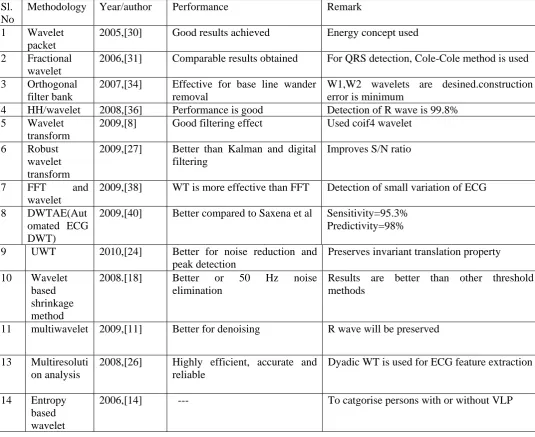
Table 2: Summary of wavelet techniques for ECG signal processing
V. Conclusions:
ECG is the prime human physiological signal which can be used for various clinical applications to detect the
healthiness of the human being. Therefore the proper processing and detection of ECG is very much important.
Since many decades various methods have been used for processing and accurate detection of human cardiac
signal. In the last two decades many researchers and scientists have been using the methods based on Wavelet
transforms and found that this Wavelet transform is more suitable for analyzing the non stationary, pseudo
periodic ECG signal. Still there is lot of scope of Wavelet transform to be used for analyzing ECG signal. The
suitability of Wavelet transform depends upon the proper selection of moth wavelet along with properties. In
this paper we made an attempt to give an overview of various wavelet techniques used by the researchers for
processing ECG signal. We hope that this material will be helpful particularly for beginners who are interested
to work in this field. Sl.
No
Methodology Year/author Performance Remark 1 Wavelet
packet
2005,[30] Good results achieved Energy concept used 2 Fractional
wavelet
2006,[31] Comparable results obtained For QRS detection, Cole-Cole method is used 3 Orthogonal
filter bank
2007,[34] Effective for base line wander removal
W1,W2 wavelets are desined.construction error is minimum
4 HH/wavelet 2008,[36] Performance is good Detection of R wave is 99.8% 5 Wavelet
transform
2009,[8] Good filtering effect Used coif4 wavelet 6 Robust
wavelet transform
2009,[27] Better than Kalman and digital filtering
Improves S/N ratio
7 FFT and wavelet
2009,[38] WT is more effective than FFT Detection of small variation of ECG 8 DWTAE(Aut
omated ECG DWT)
2009,[40] Better compared to Saxena et al Sensitivity=95.3% Predictivity=98% 9 UWT 2010,[24] Better for noise reduction and
peak detection
Preserves invariant translation property 10 Wavelet
based shrinkage method
2008.[18] Better or 50 Hz noise elimination
Results are better than other threshold methods
11 multiwavelet 2009,[11] Better for denoising R wave will be preserved
13 Multiresoluti on analysis
2008,[26] Highly efficient, accurate and reliable
Dyadic WT is used for ECG feature extraction
14 Entropy based wavelet
References:
[1] Pramodkumar, Dewanjali Agnihotri, “Biosignal Denoising via Wavelet Thresholds”,IETE journal of Research, vol 56, issue 3,pp.132-138,May-June 2010
[2] Wei Zhang,Linlin Ge, “A method for Reduction of noise in the ECG”, IEEE,pp 2119 – 2122,2008 [3] Gordan,Cornelia,ReizRomulus,”ECG Signal processing using wavelets”,Unknown
[4] Suiji L,Guangda Liu,Zhen bao Lin ,”Comparison of Wavelet packet, lifting wavelet and Stationary wavelet transform for denoising ECG”,IEEE,pp 491 -494,2009
[5] C Saritha,V .Sukanya,Y.Narasingh Murty, “ECG Signal Analysis using Wavelet Transformation”,BulgJ Physics,pp-68-77,(35) 2008,Heron Press Limited
[6] S.A.Choukari,F.Bereksi-Reguing,S.Ahmaidi and O.Fokapu, “ECG signal smoothing based on combining wavelet denoising levels”. Asian Journal of Information Technology 5(6), pp 666 - 77, 2006
[7] Abdel-Rehman Al-Quwasmi and Khaled Daqrouq, “ECG signal enhancement using Wavelet Transform”,WSEAS Transaction on Biology and Biomedicine, issue 2,vol. 7, pp-62-72,April 2010
[8] TAN Yun-fu,Du Lei, “Study on Wavelet Transform in the Processing for ECG Signals”, World congress on Software Engineering, IEEE, p 515-518, 2009
[9] Jaffery.Z.A.,Ahmad.K.,Afroz,”Performance comparision of Wavelet Threshold Estimators for ECG Signal denoising”, Computing society,IEEE pp.248-251, 2010
[10] S A Chouakri,F Bereksi-Reguig,S Ahmaidi,O Fokapu, “Wavelet Denoising of the Electrocardiogram Signal based on the Corrupted noise estimation”, computers in cardiology, IEEE vol.32,pp 1021-1024 , 2005
[11] Jeong Yup Han,Su Kyung Lee,and Hong Bae Park,” Denoising ECG using Translation invariant Multiwavelet”,International Journal of Electrical and Electronics Engineering,pp 138-142,3:3 , 2009
[12] BeatriceArvinti,MariusCostache,DumitruToader,Marius Oltean,Alexandru Isar,”ECG Statistical Denoising in the Wavelet Domain”, IEEE pp.307-310,2010
[13] MariusCostache,DumitruToader,MariusOltean,Alexandru Isar,”MAP filtering in the Diversity-enhanced wavelet domain Applied to ECG signals Denoising”, ICASSP pp. II-1196-1199, 2006
[14] B.Natwong,P.Sooraksa,C.Pintavirooj,S.Bunluechokchai,W.Ussawawongaraya,”wavelet Entropy Analysis of the High Resolution ECG”,IEEE,ICIEA 2006
[15] S.Nibhanupudi,R.Youssif,and C.Purdy, “Data-specific signal denoising using wavelets with Applications to ECG Data”,The 47th
International Midwest Symposium on Circuits and Systems, IEEE pp III-299-222, 2004
[16] Zhi-DongZhao,Yu-Quan Chen, “A New Method For Removal of Baseline Wander and Power Line Interference in ECG Sinals”,Proceedings of the Fifth International Conference on Machine Learning and Cybernetics, IEEE alian, pp 4342-4347, 13-16 August 2006
[17] M.Kania,M.Fereniec,R.Maniewski,“Wavelet Denoising for Multi lesd High Resolution ECG Signals”, Measurement Science Review,vol.7,Section 2, No.4,pp.30-33,2007
[18] S.Poornachandra,N.Kumaravel, “A novel method for the elimination of power line frequency in ECG signal using hyper shrinkage function”, Digital Signal Processing, Elsevier vol.18,pp.116-126, 2008
[19] L.N Sharma,S.Dandapat,A Mahanta, “ECG Signal Denoising using Higher Order Statistics in Wavelet Sub bands”, Biomedical signal Processing and Control, Elsevier,vol.5,pp.214 – 222, 2010
[20] S.Z.Mahmoodabadi,A.Ahmadian,M.D.Abolhasani, “ECG feature Extraction using Daubechies Wavelets”, Proceedings of the fifth International conference on Visualization, Imaging and Image Processing, pp.343-349, Sep.7-9,2005
[21] Yang Ying,Wei Yaseen, “New Threshold and Shrinkage function fot ECG Signal Denoising based on wavelet Transform” , IEEE ,pp.1-4, 2009
[22] R.F.Von Borries,J.H.Pierluissi and H.Nazeran, “Wavelet Transform based ECG Base line drift Removal for body surface potential Mapping”, 27th annual conference on Engineering in Medicine and Biology,China, IEEE ,pp.3891 – 3894, sep.1-4,2005
[23] Ruchita Gautham,Anil Kumar Sharma, “Detection of QRS complex of ECG recording based on Wavelet Transform using MATLAB”,International Journal of Engineering,Science and Technology,vol.2(7).pp.3038 -3044,2010
[24] Naregalkar Akshay, Naga Ananda Vamse and Naga Deepti Yeddanapudi, “ ECG noise Removal and QRS complex detection using UWT”, International Conference on Electrical and Information Engineering (ICEIE), IEEE vol.2,pp.438-442, 2010
[25] M Rizzi, M D Aloiaastagnolo, “Fast Parallelized Algorithm for ECG Analysis”, WSEAS Transaction on Biology and Medicine, Issue 8, vol.5, August 2008
[26] D.T Ingole, Kishore kulat, m.D.Ingole, “Feature Extraction via Multiresolution Analysis for ECG Signal”, International Conference on Emerging trends in Engineering and Technology, IEEEpp.659 – 664, 2008
[27] Arman Sargolzaei,Karim Faez,Sama Sargolzaei, “ A New Robust wavelet Based Algorithm for Base line Wandering cancellation in ECG Signals”, International conference on Signal and Image processing application”, IEEE, pp.33-38, 2009
[28] Donghui Zhang, “Wavelet approach for ECG base line wander correction and noise reduction”, Engineering in Medicine and Biology,27th Annual Conference China, IEEE, pp.1212 – 1215, September 1- 4,2005
[29] S.Poornachandra,N.Kumarvel,T.K.Sharavanan,R.Somskandan, “WaveShrink Using Modified Hyper-Shrinkage Function”, Engineering in Medicine and Biology 27th Annual Conference China, IEEE, pp30 -32,September 1- 4, 2005
[30] Behzad Mozaffary,Mohammad A Tinati, “ECG Base line Wander Elimination using Wavelet Packets”, World academy of science and technology,vol.3,pp14-16,2005
[31] F.Abdelliche, A.Charef, M.L.Talbi,M.Benmalek, “A Fractional wavelet for QRS Detection”, 0-7803-9521-2/06, IEEE pp.1186-1189, 2006
[32] Mohamed O.Ahmed Omar,Nahed H.Solouma,Yasser M.Kadah, “Morphological Characterization of ECG Signal Abnormalities:A new approach”, Proceedings Cairo International Biomedical Engineering Conference, pp.1-5,2006
[33] Alfredo Illanes Manriquez and Qinghua Zhang, “An algoritham for QRS onset and offset detection in single lead electrocardiogram records”, Proceedings of the 29th Annual International Conference Lyon,France, IEEE,pp.541-544, August 23-26,2007
[34] R.Shantha selva Kumari,S.bharathi,V.Sadashivam, “Design of Discrete Wavelet for ECG Signal using orthogonal filter bank”, International Conference on Computational intelligence and Multimedia applications,Computer Society IEEE,pp.525-529, 2007 [35] Fayyaz A Afsar and M.Arif, “Robust Electrocardiogram Beat classification using Discrete Wavelet
[36] Xiao-Li Yang, Jing-tian Tang, “Hilbert-Huang Transform and Wavelet Transform for ECG Detection”, IEEE 78-1-4244-4/08,pp.1-4, 2008
[37] Motoki Sakai and Daming Wei, “Wavelet Shrinkage applications of EEG-ECG-based Human- Computer Interface”, IEEE 78-1-4244-2358-3/08, pp.538-543, 2008
[38] A.K.M.Fazlul Haque,Md.Hanif Ali,M.Adnan Kiber and Md.Tanvir Hasan, “Detection of Small Variation of ECG Features using Wavelet”, ARPN Journal of Engineering and applied Sciences, vol.4, No.6,pp.27-30, August 2009
[39] Huaigang Zhang,Zhibin Wang and Ying Zheng, “Analysis of Signal De-noising Metod Based on an Improved Wavelet Thresholding”,The Ninth International Conference on Electronic Measurement and Instruments”,IEEE,pp.I-987-990, 2009
[40] Abdulrhman Elbuni,Salah Kanoun,Mohamed Elbuni,Nasser Ali, “ECG Parameter Extraction Algorithm using (DWTAE) Algorithm”, IEEE 978-14244-5844-8/09,pp.315-320, 2009
[41] Abed Al Raoof Bsoul,Soo-Yeon Ji,Kelvin Ward and Kayvan Najarian, “ Detection of P,QRS,and T components of ECG using Wavelet Transformation”, IEEE ,78-1-4244-3316-2/09,pp.1-5, 2009
[42] Antonio Espiritu-Santo-Rincon and Cuauhtemoc, “ECG Feature Extraction via Waveform segmentation”, 7th International Conference
on Electrical Engineering,Computing Science and Automatic Control(CCE), IEEE pp.250-255, 2010
[43] G.Ranganathan,V.Bindhu,R.Rangarajan, “ECG Signal Processing using Dyadic Wavelet for mental stress assessment”, IEEE,978-1-4244-4713-8/10,2010
[44] Zhang xizheng,Rui Yuanqing,Wang weixiong, “An New Filtering Methods in the Wavelet domain for Bowel
Sounds”,IJCSA(International Journal of Advanced Computer Science and Applications,Vol.I,No.5,pp.26-31,November 2010 [45] G.Umamaheswara Reddy,M.Murlidhar,S.Varadarajan, “ECG De-noising using improved thresholding based on Wavelet transforms”,
![Figure 4.Multiresolution process of wavelet-based peak detection. Result obtained in [26]](https://thumb-us.123doks.com/thumbv2/123dok_us/9663951.1494243/8.595.74.324.73.283/figure-multiresolution-process-wavelet-based-detection-result-obtained.webp)
![Figure 5.Denoising results using WPT, LWT and SWT on real ECG example. Results from [4]](https://thumb-us.123doks.com/thumbv2/123dok_us/9663951.1494243/9.595.181.417.76.370/figure-denoising-results-using-wpt-lwt-example-results.webp)