Published online January 06, 2015 (http://www.sciencepublishinggroup.com/j/am) doi: 10.11648/j.am.20140306.14
ISSN: 2327-2503 (Print); ISSN: 2327-252X (Online)
Orientational behavior of liquid-crystalline polymers with
amide groups
Genichiro Shimada
1, Masanori Nata
2, Shiori Tomitaka
2, Seiji Ujiie
2, *1
Division of Materials Science and Production Engineering, Graduate School of Engineering, Oita University, Oita 870-1192, Japan
2
Department of Applied Chemistry, Faculty of Engineering, Oita University, Oita 870-1192, Japan
Email address:
[email protected] (S. Ujiie), [email protected] (M. Nata)
To cite this article:
Genichiro Shimada, Masanori Nata, Shiori Tomitaka, Seiji Ujiie. Orientational Behavior of Liquid-Crystalline Polymers with Amide Groups. Advances in Materials. Vol. 3, No. 6, 2014, pp. 89-93. doi: 10.11648/j.am.20140306.14
Abstract:
Liquid-crystalline polyacrylamides with mesogenic side-chains were synthesized by the radical polymerization of a mesogenic acrylamide derivative. Their thermal properties and orientational behavior were examined by polarizing microscopy, differential scanning calorimetry, temperature-variable IR, and X-ray diffraction measurements. The liquid-crystalline polyacrylamides containing secondary amide groups formed smectic A and smectic B phases during heating and cooling processes. The glass-smectic B, smectic B-A, and smectic A-isotropic phase transition temperatures increased with increasing molecular weight. The liquid-crystalline polyacrylamide showed higher phase transition temperatures than a liquid-crystalline polyacrylate, in which the secondary amide group was replaced with an ester group. The X-ray diffraction pattern of a smectic B-oriented sample of the liquid-crystalline polyacrylamide consisted of sharp inner and very sharp outer reflections. The very sharp reflection in the wide-angle region of the X-ray diffraction pattern indicated the formation of hexatic packing within the layer. The relationship between the layer distance and the extended mesogenic side-chain length suggested that the liquid-crystalline polyacrylamide formed an interdigitated bilayer structure. The IR spectra of the liquid-crystalline polyacrylamide exhibited that the number of hydrogen bonds between the secondary amide groups decreased with increasing temperature. In the liquid-crystalline polyacrylamide, smectic A and smectic B phases, with enhanced thermal stability, were formed through the formation of hydrogen bonds between the secondary amide groups.Keywords:
Liquid Crystal Polymer, Amide, Urethane, IR, Hydrogen Bonding1. Introduction
Non-covalent interactions, such as hydrogen bonding, ionic interactions, and charge transfer interactions, can lead to the formation of liquid-crystalline phases [1-7]. Functional groups, such as carboxyl, hydroxyl, and amide, can form hydrogen bonds. In general, organic compounds having primary and secondary amide groups have high phase transition temperatures. This enhanced thermal stability is caused by the formation of hydrogen bonds between amide groups. For example, an amide compound, benzanilide (Tm=165 ºC), has a melting point higher than that of the
corresponding ester, phenylbenzoate (Tm=70 ºC), by 95 ºC.
We have reported liquid-crystalline polyacrylamides with mesogenic side-chains [8]. These liquid-crystalline polyacrylamides formed smectic phases with enhanced thermal stability due to the formation of hydrogen bonds between the secondary amide groups. Here, we describe the
molecular weight dependence of the phase transition temperatures for liquid-crystalline polyacrylamides (PAADH)
containing secondary amide groups. Moreover, the temperature-variable IR spectra and a possible packing model of PAADH are discussed.
2. Experimental
2.1. Measurements
Mettler hot stage (FP84HT). X-ray diffraction was measured using a Rigaku X-ray Rad 2B system using Ni-filtered CuKα radiation.
Figure 1. Synthesis of liquid-crystalline polyacrylamide (PAADH).
2.2. Materials
PAADH with amide groups was synthesized by previous methods [5,8,10]. The synthetic scheme is shown in Figure 1. PAADH was prepared by the radical polymerization of an acrylamide monomer whose 1H NMR spectrum is shown in Figure 2.
δ/ppm
9 8 7 6 5 4 3 2 1 0 ac b
d
e
f g
h i
Figure 2.1H NMR spectrum of acrylamide monomer (AADH).
3. Phase Transitions
A mesogenic acrylamide monomer (AADH) with a secondary amide group showed a nematic phase with a schlieren texture in the temperature range from 92.0 ºC to 107.0 ºC on a first heating process. AADH exhibited thermal polymerization in the isotropic phase.
PAADH (Figure 1), which was obtained by the radical polymerization of AADH, showed smectic A (SmA) and smectic B (SmB) phases during heating and cooling processes. PAADH exhibited glass-SmB (Tg-B), SmB-SmA (TB-A), and
SmA-isotropic (TA-i) phase transitions (Figures 3 and 4). The
phase transition temperatures of both the TB-A and TA-i were
obtained from the DSC peaks in Figure 3; however, the Tg-B
was unclear. The Tg-B was determined from the change of the
baseline (dotted line), as shown in Figure 3. PAADH had fan textures in the SmB and SmA phases. The fan textures remained unaltered at room temperature. The phase transition temperatures increased with increasing molecular weight (Figure 4). This was consistent with the molecular weight dependence of phase transitions for conventional liquid-crystalline polymers [9-12]. For example, the TB-A
(157.9 ºC) and TA-i (209.8 ºC) of PAADH with Mn=6,000
were lower than the TB-A (164.3 ºC) and TA-i (241.1 ºC) of
PAADH with Mn=12,000, respectively. Moreover, the
increase of the molecular weight leads to the formation of liquid-crystalline phases with a higher orientational order [9, 12]. From Figure 4, in PAADH with a much higher molecular weight, Tg-B, TB-A, and TA-i were determined to be 96.6, 174.1,
and 250.0 ºC, respectively.
Mn=6,000
Mn=12,000
Figure 3. DSC curves of PAADH with a secondary amide group. The DSC peaks of both TB-A and TA-i weredistinct. The glass transition was determined from the change of the dotted baselines.
T TT T
g gg g ----BBBB
T T T T
B B B B ---A-AAA
T T T T
A AA A ---i-iii
M M M Mnnnn
1 / 1 / 1 / 1 /MMMM
n n n n
t
t
t
t
/
/
/
/
℃℃℃℃
250.0
174.1
96.6
We synthesized a liquid-crystalline polyacrylamide (Figure 5, PAADM, Mn=12,800) with a tertiary amide group
(the N-H group in the secondary amide of PAADH was replaced with an N-Me group) to examine the effect of hydrogen bonding between the secondary amide groups of PAADH. PAADM showed SmB and SmA phases. However, the phase transition temperatures (Tg-B=39.0 ºC, TB-A=126.0
ºC, and TA-i=156.0 ºC) of PAADM were lower than those of
PAADH. Hydrogen bonding did not occur in PAADM, which lacks an N-H group. This demonstrated that the hydrogen bond between the amide groups is important when forming smectic phases with enhanced thermal stability.
Figure 5. Structure of liquid-crystalline polyacrylamide (PAADM) with a tertiary amide group.
4. IR Spectra
Information regarding molecular orientation can be obtained by IR, UV, ESR, and X-ray diffraction measurements. Here, the IR spectra of PAADH were measured. The temperature-variable IR spectra of PAADH (Mn=6,000) are shown in Figure 6. The curves of both N-H
wavenumber vs. temperature, and C=O wavenumber vs. temperature, are exhibited in Figure 7.
Figure 6. Temperature-variable IR spectra of PAADH with Mn=6000. The changes of N-H and C=O are shown with lines.
The stretching vibrations of the amide N-H and C=O are related to the formation of hydrogen bonds. The stretching vibration of the amide N-H was measured at 3310 cm-1 in the glass and SmB phases. Discontinuities were observed in the curve of N-H wavenumber vs. temperature at TB-A and TA-i. In
the SmA phase, the amide N-H band appeared at 3339–3361 cm-1, whereas it was observed at 3412 cm-1 or greater in the isotropic phase. The same discontinuities as the amide N-H band were observed in the curve of C=O wavenumber vs. temperature at TB-A and TA-i (Figure 7). The amide C=O band
was observed at 1661 cm-1 in the glass and SmB phases, at
C=O
N-H
Figure 7. Temperaturedependence of the stretching vibrations of N-H and C=O of the secondary amide groups.
The effect of hydrogen bonding during liquid crystal formation was also reported for liquid-crystalline polyurethanes [13]. The liquid-crystalline polyurethane showed discontinuities in the curve of N-H wavenumber vs. temperature at the glass-nematic and nematic-isotropic phase transition temperatures. This result also exhibited that the liquid-crystalline orientation of the polyurethane depended on the hydrogen bonding between the urethane groups. A similar effect due to hydrogen bonding was also reported for liquid-crystalline poly(ester-urethane)s [14]. Moreover, the hydrogen bonding network plays an important role in the photoresponse of liquid-crystalline polyesters and polyurethanes [13, 15]. The hydrogen bonding network stabilized the orientation obtained through UV irradiation.
The secondary amide groups of PAADH were directly attached to the polymer backbone. In this case, the polymer backbones aggregated due to the hydrogen bonding between the amide groups. The aggregation of polymer backbones leads to the enhancement of thermal stability [16].
5. X-Ray Diffraction
An oriented polymer sample (SmB glass) was obtained by slowly cooling from the isotropic to glass phases. The X-ray diffraction of PAADH in the SmB glass phase was measured at room temperature. PAADH showed an X-ray diffraction consisting of very sharp inner and outer reflections (Figure 8).
A sharp outer reflection appeared at 2θ=20.4º (d4=0.43 nm).
The sharp outer reflection (d4), which corresponds to
interactions between the mesogenic side-chains, implied the formation of hexatic packing within the SmB layer. However, sharp inner reflections (d2d3), which correspond to the SmB
layer spacing, were observed. The first order reflection was determined to be 4.64 nm (d1) from d2 (2θ=3.9º (2.32 nm)),
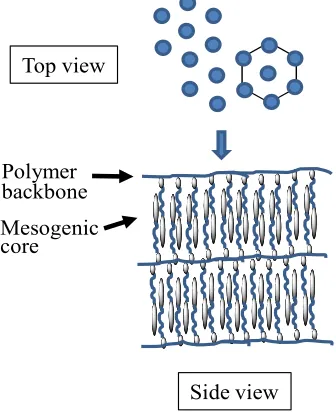
and the extended mesogenic side-chain length (L) was 3.54 nm. The relationship between d1and L is L < d1 < 2L. In this
case, we propose the packing model shown in Figure 9. An interdigitated bilayer structure was expected to form in the SmB phase. The secondary amide groups formed hydrogen bonds, and the polymer backbones strongly aggregated. The mesogenic side-chains overlapped each other within the layer.
2 10 20 30 40 2θ/°
In
te
n
si
ty
d
2d
3d
4Figure 8. X-ray diffraction pattern of PADDH with the SmB glass. Second (d2) and third (d3) order reflections were observed in the small-angle region of the X-ray diffraction pattern. Also, a sharp outer reflection (d4), which corresponds with the hexatic alignment within the layer, appeared. The mesogenic side-chains form a highly ordered structure because the d4 is a very sharp reflection.
Top view
Side view
Polymer
backbone
Mesogenic
core
6. Conclusions
Here we showed the thermal properties and orientational behavior of liquid-crystalline polyacrylamides (PAADH) with a secondary amide group. PAADH formed SmB and SmA phases during heating and cooling processes. In addition, PAADH exhibited higher phase transition temperatures due to the formation of hydrogen bonds between the secondary amide groups. In the temperature-variable IR measurement, the wavenumber of the N-H stretching vibration was about 3310 cm-1 in the glass and SmB phases, 3339–3361 cm-1 in the SmA phase, and 3412 cm-1 or greater in the isotropic phase. TheN-H stretching vibration in the isotropic phase was close to that of free N-H. The increase of the wavenumber indicated that the hydrogen bonding weakens with increasing temperature.
Figure 10. Structure of liquid-crystalline polyacrylate (PEA) without hydrogen bonding.
The effect of hydrogen bonding can be proven by comparing the thermal properties with a liquid-crystalline polyacrylate (Figure 10, PEA, Mn=18,000) where the amide
group of PAADH is replaced with an ester group. PEA formed SmB and SmA phases during heating and cooling processes and exhibited Tg-B (62.0 ºC), TB-A (132.0 ºC), and TA-i (151.3
ºC). PEA also formed the same smectic phases as PAADH. However, PAADH showed higher phase transition temperatures than PEA. For example, the TA-i of PAADH is
greater than that of PEA by approximately 90 ºC. This indicated that the formation of the hydrogen bonds between the amide groups is effective in forming smectic phases with enhanced thermal stability in PAADH.
The influence of hydrogen bonding between the secondary amide groups was shown by the temperature-variable IR spectra of PAADH. Moreover, the very sharp outer reflection in the wide-angle X-ray scattering exhibited the formation of hexatic packing within the SmB layer. The hexatic packing was stabilized through hydrogen bonds between the secondary amide groups. Hydrogen bonding can lead to the formation of smectic phases with enhanced thermal stability.
References
[1] V. P. Shivaev, “Liquid-Crystalline Polymers: Past, Present, and Future”, Polym. Sci., Ser. A, vol. 51, 2009, pp. 1131-1193.
[2] P. J. Collings and J. S. Pate, Eds. Handbook of Liquid Crystal Research, New York: Oxford University Press, 1997, pp. 330-336.
[3] S. Ujiie and K. Iimura, “Thermal Properties and Orientational Behavior of a Liquid-Crystalline Ion Complex Polymer”, Macromolecules, vol. 25, 1992, pp. 3174-3178.
[4] S. Ujiie and K. Iimura, “Formation of Smectic Orientational Order in an Ionic Thermotropic Liquid-Crystalline Side-Chain Polymer”, Polym. J., vol. 25, 1993, pp. 347-354.
[5] T. Kojo, M. Nata, and S. Ujiie, “Liquid-Crystalline Binary Systems with Nonmesomorphic Comb-Shaped Polymer Component”, Mol. Cryst. Liq. Cryst., vol. 563, 2012, pp. 75-82.
[6] S. Ujiie, H. Uchino, and K. Iimura, “Induced Smectic Phase Formed by New Liquid Crystalline Binary Systems Consisting of Main Chain Polymer and Twin Compound” Chem. Lett., 1994, pp. 195-196.
[7] S. Ujiie, H. Uchino, and K. Iimura, “Induced Smectic A and C Phases Formed by Liquid-Crystalline Binary Systems Consisting of Nematic Twin Compounds”, J. Mater. Chem., vol. 5, 1995, pp.2229-2232.
[8] S. Ujiie, K. Maekawa, and K. Iimura, “Phase Transitions of Liquid Crystalline Polyacrylamide”, Mol. Cryst. Liq. Cryst., vol. 237, 1993, pp. 487-490.
[9] S. Ujiie and K. Iimura, “Thermal Properties and Orientational Behavior of Nematic Comb-Like Polyether”, Polym. J., vol. 24, 1992, pp. 427-431.
[10] S. Ujiie, Y. Tanaka, and K. Iimura, “Thermal and Liquid Crystalline Properties of Liquid Crystalline Polymethacrylates with Ammonium Units and their Non-ionic Family”, Polym. Adv. Technol., vol.11, 2000, pp. 450-455.
[11] H. Stevens, G. Rehage, and H. Finkelmann, “Phase Transformations of Liquid Crystalline Side-Chain Oligomers”, Macromolecules, vol.17, 1984, pp. 851-856.
[12] C. B. McArdle, Ed. Side Chain Liquid Crystal Polymers, New York: Chapman and Hall, 1989, pp. 54-56.
[13] S. Ujiie, G. Shimada, and M. Nata, “New Reactive Liquid-Crystalline Poly(aminourethane)s and Their Metal-Complexed Family”, Chem. Lett., in press.
[14] F.-S. Yen, L.-L. Lin, and J.-L. Hong, “Hydrogen-Bond Interactions between Urethane-Urethane and Urethane-Ester Linkages in a Liquid Crystalline Poly(ester-urethane)”, Macromolecules, vol. 32, 1999, pp. 3068-3079.
[15] L. Frang, H. Zhang, Z. Li, Y. Zhang, and H. Zhang, “Synthesis of Reactive Azobenzene Main-Chain Liquid Crystalline Polymers via Michael Addition Polymerization and Photomechanical Effects of Their Supramolecular Hydrogen-Bonded Fibers”, Macromolecules, vol. 46, 2013, pp. 7650-7660.