Original
Article
Validation of the Malay Version of the
Parental Bonding Instrument among
Malaysian Youths Using Exploratory
Factor Analysis
Noor Azimah MuhaMMad1, KhadijahshaMsuddin2, Khairani OMar1,3, Shamsul Azhar shah2, Rahmah MOhd aMin4
1 Department of Family Medicine, Faculty of Medicine, Universiti Kebangsaan Malaysia, Jalan Yaacob Latif, Bandar Tun Razak, 56000 Cheras, Kuala Lumpur, Malaysia
2 Department of Community Health, Faculty of Medicine, Universiti Kebangsaan Malaysia, Jalan Yaacob Latif, Bandar Tun Razak, 56000 Cheras, Kuala Lumpur, Malaysia
3 Faculty of Medicine and Health Sciences, Universiti Sains Islam Malaysia, Tingkat 13, Menara B, Persiaran MPAJ, Jalan Pandan Utama, Pandan Indah 55100 Kuala Lumpur, Malaysia
4 Faculty of Medicine and Health Sciences, Universiti Sultan Zainal Abidin, Kota Campus, Jalan Sultan Mahmud 204000 Kuala Terengganu, Terengganu, Malaysia
Submitted:22 Apr 2014
Accepted:5 Jul 2014
Abstract
Background: Parenting behaviour is culturally sensitive. The aims of this study were (1) to translate the Parental Bonding Instrument into Malay (PBI-M) and (2) to determine its factorial structure and validity among the Malaysian population.
Methods: The PBI-M was generated from a standard translation process and comprehension testing. The validation study of the PBI-M was administered to 248 college students aged 18 to 22 years.
Results: Participants in the comprehension testing had difficulty understanding negative items. Five translated double negative items were replaced with five positive items with similar meanings. Exploratory factor analysis showed a three-factor model for the PBI-M with acceptable reliability. Four negative items (items 3, 4, 8, and 16) and item 19 were omitted from the final PBI-M list because of incorrect placement or low factor loading (< 0.32). Out of the final 20 items of the PBI-M, there were 10 items for the care factor, five items for the autonomy factor and five items for the overprotection factor. All the items loaded positively on their respective factors.
Conclusion: The Malaysian population favoured positive items in answering questions. The PBI-M confirmed the three-factor model that consisted of care, autonomy and overprotection. The PBI-M is a valid and reliable instrument to assess the Malaysian parenting style. Confirmatory factor analysis may further support this finding.
Keywords: Malaysia, parenting, questionnaire, validity, youth
Introduction
Parents are important people in children’s lives. Parents help build their children’s character, which persists throughout the children’s youth and the rest of their lives. To understand certain behaviours among the children or youth, one must consider the type of parenting the children have received.
The Parental Bonding Instrument (PBI)
items (1). The PBI has been found to be valid and suitable to assess past and current parenting styles (2,3). The instrument, which is a valid measure of perceived parenting (4), allows the quantification of parenting behaviour and may be used in the aetiological study of offspring’s behaviour or disorders such as delinquency, substance abuse, eating disorders, mental disorders and even suicide (5–7). The instrument has been translated into many languages including Urdu, Japanese, and Chinese (2,8–10).
The PBI is influenced by culture (5). Controversial issues surround the factorial structure of the PBI. A few studies have either confirmed the two-factor model (11,12) or suggested a three-factor model (8,13,14). Among Pakistani mothers, the PBI items loaded satisfactorily on the care and overprotection factors, with overprotection divided into encouragement of behavioural freedom and denial of psychological autonomy (8). Interestingly, when the PBI was tested on the Japanese and Chinese populations, instead of two- or three-factor models, the PBI produced a four-factor model (2,10). In these populations, the items for the care factor were further divided into care and indifference (or rejection), and the items for overprotection were further divided into autonomy and overprotection (2,10). The subdivision of the overprotection factor in the Japanese and Chinese populations was similar to that of the Pakistani population (2,8,10). Therefore, it is important to validate the PBI questionnaire among the Malaysian population because the PBI may perform differently due to the different cultural background.
The objectives of this research were to translate the PBI into the Malay language (PBI-M) and to determine the factorial structure and validity of the PBI-M among a group of Malaysian youths. To our knowledge, this is the first attempt to validate the PBI in the Malaysian population. Since the PBI is suggested for use on those over 16 years of age (1,5), youths in college were chosen to participate in this study. This study aims to suggest a standard PBI instrument that is useful in the Malaysian population.
Materials and Methods
Instrument
The PBI is available in the public domain, and its authors have granted permission for its use in research (15). In this study, the PBI was used to assess the current parenting style of the father and the mother separately. Participants were asked to rate on a 4-point Likert-type scale (1 = very unlike,
2 = moderately unlike, 3 = moderately like and 4 = very like) the similarity of each item to their father’s and mother’s parenting style. The original PBI underwent a standard translation procedure by four bilingual experts. Two forward translations into the Malay language (PBI-M) were done by a bilingual language expert and a bilingual medical doctor. Then, another bilingual language expert and another bilingual medical doctor did the backward translation of the PBI-M into English. The translated and original questionnaires were reviewed item by item by a panel of experts to verify their content validity and to identify the best translations that had a similar meaning to the original PBI. Subsequently, the original PBI and the final PBI-M version were given to three college students aged 19–22 for comprehension testing. The students were not included among the research participants.
Procedure
This research was reviewed by and obtained approval from the Universiti Kebangsaan Malaysia Research and Ethics Committee, the Ministry of Education of Malaysia and the principals of the colleges involved in the study. The data collection was done on three separate days. All the selected participants were briefed on the study protocol; only those who gave their consent were given the questionnaire. Anonymity was maintained throughout the study. The participants were requested to seal the completed questionnaire in an individual envelope and return it to the researcher on the same day.
Statistical analysis
items for each factor were finalised, a reliability test (Cronbach’s alpha) was carried out. This test was used to confirm the unidimensionality of each factor as well as the strength of the dimension (18).
Results
Participants
The PBI-M questionnaires were distributed to 277 students from three randomly selected colleges in the Klang Valley. Twenty-three students refused to participate, and six students had incomplete responses. Hence, 248 students were included in the analysis, for a response rate of 89.5%. The age range was from 18 to 22 years, with a mean age of 19.21 years (SD 0.94). There were 146 (58.9%) females and 102 (41.1%) males in the sample. The majority of them were Malays (87.5%), and most were Muslims (89.5%). Most of the respondents’ parents remained married (87.5%). More than half (59.7%) of the participants were living with their parents.
Content and face validity
The original and translated PBIs were reviewed by local experts including a psychiatrist, a psychologist, an adolescent physician, a family physician and a public health physician. The items were found to be suitable and relevant to be tested on the Malaysian population.
In the comprehension testing, the students were first asked to answer the PBI-M and then the original English version of the PBI. Questions were read aloud by a single researcher to check on their understanding of each item. They had difficulty understanding the translated phrase for “emotionally cold” in item 4 and “privacy” in item 10. Therefore, short phrases were added to each item to explain the meaning of the phrase/word. Participants also had difficulty understanding the negative items, especially the following double negative items: item 2, “Does not help me as much as I need”; item 8, “Does not want me to grow up”; item 14, “Does not seem to understand what I need or want”; item 18, “Does not talk with me very much”; and item 24, “Does not praise me”. Based on the suggestion by Gamsa (11), all five double negative items were replaced with the following positive items: item 2, “Helps me as much as I need”; item 8, “Wants me to grow up”; item 14, “Seems to understand what I need or want”; item 18, “Talks to me often”; and item 24, “Praises me”. These five positive items were proven to remain in their respective original factors of PBI (11).
Factor analysis
The sample for this validation study was deemed adequate, as supported by the high Kaiser-Meyer-Olkin value of 0.82 for PBI-M father and 0.83 for PBI-M mother. Bartlett’s test of sphericity showed a significant P-value of < 0.001. Based on the scree plot, the number of factors to retain was three. This three-factor extraction was further confirmed with parallel analysis using the Monte Carlo simulation technique. There were three factors with an actual eigenvalue greater than the random eigenvalue predicted by the parallel analysis (19). The three factors explained 46.3% of the variance in PBI-M father and 44.6% of the variance in PBI-M mother.
Two-factor extraction
Based on Parker’s model, factor 1 was the care factor. It was represented by positive items (items 1, 2, 5, 6, 11, 12, 14, 17, 18, and 24) and negative items (items 4 and 16) (1,11). Factor 2 was overprotection; it was represented by positive items (9, 10, 13, 19, 20 and 23) and negative items (items 3, 7, 8, 15, 21, 22 and 25) (1,11) (Table 1).
In our study, factor 1 was represented by items 1, 2, 5, 6, 11, 12, 14, 17, 18 and 24 for both PBI-M father and PBI-M mother. Items 4 and 16 loaded appropriately on factor 1 for PBI-M mother but showed low factor loadings (< 0.32) for PBI-M father. Factor 2 was represented by items 7, 15, 21, 22 and 25 with positive factor loadings for both PBI-M father and PBI-M mother. Items 8 and 19 were not in factor 2 for both PBI-M father and PBI-M mother. Items 3, 13 and 23 loaded incorrectly on factor 1 for PBI-M father. Items 9, 10 and 20 loaded with a factor loading of less than 0.32 (Table 1).
Three-factor extraction
In the three-factor extraction, items 1, 2, 5, 6, 11, 12, 14, 17, 18 and 24 of PBI-M father and PBI-M mother loaded on factor 1. Items 4 and 16, which were the negative items of factor 1 (care) in Parker’s model, loaded appropriately for PBI-M mother but loaded on factor 3 in PBI-M father. Items 8 and 19, which were in factor 2 (overprotection) in Parker’s model loaded on factor 1 in our model.
Table 1: Two and three factor loadings for Parental Bonding Instrument into Malay (PBI-M) mother and PBI-M father based on Parker’s model
Two-factor extraction Three-factor extraction
PBI-M father PBI-M mother PBI-M father PBI-M mother
F1 F2 F1 F2 F1 F2 F3 F1 F2 F3
Factor 1-Care Positive items
1. Speaks to me in a warm and friendly voice
0.563 0.082 0.565 0.083 0.556 0.077 0.036 0.573 0.084 -0.123
2. Helps me as much as I need
0.682 0.086 0.644 0.026 0.668 0.097 -0.060 0.646 0.020 -0.040
5. Appears to understand my problems and worries
0.640 0.079 0.698 0.015 0.631 0.079 -0.007 0.696 0.006 0.027
6. Is affectionate to me
0.641 -0.082 0.539 -0.003 0.645 -0.067 -0.116 0.539 -0.010 -0.004
11. Enjoys talking things over with me
0.694 0.034 0.770 -0.025 0.689 0.036 -0.008 0.766 -0.037 0.070
12. Frequently smiles at me
0.673 0.002 0.647 0.026 0.668 0.012 -0.073 0.646 0.019 0.005
14. Seem to understand what I need or want
0.672 0.071 0.631 0.100 0.660 0.080 -0.066 0.628 0.089 0.058
17. Makes me feel better when I am upset
0.645 -0.031 0.646 0.084 0.645 -0.023 -0.055 0.645 0.075 0.019
18. Talk with me often
0.762 0.008 0.713 -0.034 0.760 0.007 -0.015 0.709 -0.050 0.136
24. Praise me 0.518 0.144 0.355 0.123 0.509 0.126 0.098 0.349 0.112 0.135
Negative items
4. Seems emotionally cold towards me
-0.270 0.215 -0.325 0.151 -0.281 0.166 0.457 -0.343 0.148 0.262
16. Makes me feel I am not wanted
-0.301 0.236 -0.373 0.138 -0.316 0.189 0.459 -0.391 0.135 0.251
Factor 2-Overprotection Positive items
9. Tries to control everything I do
0.258 -0.176 0.171 -0.173 0.303 -0.237 0.268 0.162 -0.204 0.335
10. Invades my privacy
-0.039 0.069 -0.214 0.003 -0.015 -0.015 0.588 -0.246 -0.015 0.468
13. Tends to baby me 0.356 0.090 0.214 0.072 0.376 0.033 0.344 0.202 0.054 0.371
19. Tries to make me feel dependent of her/him
0.422 -0.140 0.361 -0.051 0.449 -0.0169 0.106 0.356 -0.078 0.337
20. Feels I cannot look after myself unless she/he is around
0.111 0.034 -0.051 0.009 0.143 -0.048 0.485 -0.083 -0.020 0.617
23. Is overprotective of me
0.369 -0.008 0.290 0.056 0.390 -0.053 0.225 0.282 0.033 0.420
(Table 1).
The decision for the final factor structure was based on the number of item loadings above 0.32 and no or few item with cross-loadings (17). The three-factor extraction especially for PBI-M mother showed a cleaner factor structure and better fit of the data compared with the two-factor extraction (Table 1). Thus, together with the result of the scree test and parallel analysis, the three-factor model was chosen as the three-factor structure of the PBI-M.
Item selection
To develop a standard instrument for both PBI-M mother and PBI-M father, any items with a loading of less than 0.32 or items that loaded on the incorrect factor based on their substantive meaning were dropped. In reference to the three-factor extraction (Table 1), items 4 and 16, which were negative items for factor 1 (care) in Parker’s model, were dropped because the items in PBI-M father showed a low negative loading on factor 1 and inappropriately loaded on factor 3. Items 8 and 19, which were items for factor 2 (overprotection) in Parker’s model, were also dropped because the items loaded on factor 1 instead (Table 1).
After removing the four items (items 4, 8, 16 and 19), factor analysis was repeated. All items of each factor had a positive factor loading. Items loaded appropriately for both PBI-M father and PBI-M mother, except item 3. Item 3 loaded on factor 1 in PBI-M father and factor 2 in PBI-M
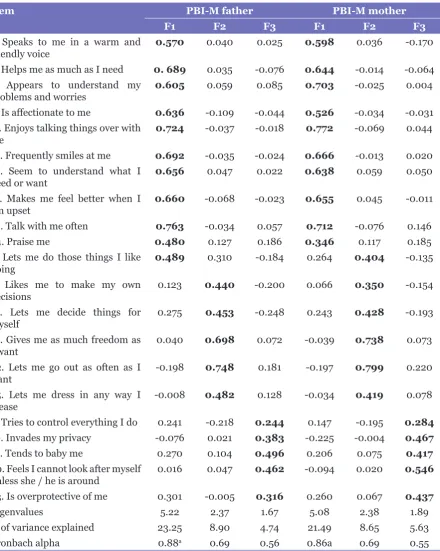
mother; as a result, item 3 was dropped. Item 9, “Tries to control everything I do”, showed a low factor loading of < 0.32 but loaded appropriately according to its substantive meaning on factor 3 in both PBI-M father and PBI-M mother. Hence, item 9 was retained in the final set (Table 2).
Reliability testing
Based on previous studies, we named factor 1 “care”, factor 2 “autonomy” and factor 3 “overprotection”. In the final version, the care factor was represented by 10 items (items 1, 2, 5, 6, 11, 12, 14, 17, 18 and 24), with a Cronbach’s alpha of 0.86 – 0.88. The autonomy factor consisted of five items (items 7, 15, 21, 22 and 25), with a Cronbach’s alpha of 0.69–0.70. The overprotection factor had five items (items 9, 10, 13, 20, and 23), with a Cronbach’s alpha of 0.54– 0.56 (Table 2).
Discussion
This study translated the PBI into Malay; the translated instrument was named PBI-M. The results of the comprehension testing show that participants had difficulty understanding double negative items. Thus, the five items were replaced with five positive items with similar meanings (11). None of the regional studies in Japan, Pakistan and China made these changes in their translated PBI versions (2,8,10). The participants of this study showed a good level of comprehension of
(Table 1 continued)
Negative items
3. Lets me do those things I like doing.
0.484 0.360 0.258 0.433 0.438 0.380 -0.060 0.262 0.438 -0.097
7. Likes me to make my own decisions
0.133 0.457 0.069 0.356 0.072 0.492 -0.089 0.074 0.368 -0.142
8. Want me to grow up
0.380 0.114 0.371 0.078 0.361 0.131 -0.107 0.370 0.071 0.033
15. Lets me decide things
0.271 0.487 0.228 0.453 0.206 0.527 -0.100 0.236 0.469 -0.163
21. Gives me as much freedom as I want
0.152 0.683 -0.020 0.735 0.078 0.670 0.089 -0.024 0.723 0.083
22. Lets me go out as often as I want
-0.052 0.695 -0.161 0.758 -0.121 0.667 0.168 -0.175 0.764 0.212
25. Lets me dress in any way I please
0.087 0.450 -0.011 0.400 0.0039 0.441 0.062 -0.012 0.397 0.022
% of variance explained
21.9 7.6 19.8 7.4 22.0 7.7 5.3 19.8 7.6 5.7
Table 2: Three factor loadings for Parental Bonding Instrument into Malay (PBI-M) mother and PBI-M father based on 21 items
Item PBI-M father PBI-M mother
F1 F2 F3 F1 F2 F3
1. Speaks to me in a warm and
friendly voice 0.570 0.040 0.025 0.598 0.036 -0.170
2. Helps me as much as I need 0. 689 0.035 -0.076 0.644 -0.014 -0.064
5. Appears to understand my
problems and worries 0.605 0.059 0.085 0.703 -0.025 0.004
6. Is affectionate to me 0.636 -0.109 -0.044 0.526 -0.034 -0.031
11. Enjoys talking things over with
me 0.724 -0.037 -0.018 0.772 -0.069 0.044
12. Frequently smiles at me 0.692 -0.035 -0.024 0.666 -0.013 0.020
14. Seem to understand what I
need or want 0.656 0.047 0.022 0.638 0.059 0.050
17. Makes me feel better when I
am upset 0.660 -0.068 -0.023 0.655 0.045 -0.011
18. Talk with me often 0.763 -0.034 0.057 0.712 -0.076 0.146
24. Praise me 0.480 0.127 0.186 0.346 0.117 0.185
3. Lets me do those things I like
doing 0.489 0.310 -0.184 0.264 0.404 -0.135
7. Likes me to make my own
decisions 0.123 0.440 -0.200 0.066 0.350 -0.154
15. Lets me decide things for
myself 0.275 0.453 -0.248 0.243 0.428 -0.193
21. Gives me as much freedom as
I want 0.040 0.698 0.072 -0.039 0.738 0.073
22. Lets me go out as often as I
want -0.198 0.748 0.181 -0.197 0.799 0.220
25. Lets me dress in any way I
please -0.008 0.482 0.128 -0.034 0.419 0.078
9. Tries to control everything I do 0.241 -0.218 0.244 0.147 -0.195 0.284
10. Invades my privacy -0.076 0.021 0.383 -0.225 -0.004 0.467
13. Tends to baby me 0.270 0.104 0.496 0.206 0.075 0.417
20. Feels I cannot look after myself
unless she / he is around 0.016 0.047 0.462 -0.094 0.020 0.546
23. Is overprotective of me 0.301 -0.005 0.316 0.260 0.067 0.437
Eigenvalues 5.22 2.37 1.67 5.08 2.38 1.89
% of variance explained 23.25 8.90 4.74 21.49 8.65 5.63
Cronbach alpha 0.88a 0.69 0.56 0.86a 0.69 0.55
Factor loadings with highest value are in bold. aCronbach’s alpha value without item 3.
the PBI-M that included the five positive items. In total, there were 20 items in the PBI-M, which can be used as a reliable instrument to capture parental care, allowance of autonomy and overprotection of Malaysian youths. We
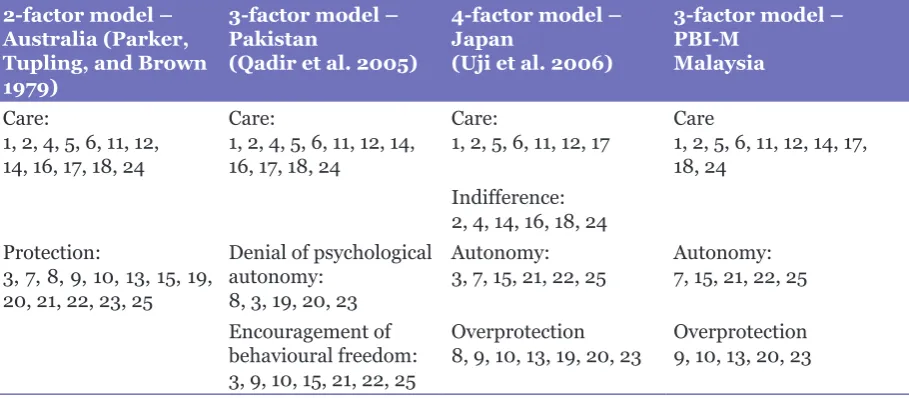
Table 3: The factor structure of Parental Bonding Instrument (PBI) in selected studies 2-factor model –
Australia (Parker, Tupling, and Brown 1979)
3-factor model – Pakistan
(Qadir et al. 2005)
4-factor model – Japan
(Uji et al. 2006)
3-factor model – PBI-M
Malaysia
Care:
1, 2, 4, 5, 6, 11, 12, 14, 16, 17, 18, 24
Care:
1, 2, 4, 5, 6, 11, 12, 14, 16, 17, 18, 24
Care:
1, 2, 5, 6, 11, 12, 17 Care1, 2, 5, 6, 11, 12, 14, 17, 18, 24
Indifference: 2, 4, 14, 16, 18, 24 Protection:
3, 7, 8, 9, 10, 13, 15, 19, 20, 21, 22, 23, 25
Denial of psychological autonomy:
8, 3, 19, 20, 23
Autonomy:
3, 7, 15, 21, 22, 25 Autonomy:7, 15, 21, 22, 25
Encouragement of behavioural freedom: 3, 9, 10, 15, 21, 22, 25
Overprotection
8, 9, 10, 13, 19, 20, 23 Overprotection9, 10, 13, 20, 23
and 16 (1). The protection items were divided into two factors: autonomy and overprotection. These two factors mimicked the factors of the model for the Japanese population, except for items 3 and 8 (2).
Item 4 (“Seems emotionally cold towards me”) and item 16 (“Makes me feel I am not wanted”) were negative items that measured parental care in the original PBI. The two negative items loaded high on the overprotection factor in PBI-M father and on the care factor in PBI-M mother. The two items behaved differently between fathers and mothers. The use of negative items might lead to misinterpretation and can be a source of considerable error (20). Thus, to have a standard PBI-M instrument applicable to both parents, the two items were dropped.
Items 8 and 19, which were designed to measure the overprotection domain in Parker’s model, behaved differently in the population of this study. The statement “Wants me to grow up” in item 8 was viewed as representing care instead of overprotection. In the study of Uji et al., item 8 (“Did not want me to grow up”) was in the double negative form and loaded highly on the overprotection factor (2). Gamsa (11) suggested that modifying the statement to a positive form such as “Wanted me to grow up” would keep the item in the overprotection factor. However, this study failed to support this suggestion. Therefore, we decided to drop the item. Item 19, “Tries to make me feel dependent on him/her”, which was meant to be in the overprotection factor, was viewed as a statement of care and was applicable to both fathers and mothers. Different cultures may view parental care differently; Eastern
cultures may view overprotection behaviour as caring behaviour (8,10). However, this item was dropped from subsequent analysis.
Once the four items were removed from the PBI-M questionnaire, the reanalysis showed better results. All the items loaded on the three factors and produced almost identical item structures for PBI-M father and PBI-M mother, except item 3 (“Lets me do those things I like doing”). In Parker’s model, item 3 is a negative item for overprotection. In our results, the item showed low negative loading for the overprotection factor and high positive loading for the care factor in PBI-M father and autonomy in PBI-M mother. Thus, item 3 was removed from our final PBI-M questionnaire. As for item 9, “Tries to control everything I do”, although the factor loading was low in both PBI-M father and PBI-M mother, it loaded appropriately on the overprotection factor for both PBI-M father and PBI-M mother. Factor loading is not absolute in reflecting the substantive importance of an item to a factor (16). We believe that item 9 should still be part of the overprotection factor, which measures controlling behaviour experienced by the youths. Hence, this item was retained in the final set of the PBI-M questionnaire.
not produce a similar result as its positive form (21,22).
Notably, the youths’ perception of some similar parenting behaviours of their fathers and mothers may carry different meanings. For example, the item “Lets me do those things I like doing” was perceived as caring if the behaviour was from fathers, but was viewed as allowing autonomy if it was from mothers. Other examples were “Seems emotionally cold towards me” and “Makes me feel I am not wanted”. The meanings of these behaviours among the youth could be explored through qualitative study to allow a better understanding of gender-specific parenting behaviours. However, this recommendation is beyond the scope of this study. To produce a standard instrument for both fathers and mothers, items that behaved differently between fathers and mothers were removed.
The conclusions made in this study are restricted to youths aged 18 to 22 who are in college. The PBI-M with 20 items may be used in different Malaysian samples but may need cross-validation. Factors such as age may affect the findings (2). In addition, the majority of participants in this study came from one ethnicity; thus, the results may not entirely reflect the multi-ethnic youth population of Malaysia. Confirmatory factor analysis with structural equation modelling may further support our three-factor model.
Conclusion
This study successfully translated the PBI into Malay (PBI-M) and supported the three-factor model in the Malaysian population. This study negated the use of negative items in the study population. The final PBI-M consisted of 20 items, all of which had a positive loading on their respective factors. There were 10 items for the care factor, five items for the overprotection factor and five items for the autonomy factor. All three factors showed acceptable internal consistency values for both parents. The PBI-M can be used to assess parenting style among the Malaysian youth. Nevertheless, the current Malay version of the PBI should be subjected to confirmatory factor analysis to confirm this three-factor model.
Acknowledgement
The authors greatly appreciate the contribution of all anonymous participants in providing valuable data to this study.
Conflict of Interest
None.
Funds
This research was supported by the fundamental grant from the Universiti Kebangsaan Malaysia (FF-2013-328).
Authors’ Contributions
Conception and design: NAM, KS, KO, RMA Analysis and interpretation of the data,drafting of the article and collection and assembly of data NAM
Critical revision of the article for the important intellectual content: KS, KO, RMA
Final approval of the article and obtaining of funding: KS
Statistical expertise: SAS
Administrative, technical or logistic support: KS, KO
Correspondence
Dr Noor Azimah Muhammad
MBBS (Queensland), MMed (Family Medicine) (UKM) Family Medicine Department
Faculty of Medicine Jalan Yaacob Latiff Cheras 68000
Kuala Lumpur, Malaysia Tel: +603-91456117 Fax: +603-91738153
Email: [email protected]
References
1. Parker G, Tupling H, Brown L. A parental bonding instrument. Brit J MedPsychol. 1979;52(1):1–10. doi: 10.1111/j.2044-8341.1979.tb02487.x.
2. Uji M, Tanaka N, Shono M, Kitamura T. Factorial structure of the parental bonding instrument (PBI) in Japan: A study of cultural, developmental, and gender influences. Child Psychiat Hum D. 2006;37(2):115– 132. doi: 10.1007/s10578-006-0027-4.
3. Safford SM, Alloy LB, Pieracci A. A comparison of two measures of parental behavior. J Child Fam Stud.
2007;16(3):375–384. doi: 10.1007/s10826-006-90
92-3.
5. Parker G. The Parental Bonding Instrument - A decade of research. Soc Psych Psych Epid. 1990;25:281–282. doi: 10.1007/BF00782881.
6. Canetti L, Kanyas K, Lerer B, Latzer Y, Bachar E. Anorexia nervosa and parental bonding: the contribution of parent–grandparent relationships to eating disorder psychopathology. J Clin Psychol.
2008;64(6):703–716. doi: 10.1002/jclp.20482.
7. Enns MW, Cox BJ, Clara I. Parental bonding and adult psychopathology: results from the US National Comorbidity Survey. Psychol Med. 2002;32(6):997– 1008. doi: 10.1017/S0033291702005937.
8. Qadir F, Stewart R, Khan M, Prince M. The validity of the Parental Bonding Instrument as a measure of maternal bonding among young Pakistani women.
Soc Psych Psych Epid. 2005;40(4):276–282. doi: 10.1007/s00127-005-0887-0.
9. Suzuki H, Kitamura T. The Parental Bonding Instrument: A Four-Factor Structure Model in
a Japanese College Sample. Open Fam Stud J.
2011;4:89–94. doi: 10.2174/1874922401104010089.
10. Liu J, Li L, Fang F. Psychometric properties of the Chinese version of the Parental Bonding Instrument.
Int J Nurs Studies. 2011;48(5):582–589. doi: 10.1016/j.ijnurstu.2010.10.008.
11. Gamsa A. A note on a modification of the Parental
Bonding Instrument. British J Med Psychol.
1987;60(3):291–294. doi: 10.1111/j.2044-8341.1987. tb02745.x.
12. Kitamura T, Suzuki T. A validation study of the Parental Bonding Instrument in a Japanese population. Psych Clinical Neurosci. 1993;47(1): 29–36. doi: 10.1111/j.1440-1819.1993.tb02026.x.
13. Chambers JA, Power KG, Loucks N, Swanson V. Psychometric properties of the Parental Bonding Instrument and its association with psychological distress in a group of incarcerated young offenders in Scotland. Soc Psych Psych Epid. 2000;35(7): 318–325. doi: 10.1007/s001270050245.
14. Cox B, Enns M, Clara I. The Parental Bonding Instrument: confirmatory evidence for a three-factor model in a psychiatric clinical sample and in the National Comorbidity Survey. Soc Psych Psych Epid.
2000;35(8):353–357. doi: 10.1007/s001270050250.
15. Parker G, Tupling H, Brown LB. Parental Bonding Instrument. Australia (AU): Black Dog Institute; [year of publication unknown].
16. Field A. Exploring factor analysis. In: Discovering statistics using IBM SPSS Statistics. 4th edition. California(US): SAGE Publications Inc.; 2013. p. 665–719.
17. Costello AB, Osborne JW. Best practices in exploratory factor analysis: four recommendations for getting the most from your analysis. Pract Assess Res Evaluat. 2005;10(7):1–9.
18. Cortina JM. What is coefficient alpha? An examination of theory and applications. J Appl Psychol. 1993;78(1):98–104. doi: 10.1037/0021-9010.78.1.98.
19. Ledesma RD, Valero-Mora P. Determining the Number of Factors to Retain in EFA: an easy-to-use computer program for carrying out Parallel Analysis.
Prac Assessment, Res Evaluat. 2007;12(2):1–11.
20. Lee SH. Constructing effective questionnaires.
In Pershing JA, editor. Handbook of Human Performance Technology: Principles, Practice and Potential. 3rd ed. San Francisco (US): Pfeiffer; 2006. p. 60–79.
21. Johnson JM, Bristow DN, Schneider KC. Did you not understand the question or not? An investigation of negatively worded questions in survey research. J Appl Bus Res. 2004;20(1):75–86.
22. Colosi R. Negatively worded questions cause
respondent confusion. Proceedings of the Survey
Research Methods Section. Minneapolis (US):