Nat. Hazards Earth Syst. Sci., 13, 3205–3210, 2013 www.nat-hazards-earth-syst-sci.net/13/3205/2013/ doi:10.5194/nhess-13-3205-2013
© Author(s) 2013. CC Attribution 3.0 License.
Natural Hazards
and Earth System
Sciences
Open Access
Collisions of two breathers at the surface of deep water
A. I. Dyachenko1,3, D. I. Kachulin1, and V. E. Zakharov1,3,2,4
1Novosibirsk State University, Pirogova 2, Novosibirsk-90, 630090, Russia 2Department of Mathematics, University of Arizona, Tucson, AZ, 857201, USA
3Landau Institute for Theoretical Physics, 1-a Semenova pr., Chernogolovka, Moscow Region, 142432, Russia 4Physical Institute of RAS, Leninskiy prospekt, 53, Moscow, 119991, Russia
Correspondence to: A. I. Dyachenko ([email protected])
Received: 3 June 2013 – Published in Nat. Hazards Earth Syst. Sci. Discuss.: 28 June 2013 Revised: 5 November 2013 – Accepted: 7 November 2013 – Published: 9 December 2013
Abstract. We present results of numerical experiments on
long-term evolution and collisions of breathers (which cor-respond to envelope solitons in the NLSE approximation) at the surface of deep ideal fluid. The collisions happen to be nonelastic. In the numerical experiment it can be observed only after many acts of interactions. This supports the hy-pothesis of “deep water nonintegrability”. The experiments were performed in the framework of the new and refined ver-sion of the Zakharov equation free of nonessential terms in the quartic Hamiltonian. Simplification is possible due to ex-act cancellation of nonelastic four-wave interex-action.
1 Introduction
Theory of weakly nonlinear waves on shallow water is a nursery for several completely integrable models. Among them are the famous KdV and KP equations (Gardner et al., 1967; Kadomtsev and Petviashvili, 1973; Zakharov and Sha-bat, 1979), the Boussinesq equation (Zakharov, 1974), and the Kaup system (Kaup, 1975). Detailed study of these in-tegrable systems has not only theoretical, but also practical importance. Recently A. Osborne showed (Osborne, 2010) that representation of solutions of KP equations in the form of Jacobi theta functions is a very efficient and economical way of analyzing experimental data for long waves in coastal areas.
Now the fundamental question appears – what can be done in the case of deep fluid? So far only one integrable model on deep water is known. It is the focusing nonlin-ear Schrödinger equation describing weakly nonlinnonlin-ear quasi-monochromatic wave trains (Zakharov, 1968; Zakharov and Shabat, 1972). Exact solutions of this equation can also be
given by theta functions (Belokolos et al., 1994). They are actively used now for determination of freak wave statistics (Osborne, 2010). However, the NLSE has a limited area of application and can hardly be applicable to many experimen-tal situations.
Hopes that the exact Euler equation for potential flow on deep water with free surface in the presence of gravity is in-tegrable appeared in 1994 when two of us (Dyachenko and Zakharov, 1994) established that the coefficient of a scat-tering matrix connecting asymptitics at t→ ±∞ states of wave field, corresponding to inelastic four-wave processes and governed by resonant conditions
k+k1=k2+k3 ωk+ωk1=ωk2+ωk3,
where ωk=
p g|k|
in 1-D geometry is identically equal to zero.
However, this cancellation is just a weak necessary condi-tion for integrability and is far from being sufficient. For inte-grability in “strong sense” we need cancellation in all orders of perturbation theory (see Zakharov and Schulman, 1991). However, in Dyachenko et al. (1995) it was shown that not all members of a five-wave scattering matrix are zero, thus we can only hope for integrability in some “weak sense”. We will not discuss this subject having a “strong mathematical flavor” here.
Meanwhile, efficient methods for numerical simulations of the exact Euler equation were developed during the last decade; massive numerical experiments were also per-formed. Again, some of them can be considered as a certain indication of integrability.
In the framework of NLSE approximation there is an ex-act solution – envelope soliton. Do such solutions exist in the exact Euler equation? If the system is nonintegrable, the soliton exists only during a finite time; then it must lose its energy due to radiation in a backward direction (Zakharov and Kuznetsov, 1998). In the nonintegrable MMT model this backward radiation is a very strong effect leading to the for-mation of an “abnormal” weak turbulent spectrum (Rumpf et al., 2009). However, in our experiments on propagation of steep envelope solitons in the frame of the Euler equation, we did not trace the slightest backward radiation (Dyachenko and Zakharov, 2008). The soliton persistently existed during thousands of their periods.
In this article we present new numerical results shedding some light on the integrability of the deep-water hydrody-namics. We study collisions of breathers (solitons) in the framework of a newly derived approximate equation applica-ble for small-amplitude waves with any spectral band width. Actually, this is what is called the “Zakharov equation” (see Zakharov, 1968), improved by the implementation of addi-tional canonical transformation to the Poincaré normal form. This transformation is possible only due to the still mysteri-ous fact of four-wave interaction cancellation.
The new equation (described in detail in Dyachenko and Zakharov, 2011, 2012) is very convenient for numerical sim-ulations. It has a nice solitonic solution that so far cannot be found analytically, but can be easily obtained numerically. Existence of solitonic solutions and their elastic collisions are indications of integrability. However, just indications are not enough. In this paper we study the collision of such soli-tons and show that this collision is nonelastic. One can how-ever only see it after multiple collisions. We can interpret this fact as a numerical proof of nonintegrability, at least for this “refined Zakharov equation”1.
2 Compact equation
A one-dimensional potential flow of an ideal incompressible fluid with a free surface in a gravity field fluid is described by the following set of equations:
φxx+φzz =0 (φz→0, z→ −∞), ηt+ηxφx =φz
z=η
φt+ 1 2(φ
2
x+φ2z)+gη=0
z=η ;
here η(x, t ) is the shape of a surface, φ (x, z, t ) is a po-tential function of the flow and gis gravitational accelera-tion. As was shown in Zakharov (1968), the variablesη(x, t ) andψ (x, t )=φ (x, z, t )
z=η
are canonically conjugated, and 1Some of the numerical results were put in Dyachenko et al.
(2012)
satisfy the equations ∂ψ
∂t = − δH
δη
∂η ∂t =
δH δψ.
Here the Hamiltonian can be written as an infinite series (see Zakharov, 1968):
H =1 2 Z
gη2+ψkψˆ dx−1 2 Z
{(kψ )ˆ 2−(ψx)2}ηdx+ +1
2 Z
{ψxxη2kψˆ +ψk(ηˆ k(ηˆ kψ ))ˆ }dx+. . . (1) In this article we consider Hamiltonians up to the fourth order. In the articles (Dyachenko and Zakharov, 2011, 2012) we applied canonical transformation to the Hamiltonian vari-ables ψ and η to introduce the normal canonical variable b(x, t ). This transformation explicitly exploits the vanishing of four-wave interaction and possibility to consider surface waves moving in the same direction. Briefly, this transforma-tion consists of two steps. First, we introduce normal com-plex variablesak(t )as follows:
ηk= rω
k 2g(ak+a
∗
−k) ψk= −i r g
2ωk
(ak−a−∗k).
Then one applies transformation from variablesak tobk to exclude nonresonant cubic terms along with nonreso-nant fourth-order terms. This transformation up to accuracy O(b5)has the form (Zakharov, 1968; Zakharov et al., 1992): ak= bk+
R 0kk
1k2bk1bk2δk−k1−k2dk1dk2−
−2R 0k2
kk1b ∗
k1bk2δk+k1−k2dk1dk2+
+ R
0kk1k2b ∗ k1b
∗
k2δk+k1+k2dk1dk2
+R Bk2k3
kk1 b ∗
k1bk2bk3δk+k1−k2−k3dk1dk2dk3+
+ RCk3 kk1k2b
∗ k1b
∗
k2bk3δk+k1+k2−k3dk1dk2dk3
+RSkk1k2k3b ∗ k1b
∗ k2b
∗
k3δk+k1+k2+k3dk1dk2dk3. (2) The particular choice of coefficients in Eq. (2) is described in Dyachenko and Zakharov (2011, 2012). The choice of 0kk
1k2 and0kk1k2 provides cancellation of cubic terms, while the choice of Ck3
kk1k2 and Skk1k2k3 provides cancellation of the nonresonant fourth-order term. The particular choice of Bk2k3
kk1 allows selfconsistent consideration of waves moving in the same direction only, making the Hamiltonian very simple at the same time. For this variableb(x, t ), Hamiltonian (1) acquires the nice and elegant form2:
H= Z
b∗ωˆkbdx+ 1 2
Z
∂b ∂x
2i
2
b∂b
∗
∂x −b ∗∂b
∂x
− ˆK|b|2
dx. (3) 2There was a misprint in the articles (Dyachenko and Zakharov,
2011, 2012): the coefficient for the quartic term in the Hamiltonian must be12instead of14
A. I. Dyachenko: Collisions of two breathers 3207
A.I. Dyachenko: Collisions of two breathers 3
here ˆP+- projection operator to the upper half-plane. ˆ
P+2=Pˆ+=1
2(1−i ˆH).
This operator is the consequence ofθ-functions in (2.4). It keeps only positive k in the system of waves. (So, we con-sider self-consistent system of waves propagating in the same direction.)
Corresponding equation of motion is the following:
i∂b
∂t =ωˆkb + i
4Pˆ
+
" b∗ ∂
∂x(b
′2
)− ∂
∂x(b
∗′ ∂
∂xb
2
)
#
−
−1
2Pˆ
+
"
b·K(ˆ |b′|2)− ∂
∂x(b
′K(ˆ |b|2))
#
, (2.6)
or in K-space
i∂bk
∂t =ωkbk+ Z
˜
Tk2k3
kk1 b
∗
k1bk2bk3δk+k1−k2−k3dk1dk2dk3. (2.7)
3 Breathers and numerical simulation of its colli-sions
Breather is the localized solution of (2.6) of the following type:
b(x,t)=B(x−Vt)ei(k0x−ω0t), (3.8)
where k0 is the wavenumber of the carrier wave, V is the
group velocity andω0 is the frequency close toωk0. In the
Fourier space breather can be written as follow:
bk(t)=e−i(Ω+Vk)tφk, (3.9)
whereΩis close toω2k0.
Forφkthe following equation is valid:
(Ω +Vk−ωk)φk=
Z
˜
Tk2k3
kk1 φ
∗
k1φk2φk3δk+k1−k2−k3dk1dk2dk3.
(3.10)
One can treatφkas pure real function of k.
To solve equation (3.10) one can use Petviashvili iteration method (Petviashvili, 1976; Lakoba and Yang, 2007) (n - is the number of iteration):
(Ω +Vk−ωk)φnk+1=Mn
Z
˜
Tk2k3
kk1 φ
∗
k1
n
φnk2φnk3δk+k1−k2−k3dk1dk2dk3(3.11).
Petviashvili coefficient Mn is the following:
Mn=
< φn
k(Ω +Vk−ωk)φ n k>
< φn k
R
˜
Tk2k3
kk1 φ
∗
k1
nφn k2φ
n
k3δk+k1−k2−k3dk1dk2dk3> 3 2 .
Angular brackets mean integration over k.
Below we present a typical numerical solution of (3.10).
Calculations were made in the periodic domain 2πwith
car-rier wavenumber k0∼64, V=1/16 andΩ =4.01. In the
Fig-ures 1, 2, 3 one can see real part of b(x), modulus of b(x) and
-0.0003 -0.0002 -0.0001 0 0.0001 0.0002 0.0003
0 1 2 3 4 5 6
Re(b)
x
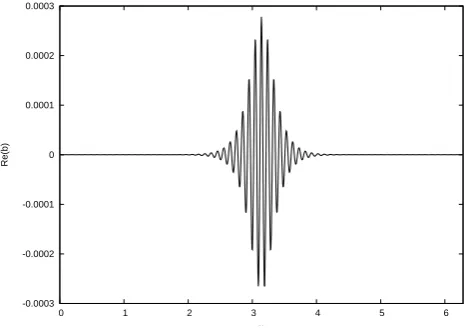
Figure 1.Real part of b(x) with V=1/16 andΩ =4.01.
0 5e-05 0.0001 0.00015 0.0002 0.00025 0.0003
0 1 2 3 4 5 6
|b|
x
Figure 2.Modulus of b(x) with V=1/16 andΩ =4.01.
Fourier spectrum of b(x). Modulus of b(x) coincides with the
modulus of B(x−Vt) if (3.8) and is similar to the wave
en-velope if we derive Nonlinear Schroedinger Equation from (2.6).
To analyze the question about integrability of the equa-tion (2.6) one can consider collision of breathers. It might be elastic or nonelastic. In the papers (Dyachenko et al., 2012; Fedele and Dutykh, 2012) there were considered one colli-sion of two breathers. This collicolli-sion was seamed to be elastic. Here, in this paper, we consider multiple collisions to check integrability numerically. For time-integration scheme 4-th order Runge-Kutta method was used. The scheme is very ro-bust and allows long-time simulation.
To study breathers collisions we performed the following numerical simulation:
– As initial condition we have used two breathers
sepa-rated in space (distance was equal toπ.)
www.jn.net J. Name
Fig. 1. Real part ofb(x)withV =1/16 and=4.01.
InK-space the Hamiltonian has the form:
H=
Z
ωk|bk|2dk+ +1
2 Z
˜ Tk3k4
k1k2b ∗ k1b
∗
k2bk3bk4δk1+k2−k3−k4dk1dk2dk3dk4. (4) Here
˜ Tkk1
k2k3=
θ (k)θ (k1)θ (k2)θ (k3)
8π [(kk1(k+k1)+k2k3(k2+k3))− −(kk2|k−k2|+kk3|k−k3| +k1k2|k1−k2|+
+k1k3|k1−k3)], (5)
θ (k)= (
0, ifk≤0; 1, ifk >0.
The Fourier transform is defined as follows:
b(x)=√1 2π
∞ Z
−∞
bkeikxdx,
whereb(x)can be analytically continued tox+iy,y >0. The motion equation forbkshould be understood as follows: i∂b
∂t = ˆP +δH
δkk∗,
herePˆ+- projection operator to the upper half-plane. ˆ
P+2= ˆP+=1 2(1−i
ˆ H ).
This operator is the consequence ofθfunctions in Eq. (4). It keeps only positive k in the system of waves. (So, we
A.I. Dyachenko: Collisions of two breathers 3
here ˆP+- projection operator to the upper half-plane. ˆ
P+2=Pˆ+=1
2(1−i ˆH).
This operator is the consequence ofθ-functions in (2.4).
It keeps only positive k in the system of waves. (So, we con-sider self-consistent system of waves propagating in the same direction.)
Corresponding equation of motion is the following:
i∂b
∂t =ωˆkb + i
4Pˆ
+
" b∗ ∂
∂x(b
′2
)− ∂
∂x(b
∗′ ∂
∂xb
2)
#
−
−1
2Pˆ
+
"
b·K(ˆ |b′|2)− ∂
∂x(b
′K(ˆ |b|2))
#
, (2.6)
or in K-space
i∂bk
∂t =ωkbk+ Z
˜
Tk2k3
kk1 b
∗
k1bk2bk3δk+k1−k2−k3dk1dk2dk3. (2.7)
3 Breathers and numerical simulation of its colli-sions
Breather is the localized solution of (2.6) of the following type:
b(x,t)=B(x−Vt)ei(k0x−ω0t), (3.8)
where k0 is the wavenumber of the carrier wave, V is the
group velocity and ω0 is the frequency close toωk0. In the
Fourier space breather can be written as follow:
bk(t)=e−i(Ω+Vk)tφk, (3.9)
whereΩis close toω2k0.
Forφkthe following equation is valid:
(Ω +Vk−ωk)φk=
Z
˜
Tk2k3
kk1 φ
∗
k1φk2φk3δk+k1−k2−k3dk1dk2dk3.
(3.10)
One can treatφkas pure real function of k.
To solve equation (3.10) one can use Petviashvili iteration method (Petviashvili, 1976; Lakoba and Yang, 2007) (n - is the number of iteration):
(Ω +Vk−ωk)φnk+1=M n
Z
˜
Tk2k3
kk1 φ
∗
k1
nφn k2φ
n
k3δk+k1−k2−k3dk1dk2dk3(3.11).
Petviashvili coefficient Mnis the following:
Mn=
< φn
k(Ω +Vk−ωk)φnk>
< φnkR T˜k2k3
kk1 φ
∗
k1
nφn k2φ
n
k3δk+k1−k2−k3dk1dk2dk3> 3 2 .
Angular brackets mean integration over k.
Below we present a typical numerical solution of (3.10).
Calculations were made in the periodic domain 2πwith
car-rier wavenumber k0∼64, V=1/16 andΩ =4.01. In the
Fig-ures 1, 2, 3 one can see real part of b(x), modulus of b(x) and
-0.0003 -0.0002 -0.0001 0 0.0001 0.0002 0.0003
0 1 2 3 4 5 6
Re(b)
x
Figure 1.Real part of b(x) with V=1/16 andΩ =4.01.
0 5e-05 0.0001 0.00015 0.0002 0.00025 0.0003
0 1 2 3 4 5 6
|b|
x
Figure 2.Modulus of b(x) with V=1/16 andΩ =4.01.
Fourier spectrum of b(x). Modulus of b(x) coincides with the
modulus of B(x−Vt) if (3.8) and is similar to the wave
en-velope if we derive Nonlinear Schroedinger Equation from (2.6).
To analyze the question about integrability of the equa-tion (2.6) one can consider collision of breathers. It might be elastic or nonelastic. In the papers (Dyachenko et al., 2012; Fedele and Dutykh, 2012) there were considered one colli-sion of two breathers. This collicolli-sion was seamed to be elastic. Here, in this paper, we consider multiple collisions to check integrability numerically. For time-integration scheme 4-th order Runge-Kutta method was used. The scheme is very ro-bust and allows long-time simulation.
To study breathers collisions we performed the following numerical simulation:
– As initial condition we have used two breathers
sepa-rated in space (distance was equal toπ.)
www.jn.net J. Name
Fig. 2. Modulus ofb(x)withV=1/16 and=4.01.
consider self-consistent systems of waves propagating in the same direction.)
The corresponding equation of motion is the following: i∂b
∂t = ˆωkb+ i 4
ˆ P+
b∗ ∂
∂x(b 02 )− ∂ ∂x(b ∗0 ∂ ∂xb 2) − −1 2 ˆ P+
b· ˆK(|b0|2)− ∂ ∂x(b
0 ˆ K(|b|2))
, (6) or inK-space
i∂bk
∂t =ωkbk+ Z
˜ Tk2k3
kk1 b ∗
k1bk2bk3δk+k1−k2−k3dk1dk2dk3.(7)
3 Breathers and numerical simulation of its collisions
A breather is the localized solution of Eq. (6) of the following type:
b(x, t )=B(x−V t )ei(k0x−ω0t ), (8) wherek0 is the wavenumber of the carrier wave, V is the group velocity andω0 is the frequency close toωk0. In the Fourier space a breather can be written as follows:
bk(t )=e−i(+V k)tφk, (9)
whereis close toωk0 2 .
Forφkthe following equation is valid: (+V k−ωk)φk=
Z ˜ Tk2k3
kk1 φ
∗
k1φk2φk3δk+k1−k2−k3dk1dk2dk3. (10)
One can treatφkas a pure real function ofk.
To solve Eq. (10), one can use the Petviashvili iteration method (Petviashvili, 1976; Lakoba and Yang, 2007) (nis the number of iterations):
(+V k−ωk)φkn+1=
Mn Z
˜ Tk2k3
kk1 φ ∗ k1 n
φkn 2φ
n
k3δk+k1−k2−k3dk1dk2dk3. (11)
3208 A. I. Dyachenko: Collisions of two breathers
4 A.I. Dyachenko: Collisions of two breathers
1e-24 1e-22 1e-20 1e-18 1e-16 1e-14 1e-12 1e-10 1e-08 1e-06 0.0001
0 100 200 300 400 500
|b|
k
Figure 3.Spectrum of b(x) with V=1/16 andΩ =4.01.
-0.0003 -0.0002 -0.0001 0 0.0001 0.0002 0.0003
0 1 2 3 4 5 6
Re(b)
x
Figure 4.Initial condition with two breathers.
– First breather has the following parameters:Ω1=4.01,
V1=1/16. Carrier wave number appears to be∼64. – For the second breather -Ω2=4.51, V2=1/18. Carrier
wave number appears to be∼81
This initial condition is shown in Figure 4. Its Fourier
spectrum is shown in Figure 5. After time (V π
1−V2)≃452.4
breathers collides. In the Figure 6 one can see breathers
at the moment of collision (t=452.4). Fourier spectrum of
two breathers at t=452.4 is shown in Figure 7. And finally we show the picture of two breathers after 100 collisions
at t∼88000 when they separated again at distance≃π.The
initial condition and state after 100 breather collisions are shown in Figure 8. Fourier spectrum of that is given in Fig-ures 9. One can compare it with initial spectrum in 5. Small radiation after 100 collisions is shown in Figure 10, which is zoomed profile of|b(x)|. During numerical simulation the to-tal energy was conserved up to ninth digit after decimal point.
1e-24 1e-22 1e-20 1e-18 1e-16 1e-14 1e-12 1e-10 1e-08 1e-06 0.0001
0 200 400 600 800 1000
|b|
k
Figure 5.Initial Fourier spectrum|bk|of two breathers.
-0.0005 -0.0004 -0.0003 -0.0002 -0.0001 0 0.0001 0.0002 0.0003 0.0004 0.0005
0 1 2 3 4 5 6
Re(b)
x
Figure 6.Two breathers collides.
To make sure the quality of long-time calculations we per-formed simulation with different time-steps. So, the simula-tion demonstrates that after multiple collisions of breathers there appears radiation. It points on nonelastic collisions and nonintegrability of the equation (2.6).
4 Conclusions
We see that individual breathers are not differ from NLSE
solitons qualitatively. We have studied numerically interac-tion of two breathers (solitons) with different values of car-rier wave lengths. Interaction of such breathers cannot be de-scribed by the NLSE even approximately.
Interaction of such solitons happens to be nonelastic. This experimental fact requires additional study to prove nonin-tegrability analytically. One can check 6-waves interaction
Fig. 3. Spectrum ofb(x)withV =1/16 and=4.01. 1e-24
1e-22 1e-20 1e-18 1e-16 1e-14 1e-12 1e-10 1e-08 1e-06 0.0001
0 100 200 300 400 500
|b|
k
Figure 3.Spectrum of b(x) with V=1/16 andΩ =4.01.
-0.0003 -0.0002 -0.0001 0 0.0001 0.0002 0.0003
0 1 2 3 4 5 6
Re(b)
x
Figure 4.Initial condition with two breathers.
– First breather has the following parameters:Ω1=4.01,
V1=1/16. Carrier wave number appears to be∼64. – For the second breather -Ω2=4.51, V2=1/18. Carrier
wave number appears to be∼81
This initial condition is shown in Figure 4. Its Fourier
spectrum is shown in Figure 5. After time (V π
1−V2)≃452.4
breathers collides. In the Figure 6 one can see breathers at the moment of collision (t=452.4). Fourier spectrum of two breathers at t=452.4 is shown in Figure 7. And finally we show the picture of two breathers after 100 collisions
at t∼88000 when they separated again at distance≃π.The
initial condition and state after 100 breather collisions are shown in Figure 8. Fourier spectrum of that is given in Fig-ures 9. One can compare it with initial spectrum in 5. Small radiation after 100 collisions is shown in Figure 10, which is zoomed profile of|b(x)|. During numerical simulation the to-tal energy was conserved up to ninth digit after decimal point.
1e-24 1e-22 1e-20 1e-18 1e-16 1e-14 1e-12 1e-10 1e-08 1e-06 0.0001
0 200 400 600 800 1000
|b|
k
Figure 5.Initial Fourier spectrum|bk|of two breathers.
-0.0005 -0.0004 -0.0003 -0.0002 -0.0001 0 0.0001 0.0002 0.0003 0.0004 0.0005
0 1 2 3 4 5 6
Re(b)
x
Figure 6.Two breathers collides.
To make sure the quality of long-time calculations we per-formed simulation with different time-steps. So, the simula-tion demonstrates that after multiple collisions of breathers there appears radiation. It points on nonelastic collisions and nonintegrability of the equation (2.6).
4 Conclusions
We see that individual breathers are not differ from NLSE
solitons qualitatively. We have studied numerically interac-tion of two breathers (solitons) with different values of car-rier wave lengths. Interaction of such breathers cannot be de-scribed by the NLSE even approximately.
Interaction of such solitons happens to be nonelastic. This experimental fact requires additional study to prove nonin-tegrability analytically. One can check 6-waves interaction
J. Name www.jn.net
Fig. 4. Initial condition with two breathers.
The Petviashvili coefficientMnis the following:
Mn= "
< φkn(+V k−ωk)φkn> < φknRT˜k2k3
kk1 φ ∗ k1
nφn k2φ
n
k3δk+k1−k2−k3dk1dk2dk3> #32
.
The angular brackets mean integration overk.
Below we present a typical numerical solution of Eq. (10). Calculations were made in the periodic domain 2π with carrier wavenumber k0∼64, V =1/16 and =4.01. In Figs. 1, 2, 3 one can see the real part ofb(x), the modulus ofb(x) and the Fourier spectrum ofb(x). The modulus of b(x)coincides with the modulus ofB(x−V t )in Eq. (8) and is similar to the wave envelope if we derive the nonlinear Schrödinger equation from Eq. (6).
To analyze the question about the integrability of Eq. (6), one can consider collision of breathers. It might be elastic or nonelastic. In the papers (Dyachenko et al., 2012; Fedele and Dutykh, 2012) one collision of two breathers was considered.
4 A.I. Dyachenko: Collisions of two breathers
1e-24 1e-22 1e-20 1e-18 1e-16 1e-14 1e-12 1e-10 1e-08 1e-06 0.0001
0 100 200 300 400 500
|b|
k
Figure 3.Spectrum of b(x) with V=1/16 andΩ =4.01.
-0.0003 -0.0002 -0.0001 0 0.0001 0.0002 0.0003
0 1 2 3 4 5 6
Re(b)
x
Figure 4.Initial condition with two breathers.
– First breather has the following parameters:Ω1=4.01,
V1=1/16. Carrier wave number appears to be∼64. – For the second breather -Ω2=4.51, V2=1/18. Carrier
wave number appears to be∼81
This initial condition is shown in Figure 4. Its Fourier
spectrum is shown in Figure 5. After time (V π
1−V2)≃452.4
breathers collides. In the Figure 6 one can see breathers at the moment of collision (t=452.4). Fourier spectrum of two breathers at t=452.4 is shown in Figure 7. And finally we show the picture of two breathers after 100 collisions
at t∼88000 when they separated again at distance≃π.The
initial condition and state after 100 breather collisions are shown in Figure 8. Fourier spectrum of that is given in Fig-ures 9. One can compare it with initial spectrum in 5. Small radiation after 100 collisions is shown in Figure 10, which is zoomed profile of|b(x)|. During numerical simulation the to-tal energy was conserved up to ninth digit after decimal point.
1e-24 1e-22 1e-20 1e-18 1e-16 1e-14 1e-12 1e-10 1e-08 1e-06 0.0001
0 200 400 600 800 1000
|b|
k
Figure 5.Initial Fourier spectrum|bk|of two breathers.
-0.0005 -0.0004 -0.0003 -0.0002 -0.0001 0 0.0001 0.0002 0.0003 0.0004 0.0005
0 1 2 3 4 5 6
Re(b)
x
Figure 6.Two breathers collides.
To make sure the quality of long-time calculations we per-formed simulation with different time-steps. So, the simula-tion demonstrates that after multiple collisions of breathers there appears radiation. It points on nonelastic collisions and nonintegrability of the equation (2.6).
4 Conclusions
We see that individual breathers are not differ from NLSE
solitons qualitatively. We have studied numerically interac-tion of two breathers (solitons) with different values of car-rier wave lengths. Interaction of such breathers cannot be de-scribed by the NLSE even approximately.
Interaction of such solitons happens to be nonelastic. This experimental fact requires additional study to prove nonin-tegrability analytically. One can check 6-waves interaction
J. Name www.jn.net
Fig. 5. Initial Fourier spectrum|bk|of two breathers.
1e-24 1e-22 1e-20 1e-18 1e-16 1e-14 1e-12 1e-10 1e-08 1e-06 0.0001
0 100 200 300 400 500
|b|
k
Figure 3.Spectrum of b(x) with V=1/16 andΩ =4.01.
-0.0003 -0.0002 -0.0001 0 0.0001 0.0002 0.0003
0 1 2 3 4 5 6
Re(b)
x
Figure 4.Initial condition with two breathers.
– First breather has the following parameters:Ω1=4.01,
V1=1/16. Carrier wave number appears to be∼64. – For the second breather -Ω2=4.51, V2=1/18. Carrier
wave number appears to be∼81
This initial condition is shown in Figure 4. Its Fourier
spectrum is shown in Figure 5. After time (V π
1−V2)≃452.4
breathers collides. In the Figure 6 one can see breathers
at the moment of collision (t=452.4). Fourier spectrum of
two breathers at t=452.4 is shown in Figure 7. And finally we show the picture of two breathers after 100 collisions
at t∼88000 when they separated again at distance≃π.The
initial condition and state after 100 breather collisions are shown in Figure 8. Fourier spectrum of that is given in Fig-ures 9. One can compare it with initial spectrum in 5. Small radiation after 100 collisions is shown in Figure 10, which is zoomed profile of|b(x)|. During numerical simulation the to-tal energy was conserved up to ninth digit after decimal point.
1e-24 1e-22 1e-20 1e-18 1e-16 1e-14 1e-12 1e-10 1e-08 1e-06 0.0001
0 200 400 600 800 1000
|b|
k
Figure 5.Initial Fourier spectrum|bk|of two breathers.
-0.0005 -0.0004 -0.0003 -0.0002 -0.0001 0 0.0001 0.0002 0.0003 0.0004 0.0005
0 1 2 3 4 5 6
Re(b)
x
Figure 6.Two breathers collides.
To make sure the quality of long-time calculations we per-formed simulation with different time-steps. So, the simula-tion demonstrates that after multiple collisions of breathers there appears radiation. It points on nonelastic collisions and nonintegrability of the equation (2.6).
4 Conclusions
We see that individual breathers are not differ from NLSE
solitons qualitatively. We have studied numerically interac-tion of two breathers (solitons) with different values of car-rier wave lengths. Interaction of such breathers cannot be de-scribed by the NLSE even approximately.
Interaction of such solitons happens to be nonelastic. This experimental fact requires additional study to prove nonin-tegrability analytically. One can check 6-waves interaction
J. Name www.jn.net
Fig. 6. Two breathers collide.
This collision seemed to be elastic. Here, in this paper, we consider multiple collisions to check integrability numeri-cally. For time-integration schemes, the 4-th order Runge– Kutta method was used. The scheme is very robust and al-lows long-term simulation.
To study breather collisions, we performed the following numerical simulation:
– As the initial condition we have used two breathers
separated in space (distance was equal toπ.)
– The first breather has the following parameters:1=
4.01,V1=1/16. The carrier wave number appears to be∼64.
– For the second breather, 2=4.51,V2=1/18. The
carrier wave number appears to be∼81. This initial condition is shown in Fig. 4. Its Fourier spectrum is shown in Fig. 5.
A. I. Dyachenko: Collisions of two breathers 3209
A.I. Dyachenko: Collisions of two breathers 5
1e-24 1e-22 1e-20 1e-18 1e-16 1e-14 1e-12 1e-10 1e-08 1e-06 0.0001
0 200 400 600 800 1000
k
Figure 7.Fourier spectrum|bk|at the moment of first collision.
0 5e-05 0.0001 0.00015 0.0002 0.00025 0.0003
0 1 2 3 4 5 6
|b|
x
1 2
Figure 8.Modulus of b(x) for two point of time. Solid line corre-sponds the initial statement (t=0), dashed line corresponds to the state after 100 breather collisions (t∼88000)
coefficient on the resonant manifold. It is nonzero if the equa-tion is nonintegrable.
This new equation (2.6) can be generalized for the ”al-most” 2-D waves, or ”al”al-most” 3-D fluid. When considering waves slightly inhomogeneous in transverse direction, one can think in the spirit of Kadomtsev-Petviashvili equation for Korteveg-de-Vries equation, namely one can treat now frequencyωk depending on both kx and ky as ωkx,ky, while
leaving coefficient ˜Tkk1
k2k3 not depending on y. b now depends
on both x and y:
H= Z
b∗ωˆkx,kybdxdy+
1 2
Z |b′x|2
i
2(bb
′∗
x −b∗b′x)−Kˆx|b|2
dxdy(4.12).
Acknowledgements. This work was supported by Grant of
Rus-sian Government N11.G34.31.0035 (leading scientist – Zakharov
1e-24 1e-22 1e-20 1e-18 1e-16 1e-14 1e-12 1e-10 1e-08 1e-06 0.0001
0 200 400 600 800 1000
|b|
k
Figure 9.Fourier spectrum|bk|after 100 collisions.
0 1e-05 2e-05 3e-05 4e-05 5e-05
0 1 2 3 4 5 6
|b|
x
1 2
Figure 10.Zoomed picture from Figure 8.
V.E., GOU VPO “Novosibirsk State University”). Also was it was supported by RFBR Grant 12-01-00943-a and RFBR Grant 12-05-92004-HHC a, the Program ”Fundamental Problems of Nonlinear Dynamics in Mathematics and Physics” from the RAS Presidium, and Grant 6170.2012.2 ”Leading Scientific Schools of Russia”.
References
Belokolos, E.D., Bobenko, A.I., Enol’skii, V.Z., Its, A.R. and Matveev, V.B.: Algebrogeometric approach to nonlinear in-tegrable problems, Springer Series in Nonlinear Dynamics, Springer-Verlag, Berlin, 337 pp., 1994.
Dyachenko, A.I. and Zakharov, V.E.: Is free-surface hydrodynamics an integrable system?, Phys. Lett. A, 190(2), 144-148, 1994 Dyachenko, A.I., L’vov, Y.V. and Zakharov,V.E.: Five-wave
inter-action on the surface of deep fluid, Physica D, 87(1-4), 233-261, 1995
Dyachenko, A.I. and Zakharov,V.E.: On the Formation of Freak Waves on the Surface of Deep Water, JETP Letters, 88(5),
307-www.jn.net J. Name
Fig. 7. Fourier spectrum|bk|at the moment of first collision.
A.I. Dyachenko: Collisions of two breathers 5
1e-24 1e-22 1e-20 1e-18 1e-16 1e-14 1e-12 1e-10 1e-08 1e-06 0.0001
0 200 400 600 800 1000
k
Figure 7.Fourier spectrum|bk|at the moment of first collision.
0 5e-05 0.0001 0.00015 0.0002 0.00025 0.0003
0 1 2 3 4 5 6
|b|
x
1 2
Figure 8.Modulus of b(x) for two point of time. Solid line
corre-sponds the initial statement (t=0), dashed line corresponds to the
state after 100 breather collisions (t∼88000)
coefficient on the resonant manifold. It is nonzero if the equa-tion is nonintegrable.
This new equation (2.6) can be generalized for the ”al-most” 2-D waves, or ”al”al-most” 3-D fluid. When considering waves slightly inhomogeneous in transverse direction, one can think in the spirit of Kadomtsev-Petviashvili equation for Korteveg-de-Vries equation, namely one can treat now frequencyωk depending on both kx and ky asωkx,ky, while
leaving coefficient ˜Tkk1
k2k3 not depending on y. b now depends
on both x and y:
H=
Z
b∗ωˆkx,kybdxdy+
1 2
Z
|b′x|2i
2(bb
′∗
x −b∗b′x)−Kˆx|b|2
dxdy(4.12).
Acknowledgements. This work was supported by Grant of
Rus-sian Government N11.G34.31.0035 (leading scientist – Zakharov
1e-24 1e-22 1e-20 1e-18 1e-16 1e-14 1e-12 1e-10 1e-08 1e-06 0.0001
0 200 400 600 800 1000
|b|
k
Figure 9.Fourier spectrum|bk|after 100 collisions.
0 1e-05 2e-05 3e-05 4e-05 5e-05
0 1 2 3 4 5 6
|b|
x
1 2
Figure 10.Zoomed picture from Figure 8.
V.E., GOU VPO “Novosibirsk State University”). Also was it was supported by RFBR Grant 12-01-00943-a and RFBR Grant 12-05-92004-HHC a, the Program ”Fundamental Problems of Nonlinear Dynamics in Mathematics and Physics” from the RAS Presidium, and Grant 6170.2012.2 ”Leading Scientific Schools of Russia”.
References
Belokolos, E.D., Bobenko, A.I., Enol’skii, V.Z., Its, A.R. and Matveev, V.B.: Algebrogeometric approach to nonlinear in-tegrable problems, Springer Series in Nonlinear Dynamics, Springer-Verlag, Berlin, 337 pp., 1994.
Dyachenko, A.I. and Zakharov, V.E.: Is free-surface hydrodynamics an integrable system?, Phys. Lett. A, 190(2), 144-148, 1994 Dyachenko, A.I., L’vov, Y.V. and Zakharov,V.E.: Five-wave
inter-action on the surface of deep fluid, Physica D, 87(1-4), 233-261, 1995
Dyachenko, A.I. and Zakharov,V.E.: On the Formation of Freak Waves on the Surface of Deep Water, JETP Letters, 88(5),
307-www.jn.net J. Name
Fig. 8. Modulus ofb(x)for two points in time. The solid line cor-responds to the initial statement (t=0), the dashed line to the state after 100 breather collisions (t∼88 000).
After time(V π
1−V2)'452.4, breathers collide. In Fig. 6 one can see breathers at the moment of collision (t=452.4).
The Fourier spectrum of two breathers at t=452.4 is shown in Fig. 7.
Finally we show the picture of two breathers after 100 col-lisions att∼88 000 when they separated again at distance 'π. The initial condition and state after 100 breather col-lisions are shown in Fig. 8. The Fourier spectrum of that is given in Fig. 9. One can compare it with the initial spec-trum in Fig. 5. Low radiation after 100 collisions is shown in Fig. 10, which is a zoomed profile of|b(x)|. During nu-merical simulation the total energy was conserved up to the ninth digit after the decimal point. To ensure the quality of long-term calculations, we performed simulation with differ-ent time steps.
A.I. Dyachenko: Collisions of two breathers 5
1e-24 1e-22 1e-20 1e-18 1e-16 1e-14 1e-12 1e-10 1e-08 1e-06 0.0001
0 200 400 600 800 1000
k
Figure 7.Fourier spectrum|bk|at the moment of first collision.
0 5e-05 0.0001 0.00015 0.0002 0.00025 0.0003
0 1 2 3 4 5 6
|b|
x
1 2
Figure 8.Modulus of b(x) for two point of time. Solid line corre-sponds the initial statement (t=0), dashed line corresponds to the state after 100 breather collisions (t∼88000)
coefficient on the resonant manifold. It is nonzero if the equa-tion is nonintegrable.
This new equation (2.6) can be generalized for the ”al-most” 2-D waves, or ”al”al-most” 3-D fluid. When considering waves slightly inhomogeneous in transverse direction, one can think in the spirit of Kadomtsev-Petviashvili equation for Korteveg-de-Vries equation, namely one can treat now frequencyωk depending on both kx and ky as ωkx,ky, while
leaving coefficient ˜Tkk1
k2k3 not depending on y. b now depends
on both x and y:
H=
Z
b∗ωˆkx,kybdxdy+
1 2
Z
|b′x|2
i
2(bb
′∗
x −b∗b′x)−Kˆx|b|2
dxdy(4.12).
Acknowledgements. This work was supported by Grant of
Rus-sian Government N11.G34.31.0035 (leading scientist – Zakharov
1e-24 1e-22 1e-20 1e-18 1e-16 1e-14 1e-12 1e-10 1e-08 1e-06 0.0001
0 200 400 600 800 1000
|b|
k
Figure 9.Fourier spectrum|bk|after 100 collisions.
0 1e-05 2e-05 3e-05 4e-05 5e-05
0 1 2 3 4 5 6
|b|
x
1 2
Figure 10.Zoomed picture from Figure 8.
V.E., GOU VPO “Novosibirsk State University”). Also was it was supported by RFBR Grant 12-01-00943-a and RFBR Grant 12-05-92004-HHC a, the Program ”Fundamental Problems of Nonlinear Dynamics in Mathematics and Physics” from the RAS Presidium, and Grant 6170.2012.2 ”Leading Scientific Schools of Russia”.
References
Belokolos, E.D., Bobenko, A.I., Enol’skii, V.Z., Its, A.R. and Matveev, V.B.: Algebrogeometric approach to nonlinear in-tegrable problems, Springer Series in Nonlinear Dynamics, Springer-Verlag, Berlin, 337 pp., 1994.
Dyachenko, A.I. and Zakharov, V.E.: Is free-surface hydrodynamics an integrable system?, Phys. Lett. A, 190(2), 144-148, 1994 Dyachenko, A.I., L’vov, Y.V. and Zakharov,V.E.: Five-wave
inter-action on the surface of deep fluid, Physica D, 87(1-4), 233-261, 1995
Dyachenko, A.I. and Zakharov,V.E.: On the Formation of Freak Waves on the Surface of Deep Water, JETP Letters, 88(5),
307-www.jn.net J. Name
Fig. 9. Fourier spectrum|bk|after 100 collisions.
A.I. Dyachenko: Collisions of two breathers 5
1e-24 1e-22 1e-20 1e-18 1e-16 1e-14 1e-12 1e-10 1e-08 1e-06 0.0001
0 200 400 600 800 1000
k
Figure 7.Fourier spectrum|bk|at the moment of first collision.
0 5e-05 0.0001 0.00015 0.0002 0.00025 0.0003
0 1 2 3 4 5 6
|b|
x
1 2
Figure 8.Modulus of b(x) for two point of time. Solid line corre-sponds the initial statement (t=0), dashed line corresponds to the state after 100 breather collisions (t∼88000)
coefficient on the resonant manifold. It is nonzero if the equa-tion is nonintegrable.
This new equation (2.6) can be generalized for the ”al-most” 2-D waves, or ”al”al-most” 3-D fluid. When considering waves slightly inhomogeneous in transverse direction, one can think in the spirit of Kadomtsev-Petviashvili equation for Korteveg-de-Vries equation, namely one can treat now frequencyωk depending on both kx and ky as ωkx,ky, while
leaving coefficient ˜Tkk1
k2k3 not depending on y. b now depends
on both x and y:
H=
Z
b∗ωˆkx,kybdxdy+
1 2
Z
|b′x|2 i
2(bb
′∗
x −b∗b′x)−Kˆx|b|2
dxdy(4.12).
Acknowledgements. This work was supported by Grant of
Rus-sian Government N11.G34.31.0035 (leading scientist – Zakharov
1e-24 1e-22 1e-20 1e-18 1e-16 1e-14 1e-12 1e-10 1e-08 1e-06 0.0001
0 200 400 600 800 1000
|b|
k
Figure 9.Fourier spectrum|bk|after 100 collisions.
0 1e-05 2e-05 3e-05 4e-05 5e-05
0 1 2 3 4 5 6
|b|
x
1 2
Figure 10.Zoomed picture from Figure 8.
V.E., GOU VPO “Novosibirsk State University”). Also was it was supported by RFBR Grant 12-01-00943-a and RFBR Grant 12-05-92004-HHC a, the Program ”Fundamental Problems of Nonlinear Dynamics in Mathematics and Physics” from the RAS Presidium, and Grant 6170.2012.2 ”Leading Scientific Schools of Russia”.
References
Belokolos, E.D., Bobenko, A.I., Enol’skii, V.Z., Its, A.R. and Matveev, V.B.: Algebrogeometric approach to nonlinear in-tegrable problems, Springer Series in Nonlinear Dynamics, Springer-Verlag, Berlin, 337 pp., 1994.
Dyachenko, A.I. and Zakharov, V.E.: Is free-surface hydrodynamics an integrable system?, Phys. Lett. A, 190(2), 144-148, 1994 Dyachenko, A.I., L’vov, Y.V. and Zakharov,V.E.: Five-wave
inter-action on the surface of deep fluid, Physica D, 87(1-4), 233-261, 1995
Dyachenko, A.I. and Zakharov,V.E.: On the Formation of Freak Waves on the Surface of Deep Water, JETP Letters, 88(5),
307-www.jn.net J. Name
Fig. 10. Zoomed picture from Fig. 8.
So, the simulation demonstrates that after multiple colli-sions of breathers, radiation appears. It points to nonelastic collisions and the nonintegrability of Eq. (6).
4 Conclusions
We see that individual breathers are not different qualitatively from NLSE solitons. We have studied numerically the inter-action of two breathers (solitons) with different values of car-rier wave lengths. Interaction of such breathers cannot be de-scribed by the NLSE even approximately.
Interaction of such solitons happens to be nonelastic. This experimental fact requires additional study to prove noninte-grability analytically. One can check the 6-wave interaction coefficient on the resonant manifold. It is nonzero if the equa-tion is nonintegrable.
This new Eq. (6) can be generalized for the “almost” 2-D waves or “almost” 3-2-D fluids. When considering waves slightly inhomogeneous in the transverse direction, one can think in the spirit of the Kadomtsev–Petviashvili equation for the Korteveg–de Vries equation, namely one can treat now frequencyωk depending on bothkx andky asωkx,ky, while
leaving coefficientT˜kk1
k2k3 not depending ony.bnow depends on bothxandy:
H=
Z
b∗ωˆkx,kybdxdy+
+1 2 Z
|bx0|2 i
2(bb 0∗ x −b
∗
bx0)− ˆKx|b|2
dxdy. (12)
Acknowledgements. This work was supported by Russian Govern-ment Grant N11.G34.31.0035 (leading scientist – Zakharov V. E., GOU VPO “Novosibirsk State University”). It was also supported by RFBR Grant 12-01-00943-a and RFBR Grant 12-05-92004-HHC_a, the “Fundamental Problems of Nonlinear Dynamics in Mathematics and Physics” program from the RAS Presidium, and “Leading Scientific Schools of Russia” Grant 6170.2012.2.
Edited by: A. Slunyaev
Reviewed by: two anonymous referees
References
Belokolos, E. D., Bobenko, A. I., Enol’skii, V. Z., Its, A. R., and Matveev, V. B.: Algebrogeometric approach to nonlinear integrable problems, Springer Series in Nonlinear Dynamics, Springer-Verlag, Berlin, 337 pp., 1994.
Dyachenko, A. I. and Zakharov, V. E.: Is free-surface hydrodynam-ics an integrable system?, Phys. Lett. A, 190, 144–148, 1994. Dyachenko, A. I. and Zakharov, V. E.: On the Formation of Freak
Waves on the Surface of Deep Water, JETP Letters, 88, 307–311, 2008.
Dyachenko, A. I. and Zakharov, V. E.: Compact equation for gravity waves on deep water, JETP Letters, 93, 701–705, 2011. Dyachenko A. I. and Zakharov, V. E.: A dynamical equation for
water waves in one horizontal dimension, European J. Mech. B/Fluids, 32, 17–21, 2012.
Dyachenko, A. I., L’vov, Y. V. and Zakharov, V. E.: Five-wave in-teraction on the surface of deep fluid, Physica D, 87, 233–261, 1995.
Dyachenko, A. I., Zakharov, V. E., and Kachulin, D. I.: Collision of two breathers at surface of deep water, http://arxiv.org/abs/1201. 4808, 2012.
Fedele, F. and Dutykh, D.: Special solutions to a compact equa-tion for deep-water gravity waves, J. Fluid Mech., 712, 646–660, 2012.
Gardner, C. S., Greene, J. M., Kruskal, M. D., and Miura, R. M.: Method for solving the Korteweg-de Vries equation, Phys. Rev. Lett., 19, 1095–1097,. 1967
Kadomtsev, B. B. and Petviashvili, V. I.: Acoustic turbulence, So-viet Physics Doklady, 18, 115–118, 1973.
Kaup, D. J.: A Higher-Order Water-Wave Equation and the Method for Solving It, Prog. Theor. Phys., 54, 396–408, 1975.
Konopelchenko, B. G.: “Solitons in multidimensions”, World Sci-entific, Singapore, 1993.
Lakoba, T. I. and Yang, J.: A generalized Petviashvili iteration method for scalar and vector Hamiltonian equations with ar-bitrary form of nonlinearity, J. Comp. Phys., 226, 1668–1692, 2007.
Osborne, A. R.: Nonlinear Ocean Waves and the Inverse Scattering Transform, International Geophysics, 97, 557–569, 2010. Petviashvili, V. I.: Equation for an extraordinary soliton, Sov. J.
Plasma Phys., 2, 257–258, 1976.
Rumpf, B., Newell, A. C., and Zakharov, V. E.: Turbulent Transfer of Energy by Radiating Pulses, Phys. Rev. Lett., 103, 074502, doi:10.1103/PhysRevLett.103.074502, 2009.
Zakharov, V. E.: Stability of periodic waves of finite amplitude on the surface of a deep fluid, J. Appl. Mech. Tech. Phys., 9, 190– 194, 1968.
Zakharov, V. E.: On Stochastization of one-dimensional chains of nonlinear oscillators, Sov. Phys. JETP, 38, 108–110, 1974. Zakharov, V. E. and Kuznetsov, E. A.: Optical solitons and
qua-sisolitons, Sov. Phys. JETP, 86, 1035–1046, 1998.
Zakharov, V. E. and Schulman, E. I.: Integrability of nonlinear sys-tems and perturbation theory, in: What is Integrability?, Springer Series Nonlinear Dynamics, Springer-Verlag, Berlin, 185–250, 1991.
Zakharov, V. E. and Shabat, A. B.: Exact theory of two–dimensional self–focusing and one dimensional self-modulation of waves in nonlinear media, Sov. Phys. JETP, 34, 62–69, 1972.
Zakharov, V. E. and Shabat, A. B.: Integration of nonlinear equa-tions of mathematical physics by the method of inverse scatter-ing. II., Funct. Anal. Appl., 13, 166–174, 1979.
Zakharov, V. E., Lvov, V. S., and Falkovich, G.: “Kolmogorov Spec-tra of Turbulence I”, Springer-Verlag, 1992.