IJSRST1738133 | Received : 20 August 2016 | Accepted: 03 September 2016 | September-October-2016 [(2)5: 355-360]
© 2016 IJSRST | Volume 2 | Issue 5| Print ISSN: 2395-6011 | Online ISSN: 2395-602X Themed Section: Science and Technology
Stochastic Model for Internet Mobile Data Traffic Sharing
Analysis in Dual SIM Environment
Sunil Patil
1, Dr. Sharad Gangele
*21Assistant Professor, Department of Computer Science & Engineering, Vedica Institute of Technology,
RKDF University, Bhopal (M.P.), India
*2 Professor, Department of Computer Science, RKDF University, Bhopal (M.P.), India
ABSTRACT
Today’s lots of remarkable features are existing over mobile phones and their users seek connectivity ubiquitously round the clock everywhere to fulfill their requirements. Normally mobile phone users identify the quality of their mobile telephone network in terms of drops in internet connectivity and speed of web-page loading. At the same time trend of using more than one SIM has become common and users have started use of dual SIM mobile handset. Mobile user’s behaviour is depending on the quality of services provided by mobile telephone operator and his marketing strategy. At the same time congestion of network is a major factor in selection of SIM of a particular operator in the setup of dual SIM environment. In this paper a stochastic model of user behaviour is proposed under dual SIM environment and a correlation concerning, mobile data traffic Sharing and congestion probability has been derived with the usage of markov chain model. Moreover, for the clarification of derived results, Simulation study has also been implemented.
Keywords: Dual SIM, Stochastic Model, Mobile Data Traffic, Congestion Probability, Dial-by-Dial, User’s behaviour
I.
INTRODUCTION
The ground breaking contribution of Neilson (2012) and his group need special mention in determining the utilisation of dual SIM and their behaviour over network congestion on traffic share. Neilson (2012 )survey reveals that 71 million subscribers use multiple sim cards in India, which show the rising trend and enlighten the potential for multiple sim mobile handsets. The subscribers who contributed in the survey were classified by age group, profession, different key reasons they gave for opting the multi sim. An obvious approach of average multiple sim users emerged as 31% subscribers showed their interest in multiple sim card to avail the better deals and offers out of which 30% were between (5-10 L), 27 % were between (10-40 L)and 40% were above 40 L. Moreover 17 % subscribers opted for multiple sim cards to get the best tariff selections available out of which 9% were between (5-10 L),18%
were involving (10-40 L) and 18 % flanked by 40 L above. Further 10 % preferred multiple sim for continuous network connectivity, While 8% showed their interest for closed user group scheme. Additionally 8% subscribers used multiple sim cards for assurance of network coverage all the time. 8% subscriber used dual sim for privacy reasons also .In addition 6% subscribers preferred to keep multiple sim for free add given by service provider.Interestingly,5% chosen because the secondary sim was offered with their handset. This work proposes a prediction model of user behaviour using specific condition of dual sim environment. However, for comparative studies, the utilisation of Markov Model by simulation study has also been determined.
II.
LITERATURE REVIEW
Fig.1 -A Survey According to Nielson (2012) for Multi Sim Users
Yassine and Abid(2010) develop a design and performance of delta networks for mpsoc on programmable circuits. A detail discussing was given by Tanenbaum (1996) in which facts of computer networks
was suggested. Neelamkavil(1990) elaboratea
fundamental discussion of simulation and modeling in various field.Shukla,Gadewar and Pathak (2007) given a view point approach on stochastic modeling for Space-Division Switches in computer networking field. Shukla and Gadewar (2007) used a markov chain model for cell movement in a knockout switch in the field of networking.Francini and Chiussi(2002) have given a study on QoS guarantees to unicast and multicast flows in multistage packet switches system. Färber, Bodamer and Charzinski (1998) have recently introduced evaluation of dial-up behaviour for Internet users. Gordon et al. (1997) worked over for the overview of Internet traffic issues on the public switch telephone network.Iverson (1999) has conducted an extensive analysis for the introduction to traffic engineering while Kassimet al. (2015) have discussed on statistical analysis and modeling of internet traffic ip-based network for tele-traffic engineering. Moustafaet al.(1999) attempts for designing a structure and performance evaluation of a replicated banyan network based atm switch in the networking field. Naldi (2002) explored a Markov chain model based study for Internet access traffic sharing in a multi-user environment where as one more similar study was given by Naldi (1998) for
the Internet growth problems. Gordon et al. (2003) have given a thought and detail discussion on System Simulation. Medhi (1992) focused on for the basic fundamental concept of stochastic process in various field. Newby and Dagg (2002) conducted a study on optical
inspection and maintenance for stochastically
deteriorating systems for average cost criteria. Thakur and Jain (2013) have another interesting contribution on user's share analysis through a prediction model in case
of dual-sim environment. Thakur, Jain and
Dashore(2013) have explored a Markov chain model based study by using prediction model for delta interconnection network and find the new result for it. Thakur,Jain and Shukal(2014) presented ainternet traffic distribution management in case when two service provider are in competitive mode under cyber crime marketing plans. Shukla and Singhai (2011) presented a view point approach on for users web browsing behaviour using markov chain model in which browser share analysis was examined in the condition when two browser are installed in a computer system. A fundamental concept of data communication was given by Singh (2006) in which various technology of networking discussed.
III.
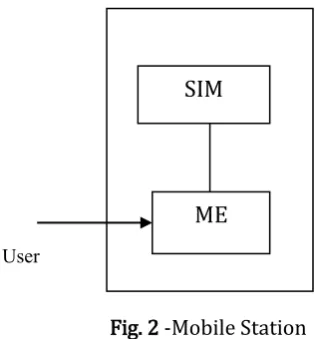
MOBILE STATION
subscriber identity module (SIM), which provides all the user specific data according to their requirements.
MS
User
Fig. 2 -Mobile Station
When network congestion take place in dual SIM, Users find disconnectivity in making calls and go for repeated call attempt to get connectivity. Due to congestion, dial-by-dial process commence between both the SIM for a successful call connection. In this paper we have focused on model based analysis of dual SIM environment to examine the User behaviour. Related contribution are reinforced by [5],[9],[11],[16],[17] and [19] for scheming such a prediction model based study.
IV.
USER’S BEHAVIOUR MODEL
We initialize the simulation with dual SIM. We consider following hypotheses for the behavior of user, while sharing the call between the two SIM.
The user has a dual SIM mobile phone, containing Sims, S1 and S2 of two different
mobile service provider or operators.
A user initially chooses one of the two SIM with probability p and (1-p) for S1 and S2 respectively
(0 ≤ p ≤ 1).
The p is affected by advertising, marketing, quality-of-service and past preference (or attractiveness).
After each failed call attempt, the user has two choices:
He can abandon with probability pE, switch over
to other SIM for a new call.
Switching among S1 and S2 is on dail-by-dail
basis depending just on the latest attempt. During the repeated calls, the congestion probability offered by S1 is C1 and of S2 is C2.
The congestion implies situation when call attempt process fails to connect a SIM.
Under above hypotheses the user’s behavior and attitude could be modeled by a four-state discrete-time markov chain {D(n), n ≥ 0} such that D(n) stands for the
state of random variable D at nth attempt made by a user
over state space {S1, S1, Z, E},
Where
State S1:Sim corresponding to first service provider StateS2:Simcorresponding to second service provider State Z: Success (in connectivity)
State E:Exit from call connectivity attempt process. The transition probabilities are indicated on the arcs connection the circles representing the chain states. The time is represented by the number of attempts. P[ D(n) = S
i] (i = 1,2) is the probability that the (n + 1)th
call attempt is placed through the Sim Si. The Fig. 1
explains the transition in model and Fig. 2 is a transition probability matrix of the model.
Fig. 3- Model of User’s Behaviour in Dual Sim Case
Fig.4- Transition Probability Matrix
SIM
V.
THE QUALITY OF SERVICE EXPERIENCE BY
USER
The prominent purpose of user is to complete the call. User experiences congestion possibility that is a primary quality of service parameter. In our model a User classified as:
(a)DEDICATED USER (DU):
Who abide with the SIM[Si (i=1,2)only],and opt for its first attempt otherwise, prefers to abandon, but doesn’t go for other competitive.
(b) UNDEDICATED USER (UDU):
Who toggles between two SIM (Si and Sj, i ≠ j = 1, 2) till he either completes his call or exits.
VI.
STATE PROBABILITIES IN N
THSTEP
2
1 1 2
[ ] (1 ) ( )
n
n n
E
P D S p p C C
2
1 2
1 1 2
[
] (1
) (1
) (
)
n
n n
E
P D
S
p C
p
C C
2
2 1 2
[ ] (1 )(1 ) ( )
n
n n
E
P D S p p C C
1
1 2
2 1 2
[
]
(1
) (
)
n
n n
E
P D
S
pC
p
C C
VII.
TRAFFIC SHARE ANALYSIS OF MOBILE
SERVICE PROVIDER (OR OPERATORS)
In this work we analyse user’s traffic share between two mobile service providers. A dial is completed through sim S1 if a dial is placed with it and the dial is not
congestion (same for S2), the probability that a call is
completed through sim S1 at nth dial is
1
( ) ( 1) ( ) ( 1)
1
.
/
1T
n n n n
P D
S P D
Z D
S
M
Herewe have again rewriting the nth state probabilities i.e
1
( ) 1 1
1 1 2
(1 )(1 ) ( )
T
n n n
E
p C p C C
M
For n is odd
1
( ) 1 1
1 1 2
(1 )(1 ) ( )
T
n n n
E
p C p C C
M
For n is even
1
( ) 1 2
2 1 1 2
(1 ) (1 )(1 ) ( )
T
n n n
E
p C C p C C
M
A dial is completed through SIM-1 within the first nth
dials we have to sum over the number of dials:
1 1
( ) ( ) ( 1)
1 1
1 1
(1 )
T T
n n
n i i
i i
C P D S
M
M
1 ( )
1 1
0
(1 )n i
i
C P D S
1 2 1 1 1 10 2 1 2
0
(1 )
(1 )
(1 ) (1 )
i i E n n i i i E
i Even i i Odd
C C p
C p
p C C C p
When n is even
1 2 2 1 1 2 2 2 1
(1 ) (1 )
(1 ) 1
(1 ) (1 ) n E E E C C
p p p
C C C
p C p
When n is odd we obtain the expression
1
1 2
1 1 2
1 2
2 1 2
( )
2 1 2
(1 ) 1 (1 )
(1 )(1 ) 1 (1 )
1 (1 )
T n E n E E n E
C p C C p
C p p C C p
C C p
M
In the same way we can obtain the probability that a dial is completed through the mobile service provider (operator) S2
2 1 2 1 ( ) 1 1 20 1 1 2
0
(1 )
(1 ) (1 )
(1 ) T i i E n n n i i i E
i Even i i Odd
C C p
C p
pC C C p
M
These probabilities indicates that the proportions by which the overall mobile data traffic offered by a user is
distributed between two mobile service
provider(operators) through SIM-1 or SIM-2.
If we suppose that the number of dials goes to infinite then, the limiting expressions are
1 1
2
1 2
lim 1 2
(1 ) (1 )
lim (1 )
1 (1 )
n
n E
T T
E
p C p p
M M C
C C p
2 2 1 2 2lim 1 2
1 (1 )
lim (1 )
1 (1 )
n
n E
T T
E
p C p p
M M C
C C p
VIII.
SIMULATION STUDY
Figure 1 reflects that the mobile data traffic share pattern is in downward trend for some constant increment in initial share p by 10% subject to the condition when opponent congestion probability of mobile service provider c2= 25% &pE=20%.
Figure 2 reveals that the mobile data traffic share decreases with respect to congestion probability C1 when
p=15% &pE=35% and for the little increment of C2 by
10%.
In the light of figure 3 it seems to be that for some constant network parameter traffic pattern decreases when abandon probability pE increased by 10%.
On the other hand when figures 4-5 are underway the mobile data traffic share patterns are overlapped for some constant parameter. While figure 6 is taking into consideration that mobile data traffic share pattern for
0 0.1 0.2 0.3 0.4 0.5
0.1 0.2 0.3 0.4 0.5 0.6 0.7 0.8 0.9
M
obi
le
D
at
a
Traf
fi
c
Share
Fig. 1 Congestion Probability C1
(Where PE=0.2, c2=0.25 )
p=0.15 p=0.25 p=0.35
0 0.1 0.2 0.3 0.4
0.1 0.2 0.3 0.4 0.5 0.6 0.7 0.8 0.9
M
obi
le
D
at
a
Traf
fi
c
Share
Fig. 2 Congestion Probability C1
( Where p=0.15, pE=0.35 )
C2=0.15 C2=0.25 C2=0.35
0 0.1 0.2 0.3 0.4
0.1 0.2 0.3 0.4 0.5 0.6 0.7 0.8 0.9
M
obi
le
D
at
a
Traf
fi
c
Share
Fig. 3 Congestion Probability C1
( Where p=0.2, pE=0.25 )
pE=0.15 pE=0.25 pE=0.35
0 0.2 0.4 0.6 0.8 1
0.1 0.2 0.3 0.4 0.5 0.6 0.7 0.8 0.9
M
obi
le
D
at
a
Traf
fi
c
Share
Fig. 4 Congestion Probability C2
( Where p=0.2, pE=0.25 )
C1=0.15 C1=0.25 C1=0.35
0 0.2 0.4 0.6 0.8
0.1 0.2 0.3 0.4 0.5 0.6 0.7 0.8 0.9
M
obi
le
D
at
a
Traf
fi
c Shar
e
Fig. 5 Congestion Probability C2
( Where p=0.3, C1=0.25)
pE=0.15 pE=0.25 pE=0.35
0 0.2 0.4 0.6 0.8 1
0.1 0.2 0.3 0.4 0.5 0.6 0.7 0.8 0.9
M
obi
le
D
at
a
Traf
fi
c Shar
e
Fig. 6 Congection Probability C2
(Where c1=0.3, pE=0.25)
sim-2 decrease subject to the condition when C1=30% &
pE=25%.
IX.
CONCLUSION
This paper has given an account of a correlation between congestion probability and mobile data traffic share which has been determined for each mobile telephone operator. Moreover, Mobile data traffic sharing is analysed through markov chain model under dual sim environment. In our findings, we observed that the pattern is overlapped where initial share of mobile users is p=30% and congestion probability 25% along with the case when p=20 % and pE=25%.Additionally, in the case
when p=20% and pE=25%, a downward pattern is found
for constant network parameter. Furthermore, the findings also reflect that in the system of dual sim environment, a negative correlation existed between congestion probability and mobile data traffic.
REFERENCES
[1] Farber, J., Bodamer, S. and Charzinski, J.,“Evaluation of
dial-up behaviour of Internet users”, ITG-Fachtagung, Stuttgart Oct. 1998, pp. 73-78, 1998
[2] Francini, A. and Chiussi, F.M.,“Providing Qos
Guarantees to Unicast and Multicast Flows in Multistage
Packet Switches”,IEEE Selected Areas in
Communications, Vol. 20, No. 8, pp. 1589-1601, 2002
[3] Farber, J., Bodamer, S. and Charzinski, J.,“Measurement
and Modeling of Internet Traffic at Access Networks”,Proceedings of the EUNICE, Munich, pp. 196-203, 1998
[4] Gordon, G.,“System Simulation”, Ed.-2,Prentice Hall of India,
New Delhi, 2003
[5] Gordon J.J., Murti K., Rayes A.,“Overview of Internet
Traffic Issues on the PSTN”, 15th International
Teletraffic Congress, Washington, pp.643-652, 1997
[6] Iverson, V. B., “Introduction to Traffic Engineering.
Textbook ,Department of
Telecommunication”,Technical University of Denmark , pp. 11-14, 1999
[7] Kassim M., Ismail M. and Yusof M. I.,“Statistical
Analysis and Modeling of Internet Traffic IP-Based Network for Tele-Traffic Engineering”,ARPN Journal of Engineering and Applied Sciences,Vol. 10, No. 3,pp.1505-1512, 2015
[8] Medhi, J., “Stochastic Processes” , Ed.4, Wiley Eastern
Limited (Fourth reprint), New Delhi, 1992
[9] Naldi M., “ Internet Access Traffic Sharing in a
Multi-User Environment”, Computer Networks, Vol. 38, Issue 6, pp. 809-824, 2002
[10] Naldi, M.,“TheInternets Growth Problems,
Telecommunications”, Vol. 32,No. 1, pp. 55-59, 1998
[11] Newby, M. and Dagg, R., “Optical Inspection and
Maintenance for Stochastically Deteriorating Systems: Average Cost Criteria”, Jour. Ind. Statistical Associations. Vol. 40, Issue 2, pp. 169-198, 2002
[12] Neelamkavil, F., “Computer Simulation and Modeling”,
John Wiley and Sons, New York, 1990
[13] Singh, B., “Data Communication and Computer
Network” , Prentice-Hall Inc., New Delhi, 2006
[14] Shukla D. and Gadewar S. ,“Stochastic Model for cell
Movement in a Knockout Switch in Computer Networks”, Journal of High Speed Network, (IOS Press Journal) Vol.16, No.3, pp. 310-332, 2007
[15] Shukla D., Gadewar S., Pathak R.K.,“A Stochastic
Model for Space-Division Switches in computer networks, Applied Mathematics and Computation (Elsevier Journal), Vol. 184, Issue 2, pp. 235-269, 2007
[16] Shukla D., Singhai R. , “Analysis of Users Web
Browsing Behaviour Using Markov Chain Model”, International Journal of Advanced networking and applications (IJANA),Vol. 02,Issue 05,pp.824-830, 2011
[17] Tanenbaum, A.S.,“Computer Networks”, 3rd Ed.,
Prentice-Hall Inc., USA (25th Indian reprint),1996
[18] Thakur, S. and Jain S. and Shukal D., “Internet Traffic
Distribution Management under Cyber Crime Marketing Plans”,International Journal of Advanced Research in Computer Science and Software Engineering, Vol. 4, Issue 6,pp.185-193, 2014
[19] Thakur, S. and Jain, P. ,“A Prediction Model for User's
Share Analysis in Dual-Sim Environment”, Computer Science & Telecommunications, Vol. 39 Issue 3, pp.106-111, 2013
[20] Thakur, S., Jain, P. and Dashore P.,“A Prediction Model
for Delta Interconnection Network”, International Journal of Computer Science and Technology (IJCST),Vol. 4, Issue Spl - 3, July-Sep , pp. 30-37, 2013
[21]
www.trak.in/tags/business/2012/06/11/indians-dual-multi-sim-nielsen/
[22] Yuan C and Lygeres J., “Stabilization of A Class of
Stochastic Differential Equations With Markovian Switching”, System and Control Letters,Vol.54, Issue 9, pp.819-833, 2005
[23] Yassine A. and Mohamed A., “Design and Performance