R E S E A R C H
Open Access
A brief 5-item version of the Neck Disability Index
shows good psychometric properties
David M Walton
1*and Joy C MacDermid
2,3Abstract
Background:The purpose of this secondary analysis of clinical databases of people with neck pain was to use a mixed unique conceptual and statistical approach to develop a brief version of the Neck Disability Index (NDI). Methods:An a priori framework of neck-related function based on the International Classification of Functioning, Disability and Health was used to identify items from the original 10-item NDI that do not conceptually fit. Remaining items were subject to Rasch analysis to identify items that did not statistically fit with axioms of quantitative measurement. Finally, approaches drawn from classical test theory were used to compare stability, responsiveness and concurrent validity of the original NDI, the new brief NDI and the linearly-transformed brief NDI. Results:Conceptual analysis identified 3 items that did not fit with the construct of self-reported ability to perform activity: pain intensity, headache, and sleeping. These items were removed, and responses to the remaining 7 items drawn from an assembled database of 316 physiotherapy patients with neck pain were subject to Rasch analysis. Two items were removed due to either considerable differential item functioning (reading) or statistical redundancy (lifting). The remaining items were considered the NDI-5. Test-retest reliability, responsiveness, sensitivity to change, and concurrent validity were all comparable across the original NDI, NDI-5 and linearly-transformed NDI-5.
Sensitivity to change over a 1-month period of physiotherapy was the notable exception, where the linearly-transformed NDI-5 showed superiority over the other two forms.
Conclusions:A shortened version of the NDI, the NDI-5, has been constructed that is conceptually and statistically sound. Implications for research and clinical practice are discussed. Comparison with the NDI-8 is provided that suggests overall similar function across the forms, although the latter may be more sensitive to change.
Background
Patient-reported outcomes (PROs) are increasingly be-coming a routine part of clinical practice. Such tools can be useful for prognosis, treatment planning, evaluating response to treatment, and determining suitability for discharge. In the area of neck pain specifically, a recent international survey of 381 clinicians [1] found that 75% of respondents used a pain intensity rating scale rou-tinely, and 49% used the Neck Disability Index (NDI, [2]) sometimes or routinely. A scoping review of the scientific literature found the NDI to be the most com-monly used neck-specific measure of disability [3] and a separate review of prognostic literature following whip-lash injury also found that, amongst disability-centric
rating scales, the NDI was the most commonly used tool to identify‘recovery’[4].
Despite widespread use, the NDI has not been consist-ently endorsed as a strong psychometric tool, especially when subject to rigourous evaluation. [5] used Rasch ana-lysis to determine, among other properties, that the NDI suffers from lack of unidimensionality, which poses con-ceptual problems when the scale is intended to provide a summative score across all items. This violates a funda-mental axiom of quantitative measurement [6], that being that any scale which is meant to be summed and subject to mathematical procedures should measure only a single di-mension. Further, if the scale is to be subject to statistical analyses that assume interval-level (linear) measurement, such as comparison of group means or correlational ana-lyses, it should conform to linear measurement models, such as that offered by Rasch analysis [7]. From a clinical perspective, pain and function are generally considered * Correspondence:[email protected]
1
School of Physical Therapy, Western University, 1201 Western Rd, London, Ontario, Canada
Full list of author information is available at the end of the article
two different constructs, and are amenable to different types of intervention. The inclusion of both constructs in a single scale risks masking important effects of treatment on one construct if the other remains stable or increases, as in the case of increased function at the expense of in-creased pain or vice versa. The result of the van der Velde et al. [5] analysis was endorsement of an 8-item version of the NDI that conformed adequately to the Rasch model.
Beyond statistical concerns, the NDI also represents a time burden that may be a barrier to wider adoption in clinical environments. One of the most commonly reported barriers to use of PROs or implementation of other best practice guidelines is a perception of the bur-den of time required to do so properly [8,9]. The original NDI comprises 10 domains, each with 6 statements that are to be read by the respondent, who then chooses the one statement that most closely represents his/her current functional status within each domain. This means that, in order to complete the NDI correctly, the participant must read 60 separate statements, which is considerably greater than many other common region-specific disability scales such as the Roland-Morris low back disability question-naire (24 statements, [10]), the Lower Extremity Func-tional Scale (20 statements, [11]), and the Disability of the Arm, Shoulder and Hand scale (30 statements in base scale, [12]). A review of the properties of the NDI found evidence to suggest that time to completion of the scale ranges from 4 to 9 minutes [13] verging on too long for routine clinical use. Even the NDI-8 of van der Velde and colleagues [5], while psychometrically more sound than the original, requires 48 statements be read.
The purpose of this study was to determine whether an even shorter,‘brief’version of the NDI could be cre-ated that possessed psychometric properties comparable to the original while focusing on a single construct (func-tion) and reduced response burden. This is in contrast to the stated purpose of van der Velde and colleagues [5], who attempted to improve the psychometrics of the NDI using the least amount of modification necessary. The major conceptual difference is that our goal was to create the shortest possible scale that remained conceptually and statistically sound. Both qualitative (descriptive theoretical analysis) and quantitative (Rasch, classical test theory) ap-proaches were used to arrive at a brief NDI.
Methods
The process of creating a brief NDI started with detailed conceptual analysis of each domain on the original NDI. The current International Classification of Functioning, Disability and Health [14] served as a conceptual frame-work. The ICF describes health as influenced by normal biological tissue structure and function, capacity to perform activities, and participation in valued life roles, influenced by personal and environmental factors. Owing
to a desire for a self-reported function-based neck disabil-ity questionnaire, those items that fit within the ‘activity’ domain of the ICF were targeted for retention.
For quantitative analysis, patient data from 4 independ-ent cohorts of community-based outpatiindepend-ent physiotherapy patients with mechanical (specific or non-specific) neck pain were compiled to provide a database of 316 patients. Subjects in all cohorts were eligible if they presented to physiotherapy for reasons pertaining to neck pain that could not be attributed to fracture, dislocation, cancer or other systemic disease (e.g. rheumatism), were between 18 and 70 years old, and could speak and understand conver-sational English. Patient characteristics included: sex, age, duration and cause of symptoms, and medicolegal status (litigation and/or compensation engagement). Work status was collected in a subset of 212 respondents and was cate-gorized as normal duties, neck-related sick leave, or other type of leave. Self-reported indicators of pain and psycho-logical components included: the Pain Catastrophizing Scale [15] the Tampa Scale for Kinesiophobia 11-item ver-sion [16] and the Numeric Pain Rating Scale [17]. The PCS, TSK and NRS have demonstrated adequate test-retest reliability (ICCs generally exceeding 0.76) and valid-ity in people with neck pain [18-20]. When items were missing, cases were dropped for that analysis and the sam-ple size was modified accordingly.
To assess longitudinal validity, NDI and NRS scores were obtained on multiple occasions from a non-random sub-sample of 50 subjects undergoing physiotherapy treat-ment for their neck problems. These subjects completed the NDI, NRS and a Global Perceived Rating of Change scale (GPRC, ranging from−7 = A very great deal worse, through 0 = no different, to +7 = A very great deal better) on a weekly basis for 1 month. The treatment was individ-ualized to the patient and included any or all of advice, education, manual joint mobilization, soft tissue stretching, therapeutic modalities and/or therapeutic exercise.
All methods were approved by the Institutional Review Board at Western University prior to initiating data col-lection in each study cohort.
Analysis
Item reduction
fitting within or outside of the disability domain. Upon consensus, only disability-related items were retained for further analysis.
The remaining items were subject to Rasch analysis to establish the degree to which the scale conforms to ax-ioms of quantitative measurement [7]. The steps taken in Rasch analysis can be extensive and have been de-tailed elsewhere [20,21]). In brief, Rasch analysis assigns each item and each respondent (termed‘person’) a loca-tion along a unitless logit-transformed continuum of the construct under measure, in this case disability. Rasch analysis posits that the relative location of an item along the continuum is estimable by virtue of knowing only the relative location of the person answering it. Con-versely, the relative location of any person should be es-timable by virtue of knowing only their response to an item. The error between the observed and estimated lo-cations is termed a ‘residual’, and the magnitude of all residuals can be tested using a bonferroni-correctedχ2 test to determine whether the observed locations devi-ate from the estimdevi-ated locations to a degree gredevi-ater than chance, which would indicate misfit of the scale to the Rasch model. Rasch analysis provides the important advantage of allowing deeper exploration of misfitting items to identify the cause of misfit. Causes include multidimensionality, location dependence, disordered response thresholds, or differential item functioning, as outlined below [21,22].
Multidimensionality and location dependence are often evaluated together. A correlation matrix of residuals for each item is generated, and patterns of strong correlations (r > 0.20 points above the mean correlation) suggest the residuals (error) are not random but rather shared (sys-tematic) across items. Strong item residual correlations indicate location dependence or multidimensionality (sub-groups of items) within the scale. The residuals can also be factor analyzed using principal components analysis. Two subsets of items can be generated; those that load positively and those that load negatively on the first factor. A logit-transformed score is calculated for each person using both subsets of items, and differences between scores attained from each subject in the database are eval-uated using a t-test. If less than 5% (<16 respondents in this case) of those t-tests are significantly different at the p<0.05 level, and no obvious pattern of residual correl-ation is identified, then the assumptions of unidimension-ality and location independence are satisfied.
Disordered response thresholds are identified by plot-ting the likelihood of choosing each possible response to an item along the continuum of disability. The ‘thresh-old’ is that point along the continuum where two adja-cent responses are equally likely (50% chance each). If the threshold for two items, say a 2 or a 3 on the NDI, is located higher than the threshold of two adjacent items,
say a 3 or a 4 in this example, then the thresholds are considered disordered. Disordered response thresholds may be an indication of ambiguous or unclear wording, or gradations that are too fine leading to an inability of respondents to reliably choose a response. Collapsing scores across disordered items is a sound way of ad-dressing this problem.
Differential item functioning (DIF) is explored through an ANOVA technique. The sample is separated into class intervals, or subgroups of respondents at similar relative locations, which serve as the within-groups factor. The between-groups factor is level of the variable being explored, which in this case were: sex (male/female), cause (traumatic/nontraumatic), duration (less than 6 months, 6 months or greater) and medicolegal status (engaged in litigation or compensation/ not engaged). DIF can be uni-form, where the between-groups factor is significant across all levels of disability, or non-uniform, where the factor only influences responses at a certain level of disability. The best approach to dealing with DIF is deter-mined on an item-by-item basis. Once all assumptions of quantitative measurement have been satisfied, and the scale items represent a reasonable‘ruler’of the construct to be measured (disability), a transformation matrix can be constructed which allows conversion of ordinal-level responses to interval-level responses using the logit-transformed scores.
Responsiveness and stability
The items remaining after the conceptual and Rasch analyses were considered a prototype‘brief’NDI and the properties of both the raw ordinal-level scores and transformed interval-level scores were subject to com-parison with the properties of the original 10-item scale. Test-retest reliability over a 1-week period for each of the full NDI, brief NDI and linear (logit)-transformed brief NDI was evaluated in the repeated measures sub-group using the Intra-class correlation coefficient Type 2,1 (ICC2,1, [23]). Data from only those subjects who reported no clinically meaningful change in their neck problems over a one week period (GPRC of−1, 0, or +1) were used for this analysis.
(AUC) of 0.50 indicates that the scale was no better than chance at discriminating between those who had and those who had not changed a subjectively meaningful amount, while an AUC of 1.0 indicated perfect discrimina-tive ability.
The effect size of the 3 NDI versions (full, brief or-dinal, brief linear) for evaluating change with the physio-therapy treatment group (n = 50) over 4 weeks was calculated by dividing the mean difference between base-line and 4-week follow up by the standard deviation of the baseline score. Effect size (ES) was interpreted as small = 0.2, medium = 0.4, and large = 0.8 [24]. For ICC2,1, AUC, SEM, Pearson’s r, and ES, 95% confidence limits were calculated to determine whether the point estimates were significantly different across the 3 ver-sions of the NDI.
Concurrent validity
Concurrent validity was evaluated through Pearson’s r between the 3 versions of the NDI and the concurrently-measured NPRS, TSK-11 and PCS
Results
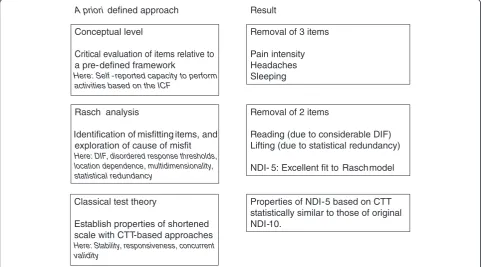
Figure 1 presents the process of scale shortening in a graphical format.
Conceptual analysis
The World Health Organization recognizes the com-plexity of disability, defining it as an umbrella term that
integrates a health condition within personal and environ-mental factors. (http://www.who.int/topics/disabilities/en/). The ICF model draws a distinction between capacity to perform (‘can do’) and actual performance (‘do do’). Through scrutiny of the items on the NDI, it is focused on the self-reported beliefs in one’s capacity to perform a number of functional activities (‘can’ do), some specific (lifting, reading, driving), some generic (work, recreational activities). The two notable exceptions are items 1 (pain intensity) and 5 (headaches), both symptom-based items that do not inherently measure function. The headache item is a notable challenge, in that the 6 response op-tions each include both an intensity (no, slight, moder-ate, severe) and frequency (no, infrequently, frequently, all the time) qualifier. Combining intensity and fre-quency will result in ambiguity for some people, for example, those with severe headaches that come infre-quently. Owing to our purpose of developing a unidi-mensional, brief, valid scale of function that would be sensitive to physical (conservative) rehabilitation, the two symptom-based items were removed.
Item 9 (sleeping) is the only item on the scale that is performance-based (actual hours of disturbed sleep) ra-ther than capacity-based. Taking the perspective of im-proving assay sensitivity it was judged that while sleep is important for people with neck pain, it was not neces-sarily linked to function-based rehabilitation programs and might be more aligned with symptoms. Considering our desire to create a scale that reflects functional levels
A prioridefined approach Result
Conceptual level
Critical evaluation of items relative to a pre-defined framework
Here: Self -reported capacity to perform activities based on the ICF
Rasch analysis
Identification of misfitting items, and exploration of cause of misfit
Here: DIF, disordered response thresholds, location dependence, multidimensionality, statistical redundancy
Classical test theory
Establish properties of shortened scale with CTT-based approaches
Here: Stability, responsiveness, concurrent validity
Removal of 3 items
Pain intensity Headaches Sleeping
Removal of 2 items
Reading (due to considerable DIF) Lifting (due to statistical redundancy)
NDI- 5: Excellent fit to Raschmodel
Properties of NDI-5 based on CTT statistically similar to those of original NDI-10.
and is responsive to changes in function, this item was removed. A sensitivity analysis (not shown) indicated that removal of this item did not influence the results of the Rasch analysis below in any meaningful way.
Rasch analysis
For purposes of comparison with van der velde and col-leagues, [5] we first performed the Rasch analysis using the full set of 10 items on the database of 316 subjects after removing 7 extreme (floor) scores. Overall the scale showed poor fit to the model (χ2 = 89.1, p<0.001). Re-moving the 3 items (pain, headaches, sleeping) led to good fit (χ2= 37.2 p = 0.24) with mean item location of 0.00 (SD 0.81) and mean person location of −0.18 (SD 1.30), suggesting good targeting of the sample to the scale. Tests for unidimensionality and location depend-ence suggested that two items (driving and lifting) were co-dependent by virtue of a strong residual correlation, and were statistically redundant loading at−0.51 (lifting) and −0.59 (driving) logits, respectively. Item 8 (driving) showed disordered response thresholds, where the thresh-old between 3 and 4 was located higher than that for 4 and 5. Looking at the response options for that item, op-tion 3 (I can’t drive my car as long as I want because of moderate pain in my neck) and 4 (I can hardly drive at all because of severe pain in my neck) are both tapping a driving restriction somewhere between none (option 2) and complete (option 5). Conceptually, collapsing these two response options would still provide an indication of restricted driving but lose the precision of neck pain se-verity, which is best left to dedicated pain severity scales. For this reason, options 3 and 4 of item 8 were collapsed, and that item was rescored 0-1-2-3-3-4, while the original scoring structure of 0-1-2-3-4-5 was retained for all others. Item 4 (reading) showed evidence of uniform DIF for each of sex, duration of symptoms and medicolegal status. One method to address DIF is to split the item, es-sentially creating different scales for males & females, acute & chronic pain, or those involved & not involved in medicolegal processes. Another option is to reword the item to make it more relevant to all subclasses, or a third option is to remove the item outright. Owing to our goal of a simplified tool, and because the conceptually similar item 6 (concentration) was retained, we opted to remove item 4 at this stage.
The problem of location dependence and redundancy between driving and lifting was solved as follows: Both are potentially important, although driving has been rated as more important in focus groups according to both Hoving and colleagues [25] and En and colleagues [26]. A critical evaluation of each item revealed both suffered from conceptual ambiguities, although collaps-ing the response options of the drivcollaps-ing item as above addressed concerns for that item. The fit to the Rasch
model with both items retained (χ2 = 37.2 p = 0.24), only lifting (χ2 = 21.5 p = 0.37) or only driving (χ2 = 23.6 p = 0.26) suggested that fit was not adversely af-fected when only 1 of the 2 were retained. A sensitivity analysis of stability, responsiveness and convergent val-idity (not shown) indicated nearly identical overall scale function when only driving, only lifting, or both were retained. These results suggest that only 1 of the 2 needed to be retained, and in accordance with the find-ings of the previous focus group studies, the driving item was retained but rescored as above, while the lifting item was removed.
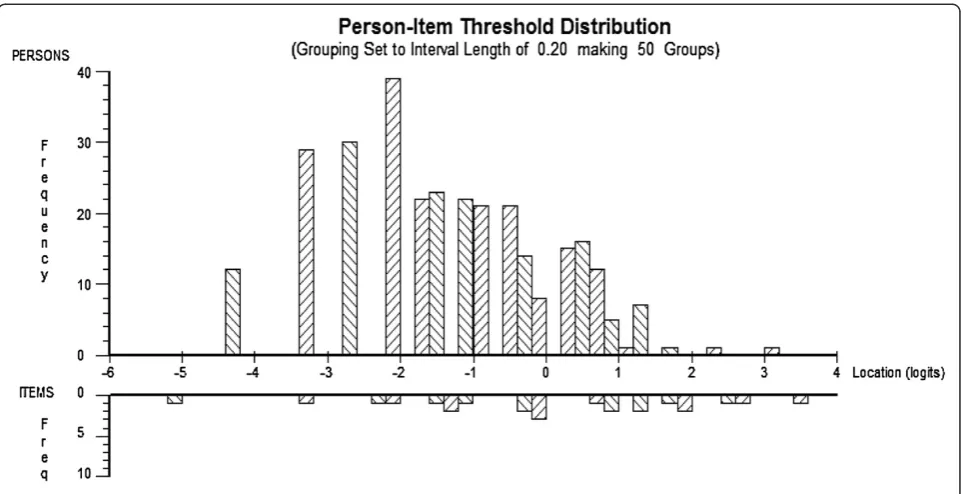
This process lead to a 5-item version of the NDI with satisfactory indicators of location dependence and unidi-mensionality (4.6% significant t-tests, mean residual cor-relation of 0.19, range 0.08 to 0.33). The brief-NDI, from here forward referred to as the NDI-5, included the following items (in order of difficulty): Person care, Concentration, Work, Driving (rescored), and Recre-ation. The scale range was therefore 0 to 24. This ver-sion of the NDI showed excellent fit to the Rasch model (χ2= 23.6, p = 0.26), a mean item fit residual of 0.0 (SD 0.85), and a person separation index (PSI) of 0.79. Re-moval of additional items led to a PSI of <0.70, inadequate for individual or group use. Figure 2 shows the histogram of person to item threshold locations, suggesting the 5-item version of the scale adequately covers the distribution of respondents in our sample, although it may be deficient for capturing change at very low levels of disability. A transformation matrix for converting raw ordinal to interval-level scores out of 24 and out of the more recognizable 50 is included in the Additional file 1.
Stability
Table 1 shows the test-retest reliability estimates of the original 10-item version, the brief NDI-5 and the linearly-transformed brief NDI-5 (from here on referred to as NDI-5 linear) along with the standard error of measure-ment (SEM) and minimum detectable change at the 90% confidence level (MDC90). Reliability estimates ranged from ICC2,1= 0.89 (NDI-5 linear) to 0.92 (original), with 95% confidence limits suggesting no significant difference across all 3. One-week MDC90for all 3 versions, expressed as a percentage of overall scale score, was 9% (NDI original), 11% (NDI-5) and 10% (NDI-5 linear).
Responsiveness
The NDI-5 linear showed the highest responsiveness (0.87) while the NDI-5 ordinal showed the lowest (0.56). Broad confidence intervals indicate that the estimates of effect size were not statistically different from one another but also limit confidence in the accuracy of the point estimate.
Cross-sectional validity
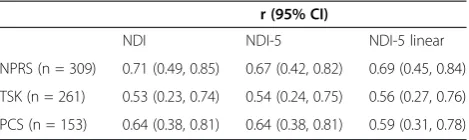
Table 3 provides the correlation coefficients between the 3 versions of the NDI and each of NPRS, TSK and PCS. All associations were of expected direction and magni-tude and all were statistically significant (p<0.05). Esti-mates across all 3 versions were also very similar with no version showing clear superiority over the other two.
Comparison with NDI-8
For the sake of comparison, we calculated the NDI-8 score for each subject based on the findings of van der velde and colleagues [5] and compared the key indica-tors between the original NDI, NDI-8 and our NDI-5. The magnitude of correlation between the NDI-8 and each of the NPRS, TSK and PCS (r = 0.72, 0.53, 0.65,
respectively) were nearly identical to those of the NDI and NDI-5 (see Table 3). The AUC of the NDI-8, indi-cating its ability to discriminate between those who had and those who had not changed a meaningful amount, was 0.79 (95% CI 0.66, 0.91), comparable to the NDI (0.76, 95% CI 0.63, 0.89) and NDI-5 (0.71, 0.57, 0.85). Fi-nally, the effect size calculated over the course of 1 month of physiotherapy treatment was 0.69 (95% CI 0.38, 0.99) for the NDI-8 ordinal and 1.13 (95% CI 0.78, 1.48) for the NDI-8 linear.
Discussion
We have described a novel qualitative and quantitative approach to arriving at a conceptually and statistically sound brief version of the NDI, the NDI-5. The proper-ties of the NDI-5 are statistically similar to the original 10-item version for all indicators explored, while the lin-ear transformation may provide slightly greater sensitiv-ity to change. The reduced number of items offers the important clinical advantage of reduced time burden while
Figure 2Person in item threshold developing of NDI-5.
Table 1 Relative (ICC) and absolute (MDC90) reliability
estimates over 1 week*
ICC (95% CI) SEM (95% CI) MDC90
NDI10 0.92 (0.85, 0.96) 1.95 (1.76, 2.67) 4.5
NDI5 0.91 (0.83, 0.96) 1.15 (0.95, 1.45) 2.7
NDI5 linear 0.89 (0.80, 0.95) 1.05 (0.98, 1.48) 2.4
*: Only those subjects who indicated a stable condition over this period, as indicated by a GPRC of−1, 0, or +1, are included in this analysis (n=36).
Table 2 Responsiveness estimates of the 3 versions of the NDI
AUC (95% CI) ES (95% CI)
NDI 0.76 (0.63, 0.89) 0.71 (0.40, 1.02)
NDI-5 ordinal 0.71 (0.57, 0.85) 0.57 (0.27, 0.86)
NDI-5 linear 0.72 (0.59, 0.86) 0.85 (0.53, 1.17)
still offering measurement properties that are meaningful to clinicians.
The properties of the NDI-5 are comparable to those of the NDI-8 [5] although the latter may be more sensitive to change. The effect size of the NDI-8 linear appears to be greater than that of the NDI-5 ordinal and the original NDI (lower limit of 95% CI = 0.78 for the NDI-8 linear vs. point estimate of ES = 0.57 and 0.71 for the NDI-5 ordinal and for the original NDI, respect-ively). No other comparisons suggested a significant difference in this regard by virtue of overlapping confi-dence intervals.
Both compare favourably with the original NDI, and we hold the belief that by virtue of removing the symptom-based items, the NDI-5 is more conceptually sound. This is of course a matter of opinion; the inclusion of symptoms may contribute to the NDI–8 being more responsive. The contention being put forth here is that pain and function, while related, are distinct constructs. Symptoms are clinically important and should be tracked separately, and symptoms and function are likely to re-spond differently to a given intervention. Where an inter-vention, such as strengthening, is intended to improve function, simultaneously capturing symptom-based items may confound the magnitude of effect. Similarly, an inter-vention meant to improve pain, such as opioid medica-tion, may not have the same magnitude of effect on function. In some cases an intervention meant to improve function may in fact worsen pain, or vice versa. Such an effect would be masked by a multidimensional scale. Where both are desirable as patient-reported outcomes, a logical suggestion would be to use a scale such as the NDI-5 or other function-based scale to capture function, and a validated symptom-based scale (such as a dedicated Numeric Pain Rating scale) to capture symptom intensity, and to evaluate the two separately in order to maximize assay sensitivity.
Rasch analysis provides detailed evaluation of scale properties, down to the function of individual response options, while classical approaches (reliability, convergent validity) provide support for the properties of a scale that are easily interpretable by clinicians. The Rasch approach also offers the added benefit of a transformation matrix
which allows ordinal-level scores to be converted to interval-level scores. This conversion is especially relevant to research applications, where statistical assumptions often require that data be interval level. The transform-ation has clinical implictransform-ations as well; the transformtransform-ation matrix suggests that the amount of linear change is not uniform across the entire breadth of the scale, and that ordinal-level changes at the poles may be more meaning-ful on a point-for-point basis than are similar changes in the mid-portions of the scale. This general relationship was also reported for the NDI-8 [5], having now been in-dependently validated in our study.
The magnitude of association between the different versions of the NDI and other constructs such as pain, catastrophizing, and fear are generally in keeping with previous work in the field [27,28] and suggest that the construct(s) being captured across all versions are simi-lar. The decision regarding which of the original NDI, NDI-8 or currently described NDI-5 to use must be based on the use scenario: both the NDI-8 and NDI-5 conform better to the Rasch model of interval level measurement than the original, and both are conceptu-ally sound. By incorporating pain intensity into the func-tional scale, the NDI-8 may be slightly more responsive to change than the NDI-5, but also risks confounding functional change with symptomatic change. Both appear to be associated with the same constructs, and both are adequately reliable and responsive for routine clinical use.
Readers should note that the removal of items pertaining to pain, headaches, lifting, reading and sleep should not be taken to suggest that these domains are unimportant. However, for either conceptual or statis-tical reasons, they either do not fit with the construct of neck-related function, do not function well in their current form, or are statistically redundant and therefore do not add enough additional information to warrant re-tention. Each of these constructs have been deemed more or less important to the neck pain experience by previous authorship groups [25,26]. As mentioned above, pain and other symptoms might be important enough to warrant a scale dedicated to their measurement. Similarly, sleeping is adequately important that a sleep-specific scale, such as the Pittsburgh Sleep Quality Inventory, [29] may be a more valuable approach to its measurement. Lifting ap-pears to be an important function for people with neck pain, but its inclusion on the NDI did not offer any im-provement in measurement properties. It is possible that this is because the lifting item in its current form is taken almost verbatim from the low-back-specific Oswestry Dis-ability Index, [30], and as such the focus is on lifting items from waist level or below. People with neck pain may well have problems with lifting or reaching, but these problems are likely to manifest when the activity is performed at or above shoulder level rather than below waist level.
Table 3 Cross-sectional correlations between the 3 versions of the NDI and key measures. All associations are significant at the p<0.01 level
r (95% CI)
NDI NDI-5 NDI-5 linear
NPRS (n = 309) 0.71 (0.49, 0.85) 0.67 (0.42, 0.82) 0.69 (0.45, 0.84)
TSK (n = 261) 0.53 (0.23, 0.74) 0.54 (0.24, 0.75) 0.56 (0.27, 0.76)
PCS (n = 153) 0.64 (0.38, 0.81) 0.64 (0.38, 0.81) 0.59 (0.31, 0.78)
Inclusion of a refined version of this item may lead to bet-ter properties than what have been reported here.
This leads to an important consideration; we have addressed problems with item misfit primarily through item removal and re-testing of the scale in the same co-hort. This was an intentionally liberal approach given our goal of creating the shortest scale possible. While we’ve determined that the NDI can be reduced as far as 5 items and still function adequately well, an alternative and argu-ably better approach would have been to re-word certain items or define new formatting for the scale and then re-test it in an independent sample. This appears to be a ripe direction for future research, and one that is sorely needed considering the influence on policy that research findings using the NDI may have (for example: [31]).
Shortening and homogenizing has both advantages and disadvantages. Whilst the scale may well be concep-tually sound, it does mean that some items of import-ance to people with neck pain will be missing. This argument is not unique to the NDI-5, it also holds for the NDI-8, original NDI, and any scale with defined activ-ities. While there is value in standardized scoring tools, especially for comparison across patients or research sam-ples, patient-centred outcomes are also valuable. For this reason clinicians are encouraged to additionally consider the use of scales such as the Patient-Specific Functional Scale [32] or Canadian Occupational Performance Meas-ure [33], both of which allow respondents to generate their own areas of concern and weight them accordingly.
We have addressed a number of limitations to this study already, most notably that item removal was liberal and that other authorship groups may have arrived at a different scale than what has been presented here. Readers will also note that the driving item has been modified slightly on the NDI-5 to read ‘driving / riding in a vehicle’, in recognition of the not insignificant por-tion of the populapor-tion who do not drive a car. While we don’t believe this change is so great as to adversely affect the properties of the scale, the results as described herein were achieved through use of the original wording of that item, which specifically addresses driving a car. Confi-dence in our findings will be increased when replicated in an independent cohort.
Conclusion
A shortened version of the NDI, the NDI-5, has been developed through qualitative and quantitative means. The scale possesses measurement properties similar to the original NDI while offering the advantage of brevity. The two symptom-based items of the original, as well as sleep, reading, and lifting have been removed for either conceptual (pain, headaches, sleep) or statistical (read-ing, lifting) reasons. The NDI-5 also performs similarly to the NDI-8 described by van der velde and colleagues
[5] although the latter may be slightly more sensitive to change over 1 month of physiotherapy treatment. The suggestion put forth is that, for those wishing to adopt the NDI-5, concurrent use of a symptom-specific scale is encouraged to allow separation of these important constructs while maximizing sensitivity to change. Con-sideration should also be given to sleep-specific and/or patient-centred scales. Measurement of neck-related func-tion appears to be a sound direcfunc-tion for future research considering the frequency and burden of the condition.
Additional file
Additional file 1:Transformation matrix.
Competing interests
The authors declare that they have no competing interests.
Authors’contributions
DW assembled the data, conducted the first-pass conceptual analysis, conducted the statistical analyses, wrote the first draft of the paper, and provided final approval. JM conducted the second-pass conceptual analysis and collaborated with DW to reach consensus, reviewed results of the statistical analysis, critically reviewed the manuscript and provided final approval. Both authors read and approved the final manuscript.
Author details
1School of Physical Therapy, Western University, 1201 Western Rd, London,
Ontario, Canada.2School of Rehabilitation Science, McMaster University, Hamilton, Ontario, Canada.3Clinical Research Lab, Hand and Upper Limb Centre, St. Joseph’s Hospital, London, Ontario, Canada.
Received: 11 April 2013 Accepted: 6 June 2013 Published: 1 July 2013
References
1. Macdermid JC, Walton DM, Cote P, Santaguida PL, Gross A, Carlesso L, ICON:Use of outcome measures in managing neck pain: an international multidisciplinary survey.Open Orthopaedics. accepted, in press.
2. Vernon H, Mior S:The Neck Disability Index: a study of reliability and validity.J Manipulative Physiol Ther1991,14(7):409–415.
3. Vernon H:The Neck Disability Index: state-of-the-art, 1991–2008. J Manipulative Physiol Ther2008,31(7):491–502.
4. Walton D:A review of the definitions of recovery used in prognostic studies on whiplash using an ICF framework.Disabil Rehabil2009, 31(12):943–957.
5. van der Velde G, Beaton D, Hogg-Johnston S, Hurwitz E, Tennant A:Rasch analysis provides new insights into the measurement properties of the neck disability index.Arthritis Rheum2009,61(4):544–551.
6. Luce RD, Tukey JW:Simultaneous conjoint measurement: a new scale type of fundamental measurement.J Math Psychol1964,1:1–27. 7. Rasch G:Probabilistic models for some intelligence and attainment tests.
Chicago, IL: University of Chicago Press; 1960.
8. Abrahamson KA, Fox RL, Doebbeling BN:Facilitators and barriers to clinical practice guideline use among nurses.Am J Nurs2012, 112(7):26–35. quiz 46,36.
9. Bayley MT, Hurdowar A, Richards CL, Korner-Bitensky N, Wood-Dauphinee S, ENG JJ, Mckay-Lyons M, Harrison E, Teasell R, Harrison M, Graham ID: Barriers to implementation of stroke rehabilitation evidence: findings from a multi-site pilot project.Disabil Rehabil2012,34(19):1633–1638. 10. Roland M, Morris R:A study of the natural history of back pain, Part I:
development of a reliable and sensitive measure of disability in low-back pain.Spine1983,8(2):141–144.
(LEFS): scale development, measurement properties, and clinical application.Phys Ther1999,79(4):371–383.
12. Hudak PL, Amadio PC, Bombardier C, The Upper Extremity Collaborative Group (UECG):Development of an upper extremity outcome measure: the DASH (disabilities of the arm, shoulder and hand) [corrected]. Am J Ind Med1996,29(6):602–608.
13. Macdermid JC, Walton DM, Avery S, Blanchard A, Etruw E, Mcalpine C, Goldsmith CH:Measurement properties of the neck disability index: a systematic review.J Orthop Sports Phys Ther2009,39(5):400–417. 14. World Health Organization:International Classification of Functioning,
Disability and Health.Geneva: World Health Organization; 2001. 15. Sullivan MJL, Bishop SR, Pivik J:The Pain Catastrophizing Scale:
development and Validation.Psychol Assess1995,7(4):524–532. 16. Vlaeyen JW, Kole-Snijders AM, Boeren RG, van Eek H:Fear of movement/
(re)injury in chronic low back pain and its relation to behavioral performance.Pain1995,62(3):363–372.
17. Cleland JA, Childs JD, Whitman JM:Psychometric properties of the Neck Disability Index and Numeric Pain Rating Scale in patients with mechanical neck pain.Arch Phys Med Rehabil2008,89(1):69–74. 18. Walton DM, Wideman TH, Sullivan MJ:A Rasch analysis of the Pain
Catastrophizing Scale supports its use an interval-level measure. Clin J Pain2013,29(6):499–506.
19. Walton D, Elliott J:A Higher-Order Analysis Supports Use of the Tampa Scale of Kinesiophobia 11-Item Version in People With Neck Pain. Phys Ther2013,93(1):60–68.
20. Tennant A, Mckenna SP, Hagell P:Application of Rasch analysis in the development and application of quality of life instruments.Value Health 2004,7(1):S22–S26.
21. Tennant A, Conaghan PG:The Rasch measurement model in rheumatology: what is it and why use it? When should it be applied, and what should one look for in a Rasch paper?Arthritis Rheum2007,57(8):1358–1362.
22. Hobart J, Cano S:Improving the evaluation of therapeutic interventions in multiple sclerosis: the role of new psychometric methods. Health Technol Assess2009,13(12):1–177.
23. Shrout PE, Fleiss JL:Intraclass correlations: uses in assessing rater reliability.Psychol Bull1979,86(2):420–428.
24. Cohen J:Statistical Power Analysis for the Behavioral Sciences.2nd edition. Hillsdale NJ: Erlbaum; 1988.
25. Hoving JL, O'Leary EF, Niere KR, Green S, Buchbinder R:Validity of the neck disability index, Northwick Park neck pain questionnaire, and problem elicitation technique for measuring disability associated with whiplash-associated disorders.Pain2003,102(3):273–281.
26. EN MC, Clair DA, Edmondston SJ:Validity of the Neck Disability Index and Neck Pain and Disability Scale for measuring disability associated with chronic, non-traumatic neck pain.Man Ther2009,14(4):433–438. 27. Rivest K, Cote JN, Dumas JP, Sterling M, De Serres SJ:Relationships
between pain thresholds, catastrophizing and gender in acute whiplash injury.Man Ther2010,15(2):154–159.
28. Schmitt MA, van Meeteren NL, de Wijer A, van Genderen FR, van der Graaf Y, Helders PJ:Patients with chronic whiplash-associated disorders: relationship between clinical and psychological factors and functional health status.Am J Phys Med Rehabil2009,88(3):231–238.
29. Smyth C:The Pittsburgh sleep quality index.Medsurg Nurs2003,12(4):261–262. 30. Fairbank JC, Couper J, Davies JB, O'Brien JP:The Oswestry low back pain
disability questionnaire.Physiotherapy1980,66(8):271–273. 31. Lamb SE, Gates S, Williams MA, Williamson EM, Mt-Isa S, Withers EJ,
Castelnuovo E, Smith J, Ashby D, Cooke MW, Petrou S, Underwood MR: Emergency department treatments and physiotherapy for acute whiplash: a pragmatic, two-step, randomised controlled trial. Lancet2012,381(9866):546–556.
32. Westaway MD, Stratford PW, Binkley JM:The patient-specific functional scale: validation of its use in persons with neck dysfunction.J Orthop Sports Phys Ther1998,27(5):331–338.
33. Law M, Baptiste S, Mccoll MA, Opzoomer A, Polatajko H, Pollock N:The Canadian Occupational Performance Measure: an outcome measure for occupational therapy.Can J Occup Ther1990,57(2):82–87.
doi:10.1186/1477-7525-11-108
Cite this article as:Walton and MacDermid:A brief 5-item version of the Neck Disability Index shows good psychometric properties.Health and Quality of Life Outcomes201311:108.
Submit your next manuscript to BioMed Central and take full advantage of:
• Convenient online submission
• Thorough peer review
• No space constraints or color figure charges
• Immediate publication on acceptance
• Inclusion in PubMed, CAS, Scopus and Google Scholar
• Research which is freely available for redistribution