S O F T W A R E A R T I C L E
Open Access
WordCluster: detecting clusters of DNA words and
genomic elements
Michael Hackenberg
1*, Pedro Carpena
2,3, Pedro Bernaola-Galván
2, Guillermo Barturen
1, Ángel M Alganza
1,
José L Oliver
1*Abstract
Background:Manyk-mers (or DNA words) and genomic elements are known to be spatially clustered in the genome. Well established examples are the genes, TFBSs, CpG dinucleotides, microRNA genes and ultra-conserved non-coding regions. Currently, no algorithm exists to find these clusters in a statistically comprehensible way. The detection of clustering often relies on densities and sliding-window approaches or arbitrarily chosen distance thresholds.
Results:We introduce here an algorithm to detect clusters of DNA words (k-mers), or any other genomic element, based on the distance between consecutive copies and an assigned statistical significance. We implemented the method into a web server connected to a MySQL backend, which also determines the co-localization with gene annotations. We demonstrate the usefulness of this approach by detecting the clusters of CAG/CTG (cytosine contexts that can be methylated in undifferentiated cells), showing that the degree of methylation vary drastically between inside and outside of the clusters. As another example, we usedWordClusterto search for statistically significant clusters of olfactory receptor (OR) genes in the human genome.
Conclusions:WordClusterseems to predict biological meaningful clusters of DNA words (k-mers) and genomic entities. The implementation of the method into a web server is available at http://bioinfo2.ugr.es/wordCluster/ wordCluster.php including additional features like the detection of co-localization with gene regions or the annotation enrichment tool for functional analysis of overlapped genes.
Background
Genome entities as diverse as genes [1], CpG dinucleo-tides [2], transcription factor binding sites (TFBSs [3]) or ultra-conserved non-coding regions [4] usually form clusters along the chromosome sequence. Such spatial clustering often translates into genome structures with a clear functional and/or evolutionary meaning: gene clus-ters encoding the same or similar products and origi-nated through gene duplication events, CpG islands, cis-regulatory modules, etc. Thus, the spatial clustering of functional genome elements (in general, words or k-mers) would somewhat remember the situation in
literary texts, where keywords show a strong clustering, whereas common words are randomly distributed [5].
Despite its potential importance, no algorithm exists to detect the clustering of DNA words in a rigorous way. Most current methods are based on densities and sliding-window approaches or arbitrary distances. For example, the Galaxy work suite ([6], http://main.g2.bx. psu.edu/) implements an algorithm which lets the user decide to fix the maximum distance between two enti-ties and the minimum number of entienti-ties in the cluster. Recently, we developed an algorithm to detect clusters of CpG dinucleotides in DNA sequences based on the distance between neighboring CpGs, then assigning a statistical significance [7]. Now, we generalize the method to any k-mer or any arbitrary combination of them, as well as to any other genome entity defined by its chromosome coordinates.
* Correspondence: [email protected]; [email protected] 1
Dpto. de Genética, Facultad de Ciencias, Universidad de Granada, Campus de Fuentenueva s/n, 18071-Granada & Lab. de Bioinformática, Centro de Investigación Biomédica, PTS, Avda. del Conocimiento s/n, 18100-Granada, Spain
Full list of author information is available at the end of the article
Implementation
TheWordClusteralgorithm allows the detection of clus-ters for DNA words (k-mers) and genomic elements (genes, transposons, SINEs, TFBSs, etc.). The algorithm is based on the distances between the entities and an assignedp-value.
The algorithm
The algorithm is basically the same for k-mers and genomic elements except for the detection of the coor-dinates and the way the success probabilities are calcu-lated. Briefly the algorithm performs the following steps:
1. Detection of allk-mer copies in the chromosomes, storing its coordinates (this step is unique to the detection ofk-mer clusters as the genomic elements already come defined by its coordinates). The copies are detected in a non-overlapping way, i.e. once a copy is found the search is resumed at the end of the word, thus preventing the detection of overlap-ping copies.
2. Calculation of the distances between consecutive copies. The distance is defined as:“start coordinate of the downstream copy” minus“end coordinate of the upstream copy”. This implies that the minimum distance is 1 when the two entities are located directly next to each other.
3. Detection of the clusters, defined as those chro-mosomal regions where all distances are equal or below a given maximum distance. A cluster is defined by its start and end coordinates and the number ofk-mers or genomic elements it contain. 4. Calculation of the statistical significance for each cluster by means of the negative binomial distribu-tion. Ap-value threshold is then used to filter out those clusters which are not statistically significant.
A main difference to the originally described algorithm is the way N-runs in the DNA sequence (ambiguous sequence sites occupied by any nucleotide) are treated. While the originalCpGclustermethod allows up to 10 Ns between two consecutive CpGs,WordClusterdetects the DNA words and the distances strictly within the contigs, i.e. not a single N is allowed to lie between two copies.
Statistical significance
From now on, we will have to use the word k-mer in different contexts. Therefore, to avoid confusion we define as“targetk-mer(s)”the k-mer(s) which are being analysed, i.e. those for which the clusters are going to be detected. On the contrary,“no-target k-mer(s)” are all the remaining k-mer(s). We usek-mer in a generic way, referring to all DNA words of lengthk.
The statistical significance is calculated as the cumula-tive density function of the negacumula-tive binomial distribu-tion:
P n n n
n p p
N p f
f n nf
,( )
( )
( ) ( )
= + − −
− − ⎛
⎝
⎜ ⎞
⎠
⎟ ⋅ − ⋅ −
1 1
1 1 1
1
beingn the number of targetk-mers within the clus-ter, nfthe number of“failures”, i.e. the number of
no-targetk-mers. For example, if we are detecting clusters of AGCT, all k-mers other than AGCT would be con-sidered as failures. Finally,pis the success probability, i.e. the probability to find a targetk-mer or genomic ele-ment within the DNA sequence. Note that in the above equation we use (n-1) instead ofn, as the first appear-ance of a targetk-mer within the cluster is trivial (i.e. all the clusters start with a target k-mer). While the nega-tive binomial distribution can be defined in the same way fork-mers and genomic elements, differences exist in the way the number of “failures” and the success probability are calculated.
Fork-mers, the number of failuresnfis simply given by
nf = Lc − ⋅n k
beingLcthe length of the cluster, kthe length of the
targetk-mer and nthe number of non-overlapping tar-getk-mers in the cluster. The number of failures is the number of no-target k-mers within the cluster. For example, given the target k-mer ATGC, the cluster
ATGCATGC would give nf = 0 while ATGCAATGC
would give nf= 1. Each k-mer can overlap with itself
and otherk-mers, but here we consider just non-over-lapping occurrences. In such a case, the probabilities for k-mers are given by the following equation
p N
Ls k N k
=
− + − ⋅
(
−)
( 1) 1
being Nthe number of non-overlapping occurrences of the targetk-mers in the sequence,kthe length of the k-mer andLsthe sequence length. The formula is simply
the number of targetk-mers in the sequence divided by the total number of k-mers in the sequence. As we do not consider overlapping instances, N*(k-1) was sub-tracted from the total number ofk-mers (Ls-k+ 1), as
those sequence positions are not considered, in order to take this effect into account.
cluster, i.e. how many failures. We define the number of failures as
n ceiling L L
f no
mean
= ( )
being Lno the number of bases in the cluster not
belonging to the genomic element andLmean the mean
length of the genomic element. Thus, this number is an approximation to the number of“no-elements” within the cluster. Finally, the success probability is then given as
p N L
L
mean
S
= ⋅
being Ls the length of the sequence,Lmean the mean
length of the genomic elements and Nthe number of genomic elements.
Distance models
The maximum distance is the main parameter of the algorithm determining the copies belonging to each cluster. We have shown previously [7] that, for most human chromosomes, the median of the observed dis-tance distribution of CpGs lies near the intersection between the observed and the expected distance distri-bution. The intersection can be interpreted as the point separating the intra-cluster from the inter-cluster dis-tances. In this new tool, we added two more distance models based on the direct detection of the mentioned intersection (one genome wide and the other for each chromosome separately). In this way, WordCluster implements a total of 4 different distance models:
1. Percentile distance: The distance corresponding to a given percentile of the observed distance distribu-tion is calculated and used as the maximum distance threshold.
2. Chromosomal intersection: The distance corre-sponding to the intersection between the observed and the expected distributions is used as the maxi-mum distance (see Figure 1).
3. Genome intersection: The distance distributions for all chromosomes are merged, then calculating the dis-tance corresponding to the “genome intersection point”. If this distance model is chosen, the success probabilities (i.e. the probability to find the target k-mers in the chromosome) are not calculated for each chromosome separately (like in the two models above), but a genome wide success probability (prob-ability to find the targetk-mers) is calculated.
4. Fixed distance: the user can set the distance threshold.
Webserver
We implemented the described algorithm into a web server. The tool uses PHP for the interaction with the user, to access the core program (written in Java) and the MySQL database. Two types of input data can be supplied: 1) a group ofk-mers and a genomic sequence to be scanned by the program (the user can upload his own sequence or choose one of the 24 genome assem-blies stored in our database - see below); and 2) a file in BED format [8,9] with the coordinates of the genomic elements whose clustering properties should be ana-lyzed. No mandatory input parameters exist, but the user can select between different distance models (the default is the chromosome intersection) and set the cut-off for the statistical significance (the default here is p-value≤1E-5).
The output generated by the web server depends on whether the user chooses a genome assembly from our database or supplies an anonymous sequence. The mini-mum output consists of the basic statistics of the clus-ters (base composition, entity composition and statistical significance) and the statistics by chromosome. Further-more, for all species in the database, the co-localization of detected clusters with different gene regions (promo-ters, introns, etc.) is reported.
Finally, for some species (human, mouse, rat, cow, C. elegans, zebrafish and chicken) an enrichment/deple-tion analysis for the genes overlapped by the clusters is carried out using the Gene Ontology [10] and the Annotation-Modules database [11,12].
Database
Currently, the genomes of 24 genome assemblies are stored into our database. The following sequences where downloaded from the UCSC genome browser or the corresponding project homepages (plant genomes): Human (hg18, hg19), Mouse (mm8, mm9), Rat (rn4), Fruit fly (dm3), Anopheles gambiae(anogam1), Honey bee (apimel2), Cow (bosTau4), Dog (canFam2),C. brigg-sae (cb3), C. elegans (ce6), Sea squirt (ci2), Zebrafish (danrer5), Chicken (galgal3), Stickleback (gasacu1), Medaka (orylat2), Chimp (pantro2), Rhesusmacaque (rhemac2), S. cerevisiae(saccer1), Tetraodon(tetnig1), Arabidopsis thaliana (tair8, tair9), andZea mays(zm1). To determine the co-localization with genes, we used RefSeq genes whenever they were available [13], Ensembl genes otherwise [14].
Results and Discussion
0 25 50 75 100 125 150 175 200 0.000
0.005 0.010 0.015 0.020 0.025 0.030 0.035
Median : 31 bp Chromosome intersec: 32 bp Genome intersec : 33 bp
P
ro
ba
bili
ty
Distance in bp Distance distributions (chr16)
Observed Expected
0 25 50 75 100 125 150 175 200
0.000 0.005 0.010 0.015 0.020 0.025
Distance distributions (chr5) Observed
Expected
P
ro
ba
bili
ty
Distance in bp
Genome intersec : 33 bp
Chromosome intersec: 39 bp
Median : 49 bp
clusters of CpGs (CpG islands) using different distance models, 2) detection of clusters of the word CWG (where W = A, T) and 3) detection of clusters of olfac-tory receptor genes in the human chromosome 11.
Detection of CpG islands with different distance models
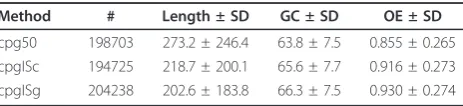
We choose this example as the detection of CpG islands was the reason to develop the algorithm from which WordCluster[7] was derived. In the originalCpGcluster algorithm, we used the percentile of the observed dis-tance distribution as disdis-tance model (apart from the fixed distance), suggesting the median as the default parameter. We did this since we observed that the inter-section between the observed and expected distance dis-tributions is often very close to the median of the observed distance distribution (see Figure 1). This inter-section can be interpreted in the following way. When the observed curve lies above the expected, theoretical curve, it means that more CpGs exist at this distance than expected by chance. We can observe in Figure 1 that this is generally the case for short distances, thus indicating the clustering (overrepresentation of short distances) of CpG dinucleotides. The intersection defines the“reversal point”, i.e. at larger distances than this point, the CpG dinucleotides are not clustered any more. Therefore, it might be that the strict use of the intersection defines better clusters that the use of the median, which is a mere approximation to the intersec-tion point. Furthermore, we observed that for some chromosomes the intersection and the median differ slightly. To clarify the impact of this change in the max-imum distance, we predict CpG islands by means of the median (cpg50), the chromosome intersection (cpgISc) and the genome intersection (cpgISg), then assessing the prediction quality by some of the criteria previously described [7,15]. Table 1 shows that the mean length of both intersection models are clearly below the mean length of the original cpg50 islands. This can be explained as the intersection models produce on average shorter distance thresholds, which leads to fragmenta-tion, shortening and disappearance of some cpg50 CpG islands. Consequently, the chromosome intersection
model (cpgISc) predicts fewer islands than the original cpg50 algorithm (3979). Nevertheless, the genome inter-section (cpgISg) yields more predictions compared to cpg50 (5535). The latter observation can be explained as the predictions are done with a single, genome wide probability. The p-value assigned to each cluster depends on the success probability, and in G+C rich chromosomes the genome wide probability is much lower than the chromosome probability. This leads to smaller p-values in G+C rich chromosomes, so that more islands can pass the p-valuethreshold. For exam-ple, cpg50 predicts 2434 islands in chromosome 22 while cpgISg predicts 5197. Of course, in AT-rich chro-mosomes this effect is reverted but less pronounced (the difference between genome wide and chromosome probabilities are smaller in AT-rich compared to GC-rich chromosomes), and therefore a higher total number of islands are predicted.
Next, we analyzed the predictions under functional aspects. Table 2 shows the overlap of the predictions with RefSeq genes [13], Alu elements and phylogeneti-cally conserved PhastCons elements [16]. The cpgISg predictions show the highest overlap with the promoter region (R13), and conserved PhastCons elements, simul-taneously showing the lowest overlap with spurious Alu elements. This might indicate that cpgISg predictions are slightly better than the other two, the original cpg50 and cpgISc. However, 1) the differences seem to be rather small and 2) a more detailed analysis would be needed to resolve this question.
Independently of this open question, we can summar-ize: 1) the chromosome intersection seems to be a good replacement for the median and furthermore removes one input parameter from the method, as the intersec-tion is a fixed statistical property of the chromosome; 2) the genome intersection may be used when the expected clusters are known to be not dependent on the chromo-some. The CpG islands are probably not dependent on the chromosome, as the biological mechanisms forming and maintaining them are probably the same for all chromosomes. This may suggest the use of the genome intersection, which is confirmed by producing slightly better results than the other two tested distance models.
Detection of CWG clusters
Besides the conventional CpG context, the CWG con-text has recently been shown to be a potential target for methylation [17].WordClusterdetects 84996 CAG/CTG clusters in the human genome (NCBI 36, hg18) signifi-cant at the 1E-5 level using the chromosome intersec-tion (Table 1). We found a high number of statistically significant CWG clusters scattered along all human chromosomes, many of which are overlapping gene regions (Table 3). To check if the detected clusters Table 1WordClusterpredictions of CpG clusters*
Method # Length ± SD GC ± SD OE ± SD cpg50 198703 273.2 ± 246.4 63.8 ± 7.5 0.855 ± 0.265 cpgISc 194725 218.7 ± 200.1 65.6 ± 7.7 0.916 ± 0.273 cpgISg 204238 202.6 ± 183.8 66.3 ± 7.5 0.930 ± 0.274
might be biologically meaningful, we compared the percentage of methylated words (CAG and CTG) inside and outside of the clusters. We observed that 26.7% of all CAG/CTG trinucleotides are methylated inside the clusters while 45.3% of them are methylated when located outside a cluster. It seems therefore, as occurs in CpG islands, that CAG/CTG clusters remain unmethylated with a much higher probability than the bulk DNA.
Detection of olfactory gene clusters
As a third example, we used WordClusterto search for significant clusters of olfactory receptor (OR) genes, the largest multigene family in multicellular organisms whose members are known to be clustered within verte-brate genomes [18,19]. Table 4 shows the basic statistics for the 13 clusters of OR genes detected by our algo-rithm in human chromosome 11. Figure 2 shows a comparative analysis of the clusters predicted by WordCluster to the clusters currently annotated in the CLIC/HORDE database [19] in a selected region of chromosome 11. Our algorithm predicts a higher num-ber of clusters, being all of them statistically significant.
Conclusions
WordCluster generalizes the previousCpGcluster algo-rithm [7] to any word or genomic element in the gen-ome, at the same time associating a statistical significance to the clusters found. It outperforms current methods relying on densities and sliding-window approaches or arbitrarily chosen distance thresholds. The implementation as a web server connected to a MySQL backend allows for co-localization studies with Table 2 Biological meaning ofWordClusterpredictions*
Method #islands #TSS overlap #R13 overlap #Alu overlap #PhastCons overlap
cpg50 198703 12432 (6.3%) 30660 (15.4%) 80323 (40.4%) 48787 (24.6%)
cpgISc 194724 11926 (6.1%) 34567 (17.8%) 70144 (36.0%) 48930 (25.1%)
cpgISg 204238 12156 (6.0%) 37616 (18.4%) 70456 (34.5%) 52335 (25.6%)
*Comparison of threeWordClusterpredictions of CG clusters (CpG islands) using three different distance models: cpgISg (genome intersection), cpg50 (median) and cpgISc (chromosome intersection). The overlap with two gene regions (TSS and R13), Alu elements and phylogenetically conserved PhastCons elements have been measured and both absolute numbers and percentages are given.
Table 3 Clusters of CWG trinucleotides*
N 84996
Genome coverage (bp) 15700789 Average length (bp) 184.7 No. of clusters co-locating with gene regions:
TSS 272
TSS ± 100 bp 686
5’UTR 4712
Introns 29326
Exons 1852
3’UTR 1658
*Statistically significant clusters of CAG and CTG trinucleotides detected by WordClusterin the human genome (hg18). We used the“genome intersection” distance model and ap-valuethreshold of 1E-05.
Table 4 Clusters of OR genes in human chromosome 11*
Cluster chromStart chromEnd length count p-value
1 4345160 5178488 833329 53 1.60E-49
2 5269273 5559687 290415 21 6.80E-21
3 5697096 6177989 480894 28 2.70E-25
4 48194938 48344593 149656 9 2.50E-08 5 48398372 48505102 106731 9 1.70E-09
6 49876392 49960613 84222 7 2.60E-07
7 51250039 51384376 134338 11 1.60E-11 8 54842612 55380573 537962 32 4.00E-29 9 55427396 56344568 917173 66 6.30E-65 10 56495101 56580184 85084 7 2.90E-07 11 57555001 57964200 409200 22 3.20E-19 12 58833691 59056759 223069 12 1.30E-10 13 123181329 123481891 300563 16 5.40E-14
*Chromosome coordinates, length, number of OR genes andp-valuesfor all statistically significant OR gene clusters in chromosome 11.
different gene regions, as well as for genome wide enrichment/depletion analysis of functional terms (GO).
Availability and requirements
The WordCluster webserver (http://bioinfo2.ugr.es/ wordCluster/wordCluster.php) is freely available. No registering is needed but every access is logged. For large jobs, a long-life web link to the results is provided.
List of abbreviations used
k-mer: DNA word (oligonucleotide) with lengthk;SINEs: Short interspersed nuclear elements; TSS: Transcription Start Site; TFBS: Transcription Factor Binding Site; R13: promoter region [TSS-1500 bp; TSS+500 bp].
Acknowledgements
The Spanish Government grants BIO2008-01353 to JLO, mobility PR2009-0285 to PC, Spanish Junta de Andalucía grants P07-FQM3163 to PC and P06-FQM1858 to PB are acknowledged. The Spanish‘Juan de la Cierva’grant to MH and Basque Country‘Programa de formación de investigadores del Departamento de Educación, Universidades e Investigación’grant to GB are also acknowledged.
Author details
1Dpto. de Genética, Facultad de Ciencias, Universidad de Granada, Campus de Fuentenueva s/n, 18071-Granada & Lab. de Bioinformática, Centro de Investigación Biomédica, PTS, Avda. del Conocimiento s/n, 18100-Granada, Spain.2Dpto. de Física Aplicada II, E.T.S.I. de Telecomunicación, Universidad de Málaga 29071-Malaga, Spain.3Division of Sleep Medicine, Brigham and Woman’s Hospital, Harvard Medical School, Boston, MA 02115, USA.
Authors’contributions
MH developed and implemented the algorithm and wrote the manuscript (with JLO), PC and PB carried out the theoretical analysis of word clustering and help with the interpretation of statistical results, GB and AMA retrieve and organize the genome and methylation databases, and JLO developed the algorithm and wrote the manuscript (with MH). All the authors critically read and approved the final version.
Competing interests None declared
Received: 30 August 2010 Accepted: 24 January 2011 Published: 24 January 2011
References
1. Durand D, Sankoff D:Tests for gene clustering.J Comput Biol2003, 10:453-482.
2. Gardiner-Garden M, Frommer M:CpG islands in vertebrate genomes.
Journal of molecular biology1987,196:261-282.
3. Makeev VJ, Lifanov AP, Nazina AG, Papatsenko DA:Distance preferences in the arrangement of binding motifs and hierarchical levels in
organization of transcription regulatory information.Nucleic acids research
2003,31:6016-6026.
4. Sandelin A, Bailey P, Bruce S, Engstrom PG, Klos JM, Wasserman WW, Ericson J, Lenhard B:Arrays of ultraconserved non-coding regions span the loci of key developmental genes in vertebrate genomes.BMC Genomics2004,5:99.
5. Carpena P, Bernaola-Galván P, Hackenberg M, Coronado AV, Oliver JL:Level statistics of words: finding keywords in literary texts and DNA.Phys Rev E
2008,79:035102-035104.
6. Giardine B, Riemer C, Hardison RC, Burhans R, Elnitski L, Shah P, Zhang Y, Blankenberg D, Albert I, Taylor J,et al:Galaxy: a platform for interactive large-scale genome analysis.Genome Res2005,15:1451-1455. 7. Hackenberg M, Previti C, Luque-Escamilla PL, Carpena P, Martínez-Aroza J,
Oliver JL:CpGcluster: A distance-based algorithm for CpG-island detection.BMC Bioinformatics2006,7:446.
8. Karolchik D, Kuhn RM, Baertsch R, Barber GP, Clawson H, Diekhans M, Giardine B, Harte RA, Hinrichs AS, Hsu F,et al:The UCSC Genome Browser Database: 2008 update.Nucleic acids research2008,36:D773-779. 9. Quinlan AR, Hall IM:BEDTools: a flexible suite of utilities for comparing
genomic features.Bioinformatics (Oxford, England)26:841-842. 10. Ashburner M, Ball CA, Blake JA, Botstein D, Butler H, Cherry JM, Davis AP,
Dolinski K, Dwight SS, Eppig JT,et al:Gene ontology: tool for the unification of biology. The Gene Ontology Consortium.Nature genetics
2000,25:25-29.
11. Hackenberg M, Matthiesen R:Annotation-Modules: a tool for finding significant combinations of multisource annotations for gene lists.
Bioinformatics (Oxford, England)2008,24:1386-1393.
12. Hackenberg M, Matthiesen R:Algorithms and methods for correlating experimental results with annotation databases.Methods in molecular biology (Clifton, NJ2009,593:315-340.
13. Pruitt KD, Tatusova T, Maglott DR:NCBI reference sequences (RefSeq): a curated non-redundant sequence database of genomes, transcripts and proteins.Nucleic acids research2007,35:D61-65.
14. Hubbard TJ, Aken BL, Ayling S, Ballester B, Beal K, Bragin E, Brent S, Chen Y, Clapham P, Clarke L,et al:Ensembl 2009.Nucleic acids research2009,37: D690-697.
15. Hackenberg M, Barturen G, Carpena P, Luque-Escamilla PL, Previti C, Oliver JL:Prediction of CpG-island function: CpG clustering vs. sliding-window methods.BMC Genomics2010,11:327.
16. Siepel A, Bejerano G, Pedersen JS, Hinrichs AS, Hou M, Rosenbloom K, Clawson H, Spieth J, Hillier LW, Richards S,et al:Evolutionarily conserved elements in vertebrate, insect, worm, and yeast genomes.Genome Res
2005,15:1034-1050.
17. Lister R, Pelizzola M, Dowen RH, Hawkins RD, Hon G, Tonti-Filippini J, Nery JR, Lee L, Ye Z, Ngo QM,et al:Human DNA methylomes at base resolution show widespread epigenomic differences.Nature2009, 462:315-322.
18. Aloni R, Olender T, Lancet D:Ancient genomic architecture for mammalian olfactory receptor clusters.Genome biology2006,7:R88. 19. The HORDE Project [http://genome.weizmann.ac.il/horde/].[http://
bioportal.weizmann.ac.il/HORDE].
doi:10.1186/1748-7188-6-2
Cite this article as:Hackenberget al.:WordCluster: detecting clusters of DNA words and genomic elements.Algorithms for Molecular Biology2011 6:2.
Submit your next manuscript to BioMed Central and take full advantage of:
• Convenient online submission
• Thorough peer review
• No space constraints or color figure charges
• Immediate publication on acceptance
• Inclusion in PubMed, CAS, Scopus and Google Scholar
• Research which is freely available for redistribution