Public Environmental Information Systems:
Challenges and Perspectives
M ordechai Elazar Haklay
D epartm ent o f G eography
University College L ondon
University o f L ondon
ProQuest Number: U643249
All rights reserved
INFORMATION TO ALL USERS
The quality of this reproduction is dependent upon the quality of the copy submitted.
In the unlikely event that the author did not send a complete manuscript
and there are missing pages, these will be noted. Also, if material had to be removed,
a note will indicate the deletion.
uest.
ProQuest U643249
Published by ProQuest LLC(2016). Copyright of the Dissertation is held by the Author.
All rights reserved.
This work is protected against unauthorized copying under Title 17, United States Code.
Microform Edition © ProQuest LLC.
ProQuest LLC
789 East Eisenhower Parkway
P.O. Box 1346
A b s t r a c t
Ever since “the environm ent” gained its place in the public agenda, it has been bundled with
inform ation and inform ation systems. Today, the claim that "the discussion on the environm ent
should be an inform ed one" can be considered as almost a truism. While m any features o f
inform ation and data are sources o f heated debate (including content, ownership, cost and
accessibility), the need for inform ation is never questioned. The area o f environmental
inform ation systems is becoming m ore complex due to the current trend o f making this
inform ation available to the public. This process is based on the assum ption that access to
environmental inform ation will improve public awareness and participation.
This thesis investigates public access to environmental inform ation, starting with the examination
o f environmental inform ation and environmental inform ation systems (EIS). This examination
dem onstrates that the term “environmental inform ation” holds a wide range o f meaning, and
while it is possible to describe “core environm ental inform ation”, the full range o f environmental
inform ation is open for wide interpretation. In regard to environm ental inform ation systems, the
thesis demonstrates the im portance o f Geographical Inform ation Systems (GIS) as a major
com ponent o f m ost EIS, and the influence o f the institutional settings within which they operate
on these systems. To better understand the requirements and needs o f likely users o f
environmental inform ation (those with interest in environmental issues and with access to the
technology), the thesis contains two empirical studies — a web-based survey o f requirements and
needs from a public environmental inform ation system for London, and a public participation
w orkshop in which representatives o f local interest groups explored the use o f GIS for local
planning purposes. The analysis o f these studies (using the framework o f Soft Systems
Methodology) leads to the developm ent o f conceptual models and criteria set for public access to
environmental inform ation. These models and criteria are then com pared to existing web-based
inform ation systems, a com parison that reveals gaps between the desired system and the current
state o f the art. The thesis ends with some suggestions about how to im prove inform ation
systems to improve public access.
T he thesis is based upon a wide array o f topics, including aspects o f H um an-C om puter
Interaction (HCI) in the context o f Geographical and Environm ental Inform ation Systems
(G IS/E IS), Inform ation Systems Design methodologies. Public Participation GIS (PPGIS),
Public Understanding o f Science (PUS), social aspects o f Inform ation and Com munication
T a b l e o f C o n t e n t s
ABSTRACT...2
TABLE OF CONTENTS... 3
LIST OF FIGURES...9
LIST OF TABLES... 11
FOREWORD AND ACKNOWLEDGEMENTS... 12
ABBREVIATIONS...14
1 ENVIRONMENT, ENVIRONMENTALISM AND INFORMATION ... 16
1.1 A BRIEF HISTORY OF ENVIRONMENTAL INFORMATION...16
1.2 QUESTIONING ENVIRONMENTAL INFORMATION...22
1.3 THE ARGUMENT OF THIS THESIS...25
1.4 THE MAIN FLOW OF THIS STUDY...26
1.5 SOME NOTES ON THE STUCTURE AND CONTENT OF THIS T H ESIS... 28
1.5.1 Defintions and the Lack o f Them...28
1.5.2 Information and Communication Technology as a Major Delivery Medium... 29
1.5.3 Modularity and Structure... 29
2 INFORMATION, ENVIRONMENT, ENVIRONMENTAL INFORMATION SYSTEMS AND THE PUBLIC... 30
2.1 ENVIRONMENTAL INFORMATION AS THE OBJECT OF INVESTIGATION...30
2.1.1 Defining Environmental Information...30
2.1.2 Capta, Data, Information and Knowledge...32
2.1.3 A Fuzzy Definition...34
2.1.4 The Core O f Environmental Information: Pressure-State-Response M odel...35
2.1.5 The Spatial Element...36
2.1.6 The Temporal Dimension...37
2.1.7 Interconnected and H olistic...38
2.1.8 Science-Based Data Capture and Analysis...38
2.1.9 Uncertainty and Accuracy...39
2.1.10 Size and Quantity M atters...39
2.1.11 Summary...39
2.2 ENVIRONMENTAL INFORMATION SYSTEM S... 40
2.2.1 Formal and Semi-Formal Definitions fo r Environmental Information Systems...40
-2.2.2 What is an Environmental Information System ?...41
2.2.2.1 Environmental Information Systems and UNEP/Earth watch...42
2.2.2.2 Environmental Information Systems and the World Bank... 44
2.2.2.3 National Environmental Information Systems...45
2.2.2.4 Sub-national Environmental Information Systems... 45
2.2.2.5 Management Tool for Regional Projects... 46
2.2.2.6 Municipal/Metropolitan Environmental Information Systems... 47
22.2.1 An Answer to ISO 14000...47
2.2.2.8 Environmental Information Systems and Industry...49
2.2.3 Typology o f Environmental Information Systems...49
2.2.4 Operational and Organisational Aspects o f Environmental Information...51
2.2.4.1 Public Sector Environment...51
2.2.4.2 Lack of Money - the Cost of Environmental Information Systems... 51
2.2.4.3 Lack of Expertise... 52
2.2.4.4 Scale, Jurisdiction and Environmental Information...52
2.2.4.5 Information Sharing... 53
2.2.4.6 Managing information... 53
2.2.4.7 GIS Related Issues... 54
2.2.4.8 Information and Information Technology “Fetishism” ...55
2.3 PUBLIC ACCESS TO ENVIRONMENTAL INFORMATION... 56
2.4 ZOOMING IN ON PUBLIC ENVIRONMENTAL INFORMATION SYSTEMS...59
2.5 DELIVERING ENVIRONMENTAL INFORMATION TO THE PU B LIC ...61
2.5.1 Public Environmental Information Systems and the Digital Divide...62
2.5.2 Environmentalism in the Information Age...65
2.5.3 Modes o f Communication and Information and Communication Technology...66
2.6 SUMMARY... 68
3 UNDERSTANDING REQUIREMENTS AND NEEDS FROM PUBLIC ENVIRONMENTAL INFORMATION SYSTEMS...70
3.1 HOW TO INVESTIGATE PUBLIC ENVIRONMENTAL INFORMATION SYSTEMS?.... 70
3.1.1 Software Engineering and Information Systems S tu d ies... 72
3.1.2 System Design Modi Operandi and Geographical and Environmental Information System s...76
3.1.3 The Adequacy o f System Analysis Modi Operandi ForTthis Thesis...76
3.1.4 Alternative Modi Operandi to Public Environmental Information Systems Investigation ... 78
3.2 TAKING A STEP BACK: TECHNOLOGICAL SOCIETY...82
3.2.1 Technology and Society...83
3.2.2 Implications to Information System Design...85
3.2.3 Choosing a Framework fo r Public Environmental Information Systems Design...86
3.3 SOFT SYSTEMS METHODOLOGY EXPLAINED... 88
3.3.2 Soft Systems Methodology Techniques and M ethods...93
3.3.2.1 Rich Picture... 93
3.3.2.2 Root Definitions... 94
3.3.2.3 Conceptual Models... 95
3.3.2.4 Comparison... 95
3.3.3 The Essence o f Soft Systems Methodology...96
3.4 THE STRUCTURE OF THE SOFT SYSTEMS METHODOLOGY STUDY OF PUBLIC ENVIRONMENTAL INFORMATION SYSTEMS DESIGN...96
3.5 LONDON ENVIRONMENT ONLINE (LEO) SURVEY ,... 98
3.5.1 Introduction and Background....98
3.5.2 User Requirement Studies and Web based Surveys...99
3.5.3 LEO Website and the Questionnaire... 100
3.6 UCL BROWNFIELD RESEARCH NETWORK...102
3.6.1 Introduction and Background....102
3.6.2 Data Collection...104
3.6.2.1 Textual Data Collection and Multimedia...105
3.6.3 Recruitment: Composition o f the Group...106
3.6.4 Recruitment Methodology...106
3.6.5 The Workshop: Organisation and Running...107
3.6.6 Context: Public Participation G IS...108
3.7 COMPARATIVE STUDY... I l l 3.8 SUMMARY... 113
THE SCOPE OF PUBLIC ENVIRONMENTAL INFORMATION SYSTEMS...114
4.1 OVERVIEW ...114
4.2 LONDON ENVIRONMENT ONLINE SURVEY... 115
4.2.1 Overview...115
4.2.2 Web-Server Analysis...115
4.2.3 Survey Results...116
4.2.3.1 Demography - Who Answered the Questionnaire?... 116
4.2.3.1.1 Gender and Age... 116
4.2.3.1.2 Occupation... 117
4.2.3.1.3 Geographical Distribution...118
4.2.3.2 Environmental Issues... 118
4.2.3.3 Types of Interactions...122
4.2.3.4 Sources of Environmental Information... 123
4.2.3.5 Access to the Internet and Patterns of Access... 124
4.2.3.6 Text Answers... 126
4.2.3.6.1 Reasons for Interest in Environmental Issues... 126
4.2.3.6.2 Uses of Environmental Information... 128
4.2.3.6.3 Perceptions of Internet-Based Environmental Information System...129
4.2.4 D iscussion...130
-4.2.4.1 The Survey Population... 131
4.2.4.1.1 Access to the Internet and Literacy in Using it...131
4.2.4.1.2 Interest and Awareness of Environmental Issues... 131
4.2.4.2 What are the Information Needs?... 132
4.2.4.3 What are the Current Sources of Environmental Information?... 133
4.2.4.4 Why is Environmental Information Needed?...134
4.2.4.5 Using the Internet as a Delivery Medium... 135
4.2.5 Summary •...135
4.3 UCL BROWNFIELD RESEARCH NETWORK WORKSHOP... 136
4.3.1 Overview...136
4.3.2 “Experiencing” G IS...137
4.3.2.1 Local Knowledge as interpretive filter... 140
4.3.2.2 Information that Participants Would Like to See...142
4.3.2.3 Difficulties with Software - Complexity... 143
4.3.2.4 Skills Needed to Operate the Computer and the GIS... 145
4.3.2.5 Internet Access - Cost, Boundary, Skills... 147
4.3.2.6 Ownership and Cost of the Information and the System... 148
4.3.2.7 Accuracy and Currency...150
4.3.2.8 Interaction with GIS... 150
4.3.2.9 Information Integration...152
4.3.2.10 Understanding and Interpreting Information... 153
4.3.2.11 Future Developments... 155
4.3.3 D iscussion...156
4.3.3.1 Local Knowledge... 156
4.3.3.2 Information - Accurate and Accessible...158
4.3.3.3 Interactive Mapping and Exloratory GIS...160
4.3.3.4 Skills... 162
4.3.3.5 Exclusion... 163
4.3.4 Summary...163
4.4 COMBINING THE EMPIRICAL STUDIES...164
5 CONCEPTUAL MODELS OF PUBLIC ENVIRONMENTAL INFORMATION SYSTEM... 166
5.1 OVERVIEW ...166
5.2 UNDERSTANDING P E IS ... 166
5.2.1 The Context o f Environmental Information (Picture 1)...168
5.2.2 Environmental Information Systems (Picture 2 )...170
5.2.3 Public Access to Environmental Information (Picture 3)...172
5.2.4 Web-based PEIS (Picture 4)...174
5.3 DEVELOPING CONCEPTUAL M ODELS... 175
5.3.1 The Aarhus M odel...176
5.3.2 Special Interest Groups (NGOs) M odel...178
5.3.4 Professional / Environmental Authority M odel...182
5.3.5 Interested Citizen (NIMBY) M odel...183
5.3.6 Interested Citizen (Active) M odel...184
5.3.7 Interested Citizen (General Interest) Model...186
5.3.8 Other Possible M odels...187
5.4 IS THERE A UNIVERSAL CONCEPTUAL MODEL?... 188
5.5 DEVELOPING CRITERIA FOR COM APRISON...189
5.6 SUMMARY... 190
6 EVALUATING THE STATE OF THE ART IN PUBLIC ENVIRONMENTAL INFORMATION SYSTEMS... 191
6.1 OVERVIEW... 192
6.2 THE UK AIR QUALITY INFORMATION ARCHIVE... 203
6.2.1 Comparison With the M odels...195
6.2.2 Criteria Evaluation...196
6.3 FRIENDS OF THE EARTH FACTORY W ATCH...197
6.3.1 Comparison With the M odels...199
6.3.2 Criteria Evaluation...201
6.4 THE ENVIRONMENT AGENCY “WHAT’S IN YOUR BACKYARD?"... 202
6.4.1 Comparison With the M odels...206
6.4.2 Criteria Evaluation... 208
6.5 CATALYTIC DATA “HOMECHECK.CO.UK” ...209
6.5.1 Comparison With the M odels...211
6.5.2 Criteria Evaluation...212
6.6 IDENTIFYING THE G A P ... 214
6.7 SUMMARY... 217
7 IMPROVING PUBLIC ENVIRONMENTAL INFORMATION SYSTEMS -A PROPOS-AL... 218
7.1 OVERVIEW... 218
7.2 PEIS WISH LIST... 218
7.3 DEVELOPING A THEORETICAL GROUNDING FOR P E IS ... 221
7.3.1 The Need fo r a Theoretical Grounding...221
7.3.2 Is a Democratic Information System Possible?... 222
7.3.3 Systems That Are Built To Be Hacked...223
7.4 THE THINGS WE CANNOT C H A N G E... 226
7.5 ... AND THOSE WE CAN... 227
7.5.1 Systems ’ Functionality...228
7.5.2 Presentation O f Environmental Information...230
7.5.3 Content...231
7.5.4 Content / Presentation...232
-7.5.5 Other Issuesin PEIS Design...235
7.6 THE ROLE OF PEIS IN DELIBERATION...236
7.7 SUMMARY... 237
7.7.1 Aims O f Ideal PEIS...237
7.7.2 Technical Aspects In PEIS D esign...238
7.7.3 Required Functionality...238
7.7.4 Presentation, Content and Content/Presentation...238
7.7.5 Organisational Aspects o f Implementation...239
8 CONCLUSION...240
8.1 SUMMARY OF THE RESEARCH AND ITS FINDINGS... 240
8.2 THESIS CONTEXT...242
8.3 METHODOLOGICAL CONCLUSIONS... 245
8.4 CONCEPTUAL CONCLUSIONS...246
8.5 FUTURE RESEARCH... 247
8.6 THIS THESIS IN A WIDER CONTEXT (AND FINALLY ...)... 248
BIBLIOGRAPHY... 250
ANNEX I: LEO SURVEY... 262
L i s t o f F i g u r e s ^
Fi g u r e 1 . 1 - Re l a t i o n s h i p s a m o n ga s s e r t i o n s... 2 3 Fi g u r e 2 .1 - In f o r m a t i o nt e r m i n o l o g y... 3 3 Fi g u r e 2 .2 - O E C D p r e s s u r e-s t a t e-r e s p o n s ef r a m e w o r k... 35 Fi g u r e 2 .3 - Ti m el i n eo f U N E P E I S ...4 2 FIGURE 2 .4 - Gr e a t La k e s E IS a r e a... 4 6 Fi g u r e 2 .5 - Be r l in U I S : m a i nc o m p o n e n t s... 4 8 Fi g u r e 2 .6 - Co n t i n u u m o fi n f o r m a t i o ns y s t e m sp r o d u c t s... 5 0 Fi g u r e 2 .7 - In t e r n e t Us e rg r o w t h 1 9 9 5 - 2 0 0 5 ... 6 4
Fi g u r e 3 .1 - Mu l t i v i e wm e t h o d o l o g y... 7 9
Fig u r e 3 .2 - Te c h n o l o g ya n d So c i e t y; m a i nt h e o r e t i c a lf r a m e w o r k s... 8 4 Fi g u r e 3 .3 - Th e S S M m o d e l p r o c e s s...89 FIGURE 3 .4 - S S M ‘MODE 2': INQUIRING/LEARNING C YCLE... 91 Fi g u r e 3 .5 - Th ep r o c e s s o f S S M ... 9 2 Fi g u r e 3 . 6 - Ric h PIC T U R E ...9 4 Fi g u r e 3 .7 - S S M a n dt h es t r u c t u r eo ft h iss t u d y... 9 8 Fi g u r e 3 .8 - Sa m p l e L E O p a g e s... 101 Fi g u r e 3 .9 - P P G IS a sp a r t o fg e n e r a lp a r t ic i p a t iv ep r o c e s s... 1 1 0 Fig u r e 4 .1 - Ag eg r o u p sa n dg e n d e ra m o n g L E O Su r v e yr e s p o n d e n t s... 1 1 7 Fi g u r e 4 .2 - Ge o g r a p h i c a ld i s t r i b u t i o no fr e s p o n d e n t s... 11 8 Fi g u r e 4 .3 - Pr e f e r r e du p d a t er a t e sf o re n v i r o n m e n t a li s s u e s...121 Fi g u r e 4 . 4 - A s n a p s h o to fam a p, a sw a s d i s p l a y e dd u r i n gt h ew o r k s h o p... 1 4 0 Fig u r e 4 .5 - Wa n d s w o r t hp l a n n i n g w e b s i t e... 1 4 4 Fi g u r e 5 .1 - Th ef o u r r ic hp i c t u r e sa n d t h e irr e l a t i o n s h i p s...16 7 Fi g u r e 5 .2 - Pi c t u r e 1 : Th ec o n t e x to fe n v i r o n m e n t a li n f o r m a t i o n ( * ) ...168 Fig u r e 5 .3 - Pi c t u r e 2 : En v i r o n m e n t a li n f o r m a t i o ns y s t e m ( * ) ... 16 9 Fig u r e 5 .4 - Pic t u r e 3 : Pu b l i ca c c e s st oe n v i r o n m e n t a li n f o r m a t i o n ( * ) ... 1 7 2 Fi g u r e 5 .5 - Pi c t u r e 4 : We b-b a s e d P E IS ( * ) ... 1 7 4 Fi g u r e 5 .6 - Aa r h u s c o n c e p t u a lm o d e l... 1 7 8 FIGURE 5 .7 - N G O s CONCEPTUAL M ODEL... 1 8 0 Fi g u r e 5 .8 - Me d i ac o n c e p t u a lm o d e l...181 Fi g u r e 5 .9 - En v i r o n m e n t a la u t h o r i t yc o n c e p t u a lm o d e l...18 3 Fi g u r e 5 .1 0 - N I M B Y c o n c e p t u a lm o d e l... 1 8 4 Fi g u r e 5 . 1 1 - Ac t i v ec it i z e nc o n c e p t u a lm o d e l...1 8 5 FIGURE 5 . 1 2 - Ge n e r a li n t e r e s tc o n c e p t u a lm o d e l...18 7
1 Larger colour versions o f the figures m arked with an asterisk are included in A nnex II
-Fig u r e 5 . 1 3 - Ge n e r a l P E IS c o n c e p t u a lm o d e l ( * ) ... 1 8 9 Fig u r e 6 .1 - Th e U K Na t i o n a l Air Qu a l i t y In f o r m a t i o n Ar c h i v eh o m ep a g e... 1 9 2 Fi g u r e 6 .2 - Airp o l l u t i o nf o r e c a s tc h a r t, t h et w oi m a g e s s h o wt h es c r o l l e dp a g e ( * ) 193 Fig u r e 6 .3 - Lo n d o n Br id g e Pl a c ei n f o r m a t io np a g e...1 9 4 Fi g u r e 6 .4 - Oz o n ein f o r m a t i o nf o r Lo n d o n Br id g e Pl a c ef o r 1 9 9 9 ... 1 9 4 Fi g u r e 6 .5 - Fr ie n d so ft h e Ea r t h U K h o m ep a g e... 1 9 7 Fi g u r e 6 .6 - F o E f a c t o r y w a t c hh o m ep a g e...19 8 Fi g u r e 6 .7 - In t e r a c t iv em a p p i n gin FoE Fa c t o r y Wa t c h ( * ) ... 1 9 9 Fi g u r e 6 .8 - Th e En v i r o n m e n t Ag e n c yh o m ep a g e...2 0 2 Fi g u r e 6 .9 - Wh a ti ny o u rb a c k y a r dp a g eo nt h e En v i r o n m e n t Ag e n c yw e b s i t e... 2 0 3 Fi g u r e 6 . 1 0 - En v i r o n m e n t Ag e n c yi n t e r a c t i v em a p p i n gs it e ( * ) ...2 0 4 Fig u r e 6 . 1 1 - Ho m e c h e c k.c o.u k h o m ep a g e...2 0 9 FIGURE 6 . 1 2 - HOMECHECK REPORT ( * ) ... 2 1 0 Fi g u r e 6 . 1 3 - e-m a i ls e n tf r o m Ho m e c h e c kt o u s e r sp r o p e r t ye x p e r t...2 1 0 Fi g u r e 7 .1 - Co n c e p t u a ld i v i s i o no fi n f o r m a t io ns y s t e m se l e m e n t s...2 2 0 Fig u r e 7 .2 - Li n kb e t w e e nt h eg e o g r a p h i c a l, s t r a t e g ic a n da r g u m e n t a t i v e
L i s t o f T a b l e s
Ta b l e 2 .1 - Ad v a n t a g e s, Di s a d v a n t a g e s a n de x a m p l e sf o rm o d e s o fc o m m u n i c a t i o n... 6 8 Ta b l e 3 . 1 - Da t au s e d i nt h e Br o w n f i e l d G I S ...1 0 4
Ta b l e 4 .1 - Ag eg r o u p sa n d g e n d e r... 117
Ta b l e 4 .2 - In t e r e s ti ne n v i r o n m e n t a li s s u e s...119
Ta b l e 4 .3 - Up d a t er a t e sf o re n v i r o n m e n t a li s s u e s...12 0 Ta b l e 4 . 4 - Is s u e st h a ta r em i s s i n gf r o mt h eq u e s t i o n n a i r e...121
Ta b l e 4 .5 - Op i n io n sa b o u tt h ec o n t e n to f L E O ... 123
Ta b l e 4 .6 - Op in io n sa b o u tt h e L E O ’si n t e r f a c e... 123
Ta b l e 4 .7 - So u r c e s o fi n f o r m a t i o n...1 2 4 Ta b l e 4 .8 - Po p u l a rc o m b i n a t i o n s o fin f o r m a t i o ns o u r c e s... 1 2 4 Ta b l e 4 .9 - Fr e q u e n c yo f In t e r n e ta c c e s s...125
Ta b l e 4 . 1 0 - Pl a c eo fa c c e s st ot o e In t e r n e t... 125
Ta b l e 4 . 1 1 - Fiv em o s tp o p u l a rc o m b i n a t i o n s o f In t e r n e ta c c e s s p l a c e... 125
Ta b l e 4 . 1 2 - “Ha n d so n” s e s s i o ng r o u p s... 137
Ta b l e 5 .1 - C A T W O E f o r Aa r h u sm o d e l... 177
Ta b l e 5 .2 - C A T W O E FOR i n t e r e s tg r o u pm o d e l... 17 9 Ta b l e 5 .3 - C A T W O E f o rm e d i am o d e l... 181
Ta b l e 5 .4 - C A T W O E f o rp r o f e s s i o n a l / r e s e a r c h e r m o d e l...1 8 2 Ta b l e 5 .5 - C A T W O E f o r N I M B Y m o d e l... 183
Ta b l e 5 .6 - C A T W O E f o ra c t i v ec it iz e nm o d e l... 1 8 4 Ta b l e 5 .7 - C A T W O E f o rg e n e r a li n t e r e s tm o d e l ... 1 8 6 Ta b l e 5 .8 - C A T W O E f o rg e n e r a l P E IS m o d e l... 1 8 8 Ta b l e 6 .1 - c o m p a r i s o no ft h e Air Qu a l i t y Mo n i t o r i n g Ne t w o r ks it ew i t hc o n c e p t u a l MODELS... 195
Ta b l e 6 .2 - c o m p a r i s o n o ft h e Air Qu a l i t y Mo n i t o r in g Ne t w o r ks it ew i t hc r i t e r i a... 1 9 6 Ta b l e 6 .3 - Co m p a r i s o n o ft h e FoE Fa c t o r y Wa t c hs it ew it h c o n c e p t u a lm o d e l s... 199 Ta b l e 6 .4 - Co m p a r i s o no ft h e FoE Fa c t o r y Wa t c hw e b s i t ew i t hc r i t e r i a...20 1 Ta b l e 6 .5 - Co m p a r i s o no ft h e En v i r o n m e n t Ag e n c y “w h a t’siny o u r b a c k y a r d?” s it ew it h
CONCEPTUAL MODELS... 2 0 6 Ta b l e 6 .6 - Co m p a r i s o no ft h e En v i r o n m e n t Ag e n c y “w h a t’si ny o u rb a c k y a r d?” s it ew it h
CRITERIA...2 0 8 Ta b l e 6 .7 - Co m p a r i s o n o ft h e “Ho m e c h e c k.c o.u k” s it ew i t hc o n c e p t u a lm o d e l s... 2 1 1 Ta b l e 6 .8 - Co m p a r i s o n o ft h e “Ho m e c h e c k” s it ew it hc r i t e r i a... 2 1 2 Ta b l e 6 .9 - Su m m a r yt a b l ef o rt h ec a s es t u d i e s...2 1 4 Ta b l e 8 .1 - Kn o w l e d g ea r e a s a n d t h e s isc h a p t e r s...2 4 3
-F o r w a r d a n d A c k n o w l e d g e m e n t s
T he study described in these thesis began three years ago w ith the awkward title: "The Socio-
E nvironm ental Implications o f Virtual Reality Interface to GIS". Its starting po in t was the false
assum ption that, in the context o f environm ental decision making, the inform ation flow to and
from the public are well understood. Hence, all that is left is to use the latest technology (VR and
GIS) and explore how it can contribute to this knowledge area.
As a student o f Geographical Inform ation Science for m any years, and being aware o f the
extensive research on environm ental applications o f GIS, I was certain that the usage o f
environm ental inform ation by different users is a well docum ented and clear issue. I was
surprised to realise that this is n o t the case. O ne o f the first issues that arose was “there is
probably nothing special in environm ental inform ation and, therefore, there is no need to focus
on it - general studies o f inform ation systems can provide the needed insights” . T he thesis that
follows argue that this is no t the case. Environm ental inform ation deserves special attention, and
the time is ripe to start scrutinising its uses and applications.
From the outset, I was conscious that a study that tackles public access to environm ental
inform ation ought to be based on an extensive research program m e. Being very aware o f my
limited resources and the time frame, I have approached this study as a collaborative project
where I will be able to receive the details that I need while others that assist m e will gain from it
too. T herefore, I feel obliged to acknowledge those w ho helped, and to clarify to which parts
they have contributed.
T he two empirical studies o f this project rely on extensive help. T he L ondon E nvironm ent
Online (LEO) survey was developed with the help o f the L E O team (Dr. K ate HeppeU and Steve
Evans) and the students on the H um an C om puter Interaction (HCI) course o f 1999 at the
C om puter Science D epartm ent under the guidance o f D r. Angela Sasse. O nce the extensive
results were gathered, I had the daunting task o f analysing vast am ounts o f textual inform ation. I
am grateful to D r. Gail Davis and her students at the Public U nderstanding o f E nvironm ental
Change course o f 2000 for their enthusiasm in dealing w ith this data and providing me with their
reports. I have stated where my analysis is interwoven with those reports.
The UCL Brownfield Research N etw ork could n o t have materialised w ithout the active
engagement o f D r. K ate HeppeU, D r. Carolyn Harrison, Rebekah B oott, D r. Judy Clark, D r. Sue
Batty, Alex Aurigi and Jerem y Moreley. T he workshop involved over 30 people from CASA,
G eomatic Engineering and G eography (Environm ent and Society Research U nit - ESRU) - aU
Finally I w ould like to express my gratitude for the support that I have received during the last
three years; First and forem ost to D r. Paul D ensham w ho provided guidance while the research
slowly developed and Prof. Mike Batty who provided the space to develop a relatively "off the
wall" research agenda. Thanks to CASA m em bers w ho provided a sounding board and a
supporting netw ork and to ESRU mem bers for providing opportunities to explore new avenues
which were unfamiliar to all o f us.
-A b b r e v i a t i o n s
CASA Centre for Advanced Spatial Analysis (UCL)
C A TW O E Clients, Actors, Transformation, Weltanschauung, Owner, Environment (part
of SSM terminology)
C E Q Council on Environmental Quality (US)
CMC Computer Mediated Communication
COTS Commercial Of-The-Shelf (standard software)
D E T R Department of Environment, Transport and Regions (UK)
DSS Decision Support System
EA Environment Agency (UK)
EC European Commission
E E A European Environmental Agency
EIA Environmental Impact Assessment
EIS Environmental Information System
EPA Environment Protection Agency (US)
ESRU Environment and Society Research Unit (Department of Geography, UCL)
FA Q Frequently Asked Questions
FoE Friends of the Earth
GIS Geographical Information System
G M O Genetically Modified Organism
GRASS Geographical Resources Analysis Support System (Open source GIS)
G R ID Global Resource Information Database (part of UNEP)
G U I Graphical User Interface
H C I Human-Computer Interaction
IC T Information and Communication Technology
IN F O T E R R A Global environmental information system of UNEP
IRC Internet Relay Chat
LE O London Environment Online
N C G IA National Center for Geographical Information and Analysis
N EIS National Environmental Information System
N E P A National Environment Policy Act (US, 1969)
N G O Non-Governmental Organisation
N IM BY Not In My Back Yard
N L U D National Land Use Database (UK wide project)
O E C D Organisation for Economic Co-operation and Development
PEIS Public Environmental Information System
PPG IS Public Participation GIS
PSR Pressure-State-Response (OECD model for environmental information)
PUS Public Understanding of Science
RAD Rapid Application Development
RD Root Definition (part of SSM terminology)
SDSS Spatial Decision Support System
SSADM Structured System Analysis and Design Methodology
SSM Soft Systems Methodology
SSSI Sites of Special Scientific Interest
UBRN UCL Brownfield Research Network
UCD User Centred Design / Development / Deployment)
U D P Unitary Development Plan
U N /E C E United Nations - Economic Commission for Europe
U N E P United Nations Environmental Programme
W W W World Wide Web
1
E n v i r o n m e n t , E n v i r o n m e n t a l i s m a n d
I n f o r m a t i o n _________________________________________
In m ost accounts, the publication o f Rachel Carson's “Silent Spring” (Carson 1962) is considered to
be the starting point for the m odern, late 20* century environm ental m ovem ent. In fact, what we
today call environm ental politics predates this era and environm ental awareness did no t appear on
the public agenda in the 1960s. A m ong events that dem onstrate awareness to environmental
problem s we can find the 1930s American “dust bowl” problem , or even as far back to 1388 when
legislation was introduced to control pollutant emissions in England (Lowenthal 1990). However,
for any study o f current day environm ental politics, the 1960s serve as an established and weU-
recognised starting point. In this m odern environm ental m ovem ent, inform ation and inform ation
systems play an intriguing role. As environm ental issues secured their position in national and
international agendas, environmental inform ation followed suit, albeit in a low key manner. In the
years and decades th at followed, environm ental inform ation, and the com puterised systems that
store it - Environm ental Inform ation Systems (EIS) - continued to evolve and to grow outside the
limelight. In recent years, the issue o f public access to environm ental inform ation is forcing a re
examination and re-evaluation o f the connection to, and role o f inform ation in, environm ental
politics.
This thesis aimes to im prove our understanding o f the role o f environm ental inform ation, and the
need for public access to it. T he main issue that will be tackled is the essence o f public access to
environmental inform ation; making the inform ation m ore relevant and effective for the core group
o f its users - those within the general pubUc with an interest in the environm ent. This thesis tries to
unpack and understand the various issues that surround public access to environm ental
information: the m eaning o f the term “environm ental inform ation”, the provision o f inform ation,
its applications and the requirem ents and needs o f its potential users. Therefore, the starting point
for the thesis is a description o f the relationship between environm ental politics and inform ation.
In subsequent paragraphs, a brief sketch o f the connection between environm ental politics and
inform ation will be outlined. O nce this connection is explained, the main research questions o f the
thesis will be explained and the general structure o f it wiU be laid out. This chapter ends with a few
general notes about the methodological and structural aspects o f this thesis.
1.1 A BRIEF HISTORY OF ENVIRONMENTAL INFORMATION
O nce the wheels o f the m odern environm ental m ovem ent were set in m otion, wide ranging
environmental regulations and legislation started to emerge throughout the developed world. By the
end o f the decade (literally on the last day o f 1969), the US congress enacted the National
Environm ent Policy A ct (NEPA) - another m ilestone in the history o f environm ental politics
(McCormick 1995). N E P A binds environmental politics and inform ation explicitly. T he two main
im plem entation vehicles established were an annual report on the state o f the environm ent and
T he E IA is a “detailed statem ent by the responsible official” (U.S. Congress 1970, Sec. 102) about
impacts o f proposed action on the environment. Indeed, N E P A refers to E IA as a decision making
tool, but leaves no doubt about the connection between decision making and information.
M oreover, sub-sections (G) and (H) o f Section 102 deal w ith environm ental inform ation directly:
“All agencies o f the federal government shall ...
(G) make available to States, counties, municipalities, institutions, and individuals, advice and information useful in restoring, maintaining, and enhancing the quality o f the environment;
(H) initiate and utilize ecological information in the planning and developm ent o f resource-oriented projects;"(U.S, Congress 1970, Sec. 102)
The other inform ation tool - the state o f the environm ent report - is described in the section that
defines the role o f the “ Council on Environm ental Quality” (CEQ). This report is subm itted by the
President to the Congress on a yearly basis and is prepared by the C E Q . T o be able to compile this
rep o rt and complete other tasks required o f them, the act states that:
“Each member shall be a person who, as a result o f his training, experience, and attainments, is exceptionally well qualified to analyze and interpret environmental trends and information o f all kinds.. .’’(U.S. Congress 1970, Sec. 201)
While the role o f the council includes:
“ ... to gather timely and authoritative information concerning the conditions and trends in the quality o f the environment both current and prospective, to analyze and interpret such information for the purpose o f determining whether such conditions and trends are interfering, or are likely to interfere, with the achievement o f the policy set forth in title I o f this Act, and to com pile and submit to the President studies relating to such conditions and trends; “(U.S. Congress 1970, Sec. 202)
In short, though N E P A sets out to deal with national policy to “encourage productive and
enjoyable harm ony between m an and his environm ent”, it im plem ents it through production and
use o f information.
T he early years o f the 1970s are seminal in the context o f the m o d em environm ental movement,
and n o t just for N EPA . O n 22"^ April, 1970, “E arth day” form ed the largest dem onstration in
Am erican history (Mowrey and R edm ond 1993). It was an active dem onstration in which local and
national environm ental topics were raised by protestors, arguing th at they m ust be tackled by the
political system. By the end o f this year, the US Environm ent Protection Agency (EPA) was
established.
T he United States was n o t the sole active scene. O ther countries w ent through similar shifts in
policy and public awareness during this period. F or example, the U K underw ent several changes
during the late 1960s (though it is possible to interpret them as a p art o f continuous m odern
environm ental awareness and politics that stems from the second half o f the 19* century). The
creation o f the Royal Commission on Environm ental Pollution (1969) and the D epartm ent o f the
E nvironm ent (1970) are the governm ental responses to increasing public pressures (McCormick
1995). It is commonly accepted that this period marks the awakening o f environm ental awareness
-throughout W estern countries (Hajer 1995, McCormick 1995). T he m ajor global event that marks
this period is the U nited Nations conference on “T he H um an E nvironm ent” held in Stockholm
during June 1972. In the action plan o f the conference, inform ation (and exchange o f information)
is m entioned over 60 times (UN 1972). T he action plan calls for knowledge sharing in many activity
areas - food production, pollution prevention and m ore. This is n o t surprising, given the
conference’s controversy between the developed and developing countries, which arose from the
view that pollution is the outcom e o f industrial growth and that, by limiting pollution, the
industrialised nations try to limit the growth o f the developing ones (McCormick 1995).
T he m ajor outcom e from the conference was the creation o f the U nited N ations Environm ental
Program m e (UN EP). From its inauguration, U N E P saw the collection o f data and information
about the environm ent as its m ost urgent task (Wallen 1997). This is based on the “Earthw atch”
principle, established in the Stockholm action plan. “Earthw atch” aims to tackle the following
areas:
“Evaluation and review, to provide the basis for identification o f the knowledge needed and to determine that the necessary steps be taken.
Research-, to create new knowledge o f the kinds specifically needed to provide guidance in the making o f decisions.
Monitoring, to gather certain data on specific environmental variables and to evaluate such data in order to determine and predict important environmental conditions and trends.
Information exchange-, to disseminate knowledge within the scientific and technological communities and to ensure that decision-makers at all levels shall have the benefit o f the best knowledge that can be made available in the forms and at the times in which it can be useful” (U N 1972, Sec. C)
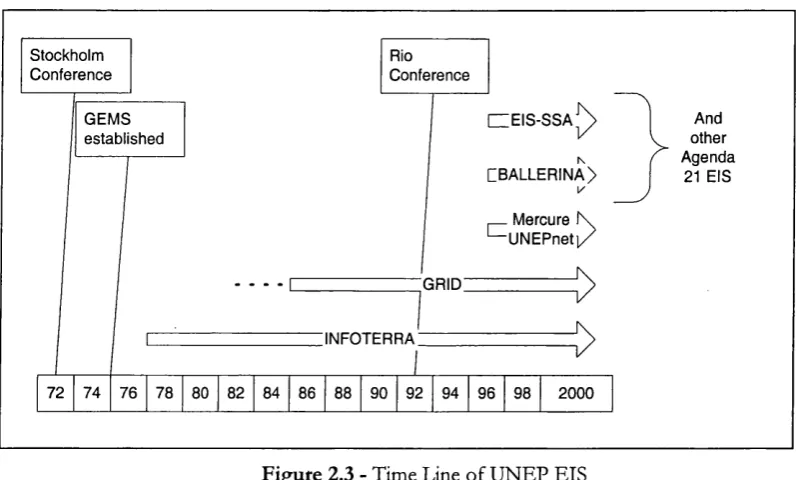
Since then, U N E P has been a catalyst and co-ordinator in the field o f environm ental data collection
and exchange. As com m only happens in such situations, considerable gaps have been found in the
data and knowledge, and U N E P have focused on filling them - a project that was supervised by the
G lobal E nvironm ent M onitoring System (GEMS) unit. By the end o f the 1970s, GEM S had
created IN F O T E R R A - the International EIS - probably the first o f its kind.
A n awareness o f environm ental problem s led the E uropean Com m unity (EC) in 1973 to move, for
the first time, beyond stricdy economic issues and to establish the E C environm ental program me
(Briggs 1986). T he first program m e focused on the issue o f pollution prevention, natural resources
protection and quality o f life and involvement in international initiatives to solve environmental
problem s. By the second action plan (amended June 1977), research, data collection and
inform ation received centre stage, alongside EIA. Some o f the directives and regulations that stem
from these policies relate directly to data collection and inform ation. F o r example, in 1979 the EC
established a program m e for the exchange o f inform ation on atm ospheric pollution, which focused
on data collection m ethods and aimed to im prove the com prehensiveness and compatibility o f air
Environm ental politics continued to develop throughout the 1970s. However, the oil crises and the
economic recession that followed caused some decline in its im portance in the political agenda.
A nother explanation, offered by Hajer, was the change o f focus o f environm ental discourse and the
m ove toward “ecological m odernisation” (1995). According to Hajer, ecological m odernisation can
be defined as a m ode o f environm ental politics that accepts the existence o f environm ental
problem s while at the same time assumes that existing political, econom ic and social institutions
can internalise the care for the environm ent. Ecological m odernisation introduces concepts that
makes issues o f environm ental degradation calculable and by framing environm ental problem s in a
way that com bines m onetary units with discursive elements derived from the natural sciences,
provides a com m on denom inator through which costs and benefits can be taken into account.
Secondly, environm ental protection is portrayed as a ‘positive-sum gam e’ w here all parties benefit.
By doing so, ecological m odernisation opens up opportunities for collective action that demands
the co-operation o f all elements o f society (individuals, firms and countries). E nvironm ental
protection thus becomes a m anagem ent problem. Thirdly, ecological m odernisation claims that
econom ic grow th and the resolution o f environm ental problem s can be reconciled. “A t the core o f
ecological m odernisation is the idea that pollution prevention pays” (Hajer 1995, p. 28) .
D uring that period (late 1970s and the early 1980s) U N E P and other environm ental program m es
on the national and supra-national levels continued to evolve. A noted m ilestone during this period
was the publication o f “T he Global 2000 R eport to the President”, which was prepared under order
from US President Carter, and was published in 1980. Global2000 was a com prehensive study o f
environm ental problem s in a global context and predictions for the future. O ne o f the
recom m endations in the subsequent docum ent, entitled “Global Future: Tim e to Act” was a call to
reorganise the U nited States governm ent and to create a new centre to co-ordinate data gathering
and modelling to support policy formulation (McCormick 1995).
T he next m ajor shift in environmental politics was m arked by the publication o f the report “O ur
C om m on F uture” by the W orld Commission on E nvironm ent and D evelopm ent (W CED and
B rundtland 1987). T he report was followed by m ajor activities in the U N , especially in view o f the
global perspective that the report nurtured. These culminated with the conference on
“E nvironm ent and D evelopm ent” held at Rio de Janeiro during June 1992. T he m ain outcom e o f
the conference was Agenda 21 - a global agenda for the 2 F ‘ century (U N 1992a). T he Rio
Declaration and Agenda 21 link inform ation and sustainable developm ent. Principle 10 o f the
declaration reads:
“Environmental issues are best handled with the participadon o f all concerned citizens, at the relevant level. A t the national level, each individual shall have appropriate access to information concerning the environment that is held by public authorities, including information on hazardous materials and activities in their communities, and the opportunity to participate in decision-making processes. States shallfacilitate and encourage public awareness andparticipation by making information widely available.
Effective access to judicial and administrative proceedings, including redress and remedy, shall be provided.” (U N 1992b, Principle 10, emphasis added)
-T he D eclaration m entions environm ental inform ation in other places. -T he need for E IA at the
national level is m entioned in principle 17 and the need to share inform ation about transboundary
impacts o f proposed actions in principle 19. Similarly, Agenda 21 pays special attention to
inform ation. In each chapter, a section is dedicated to data collection and inform ation. Moreover,
Chapter 40 o f the agenda is dedicated to “inform ation and decision m aking” and its preamble
states:
“In sustainable development, everyone is a user and provider o f information considered in the broad sense. That includes data, information, appropriately packaged experience and knowledge. The need for information arises at all levels, from that o f senior decision makers at the national and international levels to the grass-roots and individual levels. The following two programme areas need to be implemented to ensure that decisions are based increasingly on sound information:
(a) Bridging the data gap;
(b) Improving information availability. “ (U N 1992a, Chapter 40)
Tw o aspects o f this focus on environm ental inform ation are noteworthy. Firstly, the Agenda
emphasises the role o f a special kind o f inform ation system: Geographical Inform ation Systems
(GIS) and rem ote sensing systems (m entioned in connection to hum an settlem ents, deforestation,
agricultural and rural development, ocean protection and fresh water). B oth are closely related in
their developm ent history and applications (Coppock and R hind 1991). This is o f particular interest,
especially when com pared with the general reference to “inform ation technologies” or “state-of-
the-art data m anagem ent technologies” that appears in other parts o f the Agenda (Chapter 8, for
example). T hough other types o f inform ation systems are m entioned occasionally (such as expert
systems), GIS appears time and again in many chapters (but notably n o t being m entioned when
land resources are discussed!).
Secondly, special attention is paid to public access to environm ental inform ation. Both the
D eclaration and Agenda 21 m ention it (as the earlier citations dem onstrate). Section III o f the
Agenda, dedicated to “Strengthening the Role o f M ajor G ro u p s”, connects the need to integrate
w om en, children and youth, indigenous people. N o n G overnm ental Organisations (N G O s), local
authorities, trade unions, business and industry, science and technology, and farmers w ith access to
inform ation:
“Individuals, groups and organizations should have access to information relevant to environment and developm ent held by national authorities, including information on products and activities that have or are likely to have a significant impact on the environment, and information on environmental protection measures. . ( UN 1992a, Chapter 23, sec 23.2)
C urrent developm ents in environmental politics are frequently related to Agenda 21 and to the
principle o f Sustainable D evelopm ent - “to ensure that {development} meets the needs o f the
present w ithout com prom ising the ability o f future generations to m eet their ow n needs” (W CED
and B rundtland 1987, p. 8). In this context, public access to environm ental inform ation should be
seen as p art o f a m ore general principle o f public participation in environm ental decision making.
conventions that prom ulgate public access to environmental inform ation have been developed and
signed. These include the E uropean Council Directive 9 0 /3 1 3 /E E C , “Freedom o f Access to
Inform ation on the E nvironm ent” and the “Convention on Access to Inform ation, Public
Participation in Decision Making and Access to Justice in E nvironm ental M atters” (U N /E C E
1998). In the latter, the following statements can be found:
“..improved access to information and public participation in decision-making enhance the quality and the implementation o f decisions, contribute to public awareness o f environmental issues, give the public opportunity to express its concerns and enable public authorities to take due account o f such concerns...” (p. 2)
O th er developments include the creation o f purpose-built inform ation systems (many o f them are
Internet-based) to serve environmental inform ation to the public. These systems will be the centre
o f attention in this thesis.
Environm ental politics and environm ental discourse have gone through a profound change
between the first era (1960s to early 1970s) and ecological m odernisation. Careful reading o f “Silent
Spring” (Carson 1962) reveals that although Carson is calling for a reduction in the use o f chemicals
and pesticides in agriculture, the book actually calls for governm ental intervention and developm ent
o f scientific applications and m ethods (what today we call “organic farming”). T he view o f scientific
environm ental m anagem ent and control is deeply em bedded in “Silent Spring”, N E P A , the early
U N E P program mes and regulations surrounding EIA. This is n o t the case with “O ur C om m on
Future” and subsequent ecological m odernisation. In this era, environm ental concepts (in the form
o f “Sustainable D evelopm ent”) should be em bedded into aU hum an activities. It is no longer a
secluded responsibility o f an obscure public agency. This time, at least in principle, the focus is on
an inclusionary form o f decision making; so m uch so that “O u r C om m on F uture” is urging us to
take into consideration the views o f non-hum ans and the following generations (W CED and
B rundtland 1987). This principle has implications for environm ental inform ation. As was shown,
environm ental inform ation and data have always been perceived as im perative for environm ental
decision making. Therefore, to achieve a m ore inclusive form o f decision making, this inform ation
m ust be exposed and shared with aU those concerned with the decision. T he im portance o f
environm ental inform ation has been accepted by N G O s such as Greenpeace and Friends o f the
E arth (FoE). B oth have been cham pioning issues o f access to inform ation. This issue also appears
in the “Alternative Treaties” that were developed and signed by N G O s during the Rio conference.
This aspect o f environm ental politics and activities will stand at the centre o f this thesis and
provides the main m otivation for close scrutiny o f environm ental inform ation provision and use.
In the 13 years that have passed since “O ur C om m on F uture”, environm ental problem s seem to
have held their position in the political agenda. They have m oved a long way from their rather
sidelined position in the early 1970s. T he signs o f current public awareness are rife. They include
the popular attribution o f m ajor natural disasters to global warming; resistance to Genetically
M odified Organisms (GMO) and the rise in consum ption o f organic food; and attention
-throughout the mass media with the appointm ent o f special reporters on environm ental issues. I f
these current signs can be used as indicators for the future, then it is likely that we will have to deal
w ith environm ental politics well into the 21 century. This wiU include facing the challenge o f
providing better public access to environmental inform ationh
1.2 QUESTIONING ENVIRONMENTAL INFORMATION
In the previous section, the connection between environm ental politics and inform ation (mainly in
the form o f inform ation systems) was established. It was shown that every major event, convention
and discussion acknowledges inform ation. M oreover, it was dem onstrated that the circle o f
potential users^ o f environmental inform ation was extended from the scientific community to
policy and decision makers and then on to the public. As m ost environm ental inform ation is stored
in com puterised inform ation systems, and in accordance with the growing dem and for public access
to this inform ation, there is a growing need for Publicly accessible E nvironm ental Inform ation
Systems (PEIS). As will be examined and extended in the following chapters, current PEIS are
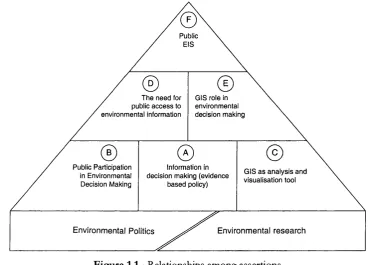
based on a set o f six assertions:
A. Sound knowledge, reliable inform ation and accurate data are vital for good environmental
decision making.
B. In sustainable developm ent/ecological m odernisation aU sta k e h o ld e rs^ should take part in
decision making processes. A direct result o f this is a call for im proved public participation in
environm ental decision making.
C. Environm ental inform ation is exceptionally suitable to GIS (or vice versa). GIS development is
closely related to developments in environm ental research, and G IS output is considered
superior in understanding and interpreting environm ental data.
D. (Based on A and B) T o achieve pubUc participation in environm ental decision making, the
pubUc m ust gain access to environm ental inform ation, data and knowledge.
E. (Based on A and C) GIS use and output is essential for good environm ental decision making.
F. (Based on all the others) PEIS should be based on GIS technologies. Such systems are vital for
pubUc participation in environm ental decision making.
^ O f course, future economic changes and shake-ups m ight change the balance o f pubUc and poUtical awareness towards environm ental issues and other topics. H owever, as ecological
m odernisation strives to integrate environm ental issues with the econom ic and social, it seems Ukely that even during such disruptions environm ental issues wiU n o t be disregarded altogether.
2 As this inform ation is distributed through com puterised inform ation systems, it makes sense to use the term “users”.
A lthough it seems that these assertions have a logical flow to them, they represent several
conceptual leaps that m ust be scrutinised. T he three basic assertions (A, B & C) grow from
different “segments” o f environmental politics. T he first comes from the institutionalised response
to the environm ental movement, the second is based on grass-roots pressure and the third emerges
in scientific-technical circles. Assertion D is arguably the basis for the grass-roots pressure for
access to environmental inform ation and the reason for environm ental N G O s to champion
“ freedom o f inform ation” issues. Assertion E can explain the integration o f GIS into m ajor
environm ental conventions (such as Agenda 21) and systems (such as U N E P ), and, finally, F
explains observations on existing PEIS. F is also im portant for a certain research theme in
G eography - Public Participation GIS (PPGIS). This them e emerged in the second half o f the
1990s and attracted attention from many sub-disciplines in current day Geography. PPG IS will be
described in m ore detail in later chapters. Notably, the connection betw een public participation (B)
and G IS (C) is a result o f the need for inform ation-based decision-making. Figure 1.1 presents the
relationships am ong the assertions.
Public E IS
/ T h e n ee d for
' public a c c e s s to e nvironm ental inform ation
G IS role in environm ental decision m aking
Public Participation in En vironm en tal D ecision M aking
Inform ation in decision m aking (e v id e n c e
b as ed policy)
G IS a s a n a ly s is an d visualis atio n tool
Environmental Politics Environmental research
Figure 1.1 - Relationships am ong assertions
Can we support these assertions with evidence from research and literature? T he first three
assertions are well established. As shown in the previous section, they appear in texts o f
international conventions and general literature. T hough they can be questioned, there is enough
supporting evidence to accept them. M oreover, they are all part o f the way we conceptualise and
frame environm ental politics. Therefore, for this thesis, they will be accepted as ‘axioms’. The
derived assumptions (D and E) are m ore problematic. Unquestionably, access to environmental
inform ation plays a m ajor role in public disputes. We can trace this back to the first litigation that
surrounded the E IA for an oil pipeline in Alaska in 1970 (Mowrey and R edm ond 1993). Is it
justified to conclude that any environm ental inform ation is useful to the public? Is this ‘pubUc’ a
m onolithic entity, a set o f single-issue interest groups, just a collection o f individuals or maybe
o ther forms? W hat kind o f inform ation should we declare as ‘environm ental’? Any overview o f
environm ental politics (such as Hajer 1995, M cCorm ick 1995) reveals changes in framing, focus,
topics and awareness to environmental issues throughout the years. H o w should public access to
environm ental inform ation reflect those changes? Finally, w hat is the relationship between public
participation and public access to information? Are they inseparable or should we analyse access to
inform ation separately?
T he foundations o f assertion E are somewhat better. The growth in G IS use m ust be attributed, at
least partially to its use as a décision-support tool. This use stems from many studies that treat GIS
as such (and coined the term Spatial Decision Support System - SDSS). These studies are based on
real problem s to which GIS technology provides useful solutions. Any m ajor book about GIS can
attest to this (Longley et al 1999, Maguire et al. 1991). This is true for Environm ental applications,
too (see G oodchild et al 1993, G oodchild et al 1996). H ow vital, then, is the use o f GIS for good
environm ental decision making? As m entioned earlier, E IA represents a widely used environm ental
decision support tool. In a survey by Joao and Fonseca (Joao 1998, Joao and Fonseca 1996), it was
dem onstrated that even though many practitioners know about GIS, it is n o t used in many cases
(for various reasons that will be discussed later). D oes this m ean that the E IA and the
corresponding decision are o f a lower quality? Therefore, we can conclude that the value o f GIS in
environm ental decision making is an open question. Exam ination o f existing literature will reveal a
lack o f knowledge about how m uch GIS contributes to the final decision.
These basic problem s with assertions D and E shake the foundations o f assertion F and force us to
question it. Therefore, it cannot be argued that the creation o f PE IS is a direct, uncomplicated
m atter. A t first sight, assertion F seems plausible: participation in environm ental decision making
requires access to information. Thus public participation in such processes cannot be done w ithout
proper means for access. As m ost o f the inform ation is stored on com puters, and - as will be
shown - in a G IS form, then it seems sensible to argue that these EIS should be opened to the
public. Even if this argument is accepted in principle, it ought to be scrutinised and validated.
This thesis aims to deal with the last three assertions and especially to explore aspects o f the final
assertion about PEIS. As part o f the wider study o f environm ental inform ation provision, this
develops a conceptual m odel o f PEIS. Such a m odel should help in understanding the audiences
for P E IS, the inform ation that such systems should hold and the appropriate delivery mechanisms.
Such thorough analysis o f PEIS on a conceptual level does n o t exist bu t it touches on an interesting
aspect o f environm ental inform ation research. W hen considering the overwhelm ing em bedding o f
inform ation into environmental discourse, it can be expected to find analysis and evaluation o f
inform ation in general, and inform ation systems in particular. Parallel fields (like the study o f
inform ation systems in general, or GIS) have developed an extensive literature in both academic
forms (journals and books) and m ore popular forms, targeted at professionals w ho work in the area
library catalogue or scientific journals index will reveal, a very limited am ount o f literature deals
w ith EIS directly. M ost o f it focuses on implementation issues and an extensive body o f research
on environm ental m odelling and analysis techniques. T here seems to be a m ajor lack o f research on
usefulness, requirem ents and broader analysis, which is com m on in Inform ation Systems research.
Before turning to a description o f the thesis’ structure and flow, it is im portant to clarify the
m eaning o f the acronym PEIS. M ost EIS are maintained and ow ned by public authorities, and in
this sense they are Public Environm ental Inform ation System. This, however, does n o t entail public
access to the inform ation system or that the system was designed for, and aimed at public
consum ption. F o r example, if a research centre creates a website to share inform ation with other
scientists, then it is, in effect, in the pubHc domain. However, such systems will no t be treated as
PEIS. PEIS are seen as systems which are in the public dom ain and for public use. O th er systems
will fall under the category o f EIS.
1.3 THE FRAMEWORK OF THIS THESIS
T he previous sections have shown that there are many questions which surround the development
and im plem entation o f PEIS. T he overarching question — “w hat is the exact influence o f
environm ental inform ation, as used by the public, on decision m aking processes?” wiU be left,
largely, unanswered. Indeed, on the backdrop o f the lack o f conceptualisation o f environmental
inform ation that was identified above, such a question m ust be left for the future. Instead, this
thesis is set up to answer a m ore m odest problem: w hat are the design issues for a computerised
and Internet-based PEIS which will provide useful inform ation to those w ith interest in
environm ental issues? The main rationale behind this question is assum ptions about the
pervasiveness o f the Internet and computerised systems as the m ain means o f inform ation delivery
to the public, and that by targeting those with interest in environm ental m atters, it will be possible
to evaluate the quality o f current inform ation provision for the “likely users” .
It should be stated from the start, that this thesis is based on a specific investigation fram ework —
Soft Systems M ethodology (SSM) (Checkland 1984, Checkland 1999, Checkland and Holwell 1998).
A lthough the rationale and explanation for using SSM to tackle such a problem is explained in
C hapter 3, it is im portant to note that this m ethodology is used here. SSM was developed to tackle
problem situations where there is a general feeling o f ‘uneasiness’ or ‘ambiguity’ towards the
problem . Such uneasiness is expressed here towards the developm ent and im plem entation o f PEIS.
T he first p art o f the thesis wiU investigate the issues o f P E IS audiences: w ho they are, w hat they
expect it and w hat they do with the inform ation they obtain. Before turning to these questions,
however, there is a need to explore the meaning o f the object ‘environm ental inform ation’ and to
understand w hat unique topics are associated with it. T hen, an examination o f EIS is needed to
understand the current state o f the art. This part o f the thesis buUds the background inform ation
about environm ental inform ation, environmental inform ation systems, pubUc access to
environm ental inform ation and the needs and requirements o f those that are likely to use PE IS -
educated m em bers o f the middle-classes with interest in environm ental issues.
This inform ation will be the basis for the second, analytical p art o f this thesis which wül attem pt to
create an holistic overview o f environm ental inform ation issues and their relationship to PEIS and
to develop conceptual models o f PEIS roles as seen from different perspectives. This analytical
section uses SSM tools and techniques to create a clearer presentation and discussion o f the issues
that the first part revealed. Equipped with these conceptual models, the next step is to compare
them to the state o f the art in inform ation provision. Based on the lack o f critical examination of
environm ental inform ation issues in general, and PEIS in particular, it is expected that such
com parison will reveal some discrepancies in existing systems.
T he third and final part o f this thesis confronts the challenges revealed in previous parts by
rethinking the role o f PEIS and exploring appropriate avenues for future developments. It is
im portant to note that the thesis does not aimed to offer a prescriptive solution or a panacea for
PEIS. T he main aim is to expose the issues surrounding PEIS and to argue that environm ental
inform ation the role o f PEIS in decision making and how they are used by the pubUc deserves
special attention and m ore comprehensive research and development. Therefore, Part III o f the
thesis serves to offer possible directions that can im prove the current state o f PEIS.
1.4 THE MAIN FLOW OF THIS THESIS
D ue to its integrative nature, the thesis passes through many topics. Therefore, a roadm ap to the
structure o f the thesis m ight prove useful. In general, the thesis is com prised o f three parts. P art I
(Chapters 1 to 4) explores the problem situation - the issues that influence PEIS and m ust be taken
into consideration when they are studied. P art II (Chapters 5 and 6) develops the concept o f PEIS
using systems thinking. Part III (Chapter 7) suggests future directions for im proving the problem
situation.
T he exploration o f PEIS started in previous sections with the description o f the connection
between environmental politics and inform ation and the developm ent o f the six assertions. Chapter
2 expands on the six assertions and investigates the grounding to the claims that appeared above. It
starts by examining environmental inform ation as the object o f investigation and asks if
environm ental inform ation (especially its public aspects) holds som e special properties that justify
special attention. A fter exploring this aspect, the three basic assertions (A, B and C) can be tackled.
First, EIS are examined in a developm ental and historical approach, w ith som e attention paid to the
relationship between them and general com puting, including the role o f GIS within EIS. Next, the
thesis will review aspects o f public participation in environm ental decision making, as currently
presented in the Literature and in practice and connects to topics o f access to environm ental
inform ation and the developments in the legalistic fram ework that supports it. T he next section of
C hapter 2 puts PEIS in the context o f other uses o f environm ental inform ation and positions the