
Efficient on-line Signature Verification System
Dr. S.A Daramola
1and Prof. T.S Ibiyemi
21Department of Electrical and Information Engineering, Covenant University Ota, Ogun State, Nigeria. 2Department of Electrical Engineering, University of Ilorin, Ilorin, Kwara-State, Nigeria.
Abstract- In this paper, a robust automatic on-line signature verification system is proposed. The effectiveness of any on-line signature verification system depends mainly on the robustness of the dynamic features use in the system. Inability to extract highly discriminative dynamic features from signature has been contributing to higher verification error-rates. On-line signature verification experiments are conducted on seven dynamic signature features extracted from signature trajectories. Three features are found to be highly discriminative in comparison with others. The proposed system incorporates these three features for signature verification. Verification is based on the average of all the distances obtain from the cross-alignment of the features. The proposed system is tested with quality signature samples and it has 0.5% error in rejecting skilled forgeries while rejecting only 0.25% of genuine signatures. These results are better in comparison with the results obtained from previous systems.
Index Term-- Dynamic features, Dynamic Time Warping, S killed forgeries, On-line S ignatures Verification,
1. INT RODUCT ION
Signature verification involves authentication of a person claimed signature in order to determine whether the claimed signature belong to the claimer or not. The signature verification can be done manually or automatically. Automatic signature verification can be classified into two categories: on-line and off-on-line. In off-on-line technique, signature is obtained on a piece of paper and scanned to a computer system while in on-line technique signature is obtained on a digitizer connected to a computer system. On-line signature verification involves comparison of two parameter vectors, that is, a template signatures stored in the system database and a test signature. The verification process is based on dynamic features captured during the process of writing the signature with a special pen on a digitizing tablet.
Jain et al[1] developed an on-line signature system that uses nine local features which includes the x and y coordinate differences between two consecutive points (∆x, ∆y), curvature β, gray values in 9x9 neighborhoods, the sine and cosine of the angle with the x-axis, absolute and relative speeds. Alisher Kholmatov et al [3] proposed an on-line signature verification system that uses local features of the points on the signature trajectory: x-y coordinates relative to the first point of signature trajectory, the x and y coordinate differences between two consecutive points and the curvature differences between two consecutive points. Also Ohishi et al [4] presented a PPI (Position, Pressure, and pen-Inclination) algorithm for on-line pen input verification. Julian Fierrez et al [5] developed a functibased approach for on-line signature verification. The system uses a set of time
et al [6] proposed a novel stroke-based feature for Dynamic System Verification (DSV).
The verification error-rates of the above mentioned systems are not too encouraging particularly for skilled forgeries . Therefore in this paper, experiments are carried out to search for more discriminative features since this will go a long way to improve the effectiveness of the proposed system. And three features are found to be highly dis criminative in comparison with other extracted features; these features are used to build the proposed system.
Also in previous systems, classification decisions are based on minimum, maximum distance of a test signature from the reference signatures and template distance [1], [2]. But in the proposed system, we developed a better method in which the threshold value is obtained based on the average of all the distances obtained from the cross-alignment of all reference signatures.
The rest of the paper is organized as follows : Section II describes the system component and data acquisition method is presented in section III, section IV introduces the feature extraction method, and section V describes the training process and threshold selection, section VI presents the classification algorithm. The experimental results are shown in section VII. Finally, conclusion is presented in section VIII.
II. SYST EM DESCRIPT ION
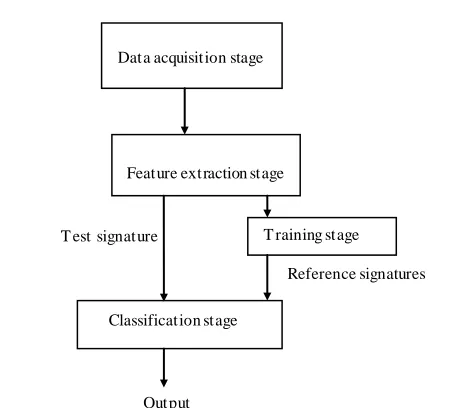
The proposed on-line signature verification block diagram is shown in fig.1. It consists of a data acquisition, feature extraction, training, and classification stage. The training and classification stages use Dynamic Time Warping (DTW) algorithm to establish a correspondence between feature sequences of signature samples.
A. Data Acquisition Device
III.
O
N-LINE DATA ACQUISITIONOn-line signature samples are collected from 200 users, each user signed ten genuine signatures on the digitizer. Total on-line genuine signature samples collected amounted to 2000. These signatures are collected over a period of three months. At the same time, 100 forgers made 400 skilled forgeries after study the shape and dynamic movement and man ner in which the genuine users signed. An example of genuine signatures and corresponding pressure graph of one particular user is shown in fig.3, also the skilled forgeries version is shown in fig.4.
n
t
t
p
t
y
t
x
t
S
(
)
[
(
),
(
),
(
)]
T
0
,
1
,
2
,...
.,
(1)A. Dynamic Signature Preprocessing
In this paper, signatures preprocessing is not carried out on the dynamics signatures in order to preserve the timing characteristics of the us er’s signatures. Actually preprocessing stage is an important stage in automatic signature verification systems particularly when acquired signatu res have been corrupted but in many cases unique properties of the user’s signature are lost during preprocessing. In [1], preprocessing was done; they uniformly re-sampled the signatures at equal interval points along the signature curve. Also in [4], [8] preprocessing was carried out, they re-sampled signature curve in such a way as to retain the critical points while in [9] tangent angle sequence was re-sampled to equidistant points. In [2], [3], [5], [10] they didn’t perform any preproces sing also we didn’t preprocess the data because the same equipment with good resolutions is used throughout the period of data collection.
VI.
N
EW ON-LINE SIGNATURE FEATURESSeven on-line signature features are extracted at each sampling point from the raw data. The features are ∆x, ∆y, ∆p, ∆y/∆x, ∆p/∆x, ∆p/∆y and v. ∆x corresponds to change of x between two successive sampling points, ∆y corresponds to change of y between two successive sampling points, ∆p corresponds to change of p between two successive sampling points, ∆y/∆x corresponds to ratio of ∆y to ∆x, ∆p/∆y corresponds to ratio of ∆p to ∆y, ∆p/∆x corresponds to ratio of ∆p to ∆x and v which corresponds to change of speed between two successive sampling points. These features are obtained using equation (2, 3 - - - 8).
x
x
(
t
)
x
(
t
1
)
(2)
y
y
(
t
)
y
(
t
1
)
(3)
p
p
(
t
)
p
(
t
1
)
(4)
)
1
(
)
(
)
1
(
)
(
t
x
t
x
t
y
t
y
x
y
(5)
v
(
x
)
2
(
y
)
2 (6)
)
1
(
)
(
)
1
(
)
(
t
y
t
y
t
p
t
p
y
p
(7))
1
(
)
(
)
1
(
)
(
t
x
t
x
t
p
t
p
x
p
(8)T est signature
Reference signatures
Output
Fig. 1. Proposed on-line signature verification system block diagram. Data acquisition stage
Feature extraction stage
T raining stage
Classification stage
V. TRAINING AND T HRESHOLD SET T ING
Each registered user submitted 10 genuine signatures to the system, out of which six signatures are used to generate 15 distance values by, cross -aligned the signature features to the same length using Dynamic Time Warping (DTW). These distance values are used to measure the variation within each
user’s signatures, so as to set user-specific thresholds for accepting or rejecting a test signature. Given six reference signature samples S1, S2, S3, S4, S5 and S6, these signatures are cross aligned to obtain 15 distance values as shown in fig. 5. The mean (mk) and standard deviation (σk) of the distance d , d , d , d , d , d , d , d , d , d , d , d , d , d and
Fig. 3. Genuine on-line signatures and the corresponding pressure graph
T est signature (ST )
dT6
dT3 dT4 dT5
dT1 dT2
S6
S1 S2 S4 S3
S5
Fig. 6. Distance between reference signatures and test signature
d56 are calculated and used to set the threshold (tk) for each user based on each feature as given in equation (9).
0
t
k
m
k
k (9)VI. CLASSIFICATION
Whenever a test signature comes into the system, the feature vector of the test signature is pair wise aligned with each of the six reference signatures using DTW. Six distance values are obtained as shown in fig.6. The distance (dt) of test signature (ST) from the six reference signatures S1, S2, S3, S4, S5 and S6 is calculated using equation (10).
6
6 5 4 3 2
1 T T T T T
T t
d
d
d
d
d
d
d
(10)
If dt is within the assigned threshold then the tes t signature is assigned a pass mark otherwise it has no pass mark. Finally a decision by the system in accepting or rejectin g a test signature is based on total pass mark it obtained based on the three features.
VII. EXPERIMENT RESULT S.
We performed experiments on seven features (∆x, ∆y, ∆p, ∆y/∆x, ∆p/∆x, ∆p/∆y and v) in order to determine the information content in each feature based on maximum, minimum and average distance threshold. The result in table I shows the verification results for each feature, it is discovered that features (∆y/∆x, ∆p/∆x and v) have low verification error rate in comparison with others using average distance threshold. The proposed on-line signature verification system is tested using 800 genuine signatures from 200 users, 400 skilled forgeries from 200 forgers and 400 random signatures. The combination of features (∆y/∆x, ∆p/∆x and v) and average distance threshold are used in the proposed system. Table II shows the on-line signature verification results for the proposed system. Actually [1], [2] and [3] used related features with minimum or template distance for signature verification but the FAR and FRR results obtained from the proposed system are better in comparison with the results obtained from the previous systems.
VIII. CONCLUSION
Efficient on-line signature verification system is needed in order to increase security in access control and financial transaction. The proposed system is robust enough to improve the current situation. The excellent verification results obtained from the system can be traced to the combined robust features and good threshold s etting adopted. The system is better in comparison with previous systems in its ability to give low error-rates against forgeries.
S1
d12
S2 d23 d15 d13
S3 d25
d34 d35
d14 d16
d24 d26
d45
S4 d36 S5
d46 d56
S6
T ABLE I
RESULT OBTAINED FROM SEVEN EXTRACTED FEATURES.
Features
Maximum distance Average distance Minimum distance
FAR FRR FAR FRR FAR FRR
∆x 0.30 0.15 0.05 0.10 0.10 0.10
∆y 0.125 0.125 0.01 0.10 0.125 0.10
∆y/∆x 0.10 0.10 0.025 0.025 0.05 0.025
∆p 0.150 0.250 0.010 0.075 0.125 0.150
∆p/∆y 0.125 0.150 0.075 0.10 0.05 0.075
∆p/∆x 0.100 0.150 0.05 0.025 0.05 0.075
v 0.075 0.10 0.05 0.05 0.15 0.10
T ABLE II
VERIFICATION RESULT
T ypes of Signature Signatures tested
Signatures accepted
Signatures rejected
FRR FAR
Genuine signatures 800 798 2 0.25
Skilled forgeries 400 2 398 0.50
Random forgeries 400 0 400 0.00
REFERENCES
[1] A.K Jain, F. D. Griess and S. D Connell, “ On-line Signature Verification,”, Pattern Recognition, Vol. 35, No.12, pp. 2963-2972, 2002.
[2] A. Kholmatov and B. Yanikoglu, “ Biometric Authentication using On-line Signatures,” Computer and Information Sciences – ISCIS 2004, 19th International Symposium, Springer, pp. 373-380, October 2004.
[3] A. Kholmatov and B. Yanikoglu, “Identity Authentication using Improved On-line Signature Verification method,” Pattern Recognition Vol. 26, No.15, pp.2400-2408, November 2005.
[4] [4] T . Ohishi, Y. Komiya and T. Matsumoto, “ On-line Signature Verification using Pen-Position, Pen-Pressure and Pen-Inclination trajectories”, Proceedings of International Conference on Docum ent Analysis and Recognition, Vol. 4, September 03-08, 2000.res
[5] Julian Fierrez, Javier Ortega-Garcia, Daniel Ramos and Joaquin Gonzalez-Rodriguez, “HMM-Based On-Line Signature Verification: Feature Extraction and Signature Modeling”, Pattern Recognition Letters, Vol. 28 no.16, pp.2325-2334. December 2007.
[6] T ong Qu, Abdulmotaleb El Saddik and Andy Adler, “ A Stroke based Algorithm for Dynamic Signature Verification”,
Proceedings of IEEE, pp.7803-8253, 2004 IEEE, Niagara Falls, 2004.
[7] Intuos2 Pen Tablets, Wacom [Online]. Available: http://www.wacom.com/intuos/index.php
[8] M. Zou, J. T ong, C. Liu, and Z. Lou, “On-line signature Verification using Local Shape Analysis,” Proceedings of 7th International Conference on Document Analysis and Recognition (ICAR-7), Vol.1, Edinburgh, U.K., pp. 314-318, Aug. 2003. [9] Z. Quan and K. Liu, “ On-line Signature Based on the Hybrid
HMM/ANN Model,” IJCSNS international journal of Com puter Science and Network Security, Vol. 7 No.3, March 2007 [10] Daramola S.A, “ Development of a Robust Automatic Off-line and
On-line Handwritten Signature Verification System," PhD. Thesis,
![Table II shows the on-line signature verification results for the proposed system. Actually [1], [2] and [3] used related features with minimum or template distance for signature](https://thumb-us.123doks.com/thumbv2/123dok_us/1394833.1651034/4.612.65.270.335.679/signature-verification-proposed-actually-features-template-distance-signature.webp)
