International Journal of Emerging Technology and Advanced Engineering
Website: www.ijetae.com (ISSN 2250-2459,ISO 9001:2008 Certified Journal, Volume 3, Issue 1, January 2013)
159
ALKALI Activated FLY-ASH Based Geopolymer Concrete
Ammar Motorwala
1, Vineet Shah
2, Ravishankar Kammula
3, Praveena Nannapaneni
4, Prof. D. B. Raijiwala
51
Departmentof Applied Mechanics, SVNIT-Surat, Gujarat-395007 2 Departmentof Civil Engineering, IIT-Delhi
3,4Departmentof Civil Engineering, SVNIT-Surat, Gujarat-395007
5Associate Professor, Departmentof Applied Mechanics, SVNIT-Surat, Gujarat-395007
Abstract- Considering the increasing demand for developing alternative construction materials, due to the growing environmental concerns, this paper discusses the feasibility of alkali activated geo-polymer concrete, as a future construction material. The main objective of this study involves observation of structural behaviours of the fresh fly ash-based geo-polymer concrete, understanding the basic mixture proportioning of fly ash-based geo-polymer concrete and evaluating various economic considerations.
Keywords- Alkali activated fly-ash based geo-polymer, construction material for green building, geo-polymer concrete, eco-friendly construction material, low calcium based geo-polymer concrete.
I. INTRODUCTION
Concrete usage around the world is second only to water and Ordinary Portland Cement (OPC) is conventionally used as the primary binder to produce concrete. The environmental issues associated with the production of OPC are too many. The cement industry is held responsible for some of the CO2 emissions. The
amount of the carbon dioxide released during the manufacturing of OPC due to the calcination of limestone and combustion of fossil fuel is in the order of one ton for every ton of OPC produced. In addition, the extent of energy required to produce OPC is only next to steel and aluminium.
The demand for Portland cement is increasing day by day and hence, efforts are being made in the construction industry to address this by utilising supplementary materials and developing alternative binders in concrete; the application of geo-polymer technology is one such alternative. The abundant availability of fly ash worldwide creates opportunity to utilise this by-product of burning coal, as a substitute for OPC to manufacture concrete. When used as a partial replacement of OPC, in the presence of water and in ambient temperature, fly ash reacts with the calcium hydroxide during the hydration process of OPC to form the calcium silicate hydrate (C-S-H) gel.
In 1978, Davidovits (1999) proposed that binders could be produced by a polymeric reaction of alkaline liquids with the silicon and the aluminium in source materials of geological origin or by-product materials such as fly ash and rice husk ash. He termed these binders as geo-polymers.
Palomo et al (1999) suggested that pozzolans such as blast furnace slag might be activated using alkaline liquids to form a binder and hence totally replace the use of OPC in concrete. Hence, in this paper an effort is made to identify and study the effect of salient parameters that affects the properties of low-calcium fly ash-based geo-polymer concrete and the properties of concrete at varied concentrations of alkali solutions and how the change in temperature affects the strength characteristics.
II. GEOPOLYMER
Geo-polymer is a term covering a class of synthetic alumino-silicate materials with potential use in a number of areas, essentially as a replacement for Portland cement and for advanced high-tech composites, ceramic applications or as a form of cast stone. The name Geo-polymer was first applied to these materials by Joseph Davidovits in the 1970s, although similar materials had been developed in the former Soviet Union since the 1950s, originally under the name "soil cements". However, this name never found widespread usage in the English language, as it is more often applied to the description of soils which are consolidated with a small amount of Portland cement to enhance strength and stability. Geo-polymer cements are an example of the broader class of alkali-activated binders, which also includes alkali-activated metallurgical slags and other related materials
A. Constituents of geo-polymer concrete
International Journal of Emerging Technology and Advanced Engineering
Website: www.ijetae.com (ISSN 2250-2459,ISO 9001:2008 Certified Journal, Volume 3, Issue 1, January 2013)
160
B. Fly Ash
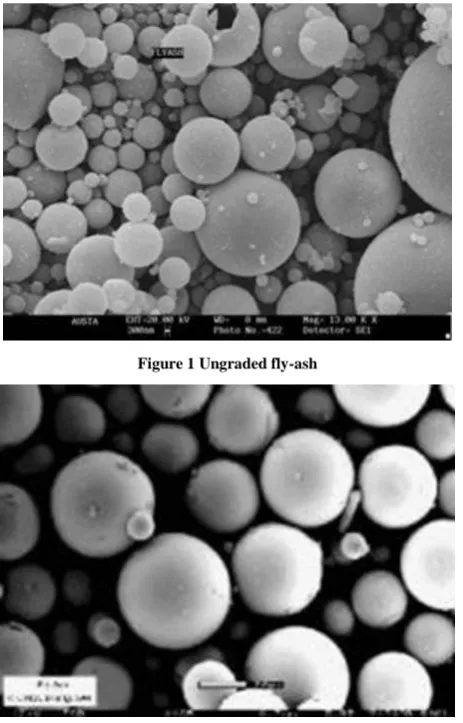
According to the American Concrete Institute (ACI) Committee 116R, fly ash is defined as „the finely divided residue that results from the combustion of ground or powdered coal and that is transported by flue gasses from the combustion zone to the particle removal system‟ (ACI Committee 232 2004). Fly ash is removed from the combustion gases by the dust collection system, either mechanically or by using electrostatic precipitators, before they are discharged to the atmosphere. Fly ash particles are typically spherical, finer than Portland cement and lime, ranging in diameter from less than 1 µm to no more than 150 µm.
[image:2.595.50.282.352.714.2]The chemical composition is mainly composed of the oxides of silicon (SiO2), aluminium (Al2O3), iron (Fe2O3), and calcium (CaO), whereas magnesium, potassium, sodium, titanium, and sulphur are also present in a lesser amount.
Figure 1 Ungraded fly-ash
Figure 2 Graded fly-ash
The characteristics of fly ash that generally considered are loss on ignition (LOI), fineness and uniformity. LOI is a measurement of un-burnt carbon remaining in the ash. Fineness of fly ash mostly depends on the operating conditions of coal crushers and the grinding process of the coal itself. Finer gradation generally results in a more reactive ash and contains less carbon.
C. Use of Fly Ash in Concrete
Fly ash plays the role of an artificial pozzolan, where its silicon dioxide content reacts with the calcium hydroxide from the cement hydration process to form the calcium silicate hydrate (C- S-H) gel. The spherical shape of fly ash often helps to improve the workability of the fresh concrete, while its small particle size also plays as filler of voids in the concrete, hence to produce dense and durable concrete.
An important achievement in the use of fly ash in concrete is the development of high volume fly ash (HVFA) concrete that successfully replaces the use of OPC in concrete up to 60% and yet possesses excellent mechanical properties with enhanced durability performance.
D. Alkaline Liquids
The most common alkaline liquid used in geo- polymerisation is a combination of sodium hydroxide (NaOH) or potassium hydroxide (KOH) and sodium silicate or potassium silicate (Davidovits 1999; Palomo et al. 1999; Barbosa et al. 2000; Xu and van Deventer 2000; Swanepoel and Strydom 2002; Xu and van Deventer 2002). The use of a single alkaline activator has been reported (Palomo et al. 1999; Teixeira- Pinto et al. 2002), Palomo et al (1999) concluded that the type of alkaline liquid plays an important role in the polymerisation process. Reactions occur at a high rate when the alkaline liquid contains soluble silicate, either sodium or potassium silicate, compared to the use of only alkaline hydroxides. Xu and van Deventer (2000) confirmed that the addition of sodium silicate solution to the sodium hydroxide solution as the alkaline liquid enhanced the reaction between the source material and the solution. Furthermore, after a study of the geo-polymerisation of sixteen natural Al-Si minerals, they found that generally the NaOH solution caused a higher extent of dissolution of minerals than the KOH solution.
E. Super Plasticisers:
International Journal of Emerging Technology and Advanced Engineering
Website: www.ijetae.com (ISSN 2250-2459,ISO 9001:2008 Certified Journal, Volume 3, Issue 1, January 2013)
161
The specific super plasticizer used in the mixture made for the project is Sikament-581.As a super plasticizer it substantially improved the workability without increasing the amount of water and hence reducing the risk of segregation. It results in normal set even when overdosed. It gives a good surface finish and as it is chloride free it doesn‟t attack reinforcement or pre-stressed cables if any. Apart from this, various other super plasticisers, which can be used, are categorized as
Super Plasticiser A (Naphthalene Formaldehyde Condensate)
Super Plasticiser B (Sulphonated Melamine Formaldehyde Condensate)
Super Plasticizer C (Aqueous De Policarboxilato)
Super Plasticizer D (Aqueous Solution of Ligno Sulphonate)
The main chemical base is Modified Naphthalene Formaldehyde and the dosage varies from 0.6-2% of the weight of fly ash.
F. Polymerisation Process
Geo-polymers are members of the family of inorganic polymers. The chemical composition of the geopolymer material is similar to natural zeolitic materials, but the microstructure is amorphous. The polymerization process involves a substantially fast chemical reaction under alkaline condition on Si- Al minerals, which results in a three-dimensional polymeric chain and ring structure consisting of Si-O- Al-O bonds
M n [-(SiO2) z –AlO2] n . wH 2O
Where: M = the alkaline element or cation such as potassium, sodium or calcium;
The symbol – indicates the presence of a bond, n is the degree of poly-condensation or polymerisation;
z is 1, 2,3, or higher, up to 32.
The schematic formation of geopolymer material can be shown as described by
n(Si2O5,Al2O2)+2nSiO2+4nH2O+NaOH or KOHNa+,K+ + n(OH)3-Si-O-Al--O-Si-(OH)3 (Si-Al materials)
(OH)2
n(OH)3-Si-O-Al--O-Si-(OH)3 + NaOH or KOH (Na+,K+)-(-Si-O-Al--O-Si-O-) + 4nH2O (OH)2
O O O The chemical reaction may comprise the following
steps
Dissolution of Si and Al atoms from the source material through the action of hydroxide ions.
Transportation or orientation or condensation of precursor ions into monomers.
Setting or poly-condensation/polymerisation of monomers into polymeric structures. However, these three steps can overlap with each other and occur almost simultaneously, thus making it difficult to isolate and examine each of them separately (Palomo et al. 1999).
The last term in Equation reveals that water is released during the chemical reaction that occurs in the formation of polymers. This water, expelled from the geo-polymer matrix during the curing and further drying periods, leaves behind discontinuous Nano-pores in the matrix, which provide benefits to the performance of geo-polymers. The water in a geo-polymer mixture, therefore, plays no role in the chemical reaction that takes place; it merely provides the workability to the mixture during handling. This is in contrast to the chemical reaction of water in a Portland cement mixture during the hydration process.
G. Chemical composition of the geo-polymers
[image:3.595.327.529.529.682.2]Differences due to various conditions of the alkaline activation may be found on the FTIR spectra.
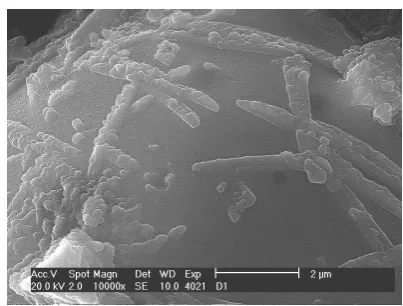
Figure 3 Beginning of the geo-polymers phase development on the surface of the fly ash particle
International Journal of Emerging Technology and Advanced Engineering
Website: www.ijetae.com (ISSN 2250-2459,ISO 9001:2008 Certified Journal, Volume 3, Issue 1, January 2013)
162
The shift is interpreted as a consequence of the Al penetration into the original structure of the Si-O-S skeleton (an analogous phenomenon was observed in zeolites). The more pronounced the shift, the greater the extent of the Al penetration from the glassy parts of the fly ash into the [SiO4]4- skeleton.
The geo-polymerization process (alkaline activation of fly ashes in the aqueous environment at pH>12) accompanied by the hardening of the material is different from the hydration processes of inorganic binders (e.g. Portland cement). This process obviously takes place predominantly “via solution” when, first, the fly ash particles are dissolved and a new geo-polymers structure is then formed starting from the solution (Fig 3).
[image:4.595.64.271.369.515.2]In addition to the preparation conditions also the presence of Ca atoms entering the Si- O-Al-O skeleton and compensating the charge on Al atoms plays an important role.
Figure 4 Detailed character of the geo-polymers (the paste w = 0.27, fracture surface, after 28 days)
These charges are usually compensated by Na+ ions. Nevertheless Ca+2 ions may probably interconnect individual Si-O-Al-O chains thus giving rise to a stronger structure characterized by higher strength values resulting from the alkaline activation of fly ashes in presence of Ca-containing materials.
Water is present in the geo-polymers structure as this is revealed by the GTA curves. Water obviously occurs in the form of “free water” but water molecules also exist inside the structure; furthermore, OH- groups are also present.
A prevailing part of water gets lost during the heating at a temperature of 150-200 oC. No crystalline hydrates could be detected in the geo-polymers microstructure.
Therefore, the geo-polymer can be characterized as three-dimensional inorganic polymer with a summary formula:
Mn [-(Si-O)z –Al-O]n . w(H2O).
III. EXPERIMENTAL DEDUCTIONS
A. Mixture Proportions:
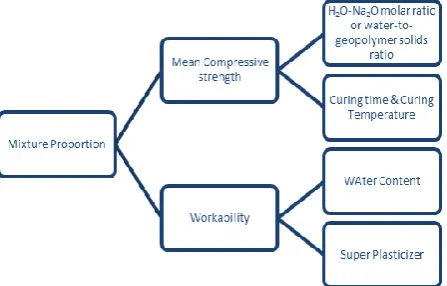
The mixture proportion of concrete contains coarse aggregate, fine aggregate, fly ash, Sodium silicate solution and NaOH solution. Three different mixtures with 8M, 10M, 12M and 14M were prepared and compressive strengths of these sample cubes were measured.
The sodium hydroxide (NaOH) solids were dissolved in water to make the solution. The mass of NaOH solids in a solution varied depending on the concentration of the solution expressed in terms of molar, M.
For instance, NaOH solution with a concentration of 8M consisted of 8x40 = 320 grams of NaOH solids (in flake or pellet form) per litre of the solution, where 40 is the molecular weight of NaOH. Similarly, the mass of NaOH solids per kg of the solution for 14M concentration was measured as 404 grams.
The sodium silicate solution and the sodium hydroxide solution were mixed together at least one day prior to use to prepare the alkaline liquid. On the day of casting of the specimens, the alkaline liquid was mixed together with the super plasticizer and the extra water (if any) to prepare the liquid component of the mixture.
[image:4.595.321.545.529.672.2]International Journal of Emerging Technology and Advanced Engineering
Website: www.ijetae.com (ISSN 2250-2459,ISO 9001:2008 Certified Journal, Volume 3, Issue 1, January 2013)
163
0 20 40
6 4 4.8
co
m
p
re
ssi
ve
st
re
n
gth
N
/m
m
2
[image:5.595.56.269.589.743.2]Flyash (Kg)
Strength
Table 1 Mixture proportions
Table 2 Mixture proportion
IV. EFFECT OF SALIENT PARAMETERS
A. Ratio of Alkaline Liquid-to-Fly Ash
The ratio of alkaline liquid-to-fly ash, by mass, was not varied. This ratio was taken as 0.4.
B. Concentration of Sodium Hydroxide (NaOH) Solution
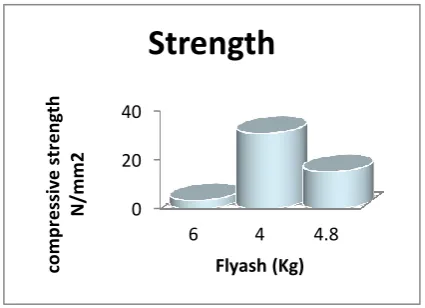
Mixtures were made to study the effect of concentration of sodium hydroxide solution on the compressive strength of concrete. Complete details of these mixtures and their properties are given in Table. The test cubes were left at ambient conditions for about 30 minutes prior to start of dry curing in an oven. The curing time was 24 hours at various temperatures. The measured 7th day compressive strengths of test cubes are given in Table.
Mixture No.
Aggregates (kg)
Fly-ash
(kg)
Water
content
(litres)
Strength
(N/mm
2)
20mm
10mm
4.75mm
1
5
12
7.3
6
2
1.09
2
5
12
7.3
6
2.25
3.48
3
10.2
6.8
7.3
4
2.1
30.95
4
12
5
7.3
4.8
2.3
24.4
5
12
5
7.3
4.8
2
15.26
6
12
5
7.3
4.5
2.1
3.7
7
12
5
7.3
4.8
2.2
2.18
8
12
5
7.3
4.5
2
1.74
Mixture
No.
Molarities
Sodium
Hydroxide
(kg)
Potassium
Hydroxide
(kg)
Sodium
Silicate
(kg)
plasticizer
(ml)
Strength
(N/mm
2)
1
10 M
0.173
0
1.657
90
1.09
2
12 M
0.238
0
1.657
48
3.48
3
14 M
0.267
0
1.657
60
30.95
4
14 M
0.267
0
1.657
50
24.4
5
16 M
0.293
0
1.657
50
15.26
6
16 M
0.293
0
1.657
50
3.7
7
0.314
1.657
50
2.18
International Journal of Emerging Technology and Advanced Engineering
Website: www.ijetae.com (ISSN 2250-2459,ISO 9001:2008 Certified Journal, Volume 3, Issue 1, January 2013)
164
0 10 20 30 40
co
m
p
re
ssi
ve
st
re
n
gth
N
/m
m
2
NaOH
Sodium Hydroxide (Kg)
Sodium
C. Effect of Molarity of Alkaline Solutions
D. Curing Temperature
Higher curing temperature resulted in larger compressive strength, although an increase in the curing temperature beyond 80 degrees Centigrade did not increase the compressive strength substantially. Three different curing temperatures were used, i.e. 25, 80 and 100 degrees Centigrade. Curing was performed in an oven for 24 hours. The results shown in Table confirm that higher curing temperature resulted in higher compressive strength.
Mixture
Curing Temperature in
O C
Compressive strength
(MPa)
1 25 0.872
2 60 2.6
3 80 30.95
E. Addition of Super plasticizer
In fresh state, the geo-polymer concrete has a stiff consistency. Although adequate compaction was achievable, an improvement in the workability was considered as desirable. As the concentration of Super plasticizer increases the amount of water required decreases.
Series of tests, performed to study the effect of super plasticizer on fly-ash concrete indicated that super plasticizer improved the workability of the fresh concrete but had very little effect on the compressive strength up to 2% of this admixture to the amount of fly ash by mass.
F. Water Content of Mixture
In ordinary Portland cement (OPC) concrete, water in the mixture chemically reacts with the cement to produce a paste that binds the aggregates. In contrast, the water in a low-calcium fly ash-based geo-polymer concrete mixture does not cause a chemical reaction. In fact, the chemical reaction that occurs in geo-polymers produces water that is eventually expelled from the binder.
G. Density
The density of concrete primarily depends on the unit mass of aggregates used in the mixture. Because the type of aggregates in all the mixtures did not vary, the density of the low-calcium fly ash-based geo-polymer concrete varied only marginally between 2330 to 2430 kg/m3. Mixture Concentration
of NaOH solution (In molars)
Ratio of Sodium Silicate to NaOH solution
Compressive strength at 7th day in Mpa (Cured at 80
0
C)
1 10 M 2.5 1.5 2 12 M 2.5 2.6 3 14 M 2.5 26.67 4 16 M 2.5 25.28
0 5 10 15 20 25 30 35
10 M
12 M
14 M
16 M
com
pr
e
ssiv
e
st
re
ngt
h
N/m
m
2
Molarity
International Journal of Emerging Technology and Advanced Engineering
Website: www.ijetae.com (ISSN 2250-2459,ISO 9001:2008 Certified Journal, Volume 3, Issue 1, January 2013)
165
V. RATE ANALYSIS
A.Cement Concrete (Grade M20)
Note: All the rates are as per the standard rates in the prevalent Indian market during the year 2012.
B. Geo-polymer Concrete (Grade M20)
Particulars Quantity
(in Kg) Rate
Amount (Rs.)
Fine
Aggregate 640 1000 420 Coarse
Aggregate 1280 1200 1008 Super
plasticizer 0.0044 75 330 NaOH 19.77 40 791
Na2SiO3 49.4 25 1235
Fly Ash 500 3.3 1650
Total 5434
Note: All the rates are as per the standard rates in the prevalent Indian market during the year 2012.
VI. DISCUSSION
The main objective of this study was to find the effect of varied concentrations of alkaline solutions on the strength characteristics of the concrete. We expect that the combined use of KOH and NaOH would help in achieving a more rigid structure and hence improve the strength characteristics.
Based on the general finding, the following conclusions were drawn:
Higher concentration (in terms of molar) of sodium hydroxide solution results in higher compressive strength of fly-ash based geo-polymer concrete and higher the ratio of sodium silicate-to-sodium hydroxide ratio by mass, higher is the compressive strength of fly ash based geo-polymer concrete, as the curing temperature in the range of 30°C to 90°C increases, the compressive strength of fly ash-based geo polymer concrete also increases, longer curing time, in the range of 4 to 96 hours (4 days), produces higher compressive strength of fly ash-based geo-polymer concrete.
With the main objective of finding the effect of varied concentrations of alkaline solutions on the strength characteristics of the concrete, the test conducted, yielded certain important findings from the material collected from local vendors.
In the process of conducting the test fly ash were procured from two different vendors which also led to contrasting variation in the results. Thus, highlighting the importance of choice of fly ash.
Selection and grading of fine aggregate also played a major role. For a ratio of 0.67 (10mm: 20mm) compressive strength of 26.67 N/mm2, and for the same molarity with a ratio of 0.42 comparatively very low compressive strength was measured, highlighting how important it is to select a proper ratio for grading.
A general increase in the compressive strength with increase in the molarity was seen.
Importance of curing temperature also was clearly seen in the tests conducted. For test conducted at 25°C, strength obtained was 0.872 N/mm2, while, on the contrary, for 80°C it was 30.95 N/mm2.
Another important observation was that curing under normal sunlight yielded strength of 16 N/mm2. This test was done in the month of February 2012 in Sardar Vallabhbhai National Institute of Technology, Surat(Gujarat) in India, where the ambient temperature was around 25 0C, hence, similar test when conducted in hotter months can yield still better results. Thus, making insitu use of fly ash concrete a future possibility.
Curing when done by wrapping with plastic bag gave better compressive strength as it preserves the moisture.
In the rate analysis carried, it came out clearly with the available resources fly ash based concrete is expensive than cement concrete and hence not economical. However in the broader picture considering carbon credit, waste disposal and limited availability of non-renewable resources, geo-polymer concrete is sure to play major role in construction industry.
Particulars Quantity
(in Kg) Rate
Amount (Rs.)
Cement 400 5.2 2080 Fine
Aggregate 640 1000 420 Coarse
Aggregate 1280 1200 1008 Super
plasticizer 0.0044 75000 330
International Journal of Emerging Technology and Advanced Engineering
Website: www.ijetae.com (ISSN 2250-2459,ISO 9001:2008 Certified Journal, Volume 3, Issue 1, January 2013)
166
REFERENCES
[1] Davidovits, J. "Geopolymers: Inorganic Polymeric New Materials" Journal of Thermal Analysis 37: 1633-1656, 1991. [2] Davidovits, J. “Chemistry of Geopolymeric Systems,
Terminology”. Geopolymer ‟99 International Conference, France, (1999).
[3] Hardjito D and Rangan B.V, “Development & properties of low calcium based geopolymer fly-ash conctrete”, Research report GC1, Curtin University of technology Perth, Australia, 2005. [4] Keun-Hyeok Yang, Ju-Hyun Mun, Jae-Il Sim, and Jin-Kyu Song,
“Effect of Water Content on the Properties of Lightweight Alkali-Activated Slag Concrete”, journal of materials in civil engineering, ASCE / june 2011.
[5] Keun-Hyeok Yang and Jin-Kyu Song, “Workability Loss and Compressive Strength Development of Cementless Mortars Activated by Combination of Sodium Silicate and Sodium Hydroxide”, Journal of materials in civil engineering, ASCE March 2009.
[6] Khater H. M, “Calcium effect on geopolymerization of Alumino silicate wastes”, Journal of Materials in Civil Engineering, June 21, 2011.
[7] Malhotra, V. M. and A. A. Ramezanianpour. “Fly Ash in Concrete”. Ottawa, Ontario, Canada, CANMET, 1994.
[8] Malhotra V. M. “Making concrete greener with fly-ash”, ACI concrete international 21(5): 65-66, 1999.
[9] Malhotra V. M, “High performance high volume fly-ash concrete”, ACI concrete international 24(7): 1-5, 2002.
[10] Malhotra V. M., “Role of supplementary cementing materials and superplasticisers in reducing greenhouse gas emissions”, ICFRC Chennai Indian allied publishers, 2004.
[11] Mehta, P. K. (2002). "Greening of the Concrete Industry for Sustainable Development." ACI Concrete International 24(7): 23-28.
[12] Mehta, P. K. "Greening of the Concrete Industry for Sustainable Development" ACI Concrete International 24(7): 23-28, 2002. [13] Mehta, P. K. "Reducing the Environmental Impact of Concrete"
ACI Concrete International 23(10): 61-66, 2001.
[14] Sumajouw M. D. J & Rangan B.V, “Low calcium fly-ash based geoplymer concrete: Reinforced beams and columns”,Research report GC3 , Curtin University of technology,Perth ,Austrlia, 2005.
[15] Teixeira-Pinto, A., P. Fernandes, S. Jalali. “Geopolymer Manufacture and Application - Main problems When Using Concrete Technology”. Geopolymers 2002 International Conference, Melbourne, Australia, Siloxo Pty. Ltd. 2002. [16] Wallah S.E & Rangan B.V, “Low calcium fly ash based