© 2018, IRJET | Impact Factor value: 6.171 | ISO 9001:2008 Certified Journal | Page 3334
Feasibility Studies for Development of Cement Free Fly Ash Based
Geo-Polymer Mortar Using Potassium Based Alkaline Activator
Kritika Keshari
1, Manish Mudgal
2, Ramesh Kumar Chouhan
3, Abhishek Bisarya
41 Assistant Professor, Civil Engineering Department, Medi-Caps University, Indore 2 Principal Scientist, Materials for Radiation Shielding and Cement Free Concrete Division,
CSIR-AMPRI, Bhopal (M.P.)
3Principal Technical Officer, Materials for Radiation Shielding and Cement Free Concrete Division, CSIR-AMPRI, Bhopal (M.P.)
4Junior Research Fellow, Materials for Radiation Shielding and Cement Free Concrete Division, CSIR-AMPRI, Bhopal (M.P.)
---***---Abstract -
Geo-polymer is an emerging technologytowards greener environment as it utilizes industrial waste in abundant quantity, like fly ash, red mud, etc. In this study class F fly ash sample which has been used was obtained from Satpura Thermal Power Plant, Sarni, Betul (M.P.). In this study potassium based alkaline activator (Combination of potassium hydroxide and potassium silicate) was used. In this research work the molarity of the solution was kept constant to be 16 and ratio of K2SiO3:KOH was varied. The ratios of K2SiO3:KOH adopted were 0.25, 0.50, 1.00, 1.50, 2.00, and 2.50. For each batch 15 cubes of sizes 7.06cm x 7.06cm x 7.06 cm were casted for each trial out of which 12 cubes were oven cured in Hot Air Oven at 60°C for 48 hours and the remaining 3 cubes were left for the ambient drying. For compressive strength testing, 3 cubes each were tested at 3, 7, 14 and 28 days respectively and the average of 3 cubes was taken as the compressive strength. It was found that initially on increasing the ratio of K2SiO3:KOH the compressive strength was increased but beyond ratio 0.50 the compressive strength was decreased. The compressive strength using 0.50 ratio of K2SiO3:KOH was found to be 85.20 MPa for oven curing at 60°C for 48 hours at 28 days of aging and 59.10 MPa for ambient curing at 28 days of aging where solution: fly ash ratio 0.27.
Key Words: Fly ash, geo-polymer mortar, compressive strength, potassium hydroxide and potassium silicate.
1. INTRODUCTION
The term ‘geo-polymer’ was first introduced by Davidovits in 1978 to describe a family of mineral binders with chemical composition similar to zeolites but with an
amorphous microstructure. Unlike ordinary
Portland/pozzolanic cements, geo-polymers do not form calcium-silicate-hydrates (CSHs) for matrix formation and strength but utilize the poly-condensation of silica and alumina to attain structural strength. Two main constituents of geo-polymers are source materials and alkaline liquids. The source materials of alumino-silicate should be rich in silicon (Si) and aluminum (Al). The by-product materials such as fly ash, silica fume, slag, rice-husk ash, red mud, etc. are reported to contain such source materials.
1.1 Mechanism of Geo-polymerization
a. Solid dissolution, which releases both Si and Al species when solids are coming in contact with the activating solutions.
b. Polymerization, possibly through colloidal formation, of the dissolved Si and Al with the soluble silicates from the activating solutions.
c. Gellation of the polymerised alumino-silicate.
d. Setting and hardening.
e. Solid-state transformation of the alumino-silicate gel.
1.2 Need of Geo-polymer Binder
© 2018, IRJET | Impact Factor value: 6.171 | ISO 9001:2008 Certified Journal | Page 3335 contemporary picture of a sustainable industry because it
uses raw materials and energy that are non-renewable; extracts its raw materials by mining and manufactures a product that cannot be recycled. Through waste management, by utilizing the waste by-products from thermal power plants, fertilizer units and steel factories, energy used in the production of respective goods can be considerably reduced. This cuts energy bills, raw material costs as well as greenhouse gas emissions. In the process, it can turn abundantly available wastes, such as fly ash and slag into valuable products, such as geo-polymer mortar and/or concretes.
1.3 Advantages of Geo-polymer Mortar and/or Concrete
a. Low cost and environmental friendly.
b. Reduction in greenhouse gas emission due to reduction in OPC use.
c. Proper utilization of industrial waste such as fly ash.
d. Low-calcium fly ash-based geo-polymer concrete has excellent compressive strength and is suitable for structural applications.
e. The elastic properties of hardened geo-polymer concrete and the behavior and strength of reinforced geo-polymer concrete structural members are similar to the Portland cement concrete.
f. Heat-cured low-calcium fly ash-based geo-polymer concrete also shows excellent resistance to sulphate attack, good acid resistance, undergoes low creep, and suffers very little drying shrinkage. (Dighe & Gulave, (2016).
2. Materials
2.1 Fly Ash
Fly ash, also known as "pulverized fuel ash", is one of the residues generated by coal combustion, and is composed of the fine particles that are driven out of the boiler with the flue gases. Ash that falls in the bottom of the boiler is called bottom. Fly ash is generally captured by electrostatic precipitators or other particle filtration equipment before the flue gases reach the chimneys of coal-fired power plants and together with bottom ash removed from the bottom of the boiler is known as coal ash. Depending upon the source and makeup of the coal being burned, the components of fly ash vary considerably, but all fly ash includes substantial amounts of silicon dioxide (SiO2) (both amorphous and crystalline), aluminium oxide (Al2O3) and calcium oxide (CaO), the main mineral compounds in coal-bearing rock strata. The fly ash can be classified as Class F fly ash and Class C fly ash.
a. Class-F Fly Ash: The burning of old anthracite and bituminous coal typically produces Class F fly ash which contains less than 10% lime (CaO). Alternatively, the addition of a chemical activator such as sodium silicate (water glass) to a class F ash can lead to the formation of a geo-polymer.
b. Class-C Fly Ash: Produced from the burning of younger lignite or sub bituminous coal and generally contains more than 20% lime (CaO). This type of ash does not require and activator and the contents of alkali and sulphate (SO4) are generally higher to a Class F fly ash.
It is used as the full replacement of cement since during the production of cement, about 1 ton of cement produces 1 ton of carbon dioxide in the atmosphere. The carbon dioxide is released while manufacturing cement from rotary clinker at 875°C where lime stones breaks into calcium oxide and carbon dioxide. But during the production of geo-polymer, 80% less carbon dioxide is emitted as compared to OPC. This results into the reduction of carbon dioxide in the atmosphere. For production of geo-polymer waste is utilized in bulk quantity, waste material that are rich in silica and alumina can be utilized for example fly ash, red mud, etc. can be used.
In this study class F fly ash sample which has been used was obtained from Satpura Thermal Power Plant, Sarni, Betul (M.P.). In India about 225 MT of fly ash generated every year from 151 thermal power plants whose installed capacity is 138916 MW. In Madhya Pradesh there are 4 thermal power plants with installed capacity of 4080 MW generating 5.50 MT of fly ash every year. The Satpura Thermal Power Plant which is situated in Sarni district Betul (M.P.) generates about 2.02 MT of fly ash every year with installed capacity of 1330 MW, utilizing only 34% of fly ash. The fly ash used was found to be equivalent to Class F fly ash as per IS 3812 (Part-1):2013. Figure 1 shows the fly ash sample that has been used. Table 1 describes the characteristics of the fly ash sample along with the standard value.
2.2 Fine aggregate
The fine aggregate used in the study for preparation of cement free fly ash based geo-polymer mortar was obtained from Narmada river, fine aggregate passing 4.75 mm IS sieve and Figure 2 shows the sample of the fine aggregate. Table 2 describes the characteristics of the fine aggregate sample and was found to be confirming to IS 383-1970.
2.3 Water
© 2018, IRJET | Impact Factor value: 6.171 | ISO 9001:2008 Certified Journal | Page 3336
2.4 Alkaline Activator
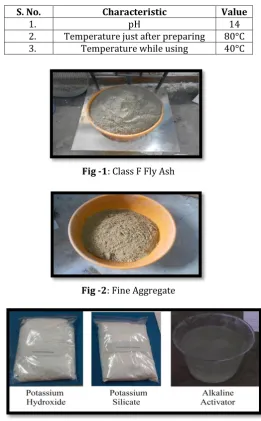
[image:3.595.305.567.97.519.2]The alkaline activator used in the study was potassium based and the chemicals used for preparation of alkaline activator are potassium hydroxide and potassium silicate which are shown in Figure 3. Table 4 describes the characteristics of the alkaline activator used. It may be noted that average temperature of alkaline activator prepared was about 80°C in the beginning while after 3-4 hours after its preparation the temperature got reduced to about 40°C.
Table -1: Characteristics of Fly Ash Sample (Satpura Thermal Power Plant, Sarni, Betul, M.P.)
S.
No. Characteristic Value Typical Range
1. Silicon di-oxide (SiO2) 62.12% 35%
(Minimum)
2. Aluminum oxide
(Al2O3)
21.30%
3. Ferric oxide (Fe2O3) 5.50
4. Silicon di-oxide (SiO2)
+ Aluminum oxide (Al2O3) + Ferric oxide
(Fe2O3)
88.92% 70%
(Minimum)
5. Magnesium oxide
(MgO) 1.58% (Maximum) 5%
6. Calcium oxide (CaO) 0.53%
7. Loss on Ignition 3.30% 5%
(Maximum)
[image:3.595.36.289.248.469.2]8. Specific Gravity 2.10 2.10-2.65
Table -2: Characteristics of Fine Aggregate Sample
S.
No. Characteristic Value Typical Range
1. Specific Gravity 2.65 2.50-3.00 2. Fineness Modulus 2.19 2.00-4.00
3. Bulking 22.00%
22.00-30.00%
Table -3: Characteristics of Water Sample
S. No. Characteristic Value
1. pH 7.00
2. Chlorides 25.00 mg/l as Cl2
3. Total Hardness 140.00 mg/l as
CaCO3
4. Calcium Hardness 100.00 mg/l as CaCO3
5. Magnesium
Hardness 40.00 mg/l as CaCO3
6. Organic Solids 21.70 mg/l
7. Inorganic Solids 10.00 mg/l
8. Suspended Matter 20.40 mg/l
Table -4: Characteristics of Alkaline Activator
S. No. Characteristic Value
1. pH 14
2. Temperature just after preparing 80°C
3. Temperature while using 40°C
Fig -1: Class F Fly Ash
Fig -2: Fine Aggregate
Fig -3: Potassium Based Chemicals along with Prepared Alkaline Activator
[image:3.595.38.288.249.469.2]© 2018, IRJET | Impact Factor value: 6.171 | ISO 9001:2008 Certified Journal | Page 3337 Table -5: Effect K2SiO3:KOH on Compressive Strength of
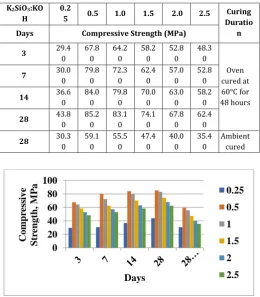
Geo-polymer Mortar at Different Days (Oven Cured at 60°C for 48 hours and Ambient Cured)
K2SiO3:KO
H
0.2
5 0.5 1.0 1.5 2.0 2.5 DuratioCuring n Days Compressive Strength (MPa)
3 29.4
0 67.8 0 64.2 0 58.2 0 52.8 0 48.3 0 Oven cured at 60°C for 48 hours
7 30.0
0 79.8 0 72.3 0 62.4 0 57.0 0 52.8 0
14 36.6
0 84.0 0 79.8 0 70.0 0 63.0 0 58.2 0
28 43.8
0 85.2 0 83.1 0 74.1 0 67.8 0 62.4 0
28 30.3
0 59.1 0 55.5 0 47.4 0 40.0 0 35.4 0 Ambient cured
Chart -1: K2SiO3:KOH on Compressive Strength of Geo-polymer Mortar at Different Days (Oven Cured at 60°C for
48 hours and Ambient Cured)
3. Result and Discussion
The geo-polymer mortar cubes were casted of size 7.06 cm x 7.06 cm x 7.06 cm. The raw materials used were fly ash, fine aggregate and alkaline activator. The ratio of fly ash: fine aggregate was 1:2.The mortar cubes were casted in varying ratio of K2SiO3:KOH as 0.25, 0.50, 1.00, 1.50, 2.00 and 2.50. For each trial 15 cubes were casted, out of which 12 cubes were oven cured in Hot Air Oven at 60°C for 48 hours and the remaining 3 cubes were left for the ambient curing. For compressive strength testing, 3 cubes each were tested for 3, 7, 14 and 28 days respectively and the average of 3 cubes was taken as the compressive strength. Figure 4 shows the cubes casted during and after curing in Hot Air Oven at 60°C for 48 hours and also the ambient cured cubes. The results of the various trials have been described in the Table 5 and also the variations in the compressive strength for each trial have been depicted in the Figure 5.
During the study it was observed that on increasing the ratio of K2SiO3:KOH from 0.25 to 0.50 the compressive strength was increased while on further increasing the ratio of K2SiO3:KOH from 1.00 to 2.50 the compressive strength was decreased for oven curing at 60°C for 48
hours and for ambient curing as well. It was also observed that, the oven cured cubes can be de-molded within 24 hours and again the cubes were kept in the oven for next 24 hours so that the heating could be provided evenly on all the faces of the cubes while in the case of ambient cured cubes it took around 4-5 days for de-molding. As per the results it was observed that the maximum compressive strength was achieved at ratio of 0.50 of K2SiO3:KOH (i.e. 85.20 MPa in case of oven curing at 60°C for 48 hours and 59.10 MPa for ambient curing) which was taken as the optimized ratio for the study.
4. CONCLUSIONS
1. Fly ash that has been used in this study was obtained from Satpura Thermal Power Plant, Sarni, Betul, (M.P.) which was analysed as Class F fly ash and was found to be suitable for making cement free fly ash based geo-polymer mortar.
2. The prepared potassium based alkaline activator was highly alkaline and having pH of 14.
3. The various ratios of K2SiO3:KOH studied were 0.25, 0.50, 1.00, 1.50, 2.00 and 2.50 for geo-polymer mortar. It was observed that at ratio 0.50 maximum compressive strength was achieved i.e. 85.20 MPa for oven cured at 60°C for 48 hours at 28 days of aging and 59.10 MPa for ambient curing at 28 days of aging where solution: fly ash ratio was 0.27. Hence, the designed optimized ratio of K2SiO3:KOH has been observed as 0.50 for geo-polymer mortar.
1. Bisarya, A., (2015), "Study of Effect of Hybrid Alkaline Activator on Engineering Properties of Cement Free Fly Ash Based Geo-Polymer Concrete", Master’s Thesis, Department of civil engineering and applied mechanics, S.G.S.I.T.S., Indore.
2. Davidovits, J. (1994), "Properties of geo-polymer cements", First international conference on alkaline cements and concretes, 1, 131-149.
3. Davidovits, J., (2002), "Environmentally driven geo-polymer cement applications", Proceedings of 2002 Geo-polymer Conference, Melbourne, Australia. 0 20 40 60 80 100 Com p re ss ive S tr en gt h , M P a Days 0.25 0.5 1 1.5 2 2.5 ACKNOWLEDGEMENT
Authors of this paper are highly grateful to Director, CSIR-AMPRI for providing necessary institutional facilities
to carry out this research work.
© 2018, IRJET | Impact Factor value: 6.171 | ISO 9001:2008 Certified Journal | Page 3338 4. Davidovits, J., and Davidovics, M., (1991),
"Geo-polymer: ultra-high temperature tooling material for the manufacture of advanced composites", How Concept Becomes Reality, 36, 1939-1949.
5. Dimas, D., Giannopoulou, I. and Panias, D. (2009), "Polymerization in sodium silicate solutions: A fundamental process in geo-polymerization technology", Journal of materials science, 44, 14, 3719-3730.
6. IS 1727:1967, "Methods of Test for Pozzolanic Materials", New Delhi, India.
7. IS 3812 (Part 1):2013, "Pulverized Fly Ash - Specification”, Bureau of Indian Standard", New Delhi, India.
8. IS 383:1970, "Specification for Coarse and Fine Coarse aggregates from Natural Sources for Concrete", New Delhi, India.
9. IS 456:2000, "Plain and Reinforced Concrete -Code of Practice", New Delhi, India.
10. Report on "fly ash generation at coal/lignite based thermal power stations and its utilization in the country for the year 2014-15", Central Electricity Authority, New Delhi.
11. Aleem, M. I. A., and Arumairaj, P.D., (2012), "Optimum Mix for the Geo-polymer Concrete", Indian Journal of Science and Technology, 5, 3, 2299-2301.
12. Allahverdi, A., and Kani, E.N., (2009), "Construction Wastes as Raw Materials for Geo-Polymer Binders." International Journal of Civil Engineering, 7, 3, 154-160.
13. Chindaprasirt, P., Chareerat, T., Hatanaka, S. and Cao, T. (2011), "High-strength geo-polymer using fine high-calcium fly ash", Journal of Materials in Civil Engineering, 23, 3, 264-270.
14. Dighe, M. S., & Gulave, M. P. (2016), "Geo-polymeric Building Material Using Industrial Waste", Imperial Journal of Interdisciplinary Research, 2(7).
15. Ghosh, K. and Ghosh, P. (2012), "Effect of Na2O/Al2O3, Si02/Al2O3 and W/B Ratio on Setting Time and Workability of Fly Ash Based Geo-polymer", International Journal of Engineering Research and Applications, 2, 4, 2142-2147.
16. Habert, G., JB D’Espinose De Lacaillerie, and N. Roussel, (2011), "An environmental evaluation of
geo-polymer based concrete production: reviewing current research trends", Journal of Cleaner Production, 19.11, 1229-1238.
17. Haque, Md. Emamul (2013), "Indian fly-ash: production and consumption scenario" International Journal of Waste Resources (IJWR), 3.1, 22-25.
18. Hardjito, D., Cheak, C. C. and Ing, C. H. L. (2008), "Strength and setting times of low calcium fly ash-based geo-polymer mortar", Modern applied science, 2, 4, 3-11.
19. Kawade, U.R., Salunkhe, P.A., Kurhade, S.D., (2014), "Fly Ash Based Geo-polymer Concrete", International Journal of Innovative Research in Science, Engineering and Technology, 3, 4, 135-138.
20. Khater, H.M., (2012), "Effect of calcium on geo-polymerization of allumino-silicate wastes", Journal of materials in civil engineering, 24, 1, 92-101.
21. Marthong, C., and Agrawal, T.P., (2012), "Effect of fly ash additive on concrete properties", International Journal of Engineering Research and Applications, 2,4, 1986-1991.
22. Mohd Mustafa, A. B., Mohammed, H., Kamarudin, H., Nizar, K., Ismail, P. M. D., & Zarina, Y. (2011), "Review on fly ash-based geo-polymer concrete without Portland Cement", 3,1,1-4.