myocardial infarction presenting to
a chiropractic office:
a case report
Parham Erfanian,
DC, FCCRS(C)*
A 53-year-old female presented to a chiropractic office with signs and symptoms of heart attack (myocardial infarction). Although she was complaining of neck and upper back pain, the cause of her condition was due to an incident of acute myocardial infarction (MI). Other than anterior chest pain, patients with MI could experience pain over lower jaw and teeth, both arms, shoulders, neck, upper back and epigastrium.
Recognizing the possible underlying cause of the patient’s complaints, and directing them toward the appropriate venues of therapy is essential. Due to the fact that heart attacks are underestimated in women within a certain age group, their detection is also less frequent. To emphasize this fact, presentation, incidence, epidemiology, examination, laboratory findings, and risk factors for the myocardial infarction (MIs) are discussed in this paper.
(JCCA 2001; 45(1):35–41)
K E Y W O R D S: chiropractic, ischemic heart disease, myocardial infarction, heart attack, chest pain.
Une femme de 53 ans s’est présentée en consultation dans un cabinet de chiropratique pour recevoir des traitements, mais, en fait, elle montrait des signes et des symptômes d’une crise cardiaque (infarctus du
myocarde). Même si elle se plaignait de douleurs au cou et dans la partie supérieure du dos, son état était dû à un infarctus du myocarde (IM). Outre les douleurs
rétrosternales, les patients victimes d’un IM peuvent ressentir de la douleur à la mâchoire inférieure et aux dents, aux bras, aux épaules, au cou, dans la partie supérieure du dos et dans l’épigastre. Il est essentiel de cerner la cause sous-jacente possible des malaises d’un patient et de le diriger vers les ressources appropriées. Comme les crises cardiaques sont sous-estimées chez les femmes appartenant à un certain groupe d’âge, on les détecte également moins souvent. C’est dans ce contexte que suit une discussion sur le tableau clinique,
l’incidence, l’épidémiologie de l’IM, ainsi que sur l’examen physique, les examens de laboratoire et les facteurs de risque.
(JACC 2001; 45(1):35–41)
M O T S C L É S : chiropratique, cardiopathie ischémique, infarctus du myocarde, crise cardiaque, douleurs rétrosternales.
* Private Practice. ALL-MED Family Care Centre, 17725 Yonge St., Newmarket, Ontario. Tel: 905-895-9777
© JCCA 2001.
Introduction
Although coronary artery disease has long been known as the leading cause of death among middle-aged men, it is an equally or even more important cause of death and disabil-ity among older women. In 1988, forty-one per cent of deaths among Canadian women – 37,000 per year –
was the leading cause of death in Canada (36%).3 Accord-ing to the American Heart Association, each year cardio-vascular diseases claim the lives of about 448,000 men and 478,000 women. This is more than 10 times the number who die of breast cancer. Yet women consistently voice much more concern over the latter.4
The symptoms of heart disease in women may be differ-ent from men. While the first sign of heart disease in men is often a heart attack (myocardial infarction), heart dis-ease in women usually presents far less dramatically. Women are more likely to experience vague pain or dis-comfort in the chest, neck, back and arms which tends to come and go for months or even years before it is diag-nosed.5 Sixty-three percent of patients who seek chiro-practic care present with musculoskeletal problems.6 Combining the incidence of heart disease in women and its possible musculoskeletal presentation, increases the likelihood of a patient presenting with neck and upper back pain secondary to underlying heart disease in chiro-practic settings.
To emphasize the typical presentation of a patient, pos-sibly experiencing a heart attack, a case of a 53-year-old female is described below. The incidence, prevalence, possible signs and symptoms, examination, laboratory findings, and risk factors are briefly discussed.
Case report
A 53-year-old female yoga instructor was experiencing insidious neck and upper back pain over a period of two days. She recalled no trauma or particular incident that could have caused the pain. She appeared tired and fa-tigued with complaints of dull and achy pain over the neck and upper back which was expanded over both shoulders and chest area. She had no arm pain or numbness. She also complained of stomach flu and abdominal pain over the last 2–3 weeks. She stated that she had been unable to eat due to lack of appetite. However she had been able to consume copious amounts of water. She appeared physi-cally fit and was a long term chiropractic maintenance patient. The possibility of an internal problem aside from her musculoskeletal pain were discussed with her. Follow-ing the chiropractic visit she was unable to contact her family doctor and decided to visit the emergency room. Upon admission, laboratory assessment indicated that she had experienced a heart attack 36 hours prior to her admis-sion. She was kept in the hospital for further observation.
Discussion
Although heart disease has largely been considered a “male-oriented disease”, and heart attack rates in women are known to lag behind those in men, after a certain age coronary artery disease is seen to affect both sexes equally. It is interesting to know, however, that there is no accurate model for heart disease in women. Until now most atten-tion was directed to men. With respect to heart studies, women have been under-represented, under-investigated, diagnosed, and according to some authors, under-treated.7 Most people consider breast cancer as the chief killer of women while in fact cardiovascular disease is the leading cause of death among women. Based on 1988 Ca-nadian statistics, 41 percent of deaths among women – 37,000 a year – occured from heart disease and stroke, seven times more than the number of breast cancer.1 In 1997, cardiovascular disease (heart disease and stroke) was the leading cause of death in Canada (36%).3 For men of all ages, 36% of deaths are attributable to cardiovascular disease, while in women the percentage is slightly higher, at 38%. In women, the proportion of all deaths due to cardiovascular disease increases after menopause. In men, the percentage of all deaths due to cardiovascular disease increases steadily from age 35 to 84.3 Although the per-centage of all deaths due to cardiovascular disease for women has decreased from 46% to 38% over the last 6 years, the number of deaths per year has been increasing from 37,000 to 39,619 for 1997.3
Myocardial infarction occurs due to narrowed or blocked coronary arteries. Coronary arteries lie on the sur-face of the heart and supply it with oxygen. The source of oxygen, however, may be altered if fatty deposits (plaque) are produced, causing atherosclerosis. Extensive athero-sclerosis reduces blood flow to the heart, causing chest pain and shortness of breath.1
This shortness of breath and chest pain is usually more prominent during physical activities (exertional angina). Myocardial ischemic pain is usually described as a press-ing, squeezpress-ing, or a weight-like heaviness on the chest. Unfortunately, non-cardiac disorders such as pleuritis, peptic ulcer disease, gastritis, cholecystitis, esophageal spasm, and musculoskeletal disorders can mimic cardiac pain.8 Myocardial ischemic pain is usually greatest in the central precordium and may be demonstrated by the pa-tient by placing a clenched fist over the sternum.8
con-form to the above classic description, however, which is largely derived from data on men.9
In addition to exertional angina, women are more likely to experience angina at rest, with mental stress, or during sleep.10 Other than anterior chest pain, women may expe-rience pain in locations such as the lower jaw and teeth, both arms, shoulders, neck, upper back and epigastrium.10 Women are more likely to have dyspnea, palpitations, presyncope, fatigue, sweating, nausea, or vomiting as chest pain equivalents.11 Women also experience more si-lent MIs; nearly half of the MIs occur in women are unrec-ognized.12
Women substantially underestimate their own risk of coronary artery disease and tend to attribute their symp-toms to other disease processes.13
One obvious difference between coronary artery disease in men and women is the older age at which it strikes fe-males. The protective effect of estrogen is believed to play a key role by controlling harmful cholesterol, and assisting in maintaining vasodilation of the coronary arteries. Once estrogen production ceases, however, women tend to have reduced effect of this natural protection. By the age 50–55, women start to catch up to men in coronary heart disease rates. By the age 65–70, heart attack rates are similar in both sexes with one in three affected by coronary disease.1,5
Prognosis, long term management and rehabilitation
Studies show that about one-third of those suffering a heart attack die before reaching hospital. When a woman has a heart attack her prognosis is even worse than man’s, and she is more likely to die during her first attack. Also more women than men suffer a second heart attack shortly after her first attack, and more women die within a year of their first heart attack.1 In a study of patients between 65 and 84 years admitted to hospital with heart failure, more than one-third were readmitted with recurrent heart failure within 1 year, and 16% were readmitted within 30 days.14 In another study contributing factors to readmission of pa-tients with heart failure included: noncompliance with medications, dietary indiscretion, inadequate discharge planning or follow up, lack of social support, and failure to seek medical attention when heart failure symptoms began.15
Cardiac rehabilitation is recognized as a critical factor in all cardiovascular patients. Complete cardiac
rehabilita-tion consisting of exercise training, risk factor modifica-tion, cardiac education and counselling has shown to im-prove functional capacity, enhance return to work, improve quality of life, and most importantly, reduce all-cause mortality, sudden death and fatal MI.16,17,18
After a first heart attack, women are less likely than men to attend cardiac rehabilitation. Women are less often re-ferred, are less motivated, have more caregiving duties and fewer family supports. Women are also more likely to suffer continued angina, are older and more frail, and may feel guilty about their illness. Recently, new specialized programs are being designed and oriented toward wom-en’s needs.1
Warning signs and symptoms
In men, a heart attack may often be the first clue to heart trouble, while more women tend to get angina as a prelimi-nary or warning symptom. When men complain of angina, it follows a classic, more easily recognized pattern de-scribed as squeezing or crushing pain and heaviness on the left side of the chest, (perhaps radiating to the shoulder or left arm), often brought on by exercise and relieved by rest. In women, angina is often atypical and does not follow any recognizable pattern. Women with angina may just com-plain of a little neck-ache, occasional pain in the back or breast or tingling in the fingers.
Women may be misdiagnosed and sent home and not thoroughly investigated for coronary heart disease.7 Therefore, it is essential to investigate patients who present with any of the following signs and symptom:5 1 Pain or discomfort in the chest brought on by activity
and relieved by rest.
2 Vague discomfort in the chest that does not go away
with rest.
3 Sudden, severe, crushing chest discomfort that may
move to other parts of the body.
4 Heaviness, pressure, squeezing, fullness, burning,
tight-ness or other discomfort in the chest, shoulder, arm, neck or jaw regions.
5 Unusual pain spreading down one or both arms. 6 Nausea, vomiting and indigestion.
7 Shortness of breath, pallor, sweating, weakness or
un-usual fatigue.
Examination
The patient is usually restless, apprehensive, pale, dia-phoretic, and in severe pain. The skin is usually cool and peripheral or central cyanosis may be present. The pulse is thready and the blood pressure is variable; however, many patients initially have some degree of hypertension unless cardiogenic shock is developing. Arrhythmia is common:
bradycardia or extrasystoles may be observed early in the course of myocardial infarction. The heart sounds are usu-ally somewhat distant; the presence of a 4th heart sound is almost universal. There may be a soft systolic blowing apical murmur at the apex.8
For some causes of chest pain, the findings on the physi-cal examination are extremely important; while for others one must rely heavily on the history and diagnostic test.
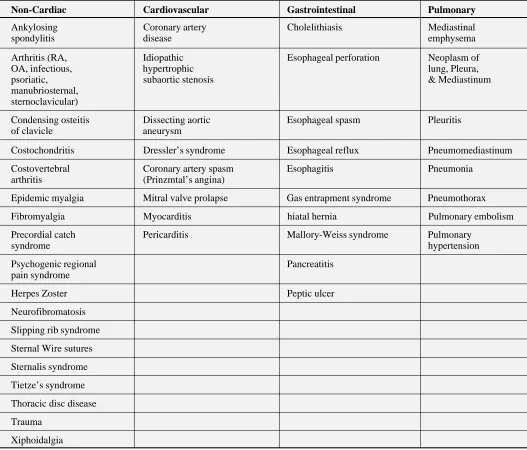
Table 1
Possible causes of chest pain
Non-Cardiac Cardiovascular Gastrointestinal Pulmonary
Ankylosing Coronary artery Cholelithiasis Mediastinal
spondylitis disease emphysema
Arthritis (RA, Idiopathic Esophageal perforation Neoplasm of
OA, infectious, hypertrophic lung, Pleura,
psoriatic, subaortic stenosis & Mediastinum
manubriosternal, sternoclavicular)
Condensing osteitis Dissecting aortic Esophageal spasm Pleuritis
of clavicle aneurysm
Costochondritis Dressler’s syndrome Esophageal reflux Pneumomediastinum
Costovertebral Coronary artery spasm Esophagitis Pneumonia
arthritis (Prinzmtal’s angina)
Epidemic myalgia Mitral valve prolapse Gas entrapment syndrome Pneumothorax
Fibromyalgia Myocarditis hiatal hernia Pulmonary embolism
Precordial catch Pericarditis Mallory-Weiss syndrome Pulmonary
syndrome hypertension
Psychogenic regional Pancreatitis
pain syndrome
Herpes Zoster Peptic ulcer
Neurofibromatosis
Slipping rib syndrome
Sternal Wire sutures
Sternalis syndrome
Tietze’s syndrome
Thoracic disc disease
Trauma
For example, a patient with angina pectoris frequently fails to show any abnormality on physical examination; while a patient with myocardial infarction may present with signs of congestive heart failure, such as a third heart sound, rales and rarely, pedal edema.19
Neuromusculoskeletal examination
When a patient with primary or secondary complaint of chest pain presents to a chiropractic office, it may be useful to organize the history taking and physical examination in terms of location, pattern, character and duration of pain. Neuromusculoskeletal cause of chest pain can be exposed by trying to mechanically reproduce the patient’s exact complaint with respect to location and quality of pain. Chiropractor’s skills in neurological, orthopaedic and pal-patory examination should be optimized to detect possible non-neuromusculoskeletal causes of chest pain.19,20,21
Researchers at the Philadelphia College of Osteopathic Medicine (PCOM) conducted a randomized control study in which 62 subjects (25 subjects had confirmed acute MI, 15 subjects had cardiovascular disease other than MI, and 22 subjects with no known heart disease as controls) were seen by osteopathic physicians for palpation of the tho-racic paravertebral soft tissue at T1 through T8. They found that the control group had low incidence of palpable changes throughout the thoracic dorsum, and these changes were uniformly distributed from T1 to T8. Exami-nation of the group with myocardial infarction disclosed a significantly higher incidence of soft tissue changes (in-creased firmness, warmth, ropiness, oedematous changes, heavy musculature), confined almost entirely to the upper four thoracic levels. Statistically significant differences were found at T1 to T4 on the left and at T4 on the right for the MI group when compared to the other two groups. The 15 patients who had cardiovascular disease other than MI also showed significantly different changes on palpation compared with the group with myocardial infarction.22 In a follow-up study, the same researchers at the Philadelphia College of Osteopathic Medicine (PCOM) found that the soft tissue changes were significantly reduced in the eight MI patients who returned for re-examination.21 As it was illustrated in this study a readily palpable somatic compo-nent might be an important sign during routine physical examination, alerting the examining physician to pursue a diagnosis of unrecognised myocardial infarction.
Laboratory findings
The most important laboratory procedure in the patient with suspected acute myocardial infarction is analysis of the ECG (electrocardiogram). In acute transmural myo-cardial infarct (Q-wave infarct) the initial ECG may be diagnostic, showing abnormal deep Q-waves and elevated ST segments in leads subtending the area of damage, or the ECG may be strikingly abnormal with elevated or de-pressed ST segments and deeply inverted T-waves without abnormal Q-waves.8 Nontransmural infarcts (non-Q-Wave infarcts) are usually in the subendocardial or mid-myocardial layers, and are not associated with diagnosic Q waves on the ECG and commonly produce only varying degrees of ST segment and T-wave abnormality.8
Resting and exercise electrocardiogram are indicated for the patient with possible angina pectoris. Coronary angiography and radionuclide studies are used for the di-agnosis and management of coronary artery disease. Echo-cardiography is the best test for assessing patients with pericarditis and mitral valve prolapse.24
Routine laboratory examination reveals abnormalities compatible with tissue necrosis. Therefore, about 12 hours after myocardial infarction, ESR (Erythrocyte sedimenta-tion rate) is increased, WBC (white blood cell) is usually elevated, and differential WBC count shifts to the left.8
Myocardial enzymes
Within 6 hours of myocardial necrosis, CK-MB (myocar-dial component of creatine kinase) is found in blood. El-evated levels persist for 36 to 48 hours after myocardial infarction. Elevation of CK with > 40% MB in combina-tion with clinical findings is diagnostic of myocardial in-farction. Repetitive measurement of CK-MB for every 6 hours for the first 24 hours will confirm or reject the diag-nosis. Serum lactic dehydrogenae (LDH) rises later and persists longer in serum (7–9 days) than CK-MB. Combin-ing repetitive CK-MB, LDH, and myocardial imagCombin-ing re-sults are useful with suspected MI patients who are seen some time after the onset of signs and symptoms.8
Differential diagnosis
Diagnosis
Typical MI is diagnosed from the history, confirmed by the initial ECG and its subsequent evolution, and sup-ported by the serial enzyme changes. Otherwise, the pa-tients must be classified as having had a possible or probable MI. However, it is wise to consider MI in all men over age 35 and all women over 50 when their major com-plaint is chest pain.8
Risk factors
The following are the most classic coronary artery disease risk factors and preventive strategies which are similar for women and men:23,24,25 Smoking; high cholesterol; high blood pressure; diabetes mellitus; physical inactivity; fam-ily history of heart disease; increasing age; obesity; and negative effects of stress. For women, additional risk fac-tors may include reduced estrogen levels triggered by menopause or other factors; oral contraceptive use for greater than 10 years (especially if begun under 35 years of age); and elevated triglyceride levels.5
Oral contraceptives
The rate of coronary heart disease is low among women of childbearing age. Among women 35–44 years of age, the annual incidence is 1 per 1,000; among women 45–54 years of age, the incidence is 4 per 1,000.26,27 The older high-dose oral contraceptives increased the risk of cardio-vascular disease by raising LDL cholesterol levels and lowering HDL cholesterol levels, reducing glucose toler-ance, raising blood pressure and promoting clotting mechanisms.28 The relative risk of myocardial infarction was elevated among women who used these oral contra-ceptives. The composition of oral contraceptives has changed considerably since they were first introduced. Current estrogen and progestin levels have been reduced, and their effect on lipoprotein levels is slight.29 The results of some recent case-control studies suggest that oral con-traceptives containing lower doses of steroids may carry less risk of coronary heart disease.30
Alcohol consumption
Although heavy alcohol use increases the risk of death from cardiovascular complications, there is much evi-dence suggesting that low to moderate daily consumption of alcohol provides protection against coronary heart dis-ease in both men and women.31
Low-dose aspirin
Meta-analyses of randomized trials involving people with a history of occlusive vascular disease have demonstrated that aspirin reduces the incidence of subsequent myocar-dial infarction, stroke, and death by about 25 percent in both men and women. Similarly, aspirin has a clear benefit in men and women with acute evolving myocardial infarc-tion.32
Antioxidant vitamins
It has been hypothesized that antioxidants such as beta carotene, vitamin E, and vitamin C may reduce the risk of cardiovascular disease. Research has demonstrated that such vitamins inhibit either the oxidation of low density lipoprotein cholesterol or its uptake in the coronary artery endothelium.33
Postmenopausal hormone-replacement therapy
There is compelling evidence that postmenopausal hor-mone-replacement therapy reduces the risk of coronary heart disease. A review of 31 observational studies esti-mated a statistically significant 44 percent reduction in the risk of coronary heart disease among postmenopausal women receiving estrogen-replacement therapy.34
Summary
Insidious onset of neck and upper back pain, secondary to heart problems paint a possible clinical complication of patients seeking chiropractic care. As in the case outlined above, recognizing the possible underlying cause of the patient’s complaints, and directing them toward the appro-priate venues of therapy is essential.
References
1 Women and heart disease, Health News. Dec 1995; 13(6):1–4.
2 National Centre for Health Statistics. Advance report of final mortality statistics, 1991. Monthly Vital Statistics Report, 1993; 42(2)(supplement).
3 Heart and Stroke Foundation of Canada, The Changing Face of Heart Disease and Stroke in Canada 2000. October 1999:68–70.
4 Giardina EG. Heart Disease in Women. The Columbia Univ. Coll. of Physicians & surgeons Complete Home Medical Guide, Edition 3. 1995:201.
6 Kelner M. Hall O, Coulter I. Chiropractors: do they help? Markham: Fitzhenry and Whiteside; 1986:99.
7 Health News. University of Toronto faculty of Medicine, Dec. 1995; 13:6.
8 Berkow R. The Merck Manual of Diagnosis and Therapy, sixteenth Edition. Rahway, N.J: Merck Research
Laboratories; 1992:367–368.
9 Pepine CJ, Adams J, Marks RG, Morris JJ, Scheidt SS, Handberg E. Characteristics of a contemporary population with angina pectoris. Am J Cardiol 1994; 74:226–231. 10 Sullivan AK, Holdright DR, Wright CA, Sparrow JL,
Cunningham D, Fox KM. Chest pain in women: clinical, investigative and prognostic features. BMJ 1994; 308:883–886.
11 Eaker ED, Packard B, Wenger NK, Clarkson RB, Tyroler HA. Coronary artery disease in women. Am J Cardiol 1988; 61:641–644.
12 Lerner DJ, Kannel WB. Patterns of coronary heart disease morbidity and mortality in the sexes: a 26-year follow-up of the Framingham population. Am Heart J 1986; 111:383–390.
13 Pilote L, Hlatky MA. Attitudes of women toward hormone therapy and prevention of heart disease. Am Heart J 995; 129:1237–1238.
14 Cline C, Broms K, Willenheimer R, Israelsson B, Erhardt L. Hospitalization and health care costs due to congestive heart failure in the elderly. Am J Geriatr Cardiol 1996; 5:10–23.
15 Vinson JM, Rich MW, Sperry JC, Shah AS, McNamara T. Early readmission of elderly patients with congestive heart failure. J Am Geriatr Soc 1990; 38:1290–1295.
16 O’Connor GT, Buring JE, Yusuf S, Goldhaber SZ, Olmstead EM, Paffenbarger RS Jr, et al. An overview of randomized trials of rehabilitation with exercise after myocardial infarction. Circulation 1989; 80:234–244. 17 Oldridge NB, Guyatt GH, Fischer M, Rimm A. Cardiac
rehabilitation after myocardial infarction; combining data from randomized clinical trials. JAMA 1988;
260:945–980.
18 Cardiac Rehabilitation Guideline Panel. Cardiac Rehabilitation. Washington: Agency for Health Care Policy and Research and the National Heart, Lung, and Blood institute, Public Health Service, US Department of Health and Human Services; 1995. Clinical practice guideline No.
19 Kaye BR. Chest pain: Not always a cardiac problem. J Musculoskeletal Medicine 1993; 10(3):37–49.
20 Souza TA. Back to basics... Differentiating mechanical pain from visceral pain. Top Clin Chiro 1994; 1(1):1–12. 21 Sprovieri J. Heart in Hand, OMT helps victims of
myocardial infarctions The DO 1993; May:83–85. 22 Nicholas AS, DeBias DA, Ehrenfeuchter w, et al. A
somatic component to myocardial infarction. Br Med J 1985; 291:13–17.
23 The Women’s Health Data Book, 2nd Ed. Jacobs Institute of Women’s Health. Washington DC: 1995; 54–80. 24 Chiamvimonvat V, Sternberg L. Coronary Artery Disease
in Women. Canadian Family Physician 1998; 44:2709–2717.
25 Rich-Edwards JW, Manson JE, Hennekens CH, Burning JE. The Primary Prevention of Coronary Heart Disease in Women. New Eng J Med 1999; 332(26):1758–1766. 26 Wenger NK, Speroff L, Packard B. Cardiovascular
health and disease in women. New Eng J Med 1993; 329:247–256.
27 Kannel Wb, Abbott RD. Incidence and prognosis of myocardial infarction in women: The Framingham Study. In:Eaker ED, Packard B, Wenger Nk, et al.(eds),Coronary heart disease in women. New York: Haymarket-Doyma, 1987:208–214.
28 Stadel BV. Oral contraceptives and cardiovascular disease. N Engl J Med 1981; 305:672–677.
29 Stampfer MJ, Willett WC, Colditz GA, Speizer FE, Hennekens CH. A prospective study of past use of oral contraceptive agents and risk of cardiovascular disease. N Eng J Med 1988; 319:1313–1317.
30 Throgood M. Oral contraceptives and cardiovascular disease: and epidemiologic overview. Pharmacoepidemiol Drug Saf 1993; 2:3–16.
31 Hennekens CH, Alcohol IN, Kaplan NM, Stamler J. Prevention of coronary heart disease: practical management of the risk factors. Philadelphia: W.B. Saunders; 1983:130–138.
32 Antiplatelet Trialists Collaboration. Collaborative overview of randomised trials of antiplatelet therapy-I: prevention of death, myocardial infarction, and stroke by prolonged antiplatelet therapy in various categories of patients. BMJ 1994; 308:81–106.
33 Steinberg D, Parthasarathy S, Carew TE, Khoo JC, Witzium JL. Beyond cholesterol: modifications of low-density lipoprotein that increase its atherogenicity. New Eng J Med 1989; 320:915–924.