24-Hour Movement Behaviors
and Impulsivity
Michelle D. Guerrero, PhD,aJoel D. Barnes, MSc,aJeremy J. Walsh, PhD,a,bJean-Philippe Chaput, PhD,a,c,d Mark S. Tremblay, PhD,a,cGary S. Goldfield, PhDa,c,d,e
abstract
BACKGROUND:The objective of this study was to examine individual and concurrent associations
between meeting the Canadian 24-Hour Movement Guidelines for Children and Youth (9–11
hours of sleep per night,#2 hours of recreational screen time (ST) per day, and at least
60 minutes of moderate to vigorous physical activity per day) and dimensions of impulsivity.
METHODS:Data from this cross-sectional observational study were part of thefirst annual
curated release of the Adolescent Brain Cognitive Development Study. Participants included 4524 children between the ages of 8 and 11 years.
RESULTS:In analyses, it was shown that adherence to individual movement behavior
recommendations as well as combinations of adherence to movement behavior recommendations were associated with each dimension of impulsivity. Meeting all 3 movement behavior recommendations was associated with lower positive urgency (95%
confidence interval [CI]:20.12 to20.05), negative urgency (95% CI: 20.04 to 20.08),
Behavioral Inhibition System (95% CI:20.08 to20.01), greater perseverance (95% CI: 0.09
to 0.15), and better scores on delay-discounting (95% CI: 0.57 to 0.94). Meeting the ST and sleep recommendations was associated with less impulsive behaviors on all dimensions of
impulsivity: negative urgency (95% CI:20.20 to20.10), positive urgency (95% CI:20.16 to
20.08), perseverance (95% CI: 0.06 to 0.15), Behavioral Inhibition System (95% CI:20.15 to
20.03), Behavioral Activation System (BAS) reward responsiveness (95% CI: 20.04 to
20.05), BAS drive (95% CI:20.14 to20.06), BAS fun-seeking (95% CI:20.15 to20.17), and
delay-discounting task (95% CI: 0.68 to 0.97).
CONCLUSIONS:Findings support efforts to determine if limiting recreational ST while promoting
adequate sleep enhances the treatment and prevention of impulsivity-related disorders.
WHAT’S KNOWN ON THIS SUBJECT:Impulsivity has been implicated in the development and maintenance of psychiatric conditions. Sleep, screen time (ST), and physical activity have been independently associated with impulsivity among children; however, how these modifiable factors concurrently relate to children’s impulse control is unknown.
WHAT THIS STUDY ADDS:This study is thefirst to show that adequate sleep and reduced ST are linked with less impulsive behavior among children. Efforts to determine if promoting adequate sleep and limiting ST enhances the prevention of impulsivity-related disorders are needed.
To cite:Guerrero MD, Barnes JD, Walsh JJ, et al. 24-Hour Movement Behaviors and Impulsivity. Pediatrics. 2019; 144(3):e20190187
a
Healthy Active Living and Obesity Research Group, Children’s Hospital of Eastern Ontario Research Institute, Ottawa, Ontario, Canada;bExercise, Metabolism, and Inflammation Laboratory, University of British Columbia
Okanagan, Kelowna, British Columbia, Canada; andcDepartment of Pediatrics anddSchool of Human Kinetics, Faculty of Health Sciences, andeSchool of Psychology, Faculty of Social Sciences, University of Ottawa, Ottawa,
Ontario, Canada
Dr Guerrero conceived the analytical approach, conducted all analyses, and assisted with drafting the initial manuscript; Mr Barnes and Drs Walsh, Chaput, and Tremblay assisted with data analysis and interpretation and critically reviewed the manuscript for important intellectual content; Dr Goldfield conceptualized the study, assisted with drafting the initial manuscript, and critically reviewed the manuscript for important intellectual content; and all authors approved thefinal manuscript as submitted and agree to be accountable for all aspects of the work.
DOI:https://doi.org/10.1542/peds.2019-0187 Accepted for publication Jun 10, 2019
Impulsivity is often characterized as a tendency to act without forethought or to make decisions that reflect an inability to delay gratification; it is a multidimensional construct that encompasses cognitive, emotional, personality, and behavioral elements.1Impulsivity is a core characteristic in attention-deficit/ hyperactivity disorder2but has also been implicated in the development and maintenance of many other psychiatric conditions, such as substance abuse disorders,3,4 behavioral addictions,5eating disorders,6and other externalizing behavioral disorders.7,8Impulsivity has also been linked to emotion dysregulation leading to self-harm9 and suicidal attempts among youth.10 Thus, identifying modifiable
determinants of impulsivity can inform targets to enhance the treatment and prevention of impulse control–related psychiatric disorders.
The average amount of sleep (in hours) that youth are achieving per night has decreased in recent decades, in part because of increased use of electronics.11Lack of sleep is related to greater impulsivity,12with mechanistic evidence suggesting that poor sleep negatively affects
prefrontal cortical functioning, resulting in impairments in behavioral inhibition.13However, little data exist on the relationship between sleep duration and measures of impulsive personality traits and behavioral inhibition in preadolescent children.
It has been postulated that engaging with electronic devices during development (eg, smartphones), which often necessitates immediate responding to maintain
communication or gaming, stimulates powerful behavioral and
neurobiological (ie, dopamine release) reinforcement that promotes greater use, resulting in impaired inhibitory control, perseverance, emotion regulation, and other
self-regulatory cognitive processes.14 General support of these hypotheses has been found in several studies; weak impulse control has been associated with heavy engagement
with mobile devices,15heavy media
multitasking,16and excessive television watching (.3 hours per day).13However, most of this research has been conducted with older adolescents, and therefore relations among screen use and impulsivity in prepubertal children (8–11 years) are unclear.
Physical activity (PA) has been shown to improve domains of cognition,17 including sustained attention, emotion regulation, and working memory, which are intricately associated with impulse control.18 Thus, PA may be a viable method for promoting better inhibitory control and reducing impulsivity. Low levels of PA have been linked to impulsive behavior,13and it has been shown in several experimental studies that PA reduces behavioral inhibition among youth from clinical populations.19,20 However, associations with other measures of impulsivity, such as delay-discounting (choosing smaller immediate rewards over larger more-delayed rewards) or self-reported impulsivity traits, have not been well studied in community samples of preadolescent children.
The Canadian 24-Hour Movement Guidelines for Children and Youth21 are thefirst evidence-based
movement guidelines that address an entire day. These guidelines
recommend that children ages 5 to 13 years accumulate a minimum of 60 minutes per day in moderate to vigorous PA, spend no more than 2 hours per day in recreational screen time (ST), and obtain 9 to 11 hours of sleep per night. Children who meet all 3 movement behavior
recommendations have better cognitive function,22lower odds of obesity,23better dietary patterns,24 and enhanced quality of life25than children who do not meet any of the
recommendations. Although individual 24-hour movement behaviors are important to consider in relation to impulsivity, what remains unknown is how these behaviors may concurrently relate to impulsivity in children. Therefore, the purpose of the current study was to examine if meeting the 24-hour movement behaviors individually and/or concurrently relate to a broad scope of dimensions of impulsivity in a large and diverse community sample of US children. We
hypothesized that children who meet the movement behavior
recommendations would exhibit lower scores on multiple indicators of impulsivity than those who do not meet recommendations and that meeting all recommendations would have the strongest relationship with impulsivity dimensions.
METHODS
Study Population
Participants were part of the Adolescent Brain Cognitive Development (ABCD) Study, an ongoing longitudinal, observational study on children’s brain
development and health.26Data for this study are collected on a biennial to annual basis over a 10-year period across 21 sites throughout the United States, using probabilistic sampling to obtain a large, diverse, and
geographically stratified
population-based sample. We used thefirst
(baseline) cross-sectional curated release of the ABCD Study data set, which comprised 4524 children aged 8 to 11 years. Approval from all relevant institutional research ethics boards were obtained, along with signed informed consent from parents or guardians and assent from participating children in accordance with the principles of Helsinki. Information on the sample,
recruitment, measure selection, and compensation are outlined
Exposures
Sleep, ST, and PA served as the independent variables. Sleep was assessed by using one question from the Parent Sleep Disturbance Scale for Children.29Parents were asked to record the number of hours of sleep their child accumulated most nights. Recreational ST was measured by using the Youth Screen Time Survey (12 items),30wherein children were asked to report the number of hours spent engaged in screen-based activities (eg, watching shows and movies, texting) on a typical weekday and weekend day. Daily recreational ST was calculated by taking
a weighted average of the weekday and weekend ST items: (sum of
weekday ST in decimal hours35)1
(sum of weekend day ST in decimal
hours32)/7. PA was assessed by
using one item from the Youth Risk Behavior Survey,31wherein children were asked to indicate on how many days they were active for at least 60 minutes per day in the last 7 days. Single-item measures of sleep and PA have moderate to strong criterion validity with accelerometry-assessed sleep and PA.32,33
Outcomes
Dimensions of impulsivity served as the outcome variables and were
measured by using 3 child-reported assessments: UPPS-P Impulsive Behavior Scale34(D. Lynam, PhD, unpublished observations),
Behavioral Inhibition System (BIS)/ Behavioral Activation System (BAS) Scale,35and cash choice delay-discounting task.36The UPPS-P scale comprises 5 dimensions: negative urgency (eg,“When I am upset, I often act without thinking”), positive urgency (eg,“When I get really happy about something, I tend to do things that can lead to trouble”), (lack of) premeditation (eg,“I like to stop and think things over before I do them”), (lack of) perseverance (“Ifinish what I start”), and sensation seeking (eg,“I like new, thrilling things, even if they are a little scary”). All items were scored on a 4-point Likert scale, anchored at 1 (not at all like me) and 4 (very much like me). Items assessing (lack of) premeditation and one item assessing (lack of)
perseverance were reverse coded. High scores on negative and positive urgency indicate high impulsivity, whereas a high score on perseverance indicates low impulsivity. The BIS/ BAS Scale comprises 4 dimensions assessing BIS (eg,“I feel worried when I have done poorly at something”), BAS drive (eg,“I do everything to get the things that I want”), BAS reward responsiveness
(eg,“I feel excited and full of energy when I get something that I want”), and BAS fun-seeking (eg,“I crave excitement and new sensations”). Items are scored on a 4-point Likert scale anchored at 0 (not true) and 3 (very true). For the delay-discounting task, children were asked to respond to a hypothetical question, indicating whether they would rather obtain $75 in 3 days (smaller, sooner reward) or $115 in 3 months (larger, later reward). They were also given a third“can’t decide”option. Scores on the UPPS-P and BIS/BAS scales have been shown to have adequate reliability coefficients,27and the delay-discounting task has correlated well with real monetary rewards.37
Statistical Analyses
All analyses were conducted by using Mplus 8.2.38Missing data (,1%) were replaced by using multiple imputation. Robust full-information maximum likelihood estimation was used to account for possible nonnormality in responses. Confirmatory factor analyses
(measurement models) werefirst
conducted to examine the factorial structure of the UPPS-P and BIS/BAS scales. Intraclass correlations were calculated to determine if meaningful between-level (ie, data collection sites) differences affected the
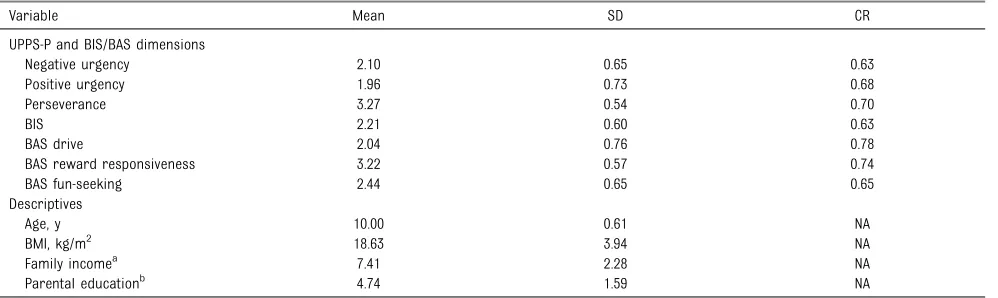
within-TABLE 1Means, SDs, and Composite Reliabilities of Study Variables
Variable Mean SD CR
UPPS-P and BIS/BAS dimensions
Negative urgency 2.10 0.65 0.63
Positive urgency 1.96 0.73 0.68
Perseverance 3.27 0.54 0.70
BIS 2.21 0.60 0.63
BAS drive 2.04 0.76 0.78
BAS reward responsiveness 3.22 0.57 0.74
BAS fun-seeking 2.44 0.65 0.65
Descriptives
Age, y 10.00 0.61 NA
BMI, kg/m2 18.63 3.94 NA
Family incomea 7.41 2.28 NA
Parental educationb 4.74 1.59 NA
CR, composite reliability; NA, not applicable.
aCombined income in past 12 mo from all sources before taxes and deductions on a scale of 1 to 10. 1 =#$5000; 2 = $50002$11 199; 3 = $12 0002$15 999; 4 = $16 0002$24 999; 5 = $25 0002$34 999; 6 = $35 0002$49 999; 7 = $50 0002$74 999; 8 = $75 0002$99 999; 9 = $100 0002$199 999; and 10 =$$200 000 (all in US dollars).
level dependent variables. The intraclass correlations from the unconditional models were low (ranged from 0.003 to 0.03), suggesting that there was little variability between data collection sites. Therefore, although the data were treated as nonnested, potential nonindependence was accounted for by using the TYPE = COMPLEX function in Mplus. Measurement (ie, configural, metric, and scalar) and structural (ie, factor variance and factor mean) invariance across sex were tested and assessed on the basis of Chen et al’s guidelines.39Structural equation modeling was used to evaluate both the measurement models and the hypothesized structural model. In the hypothesized structural model, impulsivity
dimensions were modeled as latent variables, and movement behavior combinations and the delay-discounting task were modeled as observed variables. Covariates (ie, sex, BMI, family income, parental education, and race and ethnicity) were included in the model to account for their potential effect on dimensions of impulsivity.
Information regarding how the covariates were categorized is described in Table 1. Variousfit indices were used to assess the measurement models, including the comparativefit index (CFI), standardized root square mean residual (SRMR), and root mean square error of approximation
(RMSEA). Modelfit was deemed
acceptable if CFI values were.0.90
and if SRMR and RMSEA values were ,0.08.40Composite reliability
estimates41of latent variables were also computed. Statistical inferences
were based onPvalues,.05 and
confidence intervals (CIs).
Participants were classified into 1 of 8 possible movement behavior recommendation combinations: only PA, only ST, only sleep, PA1ST, PA1
sleep, ST1sleep, PA1ST1sleep,
and none (no recommendation met).
Participants were coded as 0 if they did not meet the behavior
recommendation and as 1 if they did meet the behavior recommendation. The cash choice task was also dummy coded, wherein children who selected the larger, later reward or the“can’t
decide”option were coded as 0 and
those who selected the smaller, sooner reward were coded as 1.
RESULTS
Descriptive Statistics and Measurement Models
Descriptive statistics are presented in Tables 1 and 2. Approximately 30% of the sample did not meet any of the recommendations, whereas only 4.8% of the sample met all movement behavior recommendations. Slight
modifications were made to both
measurement models (ie, deletion of negative factor loadings). Thefinal UPPS-P solution comprised a 3-factor model (positive urgency, negative urgency, and perseverance), which showed excellent modelfit (x2[51] =
329.58,P,.001, CFI = 0.97; SRMR =
0.03; RMSEA = 0.04 [90% CI: 0.031 to 0.038]). The 4-factor solution for the
BIS/BAS Scale also revealed excellent modelfit (x2[146] = 1415.86,P, .001, CFI = 0.92; SRMR = 0.04; RMSEA = 0.04 [90% CI: 0.042 to 0.046]).
Modelfit for the measurement and
structural invariance testing
indicated acceptable modelfit, and all changes infit indices fell within acceptable ranges, as suggested by Chen et al39(see Supplemental Table 6).
Structural Model
UPPS-P
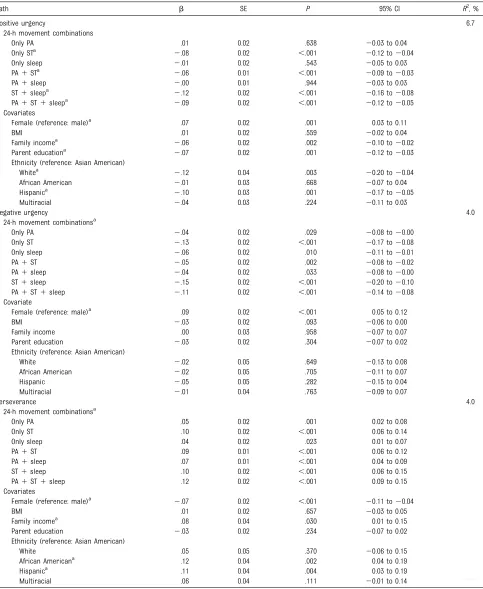
Meeting all movement behavior combinations (versus meeting none of the recommendations) was negatively related to positive and negative urgency and positively related to perseverance. Meeting the
ST1sleep recommendations (versus
meeting no recommendation) was most strongly associated with negative urgency (b=2.15), and meeting all movement behavior recommendations was most strongly associated with perseverance
(b= .12). Compared with meeting
no recommendation, meeting only
the ST recommendation (b=2.08),
the PA1ST recommendations
TABLE 2Proportions of Study Variables
Descriptives N %
Sex
Male 2152 47.6
Female 2372 52.4
Race and ethnicity
Asian American 115 2.5
African American 452 10.0
White 2660 58.8
Hispanic 740 16.4
Multiracial 557 12.3
Movement behavior combinations
Only PA 251 5.5
Only ST 522 11.5
Only sleep 1073 23.7
PA1ST 115 2.5
PA1sleep 212 4.7
ST1sleep 802 17.7
PA1ST1sleep 216 4.8
None 1333 29.4
Cash choice task
Smaller, sooner 1841 40.7
Larger, later 2617 57.8
(b=2.06), the ST1sleep
recommendations (b=2.12), and all
recommendations (b=2.09) were
negatively associated with positive
urgency. Meeting the ST1sleep
ecommendations had the strongest association with positive urgency. Standardizedbcoefficients, SEs,P values, and CIs are presented in Table 3.
BIS/BAS
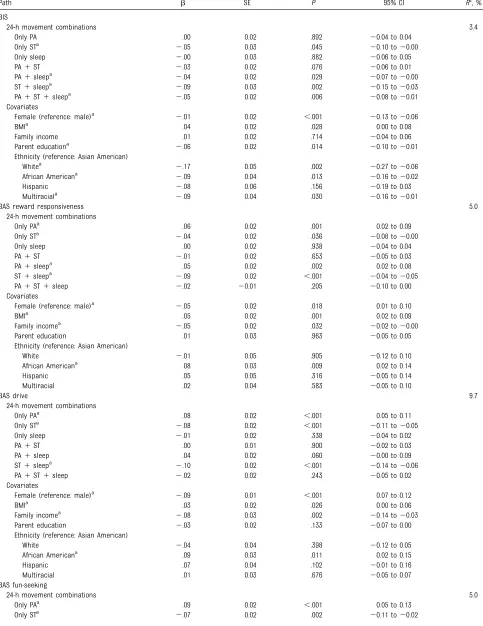
Apart from 3 exceptions (meeting only the sleep recommendation, only the PA recommendation, and the PA
1ST recommendations), meeting all
movement behavior combinations (versus meeting no recommendation) was negatively related to the BIS.
Meeting the ST1sleep
recommendations had the strongest relationship with the BIS (b=2.09). Meeting only the ST recommendation (b=2.08) and the ST1sleep
recommendations (b=2.10) (versus
meeting no recommendation) were negatively associated with BAS drive, with the latter combination having the strongest association with BAS drive. Meeting only the ST
recommendation (b=2.07) and
the ST1sleep recommendations
(b=2.11) (versus meeting no recommendation) were negatively related to BAS fun, with the later combination having the strongest association. Meeting only the ST
recommendation (b=2.04) and
the ST1sleep recommendations
(b=2.09) (versus meeting no recommendation) were negatively associated with BAS reward
responsiveness. Meeting the PA1
sleep recommendations (versus meeting no recommendation) was positively associated with BAS reward responsiveness (b= .05), and meeting only the PA recommendation (versus meeting no recommendation) was positively associated with BAS drive (b= .08), BAS fun (b= .09), and BAS reward responsiveness (b= .06). Standardizedbcoefficients, SEs,P values, and CIs are presented in Table 4.
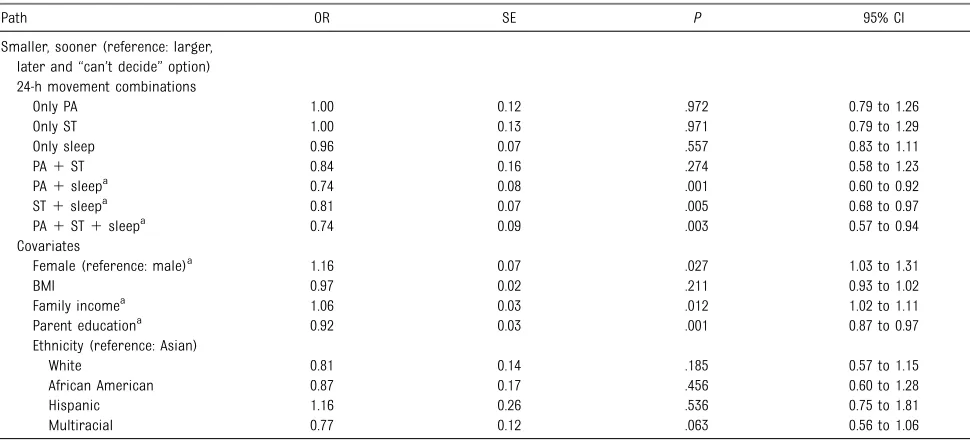
Delay-Discounting Task
Compared with meeting no recommendation, participants
meeting the sleep1PA
recommendations (odds ratio [OR] = 0.74), the sleep 1ST
recommendations (OR = 0.81), and all recommendations (OR = 0.74) were less likely to select the smaller, sooner reward than the larger, later reward or the“can’t decide”option. ORs, SEs, Pvalues, and CIs are presented in Table 5.
DISCUSSION
The purpose of the current study was to determine if meeting the 24-hour movement behavior
recommendations was associated with dimensions of impulsivity. In our results, it was shown that adherence to individual movement behavior recommendations as well as combinations of adherence to movement behavior
recommendations were associated with each dimension of impulsivity. More specifically, children who met the sleep and ST recommendations scored favorably on all 8 dimensions of impulsivity (negative urgency, positive urgency, [lack of] perseverance, BIS, BAS drive, BAS reward, BAS fun-seeking, and delay-discounting) than children who did not meet any recommendation. In
most cases, meeting the sleep1ST
recommendations had the strongest association with the impulsivity dimensions. Although meeting all 24-hour movement behavior
recommendations was associated with reduced impulsivity on 5 of the 8 domains (positive urgency, negative urgency, perseverance, BIS, delay-discounting), this movement behavior combination emerged as having the strongest association with only 1 of the impulsivity domains. Thus, with our results, it is suggested that meeting the PA recommendation provided no incremental predictive
value beyond meeting the sleep1ST
guidelines. The models explained 3.4% to 9.7% of the variance of impulsivity scores.
The sleep1ST movement behavior
combination had the strongest association with most of the impulsivity measures (7 out of 8
dimensions), whereas the sleep1ST
1PA behavior combination had the
strongest association with
perseverance. The formerfinding is
not surprising, given that increased ST and reduced sleep have been independently associated with domains reflecting higher impulsivity among university students.12,15 Moreover, more ST (eg, television, computers, video games, and mobile devices) is adversely associated with various sleep outcomes in school-aged children and adolescents, such as delayed bedtimes and shorter sleep duration.42,43Reduced ST has also been associated with greater sleep duration.44Ourfindings highlight that sleep and ST interact in a fashion that provides unique
benefits compared with meeting
either movement behavior alone and may be especially clinically relevant to target concurrently in
interventions, given a small percentage of children meet these movement behavior guidelines.
TABLE 3Standardized Path Coefficients Between Movement Behavior Recommendation Combinations and UPPS-P Dimensions
Path b SE P 95% CI R2, %
Positive urgency 6.7
24-h movement combinations
Only PA .01 0.02 .638 20.03 to 0.04
Only STa 2.08 0.02 ,.001 20.12 to20.04
Only sleep 2.01 0.02 .543 20.05 to 0.03
PA1STa 2.06 0.01 ,.001 20.09 to20.03
PA1sleep 2.00 0.01 .944 20.03 to 0.03
ST1sleepa 2.12 0.02 ,.001 20.16 to20.08
PA1ST1sleepa 2.09 0.02 ,.001 20.12 to20.05
Covariates
Female (reference: male)a .07 0.02 .001 0.03 to 0.11
BMI .01 0.02 .559 20.02 to 0.04
Family incomea 2.06 0.02 .002 20.10 to20.02
Parent educationa 2.07 0.02 .001 20.12 to20.03
Ethnicity (reference: Asian American)
Whitea 2.12 0.04 .003 20.20 to20.04
African American 2.01 0.03 .668 20.07 to 0.04
Hispanica 2.10 0.03 .001 20.17 to20.05
Multiracial 2.04 0.03 .224 20.11 to 0.03
Negative urgency 4.0
24-h movement combinationsa
Only PA 2.04 0.02 .029 20.08 to20.00
Only ST 2.13 0.02 ,.001 20.17 to20.08
Only sleep 2.06 0.02 .010 20.11 to20.01
PA1ST 2.05 0.02 .002 20.08 to20.02
PA1sleep 2.04 0.02 .033 20.08 to20.00
ST1sleep 2.15 0.02 ,.001 20.20 to20.10
PA1ST1sleep 2.11 0.02 ,.001 20.14 to20.08
Covariate
Female (reference: male)a .09 0.02 ,.001 0.05 to 0.12
BMI 2.03 0.02 .093 20.06 to 0.00
Family income .00 0.03 .958 20.07 to 0.07
Parent education 2.03 0.02 .304 20.07 to 0.02
Ethnicity (reference: Asian American)
White 2.02 0.05 .649 20.13 to 0.08
African American 2.02 0.05 .705 20.11 to 0.07
Hispanic 2.05 0.05 .282 20.15 to 0.04
Multiracial 2.01 0.04 .763 20.09 to 0.07
Perseverance 4.0
24-h movement combinationsa
Only PA .05 0.02 .001 0.02 to 0.08
Only ST .10 0.02 ,.001 0.06 to 0.14
Only sleep .04 0.02 .023 0.01 to 0.07
PA1ST .09 0.01 ,.001 0.06 to 0.12
PA1sleep .07 0.01 ,.001 0.04 to 0.09
ST1sleep .10 0.02 ,.001 0.06 to 0.15
PA1ST1sleep .12 0.02 ,.001 0.09 to 0.15
Covariates
Female (reference: male)a 2.07 0.02 ,.001 20.11 to20.04
BMI .01 0.02 .657 20.03 to 0.05
Family incomea .08 0.04 .030 0.01 to 0.15
Parent education 2.03 0.02 .234 20.07 to 0.02
Ethnicity (reference: Asian American)
White .05 0.05 .370 20.06 to 0.15
African Americana .12 0.04 .002 0.04 to 0.19
Hispanica .11 0.04 .004 0.03 to 0.19
Multiracial .06 0.04 .111 20.01 to 0.14
CIs are standardized.
TABLE 4Standardized Path Coefficients Between Movement Behavior Recommendation Combinations and BIS/BAS Dimensions
Path b SE P 95% CI R2, %
BIS
24-h movement combinations 3.4
Only PA .00 0.02 .892 20.04 to 0.04
Only STa 2.05 0.03 .045 20.10 to20.00
Only sleep 2.00 0.03 .882 20.06 to 0.05
PA1ST 2.03 0.02 .076 20.06 to 0.01
PA1sleepa 2.04 0.02 .029 20.07 to20.00
ST1sleepa 2.09 0.03 .002 20.15 to20.03
PA1ST1sleepa 2.05 0.02 .006 20.08 to20.01
Covariates
Female (reference: male)a 2.01 0.02 ,.001 20.13 to20.06
BMIa .04 0.02 .028 0.00 to 0.08
Family income .01 0.02 .714 20.04 to 0.06
Parent educationa 2.06 0.02 .014 20.10 to20.01
Ethnicity (reference: Asian American)
Whitea 2.17 0.05 .002 20.27 to20.06
African Americana 2.09 0.04 .013 20.16 to20.02
Hispanic 2.08 0.06 .156 20.19 to 0.03
Multiraciala 2.09 0.04 .030 20.16 to20.01
BAS reward responsiveness 5.0
24-h movement combinations
Only PAa .06 0.02 .001 0.02 to 0.09
Only STa 2.04 0.02 .036 20.08 to20.00
Only sleep .00 0.02 .938 20.04 to 0.04
PA1ST 2.01 0.02 .653 20.05 to 0.03
PA1sleepa .05 0.02 .002 0.02 to 0.08
ST1sleepa 2.09 0.02 ,.001 20.04 to20.05
PA1ST1sleep 2.02 20.01 .205 20.10 to 0.00
Covariates
Female (reference: male)a 2.05 0.02 .018 0.01 to 0.10
BMIa .05 0.02 .001 0.02 to 0.09
Family incomea 2.05 0.02 .032 20.02 to20.00
Parent education .01 0.03 .963 20.05 to 0.05
Ethnicity (reference: Asian American)
White 2.01 0.05 .905 20.12 to 0.10
African Americana .08 0.03 .009 0.02 to 0.14
Hispanic .05 0.05 .316 20.05 to 0.14
Multiracial .02 0.04 .583 20.05 to 0.10
BAS drive 9.7
24-h movement combinations
Only PAa .08 0.02 ,.001 0.05 to 0.11
Only STa 2.08 0.02 ,.001 20.11 to20.05
Only sleep 2.01 0.02 .338 20.04 to 0.02
PA1ST .00 0.01 .900 20.02 to 0.03
PA1sleep .04 0.02 .060 20.00 to 0.09
ST1sleepa 2.10 0.02 ,.001 20.14 to20.06
PA1ST1sleep 2.02 0.02 .243 20.05 to 0.02
Covariates
Female (reference: male)a 2.09 0.01 ,.001 0.07 to 0.12
BMIa .03 0.02 .026 0.00 to 0.06
Family incomea 2.08 0.03 .002 20.14 to20.03
Parent education 2.03 0.02 .133 20.07 to 0.00
Ethnicity (reference: Asian American)
White 2.04 0.04 .398 20.12 to 0.05
African Americana .09 0.03 .011 0.02 to 0.15
Hispanic .07 0.04 .102 20.01 to 0.16
Multiracial .01 0.03 .676 20.05 to 0.07
BAS fun-seeking
24-h movement combinations 5.0
Only PAa .09 0.02 ,.001 0.05 to 0.13
in attention, cognitive control, and impulsivity.14These neurobiological correlates of excessive ST, combined with a prominent dynamic inherent in many screen-based technologies that necessitate immediate
responding while punishing delayed responses, may serve to reinforce impulsivity and undermine the development of self-regulatory abilities.
Meeting the PA recommendation (either alone or in combination with meeting the sleep recommendation)
was positively related to BAS reward responsiveness and BAS drive. This
finding is somewhat consistent with
previous research, indicating that greater levels of PA are linked with higher scores on BAS drive48and that greater PA enjoyment is positively associated with BAS reward
responsiveness.49We also found that PA was associated with lower negative urgency and positively associated with perseverance. These novelfindings are generally
consistent with a recent systematic
review in which it was shown that PA is associated with improved executive functioning in youth.17The
inconsistent associations observed may reflect differences in PA dose, measurement, and sample
characteristics across studies. Clearly, more research is needed to determine how PA alone or combined with other movement behavior
recommendations is associated with children’s impulsive traits. The prospective, longitudinal measures from the ABCD Study will be
TABLE 4 Continued
Path b SE P 95% CI R2, %
Only sleep 2.01 0.02 .578 20.05 to 0.03
PA1ST .01 0.02 .753 20.03 to 0.04
PA1sleep .04 0.02 .118 20.00 to 0.08
ST1sleepa 2.11 0.02 ,.001 20.15 to20.07
PA1ST1sleep .01 0.02 .533 20.03 to 0.05
Covariates
Female (reference: male)a 2.05 0.02 .014 0.01 to 0.10
BMI .03 0.02 .213 20.02 to 0.07
Family income 2.02 0.03 .363 20.07 to 0.03
Parent education 2.02 0.03 .366 20.07 to 0.03
Ethnicity (reference: Asian American)
White .11 0.06 .068 20.01 to 0.23
African Americana .12 0.05 .014 0.02 to 0.21
Hispanica .11 0.05 .026 0.01 to 0.20
Multiraciala .09 0.04 .022 0.01 to 0.16
CIs are standardized.
aIndicates a significant path coefficient.
TABLE 5Relationships Between Movement Behavior Recommendation Combinations and Delay-Discounting Task
Path OR SE P 95% CI
Smaller, sooner (reference: larger, later and“can’t decide”option) 24-h movement combinations
Only PA 1.00 0.12 .972 0.79 to 1.26
Only ST 1.00 0.13 .971 0.79 to 1.29
Only sleep 0.96 0.07 .557 0.83 to 1.11
PA1ST 0.84 0.16 .274 0.58 to 1.23
PA1sleepa 0.74 0.08 .001 0.60 to 0.92
ST1sleepa 0.81 0.07 .005 0.68 to 0.97
PA1ST1sleepa 0.74 0.09 .003 0.57 to 0.94
Covariates
Female (reference: male)a 1.16 0.07 .027 1.03 to 1.31
BMI 0.97 0.02 .211 0.93 to 1.02
Family incomea 1.06 0.03 .012 1.02 to 1.11
Parent educationa 0.92 0.03 .001 0.87 to 0.97
Ethnicity (reference: Asian)
White 0.81 0.14 .185 0.57 to 1.15
African American 0.87 0.17 .456 0.60 to 1.28
Hispanic 1.16 0.26 .536 0.75 to 1.81
Multiracial 0.77 0.12 .063 0.56 to 1.06
important to better dissect these relationships.
There are limitations and strengths to our study. First, with respect to limitations, our results are based on cross-sectional data, preventing us from drawing any causal inferences regarding associations. Future researchers should not only conduct longitudinal studies but also explore the bidirectional link between the movement behaviors and impulse control. That is, children with impulse control problems may spend more time on rewarding screens, may be more likely to procrastinate bedtime, and may engage in low levels of PA (because the health benefit in future is delayed), which in turn may exacerbate impulsivity, creating a vicious cycle. Second, a single item was used to measure PA, which may have played a role in the lack of
observedfindings between PA and
dimensions of impulsivity. Using other measures of PA (eg, wearable devices) would help to improve the internal validity of ourfindings. Third, the screen-based questions in our study only assessed the amount of time spent in separate ST
behaviors. Other characteristics of ST that can potentially affect young people’s behaviors should also be considered. Such characteristics include screen content, timing exposure, size of screen, frequency of phone-checking, and simultaneous use of multiple screens.43The act of simultaneously using electronic devices (eg, mobile device, computer or tablet) while watching television is referred to as“screen-stacking”(also known as media multitasking) and is a trend expected to grow as screen-based technologies continue to rapidly evolve. In fact, in recent
evidence, it has been shown that nearly half of evening television watchers engage in“ screen-stacking.”50Despite the
acknowledged limitations, our study has notable strengths. In this study, we were thefirst to examine the concurrent associations between sleep, ST, and PA on impulsivity among children. Furthermore, our research is thefirst to include the UPPS-P and BIS/BAS in one model. By modeling different dimensions of impulsivity simultaneously, we were able to account for the interplay between these dimensions (via variance).
CONCLUSIONS
In the results of the current study, we showed that children who met the
sleep1ST recommendations
consistently reported lower levels of impulsivity compared with not meeting any movement behavior guidelines. Meeting all movement behavior recommendations was associated with reduced impulsivity on most but not all measures, suggesting that meeting the PA recommendation provided no incremental benefit in terms of reduced impulsivity, although PA is well documented to be important for physical and mental health in youth and should still be encouraged.51Our
findings have important implications for pediatricians, psychiatrists, educators, parents, and policy makers as they suggest that strategies to limit recreational ST while simultaneously promoting early, routine bedtimes and more sleep may enhance the treatment and prevention of impulsivity-related psychiatric disorders.
ACKNOWLEDGMENTS
Data used in the preparation of this article were obtained from the ABCD Study (https://abcdstudy.org), held in the National Institute of Mental Health Data Archive. This is a multisite, longitudinal study designed to recruit more than 10 000 children aged 9 to 10 years and manage them over 10 years into early adulthood. A listing of participating sites and a complete listing of the study investigators can be found at https://abcdstudy.org/principal-investigators.html. ABCD Study consortium investigators designed and implemented the study and/or provided data but did not necessarily participate in the analysis or writing of this report. This article reflects the views of the authors and may not reflect the opinions or views of the National Institutes of Health or ABCD Study consortium investigators. The ABCD Study data repository grows and changes over time. The ABCD Study data used in this report came from National Institute of Mental Health data (DOI:
10·15154/1412097).
ABBREVIATIONS
ABCD: Adolescent Brain Cognitive Development
BAS: Behavioral Activation System BIS: Behavioral Inhibition System CFI: comparativefit index CI: confidence interval OR: odds ratio PA: physical activity
RMSEA: root mean square error of approximation
SRMR: standardized root square mean residual
ST: screen time
PEDIATRICS (ISSN Numbers: Print, 0031-4005; Online, 1098-4275).
Copyright © 2019 by the American Academy of Pediatrics
FUNDING:The Adolescent Brain Cognitive Development Study is supported by the National Institutes of Health and additional federal partners under award numbers U01DA041022, U01DA041028, U01DA041048, U01DA041089, U01DA041106, U01DA041117, U01DA041120, U01DA041134, U01DA041148, U01DA041156, U01DA041174, U24DA041123, and U24DA041147. A full list of supporters is available at https://abcdstudy.org/nih-collaborators. Funded by the National Institutes of Health (NIH).
POTENTIAL CONFLICT OF INTEREST:The authors have indicated they have no potential conflicts of interest to disclose.
REFERENCES
1. Reynolds B, Ortengren A, Richards JB, de Wit H. Dimensions of impulsive behavior: personality and behavioral measures.Pers Individ Dif. 2006;40(2): 305–315
2. Miller M, Hinshaw SP. Attention-deficit/ hyperactivity disorder. In:Encyclopedia of Mental Health. 2nd ed. Amsterdam, The Netherlands: Elsevier; 2015:116–123 3. Perry JL, Carroll ME. The role of
impulsive behavior in drug abuse. Psychopharmacology (Berl). 2008; 200(1):1–26
4. Shin SH, Chung Y, Jeon SM. Impulsivity and substance use in young adulthood. Am J Addict. 2013;22(1):39–45 5. Rømer Thomsen K, Callesen MB, Hesse
M, et al. Impulsivity traits and addiction-related behaviors in youth.J Behav Addict. 2018;7(2):317–330
6. Waxman SE. A systematic review of impulsivity in eating disorders.Eur Eat Disord Rev. 2009;17(6):408–425 7. Miller JD, Zeichner A, Wilson LF.
Personality correlates of aggression: evidence from measures of thefi ve-factor model, UPPS model of impulsivity, and BIS/BAS.J Interpers Violence. 2012;27(14):2903–2919 8. Krueger RF, Markon KE, Patrick CJ,
Benning SD, Kramer MD. Linking antisocial behavior, substance use, and personality: an integrative quantitative model of the adult externalizing spectrum.J Abnorm Psychol. 2007; 116(4):645–666
9. Maxfield BL, Pepper CM. Impulsivity and response latency in non-suicidal self-injury: the role of negative urgency in emotion regulation.Psychiatr Q. 2018; 89(2):417–426
10. Huang YH, Liu HC, Tsai FJ, et al. Correlation of impulsivity with self-harm and suicidal attempt: a community study of adolescents in Taiwan.BMJ Open. 2017;7(12):e017949
11. Matricciani L, Olds T, Petkov J. In search of lost sleep: secular trends in the sleep time of school-aged children and adolescents.Sleep Med Rev. 2012;16(3): 203–211
12. Miller MB, DiBello AM, Lust SA, Meisel MK, Carey KB. Impulsive personality traits and alcohol use: does sleeping help with thinking?Psychol Addict Behav. 2017;31(1):46–53
13. Abe T, Hagihara A, Nobutomo K. Sleep patterns and impulse control among Japanese junior high school students. J Adolesc. 2010;33(5):633–641 14. Weinstein A, Livny A, Weizman A. New
developments in brain research of internet and gaming disorder.Neurosci Biobehav Rev. 2017;75:314–330 15. Wilmer HH, Chein JM. Mobile technology
habits: patterns of association among device usage, intertemporal
preference, impulse control, and reward sensitivity.Psychon Bull Rev. 2016;23(5):1607–1614
16. Minear M, Brasher F, McCurdy M, Lewis J, Younggren A. Working memory,fluid intelligence, and impulsiveness in heavy media multitaskers.Psychon Bull Rev. 2013;20(6):1274–1281
17. Donnelly JE, Hillman CH, Castelli D, et al. Physical activity,fitness, cognitive function, and academic achievement in children: a systematic review.Med Sci Sports Exerc. 2016;48(6):1197–1222 18. Diamond A. Executive functions.Annu
Rev Psychol. 2013;64:135–168 19. Medina JA, Netto TL, Muszkat M, et al.
Exercise impact on sustained attention of ADHD children, methylphenidate effects.Atten Defic Hyperact Disord. 2010;2(1):49–58
20. Smith AL, Hoza B, Linnea K, et al. Pilot physical activity intervention reduces severity of ADHD symptoms in young children.J Atten Disord. 2013;17(1): 70–82
21. CSEP SCPE. Canadian 24-hour movement guidelines: an integration of physical activity, sedentary behaviour, and sleep. Available at: https:// csepguidelines.ca/. Accessed July 24, 2019
22. Walsh JJ, Barnes JD, Cameron JD, et al. Associations between 24 hour movement behaviours and global cognition in US children: a cross-sectional observational study.Lancet Child Adolesc Health. 2018;2(11): 783–791
23. Roman-Viñas B, Chaput JP, Katzmarzyk PT, et al; ISCOLE Research Group. Proportion of children meeting recommendations for 24-hour movement guidelines and associations with adiposity in a 12-country study.Int J Behav Nutr Phys Act. 2016;13(1):123 24. Thivel D, Tremblay MS, Katzmarzyk PT,
et al; ISCOLE Research Group. Associations between meeting combinations of 24-hour movement recommendations and dietary patterns of children: a 12-country study.Prev Med. 2019;118:159–165
25. Sampasa-Kanyinga H, Standage M, Tremblay MS, et al. Associations between meeting combinations of 24-h movement guidelines and health-related quality of life in children from 12 countries.Public Health. 2017;153: 16–24
26. Garavan H, Bartsch H, Conway K, et al. Recruiting the ABCD sample: design considerations and procedures.Dev Cogn Neurosci. 2018;32:16–22 27. Barch DM, Albaugh MD, Avenevoli S,
et al. Demographic, physical and mental health assessments in the adolescent brain and cognitive development study: rationale and description.Dev Cogn Neurosci. 2018;32(32):55–66 28. Luciana M, Bjork JM, Nagel BJ, et al.
development (ABCD) baseline neurocognition battery.Dev Cogn Neurosci. 2018;32(32):67–79
29. Bruni O, Ottaviano S, Guidetti V, et al. The Sleep Disturbance Scale for Children (SDSC). Construction and validation of an instrument to evaluate sleep disturbances in childhood and adolescence.J Sleep Res. 1996;5(4): 251–261
30. Sharif I, Wills TA, Sargent JD. Effect of visual media use on school
performance: a prospective study. J Adolesc Health. 2010;46(1):52–61 31. Centers for Disease Control and
Prevention. Youth risk behavior survey. 2016. Available at: https://www.cdc.gov/ healthyyouth/data/yrbs/index.htm. Accessed July 17, 2019.
32. Scott JJ, Morgan PJ, Plotnikoff RC, Lubans DR. Reliability and validity of a single-item physical activity measure for adolescents.J Paediatr Child Health. 2015;51(8):787–793
33. Nascimento-Ferreira MV, Collese TS, de Moraes ACF, Rendo-Urteaga T, Moreno LA, Carvalho HB. Validity and reliability of sleep time questionnaires in children and adolescents: a systematic review and meta-analysis.Sleep Med Rev. 2016; 30:85–96
34. Zapolski TCB, Stairs AM, Settles RF, Combs JL, Smith GT. The measurement of dispositions to rash action in children.Assessment. 2010;17(1): 116–125
35. Pagliaccio D, Luking KR, Anokhin AP, et al. Revising the BIS/BAS Scale to study development: measurement invariance and normative effects of age and sex from childhood through
adulthood.Psychol Assess. 2016;28(4): 429–442
36. Wulfert E, Block JA, Santa Ana E, Rodriguez ML, Colsman M. Delay of gratification: impulsive choices and problem behaviors in early and late adolescence.J Pers. 2002;70(4):533–552 37. Matusiewicz AK, Carter AE, Landes RD,
Yi R. Statistical equivalence and test-retest reliability of delay and probability discounting using real and hypothetical rewards.Behav Processes. 2013;100:116–122
38. Muthén L, Muthén B.Mplus User’s Guide. 8th ed. Los Angeles, CA: Muthén & Muthén; 2017
39. Chen FF, Hayes A, Carver CS, Laurenceau JP, Zhang Z. Modeling general and specific variance in multifaceted constructs: a comparison of the bifactor model to other approaches. J Pers. 2012;80(1):219–251
40. Marsh HW, Hau K-T, Grayson D. Goodness offit in structural equation models. In: Maydeu-Olivares A, McArdle JJ, eds.Contemporary Psychometrics: A Festschrift for Roderick P. McDonald. Mahwah, NJ: Larence Erlbaum; 2005 41. Raykov T. Estimation of composite
reliability for congeneric measures. Appl Psychol Meas. 1997;21(2):173–184 42. Cain N, Gradisar M. Electronic media
use and sleep in school-aged children and adolescents: a review.Sleep Med. 2010;11(8):735–742
43. Hale L, Guan S. Screen time and sleep among school-aged children and adolescents: a systematic literature review.Sleep Med Rev. 2015;21:50–58
44. Calamaro CJ, Mason TBA, Ratcliffe SJ. Adolescents living the 24/7 lifestyle: effects of caffeine and technology on sleep duration and daytime functioning. Pediatrics. 2009;123(6). Available at: www.pediatrics.org/cgi/content/full/ 123/6/e1005
45. Taki Y, Hashizume H, Thyreau B, et al. Sleep duration during weekdays affects hippocampal gray matter volume in healthy children.Neuroimage. 2012; 60(1):471–475
46. Maski KP, Kothare SV. Sleep deprivation and neurobehavioral functioning in children.Int J Psychophysiol. 2013; 89(2):259–264
47. O’Donnell S, Epstein LH. Smartphones are more reinforcing than food for students.Addict Behav. 2019;90:124–133 48. Voigt DC, Dillard JP, Braddock KH,
Anderson JW, Sopory P, Stephenson MT. Carver and White’s (1994) BIS/BAS scales and their relationship to risky health behaviours.Pers Individ Dif. 2009;47(2):89–93
49. Schneider ML, Graham DJ. Personality, physicalfitness, and affective response to exercise among adolescents.Med Sci Sports Exerc. 2009;41(4):947–955 50. Adam EK, Snell EK, Pendry P. Sleep
timing and quantity in ecological and family context: a nationally
representative time-diary study.J Fam Psychol. 2007;21(1):4–19
DOI: 10.1542/peds.2019-0187 originally published online August 14, 2019;
2019;144;
Pediatrics
S. Tremblay and Gary S. Goldfield
Michelle D. Guerrero, Joel D. Barnes, Jeremy J. Walsh, Jean-Philippe Chaput, Mark
24-Hour Movement Behaviors and Impulsivity
Services
Updated Information &
http://pediatrics.aappublications.org/content/144/3/e20190187 including high resolution figures, can be found at:
References
http://pediatrics.aappublications.org/content/144/3/e20190187#BIBL This article cites 46 articles, 2 of which you can access for free at:
Subspecialty Collections
http://www.aappublications.org/cgi/collection/screen_time_sub Screen Time
http://www.aappublications.org/cgi/collection/media_sub Media
dicine_sub
http://www.aappublications.org/cgi/collection/adolescent_health:me Adolescent Health/Medicine
following collection(s):
This article, along with others on similar topics, appears in the
Permissions & Licensing
http://www.aappublications.org/site/misc/Permissions.xhtml in its entirety can be found online at:
Information about reproducing this article in parts (figures, tables) or
Reprints
DOI: 10.1542/peds.2019-0187 originally published online August 14, 2019;
2019;144;
Pediatrics
S. Tremblay and Gary S. Goldfield
Michelle D. Guerrero, Joel D. Barnes, Jeremy J. Walsh, Jean-Philippe Chaput, Mark
24-Hour Movement Behaviors and Impulsivity
http://pediatrics.aappublications.org/content/144/3/e20190187
located on the World Wide Web at:
The online version of this article, along with updated information and services, is
http://pediatrics.aappublications.org/content/suppl/2019/08/13/peds.2019-0187.DCSupplemental Data Supplement at:
by the American Academy of Pediatrics. All rights reserved. Print ISSN: 1073-0397.