Validation of a Clinical Prediction Rule for Pediatric
Abusive Head Trauma
WHAT’S KNOWN ON THIS SUBJECT: Pediatric Brain Injury Research Network investigators recently derived a highly sensitive clinical prediction rule for pediatric abusive head trauma (AHT).
WHAT THIS STUDY ADDS: The performance of this AHT screening tool has been validated. Four clinical variables, readily available at the time of admission, detect pediatric AHT with high sensitivity in intensive care settings.
abstract
BACKGROUND AND OBJECTIVE: To reduce missed cases of pediatric abusive head trauma (AHT), Pediatric Brain Injury Research Network investigators derived a 4-variable AHT clinical prediction rule (CPR) with sensitivity of .96. Our objective was to validate the screening perfor-mance of this AHT CPR in a new, equivalent patient population.
METHODS: We conducted a prospective, multicenter, observational, cross-sectional study. Applying the same inclusion criteria, definitional criteria for AHT, and methods used in the completed derivation study, Pediatric Brain Injury Research Network investigators captured complete clinical, historical, and radiologic data on 291 acutely head-injured children,3 years of age admitted to PICUs at 14 participating sites, sorted them into comparison groups of abusive and nonabusive head trauma, and measured the screening performance of the AHT CPR.
RESULTS:In this new patient population, the 4-variable AHT CPR dem-onstrated sensitivity of .96, specificity of .46, positive predictive value of .55, negative predictive value of .93, positive likelihood ratio of 1.67, and negative likelihood ratio of 0.09. Secondary analysis revealed that the AHT CPR identified 98% of study patients who were ultimately diag-nosed with AHT.
CONCLUSIONS:Four readily available variables (acute respiratory compromise before admission; bruising of the torso, ears, or neck; bilateral or interhemispheric subdural hemorrhages or collections; and any skull fractures other than an isolated, unilateral, nondiastatic, linear, parietal fracture) identify AHT with high sensitivity in young, acutely head-injured children admitted to the PICU. Pediatrics 2014;134:e1537– e1544
AUTHORS:Kent P. Hymel, MD,a,bVeronica Armijo-Garcia, MD,c
Robin Foster, MD,dTerra N. Frazier, DO,eMichael Stoiko, MD,f
LeeAnn M. Christie, MSN, RN,gNancy S. Harper, MD,h,iKerri
Weeks, MD,jChristopher L. Carroll, MD, MS,kPhil Hyden, MD,l
Andrew Sirotnak, MD,mEdward Truemper, MD,nAmy E.
Ornstein, MDCM, MSc,oand Ming Wang, PhDpfor the Pediatric
Brain Injury Research Network (PediBIRN) Investigators
aDepartment of Pediatrics, Dartmouth–Hitchcock Medical Center,
Lebanon, New Hampshire; Departments ofbPediatrics, and
pHealth Sciences, Penn State College of Medicine, Hershey,
Pennsylvania;cDepartment of Pediatrics, University of Texas Health
Science Center at San Antonio, San Antonio, Texas;
dDepartment of Emergency Medicine, Children’s Hospital of Richmond
at Virginia Commonwealth University Health System, Richmond, Virginia;eDepartment of Pediatrics, Children’s Mercy Hospital, Kansas
City, Missouri;fDepartment of Pediatrics, DeVos Children’s Hospital,
Grand Rapids, Michigan;gDepartment of Critical Care, Dell Children’s
Medical Center of Central Texas, Austin, Texas;hChildren’s Physician
Services of South Texas, Driscoll Children’s Hospital, Corpus Christi, Texas;iDepartment of Pediatrics, University of Minnesota Children’s
Hospital, Minneapolis, Minnesota;jDepartment of Pediatrics,
University of Kansas School of Medicine, Wichita, Kansas;
kDepartment of Pediatrics, Connecticut Children’s Medical Center,
Hartford, Connecticut;lDepartment of Pediatrics, Children’s Hospital
of Central California, Madera, California;mDepartment of Pediatrics,
Children’s Hospital Colorado, Aurora, Colorado;nDepartment of
Pediatrics, Children’s Hospital of Omaha, Omaha, Nebraska; and
oDepartment of Pediatrics, IWK Health Centre, Halifax, Nova Scotia
KEY WORDS
abusive head trauma, child abuse, decision rule, nonaccidental trauma, prediction rule, predictors, screening tools
ABBREVIATIONS
AHT—abusive head trauma CI—confidence interval CPR—clinical prediction rule CT—computed tomography MRI—magnetic resonance imaging
PediBIRN—Pediatric Brain Injury Research Network
Dr Hymel conceptualized and designed the study, designed the data collection instruments, supervised data collection at all participating sites, reviewed all data for integrity and internal consistency, carried out the initial analyses, drafted the initial manuscript, and revised the manuscript; Drs Armijo-Garcia, Foster, Frazier, Stoiko, Harper, Weeks, Carroll, Hyden, Sirotnak, Truemper, and Ornstein and Ms Christie participated in the initial conceptual design of the study, supervised data collection at 1 participating site, and revised the manuscript; Dr Wang participated in the later design of the study, verified the appropriateness and accuracy of all preliminary statistical analyses, directed and completed all secondary statistical analyses, and revised the manuscript; and all authors approved thefinal manuscript as submitted.
(Continued on last page)
acutely head-injured patients. These decisions can be quite difficult. Pre-senting signs and injuries are often nonspecific; the history of head trauma can be absent, minimized, changing, or fabricated; external injuries are not universal; most patients are unable to describe their trauma; and percep-tions of psychosocial risk can influence objectivity.
The stakes are high. Aflawed decision to forgo an abuse evaluation creates substantial risk of additional injury for an abused, head-injured child re-turned to his or her abusive care-givers.1 A flawed decision to launch
an abuse evaluation can also have adverse consequences, including ex-acerbation of parental stress, strain of the doctor–patient relationship, false-positive results, exposure of the child to additional risks (seda-tion, radiation), prolongation of hos-pital stays, and increased health care costs. Unfortunately, physicians have demonstrated significant bias and disparity in their evaluation of child maltreatment.1–12
To minimize missed cases of abusive head trauma (AHT), some clinicians elect to complete abuse evaluations on every hospitalized, acutely head-injured infant or young child. Although this approach has merit, we suspect that many clinicians defer abuse evalua-tions in some of their young, acutely head-injured patients when they deem it safe to do so. These clinicians might welcome access to an evidence-based AHT screening tool that can inform their decisions to launch (or to forgo) an abuse evaluation.
A clinical prediction rule (CPR) is an evidence-based tool that measures and then combines the predictive qualities of multiple clinicalfindings or tests to predict the probability of a diagnosis,
useful when decision-making is com-plex, when clinical stakes are high, or when cost savings can be achieved without compromising quality or safety. By convention, development of any CPR proceeds in 3 sequential stages: derivation, validation, and implementation.13,14
Pediatric Brain Injury Research Net-work (PediBIRN) investigators have derived a CPR that is simple and reliable and detects AHT with high sensitivity.15
Focusing exclusively on the PICU set-ting, we captured complete historical, clinical, and radiologic data on 209 acutely head-injured infants and young children admitted to PICUs at 14 sites; applied a priori definitional cri-teria to sort patients into comparison groups of abusive and nonabusive head trauma; and identified multiple clusters of predictor variables that, alone or in combination, identified AHT with high sensitivity. A 4-variable AHT CPR demonstrated the optimal combi-nation of simplicity, reliability, and performance, with sensitivity of .96. Achieving maximal sensitivity came at a cost; specificity was only .36.
This AHT CPR can be applied at or near the time of PICU admission, cate-gorizes patients presenting with$1 of its 4 predictor variables as higher risk, categorizes all remaining patients as lower risk, recommends thorough
evaluations for lower-risk patients (Table 1).
The primary objective of this validation study was to verify the screening per-formance of this 4-variable AHT CPR in a new, equivalent patient population. We hypothesized that the CPR would detect AHT with sensitivity $.96. This study was not designed or executed to as-sess physicians’acceptance or use of the AHT CPR in actual clinical practice or to measure its impact on relevant clinical outcomes.
We also completed secondary analyses designed to compare the predictive accuracy of various sum numbers of the CPR’s 4 predictor variables, estimate the CPR’s power to identify (categorize as higher risk) patients ultimately di-agnosed with AHT by their treating or consulting physicians, verify the iso-lated predictive qualities of each of the CPR’s 4 predictor variables, and com-pare the CPR’s performance in differ-ent geographic regions, in large PICUs versus small PICUs, and in the same PICUs over time.
METHODS
Patients and Settings
We conducted a prospective study of acutely head-injured infants and young children admitted to PICUs within the continental United States between
TABLE 1 The 4-Variable AHT CPR
To minimize missed cases, every acutely head-injured infant or young childa
hospitalized for intensive care who presents with$1 of these 4 predictor variables should be thoroughly evaluated for abuse: •Any clinically significant respiratory compromisebat the scene of injury, during transport, in the emergency
department, or before admission
•Any bruising involving the child’s ears, neck, or torsoc
•Any subdural hemorrhages orfluid collections that are bilateral or involve the interhemispheric space •Any skull fractures other than an isolated, unilateral, nondiastatic, linear, parietal skull fracture
aLess than 3 years of age, not injured in a collision involving a motor vehicle. Acutely head-injured patients with definitive
radiologic evidence of preexisting brain malformation, disease, infection, or hypoxia-ischemia were also excluded from analysis.
bDefined as infrequent or labored respirations, apnea, or any need for intubation or assisted ventilation.
March 2012 and July 2013. Ten of the 14 PICUs had participated previously in the CPR derivation study.
Study Design
This multicenter, cross-sectional study was strictly observational. Every par-ticipating site received approval from its human subjects research commit-tee with a waiver of informed consent. As required by convention for CPR development, we applied the same inclusion and exclusion criteria, defi -nitional criteria for AHT, and research methods used in the completed CPR derivation study.15
Inclusion and Exclusion Criteria
Eligible patients were children ,3 years of age admitted to the PICU for management of symptomatic, acute, closed, traumatic, cranial, or intracranial injuries confirmed by computed tomography (CT) or magnetic resonance imaging (MRI). Treating clinicians made local, independent determinations as to whether their patients’acute clinical presentations and initial neuroimaging findings resulted specifically from trauma. Patients were excluded if their head injuries resulted from a collision in-volving a motor vehicle or if initial neuroimaging revealed clear evidence of preexisting brain malformation, dis-ease, infection, or hypoxia-ischemia. Eligible patients who died were not excluded.
Data Collection and Management
As in the completed CPR derivation study, participating PICUs were re-quired to enroll .90% of eligible patients, standard-of-care treatment yielded all required data, and local investigators captured data on elec-tronic data forms within an access-controlled, online data registry. To minimize observational bias, data on the 4 predictor variables and data
informing the outcome variable (abu-sive vs nonabu(abu-sive head trauma) were captured independently. Con-cerns about data integrity or internal consistency were directed to local investigators via e-mail and tracked until resolution. Analyses were under-taken using Excel (Microsoft, Redmond, WA).
Outcome Measure
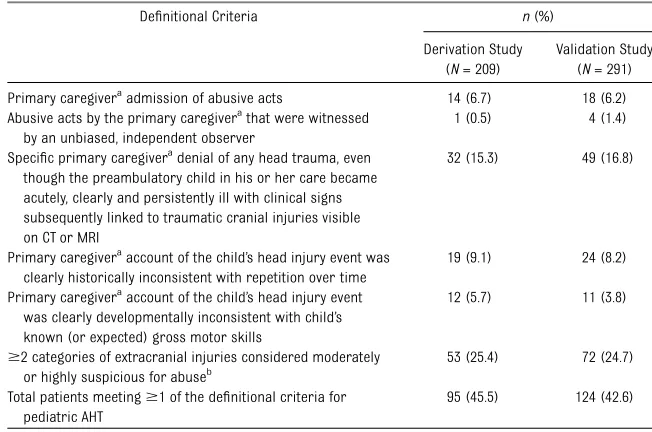
Gold standard criteria for the diag-nosis of AHT do not exist. In their ab-sence, we applied the same a priori, definitional criteria for AHT used in the completed derivation study to sort study patients into comparison groups of abusive and nonabusive head trauma (Table 2). Formulated by the lead author, these criteria mirror or replicate the criteria used in other peer-reviewed studies.16–18 To
mini-mize circular reasoning, they contain no references to specific intracra-nial injuries, to injury severity, or to
any of the 4 predictor variables in-cluded in the AHT CPR. Patients meeting $1 of these criteria were sorted as having AHT. All remaining patients were sorted as having non-abusive head trauma. Study patients’
final diagnoses of abusive versus nonabusive head trauma were not considered in the primary analyses but were used to complete relevant secondary analyses.
Primary Analyses
To measure the screening perfor-mance of the 4-variable AHT CPR in the new patient population, we ap-plied the definitional criteria to sort study patients into comparison groups of abusive versus nonabusive head trauma, applied the AHT CPR to every study patient, categorized patients who manifested $1 of the CPR’s 4 predictor variables as higher risk, categorized all remain-ing patients as lower risk, compared
TABLE 2 A Priori Definitional Criteria for AHT
Definitional Criteria n(%)
Derivation Study (N= 209)
Validation Study (N= 291) Primary caregivera
admission of abusive acts 14 (6.7) 18 (6.2) Abusive acts by the primary caregivera
that were witnessed by an unbiased, independent observer
1 (0.5) 4 (1.4)
Specific primary caregiveradenial of any head trauma, even though the preambulatory child in his or her care became acutely, clearly and persistently ill with clinical signs subsequently linked to traumatic cranial injuries visible on CT or MRI
32 (15.3) 49 (16.8)
Primary caregiveraaccount of the child’s head injury event was clearly historically inconsistent with repetition over time
19 (9.1) 24 (8.2)
Primary caregiveraaccount of the child’s head injury event was clearly developmentally inconsistent with child’s known (or expected) gross motor skills
12 (5.7) 11 (3.8)
$2 categories of extracranial injuries considered moderately or highly suspicious for abuseb
53 (25.4) 72 (24.7)
Total patients meeting$1 of the definitional criteria for pediatric AHT
95 (45.5) 124 (42.6)
aDefined as the person responsible for the child when he or she was acutely head injured orfirst became clearly and
persistently ill with clinical signs subsequently linked to traumatic cranial injuries visible on CT or MRI.
bIncluding classic metaphyseal lesion fractures or epiphyseal separations; rib fractures; fractures of the scapula or
sternum; fractures of digits; vertebral body fractures, dislocations or fractures of spinous processes; skin bruising,
abrasions, or lacerations in$2 distinct locations other than knees, shins, or elbows; patterned skin bruising or dry contact
burns; scalding burns with uniform depth, clear lines of demarcation, and paucity of splash marks; confirmed
intraab-dominal injuries; retinoschisis confirmed by an ophthalmologist; retinal hemorrhages described by an ophthalmologist as
dense, extensive, covering a large surface area, or extending to the ora serrata.
and calculated the AHT CPR’s screen-ing performance (sensitivity,
speci-ficity, predictive values, likelihood ratios).
Secondary Analyses
To compare the predictive accuracy of various sum numbers of the 4 predictor variables included in the AHT CPR, we plotted an empirical receiver operator curve (ROC) and calculated its area under the curve.
To estimate the AHT CPR’s power to identify (categorize as higher risk) study patients ultimately diagnosed with AHT by their treating or con-sulting physicians, we compared patient categorizations (higher vs lower risk) with patients’ final di-agnoses (abusive vs nonabusive head trauma) and recalculated the AHT CPR’s screening performance (sen-sitivity, specificity, predictive values, likelihood ratios). For this second-ary analysis, treating and consulting physicians’ final, consensus diag-noses of definitive or probable AHT were collapsed into a single AHT category.
To verify or validate the predictive qualities of the CPR’s 4-predictor variable in isolation, we calculated each variable’s sensitivity, specificity, predictive values, and likelihood ratios and compared these results to equiva-lent results from the completed deri-vation study.
To estimate the screening performance of the AHT CPR in different parts of the country (geographic validation), in both large and small PICUs (domain validation), and in the same PICUs over time (temporal validation), we analyzed the data from novel patient cohorts selected specifically to as-sess geographic, domain and tem-poral validation.
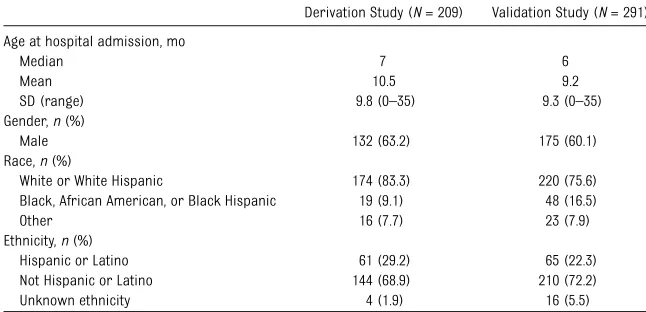
Between March 2012 and June 2013, PediBIRN investigators at the 14 par-ticipating sites captured complete clinical, historical, and radiologic data on 326 of 327 (99.7%) acutely head-injured infants and young children admitted to their PICUs. Thirty-five of these patients met exclusion criteria and were excluded from analysis, in-cluding 31 injured in motor vehicle collisions and 4 with neuroimaging evidence of preexisting brain malfor-mation, disease, infection, or hypoxia-ischemia. The remaining 291 patients made up the final validation study patient population. Their demographic characteristics mirrored those of the derivation study patient population (Table 3). All questions about data in-tegrity or internal consistency were resolved at the discretion of local investigators.
One hundred twenty-four (43%) of 291 study patients met $1 definitional criteria for AHT, including 4 whose AHT was witnessed independently, 18 whose perpetrators admitted abu-sive acts, and 72 who manifested$2 categories of extracranial injuries considered moderately or highly suspicious for abuse. These results also mirrored those obtained in the completed derivation study (Table 2).
Applied to this new patient population (N = 291), the 4-variable AHT CPR demonstrated sensitivity = .96 (95% confidence interval [CI], .90–.99). That is, of the 124 study patients who met criteria for AHT, 119 (96%) presented with $1 of the 4 predictor variables included in the 4-variable AHT CPR. Specificity was .43 (95% CI, .35–.50). Positive and negative predictive values were .55 (95% CI, .48–.62) and .93 (95% CI, .85–.98), respectively. Positive and negative likelihood ratios were 1.67 (95% CI, 1.46–1.9) and 0.09 (95% CI, 0.04–0.23), respectively. All measures of AHT screening performance matched or exceeded equivalent results from the completed CPR derivation study (Table 4).
Secondary Analyses
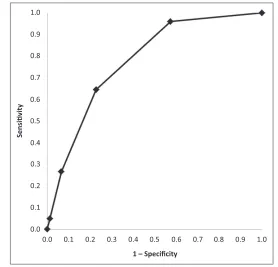
The empirical ROC curve in Fig 1 dem-onstrates the tradeoff between sensi-tivity and specificity across various cutoff points (ie, across various sum numbers of the 4 predictor variables, from 0 to 4 for this 4-variable CPR). To maximize sensitivity, we selected 1 as the optimal cutoff point. The area un-der the curve was .78.
We found significant differences (McNemar’s x2 test with continuity
TABLE 3 Patient Demographics
Derivation Study (N= 209) Validation Study (N= 291) Age at hospital admission, mo
Median 7 6
Mean 10.5 9.2
SD (range) 9.8 (0–35) 9.3 (0–35) Gender,n(%)
Male 132 (63.2) 175 (60.1)
Race,n(%)
White or White Hispanic 174 (83.3) 220 (75.6) Black, African American, or Black Hispanic 19 (9.1) 48 (16.5)
Other 16 (7.7) 23 (7.9)
Ethnicity,n(%)
Hispanic or Latino 61 (29.2) 65 (22.3) Not Hispanic or Latino 144 (68.9) 210 (72.2)
correction, P #.001) between pa-tient sorting based on the defi ni-tional criteria and study patients’
final diagnoses of abusive or non-abusive head trauma (Table 5). More specifically, the definitional criteria sorted fewer study patients as hav-ing AHT than physicians themselves.
Nevertheless, the 4-variable AHT CPR identified (categorized as higher risk) 98% of study patients who were ultimately diagnosed with AHT (Table 6).
Considered in isolation, each of the AHT CPR’s 4 predictor variables demon-strated predictive qualities (sensitivity,
specificity, predictive values, and like-lihood ratios) in this validation study that were very similar to those dem-onstrated in the completed derivation study (Supplemental Table 8).
Retrospective analyses of AHT CPR performance in novel patient cohorts revealed that the 4-variable AHT CPR demonstrated high sensitivity in dif-ferent geographic regions, in large PICUs and in small PICUs, and in the same PICUs over time (Supplemental Table 9).
DISCUSSION
An effective screening test is simple, a reliable, performs with high sensi-tivity, has few false negatives, and is therefore useful to exclude a diagnosis, when negative. An effective diagnostic test is simple, reliable, performs with high specificity, has few false positives, and is therefore useful to confirm a diagnosis, when positive. PediBIRN in-vestigators’ long-term aim is the de-velopment and dissemination of an effective AHT screening test, not a di-agnostic test. Stated in another way, PediBIRN investigators are working to develop a simple, reliable, and highly sensitive AHT screening test that can be applied at or near the time of PICU admission, helps exclude AHT when negative, helps reduce missed cases of AHT, and can inform PICU providers’ early decisions to launch (or to forgo) abuse evaluations in their young, acutely head-injured patients.
TABLE 4 4-Variable AHT CPR Screening Performance Defining AHT Using Definitional Criteria
Derivation Study (N= 209) Validation Study (N= 291)
Applying 4-Variable AHT CPR
Applying Definitional Criteria Applying 4-Variable AHT CPR
Applying Definitional Criteria
Abusive Head Trauma
Nonabusive Head Trauma
Abusive Head Trauma
Nonabusive Head Trauma
Higher risk 91 73 Higher risk 119 96
Lower risk 4 41 Lower risk 5 71
Value 95% CI Value 95% CI
SENS 0.96 0.89–0.99 SENS 0.96 0.90–0.99 SPEC 0.36 0.27–0.46 SPEC 0.43 0.35–0.50 PREV 0.45 0.39–0.52 PREV 0.43 0.37–0.49 PPV 0.55 0.48–0.63 PPV 0.55 0.48–0.62 NPV 0.91 0.78–0.97 NPV 0.93 0.85–0.98 LR+ 1.50 1.30–1.73 LR+ 1.67 1.46–1.91 LR2 0.12 0.04–0.31 LR2 0.09 0.04–0.23
LR+, positive likelihood ratio; LR2, negative likelihood ratio; NPV, negative predictive value; PPV, positive predictive value;
PREV, prevalence or pretest probability; SENS, sensitivity; SPEC, specificity.
FIGURE 1
Empirical receiver operator curve for 4-variable AHT CPR.
TABLE 5 Patient Sorting Using Definitional Criteria Versus Patients’Final Diagnoses
Validation Study (N= 291)
Applying Definitional
Criteria
Applying Patients’ Final Diagnoses
AHT Nonabusive Head Trauma
AHT 117 7
Nonabusive head trauma 27 140
2-tail McNemar’s test with continuity correction,P= .001.
The screening performance of the 4-variable AHT CPR has now been validated in a new, equivalent pa-tient population. All measures of performance matched or exceeded equivalent results from the CPR derivation study (Table 4). In the absence of a gold standard, we de-rived and validated the CPR’s per-formance using a priori definitional criteria to define AHT (Table 2). Ap-plied consistently, the CPR would have detected AHT, as defined by these criteria, with sensitivity of .96, and would have detected study pa-tients who were ultimately diag-nosed with AHT with sensitivity of .98. This latter result was somewhat surprising, in that the definitional criteria sorted fewer patients as AHT than were ultimately diagnosed with AHT.
To achieve maximum sensitivity, some screening tests demonstrate only marginal specificity.19,20 This CPR was
no exception. Specificity was .43. Ap-plied consistently, the AHT CPR would have recommended abuse evaluations for 57% of study patients with non-abusive head trauma.
torso, ears, or neck; interhemispheric or bilateral subdural hemorrhages or collections; and any skull fractures other than an isolated, unilateral, nondiastatic, linear, parietal fracture) are all readily available at or near the time of PICU admission. Their isolated predictive qualities have been verified or validated (Supplemental Table 8), and each demonstrated high interrater reliability (k, k $0.80) in the com-pleted CPR derivation study.15
In-terestingly, in isolation, the fourth predictor variable (any skull frac-tures other than an isolated, unilateral, nondiastatic, linear, parietal frac-ture) is predictive of nonabusive head trauma.
The AHT CPR’s sensitivity is not 100%. It“missed”(categorized as lower risk)
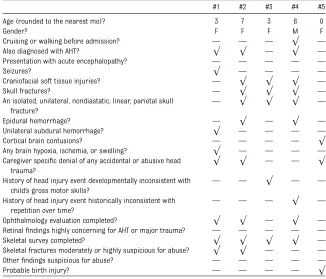
treating or consulting physicians. These 5 “missed” cases (Table 7) in-clude a newborn with probable birth injury, and 4 children between the ages of 3 and 8 months with sentinel cranial injuries that have low
speci-ficity for AHT (unilateral, nondiastatic, linear, parietal skull fracture, n = 3; epidural hematoma, n= 2; and uni-lateral or focal subdural hemorrhage,
n= 1). Their intensive care providers elected to launch abuse evaluations in these 4 children because their care-givers specifically denied any acci-dental or inflicted head trauma, or they provided an account of the child’s head injury event interpreted to be inconsistent with the child’s gross motor skills or historically inconsistent with repetition over time. In 2 of these
Validation Study (N= 291)
Applying 4-Variable AHT CPR
Applying Patients’ Final Diagnoses
AHT Nonabusive Head Trauma
Higher risk 141 74 Lower risk 3 73 Value 95% CI SENS 0.98 0.94–0.99 SPEC 0.50 0.41–0.58 PREV 0.49 0.44–0.55 PPV 0.66 0.59–0.72 NPV 0.96 0.88–0.99 LR+ 1.95 1.65–2.29 LR2 0.04 0.01–0.12
LR+, positive likelihood ratio; LR2, negative likelihood
ra-tio; NPV, negative predictive value; PPV, positive predictive value; PREV, prevalence or pretest probability; SENS, sen-sitivity; SPEC, specificity.
TABLE 7 Five“Missed”AHT Patients Who Met Criteria for AHT but Were Categorized as Lower Riska
#1 #2 #3 #4 #5
Age (rounded to the nearest mo)? 3 7 3 8 0
Gender? F F F M F
Cruising or walking before admission? — — — √ —
Also diagnosed with AHT? √ √ — √ —
Presentation with acute encephalopathy? — — — — —
Seizures? √ — — — —
Craniofacial soft tissue injuries? — √ √ √ —
Skull fractures? — √ √ √ —
An isolated, unilateral, nondiastatic, linear, parietal skull fracture?
— √ √ √ —
Epidural hemorrhage? — √ — √ —
Unilateral subdural hemorrhage? √ — — — —
Cortical brain contusions? — — — — √
Any brain hypoxia, ischemia, or swelling? √ — — — — Caregiver specific denial of any accidental or abusive head
trauma?
√ √ — — √
History of head injury event developmentally inconsistent with child’s gross motor skills?
— — √ — —
History of head injury event historically inconsistent with repetition over time?
— — — √ —
Ophthalmology evaluation completed? √ √ — √ — Retinalfindings highly concerning for AHT or major trauma? — — — — —
Skeletal survey completed? √ √ √ √ —
Skeletal fractures moderately or highly suspicious for abuse? √ √ — — — Otherfindings suspicious for abuse? — — — — —
Probable birth injury? — — — — √
√, present;—, not present.
aAnd therefore did not present to the PICU with any clinically significant respiratory compromise; any bruising involving the
child’s ears, neck, or torso; any subdural hemorrhages orfluid collections that were bilateral or involved the
4 patients, skeletal survey revealed frac-tures considered moderately or highly specific for abuse. Considered in their entirety, these 5“missed”cases illustrate the AHT CPR’s potential limitations.
Study Strengths and Limitations
This study’s primary strengths include its prospective, multicenter, observa-tional design and its method designed and successfully executed to capture complete data and to minimize sam-pling and observational bias. The study had limited generalizability in that application of the AHT screening tool in non-PICU sites will require separate validation of screening performance in those environments. Also, this study had definitional limitations: There is no gold standard for the di-agnosis of AHT, and the definitional criteria used to sort patients into comparison groups of abusive or nonabusive head trauma are probably
imperfect. Finally, the study had de-sign limitations: Because our study was strictly observational, variations in the frequency, timing, or modalities of cranial imaging could have affected the validity of conclusions about spe-cific injuries, and local clinicians’ in-dependent determinations that their patients’ head injuries resulted spe-cifically from trauma might have been inaccurate.
CONCLUSIONS
The screening performance of a 4-variable AHT CPR has been validated in a new patient population. Applied consistently, it will detect AHT with high sensitivity in young, acutely head-injured patients admitted to the PICU. Additional re-search is needed to measure and op-timize the AHT CPR’s use and screening performance in actual clinical prac-tice and to verify its effect on relevant clinical outcomes.
ACKNOWLEDGMENTS
Additional PediBIRN investigators who participated actively in the validation study include the following:
Bruce E. Herman, MD, Department of Pediatrics, University of Utah School of Medicine, Primary Children’s Medi-cal Center, Salt Lake City, Utah; Sandeep K. Narang, MD, JD, Department of Pedi-atrics, University of Texas Health Sci-ence Center, Houston, Texas; Jeanine M. Graf, MD, Department of Pediatrics, Baylor College of Medicine, Texas Children’s Hospital, Houston, Texas; Mark Dias, MD, Departments of Neurosurgery and Pediatrics, Penn State College of Medicine, Hershey, Pennsylvania; Deborah A. Pullen, BSN, MPH, Department of Pediatrics, Dartmouth–Hitchcock Medical Center, Lebanon, New Hampshire; Stephen C. Boos, MD, Department of Pediatrics, Baystate Children’s Hospital, Springfield, Massachusetts.
REFERENCES
1. Jenny C, Hymel KP, Ritzen A, Reinert SE, Hay TC. Analysis of missed cases of abu-sive head trauma.JAMA. 1999;281(7):621– 626
2. Benson DE, Swann A, O’Toole R, Turbett JP. Physicians’ recognition of and response to child abuse: Northern Ireland and the U.S.A.Child Abuse Negl. 1991;15(1–2): 57–67
3. Jones R, Flaherty EG, Binns HJ, et al; Child Abuse Reporting Experience Study Re-search Group. Clinicians’ description of factors influencing their reporting of sus-pected child abuse: report of the Child Abuse Reporting Experience Study Research Group.Pediatrics. 2008;122(2):259–266
4. Lane WG, Rubin DM, Monteith R, Christian CW. Racial differences in the evaluation of pediatric fractures for physical abuse.
JAMA. 2002;288(13):1603–1609
5. Lane WG, Dubowitz H. What factors affect the identification and reporting of child abuse-related fractures?Clin Orthop Relat Res. 2007;461(461):219–225
6. Levi BH, Brown G. Reasonable suspicion: a study of Pennsylvania pediatricians
regarding child abuse.Pediatrics. 2005; 116(1). Available at: www.pediatrics.org/ cgi/content/full/116/1/e5
7. Levi BH, Brown G, Erb C. Reasonable suspicion: a pilot study of pediatric residents.Child Abuse Negl. 2006;30(4): 345–356
8. Lindberg DM, Lindsell CJ, Shapiro RA. Var-iability in expert assessments of child physical abuse likelihood.Pediatrics. 2008; 121(4). Available at: www.pediatrics.org/ cgi/content/full/121/4/e945
9. Offer-Shechter S, Tirosh E, Cohen A. Physical abuse—physicians knowledge and report-ing attitude in Israel.Eur J Epidemiol. 2000; 16(1):53–58
10. Rangel EL, Cook BS, Bennett BL, Shebesta K, Ying J, Falcone RA. Eliminating disparity in evaluation for abuse in infants with head injury: use of a screening guideline.J Pediatr Surg. 2009;44(6):1229–1234, discussion 1234–1235
11. Trokel M, Waddimba A, Griffith J, Sege R. Variation in the diagnosis of child abuse in severely injured infants [published correction appears inPediatrics. 2006;
118(3):1324]. Pediatrics. 2006;117(3):722– 728
12. Wood JN, Hall M, Schilling S, Keren R, Mitra N, Rubin DM. Disparities in the evaluation and diagnosis of abuse among infants with traumatic brain injury.Pediatrics. 2010;126 (3):408–414
13. Jaeschke R, Guyatt G, Lijmer J. Diagnostic tests. In: Guyatt G, Rennie D, eds. Users’ Guide to the Medical Literature. A Manual for Evidence-Based Clinical Practice. Chicago, IL: American Medical Association; 2002: 121–140
14. Stiell IG, Wells GA. Methodologic standards for the development of clinical decision
rules in emergency medicine. Ann Emerg
Med. 1999;33(4):437–447
15. Hymel KP, Willson DF, Boos SC, et al; Pedi-atric Brain Injury Research Network (Ped-iBIRN) Investigators. Derivation of a clinical prediction rule for pediatric abusive head trauma.Pediatr Crit Care Med. 2013;14(2): 210–220
16. Duhaime AC, Alario AJ, Lewander WJ, et al. Head injury in very young children: mechanisms, in-jury types, and ophthalmologicfindings in 100
Grossman DC, Grady MS, Ellenbogen RG. The cause of infant and toddler subdural hemorrhage: a prospective study.Pediatrics. 2001;108(3):636–646
18. Hymel KP, Makoroff KL, Laskey AL, Conaway MR, Blackman JA. Mechanisms, clinical
multicentered, comparative study. Pediat-rics. 2007;119(5):922–929
19. Biberhtaler P, Linsenmeier U, Pfeifer KJ, et al. Serum S-100B concentration pro-vides additional information for the in-dication of commuted tomography in
20. Wisnivesky JP, Henschke C, Balentine J, Willner C, Deloire AM, McGinn TG. Pro-spective validation of a prediction model for isolating inpatients with suspected pul-monary tuberculosis.Arch Intern Med. 2005; 165(4):453–457
(Continued fromfirst page)
www.pediatrics.org/cgi/doi/10.1542/peds.2014-1329
doi:10.1542/peds.2014-1329
Accepted for publication Oct 3, 2014
Address correspondence to Kent P. Hymel, MD, The Penn State Milton S. Hershey Medical Center, Department of Pediatrics, Division of Child Abuse Pediatrics, 500 University Drive, MC H085, Hershey, PA 17033. E-mail: [email protected]
PEDIATRICS (ISSN Numbers: Print, 0031-4005; Online, 1098-4275).
Copyright © 2014 by the American Academy of Pediatrics
FINANCIAL DISCLOSURE:The authors have indicated they have nofinancial relationships relevant to this article to disclose.
FUNDING:Dr Hymel’s research activities were supported by The Gerber Foundation.
DOI: 10.1542/peds.2014-1329 originally published online November 17, 2014;
2014;134;e1537
Pediatrics
Phil Hyden, Andrew Sirotnak, Edward Truemper, Amy E. Ornstein and Ming Wang
Stoiko, LeeAnn M. Christie, Nancy S. Harper, Kerri Weeks, Christopher L. Carroll,
Kent P. Hymel, Veronica Armijo-Garcia, Robin Foster, Terra N. Frazier, Michael
Validation of a Clinical Prediction Rule for Pediatric Abusive Head Trauma
Services
Updated Information &
http://pediatrics.aappublications.org/content/134/6/e1537
including high resolution figures, can be found at:
References
http://pediatrics.aappublications.org/content/134/6/e1537#BIBL
This article cites 19 articles, 8 of which you can access for free at:
Subspecialty Collections
ub
http://www.aappublications.org/cgi/collection/child_abuse_neglect_s Child Abuse and Neglect
y_sub
http://www.aappublications.org/cgi/collection/traumatic_brain_injur Traumatic Brain Injury
ub
http://www.aappublications.org/cgi/collection/head_neck_injuries_s Head and Neck Injuries
following collection(s):
This article, along with others on similar topics, appears in the
Permissions & Licensing
http://www.aappublications.org/site/misc/Permissions.xhtml
in its entirety can be found online at:
Information about reproducing this article in parts (figures, tables) or
Reprints
http://www.aappublications.org/site/misc/reprints.xhtml
DOI: 10.1542/peds.2014-1329 originally published online November 17, 2014;
2014;134;e1537
Pediatrics
Phil Hyden, Andrew Sirotnak, Edward Truemper, Amy E. Ornstein and Ming Wang
http://pediatrics.aappublications.org/content/134/6/e1537
located on the World Wide Web at:
The online version of this article, along with updated information and services, is
http://pediatrics.aappublications.org/content/suppl/2014/11/12/peds.2014-1329.DCSupplemental
Data Supplement at:
by the American Academy of Pediatrics. All rights reserved. Print ISSN: 1073-0397.