Center
Center
Doctoral Dissertations Theses, Dissertations, Capstones and Projects
2019
Long-Term Effects of Teacher Training and Other Intervening
Long-Term Effects of Teacher Training and Other Intervening
Factors on Teaching Styles of Foreign-Language Instructors
Factors on Teaching Styles of Foreign-Language Instructors
Hamid Mohammed-Ahmed [email protected]
Follow this and additional works at: https://repository.usfca.edu/diss
Part of the Teacher Education and Professional Development Commons
Recommended Citation Recommended Citation
Mohammed-Ahmed, Hamid, "Long-Term Effects of Teacher Training and Other Intervening Factors on Teaching Styles of Foreign-Language Instructors" (2019). Doctoral Dissertations. 496.
https://repository.usfca.edu/diss/496
The University of San Francisco
LONG-TERM EFFECTS OF TEACHER TRAINING AND OTHER INTERVENING FACTORS ON TEACHING STYLES OF FOREIGN-LANGUAGE INSTRUCTORS
A Dissertation Presented to
The Faculty of the School of Education Learning and Instruction Department
In Partial Fulfillment
of the Requirements for the Degree Doctor of Education
by
Hamid Mohammed-Ahmed San Francisco, CA
THE UNIVERSITY OF SAN FRANCISCO Dissertation Abstract
Long-Term Effects of Teacher Training and Other Intervening Factors on Teaching Styles of Foreign-Language Instructors
This dissertation, written under the direction of the candidate’s dissertation committee and approved by the members of the committee, has been presented to and accepted by the Faculty of the School of Education in partial fulfillment of the requirements for the degree of Doctor of Education. The content and research methodologies presented in this work represent the work of the candidate alone.
Hamid-Mohammed-Ahmed 05/08/19
Candidate Date
Dissertation Committee
Dr. Patricia Busk 05/08/19
Chairperson
Dr. Kevin Oh 05/08/19
ACKNOWLEDGEMENTS
"Tell me and I forget, teach me and I may remember, involve me and I learn." Benjamin Franklin
I would like to pay my regards to all those whose assistance was a milestone in
the accomplishment of this dissertation study. Special thanks and gratitude to my
committee chair, Dr. Busk for her limitless support that proved to be a landmark effort in
the success of this project. Without her guidance and persistent help this project would
have not been possible. Also, I would like to express my appreciation to Dr. Oh and Dr.
TABLE OF CONTENTS
Page ABSTRACT………
ACKNOWLEDGEMENTS...………..…… TABLE OF CONTENTS………
ii iv v
LIST OF TABLES……….. ix
LIST OF FIGURES……… x
CHAPTER
I. STATEMENT OF THE PROBLEM……… 1
Purpose of the Study………... Background and Need for the Study………... Theoretical Framework………... Significance of the Study……… Research Questions………. Definition of Terms………. Summary of the Chapter………. Organization of the Study………...
2 4 8 10 13 13 18 19
II. LITERATURE REVIEW………. 20
TABLE OF CONTENTS CONTINUED
CHAPTER Page
Promoting Learner Autonomy and Challenges…………...…… Impeding and Supporting Factors for Communicative
Teaching……….. School Climate and Teaching Approach……… The Role of Gender, Experience, and Education……… Type of Foreign Language and Teaching Approach………….. The Role of Teacher’s Self-Image and Disposition……… Summary………. Summary of the Chapter……….
69 71 72 73 76 77 79 81
III. METHODOLOGY………
Research Design……….. Setting and Participants………... Recruitment and Data Collection……… Protection of Human Subjects………. Instrumentation………...
The Principles of Adult Learning Scale……….. Learner-Centered Activities……… Personalizing Instruction………. Relating Experience……… Assessing Student Needs……… Climate Building………. Participation in the Learning Process……….. Flexibility for Personal Development………. Validity of PALS……… Reliability of PALS………. Social Desirability of PALS……… Standardized Rating of PALS………. Qualitative Data……….. Data-Analysis Procedures………... Research Question 1……… Research Question 2……… Research Question 3……… The Researcher and the Second Rater………. Summary of the Chapter……….
IV. RESULTS……….
Research Question 1………... Research Question 2………... Overall Teaching Style………
TABLE OF CONTENTS CONTINUED
CHAPTER Page
Learner-Centered Activities……… Personalizing Instruction………. Relating Experience……… Assessing Student Needs……… Climate Building………. Participation in the Learning Process……….. Flexibility for Personal Development………. Research Question 3……… Part I: Instructors’ Reflections on the Training………..…
Satisfaction with the Training………. Benefits of the Training……….. Limitation of the Training………... Classroom Application of the Training………... Constraints of Implementation……… Part II: Followup Interviews………... Rationale for Using Teacher-Centered Practice……..… Ways of Promoting Learner-Centered Practice……….. Summary of the Chapter………. V. SUMMARY, FINDINGS, LIMITATIONS, DISCUSSION,
IMPLICATIONS, RECOMMENDATIONS, AND CONCLUSION…..… Summary of the Study………... Major Findings……….. Limitations of the Study……… Discussion of the Results……….. Teacher-Centered Orientation………. Learner-Centered Orientation………. Intervening Factors………. Training-Related Factors………. Teacher-Related Factors………. Classroom-Related Factors………. Implications for Teaching and Teacher Training……….. Recommendations for Future Research……… Conclusion……… REFERENCES……… APPENDIXES………
A. Consent Forms ……….………..………..
Teacher Consent for Participation in PALS Questionnaire………..…..
TABLE OF CONTENTS CONTINUED APPENDIXES
B. Demographic Data Questionnaire……… C. Means and Standard Deviations of 44-Items of PALS Ratings Obtained
from 165 Foreign-Language Instructors………... D. Script of Instructors’ Reflections on the Training……… E. Script of Follow-up Interviews with Foreign-Language Instructor………..
LIST OF TABLES
Table Page
1. Experiential Learning According to Lewin, Dewey, Piaget, and Kolb………… 31 2. Assumptions of Constructivist-Based Theories About Learning and Teacher
Training………... 38
3. Types, Description, and Purpose of Professional-Development Training ……. 57 4. Summary of Studies About the Effect of Intervention on Teaching Approach.. 62 5. Summary of Research About Factors Influencing Teaching Approach………. 79 6. Breakdown of 165 Foreign-Language Instructors by Demographic Variables.. 90 7. Means and Standard Deviation of PALS Factors and Total Rating…………... 103 8. Variables and Analysis Procedures for Research Questions……….. 107 9. Means, Standard Deviations, One-Sample t Tests, and Effect Size for 165
Foreign-Language Instructors’ Rating on PALS Compared with Population of
Adult Educators……….. 110
10. Kendall’s Tau-b Correlation Coefficient for Time of ICC or IRC with Overall
Teaching Style……… 113
11. Kendall’s Tau-b Correlation Coefficients for Language Category, Education,
Experience, and Gender with Learner-Centered Activities……… 114 12. Kendall’s Tau-b Correlation Coefficients for Time of ICC or IRC,
Experience, and Age Group with Personalizing Instruction………..……. 115 13. . Kendall’s Tau-b Correlation Coefficients for Time of ICC or IRC,
Experience, and Age Group with Assessing Student Needs……….…………. 116 14. Kendall’s Tau-b Correlation Coefficient for Time of ICC or IRC with
Climate Building………...……….. 117
15. Kendall’s Tau-b Correlation Coefficients for Language Category, Reflections on ICC and IRC, and Time of ICC or IRC with Participation in the Learning
Process... 118 16. Kendall’s Tau-b Correlation Coefficients for Language Category, Education,
Experience, and Gender with Flexibility for Personal Development……….… 119 17. Categories and Themes Emerged from the Analysis of Instructors’
LIST OF FIGURES
Figure Page
1. Teaching Style Continuum from Teacher-to Learner-Centered Approach …… 8 2. The Characteristics of Adult Learners According to the Theory of Andragogy. 27 3. Stages of Transformative Learning According to Mezirow’s (1990) Theory…. 30 4.. The Experiential Learning Process According to Kolb’s (1984) Theory……… 32 5.. The Process of Knowledge Reconstruction According to Schema Theory……. 34 6 The Components of Teacher Training and Professional-Development in the
Institute………. 41
7. Types and Phases of Reflective Teaching……….... 50 8. Standard Rating of PALS with the Population of Mean of 146 and SD of 20.... 102 9. Teaching Approach of Foreign-Language Instructors Based on PALS Ratings. 145 10. Demographic Predictor Variables and the Predicted Teaching Styles………… 146 11. Intervening Factors that Influence the Teaching Styles of Foreign-Language
CHAPTER I
STATEMENT OF THE PROBLEM
The primary goal of teacher training is to help teachers revise their existing assumptions about teaching and learning (Aydogdu & Selanik-Ay, 2016), reshape their instructional beliefs, and orient them toward a particular teaching model that can be transferred into classroom practice. In a multilanguage institute on the West coast of the United States, for instance, the learner-centered instruction is the main component of the teacher-training program to promote integration of language skills and foster the role of students as language users and producers. Instructors who teach different-foreign languages at the institute consistently receive training on the principles of learner-centered instruction in order to enhance the proficiency level of language learners given the body of research that established the importance of students’ active role in the
learner-centered practice. In fact, there is no evidence or data to suggest that these instructors are consistently using learner-centered approach in their classrooms after being certified. A previous study (Bey, 2011) surveyed 93 preservice instructors before and after ICC and found an immediate and positive effect of the training on belief change about communicative-language teaching. No study, however, investigated the extent to which the training has transformed language instructors after being classroom
practitioners, and, therefore, the long-lasting effect of ICC and IRC on the teaching practice has not been verified. Such lack of imperial data about the integration of the training principles in the daily classroom practice necessitated this investigation.
Purpose of the Study
used during the training to help language instructors implement the learner-centered instruction (Ahmed, Nordin, Shah, & Channa, 2018; Kebaetse & Sims, 2016; Kolman, Roegman, & Goodwin, 2017; Peisachovich et al., 2017). At the end of the preservice training, instructors develop their teaching portfolios that include reflective journals on their learning experience, lesson plans, reflective teaching on classroom practice, and students ‘classroom evaluation.
To further support learner-centered teaching, inservice instructors attend a required course called advanced-language academy (ALA) that introduces project-based learning, content-based learning, scenario-based learning, task-based learning, strategy-based instruction, differentiated instruction, and flipped classroom. To promote learner autonomy, most instructors receive training on student-learning service (SLS). The SLS courses teach the principles of adult learning, self-directed learning, study skills, and language-learning strategies. To assess students’ needs and devise appropriate learning plans, inservice instructors in each language school receive diagnostic assessment (DA) training. In addition to these training courses, year-round workshops are also offered in each language school to meet the professional-development needs of individual
from lecturers to facilitators. Therefore, by completing ICC, IRC and other courses, the institute expects language instructors to make learner-centered teaching a consistent practice in their classroom.
Background and Need for the Study
Attending a teacher-training program does mean that eventually the teacher will transfer the learned skills into a classroom behavior. The takeaway from the training program can vary from one teacher to another. Some teachers may fully embrace the instructional method; others may partially or minimally adopt the training principles. Research has shown that a variety of factors may intervene with the effect of teacher training and influence the classroom practice
of individual teachers (e.g., Ellis, 2016; Tawalbeh & AlAsmari, 2015). These factors can range from teachers’ ingrained assumptions about learning and instruction to the teaching environment-related variables such as the degree of students’ responsiveness and the school support (Chang & Goswami, 2011;
Colley, 2012; Oder & Eisenschmidt, 2018). Also, the teaching style can be influenced by the level of teachers’ training and years of experience as well as a variety of school-related factors such as rules and regulations, class size,
classroom culture, classroom management, resources and support, curriculum and teaching materials, and type of tests and the goal of assessment (Aydogdu & Selanik-Ay, 2016; Chang & Goswami, 2011; Kaymakamoglu, 2018).
A positive association was found between inspiring and supporting school climate, on the one hand, and the implementation of effective teaching elements such as learner
independence, active learning, and integrative practice, on the other hand (Oder & Eisenschmidt, 2018). Most language teachers believe the unfavorable classroom environment is the main obstacle for implementing the learned skills from teacher-professional-development programs (Poudel, 2018). Some research in field of foreign-language instruction also found an association between the teaching style and the type of
language being taught (Zuniga & Simard, 2016). Even though some demographic variables, such as teacher’s education and experience, were found to be associated with teaching practice, findings from studies that investigated the relationship between the teacher’s gender and the teaching style were inconsistent (Aydogdu & Selanik-Ay, 2016; Jalali, Panahzade, & Firouzmand, 2014).
Researchers also found students’ disposition and readiness to be important
contributors in the nature of classroom practice, that is, students’ motivation and learning
(Weimer, 2013, pp. 202–204). Similarly, students’ learning preferences can guide the teacher’s choice of a particular instructional style (Le et al., 2017). A factor analysis study by Le et al. (2017) revealed that the instructor’s teaching style and the student’s preference for the type of teaching style are hidden factors that influence the quality of teacher-student interaction in the classroom. “Students and teachers of the same type tend to have more positive interactions, and those of differing types tend to have more negative interactions” (Le et al., 2017, p. 115).
The role of teachers’ sense of efficacy also was studied and found to have an influence on the instructional behavior and classroom practice (Wolters & Daugherty, 2007). Teachers with a higher sense of efficacy are often open to new ideas and that they are willing to try out innovative approaches to meet students’ needs, set higher instructional aspirations, and put more effort in planning and delivering their lessons (Wolters & Daugherty, 2007). For example, Abad (2013) found that English as a foreign language-(EFL) teachers’ linguistic ego, their self-image as language teachers, and their beliefs about the status of foreign language in the local culture are important factors in determining the teachers ‘instructional strategies.
Of all the variables that influence the teaching style, teaching philosophy
and beliefs about learning and instruction were highlighted as the most important
factors that inform the teacher’s disposition to a particular teaching method and
and its perceived benefits to students (Syrmpas, Digelidis, & Watt, 2016). Instructors who value collaborative learning and students contributions are likely to encourage students to engage actively and assume ownership of learning (Moate & Cox, 2015). Also, according to Ellis (2016), instructors who identify themselves as learner centered and who believe in the benefits of the approach are more likely to use it in their
classrooms. Conversely, other studies (Kaymakamoglu, 2018) revealed some
inconsistencies between teachers’ beliefs and perceived practice on the one hand and
their actual practice on the other hand. Instructors may perceive the value of learner centeredness and identify themselves as learner centered, but other factors may orient their classroom practice (Ellis, 2016; Tawalbeh & AlAsmari, 2015). Weimer (2013) argued that some teachers resist learner-centered approach because it threatens teacher's power and authority, takes away exclusive reliance on content expertise, and moves teachers into the unfamiliar domain of learning and skills of instruction. Other teachers may resist the model for more objective reasons such as concerns about potentially diminishing the amount of content in courses, devoting class time to the development of skills, decreasing the number of rules and requirements, and giving students a role in self- and peer-assessment activities (Weimer, 2013). Finally, the teacher’s instructional
assumptions are believed to intervene with the effect of the teacher-training, and that teachers may adopt the training principles if they are congruent with their teaching
Theoretical Framework
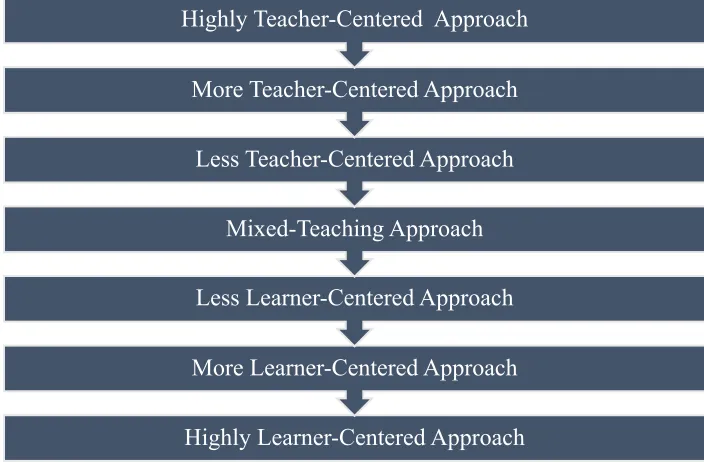
The learner-centered-teaching style is the theoretical concept that guides the current study. Conti (2004, pp. 76–77) defined the teaching style as distinct qualities that a teacher consistently displays in different situations regardless of the content. Although several descriptions of teaching style were found in the literature, Conti (1982) viewed the teaching style in terms of teacher-centered and learner-centered orientation. According, to Moate and Cox (2015), a teacher might display more learner centeredness in one situation and more teacher centeredness in another. They contended that the teaching approach should be viewed as a continuum in which the teacher could be considered as more teacher centered or more learner centered rather than the binary categorization of either or. As illustrated in Figure 1, the instructor’s teaching approach can be rated anywhere on a continuum scale.
Figure 1. Teaching style continuum from teacher-to learner-centered approach Highly Learner-Centered Approach
More Learner-Centered Approach Less Learner-Centered Approach
competing models of instruction representing two different schools of thought. The former reflects the principles of humanistic education that defines the teacher’ role as a facilitator of learning, whereas, the latter is the translation of liberal view of education that considers the teacher as expert and source of knowledge (Zinn, 2004, pp. 72–73). The humanistic philosophy of education is informed by the constructivist view that attributes knowledge creation to the activity of the learner (Gredler, 2009, p. 267). Grounded in the work of Carl Rogers and Malcolm Knowles, the humanistic perspective of adult learning emphasizes learner growth, self-actualization, self-initiated learning, and learner participation (Elias & Merriam, 2005, p. 132). According to the humanistic
teacher-center environment is the recipient of knowledge through lectures, discussion, and critical reflection (Zinn, 2004).
According to Conti (1985) the elements of learner-centered teaching are (a) using learner-centered activities, (b) personalizing instruction to accommodate learner-differences, (c) relating instruction to the learner's experience and prior knowledge, (d) assessing and responding to the student’s need, (e) creating supportive and friendly-learning conditions, (f) promoting student's participation in the learning process, and (g) providing opportunity for personal development. These elements formed the Principles of Adult Learning Scale (PALS), developed by Conti (1978, 1985, 2004) that has been used extensively in the field of adult education for measuring the degree of learner centeredness in the teaching-style orientation. In developing PALS, Conti (1982) indicated that a large body of adult-education literature supports the collaborative mode. According to Conti (1985), the collaborative-teaching-learning mode is a learner-centered method in which the teacher shares and delegates the authority to the learner. “The
collaborative mode is the process-oriented approach to teaching. The emphasis is
upon what the learner is doing. The teacher’s primary task is to organize and
maintain an environment which facilitates students’ learning” (Conti, 1985, p. 7).
Significance of the Study
Synthesis of the literature revealed that most studies on learner-centered approach have focused on four areas. First, they described different types of learning that promote learner-centered instruction and prescribed different
et al., 2017). Second, they investigated the perception of instructors toward leaner-centered approach (e.g., Ellis, 2016; Kaymakamoglu, 2018; Moate & Cox, 2015;
Tawalbeh & AlAsmari, 2015). Third, they explored the challenges and factors that tend to influence the implementation of learner-centered teaching (e.g., Aydogdu & Selanik-Ay, 2016; Colley, 2012; Weimer, 2013). Finally, they investigated the immediate effect of professional-development training on teachers’ instructional beliefs (Ashraf & Kafi; 2016; Bey, 2011; Hartman, Renguette, & Seig, 2018; Maass & Engeln, 2018; Meng,
Tajaroensuk, & Seepho, 2013; Mohammadi & Moradi, 2017; Yilmaz, 2018). These
prior studies on learner-centered instruction did not address the relationship between teacher training and teaching styles or long-term effects of teacher training on classroom practice, particularly in the field of foreign-language instruction, and this suggests a need for further research to supplement the lack of investigation in this area.
teacher-centered approach in their classrooms (e.g., Bakare, 2001; Curran, 2013;
Dupin-Bryant, 2004; Edwards, 2013; Schaefer & Zygmont, 2003; Seevers, 1995;
Wang & Mott, 2010). Other studies that had used PALS focused on examining the relationship between the teaching style and other variables such as the philosophy of adult education (Fries, 2012; Rachal & And, 1994), the learning style (Spoon & Schell, 1998), academic achievement (Conti, 1985), and self-efficacy (Peters, 2013). Therefore, the current study differs from previous ones by using PALS to measure the long-term effect of a learner-centered-based-teacher training in the field of foreign-language instruction and supplement the findings from PALS with the teachers’ interviews and their reflections on the training and classroom practice. Thus, the focus is shifted from exploring the instructors’ teaching-style orientation to investigating the extent to which the training has transformed the teaching practice.
Findings from this study not only supplement the research in the field but also guide teacher-training programs in assessing, implementing, and achieving the goals of teacher-training courses. For example, the result may orient the teacher-training programs that promote learner-centered-based language
practice in the classroom, and (e) consider the result of the study in assessing, revising, or improving the teacher-training program.
Research Questions
1. What do foreign-language instructors who have attended a learner-centered-based-teacher training in a multilanguage institute self-report about their teaching styles?
2. Is there an association between the self-reported-teaching styles of foreign-language instructors and their demographic variables?
3. What do foreign-language instructors report regarding the relationship between the teacher training and their classroom practices?
Definition of Terms
A list of terms that have been used in this study are defined in this section. The
definitions were cited from the literature and further explanation was provided for the
terms that have specific operationalized meanings and uses in the context of this study.
Andragogy is derived from the Greekword meaning the art of science of helping
the adult learn and is contrasted with pedagogy that means the art of science of teaching
children (Knowles, Holton, & Swanson, 2005, p. 62). Andragogy refers to the theory of
adult learning by Malcolm Knowles (1973) that describes the characteristics of adult
learners as self-directed and autonomous who take charge of their own learning.
Andragogy is used in this study as adult-learning theory that supports learner-centered
instruction.
Classroom-related factors as a construct is used in this study to refer to the
such as curriculum, class time, preparation time, and the level of school support for the implementation of the training.
Collaborative mode refers to a learner-centered method in which the teacher shares
authority for curriculum formation with the students or delegates the responsibility of
learning to students (Conti, 1985). In collaborative-mode classroom, the teacher’s task is to organize and facilitate the learning (Conti, 1985).
Communicative language teaching focuses on the use of language for meaningful
purposes where students are given the opportunity to produce language for real-life communication (Chang & Goswami, 2011). The communicative language teaching is used in this study to indicate the students’ participation in the learning process, and,
therefore, it is considered a form of learner-centered approach.
Constructivism is the meaning making philosophy that attributes knowledge
creation to the interaction between the individuals and the reality and views learning as
meaning making from interpretation of experience (Driscoll, 2005; Ertmer & Newby, 2013; Good & Lavigne, 2017; Gredler, 2009). Constructivism gave birth to the adult learning theories and learner-centered teaching.
Constructivist teaching approach is used in the literature to refer to the
learner-centered instruction, particularly in the field of language teaching (e.g., Aydogdu &
Selanik-Ay, 2016).
Demographic variables as a construct is used in this study to refer to the language
taught by the instructor, and the level of instructor’s satisfaction with the training. Experiential learning refers to the individual learning process that focuses on
learning from experience that can be transformed into knowledge applicable to all
situations and fields of life (Kolb, 2015). The terms experiential learning and experiential education are sometimes used interchangeably (Breunig, 2014).
Frames of reference refer to meaning perspectives, habits of mind, and mind-sets (Mezirow 200, pp. 6–7). Adults use their frame of reference to interpret the new
experience (DiBiase, 2000, p. 7).
Kendall’s Tau-b rank correlation is a nonparametric test used to measure the
strength of association between two variables when the dependent variable is measured on an ordinal scale (Lared Statistics, 2018.).
Intervening factors as a construct is used in this study to refer to the variables that
could influence the teaching practices of language instructors.
Language category refers to the grouping of languages according to their
difficulty. Languages taught at the institute (the site of this study) are classified into four categories: (a) Category I and II language are 36-week-long courses that include French, Spanish, and Indonesian, (b) Category III are 48-week-long courses that include Russian, Hebrew, Persian Farsi, Tagalog, and Urdu, and (c) Category IV are 64-week-long courses that include Japanese, Korean, Chinese, Pashto, and Arabic. This study also uses type of language to refer to the language category.
relies on lecturing as a means of instruction (Moate & Cox, 2015). In the field of foreign-language instruction, communicative foreign-language teaching is used to refer to the learner-centered teaching (Chang & Goswami, 2011). This study interchangeably uses learner-centered teaching, learner-learner-centered approach, learner-learner-centered style, and Learner-centered orientation.
Learner-centered-based-teacher training is the construct used in the study to refer to instructor-certification course (ICC) and instructor-recertification course (IRC).These two required courses are offered by the institute for preservice and inservice instructors respectively. Also, the teacher training and ICC and IRC training are used to refer to these courses.
Meaning perspectives refer to distinctive ways of an individual to interpret the experience and involve the principles, the belief system, and the criteria for making value judgments and interpreting learning (Mezirow,1990). Meaning perspectives are made up of schemata, propositions, beliefs, and assumptions, and evaluations that are acquired uncritically through the process of socialization (Mezirow, 1990). Meaning perspectives are structures of assumptions that generate meaning schemes (Mezirow, 1991, p. 5).
Meaning schemes refer to a collection of concepts, beliefs, judgements, feelings, and implicit rules that shape one’s interpretation of meaning (DiBiase, 2000, p. 5). Meaning schemes and meaning perspectives are often used to mean the same thing in the literature.
One-sample t test is used to test if the observed difference between a
determine whether a sample mean comes from a population with specific mean (Lared Statistics, 2018.).
Ordinal-logistic regression is a generalization of multiple regression. It is considered an appropriate test for predicting an ordinal-dependent variable from two or more independent variables (Lared Statistics, 2018.).
Perspective transformation refers to conscious awareness of the difference between the old assumption and the new one as well as reconstituting one’s perspective to be more inclusive to integrate new experiences and form new understandings (DiBiase, 2000).
Professional development refers to activities that are intended to help
professionals learn and apply new skills in their professional practice (Teräs & Kartoglu, 2017). Professional development program is used in this study to refer to teacher-training
courses and workshops at the institute in addition to other professional-development methods such as mentoring, practicum, reflective teaching, teaching portfolios, action research, and individual-development plans.
Schema (singular form of schemata) refer to a system for storing and retrieving knowledge from the person’s memory and represents knowledge about a structure of events (Sheridan, 1978). According to schema theory, retrieval of the related information is essential for constructing meaning form the new information (Sheridan, 1978).
Self-directed learning and autonomously learning are used interchangeably in the
strategies, and evaluating their learning progress (Ultanir, 2012).
Teaching style refers to distinct qualities that a teacher consistently displays in
different situations regardless of the content (Conti, 2004, pp. 76–77). The teaching style in the context of this study is used to differentiate between learner-centered and teacher-centered approach.
Thematic coding or thematic analysis is the method of qualitative data analysis used to cluster emerging patterns from the data in order to generate major themes and categories (Merriam, 2009).
Summary of the Chapter
This study was designed to investigate the long-term effects of a learner-centered-based-teacher training on teaching styles of foreign-language instructors in a
multilanguage institute. The research problem in this study is guided by the lack of
empirical data about the relationship between the teacher training and the daily-classroom practices of foreign-language instructors. To address the research problem, the study sought to answer three research questions about the general and specific dimensions of the instructors’ teaching-style orientation, the influence of demographic variables on the instructors’ teaching approaches, and the relationship between the teacher training and classroom practices. A theoretical foundation for this study is the learner-centered-teaching style that is grounded in the constructivist and humanistic view of adult
instruction.
Organization of the Dissertation
This dissertation is divided into five chapters. Chapter I explained the research problem, the purpose of the study, the background and need for the study, the theoretical framework, the significance of the study, the research questions, and the definition of the terms used in the study. Synthesis of literature on learner-centered approach,
CHAPTER II
REVIEW OF THE LITERATURE
The present study was intended to investigate the long-term effects of a learner-centered-based-teacher training on teaching styles of foreign-language instructors in a multilanguage institute. Prior research that constitutes the groundwork for this study is reviewed in this chapter. First, the learner-centered instruction is discussed in relation to the constructivist view of learning and other constructivist-based-learning theories that support the approach, such as andragogy (Knowles, 1973), experiential learning (Kolb, 1984), transformative learning (Mezirow, 1990), and schema model of learning
(Anderson, 1977; Rumelhart 1980). Second, a synthesis of literature on teacher training and professional development is examined. Finally, research findings on teachers’ perceptions about learner-centered instruction, the effect of the training on teachers’ beliefs and practices, and the factors influencing the teaching approach are presented.
Throughout this chapter, (a) the term the institute is used consistently to refer to the multilanguage institute where this study took place, (b) the phrase foreign-language instructors refers to the teachers at the institute or the population under study, (c) the current study, the present study, and this study are used interchangeably to refer to this
dissertation, and (d) learner-centered approach, learner-centered instruction,
communicative-teaching, and constructivist-teaching are used interchangeably to mean learner-centered-teaching style.
Learner-Centered-Teaching Style
student centered are used interchangeably in the literature to refer to the active role of students in the learning process where a teacher is a guide, facilitator, and designer of learning experiences (Weimer, 2002). The learner-centered model has changed the student's role from passive recipient of information to an active participant in the knowledge creation by minimizing teacher's involvement and maximizing the student's contribution (Tawalbeh & AlAsmari, 2015). The focus of classroom instruction is on learner needs, readiness, the purpose for learning and providing conditions for learner development, autonomy, and individual growth (Kolman, Roegman, & Goodwin, 2017). In other words, a learner is defined as self-directed and a peer collaborator, and,
therefore, the instruction should be directed at facilitating learner's thinking and knowledge construction (Gredler, 2009, p. 291).
Learner-centered instruction requires differentiated modalities to facilitate learning, and it does not rely on lectures as primary means of instruction (Moate & Cox, 2015). The model supports a variety of teaching approaches that can be grouped under collaborative and self-directed learning. Self-directed learning and autonomous learning are used interchangeably in the literature to refer to the situation where students assume the responsibility for learning (Zinn, 2004). A teacher can play the facilitator’s role who provides resources, expertise, and support when needed (Alonazi, 2017). Self-directed learning also includes motivation to use strategies and resources to achieve personal goals (Van Wyk, 2017). Research (Bedoya, 2014) indicated that autonomous learning can enhance students’ motivation and commitment. Bedoya (2014) found that learners of
English as foreign language (EFL) who were dependent and less confident had
after experiencing autonomous learning. According to Bedoya (2014), factors such as the level of teacher’s intervention, the type of course design, and classroom setting were found to effect students’ exercise of autonomous learning.
Collaborative learning is considered synonymous with learner-centered approach (Moate & Cox, 2015) and includes pair work, group task, and other types of group-investigation projects. In a collaborative mode, the focus is on what the student is doing and how the teacher facilitates the environment for learning (Conti, 1985). Collaborative learning and self-directed learning have been found to increase learners' confidence, produce positive-learning outcomes, and encourage students to make personal reflections on their performance and assess their progress (Buitrago, 2017). Research indicated that learner-centered-collaborative approach can produce higher language retention and higher accuracy rates for EFL learners than the teacher-centered-explicit instruction (Yamagata, 2018). Also, integration of learner-centered instruction was found to improve writing skills, motivation, and self-efficacy of EFL students (Lin, 2015).
Project-based learning and problem-based learning are forms of collaborative tasks that illustrate exclusive students’ ownership of learning process. Problem-based learning does not only provide opportunity for self-directed learning and negotiation of
meaning but also creates an active and collaborative setting to engage students from
diverse-learning styles (Hartman, Renguette, & Seig, 2018). By working together to investigate the problem, students can engage in an active learning and collaborative tasks and, thus, become self-directed learners and gain knowledge and skills in critical thinking
if the task generates interactive discussion, high-order-critical thinking, and knowledge application (Kong, 2014). Group-investigation projects also provide opportunities for detailed research and acquisition of specialized knowledge about the topic in addition to gaining of the research experience (Paschalis, 2017). The construction of knowledge in the project-based and problem-based-learning process involves investigation, interaction, and interpretation (Paschalis, 2017). Students can plan, research, communicate,
collaborate, negotiate, produce, and report the findings (Ünal & Çakir, 2017), that is, the students take charge of the entire learning process, whereas the teacher's role is to provide guidelines and direct students to the learning resources (Paschalis, 2017).
Other learner-centered approaches that promote collaborative and self-directed learning include discovery learning, action learning, service learning, and case studies (Yates, Wilson, & Purton, 2015). These types of inquiry-based experiences can (a) engage students (Maass & Engeln, 2018) in a learner-led investigation, hands-on practice, learner-centered activities, and authentic tasks related to learners’ real life experience; (b) provide opportunity for students to exercise self-directed learning and become active participants in determining the learning outcomes; and (c) enhance intrinsic motivation and illustrate the importance of discovery in the creation of
knowledge (Paschalis, 2017). Also, in inquiry-based learning, students can identify their existing assumptions and use critical thinking to consider alternative explanations based on the evidence derived from the experience (Maass & Engeln, 2018).
traditional homework where students are assigned with additional practice after class, in a flipped-classroom approach, students take responsibility for learning before class. For example, in the flipped classroom, language learners can perform vocabulary activities or conduct research in preparation for the next-day lesson. Also, students can listen or read texts and complete the assigned activities before class, and, therefore, class time can be devoted to additional language practice and production tasks such as writing and speaking. These learner-centered practices such as flipped classroom, self-directed learning, collaborative tasks, scenario-based learning, and all types student-led projects are included in the institute’s teacher-training for enhancing students’ language
proficiency.
Constructivist Foundation of Learner-Centered Teaching
Learner-centered instruction is grounded in the constructivist view of education that attributes knowledge to the activity of the learner (Gredler, 2009; Zinn, 2004).
Constructivism as educational philosophy dates back to the work of John Dewey and Jean Piaget who argued that knowledge is the process of social interaction between individuals and the reality, and, therefore, knowledge is created rather than passively received
interaction with the environment can lead individuals to perceive and interpret the same information differently based on their existing assumptions, beliefs, and background knowledge (Ultanir, 2012).
The basic constructivist assumptions of knowledge creation posit that (a)
knowledge is a unique representation of learner's interpretation, (b) different learners can construct different types of knowledge, (c) prior experience is the foundation for the new knowledge, (d) new information can lead to restructuring of existing knowledge or result in a new understanding, (e) knowledge is created by reasoning, critical thinking, and mindful reflection in an environment that provides conditions for social negotiations, multiple perspectives, and ownership of learning, (f) learning is a dynamic process that involves examining the content, inquiry, discussing, thinking, reasoning, and meaning making, (g) classroom is a community of social interaction and meaning making, and (h) the meaning that occurs with the group consensus can become a form of knowledge (Driscoll, 2005; Ertmer & Newby, 2013; Good & Lavigne, 2017; Gredler, 2009).
Constructivism as meaning-making philosophy gave a conceptual foundation for adult learning theory of andragogy (Knowles, 1973), experiential learning (Kolb, 1984), transformative learning (Mezirow, 1990), and schema model of learning (Anderson 1977;
(andragogy), transformative learning, experiential learning, and schema model of learning.
Andragogy and principles of adult learning
Andragogy is thetheory that promotes learner-centered teaching based on the
assumptions about of adult learning. The theorywas developed from work of the US educator of Malcolm Knowles (1973) who viewed adult learners as self-directed and autonomous and teachers as facilitators rather than knowledge providers (McCray, 2016). The theory of andragogy focuses on the characteristics of adult learners (McCray, 2016) and asserts several assumptions about adults that highlight the role of experience, motivation, goals, needs, and real-life relevance (Figure 2). According to the theory, (a) adults need to know the purpose for involving in the learning activity, (b) adults have self-concept, and they are self-directed and responsible for making their own decision, (c) adults approach the learning task with wide range of individual experiences, (d) adults are ready to learn the tasks that commensurate with their life experience and developmental stage, (e) adults are task-centered, and they have orientation to learn for solving
problems, (f) adults are internally self-motivated by desires for self-esteem and betterment (Knowles, Holton, & Swanson, 2005, pp. 64–69).
Figure 2. Characteristics of adult learners according to the theory of andragogy
The constructivist approach of andragogy necessitates students’ reliance on their experience as the resource, and, therefore, teachers can guide the students to make meaning from their existing knowledge (Cox, 2015; Leigh et al., 2015). The theory argues for self-directed learning that underlines the need for more learner-centered
enlivenment and less teacher-dominated instruction (Ultanir, 2012). In view of Knowles’
self-directed model, individuals take the lead in identifying their needs, setting goals,
identifying learning resources, selecting learning strategies, and evaluate their learning
progress and outcomes (Ultanir, 2012).
The theory also highlights the learner differences and assumes that any group of adult learners will bring heterogeneous experiences, diverse learning styles, different
motivations, diverse needs, interests, and goals, and, therefore, adult education should
emphasize individualization of teaching and instructional strategies that tap the
experience of the learners, such as real-life tasks, and problem-solving activities
(Knowles et al., 2005 p. 66). To incorporate the principles of andragogy in the teacher Characteristics
of Adult Learners The Need
to Know
Readiness to Learn
Motivation to Learn
Oreintation to Learning
Learner Prior Expeience Learner
training at the institute, foreign-language instructors are oriented on autonomous learning,
learning style, and differentiated instruction.
Transformative learning
Transformative learning is a constructivist and learner-centered-oriented theory that guides the teacher-training program at the institute. The theory postulates that adult learning is a process of using one’s existing knowledge to construct a new meaning and a
revised understanding that guides the future action and produces a change of behaviors
(DiBiase, 2000). As explained by Mezirow (2000, pp. 6–7), transformative learning occurs when individuals alter their existing meaning perspectives to make them inclusive, discriminating, open for change, and reflective to generate new beliefs that orient their future action. The theory asserts that individuals construct their view of the world and change their perspectives by active involvement and reflection on uncomfortable experiences (Strange & Gibson, 2017). According to the transformative view, meaning making is a central process for learning and that meaning making requires critical reflection for validating one’s assumptions (Mezirow, 1991).
The theory postulates several hypotheses about adult learning: (a) prior experience is the foundation for the new knowledge, (b) knowledge is a unique
representation of learner's interpretation, (c) a learner uses prior interpretation to generate revised interpretation from the experience, (d) cognition and affective dimensions
and process, individuals can elaborate, create, negate, confirm, and transform their meaning schemes or meaning perspectives (Mezirow, 1991, 2000).
Mezirow (1990) introduced meaning perspectives and meaning schemes and theorized that an individual has distinctive ways, principles, belief system, and criteria for making value judgments and interpreting learning from experience. Individual’s meaning schemes consist of specific understanding, beliefs, value judgements, and feelings that guide the construction of meaning from his or her experience (Mezirow, 1991, p. 5). As such, adults approach the new learning experience with frames of reference that
constitute their meaning perspectives and mindsets (Mezirow, 200). The learning outcome may depend on the factors that influence the individual’s frames of reference.
The central idea is that an adult learner constructs the meaning based on his or her frame
of reference or personal paradigm (DiBiase, 2000, p. 4).
Mezirow (1991, p. 98) explained that adults learn through existing meaning schemes, new meaning schemes, the transformation of meaning schemes, or the
to understand the content; in instrumental learning, a learner assesses the process and the strategies used in problem solving (Mezirow, 1990).
Figure 3. Stages of transformative learning according to Mezirow’s (1990) theory
Reflection in transformative learning involves higher-order thinking process to make inferences, generalizations, analogies, discriminations, evaluations, and
interpretations and also includes feeling, remembering, solving problems, analyzing, performing, discussing, or judging as well as assessing assumptions and implicit beliefs and validating meaning and beliefs (Mezirow, 1990). When perspective transformation occurs, an individual (a) becomes emancipated from taken-for-granted assumptions, (b) develops a critical awareness of the constrains of existing psycho-structural assumptions, and (c) reconstitutes this structure to acquire a more inclusive and discriminating
understanding of the experience. Because individuals rely on their frame of reference or meaning perspectives to interpret new experiences, perspective transformation provides a conscious differentiation between their prior assumptions and the newly acquired ones
Perspective Transformation
Reconstruction of Meaning Perspectives and Frame of Reference and Acquisition of Revised Perspectives and New Interpretation
Learning Experience
Critical Reflection on Content and Process, Defilement of Awareness, Discrimination Between the Existing and New beliefs
Existing Interpretation
(DiBiase, 2000, p. 7). Reflecting on classroom practice, writing reflective journals, developing teaching portfolios, identifying individual development plans, and
conducting action research are the teacher-training methods that are used by the institute to integrate the transformative learning and critical-reflection principles.
Experiential learning
Experiential learning principles form the basis for the design and facilitation of
teacher-training courses at the institute. The theory is another learner-centered model that
emphasizes the central role of experience in the learning process and views knowledge as
the transformation of experience (Kolb, 1984; Kolb, Boyatzis, & Mainenemelies, 2001).
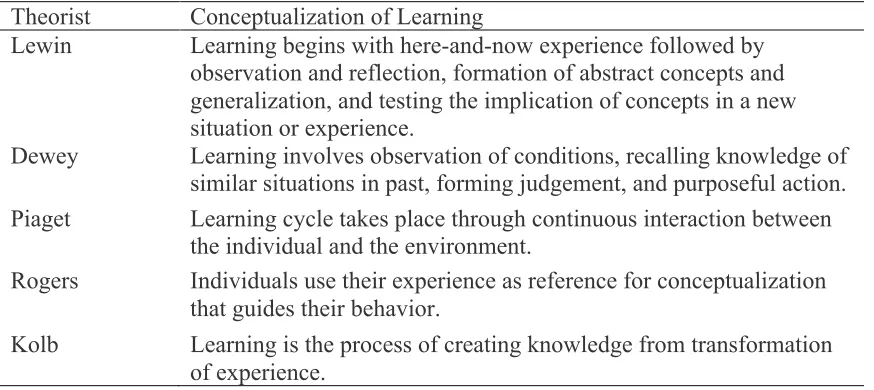
Table 1
Experiential Learning According to Lewin, Dewey, Piaget, and Kolb
Theorist Conceptualization of Learning
Lewin Learning begins with here-and-now experience followed by observation and reflection, formation of abstract concepts and generalization, and testing the implication of concepts in a new situation or experience.
Dewey Learning involves observation of conditions, recalling knowledge of similar situations in past, forming judgement, and purposeful action. Piaget Learning cycle takes place through continuous interaction between
the individual and the environment.
Rogers Individuals use their experience as reference for conceptualization that guides their behavior.
Kolb Learning is the process of creating knowledge from transformation of experience.
Kolb’s (1984) experiential-learning model was grounded in the work of John Dewey, Kurt Lewin, Jean Piaget, and Carl Rogers who emphasized the role of human experience in their theories of development and learning (Table 1). While the
likely to produce transformation (Strange & Gibson, 2017). The experiential-learning model (Kolb, 1984, pp. 27–36) theorizes that (a) learning is a continuous process of
creating knowledge, (b) ideas are formed and reformed through experience, (c) learning
is the process of adaptation that requires transactions between the person and the
environment, (d) knowledge is a production of personal-subjective-life experience and
objective-social-cultural experience, and (e) learning process requires resolving the
conflicts between modes of adaptation.
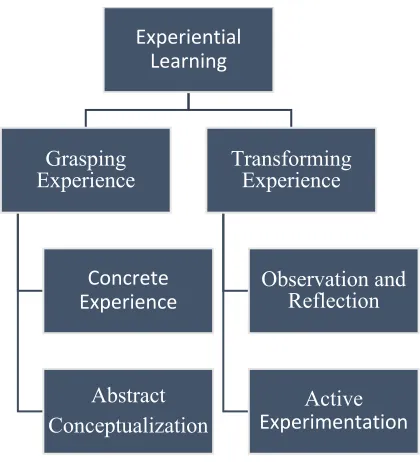
According to Kolb et al. (2001, p. 227), experiential learning occurs by a
combination of grasping experience that involves concrete and abstract conceptualization
as well as transforming experience that involves reflective observation and active
experimentation (Figure 4).
Figure 4. The experiential-learning process according to Kolb’s (1984) theory
In grasping experience, learners can approach the new information through
tangible and felt experience or abstract conceptualization of thinking and analyzing; in
Experiential Learning
Grasping Experience
Concrete Experience
Abstract Conceptualization
Transforming Experience
Observation and Reflection
transforming experience, learners can process the information through carefully watching
and reflecting on other people’s experience or by doing and experimenting things (Kolb
et al., 2001 pp. 227–228). In other words, a learner uses concrete and abstract approach or
active and reflective learning style (Kolb et al., 2001, pp. 227–228).
More specifically, there are two primary dimensions to the learning process. The first dimension represents the concrete experiencing of events on one end and abstract conceptualization of at the other. The other dimension has active experimentation at one extreme and reflective observation at the other. Thus, in the process of learning, one moves in varying degrees from actor to observer, and from specific involvement to general analytic detachment. (Kolb, 1984, p. 42)
A learning cycle may begin with immediate or concrete experience that may lead
to observations and reflections, followed by formation of new concepts and
experimentation to form new implications that can be tested to guide the creation of new
experiences (Kolb et al., 2001, p. 228). Thus, learning involves a cognitive process of
constant adaption to the environment and creation of knowledge from experience as
individuals approach the task with different modes of action including, feeling,
observing, thinking, reflecting, experimenting, and testing (Bergsteiner, Avery, &
Neumann, 2010). It is an evolving lifelong process by which ideas are created, recreated, and transformed through human experience (Moreno-López et al., 2017).
Breunig (2014) argued that experiential-learning theory contains a philosophy of educative process and a methodology of experiential way of teaching that employs the aspects experience, reflection, new knowledge, and application. Educators can engage learners in direct experience and allow them to reflect in order to generate new
knowledge or develop new skills (Breunig, 2014). Because people learn from accumulation of personal and social experience, experiential leaning formulates a
training. For instance, all teacher-training courses at the institute are designed are
designed to model experiential learning. During the training, the facilitators use learner-centered approach as a means of instruction, and the participants learn by experiencing and reflecting on the process.
Schema model of learning
The main contribution of the schema theory to constructivism is the role of
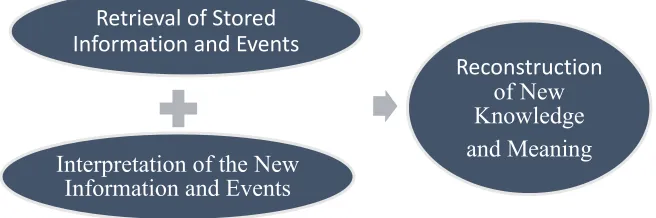
background knowledge in the creation of meaning. The schemata instruction is integrated in the preservice training at the institute to orient foreign-language instructors on the role linguistic and content knowledge in facilitating the language learning. Also, schemata activation is a part of lesson-plan, and preservice instructors are mentored on the development of background knowledge activities that facilitate comprehension of listening and reading texts. According to the schema model (Figure 5), the retrieval of related information from the memory is essential for making meaning form the new
information (Sheridan, 1978). Retrieval of Stored Information and Events
Figure 5. The process of knowledge reconstruction according to the schema theory Jean Piaget’s (1952) structural theory of the origins and development of cognition had laid the foundation for the schema theory (McVee, Dunsmore, & Gavelek, 2005). According to Piaget’s (1952) concept of assimilation and adaption, individuals approach
Retrieval of Stored Information and Events
Interpretation of the New Information and Events
Reconstruction
the new information by comparing it with knowledge existing in their mind (Ultanir, 2012), and people assimilate the new experience if it is consistent with their existing schemas or change their schemas to adapt to the new situation (McVee et al., 2005). The
schema theory assumes that (a) individuals attempt to fit the new information into some structure in the memory that helps them make sense of it, (b) individuals stored
information in the brain as a set of categories that can be recalled later, and (c) the
schema acts as a strategy-coding technique for facilitating the recall of prior knowledge
(Rumelhart, 1980). According to Anderson and Pearson (1984), the theory explains how knowledge is stored in the human memory and how the schema structure facilitates retrieval of information from the memory in order to permit reconstruction of new knowledge.
Rummelhart (1980) described the schema as organized mental structures that help individuals understand and associate new the information. The schema illustrates the relationships of common concepts in the memory that consist of objects, situations, series of actions, and series of events (Rumelhart, 1980), and it is considered a cognitive pattern of thought and knowledge that helps an individual recall and retrieve information
(Anderson, 1977; Wright et al., 2016). The experience shapes the schema and that suggests a relationship between people’s inherited knowledge and their interpretation of the reality (McVee et al., 2005). Thus, the schema mediates between one’s internal mental structure and the external world that can explain the role of culturally organized experience that helps individuals make sense of their reality (McVee et al., 2005).
(Sheridan, 1978). Therefore, active learning requires a learner to access prior knowledge,
and the schema-based instruction can help students build interrelation between the new information and the previously known information (Sheridan, 1978; Wright et al., 2016).
Summary
The learner-centered instruction is believed to foster students’ active involvement in the construction of knowledge through collaborative and autonomous learning
(Tawalbeh & AlAsmari, 2015). Constructivism and humanistic view of education formed the epistemological foundation of learner-centered approach. The constructivist view of subjective knowledge describes learning as meaning making from interaction between the
individual and the environment (e.g., Ertmer & Newby, 2013; Ultanir, 2012). As theorized, there is no absolute knowledge and different forms of knowledge can be
construed from different experiences (Ultanir, 2012). Andragogy, transformative
learning, experimental learning, and schema model of learning are adult-learning theories that share the constructivist view of meaning-making knowledge. These theories (a) place emphasis on the learners’ active role in the construction of knowledge, (b) attempt to explain how experience-based learning occurs, (c) support the learner-centered approach in the classroom, and (d) informs the teacher training at the institute where this study takes place.
On andragogy, Knowles (1973) argued that instruction should take into
courses, and all types of student-led projects would be the examples of learning that are supported by Knowles’ (1973’ adult-learning approach.
In the transformative learning model (Mezirow, 1990), a learner makes meaning from experience through perspective transformation by reflecting on content and process.
When learners have the opportunity to experience, analyze, and assess, they can revise
and change their existing beliefs and form new perspectives. Similarly, in experiential learning (Kolb, 1984), a learner makes meaning through grasping experience and transforming experience. According to Kolb (1984), learners involve in the activity or observe the activity, analyze and reflect on the learning experience, and then form and test their new perspectives. For both Kolb (1984) and Mezirow (1990), reflective assessment on the experience is essential for transformation. Both, experiential and transformative models of learning support instructional environment that allows learners to engage and reflect on the content and process, such as problem-solving, cases studies, project-based learning, task-based teaching, and scenario-based instruction.
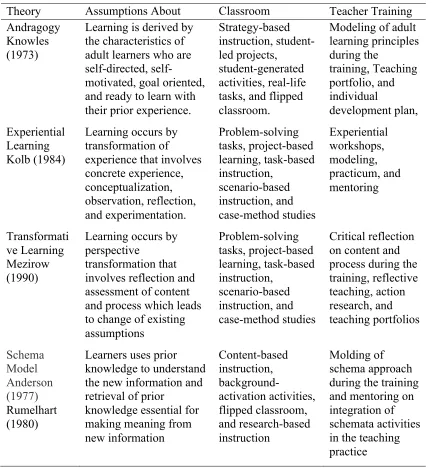
Table 2
Assumptions of Constructivist-Based Theories About Learning and Teacher Training Theory Assumptions About
Learning Classroom Instruction Teacher Training Andragogy Knowles (1973)
Learning is derived by the characteristics of adult learners who are directed,
self-motivated, goal oriented, and ready to learn with their prior experience.
Strategy-based instruction, student-led projects,
student-generated activities, real-life tasks, and flipped classroom.
Modeling of adult learning principles during the training, Teaching portfolio, and individual development plan, Experiential Learning Kolb (1984)
Learning occurs by transformation of experience that involves concrete experience, conceptualization, observation, reflection, and experimentation. Problem-solving tasks, project-based learning, task-based instruction, scenario-based instruction, and case-method studies Experiential workshops, modeling, practicum, and mentoring Transformati ve Learning Mezirow (1990)
Learning occurs by perspective
transformation that involves reflection and assessment of content and process which leads to change of existing assumptions Problem-solving tasks, project-based learning, task-based instruction, scenario-based instruction, and case-method studies Critical reflection on content and process during the training, reflective teaching, action research, and teaching portfolios Schema Model Anderson (1977) Rumelhart (1980)
Learners uses prior knowledge to understand the new information and retrieval of prior
knowledge essential for making meaning from new information Content-based instruction, background-activation activities, flipped classroom, and research-based instruction Molding of schema approach during the training and mentoring on integration of schemata activities in the teaching practice
self-directed learning, development of teaching portfolios, individual-development plans. Kolb’s (1984) experiential learning informs the design and facilitation of experiential workshops, mentoring, and practicum teaching, whereas Mesirow’s (1990)
transformative learning guides reflective teaching and action research. Both Schema (Anderson 1977; Rumelhart, 1980) and transformative learning (Mesirow, 1990) also guide reflection on learning experience where teachers use their existing schemata to reflect on their learning experiences, test their existing assumptions about learning and instruction, integrate alternative perspectives, and develop new understanding.
Teacher Training and Professional Development
The extent to which the teacher training and professional development can
transform the teaching practice is the focus of investigation by the current study. Teräs and Kartoglu (2017) defined professional-development as activities that are intended to help professionals learn and apply new skills in their professional practice. Alshehry (2018) believed that professional development should focus on the teachers’ needs,
address the skill gaps, and help teachers adopt novel methods of teaching.For many educators, professional development is the process that continues to build throughout the entire career of the individuals, and, therefore, it requires sustained learning rather than short-term courses (Sexton, 2018; Teräs & Kartoglu, 2017). In a broader sense,
professional development is understood as teacher training in the workplace. Educational
institutions espouse different methods to encourage teachers to stay abreast of their
professional development such as identifying their training needs, writing their annual
in the professional conferences, writing action research, and publishing in the educational
journals.
The end goal of professional development is to support students’ learning through
effective teaching. According to Alshehry (2018), professional development should effect the teaching practice as well as students’ learning outcomes. Participating in the
professional-development program may or may not lead to the intended goal of the training (Teräs & Kartoglu, 2017), and the outcome of training is dependent on willingness of teachers, motivation of students, and school support (Sexton, 2018).
According to Sexton (2018), knowledge alone does not lead to better teaching practice, and the training should consider teacher’s professional and personal dimensions. The training can make a difference if it addresses the educational needs of the teachers and
when the teachers receive institutional support to transfer the training into classroom
practice (Ashraf & Kafi, 2016). Also, teachers’ educational philosophy can play a role in
their motivation for professional development. For example, Ashraf and Kafi (2017)
investigated the relationship between professional development and teaching philosophy
and found that teachers who hold a philosophy that focuses on personal growth and teaching by principles are more likely to seek professional-development opportunities.
Maass and Engeln (2018) proposed a four-domain model of factors that effect the
teacher-professional growth: (a) the personal domain such as teacher’s knowledge,
beliefs, and attitudes, (b) the domain of practice or experimenting in the classroom, (c)
the external domain includes resources and support, and (d) domain of consequence or
salient outcomes. To achieve these domains, researchers suggested that teachers’
practice new ideas, collaborative support through peer collaboration and teacher-learning communities, mentoring on lesson planning, classroom observation feedback, and
development of teaching portfolios (Alshehry, 2018). These different methods of professional development are used to support teachers’ learning through practice, and they complement one another in helping teachers build their knowledge and vision about
learning and instruction (Hammond & Baratz-Snowden, 2007). A synthesis of literature
on different types of professional-development training used by the institute is provided
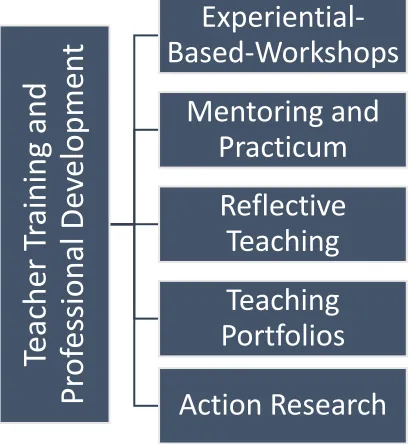
in the upcoming sections (Figure 6).
Figure 6. The components of teacher training and professional development at the institute
Experiential approach in teacher training
To communicate and model learner-centered instruction for foreign-language instructors, teacher-training courses and workshops at the institute are designed and delivered by the experiential learning approach (Kolb, 1984). During the training, instructors first experience the activity, then process and reflect to construct their new
Te
ac
he
r T
ra
in
in
g
an
d
Pr
of
es
si
on
al
D
ev
el
op
men
t
Based-Workshops
understanding and knowledge. The experiential approach not only provides teachers with an immediate opportunity to practice the newly introduced skill (Fabiano et al., 2013) but also places emphasis on the learner-constructed knowledge (Peisachovich et al., 2017). During the training, teachers can acquire instructional skills through experientially-created knowledge (Poudel, 2018) and critical reflection on the process (Kheirzadeh & Sistani, 2018). The purpose is to demonstrate learner-centered activities and to provide teachers with experiential settings by generating ideas through collaborative learning and reflection on the process. Modeling, simulation, case method, and analysis of teaching and learning are common approaches of experiential training that illustrate learner-centered activities.