Adsorption Studies of Fluoride on Multani Matti and Red Soil
Gandhi N.1, Sirisha D.1, Asthana Smita2 and Manjusha A.3 1
Centre for Environment and Climate Change, School of Environmental Sciences, JNIAS, Hyderabad, AP, INDIA 2
St. Ann’s College for Women, Mehedipatnam, Hyderabad, AP, INDIA 3
Sri Padmavathi Mahila Viswa Vidyalayam, Thirupathi, AP, INDIA
Available online at: www.isca.in
Received 23rd May 2012, revised 2nd June 2012, accepted 7th June 2012
Abstract
The present study deals with the adsorption of fluoride by multani matti and red soil. These two materials are fuller earths which are used to remove stains and non washable materials. Taking that factor into consideration, batch adsorption studies are carried for removal of fluoride from water. It is found that percentage removal increased with contact time and adsorbent dosage. The optimum contact time for multani matti and red soil is within 15 minutes. The percentage removal of fluoride decreased with increased in concentration. Langmuir and freundlich adsorption isotherms are followed. Pseudo second order kinetics and Elovich models explained the phenomena of adsorption.
Keywords: Adsorption, multani matti, red soil, kinetic models, thermodynamic models.
Introduction
Some ground water has fluoride naturally due to the prescence of minerals like fluorspar, cryolite and flouropatite. The recommended range of fluoride in drinking water is 1.5 mg/l. in Andhrapradesh there is 15 defluoridation plants based on nalgonda process which use alum. But this technique is not having success rate. Taking that factor into concederation, a study has been carried out in view of developing a defluoridation technique which uses multani matti and red soil. Batch adsorption studies are carried out in the study and it was found that both adsorbents could remove 50-70% of fluoride in the concentration range of 1-4 mg/l1-6.
Material and Methods
Selection of adsorbents: Red soils are composed of crystalling and metamorphic rocks. Mostly the areas of telangana especially nalgonda region has this type of red soil. The red colour of the soil is due to presence of iron oxide. The weathering of granites and hill rocks in Hyderabad produces red soil. By studing the physico chemical properties and free availability of soil, red soil is selected as a adsorbent7.
Multani matti (ZnCO32Zn (OH)2 H2O) is used as adsorbent to remove the air pollutants (SO2 and NO2) on Taj mahal. It is known as mont morillanite and contains grains of fine sand particles. They contain complex multi centre crystalline structure of oxides and hydroxides of magnesium, aluminum, zinc and slicon. It is also known as fullerene and it is rich in lime5-8.
Red soils are collected from Hyderabad and it is crushed, washed several times until the loosely bound particles are removed. They are dried in a microwave oven at 1000C for
about one hour. Multani matti is bought from the super market and it is dried in a microwave oven at 100 oC for about one hour. The adsorption studies carried out with respect to contact time, concentration, dosage, pH, and temperature.
Kinetic models: In order to investigate the mechanism of adsorption several kinetic models were tested including the pseudo first order kinetic model, the Elovich model and the pseudo second order kinetic model for batch adsorption process.
Lagergren (Pseudo First Order Equation) Model: The pseudo first order kinetic equation expressed as9
log (qe- qt) = log qe - KL/2.303 X t
Where, qe = the amount of fluoride at equilibrium, qt = the amount of Fluoride adsorbed at time t, KL = the rate constant for pseudo first order adsorption per minute.
The values of log (qe- qt) were linearly correlated with t, the plot of log (qe – qt) versus t should give a linear relationship from which KL and qe can be determined from the slope and intercept of the plot.
Elovich Model: The Elovich or Roginsky-Zeldovich equation is generally expressed as follows10
dqt/dt = α exp (-βqt)
Where, qt = the amount of fluoride adsorbed at time t, α = the initial Fluoride sorption rate, per min, β = the desorption constant, during the experiment.
Pseudo Second Order Model: To describe the fluoride adsorption, the modified pseudo second order kinetic equation is expressed as11
Where, qe = the amount of fluoride adsorbed at equilibrium, qt= the amount of fluoride adsorbed at time t, k2 = the rate constant for pseudo first order adsorption per minute.
Results and Discussion
Effect of Contact Time: The uptake of fluoride from industrial waste water by multani matti and red soil the adsorption rapidly increased in the first 20 minutes after 20 minutes adsorption slowly approached equilibrium. The adsorption rate and percentage removal of fluoride is high in case of red soil than multani matti. Batch adsorption studies are carried out to check the effect of contact time on percentage removal of fluoride by using red soil and multani matti12-19.
Effect of concentration of fluoride: When the initial concentration of fluoride was changed (1, 2, 3, 4 mg/L), with a constant adsorbent amount (red soil and multani matti) of 1 gm, the amount of adsorbed fluoride is decreased with increase in the concentration of fluoride. The results are shown in figure–2.
Effect of Adsorbent Dosage: The amount of clay adsorbents (multani matti and red soil) was varied from 0.2 to 1.0 gm with a constant initial fluoride concentration of 2 mg/L and equilibrium time is 60 minutes at room temperature. The amount of fluoride adsorbed per unit mass (qe) of the adsorbent at equilibrium increased with increase in the amount of clay adsorbent. The similar reports have been reported by Stephen Inbaraj and Sulochana, N. basic lead adsorption on low cost carbonaceous sorbent kinetic and equilibrium studies, and Sumanjit and Prasad.N. Adsorption of leads on rice husk Ash.
Effect of pH on Adsorption of Fluoride: The pH of the aqueous solution is an important controlling parameter in the adsorption process. In present work, adsorption of fluoride on the clay (red soil and multani matti) adsorbents was studied over the pH range of 3.0 to 8.0 for a constant clay amount of 1 gm, and 100 ml of fluride solution concentration of 2 mg/L at room temperature. As the acidity of the medium decreased, the amount of adsorbed (qe) showed a positive variation and rapidly increased at pH 6.5 in case of multani matti, and pH 5 in case of red soil20-22.
Figure-1
Variation of contact time between adsorbate and adsorbents
Figure-2
Variation of initial concentration 0
20 40 60 80
0 10 20 30 40 50
%
R
e
m
o
v
a
l
contact time in minutes
multani matti
red soil
0 20 40 60 80 100
0 1 2 3 4 5
%
R
e
m
o
v
a
l
fluoride concentration in mg
multani matti
Figure-3
Variation of adsorbent dosage
Figure-4
Effect of pH on adsorption of fluoride
Effect of temperature on adsorption of fluoride: multani mati
log Ce
lo
g
X
/m
0.5 0.6 0.7 0.8 0.9 1.0 1.1 0.0
0.5 1.0 1.5
0O C 40O C 60O C 80O C
Figure-5(a)
Red soil
log Ce
lo
g
X
/m
0.5 0.6 0.7 0.8 0.9 1.0 1.1
0.0 0.5 1.0 1.5
0OC 40O C 60O C 80O C
Figure-5(b)
Relationship between log Ce and log x/m (Freundlich isotherm)
0 20 40 60 80 100
0 0.2 0.4 0.6 0.8 1 1.2
%
R
e
m
o
v
a
l
adsorbent dosage in gm
multani matti
red soil
0 20 40 60 80 100
3 4 5 5.5 6 5.5 7 7.5 8
%
R
e
m
o
v
a
l
pH
multani matti
multani mati
Ce
Q
e
/C
e
0 5 10 15
0.0 0.2 0.4 0.6 0.8 1.0
0O C 40O C 60O C 80O C
Red soil
Ce
Q
e/
C
e
0 5 10 15
0.0 0.5 1.0 1.5
0o C 40oC 60o C 80 o C
Figure-6
Relationship between Qe/Ce and Ce
multani mati
Ce
C
e/
Q
e
0 5 10 15
0 5 10 15
0o C 40o C 60o C 80o C
Red soil
Ce
C
e/
Q
e
0 5 10 15
0 1 2 3 4 5
0o C
40 oC
60o C
80o C
Figure-7
Relationship between Ce/Qe and Ce (Langmuir isotherm)
multani mati
x/m
lo
g
(
x
/m
/C
e
) 2 4 6 8 10
-0.8 -0.6 -0.4 -0.2 0.0 0.2
0 o C
40o C
60o C
80o C
Red soil
x/m
lo
g
(
x
/m
/C
e
) 5 10 15
-0.8 -0.6 -0.4 -0.2 0.0 0.2
0oC 40 o C 60o C 80o C
Figure-8
Relationship between log (x/m/Ce) and x/m
1/T
ln
k
0.0025 0.0030 0.0035 0.0040
0 2 4 6 8 10 12
14 multani mati
red soil
Figure-9
Relationship between ln k and 1/T
favourable for adsorption of fluoride. This indicates that the adsorption capacity is increases with increasing in temperature. The thermodynamic parameters, ∆H, ∆S and ∆G, for the adsorption process are computed from the plots of In k Vs 1/T. The adsorption enthalpy, ∆H, is indicates that the adsorption interaction is exothermic. The positive value of ∆S shows that that increased randomness at solid interface during the adsorption of fluoride by multani matti and red soil.
∆G = - RTlog Kc Ln Kc = ∆S/R - ∆H/RT
The negative value of ∆G indicates the feasibility of process and indicates the spontaneous nature of adsorption 23-29
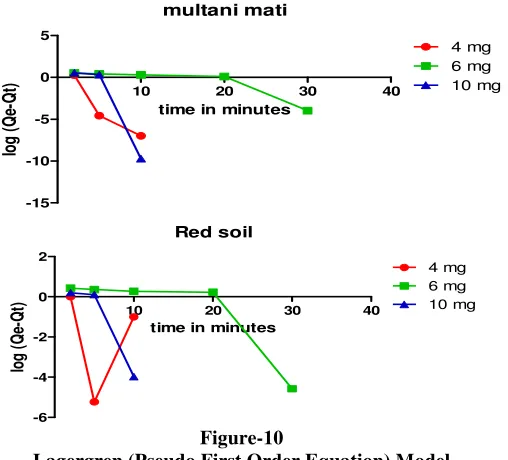
Kinetic models: Figure-10 represents a plot of the Lagergren equation for the result of adsorption of fluoride from industrial waste water by using multani matti and red soil. The plot does not showing the linear relationship between log (qe-qt) and time in minutes. It represents that lines gets deviated from linearity. From this figure it was found that Lagergren Pseudo first order equation is not suitable for adsorption of fluoride by using multani matti and red soil.
multani mati
time in minutes
lo
g
(Q
e-Q
t) 10 20 30 40
-15 -10 -5 0 5
4 mg 6 mg 10 mg
Red soil
time in minutes
lo
g
(Q
e-Q
t) 10 20 30 40
-6 -4 -2 0 2
4 mg 6 mg 10 mg
Figure-10
Lagergren (Pseudo First Order Equation) Model The result of the sorption of fluoride by using multani matti and red soil has been represented in the form of Elovich equation in figure- 11, at various initial fluoride concentration (4 mg, 6 mg, 10 mg). From the plot a linear relationship between the amount of fluoride adsorbed, qt and In (t) was established. These plots showed different distinct linear regions within individual sets of data.
The same data are shown as pseudo second order equations in figure -12. These plots show the fits had good correlation when the pseudo second order euation was employed. Thus, increasing the fluoride concentration from 4 mg to 10 mg the
fluoride sorbed at any contact time increases. This is obvious for higher concentration values, as a more efficient utilization of the sorptive capacities of the sorbent would be expected due to greater sorption driving force.
multani mati
ln (t)
Q
t
0 1 2 3 4
0 2 4 6 8
4 mg 6 mg 10 mg
Figure-11(a)
Red soil
ln (t)
Q
t
0 1 2 3 4
0 2 4 6 8
4 mg 6 mg 10 mg
Figure-11(b) Elovich Model
multani mati
time in minutes
t/Q
t
0 10 20 30 40 50
0 5 10 15 20
4 mg 6 mg 10 mg
Red soil
time in minutes
t/
Q
t
0 10 20 30 40 50
0 5 10 15 20
4 mg 6 mg 10 mg
Figure-12
Conclusion
In the present study the adsorbent (red soil) selected are naturally available materials. The cost of producing the material is reducer. It is abundantly available in different parts of Andhrapradesh. The results obtained in this study to develop a column study or for designing a plant for defluoridation. The red soil and multani matti does not cause any increase in pH, or any increase of Iron and aluminum concentration in effluent and drinking water.
References
1. John D.J., Water treatment, Handbook of Drinking Water Quality Standards and Controls, Van Nostrand Reinhold, New York, 407–490 (2008)
2. Culp R. and Stolenberg H., Fluoride reduction at La Cross, Kan, J. AWWA, 50(3), 423–431 (1958)
3. Parker C.L. and Fong C.C., Fluoride removal technology and cost estimates, Ind. Wastes, 23–25 (1975)
4. Potgeiter J.H., An experimental assessment of the efficiency of different defluoridation methods, Chem. SA, 317–318 (1990)
5. Nawalakhe W.G., Kulkarni D.N., Pathak B.N. and Bulusu K.R., Defluoridation of water with alum, Ind. J. Environ. Health, 16(1), (1974)
6. Technical Digest, National Environmental Engineering Research Institute, Nagpur, NEERI Manual (1978)
7. Mortland M.M., Shaobai S. and Boyd S.A., Clay organic complexes as adsorbents for phenol and chlorophenols, Clays Clay miner., 34, 581-585 (1986)
8. Alagumuthu G. Veeraputhiran V. and Rajan M., Comments on Fluoride removal from water using activated and MnO2-coated Tamarind Fruit (Tamarindus indica) shell: Batch and column Studies, Journal of Hazardous Materials, 183, 956-957 (2010)
9. Lagergren S., Zur theorie Der Sogennten Adsorption Geloster Stoffe, Hand linger., 24, 1-39 (1898)
10. Low K.S., Lee C.K. and Ng A.Y., Column study on the adsorption of Cr (VI) using Quanternised rice Hulls, Bioresou. Technol., 65, 205-208 (1999)
11. Chien S.H. and Clayton W.R., Application of Elovich Equation to the kinetics of phosphate release and sorption on soils, Soil sci.soc.Am.J., 44, 265-268 (1980)
12. Voudrias K. Fytianos and Bozani, Global Nest, 4(2), 75-83 (2002)
13. Arnesen A.K.M., Abrahamsen G., Sandvik G. and Krogstad T., Aluminium-smelters and fluoride pollution of soil and soil solution in Norway, Science of the Total Environment, 163, 39–53 (1995)
14. Cheung W.H., Szeto Y.S. and McKay G., Intraparticle diffusion processes during acid dye adsorption onto chitosan, Bioresource Technology, 98, 2897–2904 (2007)
15. Sujana M.G., Pradhan H.K. and Anand S., Studies on sorption of some geomaterials for fluoride removal from aqueous solutions, Journal of Hazardous Materials, 161, 120–125 (2009)
16. Zhu C.S., Bai G.L., Liu X.L. and Li Y., Screening high-fluoride and high-arsenic drinking waters and surveying endemic fluorosis and arsenic in Shaanxi province in western China, Water Research, 40, 3015– 3022 (2006)
17. Ho Y.S., Selection of optimum sorption isotherm, Carbon, 42, 2113–2130 (2004)
18. WHO, Guidelines for Drinking Water Quality, World Health Organization, Geneva (2008)
19. Ho Y.S. and Mcay G., Study of the Sorption of Divalent metal ion to peat, Adsorption. Sci. Technol., 18, 639-650 (2000)
20. Alagumuthu, G. and Rajan M., Equilibrium and kinetics of adsorption of fluoride onto zirconium impregnated cashew nut shell carbon, Chemical Engineering Journal, 158, 451– 457 (2010)
21. Rojit, Anirudihan, G. water Research, 32(12), 3772-3780 (1998)
22. Sumanjit and Prasad N., Adsorption of leads on rice husk ash, Indian Journal of Chemistry, 40A, 388-391 (2001)
23. Stephen Inbaraj and Sulochana N., Basic lead Adsorption on a
low cost carbonaceous Sorbent kinetic and equilibrium studies, Indian journal of chemical technology, 9, 201-208 (2002)
24. Alagumuthu G. and Rajan M., Kinetic and equilibrium studies on fluoride removal by zirconium (IV) – impregnated ground nutshell carbon, Hemijska industrija, 64(4), 295–304 (2010) 25. Nuhoglu Y. and Oguz, Removal of copper (II) from aqueous
solution by biosorption on the cone biomass of Thuja orientalis, process Biochem., 38, 1627-1631 (2003)
26. Gupta V.K., Jain C.K., Ali I., Sharma M. and Saini V.K., Removal of cadmium and nickel from waste water using bagasse fly ash- a sugar industry waste, water Res., 37, 4038-4044 (2003)
27. Chitin G., Annadurai M., Chellapandian and Krishnan M.G.V., Environmental; monitoring and assessment, 59(1), (1999)
28. Goel Jyotsna, Kadrivelu K., Rajgopal Chitra, Garg Vinod Kumar, Journal of chemical technology and biotechnology, 80(4), 469-476 (2005)
29. Capsule report, Environmental protection agency (1997) 30. Patil S.G., Chonde S.G., Jadhav A.S. and Raut P.D., Impact
of Physico-Chemical Characteristics of Shivaji University lakes on Phytoplankton Communities, Kolhapur, India, Research Journal of Recent Sciences, 1(2), 56-60 (2012) 31. Bhise R.M., Patil A.A., Raskar A.R., Patil P.J. and Deshpande