Open Access
Study protocol
Improving the outcome of infants born at <30 weeks' gestation - a
randomized controlled trial of preventative care at home
Alicia J Spittle*
1,2,3, Carmel Ferretti
1,2,4, Peter J Anderson
1,2, Jane Orton
3,
Abbey Eeles
1,2,3, Lisa Bates
1, Roslyn N Boyd
6, Terrie E Inder
7and
Lex W Doyle
2,3,5Address: 1Physiotherapy, School of Health Sciences, University of Melbourne, 200 Berkley Street, Parkville, Victoria, 3052, Australia, 2Victorian
Infant Brain Studies, Murdoch Childrens Research Institute, 2ndFloor, Flemington Road, Parkville, Victoria, 3052, Australia, 3Neonatal Services,
Royal Women's Hospital, 7th Floor, Cnr Grattan Street and Flemington Road, Parkville, Victoria, 3052, Australia, 4Psychology, School of
Behavioural Sciences, University of Melbourne, 12th Floor, Redmond Barry Building, Victoria, 3010, Australia, 5Department of Obstetrics and
Gynaecology, 7th Floor, Cnr Grattan Street and Flemington Road, Parkville, Victoria, 3052, Australia, 6Queensland Cerebral Palsy and
Rehabilitation Research Centre, School of Medicine, University of Queensland, Level 3, Foundation Building, Royal Children's Hospital, Herston, Queensland, 4006, Australia and 7Newborn Medicine, Washington University School of Medicine, 660 S. Euclid Avenue, St. Louis, MO, USA
Email: Alicia J Spittle* - [email protected]; Carmel Ferretti - [email protected];
Peter J Anderson - [email protected]; Jane Orton - [email protected]; Abbey Eeles - [email protected]; Lisa Bates - [email protected]; Roslyn N Boyd - [email protected]; Terrie E Inder - [email protected];
Lex W Doyle - [email protected] * Corresponding author
Abstract
Background: Early developmental interventions to prevent the high rate of neurodevelopmental problems in very preterm children, including cognitive, motor and behavioral impairments, are urgently needed. These interventions should be multi-faceted and include modules for caregivers given their high rates of mental health problems.
Methods/Design: We have designed a randomized controlled trial to assess the effectiveness of a preventative care program delivered at home over the first 12 months of life for infants born very preterm (<30 weeks of gestational age) and their families, compared with standard medical follow-up. The aim of the program, delivered over nine sessions by a team comprising a physiotherapist and psychologist, is to improve infant development (cognitive, motor and language), behavioral regulation, caregiver-child interactions and caregiver mental health at 24 months' corrected age. The infants will be stratified by severity of brain white matter injury (assessed by magnetic resonance imaging) at term equivalent age, and then randomized. At 12 months' corrected age interim outcome measures will include motor development assessed using the Alberta Infant Motor Scale and the Neurological Sensory Motor Developmental Assessment. Caregivers will also complete a questionnaire at this time to obtain information on behavior, parenting, caregiver mental health, and social support. The primary outcomes are at 24 months' corrected age and include cognitive, motor and language development assessed with the Bayley Scales of Infant and Toddler Development (Bayley-III). Secondary outcomes at 24 months include caregiver-child interaction measured using an observational task, and infant behavior, parenting, caregiver mental health and social support measured via standardized parental questionnaires.
Published: 3 December 2009
BMC Pediatrics 2009, 9:73 doi:10.1186/1471-2431-9-73
Received: 17 September 2009 Accepted: 3 December 2009 This article is available from: http://www.biomedcentral.com/1471-2431/9/73
© 2009 Spittle et al; licensee BioMed Central Ltd.
Discussion: This paper presents the background, study design and protocol for a randomized controlled trial in very preterm infants utilizing a preventative care program in the first year after discharge home designed to improve cognitive, motor and behavioral outcomes of very preterm children and caregiver mental health at two-years' corrected age.
Clinical Trial Registration Number: ACTRN12605000492651
Background
With increasing numbers of very low birthweight (VLBW; <1500 g) or very preterm (<30 weeks' gestational age) infants surviving, there is a growing recognition that sub-stantial numbers of these infants will develop motor, cog-nitive and behavioral problems. These disabilities have life long consequences and will soon translate into increased numbers of adults with disabilities[1]. The edu-cational and social implications are substantial. The pre-vention of learning disabilities, behavior and motor problems is an important goal for modern perinatal care for preterm children and their families[2].
There are many potential factors contributing to the risk of disability in the preterm infant, including severity of ill-ness, suboptimal nutrition, therapeutic exposures, envi-ronmental and social factors. Whilst there are many randomized controlled trials investigating medical inter-ventions that target some of these areas, there is a paucity of sufficiently powered randomized trials involving multi-dimensional interventions focusing on environmental, behavioral, and early developmental factors [3].
This study, called VIBeS (Victorian Infant Brain Study) Plus, follows on from the earlier VIBeS study that moni-tored the natural history of brain development by evaluat-ing alterations in brain structure in the early weeks after birth with advanced neuro-imaging modalities, and com-pared brain development, motor and behavioral out-comes at 2 years[4,5]. The current VIBeS Plus study involves a randomized controlled trial of a preventative care program with the aim to improve the infant's cogni-tive and motor development, behavioral regulation, as well as the primary caregiver-child interactions and pri-mary caregiver mental health at 24 months' corrected age.
The VIBeS Plus program is partly based on a study by Dolby et al[6], with the content of this intervention pack-age updated to incorporate several related recent theoreti-cal frameworks of development, including dynamic systems theory[7] and family-centered care[8]. The pro-gram by Dolby et al[6] involved two teams, each of a psy-chologist working collaboratively with a physiotherapist to develop a strong link between behavioral regulation and motor competence. The study by Dolby et al was a quasi-randomized trial with three groups with 81 subjects entered (27 in each group) with 69 subjects completing
the study in the preterm intervention group (n = 24), a preterm control group (n = 22) and a term control group (n = 23).
The program by Dolby et al[6] consisted of six sessions, with the family first seen in hospital at 36 weeks' post-menstrual age. The following sessions occurred at home: at term, 1, 4, 6 and 9 months' corrected age. Assessments and interventions were targeted to occur at the beginning of a new developmental phase, where there is often a period of disorganization prior to change[9]. At 12 months, infants in both groups were assessed by a psy-chologist who was masked to the infant's status (preterm vs term, and intervention vs control) using the Bayley Scales of Infant Development (BSID)[10]. The authors reported that there were significant effects in favour of the intervention group for both cognitive and motor out-comes[11].
The program by Dolby et al[6] was designed specifically for parents when their infants were at home, and was based upon the framework of the synactive model of self regulation and developmental care described by Als[12,13] and attachment theory described by Sroufe[14]. Each model described in the study of Dolby et al[6] is outlined briefly below.
Self-regulation model
model have focused on the infant in the hospital environ-ment, with reports of varying success[19,20]. Dolby et al[6] designed their study to incorporate the principles of self-regulation but hypothesized that a home-based pro-gram would be more beneficial as it could target the par-ents specifically.
Attachment Theory
Attachment refers to the relationship and special emo-tional bond that infants develop with their caregivers over the first year of life[21]. Attachment is thought to develop over a period of time, as the adult and infant engage in interaction, and the infant organises his or her behavior around the care givers[21]. Attachment theory is based upon the biological need an infant has to interact with their environment[22]. From birth, infants can attend to the sound of a voice, and be soothed by human touch[23]. As mentioned previously, preterm infants may have altered self-regulation which can affect their ability to interact with their environment, and caregiver respon-siveness is required. Positive early interactive experiences with a primary caregiver are believed to be an important process in "fine-tuning" the neural developmental sys-tems and creating a secure infant. Attachment behavior and organization evolves in phases and is dependent on the age of the child[21]. During the first phase, from birth to three months, the caregiver learns to interpret and respond appropriately to the infant's fluctuating states and behavioral cues. The caregiver has an important role in setting limits of stimulation so the infant can remain organized. During the second phase, from three to six months, the infant becomes more communicative and responsive to their caregivers. The caregiver engages, relaxes, then re-engages with the infant in response to the infant's signals. Consequently, the infant can learn to maintain organized behavior with increasing levels of stimulation[22]. The infant may initiate engagement, but cannot maintain organization independently, and the car-egiver thus has an important role in controlling their infant's state and behavior. During the next phase, from 6-12 months, the infant becomes more mobile and has an increased capacity for intentional behavior with the devel-opment of more motor control. A reciprocal attachment relationship develops when there has been a history of appropriate caregiver-orchestrated interactions during the first six months. The caregiver has an important role in providing a secure base for their infant so the infant can learn to be independent whilst being able to check that the caregiver is present, if needed [9].
Parents of infants born preterm may experience a range of responses following the birth, including depression [24-27], anxiety [28-30] and symptoms of post traumatic stress disorder[31]. Studies have also shown that parental
stress is related to less sensitive, more intrusive and more active maternal interactional behavior[32]. There is some evidence that programs that are aimed at improving the parent-child interaction through providing emotional support in the way of information and education of infants' behavioral cues, encouragement and empathy increased parental feelings of self confidence and compe-tence, and increased positive parent-infant interaction [33-35]. The study by Dolby et al[6] used the three phases of attachment development described by Sroufe above [22] to guide their intervention program.
Whilst the program by Dolby et al[6] has a strong theoret-ical background, the methodology (study design and sub-ject numbers) and reporting of the results limits the conclusions that can be drawn from the study. Therefore, we conducted a randomized controlled trial, partly based upon the theoretical content of the Dolby et al[6] study, with the aim of improving the infant's motor and cogni-tive performance, the parent-infant relationship, and pri-mary caregiver mental health outcomes. The original intervention model reported by Dolby et al[6] which was created in the 1980s, has been updated in the present intervention to account for current theories of develop-ment and research on early intervention[3]. In addition, this intervention targets very preterm infants who have been identified as being at high risk for developmental impairment. The VIBeS Plus program was designed for infants born at younger gestational ages (all infants will be born at <30 weeks' gestational age whereas the mean gestational age of the Dolby study infants was 32 weeks), with a higher incidence of multiple births, and with the study commencing later, at 40 weeks' gestation rather than before 40 weeks in the NICU. We have published a Cochrane review of early developmental interventions that demonstrated that interventions commencing post hospital discharge had similar effects on cognitive and motor development compared with interventions that commenced in the NICU[3]. The theoretical framework for the VIBeS Plus program incorporates the theoretical models used in the study by Dolby et al[6] with the inclu-sion of dynamic systems theory and family centered prac-tice model.
Dynamic Systems Theory
the infant's inherent and emerging skills with that of the environment in which the task is being performed and the characteristics of the desired task[36].
Development is considered to be non-linear within this model, such that the infant may have times of rapid devel-opment and times where the infant is refining their skills. Infants will experience 'transition phases' associated with the infant learning a higher level skill[7]. During this time the infant's movement becomes highly variable as the infant experiments with different movement patterns. As the infant learns the most efficient way of moving, the skill will be refined. This model is consistent with Als' syn-active model of neonatal behavioral organization[12] and Brazelton's theory of touchpoints[9]. Integration of new motor strategies occurs through a process of neuronal selection, in which neuronal connections associated with the most efficient movement patterns are strengthened through repeated use[37]. By creating an enriching envi-ronment, the infant should be motivated to move to inter-act with their surrounds. Our intervention is timed at stages of transition so the therapist has the ability to view how the infant learns and adapts to new tasks[38].
(a) Family-centered care
The intervention program involves "family-centered care", where the health professional recognises the impor-tant role that families play in ensuring the health and well-being of children[39]. Intervention programs have typically been child-centered, with therapists being viewed as the "expert" and setting goals that focus on bringing about changes in the child[8]. However, this form of intervention is being challenged by family-cen-tered practice which views the parent as knowing their child best, being a valuable resource and having tremen-dous insight into their child's abilities. Parents are increas-ingly involved in implementing home programs not only because of resource limitations within the healthcare sys-tem, but also because of the importance of family-cen-tered care[40]. The principles of family-cenfamily-cen-tered care are that the health professional recognises each child and their family's innate strengths, with the health care experi-ence being viewed as an opportunity to build on strengths, and to support families in the care-giving and decision making roles. It identifies that each family is dif-ferent and that the children function optimally within a supportive family and community context[8]. Family involvement is a key to intervention, as it means that activities can be incorporated into daily life and the infant can learn through repeated reinforcement of an activity. For example, if the therapist and family are working together on encouraging flexed, contained postures to help the infant settle, the family can hold the infant in flexion during feeding, nappy changes, play etc. The rela-tionship between family and professionals is a
partner-ship in which the families define the priorities for therapeutic intervention, with the therapist helping to direct the intervention process.
VIBeS PLUS
The VIBeS Plus program is home-based with the infant's primary caregiver a central component in the interven-tion. Intervention commences early in the developmental process, at term, so that various subsystems that influence development from the musculo-skeletal system to the par-ent-infant relationship can be enhanced within weeks of the baby being discharged home. At each stage compo-nents of the intervention will take account of the infant's development, caregiver-infant interaction and the envi-ronment. The program employs a problem-based learning approach where the caregiver's concerns are addressed and strategies devised together with the therapist, rather than the didactic approach where an expert delivers ther-apy or teaches the mother.
Methods/Design
The aim of this randomized controlled trial is to compare the VIBeS program, which is delivered over nine sessions by a team of a physiotherapist and psychologist, with rou-tine post-discharge care. The outcomes for this trial are the infant's cognitive, motor, and language development, and behavioral regulation, as well as caregiver-child interac-tion and caregiver mental health at 24 months of age, cor-rected for prematurity. The study has been approved by the Royal Women's Hospital and Royal Children's Hospi-tal Research and Ethics Committees.
Study sample
Infants born at <30 weeks' gestational age with no major congenital anomalies associated with a poor neurodevel-opmental outcome will be eligible for inclusion in this study. As the study involves home-based assessment and intervention, families will be required to live within a 100 km radius of the hospital. Families will need to speak Eng-lish, as funding is not available for interpreters. Infants will be excluded if they are still in hospital at 4 weeks' cor-rected age, as the study is designed to target the primary care giver and infant in a home-based setting. Infants will be recruited from the Royal Women's Hospital or the Royal Children's Hospital, Melbourne, Australia. These hospitals represent two of the four neonatal intensive care units in the state of Victoria, Australia.
Sample Size Calculations
of Infant and Toddler Development - 3rd edition[41]. With a type-I (alpha) level of 0.05, and 80% power, we will require 100 subjects in each group, i.e., a sample size of 200.
Recruitment procedure
Infants will be enrolled at 38-40 weeks, after parental con-sent is obtained. All eligible infant's mothers, fathers and/ or primary caregivers will be approached by a research nurse who is responsible for all recruitment, 4-8 weeks after birth when survival of the infant beyond the primary hospitalization period seems likely. Families will be given a parent information statement regarding the purpose of the program and consent forms to participate in the study.
Study time line and protocol
At 38-42 weeks' postmenstrual age following consent to participate, all families will complete baseline question-naires and perinatal data will be collected by the research nurse. Infants whose families consent to magnetic reso-nance imaging (MRI) will be scanned at term equivalent age. Following the MRI, or at term equivalent age if MRI is not performed, infants will be randomized to interven-tion or standard follow-up groups. Infants and families in the intervention program will have nine home visits pro-vided by a team of a psychologist and a physiotherapist throughout the first year. All infants in the intervention and standard follow-up groups will be seen at 12 months' corrected age for motor assessments and parents will be asked to complete questionnaires. At 24 months' cor-rected age all children will participate in cognitive and motor assessments, along with a primary caregiver-infant interaction task. In addition, the primary caregiver will complete questionnaires at this time (Figure 1).
Perinatal data collection
Perinatal data including information on the pregnancy, birth history, and neonatal course (e.g. gestational age, birthweight, gender, multiple birth status, cranial ultra-sound findings, proven or suspected necrotizing entero-colitis, maternal antenatal corticosteroid administration, postnatal corticosteroid use and use of oxygen at dis-charge from hospital) will be collected by the research nurse from medical files and the hospital neonatal data-base. The primary caregiver will be asked to complete questionnaires when their infant is at term equivalent age, prior to randomization, to obtain the following informa-tion:
- Social Risk [42]: will be assessed using a 12-point index comprising of six aspects of social status including family structure, education of primary caregiver, occupation of primary income earner, employment status of primary income earner, language spoken at home, and maternal age at birth. Based on the overall risk score, each family
will be categorized as lower social risk (0-1) or higher social risk (2+).
- Edinburgh Postnatal Depression Scale (EPDS) [43]: will be used to assess primary caregiver depressive symptoms at baseline. It is a widely used 10 item screening tool for postpartum depression. Each item contains a statement such as "I have felt sad or miserable" with four possible responses ranging from "No, not at all" to "Yes, most the time." The primary caregiver is directed to "Choose the answer that comes closest to how you have felt in the past seven days." Each item is scored from 0 to 3 in terms of severity, giving a total score ranging from 0 to 30. The EPDS has demonstrated high reliability and specificity as an indicator of significant depressive symptomatology in new mothers[44]. In this study a cut-off of 12 will be used to indicate depressive symptomatology based upon vali-dation studies[44,45].
- The Life Stress scale from the Parenting Stress Index [46]: will be used to examine potentially stressful events within the last 12 months, and whether the respondent thinks that they have a continuing impact. The Life Stress scale is a 19 item scale assessing the number of stressful situa-tional circumstances often beyond the control of a parent (eg. death of a relative, loss of a job). It provides an index of the amount of stress outside the parent-child relation-ship that the parent is currently experiencing.
- The Coping Inventory for Stressful Situations (CISS) [47]: which is a 48-item inventory will be used to measure three major types of coping styles in an individual, including Task-Oriented (problem-solving), Emotion-Oriented (focuses on consequent emotions, becoming angry/ upset), and Avoidance Coping (Distraction and social diversion). Primary caregivers will be asked to rate each item on a five point scale ranging from (1) "not at all" to (5) "very much".
- Impact on Family Scale (IOF-G) [48]: will be used to assess the effect of a child's illness on the family system in rela-tion to economic, social, familial, and overall strain. There are 24 items scored on a 4 point Likert scale - (strongly agree to strongly disagree) which measure 4 dimensions of impact upon the family: Financial (economic conse-quences for the family), Familial/Social (disruption of social interaction), Personal Strain (psychological burden experienced by the primary caregiver and Mastery (coping strategies by the family).
Study time line
Figure 1
Study time line. - EPDS = Edinburgh Postnatal Depression Scale[44]; CISS = Coping Inventory for Stressful Situations[46]; IOF-G = Impact of Family Scale[47]; STAI = State Trait Anxiety Inventory; Social Risk= Social risk Index[41].; PSI= Parenting Stress Index[45]; WMI = white matter injury[50,51]; BSITD-III = Bayley Scales of Infant and Toddler Development -3rd
edi-tion[40]; AIMS = Alberta Infant Motor Scale [57]; NSMDA=Neurological Sensory Motor Developmental Assessment[56]; ITSEA = Infant Toddler Social Emotional Assessment[58]; HADS = Hospital Anxiety and Depression Scale[59]; PSI-SF = Parenting Stress Index - Short Form[61]; SSQ = Social Support Questionnaire[63]; FAD = Family Assessment Device; Sensory profile = Infant Toddler Sensory Profile Questionnaire [67].
Ter m Baseline Pr edictor Measur es
- Magnetic Resonance Imaging
- Primary caregiver questionnaire (EPDS, CISS,
IOF-G, STAI, Social risk, PSI)
Bir th
Extensive Perinatal Data
12 Month Inter im Outcome Assessment
-
Motor assessment (NSMDA, AIMS)
-
Primary caregiver questionnaire (ITSEA, IOF-G,
FAD and Sensory Profile)
24 Pr imar y Outcome Assessment
- Cognitive, motor and language assessment
(BSITD-III, NSMDA)
-
Primary caregiver questionnaire (ITSEA, HADS, PSI-SF, SSQ,
FAD, Sensory Profile)
-
Primary caregiver-infant interaction task
Randomization
Stratification for WMI and multiple births
Inter vention Gr oup
9 home visits from team of
physiotherapist and psychologist
from 2 weeks -11months CA
Standar d Follow-Up Gr oup
Seen by Paediatrician and
Maternal Child Health Nurse
Recr uitment at ter m
questions. Each statement contains a 4 point Likert scale (1= not at all, 4= very much so). Higher scores indicate higher levels of anxiety. For the current study, we will uti-lized state anxiety to evaluate parents' current anxiety, rather than more stable personality attributes.
Magnetic Resonance Imaging (MRI)
Procedure for MRI
Brain MRI will be performed at 38-44 weeks' postmen-strual age at the Royal Children's Hospital. Infants are still eligible for the trial if parents do not consent to MRI. For the MRI, infants will be fed, fitted with earmuffs to mini-mise noise exposure, then carefully wrapped and placed in a vacuum fixation beanbag (S&S Radiographic Prod-ucts, Brooklyn, New York) designed to keep the infant still and supported in the scanner[4] All imaging will be obtained without sedation or anaesthesia. Infants will be closely monitored during the MRI scan by electrocardiog-raphy and pulse oximetry. MRI will initially be performed using a 1.5 Tesla General Electric Sigma System (General Electrics-Medical Systems, Milwaukee, Wisconsin). When the scanner is upgraded, infants will be scanned using a 3.0 Tesla Siemens Trio (software version 11b and 13b) using a standard 12 channel matrix head coil operating in CP mode.
MRI Protocols
Brain development at baseline will be assessed using advanced MRI techniques to qualitatively assess cerebral structure. For the 1.5 Tesla scanner two different imaging modules will be applied to the acquisition of the primary MR data, a T1 3D Fourier transform spoiled gradient recalled sequence (1.5 mm coronal slices; flip angle 45°; repetition time (TR) 35 msec; echo time (TE) 9 msec; field of view 18 cms; matrix 256 × 256) and a dual-echo proton density and T2 weighted spin echo sequence (1.6 mm coronal or 3 mm axial slices; flip angle, 90E; repetition time 4000 msec; echo time, 70 and 140 msec; field of view, 18 cm; matrix 512 × 512 were used). These sequences provide images with minimal noise and inten-sity artefacts. For the 3.0 Tesla 76 contiguous Coronal Dual Echo Turbo Spin Echo T2 weighted images (1 × 1 × 2 mm) will be acquired with TR = 4900 ms, TE = 64/179 ms and a parallel imaging factor of 2 (GRAPPA algorithm) with refocusing flip angle 150°. T1 weighted imaging was performed using 176 contiguous slices with FLASH 3D acquisition (1 × 1 × 1 mm) TR = 19 ms, TE = 4.92 ms, Flip 25° and a parallel imaging factor of 2 (GRAPPA algo-rithm).
MRI Qualitative Scoring
A standardized qualitative structural scoring system will be used to assess white and grey matter abnormali-ties[50,51]. All scans will be scored independently by a pediatric neuroradiologist or neonatologist without prior
knowledge of clinical status. This method has been reported to have excellent predictive validity and reliabil-ity[52]. White matter abnormality (WMA) will be graded using five items including: 1) the nature and extent of white matter signal abnormality; 2) periventricular white matter volume loss; 3) the presence of any cystic abnor-malities; 4) ventricular dilatation; and 5) thinning of the corpus callosum. Grey matter injury will be graded using three items assessing: 1) the presence of grey matter signal abnormality; 2) the quality of gyral maturation; and 3) the size of the subarachnoid space. White matter abnor-mality will then be further classified by the composite scores of these five categories (potential range in scores 5-15) to: no injury (score 5-6); mild injury (score 7-9); mod-erate injury (score 10-12) or severe injury (score 115)[4]. Grey matter will be categorized as normal (score 3-5) or abnormal (score 6-9).
Randomization Process
Infants will be randomly allocated to the intervention and control groups by a computer-generated random sequence, with the treatment allocation concealed in opaque envelopes; only the trial statistician will have access to the code. As parents have the choice to partici-pate in the study without their infant undergoing brain MRI, there will be three strata: 1) nil to mild white matter abnormality, 2) moderate to severe white matter abnor-mality, or 3) no-MRI group. Secondly, as infants of multi-ple births need to be randomized to the same group due the family being involved in the intervention, there will also be stratification for multiple births.
Intervention versus control group
Parents will be notified of group allocation following completion of baseline questionnaires and the randomi-zation process. The two groups are "control" or "interven-tion".
Control group
There are no standardized protocols for medical follow-up at the Royal Women's Hospital and Royal Children's Hospital, particularly as the majority of very preterm infants are discharged from these hospitals to another hospital before going home, and follow-up then occurs at the step-down hospital. Each child has access to a mater-nal child health nurse in the community. Referral can be made to early intervention services by the infant's health care team at any time during the intervention. A record sheet for visits to doctors, nurses and other health profes-sionals will be given to families.
Intervention group
until 11 months of corrected age. The preventative care program is described in the following section.
VIBeS Plus Intervention
The intervention program was designed by a multi-disci-plinary team including physiotherapists, psychologists, occupational therapists, pediatricians, neonatologists and neonatal nurses, with the actual intervention to be carried out by a team comprising a physiotherapist and a psychol-ogist.
Physiotherapy aims to improve functional use of move-ment and to limit disability[53] Postural control, that is the ability to control the body's position in space for sta-bility and orientation, is not only important for develop-ment of gross and fine motor skills but may also be important for cognitive development. Movement enables infants to regulate their behavior (e.g. sucking thumb to self calm), interact with their family, other people and objects, and to respond to environmental demands[54]. The physiotherapist and the psychologist aim to improve the infant's postural control, behavioral regulation and mobility through education of parents on positioning, carrying and play ideas.
The psychological component of the program aims to support families on several levels. Firstly, supporting maternal mental health in the adjustment to mothering a preterm infant and discussing the environmental chal-lenges that may be faced by the family when bringing home a preterm infant. Secondly, by providing an outlet for debriefing about the experience of preterm delivery and supporting the mother to deal with emotional reac-tions to preterm birth including guilt, loss, anger, sadness, anxiety and stress. In addition, standardized assessments will estimate clinical levels of depression using the EPDS at 6 months. The team will provide brief therapeutic inter-vention and referral for further support for symptoms of anxiety or depression, where indicated. Parents will be supported in creating social support networks to assist both physically and emotionally.
As a team the therapists will help parents to understand how their infant's physical and motor development/ impairments are related to cognitive, social and emo-tional development. The therapists will explore concepts of positioning and stability to promote engagement with the environment and extend the concentration period, and they will discuss the use of social and emotional rewards as motivation for exploration (and thus move-ment). The importance of enriching the environment as the baby develops throughout the first year will be rein-forced at each session, with appropriate information pro-vided on developmental stages. This will be particularly emphasized through the importance of play, as it is
through play that motor, cognitive, behavioral and lan-guage development occur.
The team will also support families with important issues, such as sleeping or feeding. Families will be encouraged to seek the support of their maternal child health nurses, doctor and other health professionals when the needs of the baby and family are beyond the scope of the interven-tion program.
Study Personnel
Intervention will be delivered by two study teams com-prising an experienced pediatric physiotherapist and an experienced clinical psychologist. All four personnel will be trained prior to study commencement on the Brazelton Neonatal Behavioral Scale [55], and will spend time syn-chronising the content of the developmental modules.
Structure and content of program
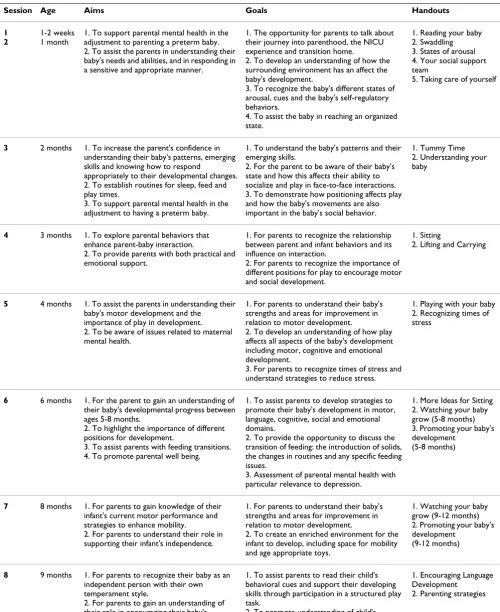
The intervention involves the simultaneous processes of assessment and treatment. Each session involves the team visiting the family (infant and mother ± father or other primary caregiver) for 1.5-2.0 hours per session. During these sessions two key issues will be identified as concerns for the caregiver/s and concerns for the therapist. The ses-sion will be guided by the identified issues and subse-quently interventions will be applied as the session progresses. In addition, these issues will serve as the basis for assessment in subsequent sessions for identification of ongoing concerns and will be used as a baseline to show developmental progress or change. The intervention pro-gram also has a structured content which is summarized in Table 1 and described in more detail.
The sessions will be carried out in the family home, as home visits allow the family to be seen in their natural environment. This also allows for the caregiver/s to feed the infant and maintain their infant's regular sleep rou-tine. When the sessions cannot be carried out at home, due to the infant being hospitalized or because caregivers work closer to the hospital, then a room in the outpatient facility at the Royal Women's Hospital or the Royal Chil-dren's Hospital will be used.
Table 1: VIBeS Plus intervention program
Session Age Aims Goals Handouts
1 2
1-2 weeks 1 month
1. To support parental mental health in the adjustment to parenting a preterm baby. 2. To assist the parents in understanding their baby's needs and abilities, and in responding in a sensitive and appropriate manner.
1. The opportunity for parents to talk about their journey into parenthood, the NICU experience and transition home.
2. To develop an understanding of how the surrounding environment has an affect the baby's development.
3. To recognize the baby's different states of arousal, cues and the baby's self-regulatory behaviors.
4. To assist the baby in reaching an organized state.
1. Reading your baby 2. Swaddling 3. States of arousal 4. Your social support team
5. Taking care of yourself
3 2 months 1. To increase the parent's confidence in
understanding their baby's patterns, emerging skills and knowing how to respond
appropriately to their developmental changes. 2. To establish routines for sleep, feed and play times.
3. To support parental mental health in the adjustment to having a preterm baby.
1. To understand the baby's patterns and their emerging skills.
2. For the parent to be aware of their baby's state and how this affects their ability to socialize and play in face-to-face interactions. 3. To demonstrate how positioning affects play and how the baby's movements are also important in the baby's social behavior.
1. Tummy Time 2. Understanding your baby
4 3 months 1. To explore parental behaviors that
enhance parent-baby interaction.
2. To provide parents with both practical and emotional support.
1. For parents to recognize the relationship between parent and infant behaviors and its influence on interaction.
2. For parents to recognize the importance of different positions for play to encourage motor and social development.
1. Sitting
2. Lifting and Carrying
5 4 months 1. To assist the parents in understanding their
baby's motor development and the importance of play in development. 2. To be aware of issues related to maternal mental health.
1. For parents to understand their baby's strengths and areas for improvement in relation to motor development.
2. To develop an understanding of how play affects all aspects of the baby's development including motor, cognitive and emotional development.
3. For parents to recognize times of stress and understand strategies to reduce stress.
1. Playing with your baby 2. Recognizing times of stress
6 6 months 1. For the parent to gain an understanding of
their baby's developmental progress between ages 5-8 months.
2. To highlight the importance of different positions for development.
3. To assist parents with feeding transitions. 4. To promote parental well being.
1. To assist parents to develop strategies to promote their baby's development in motor, language, cognitive, social and emotional domains.
2. To provide the opportunity to discuss the transition of feeding: the introduction of solids, the changes in routines and any specific feeding issues.
3. Assessment of parental mental health with particular relevance to depression.
1. More Ideas for Sitting 2. Watching your baby grow (5-8 months) 3. Promoting your baby's development
(5-8 months)
7 8 months 1. For parents to gain knowledge of their
infant's current motor performance and strategies to enhance mobility.
2. For parents to understand their role in supporting their infant's independence.
1. For parents to understand their baby's strengths and areas for improvement in relation to motor development.
2. To create an enriched environment for the infant to develop, including space for mobility and age appropriate toys.
1. Watching your baby grow (9-12 months) 2. Promoting your baby's development
(9-12 months)
8 9 months 1. For parents to recognize their baby as an
independent person with their own temperament style.
2. For parents to gain an understanding of their role in encouraging their baby's independence through play.
1. To assist parents to read their child's behavioral cues and support their developing skills through participation in a structured play task.
2. To promote understanding of child's temperament and enhance parenting.
1. Encouraging Language Development
Each session will follow a structured format, which can be adapted for the infants' and caregivers' needs. The struc-ture of the session will be dependent on the infant's state, so that if the infant is awake, then the intervention can begin with the focus on the infant. If the infant is asleep or being fed then the intervention can focus on the car-egiver. At the beginning of each session the therapists will note any "arrival issues", such as other siblings being present, and "health issues", such as a recent admission to hospital or respiratory infection. This will be followed by the "Mother and Baby Scales" (MABS), which is a scale that assesses the baby's overall behavior and parental wellbeing[55] The MABS will be administered each ses-sion and a summary given to the parents during the final session to demonstrate the parents' and child's journey over the first 12 months. During each session there will also be two key questions asked based upon the Dolby et al[6] study:
"What is the most positive thing about your baby?"
"What is the most challenging thing about your baby?"
In addition, questions on sleeping and feeding will be asked and based upon these answers and general discus-sion, two key issues will be identified for the parent and therapist. These issues form part of the individualized intervention strategies, along with the generic interven-tion content listed in Table 1. In addiinterven-tion to the generic handouts mentioned previously, caregiver/s will be given
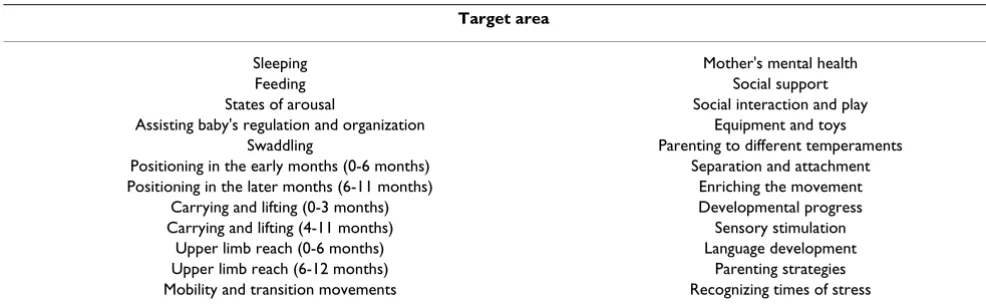
an individualized strategy sheet at the end of the session, which has a list of no more than four practical strategies that address the key issues identified by the caregiver/s and therapists during the session. The strategies are designed to meet the needs of the caregiver/s and infant and consist of activities to encourage the infant's develop-ment, enhance parenting and/or well being. Specific developmental modules have been created to target these individual needs prior to commencement of the study. The modules are listed in Table 2.
At the beginning of the next session parents will be asked whether each of the strategies was implemented and how successful it was on a visual analogue scale of 1 to 7 (1 = not at all, to 7=very). This information will be docu-mented on the data collection sheets. Strategies will then be designed for the next session based upon the success of prior strategies and current key issues.
The data recording sheets will also be used to document the following: who attended the session, the duration and location of the session, the parent's and therapist's key issues, prioritise developmental concerns, rate success of any developmental modules that have been imple-mented, and the success rate of the intervention. The suc-cess of the developmental modules and intervention will be scored on the same visual analogue scale of 1 to 7. The success of the intervention will be rated for rapport, paren-tal emotional availability, child's response to intervention and overall success of the intervention. These four areas
9 11 months 1. To prepare parents for the next 12 months
of infant development in relation to motor, cognitive, language and social development. 2. To ensure parents feel supported after the intervention program is finished.
1. To discuss developmental progress to date and what is to be expected in the next 12 months.
2. For parents to understand how to deal with challenging behaviors as the infant becomes more independent and mobile.
3. To recommend ongoing referral to appropriate intervention services if required.
1. Development over the next 12 months 2. Dealing with challenging behavior Table 1: VIBeS Plus intervention program (Continued)
Table 2: Developmental modules of VIBeS Plus program
Target area
Sleeping Mother's mental health
Feeding Social support
States of arousal Social interaction and play
Assisting baby's regulation and organization Equipment and toys
Swaddling Parenting to different temperaments
Positioning in the early months (0-6 months) Separation and attachment
Positioning in the later months (6-11 months) Enriching the movement
Carrying and lifting (0-3 months) Developmental progress
Carrying and lifting (4-11 months) Sensory stimulation
Upper limb reach (0-6 months) Language development
Upper limb reach (6-12 months) Parenting strategies
will be given a subjective score after joint discussion between the physiotherapist and psychologist at the end of the session.
Outcome Measures
All infants will be assessed by an examiner who is masked to group allocation. A flow diagram of the outcome meas-ures is outlined in Figure 1.
The primary outcome measure is cognitive, language and motor development at two years' corrected age measured using the composite scores from the Bayley Scales of Infant and Toddler Development - 3rd edition (Bayley-III) at 24 months' corrected age[41]. The Bayley-III is a norm referenced developmental scale of cognitive, language and motor development over the first 48 months that has good psychometric properties, and has been used exten-sively in follow-up of preterm infants.
The secondary outcome measures are as follows
1. Motor Development - At 12 and 24 months' corrected age the Neurological Sensory Motor Development Scale (NSMDA)[56] will be used to assess motor development. The NSMDA is a criterion-referenced test of gross and fine motor performance, neurological status, posture, balance and response to sensory input longitudinally. The Alberta Infant Motor scale (AIMs) [57] will be used to assess motor development at 12 months. The AIMS is a norm referenced observational motor assessment used for mon-itoring the gross motor development of typically-develop-ing infants from birth up to 18 months. Both of these assessments have been selected as they have good psycho-metric properties, are geared to assessment of motor out-come of infants, are quick and easy to administer with minimal handling, and have relevance to the education of parents about their child's motor maturation.
2. Infant Behavioral Regulation - The Infant Toddler Social and Emotional Assessment (ITSEA) [58] will be used at 12 and 24 months. It is a comprehensive adult report meas-ure of social -emotional problems and competencies in 1 to 3 year olds. It consists of 4 broad domains of behavior: dysregulation, externalizing, internalizing and competen-cies. Parents rate behaviors on a 3 point scale (0 = rarely/ not true, 1 = somewhat true/sometime and 3 = Very true/ often). It has good internal consistency for the 4 domains, good validity and test-retest reliability.
3. Primary caregiver mental health - will be measured with the Hospital Anxiety and Depression Scale (HADS)[59] which has 14 items in total (7 anxiety, 7 depression) at 24 months. Each item is scored with a four-point rating scale
scored from 0 to 3, (0 = not at all, 3 = most) giving total scores ranging from 0 to 21 for each subscale and from 0 to 42 for overall distress. A score of 8-10 is suggestive of the presence of the affective state, and scores between 0-7 are within the normal range. It has been validated in a variety of settings and has been found to perform well in assessing the severity of anxiety disorders and depression, not only in primary care patients but also in the general population[60].
4. Parenting - The Parenting Stress Index Short Form (PSI-SF)[61] consists of a subset of 36 items drawn from the full version (PSI) organized into three, 12-item subscales: 1) Difficult Child, 2) Parent-Child Dysfunctional Interac-tion, and 3) Parent Distress and will be used at 24 months. The statements range from 'Strongly Agree' to 'Strongly Disagree'. The questionnaire provides a total stress score and 3 subscale scores, with lower scores indi-cating less stress. The Short-Form PSI has a correlation of 0.95 with the full length version[61].
5. Family Burden - will be assessed using two measures at both 12 and 24 months. The first is the Impact of Family Scale version G (IOF-G)[48] mentioned previously in the methods. The second measure is the Family Assessment Device (FAD) which consists of 60 items rated with a 4-point likert response format (strongly agree to strongly disagree) that assesses six dimensions of family function-ing: Problem solving, Communication, Roles, Affective responsiveness, Affective involvement and Behavior con-trol. Additionally, a General Functioning Scale assesses overall health pathology in the family. Both measures have demonstrated satisfactory reliability and valid-ity[62].
6. Social Support - the Social Support Questionnaire (SSQ)[63] will be used at 24 months. It contains six items, and each item asks participants to: (a) list the people to whom they can turn and on whom they can rely in given sets of circumstances, and (b) indicate their level of satis-faction with these social supports. An individual's score represents the total level of satisfaction with their social support.
Chase-Lansdale et al[66]. The observational instrument consists of four different age-appropriate, problem-solv-ing tasks. The tasks are designed to be challengproblem-solv-ing for the child and are administered in a set sequence based on the first 3 items' progressive degree of difficulty.
An independent rater will code both the parent and child's behavior for each problem solving task using a 5-point Likert scale. Parent behavior will be assessed using a coding scheme that includes: Positive affect (the overall quality of parent's positive expressions towards their child during each task); Negative affect (the intensity and fre-quency of the parent's degree of disapproval, anger, and negativism expressed toward the child while working on each task); Supportive presence (sensitivity, warmth and responsiveness to the child as they progress through each task); Facilitates self-regulation (instruction and support provided to the child to assist with successful task comple-tion); and Intrusive/over controlling (Extent to which par-ent behavior is ill timed, intrusive, and excessively and inappropriately controlling relative to what the child is doing).
The coding scheme used to assess child behavior will include: Positive affect (the overall quality of positive expression/responses of the child during the task); Nega-tive affect (the intensity and frequency of the child's degree of unhappiness, sadness, and hurt expressed dur-ing the task); Activity level (how motorically active the child is during each task); Child persistence (extent to which the child is actually problem-oriented on the task); Dependence (extent to which the child displays personal initiative in the situation or, conversely, expects the mother to provide direction and help); and Quality of task transitions (the ability of the child to move from one task to the next).
In addition to the parent and child codes, the dyads' 'interactional synchrony' will be coded on a 5-point Likert scale for each problem solving task. Interactional syn-chrony assesses the harmony, interconnectedness, respon-siveness, reciprocity, engagement, mutual focus and shared affect of the dyad.
8. Sensory Processing - The Infant Toddler Sensory Profile Questionnaire[67] which is a parent report measure will be used to evaluate and identify patterns of sensory processing in six sensory systems including: General, Auditory, Visual, Tactile, Vestibular, and Oral Sensory Processing. It is suitable for use with 7 to 36 month olds and will be administered at 12 and 24 months' corrected age. Specific patterns of performance on the Infant/Tod-dler Sensory Profile Questionnaire have been shown to be indicative of difficulties with sensory processing and per-formance[67].
Data Storage
Data will be recorded on paper files and entered electron-ically into a computerized database and stored securely. A combined database will be created for analysis by merging data from the perinatal and qualitative database, interven-tion database and outcome assessment data base using the statistical package Stata 10.0. Data will be checked and cleaned again using Stata following merging of files.
Analysis plan
Analysis will follow standard principles for randomized controlled trials, using simple two-group comparisons performed using all subjects for whom outcome data are available, on an intention-to-treat basis. The primary comparison at 24 months will be based on the Bayley cog-nitive and motor composite scores, which will be com-pared between groups using linear regression, controlling for multiple births. Multivariate regression will be used to adjust for potential imbalances in major baseline con-founders such as the extent of brain injury (and sociode-mographic variables). Secondary analyses will use similar methods to compare the outcomes between groups for the additional motor (NSMDA, AIMs); behavioral (ITSEA), primary caregiver mental health and parent -child interac-tions measures (VIBES, EAS) at 24 months. For dichoto-mous outcomes, comparisons will be by chi-squared tests and where continuous data exhibit substantial skewness, non-parametric (Mann-Whitney U test) methods will be used for simple comparisons, and regression analyses per-formed after appropriate transformation of the outcome.
Discussion
This paper outlines a preventative care program designed for preterm infants over the first year of life to improve motor, cognitive and behavioral development. The pro-gram is based upon theoretical models and includes com-ponents of previously successful interventions. It is designed to be feasible to implement in a community set-ting, and to be able to be generalized across different groups in Australia and internationally. This study pro-vides a unique opportunity to determine if a preventative care program will improve motor, cognitive, and behavio-ral outcomes at two years of age, as well as caregiver men-tal health.
Abbreviations
Parenting Stress Index - Short Form; SSQ: Social Support Questionnaire; FAD: Family Assessment Device.
Competing interests
The authors declare that they have no competing interests.
Authors' contributions
LD, TI, RB are chief investigators for this study and were involved in the conception of the study. AS, CF, PA, JO, RB, TE, LD designed the study and intervention package. AS, CF, JO, LB were involved in data collection and deliv-ering the intervention program. AS drafted the manuscript with all authors providing critical review and final approval. AE will be involved in the independent assess-ments at 2 years of age. PA, RB, TE and LD are involved with supervision of students on this project.
Acknowledgements
We acknowledge support from the National Health and Medical Council (NHMRC) Australia Project grant (ID 284512), the Cerebral Palsy Founda-tion, Murdoch Childrens Research Institute, the Myer FoundaFounda-tion, Allens Arthur Robinson, and the Thyne Reid Foundation. Cerebral Palsy Founda-tion Post Doctoral Fellowship (AS) NHMRC Career Development Award 473840 (RB)
References
1. Hack M, Cartar L, Schluchter M, Klein N, Forrest CB: Self-per-ceived health, functioning and well-being of very low birth weight infants at age 20 years. J Pediatr 2007, 51(6):635-641. 2. Marchand L, André M, Arnaud C, Pierrat V, Rozé J, Messer J, Thiriez
G, Burguet A, Picaud J, Bréart G, et al.: Neurodevelopmental dis-abilities and special care of 5-year-old children born before 33 weeks of gestation (the EPIPAGE study): a longitudinal cohort study. The Lancet 2008, 371(9615):813.
3. Spittle AJ, Orton J, Doyle LW, Boyd R: Early developmental inter-vention programs post hospital discharge to prevent motor and cognitive impairments in preterm infants. Cochrane Data-base Syst Rev 2007:CD005495.
4. Woodward LJ, Anderson PJ, Austin NC, Howard K, Inder TE: Neo-natal MRI to predict neurodevelopmental outcomes in pre-term infants. N Engl J Med 2006, 355(7):685-694.
5. Beauchamp MH, Thompson DK, Howard K, Doyle LW, Egan GF, Inder TE, Anderson PJ: Preterm infant hippocampal volumes correlate with later working memory deficits. Brain 2008,
131(Pt 11):2986-2994.
6. Dolby R, Warren B, Heath J, Meade V, Conney G: Developmental care at home: A first year intervention for preterm babies designed to improve self-regulation (motor and state) and address parents' concerns. 2nd Annual Perinatal Society of Australia and New Zealand Conference: 1998; Alice Springs, Australia 1998. 7. Thelen E: Motor development. A new synthesis. American
Psy-chologist 1995, 50(2):79-95.
8. Rosenbaum P, King S, Law M, King G, Evans J: Family-centred serv-ice: a conceptual framework and research review. Physical and Occupational Therapy in Pediatrics 1998, 18(1):1-20.
9. Brazelton TB: Touchpoints: opportunities for preventing prob-lems in the parent-child relationship. Acta Paediatr Suppl 1994,
394:35-39.
10. Bayley N: Bayley Scales of Infant Development. New York: The Psychological Corporation; 1969.
11. Meade V, Heath J, Dolby R, Warren B: Self- organisation of move-ment in preterm infants: a randomised, controlled trial. Dev Med Child Neurol 2003, 45(96 Supplement):17.
12. Als H: A synactive model of neonatal behavioral organization: framework for the assessment of neurobehavioral develop-ment in the premature infant and for support of infants and parents in the neonatal intensive care environment. Physical & Occupational Therapy in Pediatrics 1986, 6(3/4):3-53.
13. Als H: Developmental care in the newborn intensive care unit. Curr Opin Pediatr 1998, 10(2):138-142.
14. Sroufe LA: Emotional development: The organization of emo-tional life in the early years. New York: Cambridge University Press; 1996.
15. Brown NC, Doyle LW, Bear MJ, Inder TE: Alterations in neurobe-havior at term reflect differing perinatal exposures in very preterm infants. Pediatrics 2006, 118(6):2461-2471.
16. Bigsby R, Coster W, Lester BM, Peucker MR: Motor behavioural cues of term and preterm infants at 3 months. Infant Behav and Dev 1996, 19:295-307.
17. Forcada-Guex M, Pierrehumbert B, Borghini A, Moessinger A, Muller-Nix C: Early dyadic patterns of mother-infant interactions and outcomes of prematurity at 18 months. Pediatrics 2006,
118(1):107-114.
18. Aita M, Snider L: The art of developmental care in the NICU: a concept analysis. J Adv Nurs 2003, 41(3):223-232.
19. Jacobs SE, Sokol J, Ohlsson A: The Newborn Individualized Developmental Care and Assessment Program is not sup-ported by meta-analyses of the data. J Pediatr 2002,
141(3):699-706.
20. Symington A, Pinelli J: Developmental care for promoting development and preventing morbidity in preterm infants (update of Cochrane Database Syst Rev 2003). Cochrane Data-base Syst Rev 2006, 4:CD001814.
21. Carlson EA, Sampson MC, Sroufe L: Implications of attachment theory and research for developmental-behavioral pediat-rics. Journal of Developmental & Behavioral Pediatrics 2003,
24(5):364-379.
22. Sroufe L: The coherence of individual development: Early care, attachment, and subsequent developmental issues. American Psychologist 1979, 34(10):834-841.
23. Dubowitz L, Dubowitz V, Mercuri E: The Neurological Assess-ment of the Preterm & Full-term Newborn Infant. Volume 148. 2nd edition. London: Mac Keith Press; 1999.
24. Pinelli J, Saigal S, Yow-Wu BW, Cunningham C, DiCenso AS, Teele S, Tustin P, Turner S: Patterns of change in family functioning, resources, coping and parental depression in mothers and fathers of sick newborns over the first year of life. Journal of Neonatal Nursing 2008, 14:156-165.
25. Lambrenos K, Weindling AM, Calam R, Cox AD: The effect of a child's disability on mother's mental health. Arch Dis Child Fetal Neonatal E 1996, 74(2):115-120.
26. Miles MS, Holditch-Davis D, Schwartz TA, Scher M: Depressive symptoms in mothers of prematurely born infants. J Dev Behav Pediatr 2007, 28(1):36-44.
27. Davis L, Edwards H, Mohay H, Wollin J: Mother-infant interaction in premature infants at three months after nursery dis-charge. International Journal of Nursing Practice 2003, 9:374-381. 28. Pinelli J: Effects of family coping and resources on family
adjustment and parental stress in the acute phase of the NICU experience. Neonat Netw 2000, 19(6):27-37.
29. Shields-Poe D, Pinelli J: Variables associated with parental stress in neonatal intensive care units. Neonat Netw 1997,
16(2):29-37.
30. Zelkowitz P, Bardin C, Papageorgiou A: Anxiety affects the rela-tionship between parents and their very low birthweight infants. Infant Mental Health Journal 2007, 28:296-313.
31. Holditch-Davis D, Bartlett TR, Blickman AL, Miles MS: Posttrau-matic stress symptoms in mothers of premature infants. J Obstet Gynecol Neonatal Nurs 2003, 32(2):161-171.
32. Muller-Nix C, Forcada-Guex M, Pierrehumbert B, Jaunin L, Borghini A, Ansermet F: Prematurity, maternal stress and mother-child interactions. Early Hum Dev 2004, 79(4):145-158.
33. Koldewijn K, Wolf MJ, van Wassenaer A, Beelen A, de Groot IJ, Hed-lund R: The Infant Behavioral Assessment and Intervention Program to support preterm infants after hospital dis-charge: a pilot study. Dev Med Child Neurol 2005, 47(2):105-112. 34. Browne JV, Talmi A: Family-based intervention to enhance
infant-parent relationships in the neonatal intensive care unit. J Pediatr Psychol 2005, 30(8):667-677.
35. Chiarello LA, Palisano RJ: Investigation of the effects of a model of physical therapy on mother-child interactions and the motor behaviors of children with motor delay. Phys Ther 1998,
Publish with BioMed Central and every scientist can read your work free of charge "BioMed Central will be the most significant development for disseminating the results of biomedical researc h in our lifetime."
Sir Paul Nurse, Cancer Research UK
Your research papers will be:
available free of charge to the entire biomedical community
peer reviewed and published immediately upon acceptance
cited in PubMed and archived on PubMed Central
yours — you keep the copyright
Submit your manuscript here:
http://www.biomedcentral.com/info/publishing_adv.asp
BioMedcentral
36. Case-Smith J: Analysis of current motor development theory and recently published infant motor assessments. Inf Young Children 1996, 9(1):29-41.
37. Hadders-Algra M: The neuronal group selection theory: a framework to explain variation in normal motor develop-ment. Dev Med Child Neurol 2000, 42(8):566-572.
38. Kamm K, Thelen E, Jensen JL: A dynamical systems approach to motor development. Physical Therapy 1990, 70(12):763-775. 39. Committee on Hospital Care: Family-Centered Care and the
Pediatrician's Role. Pediatrics 2003, 112(3):691-696.
40. Law M, Teplicky R, King S, King G, Kertoy M, Moning T, Rosenbaum P, Burke-Gaffney J: Family-centred service: moving ideas into practice. Care, Health & Development 2005, 31(6):633-642. 41. Bayley N: Bayley Scales of Infant and Toddler Development.
3rd edition. San Antonio: Harcourt Assessment; 2005.
42. Roberts G, Howard K, Spittle AJ, Brown NC, Anderson PJ, Doyle LW: Rates of early intervention services in very preterm chil-dren with developmental disabilities at age 2 years. Journal of Paediatrics and Child Health 2008, 44(5):276-280.
43. JL C, JM H, R S: Detection of postnatal depression. Develop-ment of the 10-item Edinburgh Postnatal Depression Scale. British Journal of Psychiatry 1987, 150:782-786.
44. Boyce P, Stubbs J, Todd A: The Edinburgh postnatal depression scale: Validation for an Australian sample. Australian and New Zealand Journal of Psychiatry 1993, 27:472-476.
45. Cox JL, Holden JM, Sagovsky R: Detection of postnatal depres-sion. Development of the 10-item Edinburgh Postnatal Depression Scale. British Journal of Psychiatry 1987, 150:782-786. 46. Abidin RR: Parenting Stress Index-manual. 3rd edition.
Char-lottesville: Psychology Press; 1990.
47. Endler NS, Parker DA: Coping Inventory for Stressful Situa-tions (CISS): Manual. 2nd edition. Toronto: Multi Health Systems; 1999.
48. Stein REK, Jessop DT: PACTS Papers/AECOM: Tables Docu-menting the Psychometric Properties of a Measure of the Impact of Chronic Illness on a Family. Bronx, NY: Department of Pediatrics, Albert Einstein College of Medicine; 1985.
49. Spielberger C: Manual for the State-Trait Anxiety Inventory.
Palo Alto, CA: Consulting Psychologists Press; 1983.
50. Inder TE, Anderson NJ, Spencer C, Wells S, Volpe JJ: White matter injury in the premature infant: a comparison between serial cranial sonographic and MR findings at term. American Journal of Neuroradiology 2003, 24(5):805-809.
51. Inder TE, Warfield SK, Wang H, Huppi PS, Volpe JJ: Abnormal cer-ebral structure is present at term in premature infants. Pedi-atrics 2005, 115(2):286-294.
52. Thompson DK, Wood SJ, Doyle LW, Warfield SK, Lodygensky GA, Anderson PJ, Egan GF, Inder TE: Neonate hippocampal volumes: prematurity, perinatal predictors, and 2-year outcome. Annals of Neurology 2008, 63(5):642-651.
53. Piper MC, Byrne PJ, Darrah J, Watt MJ: Gross and fine motor development of preterm infants at eight and 12 months of age. Dev Med Child Neurol 1989, 31(5):591-597.
54. Campbell SK, Kolobe TH, Osten ET, Lenke M, Girolami GL: Con-struct validity of the test of infant motor performance. Phys Ther 1995, 75(7):585-596.
55. Brazelton TB, Nugent JK: Neonatal behavioral assessment scale. 3rd edition. London: Mac Keith Press; 1995.
56. Burns YR, Ensbey RM, Norrie MA: The Neuro-Sensory Motor Development Assessment part 1: development and adminis-tration of the test. Australian Journal of Physiotherapy 1989,
35(3):141-157.
57. Piper MC, Darrah J: Motor Assessment of the Developing Infant. Philadelphia: W.B. Saunders; 1994.
58. Carter AS, Briggs-Gowan MJ, Jones SM, Little TD: The Infant-Tod-dler Social and Emotional Assessment (ITSEA): factor struc-ture, reliability, and validity. Journal of Abnormal Child Psychology
2003, 31(5):495-514.
59. Zigmond AS, Snaith RP: The hospital anxiety depression scale. Acta Psychiatr Scand 1983, 67(6):361-370.
60. Bjelland I, Dahl AA, Haug TT, Neckelmann D: The validity of the Hospital Anxiety and Depression Scale. An updated litera-ture review. Journal of Psychosomatic Research 2002, 52(2):69-77. 61. Abidin RR: Parenting Stress Index (PSI). 3rd edition. Odessa, FL:
Psychological Assessment Resources; 1995.
62. Wade SL, Taylor GH, Drotar D, Strancin T, Yeates KO: Family bur-den and adaptation during the initial year after traumatic brain injury in children. Pediatrics 1985, 102(1):110-116. 63. Sarason IG, Levine HM, Basham RB, Sarason BR: Assessing social
support: The social support questionnaire. Journal of Personality and Social Psychology 1983, 44:127-139.
64. Clark C, Woodward L, Horwood L, Moor S: Development of emotional and behavioural regulation in children born extremely preterm and very preterm: Biological and social influences. Child Development 2008, 79(5):1444-1462.
65. Belsky J, Jaffee S, Woodward L, Silva P: Intergenerational trans-mission of warm-sensitive-stimulating parenting: a prospec-tive study of mothers and fathers of 3-year-olds. Child Development 2005, 76(2):384-396.
66. Chase-Lansdale P, Brooks-Gunn J, Zamsky E: Young African-American multigenerational families in poverty: Quality of mothering and grand mothering. Child Development 1994,
65:373-393.
67. Dunn W, Daniels DB: Initial development of the Infant/Toddler Sensory Profile. Journal of Early Intervention 2002, 25(1):27-41.
Pre-publication history
The pre-publication history for this paper can be accessed here: