Journal of Agriculture, Food Systems, and Community Development ISSN: 2152-0801 online
https://www.foodsystemsjournal.org
Volume 8, Supplement 1 / July 2018 117
Learning from community-designed minigrant
programs in the Food Dignity project
Monica Hargraves *
Cornell University
Submitted February 23, 2018 / Published online July 18, 2018
Citation: Hargraves, M. (2018). Learning from community-designed minigrant programs in the Food Dignity project. Journal of Agriculture, Food Systems, and Community Development, 8(Suppl. 1), 117–146.
https://doi.org/10.5304/jafscd.2018.08A.007
Copyright © 2018 by the Author. Published by the Lyson Center for Civic Agriculture and Food Systems. Open access under CC BY license.
Abstract
The Food Dignity project was a five-year (2011– 2016, plus a two-year extension), US$5 million collaborative action research project funded by the U.S. Department of Agriculture’s Agriculture and Food Research Initiative, that brought together individuals from four universities and five commu-nity organizations. The project goal was to learn from and with these community organizations working to strengthen local food systems and build food justice in their communities. As part of the action research, the partnering community organizations each received US$30,000 to be distributed in their communities in the form of
minigrants. The evaluation literature on minigrant programs has highlighted their potential for foster-ing community engagement and supportfoster-ing ideas brought forward by community members with lived experience of the issue being addressed. In these minigrant programs, the outside funder or distributing agency had largely or entirely deter-mined their structure. In the Food Dignity project, however, the community organizations each designed their own program, led by their commu-nity organizers. The diversity of the commucommu-nity organizations and the flexibility and autonomy they exercised in designing their minigrant programs offers an opportunity to explore a novel question:
FoodDignity
* Monica Hargraves, Associate Director for Evaluation Part-nerships, Cornell Office for Research on Evaluation, Cornell University; 35 Thornwood Drive, Suite 200, Room 150-C, Ith-aca NY 14850 USA; [email protected]
Contributors and Supporting Agencies
Blue Mountain Associates; Feeding Laramie Valley; Whole Community Project; East New York Farms!; Dig Deep Farms; University of Wyoming; Cornell University; and the U.S. De-partment of Agriculture National Institute of Food and Agri-culture.
Author Disclosures
Hargraves serves on the board of directors and consults for Action Resources International, the sponsoring organization for Feeding Laramie Valley, one of the community organiza-tions that partnered in the Food Dignity project.
Funding Disclosure
Journal of Agriculture, Food Systems, and Community Development ISSN: 2152-0801 online https://www.foodsystemsjournal.org
118 Volume 8, Supplement 1 / July 2018
When community organizers design minigrant programs, what do they choose to build, and why? The analysis in this essay uses an evolutionary evaluation approach to study the Food Dignity-funded minigrant program designs and outcomes, with a view to identifying lessons for future mini-grant programs. The paper reports on minimini-grant program design features, factors shaping program design choices, minigrants awarded by each com-munity organization, and outcomes attributed to the minigrant programs by participants. The princi-pal findings are that program designs differed and that the patterns of difference are consistent with organizational priorities and systemic issues affect-ing community members. The innovation and variation in minigrant program designs and funded projects are instructive for anyone considering future minigrant programs. An unanticipated find-ing is that several of the community organizers utilized the design and management of minigrant programs to achieve goals outside of the minigrant funding process. That is, community organizers recognized the program design itself as a way to advance community development goals separately from the support for minigrant projects, and they deliberately selected program features to serve organizational goals. This has implications for community organizers, highlighting internally designed minigrant programs as a promising addi-tion to their strategies. This also has implicaaddi-tions for outside funders committed to supporting community-driven change. Given that minigrant programs are often valued as a way to support community-driven solutions to local problems, the results here suggest that minigrant programs can have dual channels of impact, if community organ-izations design the minigrant programs themselves rather than having features specified externally.
Keywords
Minigrant; Microgrant; Food Dignity; Community Food Systems; Community-based Participatory Research; Collaborative Pathway Models; Food Justice; Community Organizer
Introduction
The Food Dignity project was a five-year, US$5 million collaborative action research project funded
by the U.S. Department of Agriculture’s Agricul-ture and Food Research Initiative (USDA–AFRI) beginning in 2011. The goal was to learn from and with five community organizations working to strengthen local food systems and build food jus-tice in their communities. Academic researchers and students came from four universities: Univer-sity of Wyoming, Cornell UniverUniver-sity, Ithaca Col-lege, and the University of California, Davis. The five organizations that chose to partner in the Food Dignity project came from across the United States: Blue Mountain Associates (BMA) from the Wind River Indian Reservation in Wyoming; Dig Deep Farms (DDF) in the unincorporated areas of Ashland and Cherryland, California; East New York Farms! (ENYF!) in Brooklyn, New York; Feeding Laramie Valley (FLV) in Laramie, Wyo-ming; and the Whole Community Project (WCP) in Ithaca, New York.
The foundational premise of the Food Dignity project was that community leaders have important and unique understanding and expertise that shape their goals and their approaches to community change (Porter, 2018). The grant included funding for staff, projects, and research in each organiza-tion. Another key feature of the sub-award to each community organization was the funding for a minigrant program in each community. Other stud-ies have shown that community minigrants can “stimulate action and expand community control over that action,” especially when available to indi-viduals, not just agencies, and when accompanied by catalyzing support (Porter & Food Dignity Team, 2012). Drawing on this evidence, each com-munity organization in the Food Dignity project was allocated US$30,000 to distribute in the form of minigrants. In contrast to other minigrant grams studied in the literature, the minigrant pro-grams were designed by the community organiza-tions, not by the funder or allocating agency (in this case, USDA and the University of Wyoming respectively). This autonomy, combined with the different contexts and priorities of the community organizations in the Food Dignity project, provides a unique opportunity to learn about the potential for minigrants as a mechanism for supporting com-munity change.
Journal of Agriculture, Food Systems, and Community Development ISSN: 2152-0801 online
https://www.foodsystemsjournal.org
Volume 8, Supplement 1 / July 2018 119
approach to learn about the design of the mini-grant programs and their outcomes (Urban, Hargraves, & Trochim, 2014). The Food Dignity minigrant initiative was a pilot project at two levels: the community organizations were designing mini-grant programs for the first time, and the funded minigrants were pilot efforts for the minigrant recipients. Given this very early program lifecycle stage at both levels, an evaluation of causality and/or effectiveness of the minigrant programs or the individual grants would be premature. At this lifecycle stage it is appropriate, instead, to focus on program management and design, with an explora-tory examination of reported outcomes (Urban et al., 2014). Accordingly, this paper asks the follow-ing: When community organizations design mini-grant programs, what do they choose to build, and why? The more specific questions addressed within that are: What were the key features of the
community-designed minigrant programs? What considerations influenced those designs? What similarities and differences were there among the minigrant programs, and to what are these differ-ences attributable? What types of community minigrant projects were funded? What outcomes were reported for individual grants and the minigrant programs overall?
We begin below with a review of recent litera-ture on minigrant programs, followed by a descrip-tion of methods and data sources. Two important aspects of context are summarized next: the expec-tations and guidelines for minigrant programs that came from the Food Dignity project design, and the situation and characteristics of the community organizations partnering in the Food Dignity pro-ject. The results of the minigrant program evalua-tions are presented and discussed in two parts in order to focus separately on minigrant program de-sign and minigrant project awards. Conclusions and questions for future work are offered in the fi-nal section.
Review of Literature on Minigrant Program Design and Goals
Motivations for Implementing Minigrant Programs
In the published literature on minigrant programs, a common motivation cited for minigrants is thatthey provide a mechanism for increasing commu-nity involvement and supporting commucommu-nity ideas. Kegler, Painter, Twiss, Aronson, and Norton (2009) characterize the emphasis on community in-volvement in many participatory health promotion efforts as reflecting an “implicit…hypothesis that resident involvement in community decision-mak-ing leads to better policies and programs, and ulti-mately to improved community health” (p. 301). Numerous studies of minigrant programs cite their potential for building this kind of community in-volvement. For example, Bobbitt-Cooke (2005) de-scribes the Healthy Carolinians microgrant project as having “empowered communities and [commu-nity-based organizations] to be responsible for community health improvement” (p. 1). Resident mobilization was a primary goal of the Yes we can! community-building initiative in Battle Creek, Michigan, which included a neighborhood minigrant program and aimed to improve out-comes “by mobilizing low-income communities and resident leaders and building their capacity to influence the decisions and policies that impact their lives” (Foster-Fishman et al., 2006, p. 143). The desire to support solutions identified by those with lived experience of the challenges is also a common motivation: “… most mini-grant pro-grams share the goal of promoting bottom-up community building by investing resources in peo-ple and neighborhood-based organizations to crea-tively address the problems that concern them” (Foster-Fishman et al., 2006, p. 146).
Increasing community involvement may in-volve different objectives, depending on the pro-gram’s context. Numerous studies cite one or more of these specific minigrant program goals: stimulat-ing community awareness, buildstimulat-ing community ca-pacity, developing leadership, promoting commu-nity engagement or reducing barriers to it,
Journal of Agriculture, Food Systems, and Community Development ISSN: 2152-0801 online https://www.foodsystemsjournal.org
120 Volume 8, Supplement 1 / July 2018
In soliciting and supporting certain types of community-based projects, minigrant programs are designed to contribute to the goals of the funding organization, such as improved public health, neighborhood revitalization, increased physical ac-tivity, etc. Many examples of minigrant program evaluations come from the arena of public health, such as the 28 reviewed in Porter, McCrackin, and Naschold (2015); however, minigrant strategies have been used in a wide range of fields. The gen-eral potential of minigrants, independent of a par-ticular context, is reflected in the case for minigrant programs offered by the Center for Community Health and Development at the University of Kan-sas, which is included in a chapter on “Establishing Micro-Grant Programs” in its online Community
Tool Box. They list potential benefits of minigrant
programs, including inspiring creative and innova-tive thinking; reaching “hard to reach” people; ex-panding eligibility to grassroots organizations not eligible for traditional grant funding; encouraging smaller, innovative groups who might not respond to larger grant programs; and more (Center for Community Health and Development, 2017).
Minigrant Program Designs
Minigrant program designs involve specifying mul-tiple features of the program: the size of potential minigrants, who is eligible to receive one, what types of projects will be considered, how applicants are recruited, what the application process in-volves, criteria and process for selecting successful applicants, reporting requirements for
minigrantees, and so on. The availability of details about minigrant program designs varies among the studies reviewed here. Some studies, such as Dea-con et al. (2009), are focused on evaluating out-comes associated with the minigrant program taken as a whole in order to draw conclusions about the potential of minigrant programs in general. This type of study provides fewer details about the design itself. Others, such as Caperchione et al. (2006), are interested in drawing lessons that would be useful for those designing minigrant programs and so provide much greater detail about program design and management as part of their analysis. With a related goal of presenting ideas and options for future minigrant program designers, this paper
shares design features adopted in each of the Food Dignity-supported minigrant programs.
Of particular interest for the current study is strategic decision-making connecting design ele-ments to desired program outcomes. Foster-Fishman et al.’s (2006) analysis of the neighbor-hood minigrant component of the Yes we can! project provides an example of deliberate change in program design elements to redirect minigrant pro-gram outcomes. The authors describe an evolution in program design from a relatively “non-prescrip-tive program” that “was initially designed to sup-port almost any resident-initiated effort” (p. 146) to one more strategically designed to align minigrant projects with the goals of the overall initiative and the desire to foster collective action. As the authors recognize, “Because of their connection with larger systems (e.g., the Foundation) and peers,
[minigrants] encourage, reinforce, and validate cer-tain community actions and experiences” (p. 148). In this case, the application process was amended to “become more tightly focused on both the pro-cess of collective action and the goals of the initia-tive,” including specifying three funding areas into which proposals needed to fit (p. 148). By altering the minigrant program design, the funder was able to direct resources within the arena of community ideas for neighborhood improvement toward pro-jects meeting desired criteria.
My search of the minigrant literature has not succeeded in discovering examples of minigrant programs designed by front-line community organ-izations, as is the case in the Food Dignity project. Smith and Littlejohn (2007) comment on the po-tential value of community input in their reflection on community granting by a Regional Health Au-thority in Alberta, Canada. They come to a strong conclusion, pointing out that community input might have averted a costly design choice:
Journal of Agriculture, Food Systems, and Community Development ISSN: 2152-0801 online
https://www.foodsystemsjournal.org
Volume 8, Supplement 1 / July 2018 121
members had been consulted on this ques-tion. They could have shared valued insights about what they saw as the potential bene-fits and challenges of such an approach, about how well it might fit with local cul-tures, and about how well it would be re-ceived and endorsed. (p. 246)
This acknowledges the value of community input for ensuring that a funder-designed minigrant pro-gram will be viable, yet does not go so far as to suggest community-controlled design.
The literature does provide some examples of entities that were close to community-based organ-izations having control over parts of the minigrant program design. Hartwig et al. (2006) studied the
Healthy People 2010 initiative in which the Office of
Disease Prevention and Health Promotion in the U.S. Department of Health and Human Services selected two different models for awarding
minigrants of US$2010 to community-based organ-izations (CBOs). In one model, the Office of Healthy Carolinians––a state agency in North Car-olina––was the issuing agency. The agency decen-tralized the management and dissemination of the minigrants to a network of 32 community-based partnerships called Healthy Carolinians Partner-ships (HCPs). The HCPs developed their own mechanisms for selecting CBO grantees, but all were given the same forms for proposals and the same criteria for awarding grants (Hartwig et al., 2006). The authors provide some description of the variations adopted by the HCPs: “… some partnerships conducted a blinded review process while others targeted agencies new to public health and the HCP to broaden the participation of the partnership and local coalition building for public health” (p. 91). However, the variation or reasons behind it are not the focus of their paper, and no other information is available. Smith (1998) reviews minigrant programs developed independently by four Regional Health Authorities (RHAs) in Al-berta, Canada in the mid-1990s. As is reported here with the minigrant programs developed within the Food Dignity project, Smith found considerable variation in the minigrant program designs adopted by the RHAs in the study. He focuses on just two aspects of minigrant program design––the
composition of the decision-making bodies and the nature of support or assistance offered to grantees during the application process and for their projects––but the reasoning behind the variation does not appear to be available for Smith’s analysis, which focuses on perceived outcomes of individual projects rather than the implications of the
different design choices.
The above two studies provide examples in which variation in minigrant program design is observed though not explored, and in which the entities designing the minigrant programs are in relationship with community organizations but are not community organizations themselves. This analysis of the Food Dignity minigrant programs, therefore, offers a distinct addition to the under-standing of minigrant program potential by pre-senting cases of community organizations design-ing minigrant programs themselves, and by providing data on the reasoning behind their de-sign choices.
Methods
Data Sources
The principal source of data on minigrant program development and implementation was the set of in-ternal reports submitted annually by each commu-nity organization partnering in the Food Digcommu-nity project. The report format included a narrative sec-tion for their minigrant program, with specific questions about minigrants awarded; the processes for inviting or recruiting applicants, selecting grant-ees, supporting minigrantgrant-ees, and tracking
minigrant projects; challenges and/or benefits in “doing” minigrants; and lessons or recommenda-tions on minigrants. The annual reports also re-quested a list of grants issued during that year, in-cluding the dollar amounts awarded and
information about the funded projects. (These will be cited below with the format “[Community Or-ganization acronym] Annual Report Year X, [calen-dar year].”)
Additional data collected and analyzed for this research included:
Journal of Agriculture, Food Systems, and Community Development ISSN: 2152-0801 online https://www.foodsystemsjournal.org
122 Volume 8, Supplement 1 / July 2018
2011 that included a group discussion of minigrant priorities and concerns. • Notes and summaries (reviewed by the
community partners) from phone inter-views conducted in May 2013 with the community organizer in the three most ac-tive minigrant programs at that time (ENYF!, BMA, and FLV).
• Transcripts and a summary report from in-terviews with eight FLV minigrant recipi-ents in late 2013 conducted by two graduate students at the University of Wyoming. • Notes and a written summary of interviews
and meetings with 18 minigrant recipients or steering committee members in June 2014 during site visits to BMA and FLV. • Participant-observation and associated
meeting materials from the minigrant advi-sory committee for WCP in June 2014. • Minigrant application forms developed and
used by BMA, ENYF!, and WCP.
• Steering committee grant review sheets for WCP and ENYF!.
• Nine minigrant reports from individual minigrantees shared directly with Food Dig-nity by FLV and WCP in various years. • Videotaped interviews, photo stories, or profiles of 11 minigrantees produced by ENYF! and by FLV.
• Notes from an extended in-person inter-view in January 2017 with Gayle Woodsum, who served as Community Liaison for the Food Dignity project from October 2013 onwards. In that capacity, she conferred ex-tensively with all the community partner sites, in addition to serving as community organizer and project director for FLV.
Data Analysis
In the initial review of the data above I excerpted and logged passages relating to the following aspects of the minigrant programs in each organization: community context factors referenced by program directors, challenges identified by program directors, stated goals of the program, the design of the program (overall
1https://www.fooddignity.org/collaborative-pathway-models
structure, application process, selection process, and process for follow-up), overall and individual minigrant program outcomes, and reported lessons or recommendations. I reviewed these items for emergent themes within and across sites and re-turned to the source materials for confirmation or contradiction.
In addition, a review of the reports of grants awarded in each organization yielded an inventory of all grants including dates awarded, dollar amounts, project names and descriptions, and all information that was provided about project pro-gress, challenges, and outcomes. This inventory was used to generate summary statistics on minigrant grant sizes and, as described more fully later, a categorization of grants according to their purpose (food access, entrepreneurship, and so on) to assess patterns of grant types across the
minigrant programs.
In addition to these specific and formal sources, my analysis and approach are informed by having been an active member of the Food Dignity project since the summer of 2011. I was invited to join the project at that time, a few months after the project’s launch, to fill the position of evaluator of the minigrant programs. Over time my involve-ment and responsibilities expanded to include a major initiative to develop collaborative pathway models of each community organization’s work. That role gave me greater contact and deeper col-laborative relationships with community organizers and staff in each partner organization, and a more nuanced understanding of the vision and strategies connecting the parts of their work (Hargraves & Denning, 2018). The research conducted for this paper is informed by this experience, integrating the formal analytical components of this research project with the insights and strategic thinking that the community organizations in Food Dignity have shared.
Journal of Agriculture, Food Systems, and Community Development ISSN: 2152-0801 online
https://www.foodsystemsjournal.org
Volume 8, Supplement 1 / July 2018 123
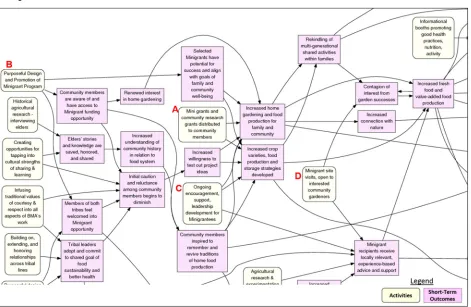
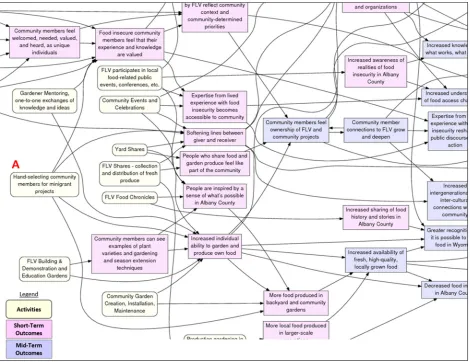
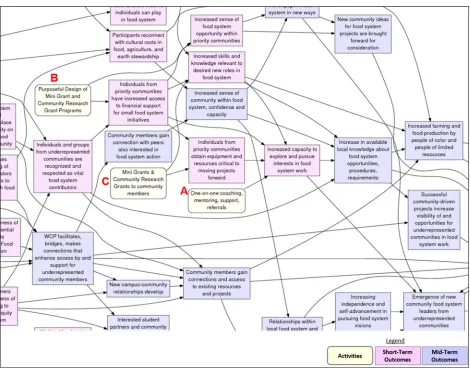
(Hargraves & Denning, 2018). The process resulted in detailed representations of the theory of change driving each community organization’s work. The models are a graphical form of a program logic model, with arrows linking individual activities to the outcome(s) to which they contribute, and in turn, the outcome(s) to which those contribute, and so on all the way through to the program’s desired long-term outcomes. As such, the model of each organization’s work presents the community organization’s articulated view of the larger body of work within which their minigrant program oper-ates. The particular contribution that minigrants are believed to play is therefore reflected in the way minigrant activities are characterized in these models, and in the causal arrows connecting them to particular short-term outcomes and then on through the subsequent pathways. The models, therefore, provided a mechanism for triangulating results from the other analyses of qualitative data in each program.
Results and Discussion
The results are presented in the following four sections: (i) a summary of the guidelines for mini-grant programs specified in the Food Dignity mini-grant (to provide context); (ii) a review of the situations, priorities, and readiness of each organization rele-vant to the development of their minigrant pro-grams; (iii) a summary of the minigrant program designs in each case, with explanations given for features that were adopted; and (iv) a summary of minigrant awards in each case, including the num-ber and size of awards together with information about the types of projects funded, information about individual projects, and reported outcomes. Each of the four sections concludes with a discus-sion summarizing the results and their significance for the overall study.
Guidelines and Flexibility in Minigrant
Program Design
The Food Dignity community support package in-cluded US$30,000 for each community partner, al-located over the years of the project. There was a
2In the early Food Dignity project documents the term “mi-crogrants” is prevalent, but usage shifted over time to
partial rollout in Year 1 (US$2,500), the funding peaked in Years 2 and 3 (US$10,000/year), and it tapered down in Year 4 (US$7,500). The commu-nity support package also included half-time fund-ing for a community organizer in each organiza-tion, whose job would include overseeing and supporting the minigrant program.Organizations could hold undistributed minigrant funds over from one year to the next. Minigrants could be awarded to individuals, groups, or organizations.
The following points, taken from the Food Dignity grant’s Year 2 renewal documents and nar-ratives produced by the project’s principal investi-gator, provided some additional clarity and guid-ance to the community partners2:
• …steering committees for each commu-nity are responsible for dispersing mi-crogrants
• The action goal of these microgrants is to support citizen strategies for building their community’s capacity to create sustainable food systems that provide food security. • Communities will select recipients and the
amount for the microgrant or stipend based on local priorities and their assess-ment of local funding availability. • [Microgrants] are not loans, ‘perks,’ or
‘gifts.’
(Food Dignity internal memo, “Porter et al. Food Dignity Revisions – Minigrants and Stipends,” August 2011)
The original grant proposal and the above clar-ification both mentioned the use of a steering com-mittee for making decisions about minigrants. However, there continued to be discussion and un-certainty about the extent to which a steering com-mittee was absolutely required and about expecta-tions or requirements for the composition of a steering committee. Community organizers asked many questions in the early discussions in and after the national team meetings in 2011, such as: What restrictions were there from the Food Dignity pro-ject or the funder (USDA) on the types of propro-jects
Journal of Agriculture, Food Systems, and Community Development ISSN: 2152-0801 online https://www.foodsystemsjournal.org
124 Volume 8, Supplement 1 / July 2018
that could be supported? Were there restrictions on whether people could receive more than one minigrant? Could steering committee members ap-ply for minigrants? Were there restrictions on the size of minigrants, or their timing? Some of these questions had very clear answers (USDA specified for example that minigrants could not be given as loans, perks, or gifts). Beyond that, however, there was flexibility: there was no minimum or maximum grant size stipulated; timing and eligibility were up to the community organization to decide on; the application format was up to the community or-ganization and/or the steering committees to de-termine. A full treatment of the internal debates and evolution of thinking on how much flexibility the community organizers had goes beyond the scope of this paper. The salient point that forms the starting point here is that community organiza-tions had control and flexibility in the design of their minigrant programs. This becomes apparent in the diversity of program designs adopted in the various organizations.
Organizational Context, Goals, and Minigrant
Program Readiness
A second important starting point for understand-ing the experience with minigrants in the Food Dignity project is how varied the circumstances of the five partnering community organizations are. Their geography and demographics immediately signal some basic differences in context. DDF operates in a coastal, temperate, and densely populated area in California. FLV and BMA both face high elevation, short growing seasons, and low population density in Wyoming. WCP is based in a small city in an upstate New York agricultural region. ENYF! is in an urban, high-density, cultur-ally diverse neighborhood in Brooklyn, New York. Their initiatives and priorities differed as well. BMA is a small nonprofit organization working to improve food security, health, and sovereignty on the Wind River Indian Reservation in Wyoming through education, research and knowledge-sharing; creation of the Wind River Tribal Farmers Market; and support for food production. DDF is a social enterprise urban farm under the umbrella of the Alameda County Sheriff’s Office’s Crime Prevention Unit, working to increase access to
fresh, healthy food and create employment oppor-tunities and community vitality in the unincor-porated areas of Ashland and Cherryland, California. ENYF! operates as part of the United Community Centers in the East New York neigh-borhood of Brooklyn, New York and runs and supports youth programs, community gardening, an urban farm, a farmers market, and more to “promote local sustainable agriculture and community-led economic development”
(https://ucceny.org/enyf/). FLV is a community-based and community-led nonprofit organization in Laramie Wyoming producing food and devel-oping community and backyard gardens, with a focus on health and mentoring, a foundational culture of sharing, and a commitment to coopera-tive efforts to create sustainable and just food access in Laramie and statewide. WCP was a program within Cornell Cooperative Extension of Tompkins County (CCETC), in Ithaca, New York, focused on community-building, food justice, and increasing the role and voice of marginalized communities in the local food system. WCP ended in 2016, ten years after its inception, with the end of the Food Dignity project funding. The other four organizations continue their work today.
Important differences in their stages of devel-opment as organizations also positioned them dif-ferently for their minigrant program development. ENYF! was the most established, having already been in existence for thirteen years at the time the Food Dignity project started. Their programming and extensive community connections, and their established focus on and experience with home and community food production gave them a natu-ral starting place for a minigrant program. In addition, ENYF! had prior experience with creat-ing a revolvcreat-ing loan program for gardeners, begin-ning in 2004, called Backyard Exchange (Daftary-Steel & Gervais, 2015, p. 13). They were interested in extending this program as part of Food Dignity, but since the loan format was prohibited, they tran-sitioned to a minigrant program (Daftary-Steel & Gervais, 2015, p. 24).
Journal of Agriculture, Food Systems, and Community Development ISSN: 2152-0801 online
https://www.foodsystemsjournal.org
Volume 8, Supplement 1 / July 2018 125
BMA had served as a member of a governing tribal council and was well connected to and within the community. The minigrant program opportunity aligned well with BMA’s mission of improving health, food production, and food access, and they were well positioned to establish a program.
WCP was founded in 2006 and operated under the organizational auspices of Cornell Cooperative Extension of Tompkins County. CCETC has a long tradition and history of agricultural, horticul-tural, and food-related programming which gave the larger organization extensive connections in the county’s food system networks. However, starting with a change in WCP leadership in 2008, the mis-sion of the project included moving outside those networks to reach and involve those traditionally underrepresented in food system work. In the pe-riod between 2008 and 2010, WCP had distributed small amounts of funds to community members in its network and had supported small grant pro-posals to other agencies that helped launch local food system initiatives. The success of these efforts motivated and formed the basis for the minigrant component of the Food Dignity grant proposal (C. Porter, personal communication, January 22, 2018). The minigrant program was thus well aligned with WCP’s goals and vision.
The initiative that became the FLV organiza-tion began in 2009, launching its collaborative ap-proach to community change by convening local and regional organizations doing frontline work to strengthen the local food system, and by offering hands-on gardening workshops to the general pub-lic. FLV’s work took greater hold in 2010 when it helped to install, and subsequently manage, the first community garden to be located in a Laramie city park, as well as a table at the Laramie Downtown Farmers Market to collect food donated by ven-dors and shoppers for sharing with community members living with food insecurity. The organiza-tion quickly expanded, clarifying its mission and driving philosophies and recruiting a team of com-mitted volunteers for program development. It had established a modest yet diverse funding stream for direct service provision at the time the Food Dig-nity project began. The flexibility of timing, scope, and structure in the Food Dignity project’s minigrant opportunity was important to FLV, and
FLV’s community organizer “began by researching grant, minigrant, and microgrant history through literature and anecdotal interviews, in an effort to develop a unique, community-driven approach to how grants are offered, who receives them, under what guidelines they are administered, and what they create,” (FLV Annual Report Year 2, 2013).
DDF was also committed to increasing food access, health, and opportunity in their community, but was an outlier relative to the other four organi-zations in several ways. DDF is part of a county government program, operating within the Ala-meda County Sheriff’s Office and managed by the Deputy Sheriff’s Activity League, an organization that actively engages with numerous community and governmental organizations and funders. It was just a year old at the time the Food Dignity project began, having just been launched as an in-novative social enterprise and urban farming ven-ture. Its goals were to increase food access in the larger community, to build the local economy, and to provide workforce opportunities for formerly incarcerated community members.
Journal of Agriculture, Food Systems, and Community Development ISSN: 2152-0801 online https://www.foodsystemsjournal.org
126 Volume 8, Supplement 1 / July 2018
significantly different from the others, I focus the remainder of this analysis on the minigrant pro-grams of the other four community organizations.
All of the community organizations that part-nered in the Food Dignity project are working to strengthen their local food systems. Their ap-proaches to that work are shaped by local priori-ties, strengths, and constraints in terms of growing seasons, community characteristics, food access, and other factors. Therefore, the community char-acteristics shared above provide important context for their minigrant program design decisions. Or-ganizational capacity and priorities matter as well, particularly given the administrative and program-matic costs of implementing a minigrant program. Although DDF is set aside for the remainder of the paper, their response to the minigrant opportunity is consistent with the overall observation that the Food Dignity partner organizations designed their minigrant programs in ways that aligned with their priorities and organizational circumstances.
Minigrant Program Designs: What Was
Chosen, and Why?
Several themes emerged in the group discussion of minigrants at the second national project meeting in November 2011, where community organizers described the thinking behind their minigrant plan-ning. Themes in the group discussion included: how to manage minigrants to ensure successful projects; how to assess feasibility and success; how to avoid issues or perceptions of bias or conflicts of interest; and sensitivity to the risks being taken by minigrant applicants in stepping forward to pro-pose and then lead projects that would be very visi-ble in their communities. In the words of one com-munity organizer, “… the eyes of the comcom-munity are going to be on the awardee. I don’t want to set someone up for failure or use someone for a learn-ing process” (Food Dignity project internal notes, December 2011). These shared concerns together with considerations specific to each community in-formed their minigrant program designs. Table 1 summarizes answers to the first research question asked in the introduction: What were the key fea-tures of the community-designed minigrant pro-grams?
Reading across the rows of Table 1 makes it
clear that there are no dimensions of minigrant program design for which all community organiza-tions adopted the same solution. Reading down the columns, on the other hand, speaks to internal consistency within each program. A common thread is that each organization designed their pro-gram to fit the community’s history, culture, cur-rent needs, and community context in ways that re-flect their organizational priorities and capacity. All community organizations responded to a common need to overcome the effects of systemic marginal-ization, which prompted various efforts to build re-lationships and trust. Beyond that, however, there is no cross-cutting “best practice” design that emerges from these four community organizations. Variety and innovation are the hallmarks of the community-designed minigrant programs funded by the Food Dignity project.
To assess the motivations behind their design choices in more detail, the sections below present additional qualitative data together with analyses of each organization’s collaborative pathway model. In all cases, the minigrant programs are aligned with the community organization’s larger goals. One unanticipated finding is the extent to which community organizations used minigrant design features to serve community objectives directly, ra-ther than through the support for community pro-jects.
Blue Mountain Associates
Table 1. Minigrant Program Characteristics
The Food Dignity project’s fiscal year was April 1–March 31. Abbreviations: SC = Steering Committee; CO = Community Organizer
Program
Component Blue Mountain Associates (BMA) East New York Farms! (ENYF!) Feeding Laramie Valley (FLV) Whole Community Project (WCP) Launch phases and
timing Full launch, with first applications and awards in Year 1 Full launch, with first applications in Year 1, first awards in April 2012
Year 1 used to research microfinance systems and experiences, define options within FD, and develop program design; first awards in Year 2
Year 1-2 grants selected by CO as SC options and community needs were explored; SC organized in Year 3 for awards early in Year 4
Minigrant program
goals “Increase health and well-being, through increased
•physical activity from gardening
and home production
•availability of fresh natural
foods to families doing the gardening
•availability of fresh natural
foods to others through Farmers Market and other outlets
•local income from sales of
produce”
(Grantees were expected to sell extra produce at the weekly seasonal Farmers Market, making produce more available to community.)
(Source: BMA Annual Report Year 2, 2013, pp. 2-3)
Increase community leadership and food access through grants and a supportive application and review process.
“The goals of the program are to:
•Increase access to food
•Share knowledge about each
project with wider audiences, so that others can gain from the project’s experience
•Develop sustainable, tangible
projects
•Contribute to applicants’ skills
and understanding of financing mechanisms so that their funding prospects improve
•Recruit and support the
Steering Committee in ways that develop and maintain
community connections” (Source: “ENYF - Potential Material for Minigrant Report for Food Dignity 2012 Annual Report” based on my interview with CO Daryl Marshall, April 2013)
Design and manage a grant program that will
•“identify, acknowledge, mentor
and support individuals, particularly from marginalized communities, who are interested in the idea of grassroots, community based and led food system work based on their interests
•create an environment and
opportunities that increase potential and possibility for them to bring their ideas into existence
•create an environment in which
they develop or strengthen relationships among themselves and with the community
•build toward a new,
community-designed and community-based funding system that does not replicate the problematic mechanisms that are the norm in most places
•support creative, innovative
projects that are food-related and that benefit the community”
•(Source: “FLV - Potential
Material for Minigrant Report for Food Dignity 2012 Annual Report”, based on my interview with CO Gayle Woodsum April
Program goals as stated in application form in Year 3:
•“Support access to healthy food
to people from low-income communities;
•Improve the long-term health of
neighborhood/community through education and awareness efforts focused on nutrition and hunger food insecurity;
•Create opportunities for
leadership and civic
engagement for individuals who have not historically been represented in the food system …; and
•Generate cooperation and
foster leadership among people from low-income household in the community to participate in the local food system in Tompkins County” (Source: Whole Community Project Food Dignity Minigrant Application Form, 2014)
2013, edited and approved by Woodsum, May 2013)
Decision-maker(s) 4-person SC, with exactly equal representation from the two tribes on the Wind River Reservation
SC varied somewhat around a core of 6; CO actively sought diversity in ages, languages, cultural backgrounds to reflect ENY community. SC met monthly, with activity varying in tune with grant cycle.
Initial grantees hand-selected by CO, first to include established and then to include emerging leaders from community; subsequent round of grantees identified and supported by first wave of grantees, giving them individual experience in receiving and then giving grants
Some grants (initially and subsequently) selected by CO; formal Committee established to review applications late in Year 3, seeking representation from experienced community business and organizational leaders as well as individuals with experience of food insecurity and/or those historically underrepresented in food system decisions
Support for
decision-maker(s) Stipends for SC members participation in meetings; on-Stipends according to amount of going person-to-person support from CO; process streamlined and ENYF! staff role expanded to reduce time burden on SC members.
CO mentored or consulted with initial grantees in their roles as grantors.
Unspecified
Timing of grant
cycles Annual, in early spring in time for growing season Two cycles per year, awards usually made in April and November
Annual, on individual schedules with each grant creating foundation for a next grant
Varied
Recruitment or
invitation process Widespread, through flyers, newspaper ads, and informal networks
Widespread, through email and mailing lists, community announcements, outreach at events and individually by SC and CO.
Person to person, not broadcast
publicly Person to person, and (in Year 3) through announcement on
listserves and other outreach
Application or
award process SC developed application process, including written application and interview with SC. Committee wanted to ensure projects were viable and had good potential for success. Applicants submitted a 1-page proposal responding to multiple questions (nature and location of project; expected results and benefits for self, family, and community; timeline; amount of funding required; how funds will be used).
Application with contact info, 9 questions on project (need for it, connection to food access, community involvement, timing and steps involved, skills and resources for successful completion, alignment with other activities (if group project)), plus budget and references. CO worked closely with grantees to support and strengthen proposals. SC also assisted, in
Conversations with CO (or subsequent grantor), continuing as needed and for as long as needed to ensure a plan that felt right to everyone. The process is “guided by their interests and motivations, their ideas, and the inherent integrity and value of them as individuals” (“FLV - Potential Material for Minigrant Report for Food Dignity 2012 Annual Report”). Proposals could be written or oral. A
project-Initial and later grants: discussion with/request to CO; for Year 3 applications with SC: paper or on-line application form with contact info, 6 questions on project (goals, who served, alignment with Food Dignity goals, projects activities and steps, individuals involved, community support) plus work plan and timeline, budget, and evaluation plan.
Jou rnal of Agri cu ltu re , F ood Sy ste ms, a nd C ommu ni ty De ve lopme nt ISSN: 2152-0801 o nlin e https://www.foodsystemsjournal. or g 128 Volume 8, Sup plemen
t 1 / Jul
order to develop and refine
project plans to promote success. specific written agreement is signed by CO and grantee, spelling out expectations for communication, record-keeping, photo permissions, and participation in discussions with other grant recipients to share lessons and ideas.
Decision-making
process SC made selections, prioritizing feasibility, likelihood of success, and contribution to health and to community.
Process evolved somewhat over time, to reduce time burden on SC which was considerable. Settled on having SC members each take on 1-2 proposals to read and present to SC for discussion and to identify additional info needed. Staff follows up and helps finalize decision. Committee seeks projects that are viable, and have community benefit or sharing of knowledge.
CO and then grantees made selections. Process was person-centered rather than project-centered, and sought established or emerging community leaders leadership potential, with “strong representation from traditionally marginalized community members, … and a cross section of cultural, racial, financial, gender, generational
backgrounds” (FLV Annual Report Year 1, 2012). Also see Goals above. Once grantee was chosen, the project development process cultivated and refined the project ideas into an awarded project plan.
Initial and later grants: internal decision by CO; SC convened early in Year 4: Review form for scoring minigrants on 9 criteria (including clarity and quality, viability, likelihood of success, involvement of under-represented
communities, potential impact re FD goals), then in-person committee meeting to discuss proposals and make decisions.
Reporting and follow-up activities
On-going support, education, and services for minigrantees to strengthen projects and knowledge-sharing. Monthly follow-up on-site with grantees and SC: “carry-in” or “pot latch” style, so grantees see all projects and can share ideas and support, build connections and network. Grantees were given a camera and submitted 3-, 6-, and 12-month reports with photos. Awards and progress of projects were highlighted in social media and through other channels, to promote new proposals and build a sense of possibilities.
SC did a site visit after 3-4 months to assess and support projects, promote success, learn about challenges, take photos, collect receipts. Selected minigrant recipients were highlighted and celebrated, as were other community members with different kinds of
involvement with ENYF!, in newsletter profiles
On-going communication and relationship, grantees expected to stay in touch regarding how project was going, and submit notes and/or photographs of their work. Two meetings of
minigrantees brought them together to share about their experience among themselves. Two public displays/receptions with widespread community publicity included photos, videos, and presentations by grantees to share stories and ideas with the community.
Varied. Year 4 awards requested a short report after 6 months and a final report.
Journal of Agriculture, Food Systems, and Community Development ISSN: 2152-0801 online https://www.foodsystemsjournal.org
130 Volume 8, Supplement 1 / July 2018
how they used to garden at home and families with enough resources have begun to develop gardens. People have memories of their grandmothers or great-grandmothers gardening, so our plans for the Mini Grant gardeners draw on those memories and knowledge” (BMA Annual Report Year 2, 2013). The balanced tribal representation on the steering committee was an important part of ensuring that members of both tribes would be treated respect-fully and fairly in the minigrant process and that community-driven solutions and ideas would be brought forward. “The purpose of the Blue Moun-tain Steering Committee was to help us know the needs of the communities and to bring all tribal members together to work on the most critical health issues, seeking solutions and implementing them through programming.” (BMA Annual Re-port Year 3, 2014). BMA’s reRe-ports recognized the damage done by outsiders and described an ac-quired caution on the part of community members that they worked hard to overcome: “Due to the reluctance of tribal members to get involved in new projects, having been disappointed through various government programs over the years, they have learned to be overly cautious. After quietly seeking basic information and hav[ing] been treated with great courtesy and respect, they became en-thusiastic and were carefully choosing projects that they felt would benefit both their families and the communities to the greatest extent” (BMA Annual Report Year 1, 2012).
The design of BMA’s application and steering committee processes, together with features such as the monthly potlatches (social gatherings where each person brings food to share), in which minigrantees and steering committee members visited and spent time with each project, reflected their intentions to promote success, build and share knowledge, and promote positive
connections within the community and especially between the two tribes. Expanding and restoring people’s sense of what was possible was an im-portant goal. One of the themes that emerged in a meeting with steering committee members and grantees, organized by BMA when I visited in June 2014, was reported this way: “One speaker re-marked that there are so many ventures that fail or simply fade away, that people become discouraged.
There was much emphasis on wanting to show what is possible, and that the aspirations that many community members share can be brought to frui-tion, with benefits for many” (“Reflections on Food Dignity ‘Minigrant Site Visit’ to Wind River Reservation and Blue Mountain Associates,” Inter-nal Food Dignity report, July 2014).
The collaborative pathway model of BMA’s work provides information about how BMA’s lead-ership viewed the contributions of the minigrant programs in the larger context of their organiza-tion’s overall work. Close examination of their model (see the Appendix for details) shows that funded minigrant projects were seen as contrib-uting to improved access to healthy food for fami-lies and community, and to increased capacity for food production––both of which served their larger goals of improving community health. Sur-rounding support activities that were part of the management of the minigrant program reinforced those goals and worked to increase the success of projects, promote food system entrepreneurship, and expand community aspirations. In addition, the design and management of the minigrant pro-gram contribute to a region of the pathway model that is not related to project-generated outcomes of food access, health, or entrepreneurship. Confirm-ing the larger vision and needs seen in the quotes above, the minigrant program was designed specifi-cally to help strengthen relations between the two tribes on the Wind River Reservation, and to ex-pand connections more generally both within and outside the reservation. That is, the opportunity to design the minigrant program in ways that suited their community gave the leaders of BMA oppor-tunities to improve the chances of success for minigrant projects. It also gave them a way to ad-vance important additional goals that extended be-yond the food system projects. As such, the minigrant program design operated essentially as a distinct initiative in its own right.
East New York Farms!
Journal of Agriculture, Food Systems, and Community Development ISSN: 2152-0801 online
https://www.foodsystemsjournal.org
Volume 8, Supplement 1 / July 2018 131
in navigating traditional funding mechanisms, and to expand and share knowledge and promote com-mitments to community well-being.
The community organizer at ENYF! worked hard to overcome the accumulated effects of his-torical exclusion and oppression, which made com-munity members skeptical of the opportunity: “…I was proposing such a thing to a historically margin-alized community, in which people can sometimes rightfully be suspicious” (ENYF! Annual Report Year 1, 2012). ENYF! reported that it was essential to build connections and relationships in the com-munity to engage steering committee members, overcome caution and skepticism, and bring for-ward community ideas and proposals. Applicants were supported throughout the process:
Right from the beginning, the [steering com-mittee] and [community organizer] work to make the application process very support-ive, spending time talking to potential appli-cants about their projects, and helping them put together an application with enough in-formation and detail.…There is support given not only to grantees, but also to appli-cants whose projects were not funded. This may include feedback on their writing or project descriptions, connections to other resources or ENYF! community partners who may be more able to assist with the project, and so on. (ENYF! Annual Report Year 2, 2013)
The support provided to applicants whose projects were not funded is an important indication of the larger commitment surrounding the
minigrant program. ENYF! recognized explicitly that the impact of the minigrant program was not just coming from the funds provided:
What we have learned throughout this pro-cess is that material resources alone are not sufficient. If we just gave out mini-grants or purchased greenhouses or water tanks, we would not see the same impact. It is the rela-tionships that we cultivate and the non-ma-terial support that we provide that makes our program effective and ensures that these
resources are having broader impacts. (ENYF! Annual Report Year 4, 2015).
The steering committee itself was seen as an important opportunity for building and utilizing ex-pertise, skills, and connections in the community. The committee met monthly, and members re-ceived a stipend for their contributions. ENYF! ad-justed the application review process after the first round, as it was seen to have placed an excessive burden on steering committee members. The new process incorporated more staff support and ad-justed compensation for steering committee mem-bers to reduce the burden on them while at the same time creating incentives to participate in meetings and ensuring that each application re-ceived a thorough and thoughtful review. The community organizer devoted time and sensitivity to supporting and guiding the steering committee, recognizing their role not only as an important contribution to the community but also as an im-portant opportunity for the members themselves. Commenting on the frustrations steering commit-tee members experienced as part of a “disenfran-chised group in a marginalized neighborhood,” and their continued dedication over months and years, the writer observed, “Our meetings were a place of empowerment, where one could have a say in their local food landscape” (ENYF! Food Dignity Final Report, 2016).
This distinct contribution of the minigrant program design is reflected in ENYF!’s collabora-tive pathway model (see the Appendix). The distri-bution of minigrant funds contributes to the launching of promising small-scale food-related projects in the community. The steering committee selection efforts together with the design and man-agement of the program help ensure that ideas are brought forward, promising projects are selected that will be useful to the community, and appli-cants gain skills and expand their capacity for en-trepreneurship. These outcomes all contribute to improved access to high-quality fresh food, and to food security. They also contribute to greater en-trepreneurship and, ultimately, to community op-portunities and community vitality.
Journal of Agriculture, Food Systems, and Community Development ISSN: 2152-0801 online https://www.foodsystemsjournal.org
132 Volume 8, Supplement 1 / July 2018
that does not operate through the funded
minigrant projects: the management of the steering committee. This process is presented distinctly in the model as a mechanism for increasing personal growth and leadership for adults in the East New York community. This is consistent with the char-acterization of the steering committee’s work in the quotes above. As was the case in BMA’s work, ENYF! utilized the minigrant design freedom to develop a mechanism for serving larger organiza-tional goals separately from the funding oppor-tunity the minigrants provided.
Feeding Laramie Valley
FLV designed the minigrant program to create and test a novel funding mechanism, seeing the
minigrant funding as “the first opportunity for FLV to exercise its desire to be a source of non-conventional funding to the community” (FLV Annual Report Year 1, 2012). The hand-selection of grantees and the conversation-based process of arriving at a viable, inspired project scope in the in-itial round of selection embodied a person-cen-tered rather than project-cenperson-cen-tered approach. This was used to bring forward a diverse mix of leaders and emerging leaders who might never have trusted or participated in a traditional funding process and to craft projects that were truly aligned with their interests and possibilities. Prospective grantees were invited to propose a project that would be “connected in some way to exploring and/or supporting the idea of improved food access and equality, and will be of some benefit to the community (you can define the community as long as it’s within Albany County)” (from
“Minigrant Development for Community Food Projects,” the invitation letter to prospective grantees). With this emphasis on their ideas and their sense of community, FLV’s minigrant program design was consistent with the overall vision of FLV’s work, described as “weaving together individual threads of desire for Albany County to have control over its food system through a unified, community based and led process of power and control equity” (FLV Annual Report Year 2, 2013).
The radical intention of having grantees turn around to become grantors continued the
person-centered approach and was intended to ensure that the minigrant process “will be one that evolves through grant giving that simultaneously builds on feedback and guidance from the grant recipients and extends itself into each subsequent granting cy-cle” (FLV Annual Report Year 1, 2012). Several minigrantees reported in follow-up interviews in 2014 that they found the role of grantor to be ap-pealing because it expanded their ability to support other community members and build connections with people. At the same time, they found it to be somewhat challenging. Finding projects and people that are not usually found is, by definition, difficult and took time. Finding a balance between support-ive involvement and ceding control to the grantee was not always easy. Moreover, the power of the granting decision could be uncomfortable. In the words of one minigrantee, “Why should I be the one to decide who gets the money?” (personal comment at FLV minigrant recipients meeting, June 30, 2014).
Journal of Agriculture, Food Systems, and Community Development ISSN: 2152-0801 online
https://www.foodsystemsjournal.org
Volume 8, Supplement 1 / July 2018 133
Whole Community Project
WCP operated in a county and region with a large agricultural sector, and many active and well-estab-lished food system organizations and groups. Within that context the mission of WCP, as stated in the first annual report, was “to address those is-sues that perpetuate the burden of chronic health conditions, food insecurity, and low representation of communities of color and people from low-in-come households in decisions that affect the food system” (WCP Annual Report Year 1, 2012). The initial vision for the steering committee reflected these priorities:
It is the opinion of the project director and the Community Organizer that a Steering Committee needs to be made up of folks with first-hand experience (or at least very deep understanding) of the challenges experienced by low income folks to meet and sustain basic needs, such as housing, healthy and dependable food access, as well as the impact of racism on food dignity, AND who have a good understanding of food systems and where interventions could significantly enhance a food system and food dignity. (WCP Annual Report Year 1, 2012)
As was also reported by ENYF! about the steering committee recruitment effort, WCP’s community organizer observed that bringing peo-ple who have been excluded from a system into an active role in decision-making within that system raises challenges of unfamiliarity and lack of con-nection. That, combined with issues of limited time and financial compensation (including how to compensate individuals for their involvement and contributions without violating the terms of any government assistance that they might have been receiving) delayed the formation of a steering com-mittee. In the interim, WCP used discretionary minigrants together with community researcher and animator stipends to support food system pro-jects and begin to build the kind of capacity and availability that they sought for the minigrant steer-ing committee. By the end of Year 3 when a
minigrant selection committee was formed, it in-cluded desired areas of experience and expertise, with representation from current minigrant recipi-ents and community members with experience of living with low income and/or food insecurity. The minigrant selection committee convened for one round of minigrant awards, which were issued early in Year 4. Remaining minigrant funds were distrib-uted through an internal decision process by the community organizer, as they had been prior to the committee’s formation (and indeed, though on a smaller scale, prior to the Food Dignity project it-self). The Community Organizer identified poten-tial minigrantees, encouraged and supported their work, and connected them to additional resources and people in the community. This individual sup-port was also provided to minigrantees who re-ceived awards through the selection committee process.
Journal of Agriculture, Food Systems, and Community Development ISSN: 2152-0801 online https://www.foodsystemsjournal.org
134 Volume 8, Supplement 1 / July 2018
design. The difference is subtle in that all four pro-grams clearly designed their minigrant propro-grams for success in supporting community ideas and so-lutions, and all selected mechanisms and features that were aligned with community needs and or-ganizational capacity.
The design summaries in Table 1 and the addi-tional detail above highlight variation among the organizations’ minigrant program designs. The timing of grant cycles and the specific goals of each program differed. The formality and structure of application processes varied (though all were in-tended to be accessible to community members and all included support for applicants in one form or another). Decision-making entities ranged from large committees that met once, to on-going work-ing groups, to community organizers and swork-ingle grantees becoming grantors. Follow-up mecha-nisms in some programs included group site visits to share information and support, and in other cases relied solely on individual written reports submitted to the community organizer. In each case, the design choices were consistent with or-ganizational goals. BMA was especially interested in increasing food production, and the grant cycle was timed for the growing season. ENYF! used a relatively formal application format, which was in-tended to build community member’s capacity to compete for other sources of local funding. FLV was interested in system change and designed a minigrant program that reversed standard grant-making practices by focusing on individuals rather than projects and having grantees become grantors in the year following their own project. WCP used a structured application and selection committee process for one major round of grant giving but also relied heavily on one-on-one relationship building and networking to connect with
un-derrepresented groups in the community in keep-ing with WCP’s overarchkeep-ing mission. In these and other ways detailed above, the similarities and dif-ferences across programs can be seen to reflect or-ganization-specific priorities and circumstances. Moreover, the internal coherence in all these pro-grams and their individuality suggest that control over minigrant design was important in allowing the organizations to integrate their minigrant pro-grams into their organization’s work and contribute to fulfilling organizational goals. For at least three of the organizations, that design control also facili-tated an innovative strategy in which design fea-tures in their own right served as valued mecha-nisms for advancing organizational goals through a channel that was separate from the minigrant pro-ject channel.
Minigrant Awards
Minigrant program results in terms of funded minigrant projects reflect a combination of the kinds of projects that were brought forward for consideration, the priorities of the community or-ganizations and their minigrant programs, as well as the strength of the individual proposals and the perceived viability of the projects. Each of the four minigrant programs supported a diverse set of pro-jects as described below.
Minigrant sizes and numbers
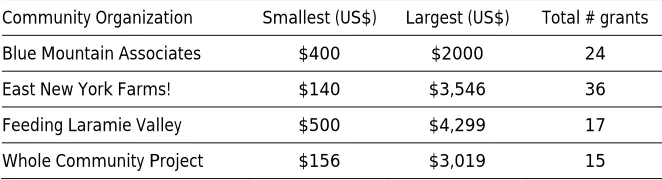
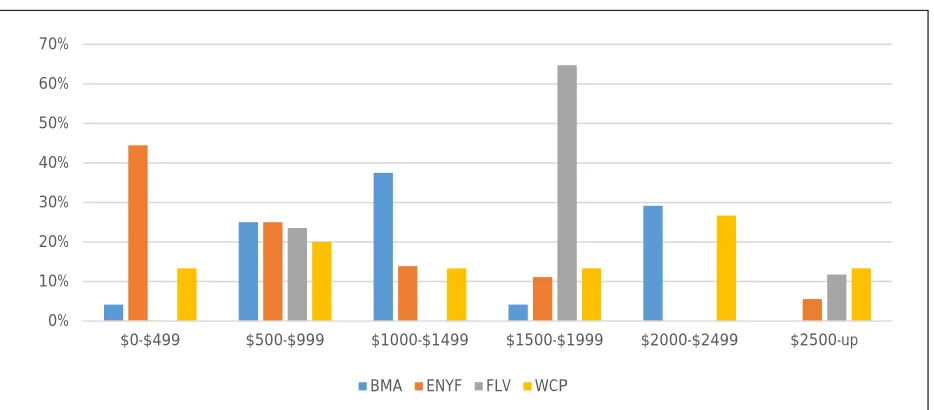
Collectively, these four community organizations distributed 92 minigrants over the course of the Food Dignity project. A snapshot of minigrant numbers and size ranges in each program is pro-vided in Table 2. Chart 1 shows the pattern that emerged in each organization in terms of the range of sizes of individual minigrants they awarded.
None of the community organizations speci-fied a minimum or maximum size for individual
minigrant awards. FLV did set a fixed grant amount in its first round (US$1500), but the amounts in subse-quent awards varied. Inevi-tably, minigrant award sizes reflect the combination of the nature and scope of projects proposed by Table 2. Minigrant Counts and Size Ranges
Community Organization Smallest (US$) Largest (US$) Total # grants
Blue Mountain Associates $400 $2000 24
East New York Farms! $140 $3,546 36
Feeding Laramie Valley $500 $4,299 17
Journal of Agriculture, Food Systems, and Community Development ISSN: 2152-0801 online
https://www.foodsystemsjournal.org
Volume 8, Supplement 1 / July 2018 135
community members and the community and organizational priorities in the selection process. In discussions at an early Food Dignity meeting, some community organizers questioned the potential impact of small grants, making the point that larger grants that would support more substantial
projects, though there was also sentiment in favor of supporting more people and ideas by giving a greater number of smaller grants (Food Dignity project internal notes, December 2011). Table 2 and Chart 1 indicate that ENYF! gave out larger numbers of smaller grants, while FLV gave out fewer, generally larger grants. BMA and WCP tended to cover all size ranges somewhat more evenly. However, there is not enough information to draw conclusions about this as a strategic choice on the part of the community organizers.
Minigrant Project Types
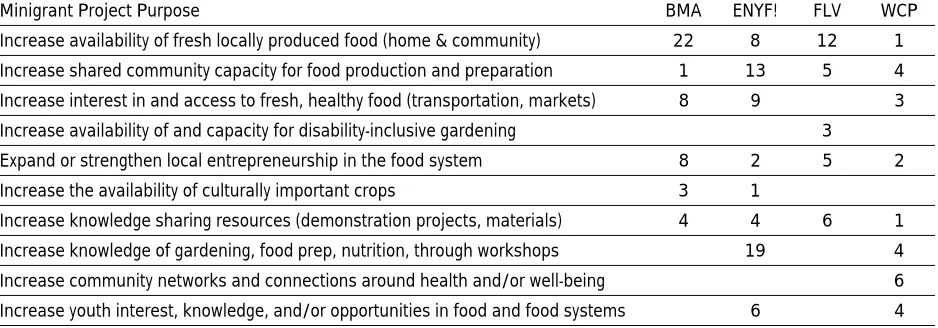
Minigrant recipients proposed a wide variety of projects and desired outcomes. To explore poten-tial patterns in the types of projects that were proposed, I categorized the 92 minigrants issued by these four community organizations according to project type. The level of detail available on pro-jects varied. In some cases, only the project title and a brief description were available; in others, there were more detailed references to a project in multiple annual reports and minigrant summaries. Because it was difficult to distinguish consistently
between, for example, a project that was solely for home food production, solely for community-des-tined food production, or involved both, some po-tentially interesting distinctions were necessarily subsumed into the broader categories presented in Table 3.
Projects were categorized in terms of the changes they were working to bring about, rather than the activities they were proposing to do to achieve those changes. This meant that, for exam-ple, season extension projects (greenhouses) were grouped with food production projects because all of them served to improve the availability of fresh produce. An alternative characterization scheme, one that focuses on the activity rather than the in-tended purpose(s), would also be a valid and useful approach. However given the diversity of contexts in which these four minigrant programs operated, it seemed more fruitful to look for commonalities and uniqueness in intended ends, rather than in the means to those ends.
The counts in Table 3 are conservative, as I erred on the side of not attributing a category unless it was explicit in the project information (for example, there were likely many more BMA-supported projects on the Wind River Reservation that resulted in increased community access to fresh food through sales of extra garden produce at the Wind River Tribal Farmers Market, since this was a general expectation of all minigrant Chart 1. Percentage of Minigrants Issued in Each Size Range
0% 10% 20% 30% 40% 50% 60% 70%
$0-$499 $500-$999 $1000-$1499 $1500-$1999 $2000-$2499 $2500-up