Journal of New Business Ideas & Trends 2014, 12(1), pp. 42-62.
”http://www.jnbit.org”
Monetary value of a supply chain relationship:
What would it take to dump your partner?
Michael D. Clements* School of Business, Faculty of Arts & Business
University of the Sunshine Coast, Queensland, Australia Email: [email protected]
(*corresponding author)
David L. Dean Commerce Division,
Lincoln University, Canterbury, New Zealand Email: [email protected]
David A. Cohen Commerce Division,
Lincoln University, Canterbury, New Zealand Email: [email protected]
Abstract
Purpose –This paper introduces a framework for measuring B2B relationship value and tests whether relationship value changes across various relationship levels. It measures relationship value in monetary terms and tests whether higher level relationships have higher value both for buyers and sellers.
Design/methodology/approach – The data was collected using structured interviews
with marketing managers and purchasing officers within the food manufacturing sector in New Zealand. The data was subjected to ANOVA statistical analysis.
Findings – The findings suggest that lower level relationships (transactional) could be
dropped for minimal additional financial gain but firms were willing to forego extremely attractive scenarios to keep their cooperative partners.
Originality/value – Implications suggest that managers value cooperative
relationships and are willing to forego very attractive prices in order to keep the non-price value components. If managers can ascertain what these valued components are and how they can be utilized, they can make themselves a highly valued partner.
Keywords: Supply chain management; buyer / seller relationships; discrete; long-term
relationships; strategic alliance; reduction in costs; trust and commitment; relationship value.
JEL Classifications: L66; M10
Introduction
In turbulent financial times, organizations must be both efficient and responsive to their supply chain partners and their customers in order to be competitive, (Coyle, Bardi & Langley 2003; Min & Mentzer, 2004; Bechtel & Jayaram. 1997; Christopher, 2000; Christopher & Lee, 2004). Managing off shore production with customer demand, and coordinating outsourced supply, and logistics activities requires linkages with distribution and warehousing facilities, all these supply chain activities require coordination achieved through dependable supply chain partners (Paik & Bagchi, 2007).
As supply chains become more global in an effort to remain competitive in manufacture and supply, by reducing costs, the structure of relationships becomes more complex in nature. Spekman and Davis (2004) suggest that “by virtue of the
interdependence that exists between trading partners” (p 431) there is the propensity for relationship risk to occur. Yet while stable relationships are desirable, each organization exposes themselves to risk when they become dependent upon relationships with other firms (Hallikis, Karvonen, Pulkkinen, Virolainen & Tuominen, 2004; Selnes, 1998).
This article conducts a study to identify the monetary value of business to business relationships. To achieve this, we define transactional and relationally orientated levels of relationships for both the purchaser and the marketer as representatives of supply chain partners and identify the relational and behavioural attributes associated with each level.
The relationship marketing literature provides sufficient theoretical foundations for the present study. Guided by the extensive literature on buyer/seller relationships (Webster, 1992; Dwyer et al., 1987; Morgan and Hunt, 1994; Donaldson & O’Toole, 2000; Spekman & Carraway 2006; Ryu, So & Koo, 2009), and using our own classification scheme framework (Clements, Dean & Cohen, 2007) which has been developed based on five
structural elements found in all relationships. These elements were drawn primarily from the work of Webster (1992), and Donaldson and O’Toole (2000) and include: regularity, input dominance, contractual status, communication status, and competitive positioning.
In transactional focused exchange including transactional marketing, both buyers and sellers interact on a generic basis (Hingley & Lindgreen, 2002), often price paid for product supplied. Conversely, relationally oriented exchange, including relationship marketing, is based upon both parties developing a unique offering which can only be satisfied through both parties working closer together. The manner in which exchange partners interact, changes from power and control as prevalent in transactional exchange to constructs such as trust and commitment in relationally oriented exchange.
In order for longer term relationships to develop, both the customer and the
supplier need to be able to depend on each other. Trust is seen as a facilitator and developer, and a critical determinant in managing business relationships (Anderson & Narus,1990; Dwyer et al., 1987; Schurr &Ozanne, 1985; Morgan & Hunt, 1994; Jap, Manolis & Weitz, 1999; Kozak & Cohen, 1997; Doney & Cannon, 1997; Sahay 2003; Johnston et al., 2004; Gounaris, 2005; Tomkins, 2001; Ulaga & Eggert, 2006), and signifies a belief that expectations and motives of a relationship partner can be relied, and delivered upon (Hogarth-Scott, 1999; Schurr & Ozanne, 1985; Kumar 1996; Moorman, Deshpandé & Zaltman, 1993; Zajac & Olsen, 1993; Mouzas, Henneberg & Naude, 2007; Caceres & Paparoidamis, 2007; Seppanen, Blomqvist & Sundqvist, 2007; Suh & Kwon, 2006).
Businesses today still place emphasis on profit-and-loss statements and quarterly earnings reports leads managers to maximise their own company’s profits. Managers therefore find it difficult not to “expropriate the economic benefits of alliances relationships at the expense of the alliance partner” (Fawcett, Ellram, & Ogden, 2007, P356).
Bearing this organizational dilemma in mind and accepting that literature identifies characteristics of different types of relationships and their strengths, there appears little research which identifies the monetary value at which supply chain partners would swap their relationship partners for each type of relationship. Whilst many
researchers identify the virtues of long term mutually beneficial stable relationships characterized by trust, commitment and information sharing, (Fontenot & Wilson, 1997), there are sparse references to the monetary value that purchaser’s and marketers both place on these ‘so called’ sought after relationships.
An investigation of switching behavior will contribute to our understanding of the monetary value purchasers and marketers attribute to the worth of transactional verses relationally oriented exchange. The present study will extend these previous findings on buyer/seller relationships by providing understanding as to the level of orientation of relationships that are considered susceptible to switching behaviour based on monetary value.
With these motivations in mind, this article reports the results of an empirical study. In the next section, we discuss the theoretical background by examining the concept of relationship worth in monetary terms from an inter-organizational perspective in the supply chain context and develop the research hypotheses. The research method for the empirical study is then explained, followed by a discussion of the data analysis and results. We then discuss the findings and draw implications for researchers and practitioners. This paper concludes by suggesting areas of further development which will encourage
sustainable relationship development in supply chains.
Competing in complex global marketplaces as supply chains
The new business model requires organizations to be able to compete globally in complex customer driven markets. This dynamic enviroment sees competition between supply chains (Christopher & Towill, 2001; Lambert & Cooper, 2000; Spekman et al., 1998; Gunasekaran, Lai & Cheng, 2008). To be able to compete organizations need to be able to leverage their own sources of competitive advantage off those of their supply chain partners (Whipple & Frankel, 2000; Hamel et al., 1989; Lorenzoni & Lipparini, 1999; Clements, Lazo, & Martin, 2008; Li et al., 2006; Cao & Zhang, 2011).
Supply chains may be conceived of as a set of organizations involved in the upstream and downstream flow of products, services, information, and finances (Min & Mentzer, 2004). In addition, the chains activities include material information which flows from initial suppliers, through the channel members to the final end user or customer (Bechtel & Jayaram, 1997). By definition, this paradigm suggests that organizations within a supply chain must work more effectively together to become customer focused and market driven (Hines, 2004) which requires organizations to be able to depend on one another in stable supply chain relationships, (Clements & O’Loughlin, 2007).
also concern at the potential risks of ongoing reliance or dependence with other channel members (Spekman & Davis, 2004; Hallikas, Karvonen, Pulkkinen, Virolainen, & Tuominen, 2004) and how the degree of inter-dependency amongst the participants
impacts the opportunity for one of the chain participants to act in its own self-interest to the detriment of other supply chain members (Spekman & Davis, 2004). The move away from contractual arms-length relationships to other more relationally oriented arrangements exposes both parties to risk that can no longer be mediated or managed by contractual agreement (Clements, Dean, & Cohen, 2010).
Within the buyer /seller relationship literature, theories on inter-firm relationship development predominately fit within two main streams. One stream considers the stages in the relationship life cycle wherein relationships evolve over the life cycle of the relationship (Dwyer, Schurr & Oh, 1987; Knox & White, 1991; Jackson, 1994; Palmer & Bejou, 1994; Heide, 1994; Wilson, 1995). The second stream draws attention to the levels of relationship based on the structure, characteristics and attributes that contribute to the nature of the relationship e.g. trust, commitment and communication (Clements, Dean & Cohen, 2007; Donaldson & O’Toole, 2000; Morgan & Hunt, 1994; Day, 2000; Webster, 1992). The attribute/characteristic mix is useful as it can be used to assess changes in inter-firm relationships (Day, 2000; Webster 1992; Macneil 1980; Donaldson & O’Toole, 2000).
In addition to these exploratory empirical studies, other researchers have examined relationships from a continiuum perspective. Whilst there is considerable variation in the number and names of relationships levels, there is some agreement on the beginning and end points (Day, 2000; Webster 1992; Clements, Dean & Cohen, 2007). Basic transactional exchange, also known as a discrete transaction is positioned at the beginning of the
continuum, with collaborative or relational exchange at the opposite end.
Webster (1992) identifies seven stages of exchange along a continuum; Day (2000) bridges the end points with opportunities for value-added activities. This concept provides both buyer and seller the chance to develop relationships by adding value to their
relationship.
With relationship continuums becoming a common tool to assess levels of exchange in inter-firm relationships within the literature (Day, 2000; Webster 1992; Donaldson & O’Toole, 2000), Clements, Dean & Cohen 2007) have developed a
classification scheme framework based on five structural elements found in all relationships which include regularity, input dominance, contractual status, communication status, and competitive positioning.
Transactional oriented exchange
organizational success will “depend upon the agility and strength of the entire supply chain rather than on the competitive power of any individual company” (Fawcett, Ellram, & Ogden, 2007, p345).
Recent streams examine relationship marketing theories, which predict buyer/seller commitment and trust in a business relationship as drivers of on-going business (Morgan & Hunt, 1994). This "relational" view is referred to as relationally oriented exchange (Park & Kim, 2006).
Relational exchange
This suggests development away from transactional focused exchange to
relationally oriented interactions is driven by a firms desire to compete as a member of a competitive supply chain. Literature identifies important relational characteristics deemed critical for successful relationships. These prominent characteristics include the relationship status such as trust, commitment, and inter-firm communication. Inter-firm trust provides a platform for firms to engage in more advanced relationships. There are many applications for the term ‘trust’. From a relational perspective, ‘trust’ signifies a belief that expectations and motives of a relationship partner can be relied, and delivered upon (Hogarth-Scott, 1999; Kumar 1996; Moorman, Deshpandé & Zaltman, 1993; Zajac & Olsen, 1993). The potential success of trust is often cited as a critical determinant in the potential success of a long-term relationship (Dwyer et al., 1987; Morgan & Hunt, 1994; Jap, Manolis & Weitz, 1999; Kozak & Cohen, 1997). Trust performs a crucial role in the minds of buyers toward their current suppliers and builds a platform for future bargaining with suppliers (Smith & Barclay, 1997). Trust combined with commitment encourages relational exchange, a vehicle to preserve relational investment through cooperation (Fontenot & Wilson, 1997).
It is necessary to understand the importance of inter-firm commitment in
developing stable buyer / seller relationships. Similar to trust, definitions of ‘commitment’ also vary depending upon context and application in a relationship. It can range from as little as an informal agreement to financial contribution to specific assets for long-term exchange. Commitment is the willingness of a firm to provide resources for the purpose of demonstrating their dedication to the continuation of a relationship (Fontenot & Wilson, 1997; Kumar, 1996; Cann, 1998). This level of dedication depends upon the involvement of a firm in the relationship, and at an advanced stage, denotes a level of relationship
satisfaction that precludes potential exchange partners who could provide similar benefits (Dwyer et al., 1987). To reduce opportunism in a relationship, commitment in relational exchange cannot be disproportionate between firms.
Communication plays an important role in the ability and the desire of a firm to advance their trading relationship. Communication has a significant influence on the ability of trading partners to form strong relationships (Berry, 1995; Holden & O’Toole, 2004; Mohr & Nevin, 1990). Open communication is associated with trust between relationship partners (Morgan & Hunt, 1994; Anderson & Narus, 1990; Berry, 1995). Collaborative communication in exchange relationships relies on mutual cooperative attitudes and helps regulate compliance amongst relationship members (Morgan & Hunt, 1994). Since
satisfaction refers to the meeting of expectations between buyers and sellers, it is proper that communication contributes to these expectation evaluations, in that it enhances the way that exchange partners perceive each other (Williams & Spiro, 1985).
The above relationship characteristics reflect both organizations desire to work together, and value of the relationship to both parties. The current study continues to investigate the monetary value that buyers and sellers place on both transactionally and relationally oriented exchange. The theoretical framework of this study is our own (Clements, Dean & Cohen, 2007) model of buyer-seller relationship levels. The model consists of four distinct levels of relationship for both the buyer and seller that are believed to predict the development and success of marketing relationships. We posit that our model provides an important framework for examining the monetary value of buyer-seller
relationships.
Value Connection
The concept of value by virtue of definition is more encompassing of a spectrum of benefits. Zeithaml (1988) notes that value has been defined as the trade-off between the “…price given and components received…. and is at the core of buyer-seller exchange” (p14). As with a spectrum of relationships from transactional to relational so value is measured dependent upon it’s application either as an outcome of a transaction, or as the benefits attributed to an ongoing mutual relationship.
From a transactional value perspective, simple participation in the transaction or exchange suggests benefits the buyer (customer) in direct outcomes of value, such as low price products, good quality products, and efficiencies that result from the transaction (Hogan, 2001). This type of supplier/ business customer value is also defined as “…the worth in monetary terms of the economic, technical, service and social benefits a customer firm receives in exchange for the price it pays for a product offering” (Anderson & Narus, 1990, p 5). The seller also benefits from the immediate sale transaction.
From a relational value perspective as supplier customer relationships develop into cooperative relationships, value from participating in the relationship increases (Wilson, 1995; Webster, 1992). The value derived from the relationship evolves into a key resource (Barney, 1991), and value is therefore amassed as the cumulative worth of all the exchanges that occur between the participating firms (Hogan, 2001). The value proposition to the industrial buyer and seller involves both value from the transaction and value from the relationship (Clements, 2004). Value from the transaction is a direct outcome of an initial exchange. Thus, for value to be continually derived by both parties, the level of relational exchange needs to continue (Clements, Dean & Cohen, 2007).
The often unquantifiable cost/benefit return equation used to gauge the ‘value’ from an exchange provides a dilemma to organizations pursuing the idea of developing relationships. Are their existing relationships acceptable in their present form, and to what end do they influence the firms competitive advantage? Alternatively Frazier (1999)
suggests that there are contexts where the costs of establishing these relationships outweigh the benefits, and one-off or repeated relationships would more aptly address the buyer / seller need. These questions encourage both the buyer and seller to investigate the monetary value of relationships so as to gauge which relationships are stable and which have the propensity to switch.
Switching Behaviour
Switching behavior has strong roots in both business-customer literature and relationship marketing theory and practise (Lopez, Redondo, & Olivan, 2006). Loss of customers affects firm profitability (Reinartz & Kumar, 2003) and costs for developing a new customer base and indeed customer loyalty are expensive, it is less expensive to retain existing customers (Fornell 1992; Reichheld 1996), as building new customer relationships can cost five times more than retaining existing customers (Peters, 1987).
Therefore switching behavior is a serious threat to a firms’ profitability and future viability (Berry, 1983; Morgan & Hunt, 1994; Grönroos, 1995) and the achievement of long term relationships (Ganesh et al., 2000). Most of the organizational concern revolves around the cost of losing the benefits associated with having long term relationships with customers. Such benefits of having good relationships with customers include greater usage of the firm's services (Bolton & Lemon, 1999), greater openness to the firm's new products (Hawkins et al., 2004), and increased support to engage in positive word-of-mouth (Dick & Basu, 1994).
Early research by Keaveney (1995) identifies eight factors that motivate customers' switching decisions. These include core service failures, pricing, employee responses to service failures, attraction by competitors, or inconvenience. Other variables include dissatisfaction (Swinyard & Whitlark, 1994), perceived quality (Rust & Zahoric, 1993), awareness of alternatives (Capraro et al., 2003).
Literature postulates that the early stages of the relationship (such as discrete and repeated as discussed earlier) are critical for future continuity of relationships (Bowman, 2004). These early relationships also have a higher probability of switching behaviour than the more long term relationships (such as long term and strategic alliances) (Ongena & Smith, 2001; Israel, 2005).
Whereas as the relationship develops, confidence in the supplier increases (Verhoef
et al., 2002), satisfaction within the relationship increases (Anderson & Weitz (1989; Wilson
and Mummalaneni, 1990) and trust develops between the parties (Gwinner et al., 1998). Also the cost of switching suppliers rises (Shapiro & Varian, 1999) and commitment increases through continuing interactions.
Loyalty and economic ties in buyer-seller relationships
Buyer-seller literature associates loyalty between relationship partners as an indicator of inter-firm commitment (Dwyer et al., 1987; Morris & Holman, 1988; Sriram & Mummalaneni, 1990) often the result of successful repeated interactions. This level of commitment often precludes the opportunity of alternative suppliers entering the market offering better deals, where current suppliers are unlikely to be replaced in relationships where strong relational characteristics such as trust and commitment are present (Lopez, Redondo & Olivan, 2006). In buyer-seller relations where commitment is economically based, these economic ties are associated in general with economic dependence, therefore emphasis increases towards a partner firm as resources and processes are developed to accommodate the relationship (Johanson et al., 1991; Young & Denize, 1995). Therefore understanding the value that inter-firm relationships utilize in determining customers' switching decisions represents a decisive step in successfully establishing, developing and maintaining buyer/seller relationships. In the next section, a theoretical framework is discussed. The methodology is then described, followed by the results, discussion and conclusion.
Given the vast literature support above to suggest that lower level transactional arm’s length relationships are not invested in, at what point is the loyalty of the other partner (supplier) such that financial incentive would lure them to another buyer? If this is so, then what financial lure would it take to disrupt higher level relationships given the importance of buyer/seller relationships to supply chain performance (Richey, Daugherty & Roath, 2007)? These questions underpin the theoretical discussion and hypothesis
development in this section.
Clements, Dean and Cohen (2007) model classifies levels of buyer/seller
relationships based on a classification framework. This paper will use this framework to test the level of financial incentive needed to lure the supplier and buyer away from their
existing relationship. This value judgment provides insight into the real monetary value of relationships given their existing relationship worth from a characteristic and attribute status.
Categories of relationships
The use of a relationship continuum as a platform to assess levels of exchange in inter-firm relationships is a common tool within the literature (Day, 2000; Webster 1992; Donaldson & O’Toole, 2000). These continuums are used to rank different levels of
relationships, by identifying common beginning and end points on the spectrum, as well as the intensity of the transactional exchange (MacNeil, 1980). Discrete transactions
positioned at one end of the continuum, with collaborative or relational exchange at the opposite end.
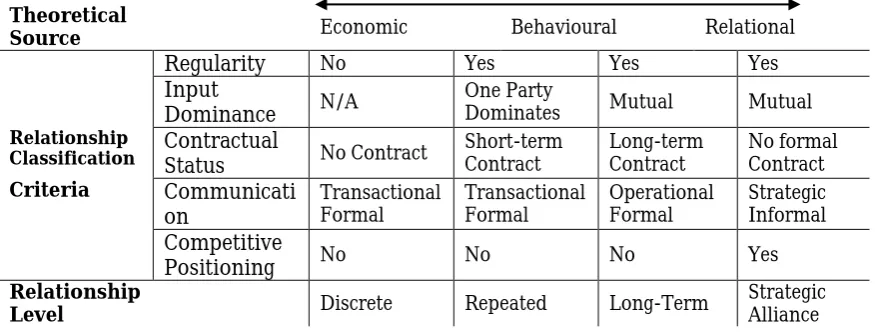
A classification scheme framework (Clements, Dean & Cohen, 2007) has been developed based on five structural elements found in all relationships. These elements were drawn primarily from the work of Webster (1992), and Donaldson and O’Toole (2000) and include: regularity, input dominance, contractual status, communication status, and competitive positioning as shown in Figure 1.
Figure 1.
Relationship Classification Criteria Linked to Theoretical Source and Relationship
Level
Theoretical
Source Economic Behavioural Relational
Regularity No Yes Yes Yes
Input
Dominance N/A One Party Dominates Mutual Mutual Relationship
Classification Contractual Status No Contract Short-term Contract Long-term Contract No formal Contract
Criteria Communicati
on Transactional Formal Transactional Formal Operational Formal Strategic Informal Competitive
Positioning No No No Yes
Relationship
Level Discrete Repeated Long-Term Strategic Alliance
Also from Figure 1, we can see that the discrete relationship is distinctive from the other levels of relationship due to its non-regularity of exchange. This one-off approach minimizes the possibility of this level of relationship contributing in any other relational manner. The repeated relationship is distinctive in that one party often controls it and short-term contracts are used. This too minimizes its opportunity of becoming relational and mutually attractive. The long-term relationship reflects a mutually acceptable
operationally focused relationship, whereas the strategic alliance focuses on attainment of strategic goals through competitive positioning. Thus, we hypothesize that:
H1: The value that (a) Buyers and (b) Sellers place on the B2B relationship will vary across relationship levels.
As buyer/seller relationships develop into cooperative relationships, value from participating in the relationship increases (Doney and Cannon 1997; Wilson, 1995; Webster, 1992). The value derived from the relationship evolves into a key resource (Barney, 1991; Hunt and Morgan, 1995), and value is therefore amassed into the cumulative worth of all the exchanges that occur between the participating firms (Hogan, 2001). Thus, we hypothesize that:
H2: The value that Buyers and Sellers place on the B2B relationship will be (a) the lowest for Discrete relationships, (b) higher for Repeated relationships, (c) higher still for Long-Term relationships, & (d) the highest for Strategic Alliances.
Research Method
Data was collected from food industry manufacturers and distributors in the Wellington and Christchurch regions of New Zealand via face–to–face structured
interviews. The interviews were made up of two parts and required the participant for thirty minutes. This was pre-tested amongst both academics and industry representatives. The interview began with general questions used to categorize the supplier or the buyer
(customer) on firm size based on annual turnover and number of employees. In the second part of the interview the respondents identified and classified a particular relationship and were asked to assess its value.
The rationale for choosing the food industry was threefold. Food manufacturing and distribution is an important industry as a major employer and exporter for New Zealand. Using land-based raw materials, it was likely that operational and strategic
decisions were likely to be local as well. The third reason was that food manufacturers often source their raw materials from a number of independent suppliers and are therefore likely to have a variety of supply chain relationships to consider. The population was food
manufacturers and distributors in the Central and Southern regions of New Zealand that were independent in their choice and management of buyer and supplier relationships. This operationalization of a strategic business unit (SBU) is consistent with the criteria for a firm to be defined as an SBU by Walker and Ruekert (1987). They suggest that the establishment of an SBU is a trade-off between a business unit “…large enough to afford and maintain critical resources and to operate on an efficient scale” (Walker & Ruekert, 1987, p 22), but not so large that its market scope is too broad or that it is unable to respond quickly to customer needs.
from its corporate base. In addition, SBU’s control their budgets. This SBU definition is essential, because it identifies business units that control their own purchasing and / or marketing decisions. SBU status can be argued, has significance for the establishment, maintenance and change of business relationships over time. For the purpose of this research, firms that controlled/owned their supplier and/or or were controlled/owned by a buyer and/or supplier were not included.
Through manufacturing associations and Yellow Pages listings, a total of 61 firms were found in Wellington and Christchurch. All of the firms were contacted, and 40 agreed to participate in an interview, a 65% response rate. SBU size varied from 990 employees to 2 employees, with a mean of 88.58 employees. The annual turnover of the SBUs ranged from 200,000 NZD to 750,000,000 NZD, with a mean of 32,281,276 NZD and a median of 3,000,000 NZD. The most senior person in the marketing department participated as the supplier’s representative or the most senior purchasing officer participated as the buyer’s representative. It was reasoned that these people would be the most likely to establish or influence relationships, relying on senior level respondents may, however, have introduced bias, in that lower level decision makers were excluded.
Measures
Respondents were given definitions of 4 relationship levels (Discrete, Repeated, Long Term, and Strategic Alliance) and were asked to identify one of the firms’ relationships that fit a particular criterion. Once established, the respondent was asked to imagine a rival partner was proposing they should stop dealing with their current partner and work with the rival. As an incentive, the rival was willing to better their current partner’s price to make the deal more attractive. Once the respondent understood the scenario, they were asked how much more attractive would the offer have to be to switch to the rival partner.
In this way, the respondents were assessing all of the tangible and intangible characteristics of the partner and converting it into a percentage discount (buyer) or
premium (seller) on their current price. If the respondent was willing to switch without any premium, it was scored as 0, and if the partner was not willing to switch at any level of premium, it was scored as 100.
While this approach is unique in the valuation of relationships, it is based on a rich tradition of examining “willingness to switch” products and services in the area of consumer behaviour (Roos, Edvardsson & Gustafsson, 2004.)
From each of the 40 organizations, two interviews were carried out, for up to 4 different company relationships (Discrete, Repeated, Long Term, Strategic Alliance). While the sampling frame and interviews were at the firm level, the hypotheses and analysis is performed at the relationship level, so it could be argued that the data represents 160 different relationships.
One-way ANOVAs were used to establish whether the value of the relationship changed across relationship level. And Least Squared Difference (LSD) post-hoc analyses were used to identify significant differences across relationship levels. All of the hypotheses were analyzed using SPSS (Statistical Programme for Social Sciences), Version 12.
Data Analysis and Results
Results
Table 1:
Descriptives
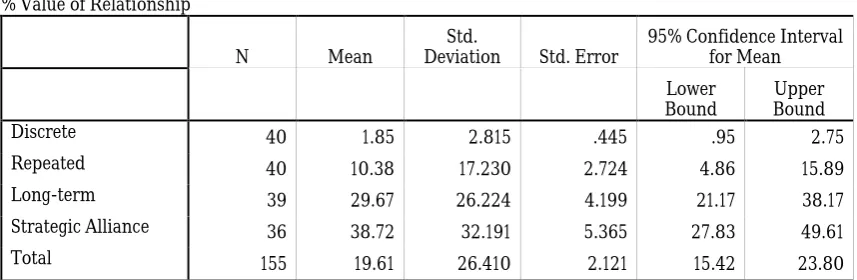
% Value of Relationship
N Mean Deviation Std. Std. Error 95% Confidence Interval for Mean
Bound Lower Bound Upper
Discrete 40 1.85 2.815 .445 .95 2.75
Repeated 40 10.38 17.230 2.724 4.86 15.89
Long-term 39 29.67 26.224 4.199 21.17 38.17
Strategic Alliance 36 38.72 32.191 5.365 27.83 49.61
Total 155 19.61 26.410 2.121 15.42 23.80
ANOVA
% Value of Relationship
Squares Sum of df Mean Square F Sig.
Between Groups 33122.410 3 11040.803 22.442 .000
Within Groups 74288.364 151 491.976
Total 107410.774 154
Table 2:
One-way ANOVA for Sellers - Descriptive Statistics
% Value of RelationshipN Mean Deviation Std. Std. Error 95% Confidence Interval for Mean
Bound Lower Bound Upper
Discrete 40 .85 2.940 .465 -.09 1.79
Repeated 39 5.28 7.398 1.185 2.88 7.68
Long-term 40 20.83 20.504 3.242 14.27 27.38
Strategic Alliance 38 26.76 26.987 4.378 17.89 35.63
Total 157 13.31 20.195 1.612 10.13 16.50
ANOVA
% Value of Relationship
Squares Sum of df Mean Square F Sig.
Between Groups 17860.066 3 5953.355 19.905 .000
Within Groups 45759.641 153 299.083
Hypothesis one tested whether different levels of relationship will have different values for the buyer and the seller. The one-way ANOVA supported this hypothesis both for the Buyer (Table 1) and for the Seller (Table 2)
Table 3:
ANOVA Post-Hoc Tests for Buyers - Multiple Comparisons
Dependent Variable: % Value of RelationshipLSD (I) Relationship level (J) Relationship level Mean Difference
(I-J) Error Std. Sig. 95% Confidence Interval Upper Lower
Discrete Repeated -8.525 4.960 .088 -18.32 1.27
Long-term -27.817(*) 4.991 .000 -37.68 -17.95
Strategic
Alliance -36.872(*) 5.096 .000 -46.94 -26.80
Repeated Discrete 8.525 4.960 .088 -1.27 18.32
Long-term -19.292(*) 4.991 .000 -29.15 -9.43
Strategic
Alliance -28.347(*) 5.096 .000 -38.42 -18.28
Long-term Discrete 27.817(*) 4.991 .000 17.95 37.68
Repeated 19.292(*) 4.991 .000 9.43 29.15
Strategic
Alliance -9.056 5.126 .079 -19.18 1.07
Strategic
Alliance Discrete 36.872(*) 5.096 .000 26.80 46.94
Repeated 28.347(*) 5.096 .000 18.28 38.42
Long-term 9.056 5.126 .079 -1.07 19.18
* The mean difference is significant at the .05 level.
Table 4:
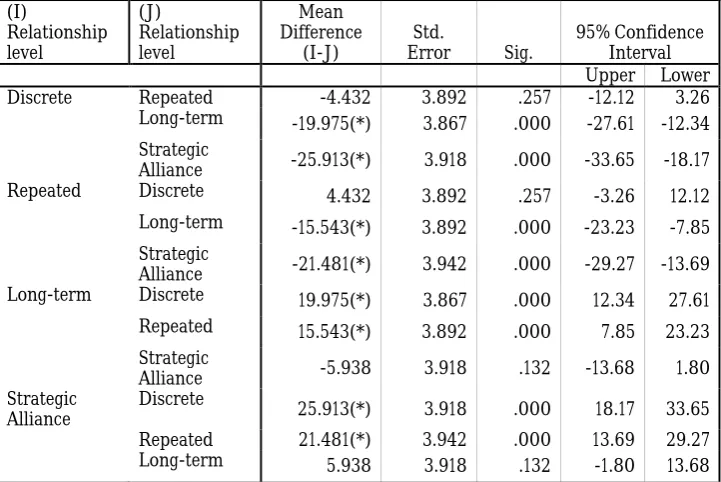
ANOVA Post-Hoc Tests for Sellers - Multiple Comparisons
Dependent Variable: % Value of RelationshipLSD (I) Relationship level (J) Relationship level Mean Difference
(I-J) Error Std. Sig. 95% Confidence Interval Upper Lower
Discrete Repeated -4.432 3.892 .257 -12.12 3.26
Long-term -19.975(*) 3.867 .000 -27.61 -12.34
Strategic
Alliance -25.913(*) 3.918 .000 -33.65 -18.17
Repeated Discrete 4.432 3.892 .257 -3.26 12.12
Long-term -15.543(*) 3.892 .000 -23.23 -7.85
Strategic
Alliance -21.481(*) 3.942 .000 -29.27 -13.69
Long-term Discrete 19.975(*) 3.867 .000 12.34 27.61
Repeated 15.543(*) 3.892 .000 7.85 23.23
Strategic
Alliance -5.938 3.918 .132 -13.68 1.80
Strategic
Alliance Discrete 25.913(*) 3.918 .000 18.17 33.65
Repeated 21.481(*) 3.942 .000 13.69 29.27
Long-term 5.938 3.918 .132 -1.80 13.68
Hypothesis two tested whether increases in value related to increases in
relationship level. For both Buyers and Sellers, Discrete and Repeated relationship levels were significantly different from Long-Term and Strategic Alliance but the differences between Discrete and Repeated or between Long-Term and Strategic Alliance were not found to be different.
The results indicate that different levels of relationship differed in terms of relationship value for both the buyer and the seller. The results also showed that the transactional relationships (discrete and repeated) were found to be less valued than the cooperative relationships (long-term and strategic alliance)
Discussion
The results of this study show that both the marketing and purchasing sides of organizations place more value on their more cooperative relationships and less value on more transactional ones. While the results support this broad distinction in relationship levels, Figures 2 and 3 shows the four relationship levels are ranked in the expected value order and the value differences between levels are not only statistically significant, but quite dramatic.
It seems that for discrete relationships, any incentive will attract the attention of both the Buyers and Sellers, but this result is not surprising. The organization has had very little to do with the discrete partner and they are an unknown quantity much like the new rival. With no preconceptions, even a slightly better price is more attractive.
The organization has begun to build a relationship with the Repeated partner. Several orders have been completed and perhaps there have been problems that have been solved, giving the organization a chance to get comfortable with the arrangement. This level of comfort was valued at around 10% price discount for the Buyers and a 5% price premium for the Buyers.
A large jump in value comes between the Repeated and the Long-Term
relationships. This jump was statistically significant in both post-hoc analyses and at near 30% discount for buyers and 21% premium for sellers, it is financially significant as well. The Strategic Alliances had the highest value scores (although not significantly different from the Long-term) at 39% for Buyers and 27% for Sellers.
This research contributes to theory by establishing that buyers and sellers do value relationships differently, and therefore warrant attention to the relationship level in future buyer / seller relationship research. This finding validates Campbell’s (1997) assertion that not every relationship results in mutual benefits, and that the relationship participants (buyer and seller) perceive relationships differently. Understanding the reasons why the seller values relationships differently from the buyer is an important question for future research.
Finally, while switching behavior is an accepted part of supply chain relationships both up and downstream between business partners and potentially between B2C
partnerships, it is pertinent to consider the influence of economic and financial drivers when determining relationship value. It is paradoxical that research in relationship value has progressed from its roots in simple economic and financial procedures to complex relational and behavioral theories which we have tried to encapsulate in an
economic/financial construct which in itself is an attempt to capture often talked about intangible value of relationships.
Managerial Implications
As well as making several contributions to theory, this research provides
meaningful contributions for managers. The managers that participated in the study had no problem converting intangible value components into a price premium/discount. Perhaps this was easy because it was consistent with their evaluation process or it mirrored actual decisions they had encountered. Nevertheless, a research process that is intuitive to manager’s means that the results could also be easily interpreted and utilised by them.
The results show that managers value cooperative relationships and are willing to forego very attractive prices in order to keep the non-price value components. If researchers can help organizations ascertain what these valued components are and how they can be utilized, they can make themselves a highly valued partner to their buyers and suppliers.
Future Research
There are numerous directions research could take from this research. First, a more detailed understanding of relational value is needed. What aspects of the relationship are managers using for their assessments and how are they making the conversion into monetary value? As mentioned in the managerial implications, researchers and managers could benefit from determining what relational values best translate into monetary value.
References
Anderson, E. & Weitz, B. (1989). Determinants of continuity in conventional industrial channel dyad, Marketing Science, 8(4), 310-23.
Anderson, J. C. & Narus, J. A. (1990). A Model of Distributor Firm and Manufacturer Firm Working Partnerships, Journal of Marketing, 54(1), 42-58.
Babbie, E (1999). The basics of social research. United States of America: Wadsworth Publishing Company.
Barney, J. B. (1991). Firm resources and sustained competitive advantage. Journal of Management, 17, 99-120.
Bechtel, C., and Jayaram, J. (1997). Supply Chain Management: A Strategic Perspective. The International Journal of Logistics Management, 8(1), 15-34.
Berry, L. (1995), Relationship marketing of services – growing interest, emerging perspectives. Journal of the Academy of Marketing Science, 23(4), 236-245.
Bolton, R.N. and Lemon, K.N. (1999). A dynamic model of customers' usage of services: usage as an antecedent and consequences of satisfaction, Journal of Marketing Research, 36, 2, 171-186.
Bowersox, D. J., Closs, D. J. & Stank, T. P. (2000). Ten mega-trends that will revolutionize supply chain logistics. Journal of Business Logistics, 21(2), 1-16.
Bowman, D. (2004). Customer retention in business services: determinants of duration in customer-supplier relationships, working paper, ISBM Report 24997, ISBM, Penn State University, University Park, PA.
Caceres, R. and Paparoidamis, N. (2007). Service quality, relationship satisfaction, trust,
commitment and business-to-business loyalty, European Journal of Marketing, 41(7), 836-867.
Campbell, A. (1997). Buyer-supplier partnerships: Flip sides of the same coin?, Journal of Business and Industrial Marketing, 12(6), 417-434.
Cannon, J. P. & Perreault, W. D. (Jr.) (1999). Buyer-seller relationships in business markets. Journal of Marketing Research, 36(4), (November), 439-460.
Cao, M. & Zhang, Q. (2011). Supply chain collaboration: Impact on collaborative advantage and firm performance, Journal of Operations Management, 3, (March), 163-180.
Capraro, A.J., Broniarczyk, S. and Srivastava, R.K. (2003). Factors influencing the likelihood of customer defection: the role of consumer knowledge, Journal of the Academy of Marketing Science, 31 (2), 164-175.
Christopher, M. (2000). The Agile Supply Chain: Competing in Volatile Markets, Industrial Marketing Management, 29 (1), 37-44.
Christopher, M,, Lee, H. (2004). Mitigating supply chain risk through improved confidence, International Journal of Physical Distribution & Logistics Management, 34(5), 388–396.
Christopher, M. & Jüttner, U. (2000). Developing strategic partnerships in the supply chain: A practitioner perspective, European Journal of Purchasing and Supply Management, 6, 117-127.
Clements, M.D., Dean. D.L. and Cohen, D.A. (2007). Proposing an operational classification scheme for embryonic cooperative relationship levels, Journal of Management and Organization, 13(1), 51-64.
Clements, M.D., Dean. D.L. and Cohen, D.A. (2010). Supplier Selected Relationships: Choosing friends over Family, International Journal of Manufacturing Technology and
Management, 19 (1/2), 47-67.
Clements, M.D., Lazo, R.M., and Martin, S.K., (2008). Relationship Connectors in NZ Fresh Produce Supply Chains, British Food Journal (Special Issue on Relationships, Networks, and
Interactions in Food and Agriculture Business-to-Business Marketing and Purchasing),110 (4/5), 346-360.
Clements M.D.J. and O’Loughlin A.M. (2007). Supply Chain Myopia: A Conceptual Framework, Conference Proceedings of the 8th International Research Conference on Quality, Innovation and Knowledge Management, New Delhi, India, February 2007.
Clements, M.D.J. and Sense, A.J. (2010). Socially Shaping Supply Chain Integration through Learning, International Journal of Technology Management, 51(1), 92-105.
Coyle, J.J., Bardi, E.J. and Langley, C.J. Jr. (2003). The management of business logistics: A supply
chain perspective (7th Edition), Canada: South-Western Thompson Learning.
Day, G. S. (2000). Managing market relationships. Journal of the Academy of Marketing Science, 28, 24-30.
Dick, A.S. and Basu, K. (1994). Customer royalty: toward an integrated conceptual framework", Journal of the Academy of Marketing Science, 22(2), 99-113.
Donaldson, B., & O’Toole, T. (2000). Classifying relationship structures: Relationship strength in industrial markets. The Journal of Business and Industrial Marketing, 15(7) 491-506.
Doney, P. M. and Cannon, J. P (1997). An examination of the nature of trust in buyer-seller relationships, Journal of Marketing; 61, 25-51.
Dwyer, F. R.; Schurr, P, H., & Oh, S. (1987). Developing buyer-seller relationships, Journal of Marketing, 51, (April) 11-27.
Dyer, J. H., & Singh, H. (1998). The relational view: Cooperative strategy and sources of
interorganizational competitive advantage, The Academy of Management Review, 23(4), 660-679.
Ellram, L. M., & Cooper, M. C., (1990). Supply chain management, partnerships, and the shipper-third party relationship, The International Journal of Logistics Management, 1(2), 1-10.
Fawcett, S. E., Ellram, L. M, & Ogden, J. A. (2007). Supply chain management: from vision to implementation, Upper Saddle River, NJ: Pearson Prentice Hall.
Fontenot, R. J., & Wilson E. J. (1997), Relational exchange: A review of selected models for a prediction matrix of relationship activities, Journal of Business Research, 39(1), 5-12.
Fornell, Claes (1992). A National Customer Satisfaction Barometer: The Swedish Experience,Journal of Marketing, 56 (1), 6-21.
Frazier, G. L. (1999). Organizing and managing channels of distribution. Academy of Marketing Science Journal, 27, (Spring), 223-240.
Gao, T., Sirgy, M. J., Bird, M. M. (2005). Reducing buyer decision-making uncertainty in
organizational purchasing: can supplier trust, commitment, and dependence help?, Journal of Business Research, 58, 397-405.
Gattorna, J. (2006). Living supply chains, Prentice Hall, Great Britain.
Gounaris, S. (2005). Trust and commitment influences on customer retention: insights from business-to-business services, Journal of Business Research, 58 (2), 126-140.
Grönroos, C. (1995). Relationship marketing: the strategy continuum, Journal of the Academy of Marketing Science, 23 (4), 252-254.
Gulati, R. (1995). Does familiarity breed trust? The implications of repeated ties for contractual choice in alliances, Academy of Management Journal, 38(1), 85-112.
Gunasekaran, A., Lai, K. H., & Cheng, T. C. E. (2008). Responsive supply chain: A competitive strategy in a networked economy, Omega – The International Journal of Management Science, 36, 549-564.
Gwinner, K.P., Gremler, D.D. and Bitner, M.J. (1998). Relational benefits in services industries: the customer's perspective, Journal of the Academy of Marketing Science, 26, Spring, 101-114.
Handfield, R. B. & Bechtel, C, (2002). The role of trust in relationship structure in improving supply chain responsiveness, Industrial Marketing Management, 31, 367-382.
Hallikas, J., Karvonen, I., Pulkkinen, U., Virolainen, V-M. & Tuominen, M. (2004). Risk management processes in supplier networks, International Journal of Production Economics, 90 (1), 47-58.
Hartley, J. L. (2000). Collaborative value analysis: Experiences from the automotive industry, Journal of Supply Chain Management, 36(4), (Fall), 27-32.
Hawkins, I., Best, J.B. and Coney, K.A. (2004). Consumer Behavior, Building Marketing Strategy, 9th ed., McGraw-Hill, New York, NY.
Hines, T. (2004). Supply Chain Strategies: Customer-driven and customer-focused, Elsevier Butterworth-Heinemann, Oxford.
Hingley, M. & Lindgreen, A. (2002), Marketing of agricultural products: case findings, British Food Journal, 104(10), 806-827.
Hogan, J. E. (2001). Expected relationship value, a construct, a methodology for measurement, and a modelling technique. Industrial Marketing Management, 30, 339-351.
Hogarth-Scott, S. (1999). Retailer-supplier partnerships: hostages to fortune or the way forward for the millennium?, British Food Journal, 101(9) 668 – 682.
Hunt, S. D., & Morgan, R. M. (1995). The comparative advantage theory of competition, Journal of Marketing, 59(2), (April), 1-15.
Israel, M. (2005). Tenure dependence in consumer-firm relationships: an empirical analysis of consumer departures from automobile insurance firms, The Rand Journal of Economics, 36, 165-92.
Jap, S. D., Manolis, C. & Weitz, B. A. (1999). Relationship Quality and Buyer–Seller Interactions in Channels of Distribution, Journal of Business Research, 46(3), 303-313.
Johnston, D. A., McCutcheon, D. M., Stuart, F. I. and Kerwood, H. (2004). Effects of supplier trust on performance of cooperative supplier relationships, Journal of Operations Management, 22, 23-38.
Kalwani, M. U., & Narayandas, N. (1995). Long-term manufacturer-supplier relationships: Do they pay?, Journal of Marketing, 59, (Jan), 1-16.
Keaveney, S.M. (1995). Customer switching behavior in service industries: an exploratory study, Journal of Marketing, 59, April, 71-82.
Kozak, R. A. & Cohen, D. A. (1997). Distributor-supplier partnering relationships: A case in trust, Journal of Business Research, 39(1), 33-38.
Krammer, R. M, Brewer, M. B., and Hanna, B. A. (1996). Collective trust and collective action: The decision to trust as a social decision, in R. M. & T. R. Kramer, Tayler (eds), Trust in
organizational frontiers of theory and research, London: Sage.
Kumar, N. (1996). The Power of Trust in Manufacturer-Retailer Relationships, Harvard Business Review, 74(6), 92-106.
Lambert, D. M. & Cooper, M. C. (2000). Issues in Supply Chain Management, Industrial Marketing Management, 29(1), 65-83.
Li, S., Ragu-Nathan, B., Ragu-Nathan, T. S. & Rao, S. S. (2006). The impact of supply chain
management practices on competitive advantage and organizational performance, Omega - The International Journal of Management Science, 34, 107-124.
Lopez, J.P., Redondo, Y.P., and Olivan, F.J., (2006). The impact of customer relationship
characteristics on customer switching behavior; Differences between switchers and stayers, Managing Service Quality, 16(6), 556-574.
Lorenzoni, G. & Lipparini, A. (1999). The Leveraging of Interfirm Relationships as a Distinctive Organizational Capability: A Longitudinal Study, Strategic Management Journal, (20)4, 317-338.
Macneil, I. R. (1980). The social contract, an inquiry into modern contractual relations, New Haven; Yale University Press.
Mahadevan, B. (2000). Business models for internet-based e-commerce: An anatomy, California Management Review; 42(4), (Summer), 55-69.
McAllister, D. J. (1995). Affect and cognition-based trust as foundations for interpersonal cooperation in organizations, Academy of Management Journal, 38(1), 24-59.
McClave, J. T., Benson, P. G., & Sincich, T. (2005). Statistics for Business and Economics, (9th Ed), Pearson Prentice Hall, New Jersey, USA.
McGuffog, T., & Wadsley, N. (1999). The general principles of value chain management, Supply Chain Management: An International Journal, 4(5), 218-225.
Min, S. and Mentzer, J.T. (2004). Developing and Measuring Supply Chain Management Concepts. Journal of Business Logistics. 25(1), 63-99.
Moorman, C., Deshpande, R., & Zaltman, G. (1993). Factors affecting trust in market research relationships, Journal of Marketing, 57, (January), 81-101.
Morgan, R. M., & Hunt, S. D. (1994). The commitment-trust theory of relationship marketing. Journal of Marketing, 58, (July), 20-38.
Morris, M.H. and Holman, J.L. (1988). Source loyalty in organizational markets: a dyadic perspective, Journal of Business Research, 16 (2), 117-31.
Ongena, S. and Smith, D.C. (2001). The duration of bank relationships, Journal of Financial Economics, 61, 449-475.
Paik, S. K. and P. K. Bagchi, (2007). Understanding the Causes of the Bullwhip Effect in a Supply Chain, International Journal of Retail and Distribution Management, 35, (4), 308-324.
Reichheld, F. F., & Sasser, W. E. (1990). Zero deflections: Quality comes to services. Harvard Business Review, 68(Sep-Oct), 105-111.
Peters, T. (1987). Thriving on Chaos, Alfred A. Knopf, New York, NY.
Reichheld, Frederick F. (1996). The Loyalty Effect: The Hidden Force behind Growth, Profits, and Lasting Value, with Thomas Teal. Boston: Harvard Business School Press.
Reinartz, W. and Kumar, V. (2003). The impact of customer relationship characteristics on profitable lifetime duration, Journal of Marketing, 67 (1), 77-99.
Richey R. G., Daugherty, P. J. Roath, A. S., (2007). Firm Technological Readiness and
Complementarity: Capabilities impacting logistics service competency and performance, Journal of Business Logistics. 28, (1), 195-220.
Roos,I., Edvardsson, B., and Gustafsson, A., (2004). Customer Switching Patterns in Competitive and Non-Competitive Service Industries, Journal of Service Research, 6(3), 256-271.
Rotter, J. B. (1967), A new scale for the measurement of interpersonal trust, Journal of Personality, 35, 651-665.
Rust, R.T. and Zahoric, A.J. (1993). Customer satisfaction, customer retention, and market share, Journal of Retailing, 69 (2), 193-215.
Rutner, S. M., & Langley, C. J., Jr. (2000). Logistics value: Definition, process and measurement, International Journal of Logistics Management, 11(2), 73-82.
Ryu, I., So, S.and Koo C. (2009). The role of partnership in supply chain performance, Industrial Management and Data Systems, 109 (4), 496-514.
Sahay, B.S. (2003). Understanding trust in supply chain relationships, Industrial Management & Data Systems, 103(8), 553-563.
Sako, M. (1992). Prices, quality and trust, inter-firm relations in Britain and Japan, Cambridge; University Press.
Schoulten, E. A. (2000). Creating customer value through the logistics process: An empirical investigation of marketing and management accounting integration. MCM Thesis Unpublished, Lincoln University.
Schurr, P. H. & Ozanne, J. L. (1985). Influences on Exchange Processes: Buyers' Preconceptions of a Seller's Trustworthiness and Bargaining Toughness, Journal of Consumer Research, 11(4) 939-953.
Seppanen, R., Blomqvist, K & Sundqvist, S. (2007). Measuring inter-organizational trust—a critical review of the empirical research in 1990–2003, Industrial Marketing Management, 36, 249-265.
Shapiro, C. and Varian, H. (1999). Information Rules: A Strategic Guide to the Network Economy, Harvard Business School Press, Boston, MA.
Simatupang, T. M. & Sridharan, R. (2002). The collaborative supply chain, The International Journal of Logistics Management, 13(1) 15-30.
Smeltzer, L. R. & Siferd, S. P. (1998). Proactive supply management: The management of risk. International Journal of Purchasing and Materials, 34 (1), 38-46.
Smith J. B., & Barclay, D. W. (1997). The effects of organizational differences and trust on the effectiveness of selling partner relationships, Journal of Marketing, 61, (January), 3-21.
Spekman, R. E., & Carraway, R. (2006). Making the transition to collaborative buyer–seller relationships: An emerging framework, Industrial Marketing Management, 35(1), 10-19.
Spekman, R. E., & Davis, E. W. (2004). Risky business: Expanding the discussion on risk and the extended enterprise, International Journal of Physical Distribution & Logistics
management, 34(5), 414-433.
Spekman, R. E., Kamauff, J. W., Jr & Myhr, N. (1998). An empirical investigation into supply chain management – A perspective on partnerships. International Journal of Physical
Distribution & Logistics Management, 28, 630-650.
Sriram V. and Mummalaneni, V. (1990). Determinants of source loyalty in buyer-seller relationships, Journal of Purchasing and Materials Management, 26, Fall, 21-27.
Suh, T. and Kwon, I. G. (2006). Matter over mind: When specific asset investment affects calculative trust in supply chain partnership, Industrial Marketing Management, 35, 191-201.
Swinyard, W.R. and Whitlark, D.B. (1994). The effect of customer dissatisfaction on store repurchase intention: a little goes a long way, The International Review of Retail, Distribution and Consumer Research, 4 (3), 329-344.
Tomkins, C. (2001). Interdependencies, trust and information in relationships, alliances and networks, Accounting, Organizations and Society, 26, 161-191.
Ulaga, W. & Eggert, A. (2006). Relationship value and relationship quality: Broadening the
nomological network of business-to-business relationships, European Journal of Marketing, 40 (3), 311-327.
Verhoef, P.C., Franses, P.H. and Hoekstra, J. (2002). The effect of relational constructs on customer referrals and number of services purchased: does age of the relationship matter?, Journal of the Academy of Marketing Science, 30, Summer, 202-216.
Walker, O. C. Jr., & Ruekert, R. W. (1987). Marketing’s role in the implementation of business strategies: A critical review and conceptual framework, Journal of Marketing, 51, 15-33.
Walter, A., Mueller, T. A., Helfert, G., & Wilson, D. T. (2002). Delivering relationship value: Key determinant for customers’ commitment, Retrieved March 4, 2004 from the World Wide Web.
Webster, F. E., Jr. (1992). The changing role of marketing in the corporation, Journal of Marketing, 58 (October), 1-17.
Whipple, J. S., Frankel, R., & Anselmi, K. (1999). The effect of governance structure on performance: A case study of efficient consumer response. Journal of Business Logistics; 20(2), 43-62.
Williamson, O. E. (1979). Transaction-cost economics: The governance of contractual relations, Journal of Law and Economics, 22(1), 233-261.
Wilson, D. T. (1995). An integrated model of buyer-seller relationships, Journal of Marketing Science, 23(4), 335-345.
Wilson, D. T. & Jantrania, S (1994). Understanding the value of a relationship, Asia-Australia Marketing Journal, 2(1), 55-65.
Wilson, D.T. and Mummalaneni, V. (1990). Bonding and commitment in buyer-seller relationships: a preliminary conceptualisation", in Ford, D. (Ed.), Understanding Business Markets,
Academic Press, Harcourt Brace Jovanovich, London, 408-420.
Yang, J., Wang, J., Wong, C. & Lai, K. (2008). Relational stability and alliance performance in supply chain, Omega – The International Journal of Management Science, 36, 600-608.
Young, L., and Denize, D. (1995). A concept of commitment: Alternative views of relational continuity in business service relationships, The Journal of Business & Industrial Marketing, 10, (5), 22-38.
Zajac, E. J. & Olsen, C. P. (1993). From transaction cost to transactional value analysis: Implications for the study of interorganizational strategies, Journal of Management Studies, 30(1), 131-145.