Task Scheduling in Public Cloud: A Review
Pooja*
M. Tech. Scholar, [email protected]
Dr.Sanjay Tyagi*
Assistant Professor, [email protected]
*Department of Computer Science & Applications, Kurukshetra University, Kurukshetra - 136119
ABSTRACT
Cloud computing is the technology, which allows the user to pay-per-use. Effective and efficient use of resources like virtual machines, networks, storage memory and bandwidth etc is a big challenge in cloud environment. Over-utilization and under-utilization situation can be avoided by using a good task scheduling technique in cloud computing. Many meta-heuristic algorithms have been used to solve the NP-hard optimization problems of task scheduling. The main goal of task scheduling algorithms is to reduce the total makespan of a task. This paper surveys different task scheduling algorithms in Cloud Computing environment.
Keywords: Cloud Computing, Distributed computing, task scheduling, Virtualization.
1. INTRODUCTION
Cloud computing is internet based technology that provides sharing of resources and data to computers and other devices according to user demand. Cloud computing is a combination of distributed processing, parallel processing and grid computing. Due to high computing power and high performance ability, cloud computing has become a highly demanded service. In simple way, one can say that cloud computing is a combination of software and services. In cloud computing, user data is stored in the data center of internet not locally. Three services of cloud are: Infrastructure as a Service (IaaS), Platform as a Service (PaaS) and Software as a Service (SaaS).
In case of IaaS, grid clusters, servers, useful resources and system software are provided as a service. In IaaS, infrastructure is managed by cloud service provider. The best example is Amazon’s Elastic Computer Cloud (EC2) and Simple Storage Service’s (S3), which provide best resources as services to the user.
In PaaS, the platform is provided to the users as a service such as API’s, which is used to control the behavior of a server hosting engine for execution and repeat the execution according to user requirements. For example, force.com, Google App Engine.
Standard software is provided to the user as a service in SaaS. SaaS has become a most popular delivery model for many business applications and applications used by SaaS service model are platform independent. Applications and data both are managed by cloud service provider. Examples are Google Apps and Salesforce.com [1].
Cloud is based on two basic questions: Firstly, which are legal resources that have been allocated to the available task and secondly, which task should be run on these legal resources. These answers are given by a scheduler, an essential segment of disseminated processing frameworks which includes mists and matrices [2].
There are three cloud deployment models, Private cloud which is used within a single organization and also managed by the organization itself or by a third-parity. Public cloud which is publically available on the internet & users can access it easily. Hybrid cloud is the combination of public cloud and private cloud.
Task scheduling is multiprogramming in nature in cloud environment. Task scheduling can be done in two different modes in cloud computing, Space shared & Time shared. In space shared mode, resources are allocated to the task until task completes its execution. But in case of time shared mode, if size of new task is less than the task executing at that time, then the small size task is executed first. Hence, time shared mode uses preemption approach in task scheduling.
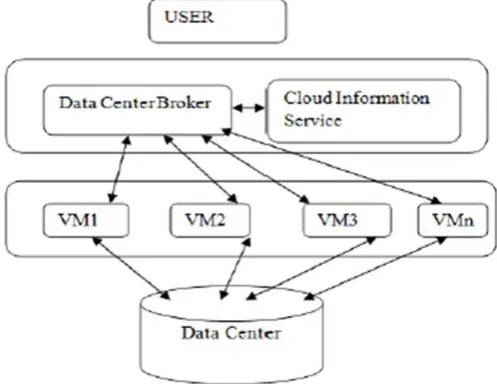
the virtual machine. CIS returns broker the registered data center into the CIS with their configuration. In the end, broker submits job to the virtual machine, which runs on physical machine in the data center as shown in figure 1.
Figure 1: Job Scheduling in Cloud Computing
2. BASIC SCHEDULING ALGORITHMS IN CLOUD COMPUTING
2.1 First come first serve (FCFS) Algorithm
In FCFS algorithm, the task at first position is chosen first for execution and after that second number task is chosen. This process is continued till there is no task in the ready queue. Due to this, shortest task, which is at the end of queue list (having smallest execution time), has to wait for a long time until the longest task completes its execution. This is the main drawback of the FCFS algorithm. Its performance is very poor and has less response time [3].
2.2 Round Robin Algorithm (RR)
It overcomes the drawback of the FCFS algorithm. In this algorithm, each task is executed for a fixed time interval known as Quantum time (QT). This time is already fixed for all the tasks that are ready to execute. When task begins its execution, QT is assigned to the task. If the task can’t complete its execution in a given QT, these tasks are blocked and placed at the end of the list. This process is repeated till no task is remaining in the list. In this algorithm, fewer QT increases overhead and high Quantum time increases average waiting time and around time. Improved Round Robin Algorithm is used to minimize the average waiting time and turn-around time and maximize the throughput [4].
2.3 Genetic Algorithm
Genetic algorithm was first introduced in 1960 by John Holland. Genetic algorithm is a population-based search algorithm. The basic term used in the Genetic algorithm is Gene. Three main operations playing an important role in the Genetic algorithm are Selection, Crossover and Mutation. These three strategies are based on fitness, if fitness is high, good performance is obtained. The best optimal solution can be obtained using these three operations [5].In cloud computing, GA plays an important role. It is used for balancing the load equally between all the nodes and also to minimize the completion time of the task and waiting time of the overall system.
2.4 Generalized Priority Algorithm
2.5 Min-Min Algorithm
This is the most common algorithm used in cloud computing. In this algorithm, the smallest task is chosen first and assigning this task to the resource having minimum execution time. The drawback of this algorithm is that it increases the waiting time of largest task, which is placed at the end of the ready queue that means these tasks start their execution after the completion of smallest tasks. [7]
2.6 Max-Min Algorithm
Max-Min algorithm overcomes the drawbacks of the Min-Min algorithm. It is followed by Most Fit algorithm having small makespan. In Max-Min algorithm, task having maximum execution time is chosen first and then assigning the task to the resource having minimum completion time. This algorithm assigns a large number of tasks to the machine having capability to execute these tasks in a small time. Due to less time consumption, the completion time of the overall system is reduced [8].
3. LITERATURE SURVEY
Load Balancing Ant Colony Optimization algorithm (LBACO) developed by Li Kun, et al. [9] can be used to solve the scheduling NP-hard optimization problem. LBACO algorithm inherits some basic ideas from ACO algorithm and the overall makespan is decreased. ACO is based on the nature of real ants. On the basis of pheromone which is spread on the ground by real ants, ACO has the capability that they find the best optimal path from nest to food. The probability of the path chosen by ants is directly proportion to the amount of Pheromone spread on the ground. Pheromone is updated after the completion of ant tour. LBACO algorithm not only decreases the total completion time of task, but also balances the load equally across multiple VMs. Load balancing factor is also used in this algorithm.
PSO algorithm gives an optimal or suboptimal solution, but it is not the best for difficult problems. To overcome the disadvantage of PSO, Self-adaptive learning particle swarm optimization (SLPSO) algorithm was introduced by Zuo Xingquan et al. [10]. In SLPSO, each particle represents the set of priority which is given to the task. On the basis of this priority, allocation of the task to the private cloud or External Cloud takes place. IaaS providers give the task to the external cloud resource when its own resources are not capable to fulfill user demands. Resource allocation in hybrid cloud environment is a deadline constrained task scheduling problem, which is solved by SLPSO. It also solves the problem of how to allocate the task to the resources for obtaining maximum profit while guaranteeing QoS. To update the position of particle, pbest and gbest concepts are used. To improve the robustness and ability of global search, four different velocity update strategies are used. They also update the velocity of each particle. Due to this, more profit and best optimal solution is obtained by SLPSO algorithm as compared to standard PSO.
PSO algorithm used in task scheduling gives better results in case of global search optimization problem, but it is not so good in case of local search. Tabu Search which is an optimization method gives better results in case of local search. Combination of PSO and TS, a new hybrid PSO algorithm was proposed by Dr. M.Sirdhar et al. [11]. Hybrid PSO is the population based algorithm. Fitness value of each particle is calculated by using fitness function. In hybrid PSO, half of the population is updated by PSO using pbest and gbest position update concept and other half is updated by Tabu Search. With the combination of both half populations, best optimal solution is obtained in local search as well as global search. The main objective of hybrid PSO is to manage load equally between all the resources with minimum execution time. Hybrid PSO gives better results as compared to Max-Min scheduling by reducing the schedule length when number of task increases and maximizing the execution ratio.
Priority based job scheduling algorithm using IBA and EASY algorithm has been purposed by Kalka Dubey et al. [12]. FCFS, SJF and LJF algorithm are used for task scheduling in cloud computing, but there is a problem of starvation. To overcome this problem and for best utilization of resources, an improved backfill algorithm using balanced spiral method was introduced. It gives same priority to all the tasks and these tasks are scheduled in FCFS order. But in some cases, there are number of tasks, which are more important than others and are scheduled according to their priority. In such cases, priority based improved backfill algorithm is used. It assigns different priority to different tasks and maximizes the resource utilization ratio according to user requirements. Final result is obtained by applying IBM and EASY Backfill algorithm on complete task sequence.
Crossover and Mutation are applied on initial population and best optimal solution is obtained. On the basis of fitness value, new population is created by applying crossover operation. GA based task scheduling gives better results as compared to FCFS.
DVFS-enable Energy-efficient Workflow Task Scheduling algorithm was proposed by Tang Zhou et al. [14]. DEWTS can reduce the total energy dissipation and also solve the problem of energy consumption. By using Switching between processors which operates on different voltage and frequencies level, it achieves the reduction in power consumption. The main goal of this research was to reduce processor energy cost in task scheduling by decreasing the number of inefficient processors, minimizing the total completion time of tasks and maintaining QoS. DEWTS algorithm maximizes the resource utilization ratio. Heterogeneous-Earliest-Finish-Time (HEFT) algorithm is used to complete the task execution process in a given deadline and maximize the performance of task scheduler.
4. COMPARATIVE ANALYSIS OF ALGORITHMS
Scheduling Algorithm Scheduling Parameters Findings Tool
Load Balancing Ant
Colony Optimization Makespan Balanced the entire system load using (LBACO) CloudSim Self-Adaptive Learning
PSO Average profit of service provider, Utilization ratio, Average time
More profit and best optimal solution is obtained by SLPSO algorithm as compared to standard PSO
Matlab 7.0
Hybrid Particle Swarm
Optimization Execution time Gives better results in local search and global search using average scheduling length and successful execution ratio
CloudSim, Gridbus
Priority Based Job Scheduling Using IBA and EASY Algorithm
Utilization rate, Processing
Time Resource utilization ratio is maximized using priority concept with IBA and EASY algorithm
CloudSim
Genetic Algorithm Time Overall response time can be minimized by using GA, which distributes the load equally among all the VMs
CloudSim
DVFS-enabled Energy Efficient Task Scheduling Algorithm
Energy saving ratio, average resource utilization, average execution time, Cost
DEWTS reduce energy dissipation and maintain quality of service in a given deadline
CloudSim
5. CONCLUSION
Cloud computing is a technology with a lot of challenges that are faced in day by day functioning and task scheduling is one of them. Different scheduling algorithms have been reviewed in this paper for scheduling the tasks in an efficient way. Scheduling algorithms based on a number of different scheduling parameters like completion time, cost of resources, throughput and performance have been discussed. Maximizing the resource utilization and minimizing the makespan is the main goal of task scheduling. Future scope of our research is study the concept of security and maximum efficiency using Genetic Algorithm.
6. REFERENCES
[1] N. Pasha, D. Agarwal and D. Rastogi, "Round Robin Apporach for VM Load Balancing Algorithm in Cloud Computing Environment," International Journal of Advanced Research in Computer Science and Software Engineering, vol. 4, no. 5, pp. 34-39, 2014.
[2] Y. Fang, F. Wang and Junwei, "A Task Scheduling Algorithm Based on Load Balancing in Cloud Computing," in International Conference on Web Information System and Mining.Springer Berlin Heidelberg, 2010.
[3] P. Singh and N. K. Walia, "Cloud Computing using Various Task Scheduling Algorithm," International Journal of Computer Application, vol. 142 , no. 7, 2016.
[5] T. Wang, Z. Liu, Y. Chen, Y. Xu and X. Dai, "Load Balancing Task Scheduling based on Genetic Algorithm in Cloud Computing," in 2014 IEEE 12th International Conference on Dependable,Autonomic and Secure Computing, 2014.
[6] P. Salot, "A survey of Various Scheduling Algorithm in Cloud Computing Environment," International Journal of Research in Engineering and Technology, vol. 2, no. 2, 2013.
[7] H. Chen, P. F. Wang, D. N. Helian and G. Akanmu, "User-Priority Guided Min-Min Scheduling Algorithm For Load Balancing in Cloud Computing," in National Conference on Parallel Computing Technologies,IEEE, 2013.
[8] Taneja, "An Empirical Study of Most Fit,Max-Min and Priority Task Scheduling Algorithm in Cloud Computing," in International Conference on Computing,Communication and Automation(ICCCA).IEEE, 2015.
[9] K. Li, G. Xu, G. Zhao, Y. Dong and D. Wang, "Cloud Task scheduling based on Load Balancing Ant Colony Optimization," in 2011 Sixth Annual ChinaGrid Conference.IEEE, 2011.
[10] X. Zuo, G. Zhang and W. Tan, "Self-Adaptive Learning PSO-Based Deadline Constrianted Task Scheduling for Hybrid IaaS Cloud," IEEE Transact ion on Automation Science and Engineering, vol. 11, no. 2, pp. 564-573, 2014.
[11] Dr.M.Sridhar and D. M. Baba, "Hybrid Particle Swarm Optimization Scheduling for Cloud Computing," in 2015 IEEE International Advance Computing Conference(IACC), 2015.
[12] K. Dubey, M. Kumar and M. A. Chandra, "A priority Based Job Scheduling Algorithm Using IBM and EASY Algorithm for Cloud Metaschedular," in 2015 International Conference on Advances in Computer Engineeringand Application(ICACEA) IMS Engineering College, Ghaziabad, India, 2015.
[13] M. Agarwal and D. M. S. Srivastava, "A Genetic Algorithm inspried task scheduling in Cloud Computing," in International Conference on Computing, Communication and Automation(ICCCA2016), 2016.