CROSS PLATFORM APPLICATION
DEVELOPMENT WITH COMPATIBLE
GUI SOLUTIONS
NITHIYANANTHAM.C
Department of Pervasive Computing Technology Kings College of Engineering
Punalkulam, Pudukkottai, India [email protected]
KIRUBAKARAN.R
Department of Pervasive Computing Technology Kings College of Engineering
Punalkulam, Pudukkottai, India [email protected]
Abstract
Evolution of Smart phones and their applications takes one of the important roles in pervasive computing environments. But the diversity of mobile platforms and their APIs increase the effort of software development approach for Smartphone applications. The cross-platform mobile development tool provides code less futures, but they cannot able to solve the device fragmentation issues. The purpose of this paper is to construct a robust architecture of smart phone application development, which should provide an optimal GUI solution (coherency) with the assistance of responsive functionalities.
Keywords—cross-platform; mobile applications; coherency; responsive; 1. Introduction
Pervasive computing is a technology to access the application at anywhere any time, with the help of any device [1]. Everywhere you go, people are using mobile devices to keep in touch with family and friends, to find a nearby restaurant, to store and access the content through the cloud, or to check the latest news headlines. Mobile phones which provides a powerful link between two or more people who were living in various edges of the world. Their smart phones have lot of applications which should make the human life as convenient and easy one. The application user isn't aware of the development technologies, but they view in terms of the benefits provide them. So the developer must aware of technologies that deliver the benefits, fulfillment of customer expectations. Gartner analysis of OS, mobile device and development states that in 2015 the sales rate of Smart phones is up to 11048898 (Thousands of units) [2].
Besides there are at least five smaller Mobile OS are available (Windows Mobile (WinMob), Windows Phone 7 (WP7), bada, webOS, and MeeGo). The vitality of the field is strong: RIM is planning to move from BlackBerry OS to BlackBerry Tablet OS which is based on QNX, Nokia will abandon Symbian in favor of WP7, and MeeGo will be replaced by a new, Linux-based OS called Tizen. The applications of these operating systems should download from their respective marketplace. In mobile application development process developing the software, building and deploymentation should also consider each of its respective mobile operating systems. So the developer has specialized skills in a particular platform, and even though they create an application but it should not compromise with devices because of device fragmentation issues.
In first section, we describe the essential of Smart phones in pervasive computing environments and current issues of mobile development technologies; in the third chapter we provide some details about cross-platform tools; in the next chapter the mobile operating systems similarities and its incompatibility will be given.
2. Mobile Operating System
In an industrial point of view, the mobile operating system should consider as servant for a user and master for mobile components. The major mobile operating system such as Android, Bada, Blackberry, iPhone and Windows phones comes with built in features such as Bluetooth, Wi-fi, Gallery. These features also support or adapt with the new control coding.
2.1 Smart phone applications
In general, there are two kinds of smart phone applications such as stand-alone applications (native) and Web service based applications (web). Native applications are only specific for its appropriate mobile platforms that applications are such as alarms, phone dialers, and offline games. They should have its own development language, frameworks. An android application development process it uses the Eclipse IDE and Java language. Similarly blackberry Webworks or blackberry IDE and Java language for blackberry application, Xcode IDE and objective-c for iPhone, visual studio IDE and c#.net for windows phone. Android and Blackberry have same developmental language but their applications quite differ because of its library functions. The following diagram represents the development and execution flow of native Android application.
Fig.1 Workflow of Android native application
The android libraries are developed using c++ language. The Dalvik virtual machine is used for the conversion of Java to byte codes. Mobile web application refers to the bundle package of web pages. This is like a native widgets but the mobile network or wireless network is needed to run these applications. Because they are under the control of site domains and servers. Web service-based mobile applications are applications like emails, calendars, Twitter clients, online games, and applications that interact with web services. A common web language such as HTML, PHP is enough for developing this application. They’re accessed through the mobile device’s web browser so the web widgets are acting as online active plugins.
The defining characteristics of a web applications are that the user interface (UI) is built with web standard technologies, it is available at a URL (public, private, or perhaps behind a login), and it is optimized for the characteristics of a mobile device. Figure 2 represents web application workflow.
2.1.1 Benifits of native and web application
Native applications have a richer, more compelling user experience: Native applications can leverage the capabilities of the mobile device, including on-board hardware (such as GPS, camera, and graphics) and software (such as email, calendar, contacts, picture/video gallery, file manager, and home screen widget areas). Because of its library function the execution files will be directly associated the OS kernel. Web applications can enable access to information, anytime and anywhere there is cell phone coverage.
By freeing information from the restrictions of a desk or search for a nearby WiFi hotspot, people can quickly retrieve and exchange information.
Fig.2 Interaction of web server through a web application
It can provide location-sensitive content. Location technologies can enable location sensitive information is provided to a user [5]. This can reduce the steps required for the user to reach useful content, and so makes it accessible with the least amount of effort.
In this second section we, describe about mobile operating systems, mobile applications and behavior of mobile applications on the operating system; the combination this observation supports a system design.
3. Cross-Platform Tools
Generating hybrid application is an ultimate aim of these tools. A combination of web application and native application gives up hybrid application. MobiWeb, Visual Tool App Generator, Hybrid App, and Game Builder are the major categories.
List of available tools:
3.1 Rhodes [6]: RhoMobile is a set of products, which provides a framework for cross-platform Smartphone applications. It is developed by Rhodes Mobile that offers an open source Ruby-based mobile development environment, which aims in managing enterprise application and data. Rhomobile composed of many products, like Rhodes (Develop), RhoConnect (Integrate), Rhohub (Deploy) and RhoGallery (Manage). RhoMobile tools and framewoks can be used across Linux, Mac and Windows OS.
3.2 Appmobi[7]: App Framework is the definitive javascript library for mobile HTML5 app development. It contains a query selector library which was built from the ground up to be light, fast and excel on mobile devices. It takes advantage of new browser features and supports valid W3C CSS selectors. It's under game development. Independent tests have proven it to be the fastest library out there.
3.3 Phonegap[8]: Phonegap under the category of Hybrid app. Essentially is a ”wrapper” that allow to developers to enclose applica- tions written in known languages into native applications and as each valid open-source software it is composed by many components and extensions.
3.4 DragonRad[9]: DragonRad is a cross-platform mobile application development platform that allows developer to develop, manage and deploy the mobile applications. The cross-platform property of tool allows support to many mobile OS such as iPhone, Android, BlackBerry and Windows Mobile.
3.5 Mosync [10]: Mosync is an open source solution developed by Swedish company targeted to mobile market. It has fully fledged SDK which helps developer to build and package all type of applications. Application of all kind like simple application, advanced and complex will share the same code base.
4. Challenges in Mobile Application Development 4.1 Device Fragmentations
4.2 Operating System Fragmentations
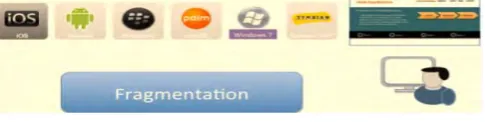
Mobile operating system fragmentation is an IT migraine waiting to happen, because of the problems it causes around support, management, compatibility and app distribution. The mobile computing market is awash with various devices, OSes and wireless networks.
Fig. 3 Fragmentation due to number of mobile operating systems
Mobile OS fragmentation is the worst and most diverse fragmentation of all. This adds a sizable technical challenge to launching mobile applications on all mobile platforms [11].
4.3 Cascading Style Sheet (css3)
Many properties have not even reached a mature syntax yet. Even if a property is supported by all the modern browser, the same will probably not be true for older ones and, again, we have to decide how to handle this [12]. Most of the cross platform tools using this css3 for providing efficient design but the problem is it is not a dynamic one. The set of values like image sizes and text are not dynamic. So the flexible grid lines do not appear. 5. Optimal GUI Solution and web services for Cross-Plaform Applications
5.1 Responsive Design
A unified approach of flexible grid layout, flexible images and media queries [13]. The flexible layout was a fluid layout that can be adapted to the device as for the instruction of media queries. The media queries having a separate range which assists the device screens. The designs are executed at the viewport or viewable area which also performs the task of screen identification of devices. Less framework was an open source script that acts like jquery [14]. It reduces the x- axis scroll work.
5.2 Design Algorithm
Step1: Design the layout, fixed the tablet screen size.
(E.g. x)
Step2: x/2 for 400x480 screen devices and x/4 for 200x240.
Step3: Prepare the images, icons in standard vector graphics format (svg). Step4: Declare that primary value of images and contents into less framework. Step5: Process the view port i.e. applies the view port range into media queries.
Step6: If the view port range is greater than 240, then 400x480 media query property will be executed. Step7: If the view port range is greater than 400, then tablet media queries (1024x780) will be executed.
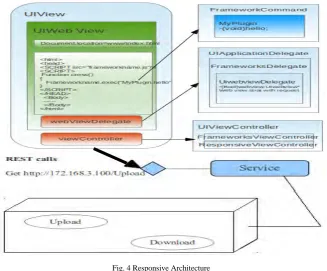
Fig. 4 Responsive Architecture
Webkit is a web render engine, which render the HTML5 and JavaScript and less code. The following code represents the less integrated part into front end design.
@primaryWidth:100%; @primaryHeight:100%; @imageWidth_Macbook:100%; @imageHeight_Macbook:100%; .
@media screen and (min-width:1024px) and (max- width:1200px) {
img{width:@imageWidth_Macbook;height:@imag eHeight_Macbook;}
.
@media screen and (min-width:400px) and (max- width:1023px)
{ img{width:@imageWidth_Macbook/2;height:@im ageHeight_MacBook;}
.
@media screen and (min-width:200px) and (max-
width:399px) {img{width:@imageWidth_Macbook/4;height:@imageHei ght_Macbook/4;}
Fig.5 Application runs on Android Tablet
Fig.6 Same application runs on blackberry phone
The fig. 6 shows that the same android application designed for tablets which can able to run on blackberry device emulator with a fluid layout. Here the x-axis scroll was eliminated. Images and texts give response for device screens.
6. Conclusion
A good functionality of mobile application will satisfy the customer needs. Developing the same application for different platform is also a tough work and that should increase the development cost. HTML5 are strongly used here to develop an application that may able to use device native hardware future like accelerometer, camera that had across the platform and perform both online and off line functionalities. The device fragmentations are solved with the assistance of responsive functionalities.
The application able to interact the web servers with the help of rest calls [15]. So the mobile resource utilization has to be reduced. It stimulates the application to be faster access.
REFERENCES
[1] Computing now, pervasive computing, January, 2013 http://www.computer.org/portal/web/computingnow/pervasivecomputing.
[2] Market comprehensive, mobile application, January, 2013 http://goarticles.com/article/A-More-Comprehensive
Overview-About-Mobile-Applications-Development/7438753/.
[3] Anthony I. Wasserman. Software engineering issues for mobile application development. In Proceedings of the FSE/SDP workshop on
[4] Mobile web application vs mobile native application: how to make a right choice, white paper, Dec 2012, Lionbridge-WP_MobileApps2.pdf.
[5] Mobile Web Developer’s Guide Part I: Creating Simple Mobile Sites for Common Handsets, white paper, Dec 2012, dotMobi mobile
web developers guide.pdf
[6] RhoMobile, [online] What is so special about the Rhodes smartphone app framework?, March, 2012,
http://rhomobile.com/blog/whats-so-special-about-the- rhodes-smartphone-app-framework.
[7] Appmobi, [online] 20 febraury 2013 available http://app-framework-software.intel.com/
[8] PhoneGap, API reference [online] 20 january 2013 http://docs.phonegap.com/en/2.2.0/
[9] DragonRAD, [online] available 01 March 2013, http://dragonrad.com/foswiki/bin/view/Help/Introduction.
[10] Mosync, [online] available 02 March 2013, http://www.mosync.com/content/mosync-cross-platform mobile-development-made-easy.
[11] Rohit Ghatol & Yogesh Patel “Beginning Phonegap: mobile web framework for Java script and HTML5”, Apress, ISBN-13 (pbk):
978-1-4302-3903-1 ISBN-13 (electronic): 978-1-4302-3904-8, 2012, 1-10
[12] Css3 Properties, [online] available 02 March 2013, http://a-developer-life.blogspot.in/pros-and-cons-of-css3.html
[13] Ben Frain “Responsive web desin with HTLM5 and CSS3: Learn responsive desin Using HTML5 and CSS3 to adapt websites to any
browser or screen size”, PACKT, 978-1-84969-318-9, 1-61
[14] Jquery, Browser support, [online] 02 March 2013, http://jquery.com/browser-support/