The Challenges of Cloud Computing Management
Information System in Academic Work
Abstract—The objectives of this research were 1) to synthesize the features of cloud computing management information system in academic work, 2) to synthesize the elements of cloud computing management information system in academic work, 3) to develop models of cloud computing management information system in academic work, 4) to evaluate the models of cloud computing management information system in academic work. The research findings were as follows: 1) the models of management information system in academic work by cloud computing technology comprised of 6 elements: Cloud Computing Technology, Curriculum, Center, Connectivity, Client and Consumer, which are called C6. It is a very popular technology in the present time to be used for administration in academic work of Thailand’s Universities. It is the integration and sharing common resources of computer technology including software, hardware and database, 2) the results evaluated by 5 experts showed that the model of cloud computing management information system in academic work had appropriateness at a high level.
Index Terms—cloud computing, management information system, academic
I. INTRODUCTION
Nowadays the progress of Information and Communication Technology (ICT) accelerates the development of public service administration which is implemented by the government to the people with effectiveness. Especially, hardware and software have progressed dramatically. One of computing technologies which is very popular in the present time is Cloud Computing Technology. It is very crucial technology for the nation’s development, especially in the education. In order to get ready for entering the ASEAN Community 2015, Thailand needs to prepare for the readiness of higher education institutions to meet a variety of changes such as international exchange of youths, students and working staff, credit transfer, defined occupation standards, cooperation of universities in ASEAN countries [1].
According to Section 47, in the Chapter 6 of Standard and Quality Assurance in Education of the National
Manuscript received March 20, 2014; revised June 30, 2014.
Education Act B.E. 2542 and Amendments B.E. 2545, it said there shall be a system of educational quality assurance to ensure improvement educational quality and standards at all levels, Thai Qualification Framework for Higher Education B.E. 2552 was prepared to be used as guidelines to improve and develop curriculums, administration of education in order to produce qualified graduates to the society [2].
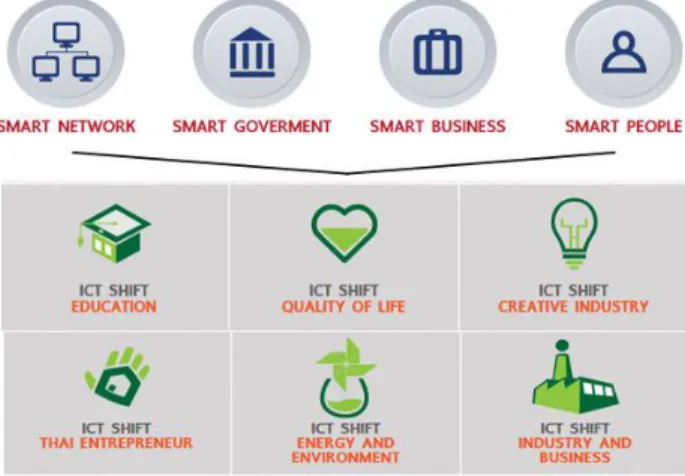
Thailand’s higher education institutions aim to improve the quality of education by using ICT and Ministry of Information and Communication Technology has defined Smart Thailand 2020 Strategy as Fig. 1 to prepare readiness for dramatically development in order to compete with other countries in the region and become the ICT leader in 2020.
Figure 1. SMART 2020 strategy
ICT SHIFT EDUCATION is to raise the quality of Thai education by using ICT wisely and efficiently in order to develop the education and produce potential human resources through mobile computer and interactive instruction [3].
In order that the academic administration of Thailand’s higher education institutions would be the highest effectiveness, researchers has developed the models of ICT management for academic work by cloud computing technology. The cloud computing technology is used for academic administration which is consistent with the National Act of Education, the quality assurance in education and Smart Thailand 2020 Strategy. Due to the cloud computing technology, hardwares and softwares
T. Rodmunkong, P. Wannapiroon, and P. Nilsook
Department of Information and Communication Technology for Education, Faculty of Technical Education, King Mongkut’s University of Technology North Bangkok, 1518 Pracharat 1 Rd., Wongsawang, Bangsue, Bangkok, 10800,
Thailand
will be used through the internet, the cost of expenses can be reduced. The service on cloud computing technology can be divided into three levels, which are called SPI Paradigm, such as SaaS, PaaS and IaaS [4]. All parties are able to use the data and working system from the center and they will share the common resources, such as internet system, servers, storages, applications and any other services which will be provided very quickly [5].
II. RELATED DOCUMENTS AND RESEARCHES A. What is Cloud Computing
1) The background of cloud computing
Cloud computing was first born in Google, be thought as impulse by enterprises. So of course, the cloud computing has not a unified definition yet, but since the official presentation of the concept of cloud computing--especially in recent years--many scholars and companies have joined in the cloud computing research and application, to the analysis of its revolutionary impact on information industry and IT industry, [6] focusing on the connection between software trade development and cloud computing. He proposed cloud computing healthy development definitely makes the software trade to change from the pure SaaS model to PaaS/IaaS, software on demand is the mainstream in the future [7].
2) Current cloud computing research and applications
Cloud computing is a relative new concept, although have not formed a unified definition, but the domestic and foreign scholars, universities, venders, government organizations from different angles are investing in research around the topic of cloud computing. The basic meanings as follow: A form of standardized IT-based capability–such as Internet-based services, software, or IT infrastructure – offered by a service provider that is accessible via Internet protocols from any computer, is always available and scales automatically to adjust to demand, is either pay-per-use or advertising-based, has Web-Cloud computing is to provide the applications of the previous hardware and software that require investment and technical capacity Web-based services to users; cloud computing means outsourcing, how much to buy cloud computing services relies on how much it is needed; Cloud is a huge resource pool, you pay-per-demand, cloud is virtualization, cloud can pay the same way as running water, electricity, gas [8].
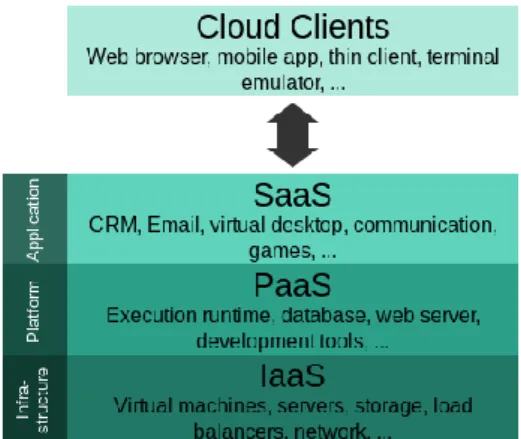
Figure 2. Cloud computing layers
B. Cloud Computing Layers
Cloud computing providers offer their services according to several fundamental models: infrastructure as a service (IaaS), platform as a service (PaaS), and software as a service (SaaS) where IaaS is the most basic and each higher model abstracts from the details of the lower models [9]. Cloud Computing Layers consisted of IaaS, PaaS and SaaS can be seen in Fig. 2.
1) Infrastructure as a service (IaaS)
In the most basic cloud-service model, providers of IaaS offer computers – physical or (more often) virtual machines – and other resources. IaaS clouds often offer additional resources such as a virtual-machine disk image library, raw (block) and file-based storage, firewalls, load balancers, IP addresses, virtual local area networks (VLANs), and software bundles. To deploy their applications, cloud users install operating-system images and their application software on the cloud infrastructure.
2) Platform as a service (PaaS)
In the PaaS models, cloud providers deliver a computing platform, typically including operating system, programming language execution environment, database, and web server. Application developers can develop and run their software solutions on a cloud platform without the cost and complexity of buying and managing the underlying hardware and software layers.
3) Software as a service (SaaS)
In the SaaS model, cloud providers install and operate application software in the cloud and cloud users access the software from cloud clients. This eliminates the need to install and run the application on the cloud user's own computers, which simplifies maintenance and support.
4) Cloud clients
Users access cloud computing using networked client devices, such as desktop computers, laptops, tablets and smartphones. Some of these devices – cloud clients – rely on cloud computing for all or a majority of their applications so as to be essentially useless without it. Examples are thin clients and the browser-based Chrome book. Many cloud applications do not require specific software on the client and instead use a web browser to interact with the cloud application. With Ajax and HTML5 these Web user interfaces can achieve a similar, or even better, look and feel to native applications. Some cloud applications, however, support specific client software dedicated to these applications.
C. Implementation of Cloud Computing in Education – A Revolution
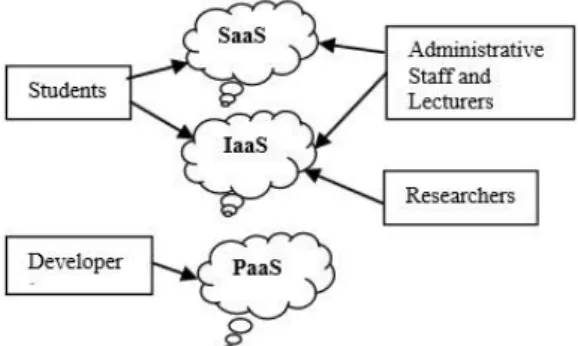
Saju Mathew conducted the research titled “Implementation of Cloud Computing in Education – A Revolution”. It said that the cloud computing was used in the education about teaching, flexibility and expenses for fundamental structures as Fig. 3. The benefits and limitations of cloud computing are also mentioned in the research. According to the findings, a lot of universities improved the fundamental structures of IT and data. The challenges could be solved by using cloud computing. The challenges included expenses, flexibility, access to information and technology. Using cloud computing
technology in the institutions, neediness should be defined and the privacy identification and cloud services are as follows:
1)Infrastructure as a Service (IaaS): can be used to satisfy the infrastructure needs of the students, faculties or researcher globally or locally with some specific hardware configuration for a specific task.
2)Platform as a Service (PaaS): certain providers are opening up application platforms to permit customers to build their own application without the cost and complexity of buying and managing the underlying hardware and software layers.
3)Software as a Service (SaaS): the application service provider is hosting the application which runs and Interacts through web browser, hosted desktop or remote client. It eliminates the need to install and run the application on customer own computer and simplifying maintenance and support.
4) Computing as a Service (CaaS): providers offer access to raw computing power on virtual server such as Amazons, EC2 service. Following figure shows the university using the services of cloud computing [10].
Figure 3. University using the services of cloud computing
Cloud Architecture for Institutions can be shown in Fig. 4.
Figure 4. Education cloud architecture
Nowadays cloud computing providers for institutions increase the opportunity to replace the data and information by using data collecting center, server and applications instead of the traditional ones.
III. PURPOSE OF THE RESEARCH
1) To synthesize the features of management information system in academic work by cloud computing technology.
2) To synthesize the elements of management information system in academic work by cloud computing technology.
3) To develop models of management information system in academic work by cloud computing technology.
4) To evaluate the models of management information system in academic work by cloud computing technology.
IV. RESEARCH FRAMEWORK
Conceptual framework in designing cloud computing management information system in academic work can be shown in Fig. 5.
Figure 5. Conceptual framework in designing
V. METHODOLOGY
A. The Development of Cloud Computing Management Information System in Academic Work Can Divide into Four Phases as Follows:
1) Synthesize the features of cloud computing management information system in academic work from Related documents and researches 2) Synthesize the elements of cloud computing
management information system in academic work.
3) Develop models of cloud computing management information system in academic work.
4) Evaluate the models of cloud computing management information system in academic work.
B. Population and Samples
Population was the experts in Management Information System, cloud computing technology and Academic.
Samples were selected from the experts in the population using purposive sampling technique. The five
experts comprised of Management Information System, cloud computing technology and Academic with no less than three-year experience in their field and Qualified doctoral.
C. Variables in This Study
1) Independent variable was the development of cloud computing management information system in academic work.
2) Dependent variable was the results of evaluation of development of cloud computing management information system in academic work.
VI. CONCLUSION
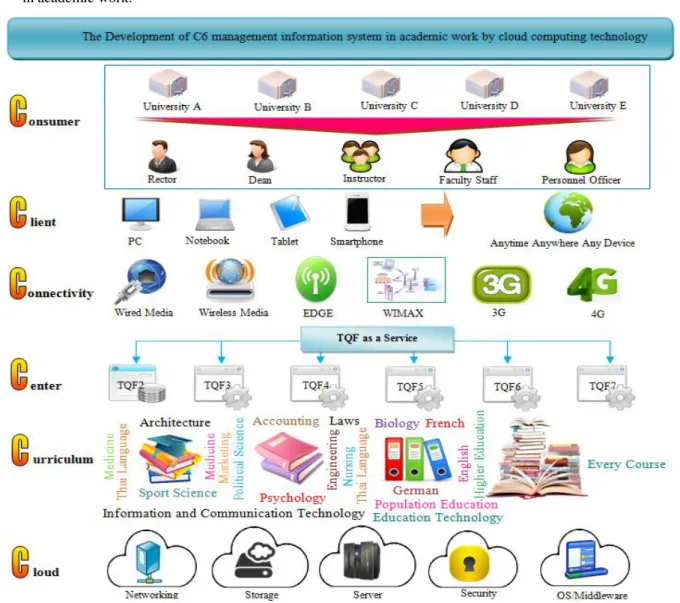
The findings from the research study can be shown in Fig. 6.
Figure 6. The development of C6 cloud computing management information system in academic work.
From Fig. 6, the elements of management information system in academic work can be seen in Table I:
The features of cloud computing management information system in academic work can be seen in Table II:
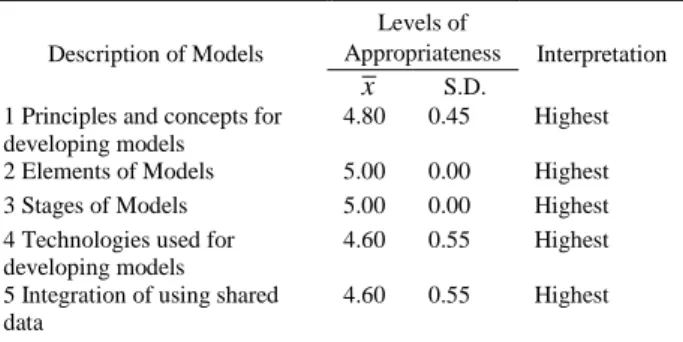
The results from evaluation of the developed cloud computing management information system in academic work can be seen in Table III.
From the results of the evaluation as shown in Table III, the appropriateness of details in the developed cloud computing management information system in academic work reveal that the appropriateness was at the highest score (means = 4.85, S.D.=0.16).
VII. DISCUSSION
The results of the study showed that there were six elements of cloud computing management information system in academic work: cloud computing technology, curriculum, center (TQF as a Service), connectivity, client and consumer. The cloud computing technology is used for managing academic work by developing software to be served in academic service for Thailand’s universities. Every university can login to create the website for academic administration through TQF as a Service. It helps save the cost of fundamental structure investment and system maintenance. Users are able to access the data easily and quickly via a variety of electronics devices anywhere, anytime. It can be used through wired media, wireless media and through the mobile signals such as 4G, 3G, wimax and EDGE which
are stable and secure. The evaluation result of the models by five experts, was at the highest level (4.85) which was consistent with [11] stated that clouding computer is powerful technology and it is very well known in adding values of information technology. It helps institutions save cost and get benefits in terms of technology development. Both private cloud and education cloud can establish platforms for exchanging various resources among institutions.
TABLEI. THE ELEMENTS OF CLOUD COMPUTING MANAGEMENT
INFORMATION SYSTEM IN ACADEMIC WORK
C6 Description
Cloud Using cloud computing technology in administration of academic work in institutions. The services of Private Cloud (IaaS, Paas and Saas) are available.
Curriculum The curriculums in bachelor, master and doctor’s degree of Thailand’s universities such as Math, Computer Education, Special Education, Engineering etc.
Center (TQF as a Service)
Software to be served in administration of academic work and the center of academic information of Thailand’s universities. Admin can enter the system by login and create the administration of academic work in the university and define the consumer’s right of using. Connectivity Mediums used for communication. Mediums with wire
i.e. UTP, Fiber Optic and mediums without wire i.e. Wi-Fi, Bluetooth, included mobile signals of 4G, 3G, WIMAX and EDGE
Client Electronics devices used for communication such as PC, Smartphone, Notebook, Tablet, Mobile. Available to access data anywhere, anytime, any device. consumer Thailand’s universities use the software system of TQF
as a service for administration of academic work, concerning administrators, teachers, academic staff. TABLEII. THAILAND HAVE DIFFERENT FREQUENCY
Characteristics Description
Access PC, Smartphone, Notebook, Tablet, Mobile can be served a large of users with effectiveness, quickly access to the data anywhere and anytime.
management information system in academic work
Using cloud computing technology in administration of academic work such as TQF curriculums comprised of TQF2 TQF3 TQF4 TQF5 TQF6 TQF7. Integration of hardware and software.
Computer Technology
Cloud Computing is the next stage in the Internet's evolution, providing the means through which everything - from computing power to computing infrastructure, applications, business processes to personal collaboration - can be delivered to you as a service wherever and whenever you need. The “cloud” in cloud computing can be defined as the set of hardware, networks, storage, services, and interfaces that combine to deliver aspects of computing as a service. MIS Management Information System is typically
computer system used for managing. The five primary components: 1) Hardware 2) Software 3) Data (information for decision making), 4) Procedures (design, development and documentation) and 5) People (individuals, groups, or organizations).
4G 4G LTE or Long Term Evolution on 2.1 GHz, the same as in European Union that allowed 2.1 GHz of 3G to be reframed for
service of 4G LTE. It is advanced technology, extended from 3G under the Standard of IMT Advance which is able to serve hi-speed broad band from 100-1024 Mbps (1Gbps) faster than the former 3G 7 times. 4G is able to send vdo file with high definition and able to be Live Broadcast on Realtime, Interactive Conference, cloud service, supporting learning by e-learning, Telemedicine and seeing movies with high definition on internet.
3G 3G is the technology under Standard called IMT 2000. Speed of sending data not lower than 200 kbps. Nowadays 3G users in Thailand have different frequency as follows:
Frequency Users
2100 MHz AIS, Dtac, TruemoveH, TOT 3G
850 MHz Dtac, TruemoveH
900MHz AIS
850 MHz and 2100 MHz TruemoveH
EDGE is the wireless internet 2.75G in mobile network as defined by world standard of ITU (International Telecommunications Union), four times faster than GPRS, at the level of 200-300 Kbps. It is created in between 2G and 3G.
GPRS Hi-speed sending 2.5 G available for Dual Band (GSM 900 PCN 1800)
WIMAX is developed on IEEE 802.16 and then developed to IEEE 802.16a WIMAX is available to serve covering the area 10 times more than 3G, radiance of 3-10 kms. Speed sending at 75 Mbps 30 times faster than 3G. WiMAX is able to sending signals from one point to many points (Point-to-multipoint) at the same time and can be served as Non-Line-of-Sight. several advantages Reliability, Simplicity, Flexibility,
Collaboration, Privacy and Security, Data Servers and Managing, Energy Consumption.
Security Advantages with Cloud Computing
Data Fragmentation and Dispersal, Dedicated Security Team Greater Investment in Security Infrastructure, Fault Tolerance and Reliability, Greater Resiliency, Hypervisor Protection Against Network Attacks, Possible Reduction of C&A Activities (Access to Pre-Accredited Clouds) Simplification of Compliance Analysis, Data Held by Unbiased Party (cloud vendor assertion), Low-Cost Disaster Recovery and Data Storage Solutions, On-Demand Security Controls, Real-Time Detection of System Tampering, Rapid Re-Constitution of Services Advanced Honeynet Capabilities. TABLEIII. THE RESULTS FROM EVALUATION
Description of Models
Levels of
Appropriateness Interpretation
x S.D.
1 Principles and concepts for developing models
4.80 0.45 Highest 2 Elements of Models 5.00 0.00 Highest 3 Stages of Models 5.00 0.00 Highest 4 Technologies used for
developing models
4.60 0.55 Highest 5 Integration of using shared
data
6 Simplicity of using 5.00 0.00 Highest 7 Saving cost for development
and maintenance
5.00 0.00 Highest 8 Appropriateness of models in
overview
4.80 0.45 Highest
Summary 4.85 0.16 Highest
VIII. SUGGESTIONS FOR FURTHER RESEARCH
1) The model of management information system in academic work by cloud computing technology should be developed.
2) The institutions of primary and secondary schools should be studied for model comparison.
REFERENCES
[1] W. Sangnapaboworn. Preparing the readiness in both proactive and reactive ways of Thailand’s higher education institutions in AEC. [Online]. pp. 1-22. Available: http://web62.sskru.ac.th/UserFiles/File/Dr%20Waraiporn.ppt [2] Office of the Higher Education Commission. (Dec. 2013). Higher
education commission announcement titled guildlines for Thai qualification framework for higher education B.E.2552. [Online]. Available: http://www.mua.go.th/users/tqf-hed/news/FilesNews/FilesNews3/News328072552.pdf
[3] Ministry of Information and Communication Technology. (Feb. 2014). SMART THAILAND 2020. [Online]. Available: http://www.smartthailand2020.com
[4] B. Iyer and J. C. Henderson, “Preparing for the future: Understanding the seven capabilities of cloud computing,” MIS Q Exec, vol. 9, no. 2, pp. 117-131, 2010.
[5] P. Mell and T. Grance, “The NIST definition of cloud computing,” Tech Report National Institute of Standards and Technology, USA, Aug. 2009.
[6] H. Erdogmus, “Cloud computing: Does Nirvana hide behind the nebula?” IEEE Software, vol. 26, no. 2, pp. 4-6, 2009.
[7] Y. Chen, X. Li, and F. Chen, “Overview and analysis of cloud computing research and application,” in Proc. IEEE International Conference on E-Business and E-Government, pp. 1-4, 2011. [8] Liao Li and Zhang Tao, “The development of cloud computing,”
Information Technology, pp. 86-93, 2010.
[9] Service Models by Wikipedia. (Mar. 2014). Cloud computing. [Online]. Available: http://en.wikipedia.org/wiki/Cloud_computing [10] N. Sultan, “Cloud computing for education: A new dawn?”
International Journal of Information Management, vol. 30, no. 2, pp. 109-116, 2010.
[11] S. Mathew, “Implementation of cloud computing in education - A Revolution,” International Journal of Computer Theory and Engineering,vol. 4, no. 3, Jun. 2012.
Thassanee Rodmunkong was born in Chachoengsao Province, Thailand, She is a doctoral candidate in the Information and Communication Technology for Education program, Faculty of Technical Education, King Mongkut’s University of Technology North Bangkok (KMUTNB). She research interests include Cloud Computing, Management Information System, Information and Communication Technology.
Dr. Panita Wannapiroon is an Assistant Professor at Division of Information and Communication Technology for Education, Faculty of Technical Education, King Mongkut's University of Technology North Bangkok (KMUTNB), Thailand.
She has experience in many positions such as the Director at Innovation and Technology Management Research Center, Assistant Director of Online Learning Research Center, Assistant Director of Vocational Education Technology Research Center, and Assistant Director of Information and Communication Technology in Education Research Center. She received Burapha University Thesis Award 2002. She is a Membership of Professional Societies in ALCoB (APEC LEARNING COMMUNITY BUILDERS) THAILAND, and Association for Educational Technology of Thailand (AETT).
Dr. Prachyanun Nilsook is an Associate
Professor at Division of Information and Communication Technology for Education, Faculty of Technical Education, King Mongkut's University of Technology North Bangkok (KMUTNB), Thailand. He research topics and interests include instructional design, e-Learning, e-Training, ICT management, ICT in education, Knowledge Management in Higher Education, Human Performance Technology and Imagineering.