The Lewin Group Inc.
The Georgia SecureCare
Program:
Estimated Cost and Coverage
Impacts
Final Report
Prepared for:
Georgians For A Common Sense Health Plan
Prepared by:
The Lewin Group, Inc.
October 21, 2003
Funded by a grant from Healthcare Georgia Foundation (HGF). Created in 1999 as
an independent private foundation, HGF’s mission is to advance the health of all
Georgian’s and to increase access to affordable, quality healthcare for underserved
The Lewin Group, Inc. i 333112
TABLE OF CONTENTS
THE LEWIN GROUP EXPERIENCE... ii
EXECUTIVE SUMMARY...iii
I. INTRODUCTION... 1
II. SPECIFICATIONS OF THE SECURECARE PROGRAM FOR GEORGIA... 2
A. ELIGIBILITY... 2
B. COVERED SERVICES... 2
C. LONG-TERM CARE... 3
D. BENEFITS DESIGN... 4
E. DISPOSITION OF MEDICAID... 4
F. HMO COVERAGE OPTION... 5
G. PROVIDER PAYMENTS IN FIRST YEAR... 5
H. HEALTH SPENDING IN FUTURE YEARS... 5
I. FINANCING... 6
III. ESTIMATING THE IMPACT OF THE GEORGIA SECURECARE PROGRAM... 8
A. THE HEALTH BENEFITS SIMULATION MODEL (HBSM)... 8
B. HOUSEHOLD DATA... 9
C. HEALTH SPENDING DATA... 11
D. PROJECTIONS THROUGH 2003... 11
IV. SUMMARY OF KEY ASSUMPTIONS... 12
A. UTILIZATION OF PRIMARY AND ACUTE CARE SERVICES... 13
B. UTILIZATION OF LONG-TERM CARE SERVICES... 14
C. BULK PURCHASING... 15
D. ADMINISTRATIVE COSTS... 15
E. EMPLOYER RESPONSE... 16
V. ESTIMATED COSTS AND IMPACTS... 17
A. TOTAL HEALTH SPENDING... 17
B. PROGRAM COSTS AND REVENUES... 20
C. PRIVATE EMPLOYER IMPACTS... 23
D. IMPACT ON HOUSEHOLD HEALTH SPENDING... 25
E. COSTS IN FUTURE YEARS... 29
VI. CAVEATS...34
APPENDIX A
The Georgia Version of the Health Benefits Simulation Model (HBSM)
Appendix B
Estimating Health Spending in Georgia
APPENDIX C
The Lewin Group Experience
The Lewin Group has over 18 years experience in analyzing the impact of health reform initiatives on major stakeholder groups including employers, providers, governments and consumers. The Lewin analyses are based primarily upon a model of the U.S. healthcare system called the Health Benefits Simulation Model (HBSM), which first came to prominence in 1989 when it was used to estimate the cost of alternative universal coverage proposals for the Bipartisan Congressional Commission on Health Care. The model was again used by the Advisory Council on Social Security in 1991, and was used to analyze the impact of President Clinton’s health reform proposal in 1993. We have since used the to model to simulate
numerous health reforms at the state and federal levels ranging from expansions in the Medicaid program to single-payer models such as the proposal analyzed in this study.
This analysis was directed by Mr. John Sheils, a vice president with the Lewin Group, who is a nationally known expert on designing and evaluating health coverage expansion proposals. He joined Lewin in 1980 and has worked to establish the firm as one of the few independent sources of information on the financial impacts of major health reform initiatives. He has testified before various congressional committees and often works directly with members of Congress in evaluating and developing health reform initiatives. Mr. Sheils also authored the first independent analysis of President Clinton’s health reform proposal in 1993, and is currently analyzing a selection of health reform proposals for the Robert Wood Johnson Foundation (RWJF). A detailed documentation of HBSM is available upon request.
The Lewin Group, Inc. iii 333112
EXECUTIVE SUMMARY
In this analysis, we estimated the impact of covering all Georgians under a single health insurance program. The program would cover a broad range of health services for all Georgia residents, including an estimated 1.1 million Georgians who are currently uninsured. Premium payments would be eliminated for employers and individuals. Instead, the system would be funded with current spending for government health programs and new dedicated revenues created to fund the program.
We estimated the amount of health spending in Georgia under today’s health care system for various payers for health care including employers, households and the state, local, and federal governments. We then estimated the impact of adopting the Georgia SecureCare (SecureCare) program on health spending for each of these payer groups. We also estimated the financial impact of the plan on employers by industry and firm size. In addition, we estimated the impact of the plan on household health spending by age, income level, and other demographic
characteristics.
The SecureCare Program
The SecureCare Program would cover all Georgians under a single uniform health plan that is administered and funded by the state. The SecureCare program would replace all current public-sector insurance systems including: Medicare, Medicaid, PeachCare, CHAMPUS and the Federal Employees Health Benefits Plan (FEHBP). It would also replace private health insurance plans in the state. The program would be financed with current government health care funding for discontinued programs, a payroll tax to replace employer benefits plans and other dedicated revenues (i.e., taxes) on households.
The SecureCare benefits package covers a broader range of services than are now covered under many private health plans. The program would cover medically necessary hospital inpatient and outpatient care, emergency room visits, physician services (including preventive care), prescription drugs, lab tests, mental health and addictive disease treatment, eyeglasses and other services. The program would also cover long-term care services including nursing home (except room and board) and home and community based services (HCBS), with an emphasis on services that enable patients to remain in the community. Dental care would be covered along with vision exams. It would not cover cosmetic surgery, cosmetic orthodontia and private hospital rooms.
There would be no deductible or co-payments for services under the program. The program would also use a primary care provider referral model where all patients are encouraged to select a primary care provider and pay a $25 co-payment for visits to physician specialists without referral. Benefits that are currently provided to Medicaid eligible people that would not be covered under the SecureCare program would be continued for low-income people who qualify for the existing Medicaid program such as nursing home room and board for low-income people (including spend-down) and therapeutic services provided by schools for income eligible children.
State-Wide Health Spending Under The SecureCare Program
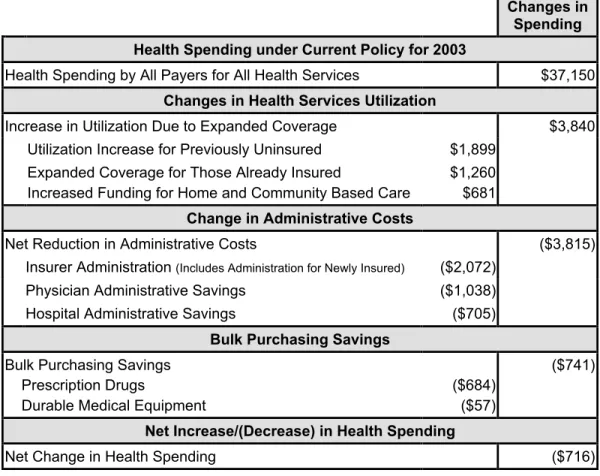
We estimate that total health spending for Georgia residents under the current system will be about $37.2 billion in 2003. This includes spending for benefits and administration currently covered by all payers including governments, employers and households. Our analysis indicates that the SecureCare program would achieve universal coverage while actually reducing total health spending for Georgia by about $716 million (Figure ES-1). The primary source of these savings would be reductions in the cost of administering various health insurance programs, and savings though bulk purchasing.
Figure ES-1
Changes in Health Spending in Georgia Under the SecureCare
Program in 2003
(in millions) a/
Changes in Spending Health Spending under Current Policy for 2003
Health Spending by All Payers for All Health Services $37,150
Changes in Health Services Utilization
Increase in Utilization Due to Expanded Coverage $3,840 Utilization Increase for Previously Uninsured $1,899
Expanded Coverage for Those Already Insured
Increased Funding for Home and Community Based Care
$1,260 $681
Change in Administrative Costs
Net Reduction in Administrative Costs ($3,815) Insurer Administration (Includes Administration for Newly Insured) ($2,072)
Physician Administrative Savings ($1,038) Hospital Administrative Savings ($705)
Bulk Purchasing Savings
Bulk Purchasing Savings Prescription Drugs
Durable Medical Equipment
($684) ($57)
($741)
Net Increase/(Decrease) in Health Spending
Net Change in Health Spending ($716)
a/ Includes all people in the state including those with public and private coverage. Source: Lewin Group estimates using the Health Benefits Simulation Model (HBSM).
There would be an increase in utilization of health services of about $3.8 billion in 2003 among uninsured and under-insured Georgians as they become covered under the program. We estimate that utilization of health services would increase by about $1.9 billion for the 1.1
million uninsured people in Georgia who would become covered. Utilization would increase by an additional $1.3 billion among currently insured people due to the elimination of
co-payments (i.e., there would be no charge to the patient for a physician visit) and coverage for services not now covered under some health plans such as prescription drugs and preventive dental care. In addition, the proposed program would budget for an increase in funding for long-term care services of about $681 million.
The cost of these increases in utilization for uninsured and under-insured people would be largely offset by reduced administrative costs under the program. The SecureCare Program
The Lewin Group, Inc. v 333112 replaces the current system of multiple public and private insurers with a single source of payment for all covered services. This eliminates the complexity of diverse insurer rules, patient billing for un-reimbursed amounts, claims adjudication and selective contracting negotiations. Total savings would be about $3.8 billion including insurer administrative savings of about $2.1 billion and administrative savings to providers of about $1.8 billion.
The program would also realize savings through bulk purchasing of prescription drugs and durable medical equipment (e.g., wheelchairs). The program would make all purchases of these items through a single purchasing entity capable of negotiating substantial price discounts. We estimate a total savings of about $741 million through bulk purchasing if implemented in 2003.1 Thus the cost of increased utilization of health services under the program would be more than offset by the savings in administration and bulk purchasing. The net savings in health spending for Georgians would be about $716 million if fully implemented in 2003, which is equal to about two percent of total health spending in the state.
Georgia State Government Spending
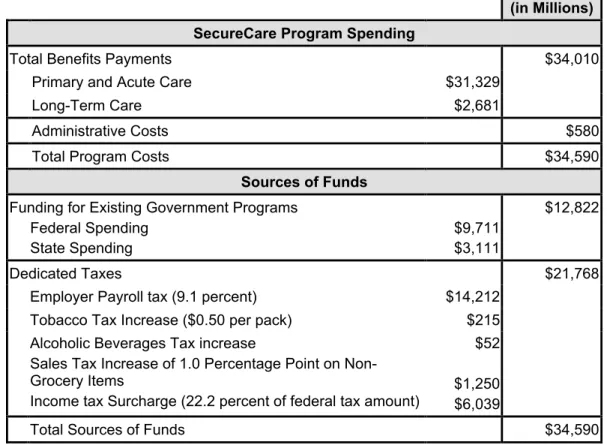
Program expenditures under the SecureCare program would be about $34.6 billion if fully implemented in 2003. This includes about $31.3 billion in payments to providers for primary and acute care services and about $2.7 billion in spending for long-term care services (Figure ES-2). The cost of administration under the program would be about $580 million.
Funding for the program would include government spending for health benefits programs that would be discontinued under the program and dedicated funding for the program (i.e., new taxes). Total government spending for discontinued programs would be about $12.8 billion in 2003, of which about $9.7 billion is federal funding for Medicare, Medicaid and other federal health benefits programs. This assumes that federal law is changed to transfer federal funds for Georgia residents under these programs to the SecureCare program, which would then be responsible for covering these beneficiaries.
The balance of the program ($21.8 billion) would be revenues from newly created taxes under the program. These include:
• An employer payroll tax equal to 9.1 percent of wages and salaries for all employees ($14.2
billion);
• An increase in tobacco taxes of $0.50 per pack with proportionate increases in taxes for
other tobacco taxes ($215 million);
• An increase in taxes on alcoholic beverages ($52 million);
• An increase in the state sales tax on non-grocery items of one percentage point (i.e., one
penny tax per dollar of taxable purchases). This would raise about $1.25 billion;
• An income tax payment for all Georgians computed to be equal to about 22.2 percent of
each Georgia taxpayer’s federal income tax ($6.0 billion).
1This estimate is consistent with the rebates for prescription drugs under the current Georgia Medicaid
Figure ES-2
Sources and Uses of Funds for the Georgia SecureCare
Program in 2003
(in millions) a/
Amount (in Millions) SecureCare Program Spending
Total Benefits Payments $34,010
Primary and Acute Care $31,329
Long-Term Care $2,681
Administrative Costs $580
Total Program Costs $34,590
Sources of Funds
Funding for Existing Government Programs Federal Spending
State Spending
$9,711 $3,111
$12,822
Dedicated Taxes $21,768
Employer Payroll tax (9.1 percent) $14,212 Tobacco Tax Increase ($0.50 per pack) $215 Alcoholic Beverages Tax increase
Sales Tax Increase of 1.0 Percentage Point on Non-Grocery Items
Income tax Surcharge (22.2 percent of federal tax amount)
$52 $1,250 $6,039
Total Sources of Funds $34,590
Source: Lewin Group estimates using the Health Benefits Simulation Model (HBSM).
Impact on Private Employers
Health coverage for workers and their dependents under the SecureCare program would be financed in part with a payroll tax paid by employers. The SecureCare program would
eliminate the need for employer provided health insurance, which we estimate will cost private employers in Georgia who contribute to employee’s healthcare about $9.5 billion in 2003
(excludes employee contributions). This would be replaced with a payroll tax equal to about 9.1 percent of employee wages and salaries for all employers in the state.
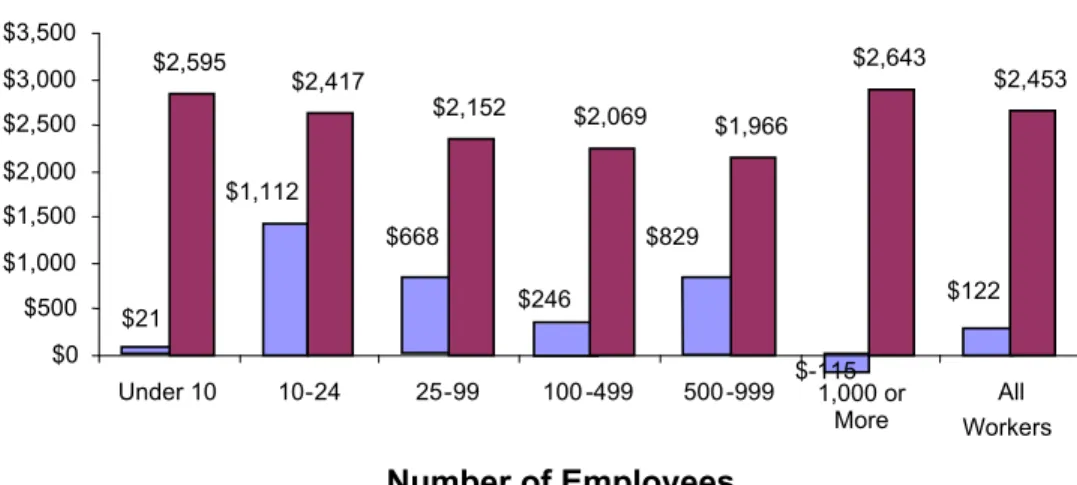
Under this payroll tax, total employer health spending in Georgia would increase by about $2.5 billion under the SecureCare program in 2003. This includes $2.2 billion in payroll tax payments by firms that currently do not offer coverage and a net increase in spending for firms that currently provide coverage to their workers of about $320 million (i.e., the payroll tax for insuring firms would on average be greater than what they currently pay for health benefits). This would be an increase in average annual costs of about $122 per worker for firms that now offer insurance and about $2,453 per worker for firms that do not now offer coverage (Figure ES-3).
However, economic theory and research indicate that over-time, increases in employer costs for health and other benefits are typically passed-on to workers in the form of reduced wage growth. Thus, we assume that over the long-term, all of the changes in employer costs for workers under the program will be passed-on to workers in their wages as labor markets adjust to reflect changes in total employee compensation costs under health reform. Due to these wage adjustments, there would be little or no net changes in employer labor costs over-time.
The Lewin Group, Inc. vii 333112
Figure ES-3
Change in Private Employer Health Spending Per Worker by Firm Size and Current Insuring Status Under the Georgia SecureCare Program in 2003: Before Wage Effects a/
Number of Employees
a/ Assumes Full Implementation in 2003.
Source: Lewin Group estimates using the Health Benefits Simulation Model (HBSM).
Household Impacts
We estimate that household health spending would decline by about $10.3 billion due to the elimination of premium payments, the elimination of co-payments for nearly all health services, and the elimination of other out-of-pocket spending for insured and newly insured people. These savings would be partially offset by a reduction in after-tax wage income of about $2.2 billion in response to the increase in employer costs due to the payroll tax.2 For purposes of this analysis, we treat the after-tax loss of wages as an increase in household health spending under the proposal. Households would also pay about $7.6 billion in new taxes under the program to substitute for premiums and cost-sharing, including increased taxes on tobacco products and alcoholic beverages, the increased sales tax on non-food items and additional income tax payments.
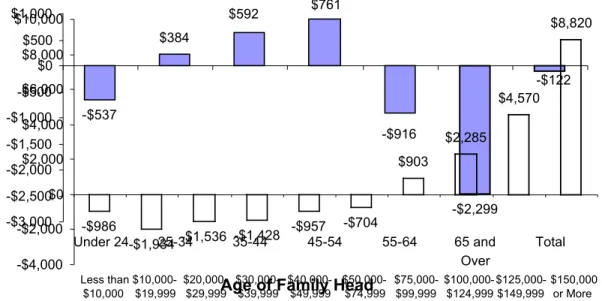
The net result of these changes would be an overall reduction in household health spending of about $520 million, which is an average savings of about $122 per family (Figure ES-4). Savings under the program would average about $2,299 for families headed by someone age 65 or older. This reflects the fact that the program would cover many services not currently covered under Medicare for this population such as prescription drugs and long-term care. Health spending would on average increase for families headed by someone between the ages of 25 and 54, reflecting the fact that these people are in their prime earnings years and would absorb most of the wage effect and pay much of the increase in income and sales taxes under the program.
2 Wages would increase for workers in firms where the payroll tax is less than what the employer now pays for health benefits, and would decline for workers in firms where the payroll tax exceeds what the employer now pays for health benefits. The net effect is a reduction in after-tax wages of $2.2 billion.
$21
$1,112
$668
$246
$829
$-115
$122 $2,595
$2,417
$2,152 $2,069
$1,966
$2,643
$2,453
$0 $500 $1,000 $1,500 $2,000 $2,500 $3,000 $3,500
Under 10 10-24 25-99 100 -499 500-999 All
Workers
Currently Offer Coverage Currently Do Not Offer Coverage
1,000 or More
Figure ES-4
Change in Average Family Health Spending by Age of Family Head Under the Georgia SecureCare Program in 2003: After Wage Effects a/
a/ Assumes Full Implementation in 2003
Source: Lewin Group estimates using the Health Benefits Simulation Model (HBSM).
Some of the savings to older people actually would accrue to other family members outside the household. For example, many working age people help their parents by purchasing coverage for them and/or by paying for services that are not now covered under Medicare. Thus, much of the savings for older people would actually accrue to younger people who are now assisting their parents or other relatives in this way.
In general, the SecureCare program would tend to reduce health care costs for lower- and middle-income families, while increasing health related costs for people in higher income groups. For example, families with under $75,000 in annual income would on average see savings of between $700 and $1,900 per family. However, health spending for families with $150,000 or more in income would increase by an average of about $8,820 per family (Figure ES-5). This reflects the fact that the program would shift Georgia from a premium-financed system to a tax-financed system where total family tax payments for health spending generally would be in proportion to family earnings and income.
Figure ES-5
Change in Average Health Spending Per Family Under the Georgia SecureCare
Program by Family Income in 2003: After Wage Effects
a/Age of Family Head
-$537 $384 -$916 -$2,299 -$122 -$3,000 -$2,500 -$2,000 -$1,500 -$1,000 -$500 $0 $500 $1,000
Under 24 25-34 35-44 45-54 55-64 65 and Over
Total $761
$592
-$986
-$1,934-$1,536 -$1,428
-$957 -$704 $903 $2,285 $4,570 $8,820 -$4,000 -$2,000 $0 $2,000 $4,000 $6,000 $8,000 $10,000 Less than $10,000 $10,000-$19,999 $20,000-$29,999 $30,000-$39,999 $40,000-$49,999 $50,000-$74,999 $75,000-$99,999 $100,000-$124,999 $125,000-$149,999 $150,000 or More
The Lewin Group, Inc. ix 333112 a/Assumes Full Implementation in 2003. Excludes institutionalized people.
Source: Lewin Group estimates using the Health Benefits Simulation Model (HBSM).
Spending in Future Years
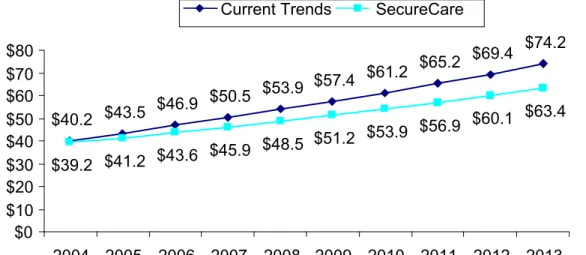
The program would constrain the growth in health spending so that it does not exceed the rate of growth in state gross domestic product (GDP). Under current trends, health spending is projected to grow at between 7.0 percent and 8.0 percent per year over the next ten years. Under the SecureCare program, spending would be permitted to increase no faster that the rate of growth in GDP, which is projected to be about 5.5 percent per year.
Total health spending would increase from $40.2 billion in 2004 (up from $37.2 billion in 2003) to $74.2 billion in 2013 under current policy (Figure ES-6). Under the SecureCare program, health spending in Georgia would be allowed to grow to about $63.4 billion in 2013. Total savings over the 2004 through 2013 period would be about $58.5 billion.
Figure ES-6
Projected Growth in Health Spending Under Current Trends and the Georgia SecureCare Program: 2004-2012 (In billions)
Source: Lewin Group estimates.
$40.2 $43.5 $46.9 $50.5
$53.9 $57.4 $61.2
$65.2 $69.4
$74.2
$39.2 $41.2 $43.6 $45.9
$48.5 $51.2 $53.9 $56.9
$60.1 $63.4
$0 $10 $20 $30 $40 $50 $60 $70 $80
2004 2005 2006 2007 2008 2009 2010 2011 2012 2013
I. INTRODUCTION
In this study, we estimated the cost impacts of covering all Georgia Residents under a single state-wide health insurance program called SecureCare. This includes estimates of the impact on state-wide health spending and the amounts paid by major stakeholder groups including the state government, employers, consumers and the federal government. We also present detailed analyses for employers by firm size, and estimates of changes in health spending for consumers by income, age and other demographic groups.
The SecureCare program covers all individuals in the state under a single uniform health insurance plan that is administered and funded by the state. The new program would replace all current public sector insurance systems including: Medicare, Medicaid, PeachCare,
CHAMPUS and the Federal Employees Health Benefits Plan (FEHBP). It would also replace private health insurance plans in the state. The program would be financed with: current government health care funding for discontinued programs; and dedicated revenues from new taxes on employer payroll, tobacco products, alcohol products, and personal income.
These estimates are based upon data from several sources on health expenditures in Georgia. The model uses the Georgia sub-sample of the March 2002 Current Population Survey (CPS) data which provides estimates of the sources of coverage for Georgia residents and the
distribution of people by income and demographic group. We supplemented these population data with health spending for consumers by income and demographic group reported in the Medical Expenditures Panel Survey (MEPS) data.
We used the most recent data on health spending for public programs in Georgia under Medicaid, PeachCare (i.e., the state children’s health insurance program (SCHIP)), the Merit System State Employees Health Benefits Program and the Indigent Care Trust Fund (ICTF). We also used data on private health spending in Georgia compiled by the Centers for Medicare and Medicaid Administration (CMS) and the Georgia sub-sample of the MEPS survey of employer health plans. Other state-level data sources were also used including the Georgia Hospital Financial Survey data.
The data and methods used to develop these analyses are presented in the Appendices to this report. Appendix A describes the modeling system developed for Georgia. Appendix B describes the methods used to estimate health spending in Georgia by type of service and source of payment. Appendix C describes the methods used to estimate the impact of the program on health care administrative costs. Our analysis is presented in the following sections:
• Specification of the Georgia SecureCare program;
• Estimating the Impact of the Georgia SecureCare program; • Key Assumptions;
• Program Cost Impacts; and • Caveats.
The Lewin Group, Inc. 2 333112
II. SPECIFICATIONS OF THE SECURECARE PROGRAM FOR GEORGIA
In this study we estimated the impact of the SecureCare program on health spending in Georgia. This proposal would create a single source of insurance for nearly all health services provided to Georgia residents. The program includes a comprehensive benefits package
covering hospital care, physicians services, prescription drugs and long-term care. It would also cover durable medical equipment, eyeglasses and rehabilitative services.
Hospitals would be placed on annual budgets for operations and capital expenditures, thus eliminating the need for billing for hospital services. Other providers would be reimbursed on a fee-for-service basis according to a uniform billing system. Alternatively, individuals could elect to be covered under group HMO plans with the plan receiving a capitated payment. Health professionals would continue to operate their own practices and health facilities would remain independently owned.
In this section, we summarize the major components of the SecureCare program. The program is presented in the following sections:
A.
Eligibility
All state residents would be covered for a standard benefits package including:
• U.S. Citizens;
• Legal resident non-citizens; • Undocumented non-citizens.
There would be a three-month residency requirement to avoid covering out-of-state residents with pre-existing conditions who might relocate in Georgia solely to take advantage of the program. The three month residency requirement would be waived for the following:
• People relocating to Georgia to take a job (includes migrant workers); and
• People experiencing a change in family status due to divorce or death of a spouse.
B.
Covered Services
The plan would cover the following services:
• Inpatient/outpatient hospital care; • Emergency room services;
• Physician office visits;
• Primary care and chronic disease case management; • Patient education;
• Specialist services; • Regular physical exams; • Nurse practitioner services; • Physician Assistants; • Well child care; • Immunizations;
• Emergency transportation; • Prescription drugs;
• Mental Health including:
æ Inpatient /outpatient hospital; æ Psychiatrists; and
æ Psychologists;
• Addictive disease treatment;
• Rehabilitative therapy services including: æ Physical therapy;
æ Occupational therapy; and æ Speech therapy.
• Dental care except orthodontia; • Vision Care including:
æ Optometry; and
æ Eyeglasses (1 pair per year; basic). • Podiatry;
• Chiropractic; • Midwives;
• Long-term care services including (see discussion below): æ Nursing Home care except room and board; and æ Home and community based services (HCBS).
• Skilled nursing facilities (as alternative to continued hospitalizations); • Hospice services.
C.
Long-Term Care
The program would be designed to provide a more appropriate balance between nursing home care and home and community based services (HCBS), with an emphasis on enabling
beneficiaries to remain in the community. The specific services provided would be developed and adapted over time based upon needs assessments.
In the initial year, the budget would be equal to what is now spent on nursing home and home and community based services, plus an allotment for expanded services. For illustrative
purposes, we assume that the expanded services allotment would be equal to a 25 percent increase in what is now spent for long-term care services statewide. This is comparable to the percentage increase in nursing home and HCBS spending that would have occurred under several recent programs similar to SecureCare.3
As discussed above, the actual allocation of resources to various long-term care services would be developed based upon a continuous needs assessment process. Long-term care would be globally budgeted just as hospitals would be under the plan. The long-term care benefit for HCBS is very flexible and can be whatever the person/family needs to make it work as long as the cost does not exceed the cost of nursing home care.!The service might be a home
modification, adaptive equipment, respite care, sitter service, personal emergency response, nursing care, attendant care, etc.
!
Under the system, the services actually provided would be affected by the overall planning for the system under the SecureCare program.
3 “Cost and Coverage Analysis of Nine Proposals to Expand Health Insurance Coverage in California,” (report to the California Health and Human Services (CHHS) Agency), April 22, 2002, The Lewin Group, Washington D.C..
The Lewin Group, Inc. 4 333112
D.
Benefits Design
The program would include an emphasis on primary care as follows:
• Participants would be encouraged to select a primary care physician or other covered
provider, in which case, a “mutual declaration” by patient and provider would be required;
• There would be no co-payments for services provided by an individual’s primary care
physician and/or nurse practitioner. In addition, there would be no co-payment for specialist services provided upon referral;
• There would be a co-payment of $25 per visit for specialist services provided without
referral from a primary care provider;
• There would be a peer review process to monitor referral rates; and • There would be no deductible.
E.
Disposition of Medicaid
We assume that the Medicaid program is retained to cover services currently covered under Medicaid that are not covered under the program. These include:
• Nursing home room and board for low income people; • Non durable medical equipment; and
• Non-emergency transportation.
Medicaid would also cover Medicaid EPSDT services for children that are not covered under the SecureCare program. Federally mandated EPSDT services under Medicaid include the following:
• Screening; • Vision care;
• Dental including some orthodontia; • Hearing; and
• Any treatments covered under the lists of federal mandatory and optional benefits under
Medicaid.
Most of these EPSDT services are covered under the SecureCare benefits package listed above. EPSDT services not covered under the plan include:
• Medically necessary orthodontia; and • Non-rehabilitative therapies including:
æ Speech therapy;
æ Occupational therapy; and æ Physical therapy.
Note that under the Individuals with Disabilities Education Act (IDEA), public school systems are required to provide these non-rehabilitative therapeutic services for children where needed. Thus, Medicaid payments for these services are often paid to school systems for Medicaid eligible people receiving these services through school.
F.
HMO Coverage Option
Beneficiaries would have the option of enrolling in integrated delivery system models such as Health Maintenance Organizations (HMO). The following would apply:
• People who chose the HMO option would be required to remain with the plan for one year;
and
• Payments to the plan would be risk-adjusted and calibrated so that enrollment in HMOs is
budget neutral.
G. Provider Payments in First Year
Health spending for covered services under the program would be determined through a budgeting process as follows:
• Hospitals would be given annual budgets that in the first year are equal to what total
spending for hospital services would have been in that year under the current system. Separate budgets would be set for operations and capital expansion; and
• Fee-for-service (FFS) payment rates for other providers would be set so that on average,
payment rates under the program are equal to overall average payment rates across all payers in today’s system (i.e., private payers, Medicare and Medicaid) for each individual unit of service.
Hospital budgets and aggregate FFS provider payments would be adjusted to reflect the following:
• Increased utilization for newly insured;
• Changes in long-term care services utilization resulting under the program; • Provider administrative savings;
• Reduced uncompensated care expenses; and • Savings from the primary care model.
H.
Health Spending in Future Years
The program would determine the increase in health spending permitted in each year. We assume that the program is required to constrain the rate of growth in per-capita health spending so it does not exceed the rate of growth in per-capita gross domestic product (GDP) for the state of Georgia.
Spending caps would be implemented through:
• Annual hospital budgets for operations; • Annual hospital capital expansion budgets;
The Lewin Group, Inc. 6 333112
• HMO payment rates adjusted to reflect the allowable rate of growth in per-capita spending
(i.e., per-capita GDP growth).
Spending levels for services would be adjusted to reflect the cost of prescription drugs, durable medical equipment and adaptive equipment (with bulk purchasing savings) so that aggregate spending under the program is within budgeted levels.
FFS payment rates also would be adjusted to reflect any increases in utilization of FFS services that occur during the year so that aggregate spending for these services does not exceed budgeted levels.
The system would include reports to providers on quality of care indicators and referral patterns for comparison purposes. Peer review also would be established to monitor referral patterns and quality of care indicators.
I.
Financing
The program would be financed with funds that would have been used for public programs under current law and certain dedicated taxes. Funding sources include:
• Funding for current federal and state health insurance programs would be recovered
including:
æ Medicaid (state and federal shares);
æ PeachCare (State Children’s Health Insurance Program (SCHIP)); æ Medicare;
æ CHAMPUS (military dependents and retirees); and
æ Workers compensation (existing funding mechanism retained).
• The program would also recover spending under state funded safety-net programs. • Dedicated taxes including:
æ Tobacco tax increase of $0.50 per pack with proportional increase in tax on other
tobacco products; and
æ Alcoholic beverage tax increase of 50 percent.
• An employer payroll tax sufficient to raise about two-thirds of the cost of providing benefits
for workers and their dependents.
• The Merit System State Employees Health program and all other government worker health
benefits programs would be eliminated, and state and local governments would be required to pay the payroll tax like any other employer. Funding for these employee benefits
programs would be made available to help fund the program.
• Local governments would retain savings in local government indigent care programs such
as property tax revenues in Fulton/Dekalb county currently used to fund indigent care for Grady hospital. Local governments would be free to either reduce local taxes or use these savings to provide additional services, including non-health services, to the community.
The remainder of the program would be funded through a progressive income tax. The tax would be computed as a percentage of individual federal income tax payments for Georgians.
The Lewin Group, Inc. 8 333112
III. ESTIMATING THE IMPACT OF THE GEORGIA SECURECARE PROGRAM
In this analysis, we estimated the financial impact of the SecureCare program on major payers for health care in Georgia including state and local governments, employers, households and federal government. In particular, we estimated the distributional impact of this proposal on various subgroups of payers such as small employers and families in various age and income groups. These estimates were developed using the Lewin Group Health Benefits Simulation Model (HBSM) which is specifically designed to provide these detailed distributional impacts analyses for state-level health reform initiatives.
In this section, we describe the data and methods used in HBSM to develop estimates of the impact of the program in Georgia. We begin by describing the overall methodology used in the model. We then explain how the model was adapted to provide Georgia specific estimates of the impact of this bill on health spending by various payers in future years. Our discussion is presented in the following sections:
• Overview of HBSM
• Health Spending in Georgia; • Projections to Future Years
A.
The Health Benefits Simulation Model (HBSM)
HBSM is a “micro-simulation” model of the health care system. The core for the model is a representative sample of Georgia households. For each household in the sample these data provide information on health insurance coverage, health spending, income, employment and basic demographic characteristics. The model uses these data to show how expenditures for households will change as they become covered under a new health insurance system such as the Georgia SecureCare Program. This micro level approach of simulating changes in spending for individual households permits us to estimate both the aggregate impact of major health reform initiatives as well as the impact on households of various socioeconomic groups. For example, the model estimates the increase in utilization which will occur as coverage is extended to previously uninsured people. The model also determines which of the services for each individual are covered under the plan, and the reimbursement amount for these services under the plan’s cost sharing and reimbursement rules. It also estimates savings to the sources of payment for this care under current law (family out-of-pocket, employers, county hospitals, charity care, etc.).
Because the model is based upon a representative sample of the population, it produces aggregate estimates of the impact of policy proposals on the total number of people affected, aggregate health spending, and program costs. However, because the model develops these estimates based upon analyses performed on an individual-by-individual basis, the model also provides estimates of the impact of these policies on various socioeconomic groups.
Using these data, HBSM produces estimates of program impacts by source of payment including:
- Number of workers and dependents affected - Cost to employers
- Impact on firms that do not now insure - Number of firms affected
- Uncompensated care cost shift savings
- Tax savings (corporate deductions for health benefits, if applicable) • Provider Impacts
- Utilization by type of service/provider - Sources of payment for care
- Expenditures for services by type of service/provider - Hospital uncompensated care
• Household Impacts
- Number of insured by income, age, sex, etc. - Family premium payments
- Family out-of-pocket spending • Government Impacts
- Offsets to public hospitals - Corporate income tax losses
- Tax revenues under various financing mechanisms
B.
Household Data
The basic data source used in this analysis is the Georgia sub-sample of the March 2002 Current Population Survey (CPS) conducted by the Bureau of the Census. These data provide detailed information on Georgia residents by age, income, employment status and other demographic characteristics. The March CPS for 2002 includes a much increased sample size designed to improve state-level estimates developed using these data.
We needed to correct the CPS for under-reporting of Medicaid coverage. The March 2002 CPS reports that there are about 1.4 million uninsured people in Georgia in 2001 (the 2002 CPS reports sources of insurance for 2001). However, these data under-report the number of people on Medicaid and/or PeachCare by about 30 percent. This serious under-reporting of Medicaid coverage causes the CPS to substantially overstate the number of uninsured in the state (similar problems exist for other states). When we corrected the Medicaid data in the CPS, the number of uninsured people in Georgia declines from about 1.4 million people in the unadjusted CPS to about 1.1 million people.
Figure 1 presents our estimate of the distribution of Georgia residents by source of insurance with and without the correction for under-reporting.
The Lewin Group, Inc. 10 333112
Estimated Number of Georgians by Source of Insurance With and Without
the Correction for Underreporting of Medicaid Coverage for 2003
a§
Numbers do not add to total because some people report more than one source of coverage. Source: Lewin Group analyses of the March 2002 Current Population Survey (CPS) data.
As Reported In CPSa§ Corrected for Under
Reporting
Total Population 8,288.7 8,288.7
Employer Coverage 5,132.1 5,132.1
Workers 2,561.9 2,561.9
Dependents 2,392.5 2,392.5
Retirees 177.7 177.7
Non-Group Policies 578.2 578.2
Medicare 868.1 868.1
Medicaid/PeachCare 855.1 1,238.8
CHAMPUS/Military 349.5 349.5
C.
Health Spending Data
Because the CPS does not include health spending data, we merged the Georgia sub-sample of the CPS with the 1996 Medical Expenditures Panel Survey (MEPS) data. These data provide information on health services utilization and expenditures for households across various income, age and employment status groups. The population and income data in the database were adjusted to 2003 based upon population projections developed by the Bureau of the Census and other government sources.
Health expenditures data were controlled to replicate aggregate health expenditures estimates for 2003 by type of service and source of payment. These estimates were compiled from state budget projections for Georgia health programs including Medicaid, PeachCare and the state employees health benefits program. Estimates of spending for private insurance in the state were derived from state-wide health expenditures estimates developed by the Centers for Medicare and Medicaid Services (CMS). The MEPS survey of employers provides information on spending for employer insurance and the amounts paid by the employer and the worker. In addition, hospital spending data were obtained from the Georgia Hospital Financial data.
D.
Projections Through 2003
The household database was “aged” to be representative of the Georgia state population in 2003. This was accomplished by adjusting the population totals in these data to reflect trends in population growth by age and sex. The earnings and other income data reported in the
household database were also adjusted to reflect income growth projections. Finally, health expenditures were adjusted to reflect projections of health spending by type of service and source of payment. The population totals were adjusted to reflect Bureau of the Census projections of population levels by age and sex in Georgia through 2003.
We adjusted the incomes reported by individuals in the database to 2003 (the income data in the 2002 CPS is for calendar year 2001). Earnings were adjusted based upon historical data on real growth in earnings per worker. Non-earnings income was projected based upon the historical rate of growth in non-earnings income per person. These growth estimates were adjusted to be consistent with national income projections provided by the Congressional Budget Office (CBO).
Health expenditures were increased based upon projections of the growth in per-capita health spending by type of service provided by CMS. Using this methodology, we estimate that health spending in Georgia will reach about $37.2 billion in 2003 (these estimates exclude expenditures for public health, research, and construction). Figure 3 presents our estimates of health
The Lewin Group, Inc. 12 333112
Figure 3
Health Expenditures for Georgia Residents by Type of Service and Source of
Payment in 2003 (in millions)
a/a/ See Appendix B
Source: Lewin Group estimates using the Health Benefits Simulation Model (HBSM).
IV. SUMMARY OF KEY ASSUMPTIONS
Other Public
Champus/Vet
12
Medicaid Total Spending = $37.2
Expenditures by Type of Service Expenditures by Source of Payment
Insurer Administration
$2.7
Other Professional $3.5
Hospital Inpatient ,
$7.3 Hospital
Outpatient $5.4
Long Term Care $2.8 Prescription Drugs $5.1 Physician $9.1 Other Health $1.3 7.2% 14.5% 7.5% 13.7% 24.5% 19.7% 9.4% 3.5% Self-pay $6.3 Workers Comp, $0.4 Medicare $6.1 Other Public $0.8 Private Employer Coverage $13.7 CHAMPUS/Vet $1.0 Medicaid $4.9 Non-group $1.2 3.2% 16.4% 16.9% 1.1% 13.2% 44.4% 2.7% 2.1% 36.8% Public Employer Coverage $2.8 7.6% Insurer Administration $2.7 Other Professional $3.5
Hospital Inpatient ,
$7.3 Hospital
Outpatient $5.4
Long Term Care $2.8 Prescription Drugs $5.1 Physician $9.1 Other Health $1.3 7.2% 14.5% 7.5% 24.5% 19.7% 9.4% 3.5% Insurer Administration $2.7 $3.5 Hospital Inpatient ,
$7.3 Hospital
Outpatient $5.4
Long Term Care $2.8 Prescription Drugs $5.1 Physician $9.1 Other Health $1.3 7.2% 14.5% 7.5% 24.5% 19.7% 9.4% 3.5% Self-pay $6.3 Workers Comp, $0.4 Medicare $6.1 Other Public $0.8 Private Employer Coverage $13.7 CHAMPUS/Vet $1.0 Medicaid $4.9 Non-group $1.2 3.2% 16.4% 16.9% 1.1% 13.2% 44.4% 2.7% 2.1% Self-pay $6.3 Workers Comp, $0.4 Medicare $6.1 Other Public $0.8 Private Employer Coverage $13.7 CHAMPUS/Vet $1.0 Medicaid $4.9 Non-group $1.2 3.2% 16.4% 16.9% 1.1% 13.2% 44.4% 2.7% 2.1% 36.8% Public Employer Coverage $2.8 7.6%
Our analysis includes several key assumptions concerning the utilization of health services under the program and savings from administrative simplification. We also made certain assumptions concerning the economic impacts of the program. These assumptions are
summarized below. A more detailed description of the data and methods used is presented in the Appendices A, B and C of this report. The key assumptions used in this analysis are
summarized in the following Sections:
A.
Utilization of Primary and Acute Care Services
Primary and Acute care services include inpatient hospital services and ambulatory care
provided by physicians and other licensed providers. In this analysis, we have also defined it to include outpatient prescription drugs and durable medical equipment. Primary and Acute care excludes nursing home services and home and community based services.
1. Utilization for Uninsured
We assume that uninsured people who become covered under the proposal would use health care services at the same rate reported by currently insured people with similar age, sex and health status characteristics. This assumption encompasses two important effects. First, the increase in access to primary care for this population would result in savings due to a reduction in emergency room visits and hospitalizations. Second, there would be a general increase in the use of such services as preventive care, corrective orthopedic surgery, advanced diagnostic tests, and other care that the uninsured often forego or delay.
Using this methodology, we estimate that health spending among the currently uninsured population would increase. That is, savings from improved primary care would be more than offset by increased use of non-emergency care. We estimate that in Georgia, the uninsured will consume about $5.2 billion in health services in 2003, including free care (i.e., uncompensated care valued at cost) and services purchased out-of-pocket. We estimate that if these individuals were to become insured, utilization of health services would increase by about 67 percent.
2. Utilization for Under-insured
Many of the insured have policies that do not cover certain services including prescription drugs, dental care and other services. In this analysis, we assume that utilization of these services by people who are not covered for these services would increase to the levels observed among those with similar demographic and health status characteristics who are covered for these services.
3. Elimination of Cost Sharing
The Georgia SecureCare program would have no deductible or co-payment requirements as found in most health plans (e.g., $10 per visit, $10 per prescription etc.). Prior studies have shown that eliminating cost sharing results in increased utilization of health services. For example, the National Health Insurance experiment data developed by the Rand Corporation
The Lewin Group, Inc. 14 333112 showed that eliminating cost sharing increases physician utilization by about 31 percent and increases inpatient utilization by about 10 percent.4
Another study compared health services utilization in Canada, where there is no cost sharing, with neighboring American states where cost sharing is common. The study indicated that physician utilization in Canada is about 30 percent higher than in the US.5 A recent study from the Congressional budget Office (CBO) also showed that health services utilization among Medicare beneficiaries with supplemental coverage (i.e., Medigap) is about 28 percent higher than among those without supplemental coverage. In addition, studies have shown that even among HMOs, eliminating cost sharing can result in utilization increases ranging from 11 to 30 percent.
In addition, there are studies showing that co-payments reduce utilization of needed health services for low-income people with a resulting reduction in health status. These issues are addressed in this plan by eliminating co-payments.
In this analysis, we assume that utilization of health services would increase for all people who do not currently have first dollar coverage. We assume that utilization of physician services would increase by 30 percent and that inpatient hospital utilization would increase by about 10 percent. We simulate no change in utilization for people who already have a policy without cost sharing. These include Medicaid enrollees, aged people with Medigap coverage (these policies typically pay the amount not paid by Medicare for covered services), and people currently enrolled in HMOs that do not have cost sharing.
4. Increased Emphasis on Primary Care
The program would encourage the use of primary care by encouraging each Georgia resident to select a primary care provider and by imposing a $25 co-payment on specialist services
provided without a referral. This is expected to reduce costs by encouraging prevention. Also, primary care physicians and nurse practitioners typically have lower charges than specialist physicians and typically use fewer expensive diagnostic services. Thus, the emphasis on primary care is likely to reduce costs.
For illustrative purposes, we assume that a shift to primary care would result in an overall reduction in utilization of about four percent for all Georgians who are not already enrolled in an HMO. This assumption is based upon analyses of the utilization impacts of health plans placing increased emphasis on primary care. 6
B.
Utilization of Long-Term Care Services
As discussed above, the program would create a budget for term care covering all long-term care services such as nursing home and home and community based services (HCBS). Spending would be allocated over these services based upon continuing needs assessments. These budgets would include current spending for these services in Georgia plus an allowance
4 W.G. Manning et., al., ”Health Insurance and the Demand for Medical Care: Evidence from a Randomized Experiment,” The American Economic Review, vol.77, No. 3, June 1987, pp.251-277.
5 Victor R. Fuchs and James S. Hahn, ”How Does Canada Do It? A Comparison of Expenditures for Physician’s Services in the United States and Canada,” New England Journal of Medicine, vol.323, September 27, 1990, 13, pp. 884.
6 The Lewin Group In., “New Evidence on Savings from Network Models of Managed Care,” (a report to the Healthcare Leadership Council), Washington DC, May 1994.
for increased services. As discussed above, we assume that the allowance for increased services would be equal to 25 percent of total state-wide spending for these services under current policy.
C.
Bulk Purchasing
Under this proposal, prescription drugs and durable medical equipment would be purchased through a single purchasing entity. For prescription drugs, we assume that the SecureCare program would receive the same rebates from manufacturers as are currently received by the Georgia Medicaid program, which is estimated to be about 18 percent.7 This compares with an average rebate of about 8 percent under private health plans. We assume that the percent savings for central purchasing of durable medical equipment would be the same.
D.
Administrative Costs
In this analysis, we estimated savings in administration based upon administrative data
available for the state of Georgia and a prior Lewin Group study of the impact of a single-payer model on administrative costs. The methods used to estimate the administrative savings are presented in detail in Appendix C to this report.8 These administrative savings are summarized below.
1. Insurer Administration
The SecureCare program would extend large-group economies of scale throughout the health care system by covering all individuals under a single insurance mechanism. This would eliminate the costs associated with underwriting, transitions in coverage, and maintaining the administratively cumbersome linkage between employers and insurers.
We assumed that the cost of insurer administration is similar to administrative costs under the Medicare program (modified to reflect administrative simplification), which can be thought of as a single-payer program for the elderly. Medicare administrative costs are equal to about two percent of covered benefits compared with an average of between 12 and 18 percent under private insurance arrangements. We estimated the amount of insurer administrative savings based upon the difference between total insurer and government program administrative costs under the current system (see Appendix A) and estimated administrative costs under the SecureCare program (private insurer administrative costs are assumed to continue at their current levels for services covered by employers that are not covered by the SecureCare program such as orthodontia).
2. Physician Administration
The SecureCare program would substantially reduce claims filing costs for physicians by standardizing the means of reimbursement through a single insurer and by providing full reimbursement through a single source using a standardized electronic claims-filling process. Standardization of coverage would also reduce physician costs related to adjudication of claims and negotiation of selective-contracting arrangements.
7 “Prescription Drug Coverage, Spending, Utilization, and Prices,” (Report to the President from the Department of Health & Human Services), April 2000.
The Lewin Group, Inc. 16 333112 We estimated administrative savings for physicians using data provided by the Medical Group Management Association (MGMA) which provides administrative costs data by function for physician practices. We used these data to identify the categories of administration that are attributed to the administrative functions that would be eliminated or simplified under the SecureCare program.
3. Hospital Administration
The SecureCare program would all but eliminate hospital administrative costs associated with filing claims, except for patients who live out-of-state. This is because under SecureCare, hospitals are given an annual operating budget covering all services provided by the hospital. This eliminates the costs associated with claims filing, bill generation, collections of unpaid amounts, service classification such as diagnostic related groups (DRGs) and price negotiations with insurers and other selective contracting expenses.
Our estimates of the savings in hospital administration are based upon detailed hospital spending data for Georgia hospitals reported in the Medicare Cost Report Data. These data show costs for patient care hospital administration and other cost centers. We supplemented these data with an earlier Lewin Group study of the impact of a single-payer program on hospital administrative systems and costs.
E.
Employer Response
Our assumptions concerning the employer response to the SecureCare program include:
1. Employer Supplemental Coverage
Employers are assumed to provide supplemental coverage for services that they now cover under
their plans which would not be covered under the Georgia SecureCare program. These services
include certain dental and orthodontia services.
2. Wage Effects
Increases in employer costs are assumed to be passed on to employees in the form of reduced
wages. This automatically affects tax revenues from income and sales taxes.
V. ESTIMATED COSTS AND IMPACTS
We present our estimates in two ways. First, we present estimates of the cost and coverage impacts of each provision of these proposals assuming full implementation in 2003. These estimates are useful for comparing program impacts at the current levels of the uninsured and health care costs. Second, for budgetary purposes, we also present year-by-year cost estimates for 2004 through 2013, which reflect the expected dates of program implementation.
A.
Total Health Spending
In this analysis, we developed estimates of the impact of the Georgia SecureCare program on total health spending in the state and health spending for major stakeholder groups, including employers and consumers. We project that total spending in Georgia for all health services will be about $37.2 billion in 2003, which includes spending for all health services paid by both public and private payers. 9
The program would result in a net reduction in what Georgians pay for health care services of about $716 million (Figure 4). Spending for health services would increase by about $4.6 billion as coverage is extended to uninsured and under-insured people. This would be more than offset by savings of about $5.3 billion due to increased emphasis on primary care, bulk purchasing savings and administrative savings. The net effect of the program would be a reduction in health spending of $716 million if fully implemented in 2003.
1. Changes in Health Services Utilization
We assume that under a program of universal insurance coverage, use of health services by those who otherwise would be uninsured would adjust (increase) to levels reported by insured people with similar age, sex, income and health status characteristics. Based on this assumption, we estimate that the net increase in health spending for previously uninsured people would be about $1.9 billion (Figure 4). This is an estimate of the net change in utilization for this group which reflects reduced hospitalizations for preventable conditions offset by increased utilization of preventive care and increased use of non-emergency procedures.
9 Smith, S., “The Next Ten Years of Health Spending: What Does the Future Hold?,” Health Affairs, Volume 17, Number 5.
The Lewin Group, Inc. 18 333112
Figure 4
Changes in State-Wide Health Spending Under the Georgia
SecureCare Program in 2003
Amount in Millions
Current Health Spending a/ $37,150
Increases in Utilization
Utilization Change for Uninsured $1,899 Utilization for “under-insured”
Prescription Drugs $205 Dental $105 Other $50
$360
Elimination of Cost Sharing $1,637
Long-Term Care and HCBS $681
Spending Offsets
Increased Primary Care Emphasis ($737) Bulk Purchasing
Prescription Drugs $684 Durable Medical Equipment $57
($741) Administrative Savings
Insurer Administration $2,042 Hospital Administration $705
Physician Administration $1,038
($3,815)
Net Change in Spending
Net Change ($716)
a/Excludes public health expenditures not associated with personal health care spending such as reporting of infectious diseases, ground water testing and public health education. Also excludes Research and Construction.
Source: Lewin Group estimates using the Health Benefits Simulation Model (HBSM).
There also would be an increase in utilization for previously “under-insured” people. The health plans that many insured people have do not cover some of the services that would be covered under the uniform benefits package. For example, the current Medicare program does not cover prescription drugs. Many private plans also do not cover prescription drugs,
psychiatric services, and preventive dental care. We assume that utilization of these services would increase to levels reported by people who have coverage for these services with similar age, sex, income and health status characteristics. The net increase in spending for the under-insured would be $360 million in 2003.
As described above, we assume that utilization of hospital and physician services would increase due to the elimination of cost sharing (i.e., deductibles and co-payments). This would occur among people whose current health policy requires deductibles and/or co-payments. We estimate that the utilization increase for these services would be about $1.6 billion. However, this would be partly offset by the use of financial incentives designed to encourage use of primary care (i.e, a $25 co-payment for use of specialist care without a primary care provider referral). Savings from increased use of primary care would be about $737 million.
As discussed above, the program budgets for a 25 percent increase in spending for long-term care. This would be an increase in spending for long-term care of about $681 million. However, the actual allocation of funding between nursing home and a broad range of HCBS services would be determined through a planning process based upon continuing needs assessments.
2. Bulk Purchasing
As discussed above, we assume that the program would purchase prescription drugs for all Georgians. We assume that the program would be able to achieve savings comparable to the rebates received under the current Medicaid program (about 18 percent). We also assume that the program would achieve similar percentage savings through bulk purchasing of durable medical equipment. Using these assumptions, we estimate savings from bulk purchasing of about $684 million for prescription drugs and about $57 million for durable medical equipment.
3.
Administrative CostsThe use of a single insurer would result in a reduction in administrative costs of about $3.8 billion (Figure 5). The SecureCare program would extend large-group economies of scale throughout the health care system by covering all Georgians under a single insurance mechanism. We estimate that insurer administrative costs would be reduced by about $2.1 billion under the program.
The SecureCare program would also significantly reduce administrative costs for hospitals and physicians. For example, the annual operating budget for hospitals would eliminate claims filings for hospital care (except for out-of-state patients). Standardization of coverage would also reduce physician costs related to claims filing, claims adjudication and negotiation of selective-contracting arrangements. We estimate that hospital administrative costs would be reduced by $705 million and physician administrative costs would be reduced by about $1.0 billion.
Figure 5
Changes in Administrative Costs Under the Georgia SecureCare Program for
Insurance and Health Care Providers: 2003 (in millions)
Source: Lewin Group Estimates using the Health Benefits Simulation Model (HBSM).
4. Changes in Spending By Payer
Figure 6 summarizes how these changes in spending are distributed over major stakeholder groups. Initially, state government spending on health care would increase by about $7.6 billion. Employer costs would increase initially by about $2.5 billion as employer premiums are replaced with the payroll tax requirement for employers. However, economic theory and evidence indicates that wages would be reduced over-time to reflect the increase in health benefits costs for employees.
$2,669
$3,327 $3,351
$596
$2,289
$2,646
$0 $500 $1,000 $1,500 $2,000 $2,500 $3,000 $3,500 $4,000
Insurer
Administration AdministrationPhysician
Hospital Administration Current SecureCare
The Lewin Group, Inc. 20 333112 Households would see savings of about $10.3 billion due to the elimination of co-payments and premiums. However, savings to households would be largely offset by an increase in the personal income tax to cover the cost of the program and loss of wages due to the increase in employer costs.
Figure 6
Change in Health Spending under the Georgia SecureCare Program by
Stakeholder Group in 2003
(in millions)
Without Wage
Effects With WageEffects and Fully FinancedWith Wage Effects
State Government $7,556 $7,679
--Local Government ($193) ($193) ($193)
Federal Government $249 $603 $603
Private Employers $2,508 ($606) ($606)
Households ($10,338) ($8,199) ($520)
Total health spending ($716) ($716) ($716)
Source: Lewin Group estimates using the Health Benefits Simulation Model.
The program would also have an impact on health spending for both the federal and local governments. We estimate a reduction in spending for local governments of about $193 million due to the elimination of payments to hospitals for indigent care in areas where this is done (e.g., Fulton/Dekalb county funding for Grady hospital), and savings in local government employee health benefits costs. Federal income and payroll tax revenues also would decline by nearly $603 million due to the reductions in wages resulting from the increase in employer costs under the program.
The program’s impact on various stakeholder groups is presented below in greater detail.
B.
Program Costs and Revenues
The Georgia SecureCare program would be a state operated program responsible for paying for covered health services and administering all aspects of the program. Total expenditures under the program would be about $34.6 billion if fully implemented in 2003 (Figure 7). This includes the cost of all benefits payments and the cost of administering the program.
As discussed above, we assume that the program would be designed so that in the first year of the program, provider payment levels would be equal to the average payment levels for covered services in the current system (i.e., averaging across Medicare, private insurance, etc.). However, we assume that these provider payment rates would be adjusted to reflect provider savings in administrative costs and the elimination of uncompensated care expenditures resulting from universal coverage.
Under these assumptions, total benefit payments before adjustments would be $37.2 billion, which reflects the increase in utilization for previously uninsured people discussed above and other adjustments to utilization from expanded use of primary care and the elimination of co-payments. Provider payment levels would be reduced by $2.8 billion to reflect reduced
uncompensated care and administrative costs. This reflects the fact that providers will receive payments for services that would have been counted as uncompensated care under current
policy ($1.1 billion). 10 This also reflects administrative savings that will be realized by providers under the SecureCare program ($1.7 billion).
The program would receive funds that otherwise would have been used to fund health care benefits under public programs. Specifically, funds from Medicaid, Medicare, and various other federal and state indigent care programs would be used to cover program costs. Total funding from these sources would be $12.8 billion in 2003.11 In addition, there would be net savings to state and local government employee benefits programs of about $192 million because state employer tax payments to the SecureCare program for workers and retirees would be less than their current cost of insurance.12
The remainder of the program would be financed with new revenues. A payroll tax on employers of 9.1 percent would provide $14.2 billion in revenue. Increases in tobacco and alcoholic beverage taxes would provide an additional $267 million in funding. The balance of the program (i.e., $6.0 billion) would be funded through an income tax equal to about 22.2 percent of federal income tax payments for Georgians.
The income tax amount is adjusted to reflect the loss of state income tax revenues due to wage adjustments (primarily reductions) in response to changes in employer costs. We estimate the reduction in employee wages will reduce state income tax collections by about $123 million. The income tax is set at the level required to offset this revenue loss.
10This adjustment is needed to account for the fact that uncompensated care is currently financed
through the cost- shift.
11 Savings due to elimination of local government payments to hospitals would be retained by these governments under the proposal.
12 We estimate that the employer share of the costs of health benefits for all state and local government worker benefits plans will be about $2.2 billion in 2003. This includes costs for workers, dependents and retirees. Total payroll tax payments would be about $2.0 billion under the program resulting in a net savings to state and local governments of about $192 million. In this analysis, we assume that these savings are available to fund the program.