Refereed papers
Identifying barriers to implementing a
cardiovascular computerised decision
support system (CDSS): a Delphi survey
Anne Wilson PhD BN MN Grad Dip Health Couns, FRCNA
Lecturer, Discipline of NursingMelissa Opolski BA (Hons) Psych
Project Officer, School of Population Health and Clinical Practice
The University of Adelaide, Australia
Introduction
In a technological age, the use of electronic means to assist health professionals in their work appears to have achieved limited adoption. In the USA, for example, it is reported that during 2005, approximately 23.9% of physicians used electronic health records (EHRs) in the ambulatory setting, while only 5% of hospitals used computerised physician order entry systems.1 Likewise, in the UK, which has an extensive computer-ised primary healthcare sector, the use of computercomputer-ised decision support systems (CDSS) is not common-place.2 Investigating primary care physicians’ use of electronic patient records in Norway, Christensenet al
concluded that their full potential had not been reached
and that problems of integration and functionality needed to be addressed to achieve this.3Computerised decision support systems are one type of electronic interface designed to assist clinicians in decision making and risk management and to facilitate shared decision making between health professional and patient.3 Achieving maximum adoption and usage by primary care professionals requires a comprehensive understand-ing of which professionals find it attractive and why.
This paper – a report of research that obtained health professionals’ and industry representatives’ opinions on the most effective approach or approaches to the dissemination of an electronic decision support
ABSTRACT
Purpose This paper reports an evaluation of stake-holders’ perspectives and recommendations for the dissemination of a cardiovascular computerised decision support system (CDSS) program. Methods A literature review of dissemination models for health information and decision support aids was undertaken to develop a semi-structured interview protocol outlining a range of dissemin-ation models for distribution. A cross section of eight health professionals and three corporate man-agers were interviewed to provide as broad a view as possible of eight dissemination models. Data were collected via two questionnaires incorporating the Delphi technique. Perspectives from the corporate managers were collected by telephone interview. Results Financial incentive was the most highly rated dissemination method, followed by joint prom-otion with a professional body and undergraduate
medical education. The lowest average rating was for dividing the program into separate components. Participants provided five other suggestions for dissemination. Suggestions for further exploration include the development of a multi-professional model comprising two or more approaches that is piloted and evaluated.
Conclusion Our results provide beneficial infor-mation on the potential dissemination of computer decision support systems to health professionals whose uptake of CDSS has not previously been explored. Whether use of a shared decision aid impacts on the decisions made by health profes-sionals working in a team is, however, less evident.
system – represents one of the few published investi-gations into professionals’ perspectives of what en-courages them to use CDSS.
Background
Introduced in 1998, electronic decision support sys-tems have been defined as ‘access to knowledge stored electronically to aid patients, carers, and service pro-viders in making decisions on health care’.4 Com-puter-based information systems may be used to integrate clinical and patient information and provide support for decision making in patient care. Risk assessment statistical models are being used in medical decision making, quality improvement tools, and as aids to patient counselling.5
Applications have the potential to assist clinicians and patients to make specific and conscious choices regarding health care and intervention options. They have the potential to act as a record system, aid diag-nosis, provide alerts, and to calculate risk or mortality. Importantly, in primary care, decision support tools can help providers put the focus of care on prevention. An additional advantage is that decision support sys-tems can be shared by all members of the primary care team, with each recording their management of the patient. Thus, it is possible to get an integrated view across provider categories of those problems of one patient that belong together. This shared problem-oriented patient record provides an important feature for the primary care team.6
Cardiovascular disease (CVD) is a major health problem worldwide and one of the main causes of morbidity and mortality. Treating complications from this disease costs healthcare systems billions of dollars each year. However, early detection provides oppor-tunities to reduce this problem and CVD can often be prevented if persons at risk are identified and interven-tions begun early.7Cardiovascular disease is complex, requiring risk assessment, management of symptoms and management of the changing physiological state due to interventions. Use of information technologies, including clinical decision support systems, can help address this complexity.
Utilising a comprehensive approach, computerised decision support software may be used to support a primary care consultation in the following ways:
. by providing easy access to appropriate and
accu-rate information, including educational material8
. by assisting in diagnosing or alerting the
practi-tioner and patient to a probable outcome2and
. by engaging and involving patients in decision
making regarding their own health care.2,8
A range of clinical decision tools to assist providers to perform cardiovascular assessment have been developed, validated, and even adapted to hand-held computers to increase their portability. Some cardiovascular decision tools, such as those developed by the New Zealand National Prescribing Service,9 American College of Physicians (ACP) and American College of Cardiology/American Heart Association (ACC/ AHA), are algorithmic approaches that make direct recommendations about whether to pursue cardiac testing. Other decision tools provide a risk score or index, which the user must interpret and translate into appropriate recommendations.
Within the literature there is a dominance of papers discussing EHRs. These frequently reported that the uptake of such tools was slow,10,11 suggesting that greater support for practices, particularly smaller ones, would enhance the adoption of electronic tools. Giebert reasons that the explosion of clinical data that are avail-able make it difficult for clinicians to find answers to clinical questions.12Although resistance to the implemen-tation of technology-assisted care is not uncommon electronic healthcare records and other electronic means are increasingly used to assist clinicians in this process.12
Advantages for providers
As discussed, decision support tools assist providers to focus their attention on prevention. In complex primary care settings where there are low adoption rates of elec-tronic tools to support the care of patients with chronic conditions, successful implementation may require a set of interrelated system and technology factors.13
The type and depth of clinical information available to clinicians is expanding rapidly. To be most useful, information should be available at the time and place it is needed and be specific to the task at hand.14In an approach based on continuous quality improvement and evidence-based health care, useful information must be relevant to both the processes and outcomes of care. Clinical practice guidelines have become increasingly popular for improving the quality of health care and are updated frequently. To be most useful they must be readily at hand. The field of medical informatics can bring cogent information to the point where decisions are being made to augment quality improvement activi-ties in general, and practice guidelines in particular.14 Implementation of innovative electronic technology will assist in providing better patient care by allowing for and providing more accurate, easily accessible and available patient information.15
Advantages for patients
personal values. Clinical decision aids are designed to facilitate patient-driven decision making by providing relevant information on the options while eliciting and incorporating patient preferences; they have been designed to support decision making in the preven-tion, screening and treatment of disease. Neuman reports that cancer-related decision aids have been shown to increase patients’ knowledge regarding their disease, and may facilitate patients playing a more active role in decision making.16Some studies suggest less decisional conflict and improved satisfaction with decision making as a result.8Whether use of a decision aid impacts on the actual decisions made by patients is, however, less evident.16
Assessment of patients’ responsiveness to a decision support tool for primary prevention of CVDs has been investigated. van Steenkiste and Wilson both found that decision support is welcomed by patients who enjoyed sharing information with a professional on a personal cardiovascular risk management plan.8,17
Barriers to adoption
Leslie et al reported that identified barriers to im-plementation in primary care included lower com-puter literacy among general practitioners (GPs), a lack of complexity within CDSS in addressing non-medical needs of patients and a reluctance among medical staff to consult guidelines during patient consultations. Improving computer skills, integrating CDSS into referral pathways and requests for investi-gations may be ways of enhancing use of this type of technology.18
Another study found that GPs believed that im-portant interactions might be missed because of dis-traction resulting from too many alerts, which also intruded on workflow.19If interaction alerts were severity graded and only significant ones appeared this could improve adoption of CDSS systems.19
Several practical barriers to the use of computerised support systems in primary care consultations were identified. These included limitations of practitioners’ information technology skills, problems for GPs in understanding the risk output of systems and GP con-cerns about communicating risk sufficiently well to patients.20Concerns over the potential impact of time using a system in a consultation was also identified as a barrier.8
A probabilistic decision support
program
‘Probabilistic’ CDSS systems compare patient data to recorded population data to predict or diagnose
medical events. One example of this type of system is cardiovascular risk calculators, which are becoming a more widely accepted part of many primary care consultations.2The program on which this evaluation reports was a newly-developed probabilistic CDSS program that aimed to enhance hypertension man-agement in medical settings. Clinicians conducting health assessments on patients enter data including age, gender, blood pressure, cholesterol level, and risk factors including diabetes and smoking history into the program, which then calculates the patient’s rela-tive risk of a cardiovascular event. This information may be easily stored in and retrieved from computer-ised medical record databases such as Medical Director. The program also contained educational materials for patients to access either in print form or as a video, which was designed to encourage the sharing of man-agement and responsibility between patient and doc-tor, and to focus on health promotion rather than only on illness management.8
Following development and initial testing, a recent study investigated GP and consumer views on the acceptability and usability of the program.8Following use in general practice consultations, consumer feed-back indicated that the program was generally seen as acceptable, practical, and serviceable. Consumers also considered it as a positive way to interact with the GP, and the possibility of being able to access the edu-cational materials was well regarded. On the other hand, GPs were somewhat wary of the increased demands on their time made by using the program and were concerned about possible disruption to patient con-sultations. However, consumers indicated that they did not oppose its use in their general practice con-sultations.8
Study aim
The reported study aimed to obtain consensus from health professionals and industry representatives on the most effective approach or approaches to utilise to disseminate the program. Ethics approval to con-duct the study was obtained from the University of Adelaide Human Research Ethics Committee, project no. H-023–2005.
Method
perspectives, with two GPs, two cardiologists, two nurses, one pharmacist, and one primary healthcare co-ordinator taking part.
As Table 1 shows, the majority of participants were male (n= 5), aged 41–50 years (n= 6), and worked full time (n= 5). The average length of time professionals had worked in their current profession was 10.5 years (range 1–22 years), and most considered themselves to be in the middle stages of their career (n= 4). Just one (n= 1) participant worked in a country area.
To gain an industry perspective on dissemination, three managers responsible for product development, corporate development, and business affairs within the study funding body participated in phone inter-views.
Both quantitative and qualitative methods of data collection were used in this study which consisted of two stages. Stage one developed the background infor-mation and tools for the project. A review of the literature revealed previous research studies and re-ports. A literature search including the mesh terms ‘decision making’, ‘computer-assisted’ and ‘diffusion of innovation’ revealed 62 articles, none of which de-scribed a study with a similar aim to the reported one. The dissemination models described in the study were sourced from the final report of the Integrated Care Program (ICP), a joint venture between the Pharma-ceutical Alliance (Eli Lilly, GlaxoSmithKline and Merck Sharp and Dohme), the Australian Government Department of Health and Ageing, and Central Bayside Division of General Practice.21 The results of the literature review helped to develop the questions for the semi-structured interview protocol presenting a variety of dissemination models. In stage two, data were collected through a survey and telephone interviews of stakeholders’ perspectives and recommendations on
the dissemination of computer decision support software. Data identified the type of decision support aids used and how these were accessed or obtained.
The Delphi method
The Delphi technique (or method) was designed as a way to gather a reliable consensus from a group of ‘experts’ on a certain topic, without them needing to actually having to be in one place at the same time.22 This technique has the benefit of avoiding potential group biases. Delphi aims to gather a reliable consensus from a group through a cyclical process first involving the completion of a postal questionnaire by a number of ‘experts’ on the topic being investigated. The com-pleted questionnaires are then collated, and controlled feedback is provided to the experts before they re-complete the original questionnaire. This ‘question-naire–feedback’ process is repeated until the best possible consensus has been obtained from the group.23While up to six rounds of questionnaires have been em-ployed, utilising two or three rounds is more common in research.23
Round I questionnaire
The first round questionnaire initially asked partici-pants for a selection of demographic and occupation-related data. Next, participants were asked to read the following:
Empower is an electronic cardiovascular assessment and management tool. It allows clinicians conducting health assessments on patients to enter data including blood pressure, cholesterol level, and risk factors including diabetes and smoking history into an algorithm, which then
Table 1 Demographic and occupational characteristics of participating healthcare professionals
Profession Gender Age Work status
Career stage
Years in profession
Work location
GP Male 51–60 Full time Mid 22 Suburbs
GP Male 41–50 Full time Mid 15 Suburbs
Cardiologist Male 41–50 Part time Mid 11 Capital city
Cardiologist Male 41–50 Full time Mid 15 Metro. centre
Nurse Female 41–50 Part time Mid 8 Country
Nurse Female 41–50 Part time Later 10 Capital city
Pharmacist Male 21–30 Full time Early 2 Capital city
PHC coordinator
calculates the patient’s relative risk of a cardiovascular event. This data may also be stored in electronic medical records and retrieved when desired. In addition, Empower contains patient education material that can be printed or viewed as a video.
After the description, respondents were asked to indi-cate on a Likert scale from 1 (extremely likely) to 10 (extremely unlikely) how likely they ‘would be to use this program while caring for patients who had either existing cardiac problems, or who presented to [them] with risk factors for cardiac problems, and why?’. Space was provided for a qualitative response to the question.
The main section of the questionnaire asked for respondents’ opinions regarding a number of poten-tial dissemination models for the program. Table 2 displays the dissemination models investigated, which were sourced from the final report of the ICP.21 Respondents were asked to read the description pro-vided about each model (as per Table 2), and indicate on a Likert scale ranging from 1 (extremely ineffective) to 10 (extremely effective) ‘how effective you think this method would be in disseminating the Empower program to health professionals, and describe why you chose this answer’. Follow-up questions were asked for several of the dissemination models.
The final items in the questionnaire asked respon-dents to choose which two dissemination models, if begun immediately, would work best to (a) ‘maximise the short-term distribution of Empower (in the first 12–18 months of its release)?’ (b) ‘maximise the longer-term distribution of Empower (from the second year of release onward)?’ and (c) ‘which two dissemination methods would be the best overall to use in dissem-inating Empower?’. Respondents were also asked to describe any other possible effective dissemination methods they could suggest.
Round II questionnaire
Responses provided by participants in the first round were collated and, using SPSS 13.0 (SPSS Inc 2004), analysed for basic frequencies and descriptives. In the round two questionnaire, respondents were provided with the same descriptions of the program and dis-semination methods (Table 1) as in the first round questionnaire, but were also fed back their own answer for each question, plus the answer most commonly chosen by the participants. Respondents were asked to consider the feedback and re-answer the questions, ‘How likely is it that you would use Empower when caring for patients with either existing cardiovascular problems or risk factors for cardiovascular problems?’ and for each dissemination method, ‘How effective do you now think this model would be in disseminating the Empower program to health practitioners?’. Each
question was answered on the same 10-point Likert scale used in the first round questionnaire.
Phone interviews
Three industry partner representatives from the areas of product development, corporate development, and business affairs were also interviewed, to gather a corporate view on dissemination methods. Interviewees were asked in phone interviews about how they might expect the program to impact on their job, and how it could contribute to their particular business responsi-bilities or activities.
Procedure
The Delphi technique requires that participants be ‘experts’ in the topic being examined.23Based on this premise, seven South Australian healthcare profes-sionals who were known to the lead researcher were personally approached to take part in the study. One other participant in this study was provided with the round one questionnaire by a third party. Participants were offered AUS$50 remuneration for their time.
After verbally agreeing to be involved, the partici-pants were provided with the first round questionnaire. They were asked to answer and return the question-naire as soon as possible by fax, email, or post. Re-minder phone calls were made and/or emails were sent every fortnight until all questionnaires had been returned. The second round of questionnaires was provided to participants two to three weeks after all of the first round questionnaires had been returned.
All seven healthcare professionals who had been invited to participate completed and returned both the first and second round questionnaires. The par-ticipant who was given the first questionnaire by a third party completed only the round one question-naire, as she was unable to be contacted to take part in the second round. Therefore, eight participants com-pleted the first round, and seven comcom-pleted the second. Three staff members from the study funding body participated in a short, semi-structured telephone inter-view at a time convenient to them.
Results
Table 2 Names and descriptions of dissemination models explored in this study
Dissemination model
Description (relating to use of model with Empower)
Continuing medical professional education (CPE)
The continuing medical professional education program allows medical practitioners, including doctors and nurses, to gain points for completing training programs that assist in maintaining and updating their knowledge, to provide improved care to patients. By including information and training for the use of Empower as part of a CPE program, practitioners would gain points towards their accreditation.
Integration into undergraduate medical education
Studies have shown that younger doctors are more confident in the use of computer decision support software such as Empower. Training for a variety of these types of software, including Empower, could be integrated into undergraduate medical education, providing medical students and nurses with a knowledge and
understanding of electronic tools that are often used in the medical field.
Integration into postgraduate medical training
Training in the use of computer decision support software such as Empower could also be incorporated into medical training programs for trainee GPs, specialists, and nurses at a postgraduate level. This model would be similar to the previous one, except that the focus would be on postgraduate, rather than undergraduate, training.
Practice nurses With many practices employing practice nurses, practice nurses could be made responsible for the management of CDSS programs such as Empower. GPs and specialists would be relieved of the time-consuming task of entering the initial patient data in the system, leaving them free to use CDSS programs including Empower as a support tool in consultations.
Targeting younger, computer-literate medical
practitioners
Research has shown that younger medical practitioners are often more computer literate and more confident in using CDSS programs such as Empower. Targeting younger medical practitioners in the dissemination of Empower may ensure that the program is most widely distributed to users who are more likely to use it.
Financial incentives In this model of dissemination, users would be provided with a one-off payment which would be linked to a formal agreement for the user to install and use Empower in their practice. The practitioner would be paid their consultancy fee for participation in Empower training, and a separate payment would be made once evidence is received that Empower is being used, and that a target number of uses has been met.
CDSS as separate components
Empower consists of three main components: a disease management tool involving electronic case notes for storing patient information, an algorithm for calculating cardiovascular risk, and health education information including a video on healthy eating and printed material on salt intake. Empower could be developed as separate programs, which might incorporate one or more of these components. Furthermore, if the software was split into two or three applications to install, a doctor and practice nurse within a practice could each separately manage the various components of the Empower program.
Joint promotion with peak body
between rounds indicated greater stability of opinion from the experts.23,24
First and second round analyses of experts’ ratings on how likely they would be to use the program while caring for patients showed both a closer consensus (SD = 2.41 vs 2.14) and a greater likelihood of them utilising the program (M = 6.36 vs 5.86) in the second round of questionnaires than the first round (Table 3). The second round consensus also indicates that the average participating medical professional would be somewhat likely (more likely than not) to use CDSS with patients (M = 6.36; SD = 2.14).
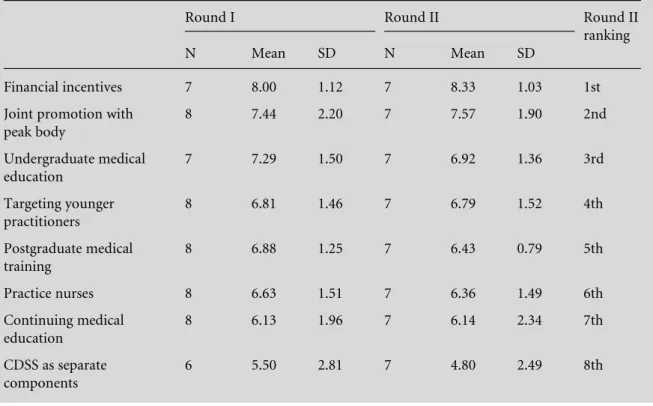
Table 4 displays medical professionals’ ratings of each of the investigated potential dissemination methods in both Delphi rounds. Rankings for most methods remained relatively stable across both rounds, and a closer consensus on most dissemination
methods was found in the second round (excluding ‘targeting younger practitioners’ and ‘continuing medical education’).
The second round consensus showed that overall, using financial incentives was the most highly rated dissemination method (M = 8.33; SD = 1.03), fol-lowed closely by joint promotion with a professional body (M = 7.57; SD = 1.90) and dissemination through undergraduate medical education (M = 6.92; SD = 1.36). The lowest average rating was given to separating the program into separate components for different practitioners’ use (M = 4.80; SD = 2.49).
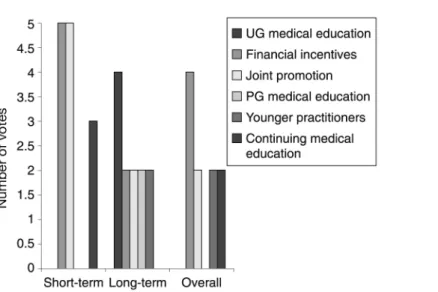
As collected in the first round questionnaire, medi-cal professionals’ ratings of which methods they be-lieved would be most effective for the short term, long term, and overall dissemination are displayed in Figure 1. The two most popular short-term methods
Table 3 Participants’ round I and II ratings (1 = extremely unlikely, 10 = extremely likely) of how likely they would be to use the Empower program when caring for patients
Round I Round II
Mean SD Range Mean SD Range
Likelihood of using Empower program in own clinical work
5.86 2.41 3–8 6.36 2.14 3–9
Table 4 Participants’ average ratings (1 = extremely unlikely, 10 = extremely likely) given to each dissemination method in rounds I and II
Round I Round II Round II
ranking
N Mean SD N Mean SD
Financial incentives 7 8.00 1.12 7 8.33 1.03 1st
Joint promotion with peak body
8 7.44 2.20 7 7.57 1.90 2nd
Undergraduate medical education
7 7.29 1.50 7 6.92 1.36 3rd
Targeting younger practitioners
8 6.81 1.46 7 6.79 1.52 4th
Postgraduate medical training
8 6.88 1.25 7 6.43 0.79 5th
Practice nurses 8 6.63 1.51 7 6.36 1.49 6th
Continuing medical education
8 6.13 1.96 7 6.14 2.34 7th
CDSS as separate components
were financial incentives and promotion with a pro-fessional body, while in the longer term promotion through undergraduate medical education and utilising practice nurses were seen as being potentially more productive. Consistently, the most popular ‘overall’ dissemination methods were two of the popular long-and short-term ones: utilising practice nurses long-and financial incentives.
Interviews with industry partner representatives found an unexpected view from a pharmaceutical company about its potential role and its perception of responsibility in the healthcare sector. It was obvi-ous to the interviewer that the company prided itself on its wish to contribute to improving health out-comes and not only to be seen as a business enterprise.
Need to consider how to enhance the company’s standing in the eyes of stakeholders, enhance quality use of medi-cines, and differentiate ourselves from other competitors. The goal isn’t necessarily to sell more products, it’s to be held in good stead with the government and to be recog-nised by them that we are trying to improve health out-comes. We are also trying to open up other opportunities for working in partnership with others such as com-munity, policy, and government stakeholders.
Discussion
Evaluation of a number of potential dissemination models for CDSS was conducted to gain a broad perspective from ‘expert’ South Australian health professionals. General practitioners and practice nurses were in favour of a program that was inexpensive, fast, and able to keep data as a permanent record, ideally within the main software program run on practice computers. Additional factors were whether it helped
with patient motivation, as well as clinical decision making and whether it incorporated ‘check box’ type data entry rather than long data entry.
A less favourable view from a pharmacist and cardiologist was that good and established calculators already existed and another would not be attractive just because it was electronic. Difficulties incorporat-ing risk calculators into a patient consultation in the past had been experienced and in addition the likeli-hood of using or accessing computers during consul-tations may be limited.
Medical professionals’ individual ratings of how likely they felt they would be to use the Empower program in their clinical work, and their reasons for the rating they chose, are found in Table 4. Those who were more positive about using the program emphasised issues such the need for cheap, easy-to-use programs, and being able to keep permanent records of results. Medical professionals who felt they were less likely to use CDSS gave reasons including not usually using patient education materials in consultations, limited access to computers when with patients, and the exist-ence of other reliable cardiovascular risk calculators.
Financial incentives, joint promotion with a pro-fessional body, and undergraduate medical education were highly ranked; although it could not be deter-mined that one professional group preferred one over the other.
Most professionals’ comments toward incorporating CDSS in undergraduate medical education were gen-erally positive, noting that the skills would be formed early and would thus be sustained for longer (‘hard-wired’), that electronic tools were becoming more readily used in medical settings, and that it would be more likely to become ‘usual practice’ for the students. On the other hand, one medical professional felt that this method would be ineffective because medical
students already have the skills needed to use CDSS programs in clinical consultations without extra train-ing.
Negative thoughts on financial incentives as a method included that GPs might be more wary of being involved if there were financial incentives as they might expect more up-front work, that clinicians are already inundated with paid surveys, and that ethically medical professionals shouldn’t be paid anything. More positive perspectives included the opinions that the project would have a better chance of succeeding if medical professionals were reimbursed for their time, and that it’s ‘all about the buck’ and that ‘time is money’.
Medical professionals’ ratings and opinions of pro-motion in conjunction with a professional body (i.e. the National Heart Foundation) were generally posi-tive. The ‘for’ comments included medical profes-sionals liking to know that these types of tools are being driven by the right reasons and not commercial interests, that medical professionals already base their care on National Heart Foundation guidelines and this would validate the program, that the established reputation of the professional body would be bene-ficial, and that this would reassure practitioners that the program was evidence-based and supported/vali-dated by credible affiliations. More cautious opinions on professional body promotion were that it could be quite time consuming, that on its own this method would not be enough for dissemination, and that the program might become known as ‘belonging’ to the professional body (which could be either a benefit or hindrance).
As financial strategies may be short term, but collaboration with a professional body and a strategy that targets upcoming practitioners may be medium to long term, it is suggested that different approaches be explored. Due to the divergence of views in the findings, it is clear that a model comprised of two or more approaches would be beneficial and that the target population should be multi-professional.
Methodological issues/further research
As only one expert participant in the study worked in a country area, it was not possible to hypothesise as to whether there could be a different need for or appli-cation of the program in rural areas, where nurses and health workers commonly provide primary care ser-vices. Practice nurses are becoming increasingly more prevalent in general practice, with their roles evolving quickly. However, it was evident from their responses that some participants, not having had the experience of working with a practice nurse, found questions about how nurses could be involved in the dissemi-nation of CDSS both confusing and thought provoking.
It would be interesting to revisit this dissemination model in 6–12 months as practice nurse roles continue to evolve.
Future research may wish to explore the feasibility of non-financial incentive models, as well as teaching-only and service delivery-teaching-only versions of CDSS pro-grams, which could also be linked to an incentive model. General practice training programs might be targeted as a source to help develop the program as a teaching tool and target new doctors. The potential value for young practitioners developing assessment expertise was first identified during alpha testing, which investigated the acceptability and usability of the software. Likewise the consumers, who were not involved in this study but who were involved in the previous testing phase,8were eager to be able to access the educational materials at home.
From these findings it is recommended that a multi-professional dissemination model be developed, piloted, and evaluated.
Conclusion
This study sought to explore health professionals’ opinions of the most effective ways to disseminate a computer decision support software program for the assessment and management of cardiovascular dis-ease. A literature review of dissemination models for health information and decision support aids was undertaken and a semi-structured interview protocol outlining a range of dissemination models for distri-bution developed. A cross section of eight health professionals and three corporate managers were inter-viewed to provide as broad a view as possible of eight dissemination models. Data from the health profes-sionals were collected via two questionnaires incorp-orating the Delphi technique. Perspectives from the corporate managers were collected by telephone inter-view.
The lack of literature on the dissemination of deci-sion support software has implications for development of programs and uptake by health professionals. Ways to seek appropriate funding and provide adequate resources should be explored. The development of CDSS requires a multidisciplinary iterative process of feedback from professionals and modification by designers. Barriers to implementation identified in-clude computer literacy, a lack of complexity within CDSS in addressing non-medical needs of patients and a reluctance among medical staff to consult guidelines during patient consultations. Integrating CDSS into education pathways and making it more available for a broad range of health professionals may be ways of enhancing use of this emerging technology. Designers of decision support systems for use in primary care consultations must account for the practical needs of users when developing computer-ised support systems. Systems must be acceptable to the format of a consultation, include definitions of what output means, and help facilitate dialogue be-tween the GP and the patient.
REFERENCES
1 Jha AK, Ferris TG, Donelan Ket al. How common are electronic health records in the United States? A sum-mary of the evidence.Health Affairs2006;25:w496–507. 2 DelaneyBC, Fitzmaurice DA, Riaz A and Hobbs FDR. Can computerised decision support systems deliver improved quality in primary care? British Medical Journal1999;319:1281–4.
3 Christensen T and Grimsmo A. Expectations for the next generation of electronic patient records in primary care: a triangulated study.Informatics in Primary Care2008; 16:21–8.
4 National Electronic Decision Support Task Force. Elec-tronic Decision Support for Australia’s Health Sector. Canberra: Commonwealth Department of Health and Ageing, 2002.
5 Goldberg ARJ, Akhras KS, Chen C, Chen S, Pettit KG and Kaniecki DJ. Review of the development, validation, and application of predictive instruments in inter-ventional cardiology.Heart Disease1999;1(3):138–48. 6 Linnarsson R and Nordgren K. A shared
computer-based problem-oriented patient record for the primary care team.Medinfo1995;8 Pt 2:1663.
7 Gargasas L, Janusauskas A, Lukosevicius Aet al. Devel-opment of methods for monitoring of electrocardio-grams, impedance cardiograms and seismocardiograms. Studies in Health Technology and Informatics2004;105: 131–41.
8 Wilson A, Duszynski A, Turnbull D and Beilby J. Investigating patients’ and general practitioners’ views of computerised decision support software for the assess-ment and manageassess-ment of cardiovascular risk. Inform-atics in Primary Care2007;15:33–44.
9 National Prescribing Service Paper-based New Zealand Cardiovascular Risk Calculator. Surrey Hills, New South
Wales: National Prescribing Service, 2004. Available from www.nps.org.au/health_professionals/tools/cardiovascular _risk_calculator
10 Gans D, Kralewski J, Hammons T and Dowd B. Medical groups’ adoption of electronic health records and infor-mation systems.Health Affairs2005;24:1323–33. 11 Menachemi N, Perkins RM, van Durme DJ and Brooks
RG. Examining the adoption of electronic health records and personal digital assistants by family physicians in Florida.Informatics in Primary Care2006;14:1–9. 12 Geibert RC. Using diffusion of innovation concepts to
enhance implementation of an electronic health record to support evidence-based practice.Nursing Adminis-tration Quarterly2006;30:203–10.
13 Green CJ, Fortin P, Maclure M, Macgregor A and Robinson S. Information system support as a critical success factor for chronic disease management: necess-ary but not sufficient.International Journal of Medical Informatics2006;75:818–28.
14 Tierney WM. Improving clinical decisions and out-comes with information: a review.International Journal of Medical Informatics2001;62:1–9.
15 Houser SH and Johnson LA. Perceptions regarding electronic health record implementation among health information management professionals in Alabama: a statewide survey and analysis. Perspectives in Health Informatics Management2008;5:6.
16 Neuman HB, Charlson ME and Temple LK. Is there a role for decision aids in cancer-related decisions?Critical Reviews in Oncology/Haematology2007;62:240–50. 17 van Steenkiste B, van der Weijden TM, Stoffers JH and
Grol RP. Patients’ responsiveness to a decision support tool for primary prevention of cardiovascular diseases in primary care.Patient Education Counselling2008;72:63– 70.
18 Leslie SJ, Hartswood M, Meurig Cet al. Clinical decision support software for management of chronic heart failure: development and evaluation.Computers in Biology and Medicine2006;36:495–506.
19 Ahearn MD and Kerr SJ. General practitioners’ percep-tions of the pharmaceutical decision-support tools in their prescribing software.Medical Journal of Australia 2003;179:34–7.
20 Short D, Frischer M and Bashford J. Barriers to the adoption of computerised decision support systems in general practice consultations: a qualitative study of GPs’ perspectives.International Journal of Medical Informatics 2004;73:357–62.
21 Coulthard M, Gialamas A, Holton C et al.Integrated Care Program Business Case. Unpublished. Adelaide: The University of Adelaide, 2004.
22 Bowling A. Research Methods in Health: investigating health and health sciences.Buckingham: Open University Press, 1997.
23 Wilson A, Averis A and Walsh K. The influences on and experiences of becoming nurse entrepreneurs: a Delphi study.International Journal of Nursing Practice2003;9: 236–45.
CONFLICTS OF INTEREST
Funding for the study was provided by Alphapharm Pty Ltd. The three industry partner representatives interviewed were employees of the company. The following rules were undertaken by the authors: study design, data collection, analysis, interpretation, and preparation of the manuscript. Alphapharm Pty Ltd did not contribute to the manuscript, see the manu-script prior to submission nor influence the views of the authors.
ADDRESS FOR CORRESPONDENCE
Dr Anne Wilson Discipline of Nursing
School of Population Health and Clinical Practice The University of Adelaide
SA 5005 Australia
Email: [email protected]