HIV-Specific,
Ex Vivo
Expanded
T
Cell
Therapy:
Feasibility,
Safety,
and
Efficacy
in
ART-Suppressed
HIV-Infected
Individuals
Julia
A.
Sung,
1,2Shabnum
Patel,
5Matthew
L.
Clohosey,
1Lauren
Roesch,
5Tamara
Tripic,
6JoAnn
D.
Kuruc,
1,2Nancie
Archin,
1,2Patrick
J.
Hanley,
5C.
Russell
Cruz,
5Nilu
Goonetilleke,
1,2,3Joseph
J.
Eron,
1,2,4Clio
M.
Rooney,
6Cynthia
L.
Gay,
1,2Catherine
M.
Bollard,
5and
David
M.
Margolis
1,2,3,41UNCHIVCureCenter,UniversityofNorthCarolinaatChapelHill,ChapelHill,NC27599,USA;2DepartmentofMedicine,UniversityofNorthCarolinaatChapelHill,
ChapelHill,NC27599,USA;3DepartmentofMicrobiologyandImmunology,UniversityofNorthCarolinaatChapelHill,ChapelHill,NC27599,USA;4Departmentof
Epidemiology,UniversityofNorthCarolinaatChapelHill,ChapelHill,NC27599,USA;5CenterforCancerandImmunologyResearch,Children’sNationalHealthSystem,
Washington,DC20010,USA;6SectionofHematology-Oncology,DepartmentofPediatrics,CenterforCellandGeneTherapy,BaylorCollegeofMedicine,Houston,TX
77030,USA
Adoptive T cell therapy has had dramatic successes in the treat-ment of virus-related malignancies and infections following he-matopoietic stem cell transplantation. We adapted this method to produce ex vivo expanded HIV-specific T cells (HXTCs), with the long-term goal of using HXTCs as part of strategies to clear persistent HIV infection. In this phase 1 proof-of-concept study (NCT02208167), we administered HXTCs to antiretrovi-ral therapy (ART)-suppressed, HIV-infected participants. Par-ticipants received two infusions of 2107cells/m2HXTCs at a 2-week interval. Leukapheresis was performed at baseline and 12 weeks post-infusion to measure the frequency of resting cell infection by the quantitative viral outgrowth assay (QVOA). Overall, participants tolerated HXTCs, with only grade 1 adverse events (AEs) related to HXTCs. Two of six participants exhibited a detectable increase in CD8 T cell-mediated antiviral activity following the two infusions in some, but not all, assays. As ex-pected, however, in the absence of a latency reversing agent, no meaningful decline in the frequency of resting CD4 T cell infec-tion was detected. HXTC therapy in ART-suppressed, HIV-in-fected individuals appears safe and well tolerated, without any clinical signs of immune activation, likely due to the low residual HIV antigen burden present during ART.
INTRODUCTION
HIV persists within a latent reservoir in transcriptionally quiescent cells, unaffected by antiretroviral therapy (ART) and of limited visi-bility to the immune system.1–3The long half-life of these cells
sug-gests that more than 70 years of ART would be required to eradicate this latent HIV reservoir.4,5Approaches using pharmacological HIV latency reversal agents (LRAs) to induce latent virus to express viral protein may make this reservoir vulnerable to CD8 T cells and other effector mechanisms.6–11
HIV-reactive CD8 T cells play a crucial role in the control of HIV viremia.12–14However, the existing HIV-specific immune response
in ART-suppressed individuals is insufficient to clear persistent infec-tion, even in the presence of LRAs that induce HIV expression.15–17 Obstacles to immune-mediated clearance of reactivated latent HIV include the low frequency of HIV-specific T cells in ART-suppressed individuals, impaired CD4 T cell help, pre-existing immune escape variants archived in the latent reservoir, and dysfunctional CD8 T cell function dominated by responses that lack specificity for these escape variants.11,18–21
Adoptive T cell therapy using autologous T cells that are expanded
ex vivoin the presence of viral peptides and cytokines offers a safe avenue for reeducation and expansion of T cell responses through pre-cise manipulation of cell number, phenotype, and function that would not otherwise be safe or feasiblein vivo.22Earlier adoptive T cell ther-apy approaches for HIV had limited efficacy because of multiple fac-tors, including use of single epitope specificity, the development of escape variants in actively viremic participants, and effector cell exhaustion following ex vivoexpansion.22–27Since these earlier at-tempts, the adoptive T cell therapyfield has made significant advances, largely in the oncologyfield, that may be leveraged to overcome some of the pitfalls encountered with earlier T cell therapy approaches for HIV. Polyclonal, virus-specific T cells expandedex vivoand reinfused into hematopoietic stem cell transplant patients have shown efficacy for the treatment of Epstein-Barr virus (EBV), cytomegalovirus (CMV), adenovirus, BK virus, and human herpesvirus 6 infection28–34 as well as the treatment of EBV-mediated malignancies.35–39T cells
Received 4 April 2018; accepted 15 August 2018; https://doi.org/10.1016/j.ymthe.2018.08.015.
Correspondence:David M. Margolis, UNC HIV Cure Center, University of North Carolina at Chapel Hill, 2016 Genetic Medicine Building, CB 7042, 120 Mason Farm Road, Chapel Hill, NC 27599-7042, USA.
E-mail:[email protected]
generated using these sophisticated methods of expansion have been safe and well tolerated, as well as highly effective.38,40
We previously demonstrated that it is feasible to adapt this method of expansion of polyclonal virus-specific T cells to the HIV setting and expand polyfunctional, potent HXTCs targeting multiple HIV epi-topes under good manufacturing practice (GMP) conditions.41–43 In this study, we demonstrate the in vivosafety and tolerability of HXTC therapy in HIV-infected, ART-suppressed participants.
RESULTS
Clinical Characteristics and Background of Participants
All participants were on a stable regimen of suppressive ART at the time of study entry, with median duration of ART of 6.5 (range 1–9.5) years (Table 1). Participants were mostly male (five of the six participants) and Caucasian (five of six participants), with one fe-male African American participant, and had a median age of 55.5 (range 35–65) years (Table 1). Two of the six participants initiated ART during acute infection.44Nadir CD4 ranged from 168 to 528,
with a median of 277, although all participants had experienced CD4 recovery following ART initiation. Reflecting the range in base-line clinical and virologic characteristics, the frequency of persistent resting CD4 T cell infection (“reservoir size”) in infected units per million (IUPM) as measured by quantitative outgrowth assay (QVOA45) ranged from below the limit of detection of the assay
(<0.02 per million in HXTC-03) to 2.49 per million, with a median IUPM of 0.56, similar to those previously reported.4,11
HLA typing by sequencing was performed for all participants (Table S1). One participant, HXTC-06, was found to have two HLA alleles known to be favorable host factors, B*81:01 and HLA-A*74:01.46–50In contrast, HLA alleles associated with ineffective viral control and rapid disease progression, HLA-B*18, HLA-B*35, and HLA-B*08, were found in HXTC-02, -04, and -05, respectively.51,52
HXTC Product Phenotype and Specificity
HXTCs were generated as previously reported, using lymphocytes stimulated by irradiated autologous dendritic cells pulsed with
over-lapping HIVpeptides spanning the entire regions of Gag, Pol, and Nef in the presence of supportive cytokines and then stimulated by pep-mix-pulsed autologous phytohemagglutinin (PHA)-treated lympho-blasts (Figure S1).41,42All cultures were performed in the presence
of the antiretroviral agents indinavir and raltegravir.
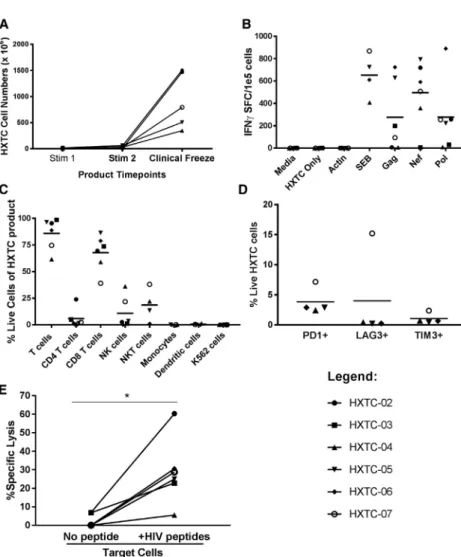
Using this expansion method, HXTCs were readily expanded to numbers sufficient for use in the clinical trial after just two rounds of stimulation in just over 3 weeks (Figure 1A). The total fold expansion starting with bulk lymphocytes ranged from approximately 2.5 logs (04) to greater than 3 logs expansion, in the cases of HXTC-02 and HXTC-06. As previously published, expansion is exponential, with a significant augmentation of expansion following the second stimulation.41,42 HXTCs exhibited specificity for the Gag, Nef, and
Pol peptide pools as measured using interferon gamma (IFNg) ELISpot assays, with negligible nonspecific activity (Figure 1B). The magnitude and breadth of HIV-specific T cell responses within the HXTC product varied among participants. HXTCs from three of the six participants showed T cell responses to all three peptide pools (HXTC-05, -06, and -07), two exhibited T cell responses to two of the three peptide pools (HXTC-02 to Nef and Pol, and HXTC-03 to Gag and Pol), while HXTCs from one participant had a T cell response targeting Nef only (HXTC-04). The median magnitude of T cell responses was 146.0, 237.9, 549.1, and 650.58 IFNgspot-forming centers (SFCs)/105cells to Gag, Pol, Nef, and combined peptide pools, respectively.
HXTCs were predominantly CD8 T cells (median 72%, range 39%– 88%), although natural killer (NK) cells expanded within the HXTCs from some participants, with the largest proportion seen in HXTC-07 (21.8%) and HXTC-04 (36.1%;Figure 1C). As expected, there were no residual dendritic cells or co-stimulatory K562 cells detected at the end of the expansion period (Figure 1C). Despite the two rounds of stimulation, HXTCs displayed detectable but low levels of immune exhaustion markers (Figure 1D).
HXTCs also demonstrated potent cytotoxicity against autologous target cells pulsed with Gag, Pol, and Nef peptide pools in51Cr release assays (Figure 1E). Cytotoxicity was HIV-specific, with negligible51Cr Table 1. Clinical Characteristics and Baseline Reservoir Size
Study ID Age (Years) Sex Race/Ethnicity
Stage ART
Initiateda Nadir CD4 CD4 at Study Entry
Pre-ART
Viral Load Years on ART IUPMb
HXTC-02 50 M Caucasian chronic 168 563 323,000 8 0.21
HXTC-03 35 M Caucasian acute 427 721 24,905 7 <0.02
HXTC-04 65 M Caucasian acute 277 950 14,538,865 9.5 0.90
HXTC-05 53 M Caucasian chronic 174 1,047 635,000 2.5 2.49
HXTC-06 61 F African American chronic 528 943 18,910 1 0.24
HXTC-07 58 M Caucasian chronic 338 816 58,500 6 0.89
All values were taken at the time of screening or baseline leukapheresis.
aAcute HIV infection (AHI) was defined as: (1) a negative or indeterminate enzyme immunoassay (EIA) plus a reproducibly detectable HIV by amplification methods, or (2) a positive
fourth-generation HIV Ag/Ab combination assay and either a negative or indeterminate HIV rapid test or a negative/indeterminate western blot, or (3) a negative HIV RNA test within 45 days of a positive EIA and ART initiation. All others with confirmed HIV infection on ART were defined as having started HIV therapy during chronic infection.
b
release seen when HXTCs were co-cultured with autologous target cells that were not pulsed with any peptide (Figure 1E). Maximum HIV-specific cytotoxicity ranged from approximately 8% specific lysis (HXTC-04) to greater than 60% specific lysis (HXTC-02), with a me-dian cytotoxicity of 24%, at an effector:target (E:T) ratio of 20:1 (
Fig-ure 1E). Little difference was seen at ratios as low as 5:1, except for
HXTC-04, which exhibited a lower maximum cytotoxicity than HXTCs from other participants and did show a dose-dependent cyto-toxicity, with 4% specific lysis at the lowest E:T ratio tested (5:1), up to a maximum of 8% specific lysis at higher E:T ratios.
HXTC Expression of Homing Markers to Gut and Lymph Node Tissues
Homing markers, including integrina4b7, L-selectin (CD62L), and the chemokine receptor CXCR5, were examined to determine whether HXTCs exhibited the potential to home to putative sites of persistent HIV infection, including the B cell follicle and the gut. Memory CD8+T cells (live, dump channel , CD3+, CD4 , CD8+, CD45RO+;
Figure 2A for gating strategy) from three HXTC participants were
eval-uated, chosen based on cell availability. Integrina4b7 was expressed at
Figure 1. Characterization of HXTC Products
(A) HXTC products expanded to clinically relevant levels after two stimulations (n = 6). (B) All HXTC products produced IFNg
in response to HIV Gag, Neg, Pol (GNP) pepmix stimulation, as measured on ELISpot. (C) Product phenotying by flow to show T cells (CD45+
, CD3+
), CD4 T cells (CD3+ CD4+
), CD8+ T cells (CD3+
CD8+
), NK cells (CD3 CD56+ CD16+
), natural killer T (NKT) cells (CD3+
CD56+ CD16+
), monocytes (CD45+
CD14+
), dendritic cells (CD3 CD83+ , HLADR+
), and K562 cells (CD45+
CD562 , CD16 , CD56 , CD32+ , CD83+
). (D) HXTC products displayed minimal exhaustion on CD3+
T cells. (E)51
Chromium cytotoxicity assay shows spe-cific lysis of HXTC products against autologous PHA blast target cells pulsed with no peptides or HIV peptides (gag, nef, pol peptide pools) at an E:T ratio of 20:1. Each data point represents the mean of three technical replicates. *p < 0.05 by Wilcoxon signed rank test.
a range of frequencies on baseline peripheral blood mononuclear cells (PBMCs; mean of 31.25% of memory CD8 T cells, range 12.85%–51.2%), and trended to an increase in frequency in HXTCs (mean 78% of memory CD8 T cells, range 41.4%– 97.5%) (Figure 2B). CD62L and CXCR5 were ex-pressed on a minority of peripheral blood memory T cells (mean 21.1%, range 14.0%–31.3% CD62L+
CD8 memory T cells; mean 2.8%, range 1.2%– 4.2% CXCR5+CD8 memory T cells), and expres-sion either remained stable or trended to a decrease on HXTCs compared with PBMCs (Figure 2B).
HXTC Infusion Was Safe and Well Tolerated
All six participants completed the study proto-col consisting of two HXTC infusions (2 10e7/m2/dose) 2 weeks apart, without dose-limiting toxicity. Overall, the cell infusions were safe and well tolerated. Two participants (HXTC-02 and HXTC-07) had transient, self-limiting fevers and myalgia of DAIDs toxicity grade 1 severity 1 day post-infusion (HXTC-02) and 2 months post-infusion (HXTC-07). One participant (HXTC-07) also experienced a transient increase in viremia above the 40 copies/mL limit of detection 1 month following infusion, with a peak detectable viral load of 80 copies/mL that resolved without inter-vention within 60 days. No other treatment-related adverse events occurred. Other adverse events recorded were not attributable to the HXTC infusion. This included a transient increase in blood pres-sure with the leukapheresis procedure in four of six participants, an expected and well-described effect of the procedure, all at or below grade 3.
Antiviral Activity as Measured by a VIA and Latency Clearance Assay following HXTC Infusion
activated CD4 T cells are spinoculated with the lab-adapted, CCR5 tropic HIV-1 isolate JR-CSF and co-cultured with CD8 T cells at a low E:T ratio of 1:10. A decrease in the p24 production measured in supernatant 6 days later indicates inhibition of viral spread. CD8 T cell performance in this assay may reflect multiple antiviral func-tions, including proliferation, cytokine production, and cytotoxicity, and has been associated with parameters of in vivo viremic con-trol.53 Baseline antiviral activity varied among participants and ranged from modest reduction of p24 production, to 50% of that seen in the absence of CD8 T cell addition, to no reduction
(Figure 3A).
Two participants (HXTC-02, HXTC-07) exhibited a mild to modest and sustained improvement in antiviral activity, with a reduction in the %p24 production in this assay seen as early as 1 week following thefirst infusion (Figures 3A–3F). The improved ability to reduce p24 production was maintained through the last time point measured, 13 weeks following the first infusion (Figures 3A and 3F). However, no impact on antiviral activity was seen in the remain-ing four participants (Figures 3B–3E); in aggregate across all six participants, no significant improvement in antiviral activity was observed following HXTC infusion.
To measure the antiviral activity in an assay with potentially more clinical relevance for participants on ART, during which time HIV antigen exposure is likely rare and at very low levels, we performed latency clearance assays (LCAs).42,54,55 In this assay, autologous
resting CD4 T cells were exposed to vorinostat, a histone deacetylase inhibitor under clinical investigation as a LRA,6,8,9,43,56,57and then co-cultured with CD8 T cells for a discrete 24-hr period. CD8 T cells are then depleted so that reductions in virus recovery are attributed to the discrete co-culture period only, and allogeneic acti-vated CD8-depleted PBMCs are added to amplify any residual rare virus in replicate wells plated under limiting dilution conditions. In two of the six participants, the frequency of latent virus infection
was too low at baseline to perform this assay with the cells available. The participant with the strongest improved CD8 performance in the VIA (HXTC-02) also showed an improved activity of CD8 T cells in the LCA following HXTC infusion, from modest (50%) reduction in virus recovery with co-culture with pre-infusion CD8 T cells to complete ablation of virus recovery with co-culture with post-infusion CD8 T (p = 0.01 by Fisher’s exact test). Although a trend toward reduction was seen for the other three participants, it was not statistically significant due to the low number of positive wells in the control condition (three or fewer positive wells in con-trol condition). The total number of wells plated was restricted due to limited cell availability and the large number of cells required for the assay, a known limitation of the assay,43preventing definitive conclusions from being drawn. The week 13 post-infusion time point evaluated was chosen based on cell availability from the leu-kapheresis procedure; earlier post-infusion time points were not assessed.
The Frequency of HIV-Specific T Cells as Measured by IFNg Release Did Not Change following HXTC Infusion
The impact of HXTC infusion on ex vivo HIV-specific T cell responses was measured by IFN-gELISpot. HIV reactive T cell re-sponses were detectable in all six participants at baseline. No increase or change in T cell specificity was observed following HXTC infusion.
IFNgrelease from T cells in response to clade B consensus peptide pools of Gag, Pol, or Nef was detectable for at least one of the three peptide pools in all six participants at baseline, with a median of 61.5 SFU/105 PBMCs to Gag (Figure 4A), a median of 58.8 SFU/105PBMCs to Pol (Figure 4B), and a median of 47.7 SFU/105 PBMCs to Nef (Figure 4C). Overall, despite the increase in antiviral activity detected in two of the six participants, no significant change in IFNg release to Gag, Nef, or Pol peptide pools was observed when measured at 1, 2, 4, 8, and 13 weeks following thefirst HXTC infusion (results shown for week 13).
Figure 2. Homing Markers of PBMCs and HXTCs
PBMCs and HXTCs from three participants chosen based on cell availability were thawed, rested overnight, and stained for the described cell surface markers. Gating strategy is shown in (A). The % of live, CD8+
Virologic Outcome following HXTC Infusion
We next assayed the frequency of rare, latently infected resting CD4 T cells via the quantitative viral outgrowth assay (QVOA) using maxi-mally activated resting CD4 T cells, as previously described.4Overall, no change in the frequency of latently infected resting CD4 T cells was observed following HXTC infusion, indicating no detectable impact on the latent reservoir (Figure 5A; p = 0.13 by Wilcoxon matched-pairs signed rank test). To assess the effect of HXTC infusion on persistent, residual low-level viremia, we measured the plasma load of HIV using a single-copy assay (SCA) capable of detecting plasma RNA levels lower than 1 copy/mL.58Two baseline SCA values were obtained prior to infusion; then plasma samples were analyzed at weeks 3 and 13 following thefirst infusion. Five of six participants had detectable low-level viremia at baseline, with a median of 2 copies/mL (range 0.74–5.5), consistent with what has been reported.59 No significant change in low-level, residual viremia was detected (
Fig-ure 5B; p = 0.58 by Friedman’s test). High variability of SCA results
for participants from visit to visit was observed and was consistent with results from longitudinal studies of ART-suppressed individ-uals.59The high visit-to-visit variability would prevent detection of
more modest reductions.
DISCUSSION
HXTC infusions were safe and well tolerated in HIV-infected, ART-suppressed individuals, with few mild treatment-related adverse events (grade%1). The safety and tolerability in thisfirst proof-of-concept study for HXTC therapy is consistent with results of previous
clinical trials of adoptively transferred virus-specific T cells, with most studies documenting only grade 1 or 2 adverse events.40
Two of six participants demonstrated an increase in CD8 T cell anti-viral activity against JR-CSF HIV-infected autologous targets in an
ex vivoautologous assay (VIA), although the clinical significance of this mild to modest impact is unknown. Interestingly, these were the participants who reported mildflu-like illnesses following infu-sion. This increase in antiviral activity did not correlate with an in-crease in the apparent frequency of HIV-specific T cells as measured by IFNgrelease following stimulation with Gag, Pol, and Nef peptide pools. This discrepancy may be explained by underlying differences in the assays. IFNgrelease following overnight stimulation measures only one aspect of antiviral function over a short time period. In contrast, VIAs span 6 days of co-culture, and thus may reflect multi-ple antiviral functions including proliferation, cytokine release, and cytotoxicity. HXTC product of the participant with the strongest in-crease in antiviral activity (HXTC-02) did exhibit by far the strongest HIV-specific cytotoxicity. Importantly, antiviral activity as measured in a VIA has been associated within vivoparameters of viremic con-trol;53however, the robustness and utility of such assays in the setting of efforts to clear persistent HIV infection require further study and validation. Further evaluations into the mechanisms underlying this difference in antiviral capacity, including the breadth of HIV-specific responses and functional avidity of the TCRs, will be important to include in analysis if this signal is replicated in larger numbers as additional participants receive HXTC infusions in ongoing studies. Figure 3. Antiviral Activity following HXTC Infusion
Because the majority of the HXTCs were composed of CD8 T cells, CD8 T cells were the focus of analysis in this manuscript. However, additional cell subsets were present in the HXTC product to varying degrees, including NK cells, in particular in two of the participants. This may be a reflection of the use of modified K562 cells during the expansion process. Recent studies have shown that particular NK cell phenotypes and functional signatures have been associated with improved viremic control and lower reservoir sizes,60,61 and
that NK cells are capable of migrating into B cell follicles during sim-ian immunodeficiency virus (SIV) infection,62sparking interest in how to best enhance and employ NK cells for HIV cure.11,62–64 Further investigation into characterizing the NK cells within the product and post-infusion in future studies may bear interesting re-sults to help inform these efforts.
We did not observe any overall enhancement of the magnitude of the HIV-specific immune response, by IFNgrelease or by VIA, when evaluating participants in aggregate. This is not unexpected given the low dose (2 107cells/m2per infusion) of the two infusions
and the absence of in vivo stimulus for expansion of the cells, including the lack of concomitant robust HIV antigen exposure, no pre-infusion lymphodepletion with myeloablative therapy and condi-tioning, and no additional cytokine support that would promote
in vivoexpansion of the cells. Notably, in the EBV setting, increasing the dose beyond the total dose of 4107cells/m2as used in this HIV
study did not translate to an increase in efficacy. This suggests that simply increasing the cell dose may not improve immunologic or
clin-ical impact, and additional strategies to promotein vivoexpansion may be necessary.
The lack of genetic engineering of T cells allows for an attractive safety profile. However, a limitation of this approach is the inability to pre-cisely track the migration, proliferation, and survival of HXTCs
in vivo.Ex vivo-expanded EBV-specific cells expanded under similar conditions were found to survive for over 4 years following infusion in patients with lymphoma, suggesting that HXTC therapy could have similar longevity.38However, extrapolation of these findings from the setting of EBV-mediated lymphoma or hematopoietic stem cell transplant to that of HIV infection is uncertain.
Homing receptor expression on the HXTCs suggests the potential for homing to the gut, due to the high expression of the integrina4b7 that is increased beyond what was seen in memory CD8 T cells of the corresponding PBMCs. Integrin a4b7 expression is known to be increased by up to 2-fold following exposure to supraphysiologic levels of interleukin-7 (IL-7; albeit largely in the naive subpopulation of CD4 and CD8 T cells), as was used in this particular expansion pro-tocol, which may explain the high levels of a4b7 expression.65In contrast, the lymph node homing marker L-selectin (CD62L), which facilitates entry into the lymph node via the high endothelial ve-nules,66and the B cell follicle homing chemokine receptor CXCR5,
which allows T cells to migrate to B cell follicles within the lymph node along a CXCL13 axis,67showed a trend to modest downregula-tion on HXTCs when compared with memory CD8 T cells in PBMC Figure 4. HIV-Specific T Cell Responses following HXTC Infusion by IFNgRelease
PBMCs isolated from leukapheresis products were stimulated with overlapping peptides spanning HIV Clade B Gag (A), Pol (B), or Nef (C) overnight in an ELISpot assay. Resulting IFNgspot-forming units per 1105
counterparts. This is consistent with what was observed in a preclin-ical evaluation of HXTCs.41Although IL-15 has been shown to induce CXCR5 expression68and was included during the HXTC expansion,
it is possible the overall activating signals may have driven down expression of CXCR5 and/or the IL-15 impact was only transient. Future work could include approaches to durably increase CXCR5 expression on the HXTCs, including optimization of the IL-15 expo-sure during the expansion process, among other strategies,69,70to
improve targeting the B cell follicles, a putative site of persistent HIV infection.71It is worth noting, however, that although downre-gulated, the expressions of CD62L and CXCR5 were present; what proportion of the HXTCs homing to lymph nodes is ideal for cure strategies is not yet clear.
As expected with this study design, we did notfind any decrease in the size of the latent reservoir, as measured by QVOA. Additionally, we did not observe any significant change in low-level residual viremia by SCA at weeks 3 and 13 following thefirst infusion. There is the pos-sibility that a modest decline in this measure of persistent HIV infec-tion was unmeasurable given the known visit-to-visitfluctuation in SCA values.4,59However, it is most likely that the lack of an impact on reservoir size was due to the absence of therapies designed to per-turb the latent reservoir and induce recognizable expression of HIV antigen.
A critical question will be whether HXTC therapy in combination with latency reversing agents can deplete the HIV reservoir to an extent that is measurable by current gold standard assays of HIV la-tency. A 6-fold reduction measured by the current QVOA assay would hold relevance for HIV cure strategies.4Preclinical in vitro
studies suggest HXTC with the latency reversing agent vorinostat is a promising approach.42A study of HXTC in combination with vorinostat is currently undergoing evaluation in an ongoing clinical trial (NCT03212989). Should antigen production following LRA exposure prove to be insufficient to drive in vivo expansion of HXTCs, future studies may also need to incorporate strategies such as optimized lymphodepletion therapies or adjunctive cytokine therapy.
MATERIALS AND METHODS
Clinical Protocol
In this phase I single-site study, participants between the ages of 18 and 65 years with a documented history of HIV infection on suppres-sive ART for at least 1 year were eligible. Participants initiating ther-apy during either chronic HIV infection (CHI) or acute HIV infection (AHI) were eligible. AHI was defined as: (1) a negative or indetermi-nate enzyme immunoassay (EIA) plus a reproducibly detectable HIV by amplification methods, or (2) a positive fourth-generation HIV an-tigen/antibody (Ag/Ab) combination assay and either a negative/ indeterminate HIV rapid test or a negative/indeterminate western blot, or (3) a negative HIV RNA test within 45 days of a positive EIA and ART initiation.
Notably, the HIV definitions above are pertinent to the time of diag-nosis and treatment initiation. Active co-infections, such as HBV and HCV, and prior receipt of an HIV vaccine and/or immunotherapy within the past 12 months excluded potential participants. Once enrolled, all participants continued baseline ART, completed a base-line leukapheresis procedure, and received two 2107/m2doses of HXTC infusions 2 weeks apart. The study collected serial blood sam-ples throughout to measure immune response by IFNgELISpot and VIA, and to measure HIV RNA by SCA. Post-infusion assessments, based on the date of thefirst infusion, included a leukapheresis per-formed at week 13 and safety evaluation visits through week 48.
The study was approved by the University of North Carolina, Baylor College of Medicine, and Children’s National Medical Center Institu-tional Biomedical Review Boards, and written informed consent was obtained from each participant.
Generation of HXTCs
HXTCs were generated as previously described.42,72In brief, mono-cytes were isolated from PBMCs by plastic adherence. Dendritic cells were generated using standard cytokine cocktails of IL-4, IL-1b, tumor necrosis factor alpha (TNF-a; R&D Systems, Minne-apolis, MN, USA), IL-6 (Cellgenix, Freiburg, Germany), gran-ulocyte-macrophage colony-stimulating factor (GM-CSF) (Sanofi, Figure 5. Neither the Latent HIV Reservoir Nor Residual Viremia Decreased following HXTC Infusion
and Integrin-b7 PE (FIB27) from BioLegend (San Diego, CA, USA). A live/dead exclusion marker (Zombie Aqua; BioLegend) and staining for exclusion markers (CD16, 3G8, CD56, HCD56, CD14, M5E2,gd, B1, CD19, HIB19-BV510; BioLegend) were also employed. Samples were analyzed on a BD LSRFortessa Flow Cytom-eter (BD Biosciences).
Samples were run in parallel with appropriately labeled isotype-matched antibodies and FMOs for gating strategies. Data were analyzed with FlowJo Software (FlowJo, Ashland, OR, USA).
51Chromium Cytotoxicity Assay
The cytolytic activity of HXTCs was assessed in51Cr sodium chro-mate (CCS) (51Cr)-release assays 10 days after thefinal stimulation.
Untreated autologous PHA blasts (negative control) or PHA blasts pulsed with Gag, Nef, and Pol pepmixes (JPT) were labeled with CCS for 1 hr at 37C, washed, and resuspended with HXTCs at E:T ratios from 40:1 to 5:1 and incubated for 4–8 hr. Spontaneous lysis was determined by measuring51Cr release from target cells into the
supernatant using a MicroBeta2 gamma counter (Perkin Elmer, Wal-tham, MA, USA) in the absence of effectors. Maximum lysis was measured by addition of 1% Triton X-100 (Sigma-Aldrich) to target cells during the 4- to 8-hr incubation. Specific lysis was calculated as follows: Specific lysis % = (experimental release spontaneous release)/(maximum release spontaneous release)100.
VIA
PBMCs were isolated from participants by peripheral blood draws at the indicated time points by Ficoll isolation. PBMCs were frozen and batched to allow all time points from each participant to be run simul-taneously. CD8 T cells were isolated from PBMCs by positive selec-tion (EasySep human CD8 Selecselec-tion Kit; STEMCELL, Cambridge, MA, USA). CD8-depleted PBMCs were preactivated with 2mg/mL PHA (Remel, Lenexa, KS, USA) and 60 U/mL IL-2, and spinoculated at 2,500 rpm for 90 min with JR-CSF at an MOI of 0.005. A total of 5 104 targets/well was plated in quadruplicate and co-cultured
with HXTCs (E:T ratio of 1:10), autologous unexpanded CD8 T cells ( E:T ratio of 1:10), or no effectors, in 0.2 mL of RPMI 1640 media supplemented with 10% FBS, 1% penicillin/streptomycin, and 5 U/mL IL-2. Supernatant was assayed on day 6 by p24 ELISA (ABL, Rockville, MD, USA). Results were calculated as %p24 produc-tion, normalized to the p24 supernatant concentration in the condi-tion with no effector cells [(concentracondi-tion p24 in effector wells)/(con-centration p24 in control well)*100].
LCA
The LCA was performed as previously described.42,54,55 In brief, resting CD4 T cells were isolated from a leukapheresis product by negative selection and exposed to vorinostat (VOR) (335n; gift of Merck Research Laboratories, Kenilworth, NJ, USA) at a concentra-tion of 5 million/mL in the presence of the antiretrovirals abacavir (4mM; gift of Glaxo SmithKline, Philadelphia, PA, USA) and raltegra-vir (1mM; gift of Merck Research Laboratories, Kenilworth, NJ, USA). After 6 hr, cells were extensively washed, and CD8 T cells were added Bridgewater,NJ,USA),andprostaglandinE1(PGE-1)(Pfizer,New
York, NY, USA). Non-adherent PBMCs were cryopreserved and thawed upon completion of dendritic cell maturation. PBMCs were stimulated with irradiated autologous dendritic cells pulsed with Gag, Pol, and Nef peptide pools in the presence of IL-7, IL-12 (R&D Systems), andIL-15 (Cellgenix) forthefirst stimula-tion. Cells were then co-cultured with autologous PHA-treated blastspulsedwithGag,Pol,andNef peptidepoolsinthepresence ofIL-15(Cellgenix)forsecondstimulationandIL-2(Prometheus, SanDiego,CA,USA)fortheoptionalthirdstimulation.HIV pep-tide pools comprised overlapping 15-mer peptides by 11 amino acids, providingcoverage ofGagp24,Pol, andNef across HIV-1 clades (JPT Peptide Technologies, Acton, MA, USA). Irradiated K562 cells(kindgiftofCellMedica, UK)modifiedtooverexpress the co-stimulatory molecules CD80, CD83, CD86, and 4-1BBL wereusedinthesecondstimulationandintheoptionalthird stim-ulation. Expansions were performed in the presence of indinavir andraltegravir(Merck,Kenilworth,NJ,USA)topreventreplication ofHIV.
IFNg ELISpot Assays
ParticipantPBMCs,cryopreservedatthedesignatedtimepoints pre-andpost-infusion,orHXTCsasindicated,werethawedandrested overnightfor16–24hrinRPMI1640with10%fetalbovineserum (FBS)and1%glutamine.Cellswerethenharvested,recounted,and platedat4105cells/wellinquadruplicate(PBMCs)or1105in triplicate(HXTCs)andstimulatedwitheitherGag,Pol,orNef pep-tidepools(NIHAIDSReagentRepository,Bethesda,MD,USA)at afinalconcentrationof2mg/mLfor18–20hr.Foreachassay,atleast fournegativecontrolwells(nopeptide,‘Mock,’oractin,withHXTC evaluations)andtwopositivecontrolwells(PHAatafinal concentra-tionof10mg/mL,forPBMCtests,andstaphylococcalenterotoxinB (SEB) forHXTC evaluation; Sigma-Aldrich, St. Louis, MO,USA) were included. ForPBMCs, athreshold of 4 Mock and greater than5SFU/105wasusedtodeterminepositiveresponses,as previ-ouslyreportedbyothers.14,43,73 ForHXTCs,athresholdof4 nega-tive control,actin SFU,and greaterthan 50SFU/105wasused to determinepositiveresponses.
FlowCytometricAnalysis
at an E:T ratio of 1:10. Antiretrovirals were again added, and cells were co-cultured at a concentration of 5 million resting CD4 T cells/mL. After 24 hr, cells were extensively washed and depleted of CD8 T cells via three serial magnetic selections (STEMCELL Tech-nologies, Vancouver, BC, Canada). Remaining CD4 T cells were recounted, then plated in 16–48 replicate wells at 0.25–1 million cells/well (depending on cell availability and reservoir size) and cultured with allogeneic CD8-depleted PBMCs from an HIV-negative donor to amplify any residual virus. The presence of HIVGagp24 an-tigen was measured on day 15 and confirmed on day 19 for each well by ELISA (ABL, Rockville, MD, USA). Each LCA was performed at an independent time point.
Quantitative Viral Outgrowth Assay
Lymphocytes were obtained by continuous-flow leukapheresis. Isola-tion of resting CD4 T cells and recovery and quantification of repli-cation-competent virus were performed as described previously.45 In brief, approximately 34–49 million resting CD4 T cells were plated in replicate-limiting dilutions of 2.5 million (12–18 cultures in 6-well plates), 0.5 million (6 cultures in 12-well plates), and 0.1 million (6 cultures in 12-well plates) cells per well, activated with PHA (Remel, Lenexa, KS, USA) and a 5-fold excess of allogeneic irradiated PBMCs from a seronegative donor and 60 U/mL IL-2 for 24 hr. Cul-tures were washed and co-cultivated with CD8-depleted PBMCs collected from selected HIV-seronegative donors screened for adequate CCR5 expression. Culture supernatants were harvested on days 15 and 19, and assayed for virus production by HIV p24 antigen capture ELISA (ABL, Rockville, MD, USA). Cultures were scored as positive if p24 was detected at day 15 and was increased in concentra-tion at day 19. The number of resting CD4 T cells in IUPM was esti-mated by a maximum likelihood method.74,75
Statistical Analysis
Statistical comparisons between groups were analyzed using the Wil-coxon signed rank test or Friedman’s test with posttest correction for multiple comparisons when results were taken in aggregate across participants. Significance for each individual participant was analyzed using a Dunnett’s test with posttest correction for multiple compari-sons (VIA) or Fisher’s exact test (LCA). p < 0.05 was considered significant.
SUPPLEMENTAL INFORMATION
Supplemental Information includes onefigure and one table and can be found with this article online athttps://doi.org/10.1016/j.ymthe.
2018.08.015.
AUTHOR CONTRIBUTIONS
J.A.S. and S.P. designed, performed, and analyzed results of experi-ments with assistance from M.L.C. and input from D.M.M., N.G., N.A., and C.M.B. S.P., L.R., T.T., P.J.H., C.R.C., C.M.R., and C.M.B. were responsible for designing and performing expansions of cells. J.A.S., J.D.K., C.L.G., J.J.E., and D.M.M. were responsible for writing, overseeing, and implementing the study protocol. All authors contributed to the writing and editing of the manuscript.
CONFLICTS OF INTEREST The authors have no conflicts of interest.
ACKNOWLEDGMENTS
We thank B. Allard, J. Kirchherr, E. Steulke, and K. Sholtis for tech-nical assistance; F. Maldarelli and R. Gorelick at NCI Frederick for the HIV RNA single-copy assay; M. Hudgens and K. Mollan for statistical advice; Y. Park and the UNC Blood Bank for apheresis management; and Amanda Crooks for participant coordination. We thank Cell Medica for their kind gift of the K562 cell line. We would like to thank all of our study participants for their donations to this research. This work was supported by NIH grant R01 HL132791 (to D.M.M. and C.M.B.), amfAR grant 108839-55-RGRL (to C.G.), NIH grant UM1AI126619 (to D.M.M.), NIH grant KL2 TR001109 (to J.M.S.), P30 CA016086 Cancer Center Core Support Grant to the UNC Line-berger Comprehensive Cancer Center for the UNC Flow Cytometry Core Facility, NIH grant P30 AI50410, and NIH-NHLBI Production Assistance for Cell Therapy (PACT) grant NHLB1-N01 HB37163 to Baylor College of Medicine.
REFERENCES
1.Chun, T.W., Carruth, L., Finzi, D., Shen, X., DiGiuseppe, J.A., Taylor, H., Hermankova, M., Chadwick, K., Margolick, J., Quinn, T.C., et al. (1997). Quantification of latent tissue reservoirs and total body viral load in HIV-1 infection. Nature387, 183–188.
2.Chun, T.W., Finzi, D., Margolick, J., Chadwick, K., Schwartz, D., and Siliciano, R.F. (1995). In vivo fate of HIV-1-infected T cells: quantitative analysis of the transition to stable latency. Nat. Med.1, 1284–1290.
3.Chun, T.W., Stuyver, L., Mizell, S.B., Ehler, L.A., Mican, J.A., Baseler, M., Lloyd, A.L., Nowak, M.A., and Fauci, A.S. (1997). Presence of an inducible HIV-1 latent reservoir during highly active antiretroviral therapy. Proc. Natl. Acad. Sci. USA94, 13193– 13197.
4.Crooks, A.M., Bateson, R., Cope, A.B., Dahl, N.P., Griggs, M.K., Kuruc, J.D., Gay, C.L., Eron, J.J., Margolis, D.M., Bosch, R.J., and Archin, N.M. (2015). Precise quan-titation of the latent HIV-1 reservoir: implications for eradication strategies. J. Infect. Dis.212, 1361–1365.
5.Siliciano, J.D., Kajdas, J., Finzi, D., Quinn, T.C., Chadwick, K., Margolick, J.B., Kovacs, C., Gange, S.J., and Siliciano, R.F. (2003). Long-term follow-up studies confirm the stability of the latent reservoir for HIV-1 in resting CD4+ T cells. Nat. Med.9, 727–728.
6.Archin, N.M., Bateson, R., Tripathy, M.K., Crooks, A.M., Yang, K.H., Dahl, N.P., Kearney, M.F., Anderson, E.M., Coffin, J.M., Strain, M.C., et al. (2014). HIV-1 expres-sion within resting CD4+ T cells after multiple doses of vorinostat. J. Infect. Dis.210, 728–735.
7.Archin, N.M., Espeseth, A., Parker, D., Cheema, M., Hazuda, D., and Margolis, D.M. (2009). Expression of latent HIV induced by the potent HDAC inhibitor suberoyla-nilide hydroxamic acid. AIDS Res. Hum. Retroviruses25, 207–212.
8.Archin, N.M., Kirchherr, J.L., Sung, J.A., Clutton, G., Sholtis, K., Xu, Y., Allard, B., Stuelke, E., Kashuba, A.D., Kuruc, J.D., et al. (2017). Interval dosing with the HDAC inhibitor vorinostat effectively reverses HIV latency. J. Clin. Invest.127, 3126–3135.
9.Archin, N.M., Liberty, A.L., Kashuba, A.D., Choudhary, S.K., Kuruc, J.D., Crooks, A.M., Parker, D.C., Anderson, E.M., Kearney, M.F., Strain, M.C., et al. (2012). Administration of vorinostat disrupts HIV-1 latency in patients on antiretroviral therapy. Nature487, 482–485.
11.Archin, N.M., Sung, J.M., Garrido, C., Soriano-Sarabia, N., and Margolis, D.M. (2014). Eradicating HIV-1 infection: seeking to clear a persistent pathogen. Nat. Rev. Microbiol.12, 750–764.
12.Barry, A.P., Silvestri, G., Safrit, J.T., Sumpter, B., Kozyr, N., McClure, H.M., Staprans, S.I., and Feinberg, M.B. (2007). Depletion of CD8+ cells in sooty mangabey monkeys naturally infected with simian immunodeficiency virus reveals limited role for immune control of virus replication in a natural host species. J. Immunol.178, 8002–8012.
13.Cartwright, E.K., Spicer, L., Smith, S.A., Lee, D., Fast, R., Paganini, S., Lawson, B.O., Nega, M., Easley, K., Schmitz, J.E., et al. (2016). CD8(+) lymphocytes are required for maintaining viral suppression in SIV-infected macaques treated with short-term an-tiretroviral therapy. Immunity45, 656–668.
14.Goonetilleke, N., Liu, M.K., Salazar-Gonzalez, J.F., Ferrari, G., Giorgi, E., Ganusov, V.V., Keele, B.F., Learn, G.H., Turnbull, E.L., Salazar, M.G., et al.; CHAVI Clinical Core B (2009). Thefirst T cell response to transmitted/founder virus contributes to the control of acute viremia in HIV-1 infection. J. Exp. Med.206, 1253–1272.
15.Chun, T.W., Davey, R.T., Jr., Engel, D., Lane, H.C., and Fauci, A.S. (1999). Re-emer-gence of HIV after stopping therapy. Nature401, 874–875.
16.Davey, R.T., Jr., Bhat, N., Yoder, C., Chun, T.W., Metcalf, J.A., Dewar, R., Natarajan, V., Lempicki, R.A., Adelsberger, J.W., Miller, K.D., et al. (1999). HIV-1 and T cell dy-namics after interruption of highly active antiretroviral therapy (HAART) in patients with a history of sustained viral suppression. Proc. Natl. Acad. Sci. USA96, 15109– 15114.
17.Shan, L., Deng, K., Shroff, N.S., Durand, C.M., Rabi, S.A., Yang, H.C., Zhang, H., Margolick, J.B., Blankson, J.N., and Siliciano, R.F. (2012). Stimulation of HIV-1-spe-cific cytolytic T lymphocytes facilitates elimination of latent viral reservoir after virus reactivation. Immunity36, 491–501.
18.Deng, K., Pertea, M., Rongvaux, A., Wang, L., Durand, C.M., Ghiaur, G., Lai, J., McHugh, H.L., Hao, H., Zhang, H., et al. (2015). Broad CTL response is required to clear latent HIV-1 due to dominance of escape mutations. Nature517, 381–385.
19.Papuchon, J., Pinson, P., Lazaro, E., Reigadas, S., Guidicelli, G., Taupin, J.L., Neau, D., and Fleury, H.; Provir/Latitude 45 project (2013). Resistance mutations and CTL epi-topes in archived HIV-1 DNA of patients on antiviral treatment: toward a new concept of vaccine. PLoS ONE8, e69029.
20.Hancock, G., Yang, H., Yorke, E., Wainwright, E., Bourne, V., Frisbee, A., Payne, T.L., Berrong, M., Ferrari, G., Chopera, D., et al. (2015). Identification of effective subdom-inant anti-HIV-1 CD8+ T cells within entire post-infection and post-vaccination im-mune responses. PLoS Pathog.11, e1004658.
21.Mothe, B., Llano, A., Ibarrondo, J., Daniels, M., Miranda, C., Zamarreño, J., Bach, V., Zuniga, R., Pérez-Álvarez, S., Berger, C.T., et al. (2011). Definition of the viral targets of protective HIV-1-specific T cell responses. J. Transl. Med.9, 208.
22.Lam, S., and Bollard, C. (2013). T-cell therapies for HIV. Immunotherapy5, 407–414. 23.Koenig, S., Conley, A.J., Brewah, Y.A., Jones, G.M., Leath, S., Boots, L.J., Davey, V., Pantaleo, G., Demarest, J.F., Carter, C., et al. (1995). Transfer of HIV-1-specific cyto-toxic T lymphocytes to an AIDS patient leads to selection for mutant HIV variants and subsequent disease progression. Nat. Med.1, 330–336.
24.Lieberman, J., Skolnik, P.R., Parkerson, G.R., 3rd, Fabry, J.A., Landry, B., Bethel, J., and Kagan, J. (1997). Safety of autologous, ex vivo-expanded human immunodefi -ciency virus (HIV)-specific cytotoxic T-lymphocyte infusion in HIV-infected pa-tients. Blood90, 2196–2206.
25.Chapuis, A.G., Casper, C., Kuntz, S., Zhu, J., Tjernlund, A., Diem, K., Turtle, C.J., Cigal, M.L., Velez, R., Riddell, S., et al. (2011). HIV-specific CD8+ T cells from HIV+ individuals receiving HAART can be expanded ex vivo to augment systemic and mucosal immunity in vivo. Blood117, 5391–5402.
26.Brodie, S.J., Lewinsohn, D.A., Patterson, B.K., Jiyamapa, D., Krieger, J., Corey, L., Greenberg, P.D., and Riddell, S.R. (1999). In vivo migration and function of trans-ferred HIV-1-specific cytotoxic T cells. Nat. Med.5, 34–41.
27.Tan, R., Xu, X., Ogg, G.S., Hansasuta, P., Dong, T., Rostron, T., Luzzi, G., Conlon, C.P., Screaton, G.R., McMichael, A.J., and Rowland-Jones, S. (1999). Rapid death of adoptively transferred T cells in acquired immunodeficiency syndrome. Blood
93, 1506–1510.
28.Leen, A.M., Myers, G.D., Sili, U., Huls, M.H., Weiss, H., Leung, K.S., Carrum, G., Krance, R.A., Chang, C.C., Molldrem, J.J., et al. (2006). Monoculture-derived T
lym-phocytes specific for multiple viruses expand and produce clinically relevant effects in immunocompromised individuals. Nat. Med.12, 1160–1166.
29.Hanley, P.J., Cruz, C.R., Savoldo, B., Leen, A.M., Stanojevic, M., Khalil, M., Decker, W., Molldrem, J.J., Liu, H., Gee, A.P., et al. (2009). Functionally active virus-specific T cells that target CMV, adenovirus, and EBV can be expanded from naive T-cell populations in cord blood and will target a range of viral epitopes. Blood114, 1958–1967.
30.Hanley, P.J., Lam, S., Shpall, E.J., and Bollard, C.M. (2012). Expanding cytotoxic T lymphocytes from umbilical cord blood that target cytomegalovirus, Epstein-Barr virus, and adenovirus. J. Vis. Exp. (63), e3627.
31.Hanley, P.J., Melenhorst, J.J., Nikiforow, S., Scheinberg, P., Blaney, J.W., Demmler-Harrison, G., Cruz, C.R., Lam, S., Krance, R.A., Leung, K.S., et al. (2015). CMV-spe-cific T cells generated from naïve T cells recognize atypical epitopes and may be protective in vivo. Sci. Transl. Med.7, 285ra63.
32.Dave, H., Luo, M., Blaney, J.W., Patel, S., Barese, C., Cruz, C.R., Shpall, E.J., Bollard, C.M., and Hanley, P.J. (2017). Toward a rapid production of multivirus-specific T cells targeting BKV, adenovirus, CMV, and EBV from umbilical cord blood. Mol. Ther. Methods Clin. Dev.5, 13–21.
33.Boeckh, M., and Corey, L. (2017). Adoptive Immunotherapy of Viral Infections: Should Infectious Disease Embrace Cellular Immunotherapy? J. Infect. Dis.216, 926–928.
34.Papadopoulou, A., Gerdemann, U., Katari, U.L., Tzannou, I., Liu, H., Martinez, C., Leung, K., Carrum, G., Gee, A.P., Vera, J.F., et al. (2014). Activity of broad-spectrum T cells as treatment for AdV, EBV, CMV, BKV, and HHV6 infections after HSCT. Sci. Transl. Med.6, 242ra83.
35.Bollard, C.M. (2013). Improving T-cell therapy for epstein-barr virus lymphoproli-ferative disorders. J. Clin. Oncol.31, 5–7.
36.Bollard, C.M., and Barrett, A.J. (2014). Cytotoxic T lymphocytes for leukemia and lymphoma. Hematology Am. Soc. Hematol. Educ. Program2014, 565–569.
37.Bollard, C.M., Gottschalk, S., Huls, M.H., Molldrem, J., Przepiorka, D., Rooney, C.M., and Heslop, H.E. (2006). In vivo expansion of LMP 1- and 2-specific T-cells in a pa-tient who received donor-derived EBV-specific T-cells after allogeneic stem cell transplantation. Leuk. Lymphoma47, 837–842.
38.Bollard, C.M., Gottschalk, S., Torrano, V., Diouf, O., Ku, S., Hazrat, Y., Carrum, G., Ramos, C., Fayad, L., Shpall, E.J., et al. (2014). Sustained complete responses in pa-tients with lymphoma receiving autologous cytotoxic T lymphocytes targeting Epstein-Barr virus latent membrane proteins. J. Clin. Oncol.32, 798–808.
39.Bollard, C.M., Rooney, C.M., and Heslop, H.E. (2012). T-cell therapy in the treatment of post-transplant lymphoproliferative disease. Nat. Rev. Clin. Oncol.9, 510–519.
40.Cruz, C.R., Hanley, P.J., Liu, H., Torrano, V., Lin, Y.F., Arce, J.A., Gottschalk, S., Savoldo, B., Dotti, G., Louis, C.U., et al. (2010). Adverse events following infusion of T cells for adoptive immunotherapy: a 10-year experience. Cytotherapy 12, 743–749.
41.Lam, S., Sung, J., Cruz, C., Castillo-Caro, P., Ngo, M., Garrido, C., Kuruc, J., Archin, N., Rooney, C., Margolis, D., and Bollard, C. (2015). Broadly-specific cytotoxic T cells targeting multiple HIV antigens are expanded from HIV+ patients: implications for immunotherapy. Mol. Ther.23, 387–395.
42.Sung, J.A., Lam, S., Garrido, C., Archin, N., Rooney, C.M., Bollard, C.M., and Margolis, D.M. (2015). Expanded cytotoxic T-cell lymphocytes target the latent HIV reservoir. J. Infect. Dis.212, 258–263.
43.Sung, J., Sholtis, K., Kirchherr, J., Kuruc, J., Gay, C., Nordstrom, J., Bollard, C., Archin, N., and Margolis, D. (2017). Vorinostat renders the replication-competent latent reservoir of human immunodeficiency virus (HIV) vulnerable to clearance by CD8 T cells. EBioMedicine23, 52–58.
44.McKellar, M.S., Cope, A.B., Gay, C.L., McGee, K.S., Kuruc, J.D., Kerkau, M.G., Hurt, C.B., Fiscus, S.A., Ferrari, G., Margolis, D.M., et al.; Duke-Unc Acute HIV Infection Consortium (2013). Acute HIV-1 infection in the Southeastern United States: a cohort study. AIDS Res. Hum. Retroviruses29, 121–128.
46.Prentice, H.A., Porter, T.R., Price, M.A., Cormier, E., He, D., Farmer, P.K., Kamali, A., Karita, E., Lakhi, S., Sanders, E.J., et al.; IAVI African HIV Research Network (2013). HLA-B*57 versus HLA-B*81 in HIV-1 infection: slow and steady wins the race? J. Virol.87, 4043–4051.
47.Leslie, A., Matthews, P.C., Listgarten, J., Carlson, J.M., Kadie, C., Ndung’u, T., Brander, C., Coovadia, H., Walker, B.D., Heckerman, D., and Goulder, P.J. (2010). Additive contribution of HLA class I alleles in the immune control of HIV-1 infec-tion. J. Virol.84, 9879–9888.
48.Tang, J., Malhotra, R., Song, W., Brill, I., Hu, L., Farmer, P.K., Mulenga, J., Allen, S., Hunter, E., and Kaslow, R.A. (2010). Human leukocyte antigens and HIV type 1 viral load in early and chronic infection: predominance of evolving relationships. PLoS ONE5, e9629.
49.Matthews, P.C., Adland, E., Listgarten, J., Leslie, A., Mkhwanazi, N., Carlson, J.M., Harndahl, M., Stryhn, A., Payne, R.P., Ogwu, A., et al. (2011). HLA-A*7401-mediated control of HIV viremia is independent of its linkage disequilibrium with HLA-B*5703. J. Immunol.186, 5675–5686.
50.Goulder, P.J., and Walker, B.D. (2012). HIV and HLA class I: an evolving relation-ship. Immunity37, 426–440.
51.Pereyra, F., Jia, X., McLaren, P.J., Telenti, A., de Bakker, P.I., Walker, B.D., Ripke, S., Brumme, C.J., Pulit, S.L., Carrington, M., et al.; International HIV Controllers Study (2010). The major genetic determinants of HIV-1 control affect HLA class I peptide presentation. Science330, 1551–1557.
52.Fellay, J., Ge, D., Shianna, K.V., Colombo, S., Ledergerber, B., Cirulli, E.T., Urban, T.J., Zhang, K., Gumbs, C.E., Smith, J.P., et al.; NIAID Center for HIV/AIDS Vaccine Immunology (CHAVI) (2009). Common genetic variation and the control of HIV-1 in humans. PLoS Genet.5, e1000791.
53.Yang, H., Wu, H., Hancock, G., Clutton, G., Sande, N., Xu, X., Yan, H., Huang, X., Angus, B., Kuldanek, K., et al. (2012). Antiviral inhibitory capacity of CD8+ T cells predicts the rate of CD4+ T-cell decline in HIV-1 infection. J. Infect. Dis.206, 552–561.
54.Sung, J.A., Pickeral, J., Liu, L., Stanfield-Oakley, S.A., Lam, C.Y., Garrido, C., Pollara, J., LaBranche, C., Bonsignori, M., Moody, M.A., et al. (2015). Dual-affinity re-target-ing proteins direct T cell-mediated cytolysis of latently HIV-infected cells. J. Clin. Invest.125, 4077–4090.
55.Sung, J.A., Sholtis, K., Kirchherr, J., Kuruc, J.D., Gay, C.L., Nordstrom, J.L., Bollard, C.M., Archin, N.M., and Margolis, D.M. (2017). Vorinostat renders the replication-competent latent reservoir of human immunodeficiency virus (HIV) vulnerable to clearance by CD8 T cells. EBioMedicine23, 52–58.
56.Barton, K.M., Archin, N.M., Keedy, K.S., Espeseth, A.S., Zhang, Y.L., Gale, J., Wagner, F.F., Holson, E.B., and Margolis, D.M. (2014). Selective HDAC inhibition for the disruption of latent HIV-1 infection. PLoS ONE9, e102684.
57.Wu, G., Swanson, M., Talla, A., Graham, D., Strizki, J., Gorman, D., Barnard, R.J., Blair, W., Søgaard, O.S., Tolstrup, M., et al. (2017). HDAC inhibition induces HIV-1 protein and enables immune-based clearance following latency reversal. JCI Insight2, e92901.
58.Palmer, S., Wiegand, A.P., Maldarelli, F., Bazmi, H., Mican, J.M., Polis, M., Dewar, R.L., Planta, A., Liu, S., Metcalf, J.A., et al. (2003). New real-time reverse transcrip-tase-initiated PCR assay with single-copy sensitivity for human immunodeficiency virus type 1 RNA in plasma. J. Clin. Microbiol.41, 4531–4536.
59.Palmer, S., Maldarelli, F., Wiegand, A., Bernstein, B., Hanna, G.J., Brun, S.C., Kempf, D.J., Mellors, J.W., Coffin, J.M., and King, M.S. (2008). Low-level viremia persists for at least 7 years in patients on suppressive antiretroviral therapy. Proc. Natl. Acad. Sci. USA105, 3879–3884.
60.Marras, F., Casabianca, A., Bozzano, F., Ascierto, M.L., Orlandi, C., Di Biagio, A., Pontali, E., Dentone, C., Orofino, G., Nicolini, L., et al. (2017). Control of the HIV-1 DNA reservoir is associated in vivo andin vitro with NKp46/NKp30
(CD335 CD337) inducibility and interferon gamma production by transcriptionally unique NK cells. J. Virol.91, e00647-17.
61.Olesen, R., Vigano, S., Rasmussen, T.A., Søgaard, O.S., Ouyang, Z., Buzon, M., Bashirova, A., Carrington, M., Palmer, S., Brinkmann, C.R., et al. (2015). Innate immune activity correlates with CD4 T cell-associated HIV-1 DNA decline during latency-reversing treatment with panobinostat. J. Virol.89, 10176–10189.
62.Huot, N., Jacquelin, B., Garcia-Tellez, T., Rascle, P., Ploquin, M.J., Madec, Y., Reeves, R.K., Derreudre-Bosquet, N., and Müller-Trutwin, M. (2017). Natural killer cells migrate into and control simian immunodeficiency virus replication in lymph node follicles in African green monkeys. Nat. Med.23, 1277–1286.
63.Garrido, C., Abad-Fernandez, M., Tuyishime, M., Pollara, J.J., Ferrari, G., Soriano-Sarabia, N., and Margolis, D.M. (2018). Interleukin-15-stimulated natural killer cells clear HIV-1-infected cells following latency reversalex vivo. J. Virol.92, e00235-18.
64.Riley, J.L., and Montaner, L.J. (2017). Cell-mediated immunity to target the persistent human immunodeficiency virus reservoir. J. Infect. Dis.215(Suppl_3), S160–S171.
65.Cimbro, R., Vassena, L., Arthos, J., Cicala, C., Kehrl, J.H., Park, C., Sereti, I., Lederman, M.M., Fauci, A.S., and Lusso, P. (2012). IL-7 induces expression and acti-vation of integrina4b7 promoting naive T-cell homing to the intestinal mucosa. Blood120, 2610–2619.
66.Weninger, W., Crowley, M.A., Manjunath, N., and von Andrian, U.H. (2001). Migratory properties of naive, effector, and memory CD8(+) T cells. J. Exp. Med.
194, 953–966.
67.Breitfeld, D., Ohl, L., Kremmer, E., Ellwart, J., Sallusto, F., Lipp, M., and Förster, R. (2000). Follicular B helper T cells express CXC chemokine receptor 5, localize to B cell follicles, and support immunoglobulin production. J. Exp. Med.192, 1545–1552.
68.Perera, L.P., Goldman, C.K., and Waldmann, T.A. (1999). IL-15 induces the expres-sion of chemokines and their receptors in T lymphocytes. J. Immunol.162, 2606–
2612.
69.Ayala, V.I., Deleage, C., Trivett, M.T., Jain, S., Coren, L.V., Breed, M.W., Kramer, J.A., Thomas, J.A., Estes, J.D., Lifson, J.D., and Ott, D.E. (2017). CXCR5-dependent entry of CD8 T cells into Rhesus macaque B-cell follicles achieved through T-cell engineer-ing. J. Virol.91, e02507-16.
70.Haran, K.P., Hajduczki, A., Pampusch, M.S., Mwakalundwa, G., Vargas-Inchaustegui, D.A., Rakasz, E.G., Connick, E., Berger, E.A., and Skinner, P.J. (2018). Simian immunodeficiency virus (SIV)-specific chimeric antigen receptor-T cells engineered to target B cell follicles and suppress SIV replication. Front. Immunol.9, 492.
71.Fukazawa, Y., Lum, R., Okoye, A.A., Park, H., Matsuda, K., Bae, J.Y., Hagen, S.I., Shoemaker, R., Deleage, C., Lucero, C., et al. (2015). B cell follicle sanctuary permits persistent productive simian immunodeficiency virus infection in elite controllers. Nat. Med.21, 132–139.
72.Lam, S., Sung, J., Cruz, C., Castillo-Caro, P., Ngo, M., Garrido, C., Kuruc, J., Archin, N., Rooney, C., Margolis, D., and Bollard, C. (2015). Broadly-specific cytotoxic T cells targeting multiple HIV antigens are expanded from HIV+ patients: implications for immunotherapy. Mol. Ther.23, 387–395.
73.Goonetilleke, N., Moore, S., Dally, L., Winstone, N., Cebere, I., Mahmoud, A., Pinheiro, S., Gillespie, G., Brown, D., Loach, V., et al. (2006). Induction of multifunc-tional human immunodeficiency virus type 1 (HIV-1)-specific T cells capable of pro-liferation in healthy subjects by using a prime-boost regimen of DNA- and modified vaccinia virus Ankara-vectored vaccines expressing HIV-1 Gag coupled to CD8+ T-cell epitopes. J. Virol.80, 4717–4728.
74.Macken, C. (1999). Design and analysis of serial limiting dilution assays with small sample sizes. J. Immunol. Methods222, 13–29.