International Journal of Advances in Management and Economics
Available online at:
www.managementjournal.info
RESEARCH ARTICLE
Managing Local Government Performance in Italy: Issues,
Assessment Criteria and Perspectives
Adalberto Rangone
1*, Francesco Paolone
21Department of Economics and Management, University of Pavia, Pavia, ItalyVia San Felice, 5, 27100 Pavia.
2Department of Accounting and Business Administration, Parthenope University, Naples Italy. Via Generale Parisi, 13, 80132 Naples.
*Corresponding Author: Adalberto Rangone
Abstract
In Italy local governments are still a vivid reality, witness of the interaction between the process of globalization and globalization. The contribution that local governments generate to improve the local welfare is inexorably tied to performance levels that involve both governance frameworks as well as managerial choices. These considerations lead to precise control systems to be accomplished both internally – concerning the management of the available resources – and externally through a careful monitoring of investee companies and stakeholders’ needs. Given the heterogeneity of the topic, this work aims to investigate how the performance of local governments can be improved by increasing internal and external control. Such a connection makes it possible to clarify the concatenation between performance and governance structure of the local governments and, ultimately, their governance and local welfare considered as immediate evaluation criterion.
Keywords: Public management, Performance management, Local government, Public governance, Local welfare.
Subject classification codes: H72 – H83 – M40
Brief Considerations on the Normative Context
In order to introduce the analysis on the operational and governance systems of local governments we deem proper making some notes on influence exerted by European and national legislation. At supranational level the European Union is a source of regulations and directives but also a source of subsidy for economic and social development initiatives. For the numerous chances local government bodies have geared up to get a direct contact with the European Union, aiming for a better representation of the local needs.
However, although they’re less noticeable, also the influences by other international institutions can be observed: in example the World Trade Organization that involves significant influences for local economic development [1].Nationally instead, being the influence dictated essentially by economic and political principles, it is conferred by the
continuous and changing legislation concerning the relationship between the peripheral and central power, as well as between regional and provincial levels. By virtue of this process local governments (identified by the Legislative Decree No. 267 of August 18, 2000) take on strategic importance as interlocutors.
The relevant position they assumed in the economic and political context - profoundly marked by global processes - has led to a more assiduous control on them. Initially the Legislative Decree No. 286/1999 disposed precise controls in relation to:
Administrative and accounting regularity;
Evaluation and strategic control;
Administrative management efficiency;
This system allowed to encounter important gaps concerning the solutions active in local governments, thus about their governance as well as about the fulfillment of the principles of reform. With the Decree-Law No. 174/2012 were therefore confirmed the provisions in the matter of control by introducing rules to better safeguard the financial balances of local government bodies.
The legislation was therefore intended to ensure that the revenue in local governments were proportionate to the multiannual commitments, so as to ensure an effective financial cover for the obligations assumed. Additionally, a special review of all residual assets and liabilities retained in the balance sheet was ordered, by deleting the old outstanding residual assets .The internal accounting control supporting the local governments management is carried out by the Public Auditors Board (just one public auditor in case of small local governments), whereas the external control is carried out by Italian Court of Audit.
The juridical nature of the Public Auditors Board is the same of a public officer ex art. 357 of Italian Penal Code [2]. The Decree-Law n. 174 of 10 October 2012 disposed also
important measures concerning the
governance in local governments through the strengthening of controls and improving financial stability. A stability which in many cases has demonstrated inefficiency. As pointed out by the Court of Auditors [3] the need for the improvement of control over local government bodies was and still today it is the result of a long process of wastefulness and inefficiencies detection related to the public participation companies.
However, this has collided with the ratio inspiring the birth of ancillary services undertakings, designed to ease the State budget as well as to improve efficiency through a leaner organization.
In this respect the Article 18 of the enabling Act No. 124 of 2015, better known as Madia Law, is illuminating .Although some authors claim that the intention of the Act was to simplify the law relating to investee companies [4-5] actually it is believed that the aim was to strengthen the legislation in order to limit the recourse to ancillary services undertakings, just in presence of a
clear connection between their functionality and the institutional goal and however for specific activities (purpose and task constraints).By distinguishing different types of public companies (for activities and interests pursued) has been possible to organize the reduction of public interest in accordance with the efficiency and cost effectiveness.
In order to complete the introduction on the regulatory aspect, we would like to underline that Madia Law was not limited to regulate the investee companies in relation to local governments but it focused also on the governance framework aiming to discipline directors’ liability as well as their compensation in accordance with the performance obtained and the transparency of transactions carried out.
The New Role of Stakeholders in Relation to Local Governments
The slow transformation of local
governments over the years has increased not only their role but also the importance of all economic players who work in close contact with them [6].Acting in a broader context, stakeholders’ structure developed entailing inevitable changes. Among them usually it is possible to distinguish different levels of stakeholders:
Community (civil society, companies and private economic groups, suppliers of Local Governments);
Third sector (voluntary associations; social promotion associations; foundations; social cooperatives; NGOs and others with various legal forms).
conditioned the managerial aspects of local governments [11-13] highlighting the impact they have on society.
In the 1990 the Law No. 142 on local authorities gave a strong boost to the
decentralization of powers and
administrative functions as well as to strengthening the role of the local governments. At the same time, the life quality of citizens and the territory efficiency have become important parameters for evaluating the performance of public action, then the degree of innovation in the administration and the management process of public services. In this sense, the ultimate local administrative performance parameter is expressed by the following relationship:
+ LG efficiency = + services = – costs for citizens = + local welfare
The governance of local governments tried to transform itself from a simple structure for the provision of services and utilities into a complex of operational policies turned to the attainment of performance adequate to European standards. The new governance profile of local government bodies identified itself with a typical business activity in primis aimed to provide services to the community [14].
However, it should be pointed out that in such a context of renewal, the local government is not the direct executor of services but rather the authority who
prepares the best choices (by participating directly in companies providing the service) in order to achieve appropriate solutions for citizens.
Rebus sic stantibus, we believe that the satisfaction level of community and the economic efficiency can be directly related to the level of governance achieved by local governments.
We would like also to add the hypothesis – not so risky – according to which there is a kind of similarity between the financial model (typical in the governance systems characterizing for profit companies) and the economic and social efficiency of the territory in which local governments operate [15].
According to the financial model – typical in the market based systems-the stock market is an evaluation criterion reflecting business decisions, thus indirectly the arrangements of corporate governance. New managerial decisions such as mergers or acquisitions would be herald of the growing (decreasing) shares value, transforming the stock market into an actual reflection about the quality of managerial decisions. While admitting the public sector presents different governance and managerial arrangements from those adopted by for profit companies, it is interesting to note that in both cases an immediate reverb is emanated from managerial decisions and then, for obvious consequence, it can useful as criterion for efficiency and performance valuation.
Market Local Welfare
Performance
For Profit Local Governments
If the market becomes a parameter, being considered the main and final entity the company modus operandi is aimed at, similarly the social and economic status of the local community represent a criterion for the performance and efficiency valuation of local governments – because it is an entity the public services are made for.
Appraisal of Local Governments’ Performance
The Performance Management Cycle: Objectives and Methods
If the welfare degree can be considered and accepted as a criterion for the evaluation of
the governance framework in local
governments, it seems appropriate to analyze the areas mainly involved in the performance appraisal process [16 -18].
public administrations are required to develop the performance management cycle. Contextually, are clearly identified:
The aims to be attained, the expected values and the respective indicators;
The link between the aims and the resources allocation;
The oversight and the remedial actions; The measurement and evaluation of
performance both organizational and individual;
The rewarding systems by identifying the criteria for the merit appreciation;
The reporting systems to communicate the results obtained to the bodies appointed with the steering power, as well as the
high level administrations and
stakeholders.
As for the first point, we would underline the relevance of the goals in primes related to the community needs, but also the management policies and strategies. And it is precisely in accordance with such a very important relation we want to support the thesis above mentioned.
The ordinary process of performance measurement is based on the observations that the steering bodies and managers perform periodically not only on accounting records but also and especially on the result obtained for the community. For a complete overview, the surveys are compared to the estimates carried out by the independent bodies responsible for the control systems and by a central Commission for evaluation, transparency and integrity.
The analysis made by the performance measurement system, thus, concerns the level of policies implementation modulated to satisfy the needs of the community; therefore, it concerns the monitoring process of the implementation time and the fulfillment. It’s then possible to recognize the importance of an interaction between economic, psychological and sociological analysis [15]. The measurement is carried out taking into account the achievement of precise qualitative and quantitative standards for the recipients benefit in relation to the degree of absorption of the available resources (article no. 8, § 18,
Legislative Decree dated 10/27/2009, no. 150).
The development of the relationship with stakeholders and users, as well as the degree of satisfaction of citizens more generally, thus, is essential for the performance detection of local governments. These results are then compared to the degree of efficiency achieved in the use of resources through the
reduction of costs and processes
implementation. They are also combined with the estimates concerning the individual performance linked to particular goals, but also the employees and structure efficiency as well as the managerial skills.
Technical Appraisal of Performance: Areas of Intervention
In accordance with the principles of transparency and reliability [19] the performance management cycle must consist at least on two essential documents. These are set at the beginning and half of the calendar year so that it is possible to ponder the evaluative data on the ongoing activities with the results obtained previously.
The preparation of the three-year planning document (also called performance plan) – to be drawn up by the 31st of January of each year – allows identifying the aims and the guidelines to achieve them, duly taking into account the most adequate strategies to preserve the resources.
Whereas, the performance report is a final document to be drawn up by the 30th of June. In compliance with the Legislative Decree dated 30 March, 2001 and Legislative Decree 27 October, 2009 no. 150, this
document aims to highlight the
organizational and the individual results achieved the previous year.
expenditures: this area of intervention presupposes the continuous and careful monitoring of the accounting data related not only to the public body but also to the investee bodies in charge of the services. As provided by the Legislative Decree dated 23June, 2011, no. 118 is, in fact, a clear distinction between the institutions for the ancillary services and the organisms for the ancillary services-since the latter are without legal personality while in possession of operational and accounting autonomy.
In this sense, the analysis must carefully distinguish the cases in which the services are carried out through the in-house provision, or the cases in which the assignment is given to third parties due to the social utility or by the establishment of special undertakings (also used to carry out various tasks) [14].
The normative reform recently adopted with the actualization of the Legislative Decree No 126 of 10th August, 2014 has forced local governments to adapt to new accounting standards. Specifically, the draft reform included the adoption of an integrated chart of accounts, the elaboration of the consolidated balance sheet with the ancillary services undertakings as well as the principle of juxtaposition of the financial accounts with the assets one.
The harmonization of accounting standards already laid down by the Law no. 42 of 2009 expresses a fundamental condition in order to better understand the functioning of the administration .This practice finds its justification in the fact that the budgeting system fulfils different functions (Ministry of Interior 2008):
Political and administrative; Economic and financial; Public information.
However, regulating their accounting system in accordance with the principle of reform presupposes that local governments do not make a simple processing intervention but rather require the coordination of all offices of the organization in charge of this task.
So even it is essential the assignment of services to providers is periodically controlled through the direct analysis of their financial statements or through the timely request for
reports on the economic-financial
performance by persons in charge.
Area of intervention no.2- Reorganization of control structures: for the considerations above assumed, it is then basically presumable the reorganization of the entire governance in order to regulate better the different control systems and - for obvious consequence-the various operational areas .In our humble opinion the governance and control mechanisms entail the most critical area.
First, because the concept of governance usually refers to private entities, it is important to make a very brief identification of control systems involved [20].
In the specific case of the local government sit is not possible to refer to a real ownership but rather to an essential principle of control. In the absence of a share structure and therefore a right of ownership, the collective bodies sharing the steering functions well as the deliberative and political-administrative management are the emerging figures. However, although we cannot recognize a principle of ownership, local governments express control structures and participation towards third parties, precisely because of their essence .This principle is revealed by defining different frameworks as represented in the following Table.
Table 1: Control framework of local governments
Types of frameworks Relevant Legislation Features and aims
Wholly state-owned capital art. 113, § 2, Lgs. D.18 August
2000, no. 267
The control is exerted as for the services directly managed by Local Governments. Here the LG execute the most important
part of their activity.
Semi-Public (majority state-owned) art. 11 quater, § 32, Lgs. D. 23 June 2011, no. 118
a) the direct or indirect control is exerted by owning the majority of votes; b) The dominant influence is exerted by statutory
clauses or by contracts.
June 2011, no. 118 company.
Special Companies art. 114, § 2, Lgs. D. 18 August 2000, no. 267
Various bodies for the ancillary services, constituted with a consortium form owning juridical and entrepreneurial
personality.
Istitutions art. 114, § 2, Lgs. D. 18 August 2000, no. 267
Institutions for the ancillary services with managerial autonomy but without juridical personality. Their accounting system must be uniform with the local governments that have established them. Source: our elaboration
The table clearly shows that like any private company to fulfill the execution of public services, even local governments are involved in complex systems of governance which require precise control and monitoring systems.
How Does Governance Affect Local Governments’ Performance?
The Control OF Local Governments on the Investee Companies
As we have described in the previous paragraph, the governance system of local governments and the level of performance achieved are also related to the control
system on the ancillary services
undertakings established to manage the community services. This implies, therefore, a deep analysis on the economic, financial and qualitative investigations mainly related to the management carried out by the latter.
Due to the limits we have dictated to the present work, the complexity of the assessment lies in the fact that the analyses
should be based on different
parameters.Among these we highlight the actual consistency between the policies adopted by local governments and the concrete choices of the companies appointed of the services provision.
Although the system of internal controls (see art. 147 quarter of T.U.E.L.) aims to avoid any inconsistency of such a kind, however the chance that managers responsible for financial management and administration deviate from the correct path adopted by local governments is actually concrete .This circumstance –widely treated by the intuitive Agency Theory promoted by Jensen and Macklin– occur especially when the ancillary services undertakings are featured by public-private participation; in fact, common interests over time may diverge due to inappropriate decisions, particularly in the absence of clear and measurable objectives initially stated by local governments.
Regular oversight and assessment of managerial performance are then essential prerequisites in order to pursue strategic programs and guidance for the public wealth [14].
The Importance of Holdings for Local Governments
The case of holdings constituted by local governments has been widely debated and still today it involves remarkable reflections.
The main reason resides in the same concept of framework functionality and in the appropriateness of the particular case in which it is realized [21]. First, we must start by stressing that the propensity to establish holding is generally traced back to very complex reality. It’s certainly not the case of a small municipality who requests the assistance of new coin order to control the investee companies. In this regard the parent company (wholly owned by the local government) would have the function of leading company exerting control over numerous subsidiary companies in order to replace local government.
As in typical field of corporate governance, this framework may involve benefits but also disadvantages. Among the positive remarks we can notice the reduction of burden for local governments in terms of decision-making and managerial aspects.
In this perspective the holding supports the local government providing constant information and reports as well as
managerial support with regard to
holding is required to prepare the consolidated financial statement, simplifying the accounting practice in case the subsidiary companies have operating losses.
However, the holding model could give rise to some problems. In example, a very delicate issue is the way a new co can influence management and propose steering lines for the different operative areas of the companies in the group [2].
As consequence for the transfer of responsibility to control from the local government to the holding, we also note the possibility of a progressive disinterest of local governments in the group development, then in the performance of the subsidiary companies and, therefore, in the quality of services offered to the local community.
Therefore, this cause would create a special consonance with the problem of corporate
governance and corporate social
responsibility in for profit companies [23].
In addition, a special focus should be placed with reference to the tasks attributed in house. In this regard, we are referring to the case of groups containing semi-public investee companies that cannot be appointed for the in house providing (see in this respect the opinion AS862 dated 22 July 2011 issued by the Antitrust Authority). Since 2010, a document by CNDCEC (National Council of Chartered Accountants and Registered Auditors) noted the propensity of the regulations in force to facilitate the establishment of holding as long as it was evident the nature and purpose of the parent company as well as of the group subsidiaries.
Table 2: Investee companies included in the group
So colled “Asset” companies Company recipient of plants, networks and further equipments to carry out local public services
Company for the provision of local public services
They can be distinguished in:
- companies directly appointed for the services provision; - companies appointed with public tender.
“In house” companies
Companies appointed to manage the local governments’ networks and assets or wholly public companies aimed to provide public services and support the local
governments.
Ancillary services undertakings Companies established ad hoc and exclusively in the interest of the local governments (See so called art. 13 of “Bersani Law”).
Other companies Various types of companies not included in the cases upper mentioned
Source: our elaboration with data from CNDC (2010), “Costituzione della Holding”.
Therefore, it is necessary to evaluate case by case the real need to establish a holding company, not only for the intrinsic affects it involves to the relationship with the local government but also to the relationship with the different investee companies.
In primis, we reiterate the necessity to analyze the governance framework of investee companies-especially those for the in house providing (article 13, c. 5, letter c) of T.U.E.L.), as well as the principle of control exerted by holding as a substitution of local government [2].
This delicate process must also take duly account of the specific type of company for the holding establishment, i.e. in case it must be established in the form of joint stock company or limited liability company .However, for the limits imposed to this analysis, we refer the appropriate considerations to subsequent works.
The Awkward Case of “in House” Provision
The recent regulations aimed to individuate further criteria for the performance assessment. However, the difficulty to correlate managerial choices of the ancillary services undertakings with the expected objectives as well as to correlate the result obtained with the economic and financial criteria has induced local governments to adopt the in house provision.
The in house solution represents the typical form of direct management of public services, whereby local governments control totally the ancillary services undertakings created ad hoc or by establishing bodies with administrative autonomy but without juridical personality.In the matter of control, the in house solution involves at least two facilitations. By holding the totality of votes, the local government is allowed to influence the managerial choices.
interventions on capital remain exclusive collective competences [24]. However, in order to exert a wider control on performance, by the in house solution local governments might extend further the restrictions on CEOs’ scope.Without particular measures, restrictions on proxies are a valid solution to better regulate directors’ functions, thereby preventing the “agency” problems.
With regard to the second criterion of simplification, the Legislative Decree 33/2013 contemplated specific measures in terms of transparency relating to the in house companies.
Unlike other companies with public interest, in fact, thorough demonstration of transparency is required to in house companies through the disclosure of directors’ asset, thereby not only providing information about the entire organization or the activities of public interest. Empirical
Evidence on Local Governments’
Performance
The Ministry of Interior Decree dated 22 December, 2015 provided new indicators useful for the assessment of local governments’ performance. Since local governments shall apply this provision with the final balance sheet 2016 and the forward estimates 2017-2019, they have not released yet any data.
For this reason we propose an analysis with the indicators of deficit calculated for each individual municipality in accordance with Legislative Decree of 18thFebruary, 20131
published in the Official Gazette at no. 55 of 6thMarch, 2013 and Official Gazette at no. 102 of 3th May 2013. The result is then compared with the minimum threshold set by law to discriminate the municipalities that have exceeded such a value (negativity) or not (positivity).
For this reason, indicators seek to highlight serious imbalance conditions described in the table attached to the Certificate on management statement. Deficit indicator thresholds of Italian municipalities are listed below2:
1Individuation of local governments operating at a deficit on
the basis of specific parameters during the period 2013-2015.
2 Over these values, the local government is considered not
efficient.
Indicator 1– Negative value of management accounting result in terms of absolute value over 5%of current receipts (for these
purposes, the surplus from the
administration used for the investment expenditures is added to the accounting outcome).
Indicator 2– Volume of the residual assets newly formed from the management and related to titles I and III, excluded the resources in quality of experimental rebalancing fund (as by art. 2 of Legislative Decree no. 23 of 2011) or in quality of solidarity fund (as by art. 1 of Law no. 228 of 2012), over 42% of revenue assessment values of the same titles I and III but excluded the resources of the experimental rebalancing fund or the solidarity fund.
Indicator 3– Amount of the residual assets from the management referred to the title I and title III over 65%, excluding any residue from the experimental rebalancing fund or the solidarity fund, compared with the revenue assessment values of the same titles I and III with the exception of the resources for the experimental rebalancing fund or the solidarity fund.
Indicator 4-Volume of residual liabilities from the title I over 40% of commitments of the current spending.
Indicator 5- Presence of compulsory enforcement procedures over 0.5% of current spending.
Indicator 6-Total volume of staff costs in relation to total volume of current revenues by titles I, II and III over 40% for the municipalities with less than 5,000 inhabitants, over 39% for municipalities from 5,000 to 29,999 inhabitants and over 38% for municipalities over 29,999 inhabitants; This value is calculated net of regional contributions as well as other public bodies aimed to finance staff costs for which the value of these contributions must be deducted both the numerator and the denominator of the parameter.
result, always in compliance with the indebtedness limit considered by article 204 of T.U.E.L.
Indicator 8- Consistency of off-balance sheet liabilities (ex art. 194 of T.U.E.L.) recognized during the year over 1% compared to values of current revenue assessment, provided that the index is considered negative if such a threshold is exceeded in all the past three financial years.
Indicator 9- Presence at 31 December of advances from the municipality treasurer’s office not refunded over 5% compared to current revenues.
Indicator 10- Payment of imbalances ex art. 193 of T.U.E.L. with the sale of assets and/or
management surplus over 5% of current expenditure, considering the provisions as by article 1, c. 443 and 444 of Law dated 24 December 2012, no. 228. In presence of normative conditions aimed to finance the counterbalance over more fiscal years, the entire amount financed by the assets sale is considered as numerator of the parameter, although it is intended to finance the imbalance over the following fiscal years.
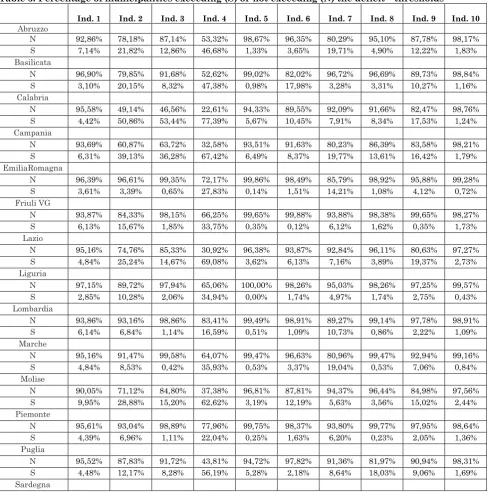
In the table no. 3, we report the percentage of municipalities distinguished by regions that have exceeded the deficit thresholds (S) and those who maintained values below these thresholds (N). For our analysis we have considered the average percentage of the past four administrative periods (2011-2014) because the only ones available.
Table 3: Percentage of municipalities exceeding (S) or not exceeding (N) the deficit thresholds
Ind. 1 Ind. 2 Ind. 3 Ind. 4 Ind. 5 Ind. 6 Ind. 7 Ind. 8 Ind. 9 Ind. 10 Abruzzo
N 92,86% 78,18% 87,14% 53,32% 98,67% 96,35% 80,29% 95,10% 87,78% 98,17%
S 7,14% 21,82% 12,86% 46,68% 1,33% 3,65% 19,71% 4,90% 12,22% 1,83%
Basilicata
N 96,90% 79,85% 91,68% 52,62% 99,02% 82,02% 96,72% 96,69% 89,73% 98,84%
S 3,10% 20,15% 8,32% 47,38% 0,98% 17,98% 3,28% 3,31% 10,27% 1,16%
Calabria
N 95,58% 49,14% 46,56% 22,61% 94,33% 89,55% 92,09% 91,66% 82,47% 98,76%
S 4,42% 50,86% 53,44% 77,39% 5,67% 10,45% 7,91% 8,34% 17,53% 1,24%
Campania
N 93,69% 60,87% 63,72% 32,58% 93,51% 91,63% 80,23% 86,39% 83,58% 98,21%
S 6,31% 39,13% 36,28% 67,42% 6,49% 8,37% 19,77% 13,61% 16,42% 1,79%
EmiliaRomagna
N 96,39% 96,61% 99,35% 72,17% 99,86% 98,49% 85,79% 98,92% 95,88% 99,28%
S 3,61% 3,39% 0,65% 27,83% 0,14% 1,51% 14,21% 1,08% 4,12% 0,72%
Friuli VG
N 93,87% 84,33% 98,15% 66,25% 99,65% 99,88% 93,88% 98,38% 99,65% 98,27%
S 6,13% 15,67% 1,85% 33,75% 0,35% 0,12% 6,12% 1,62% 0,35% 1,73%
Lazio
N 95,16% 74,76% 85,33% 30,92% 96,38% 93,87% 92,84% 96,11% 80,63% 97,27%
S 4,84% 25,24% 14,67% 69,08% 3,62% 6,13% 7,16% 3,89% 19,37% 2,73%
Liguria
N 97,15% 89,72% 97,94% 65,06% 100,00% 98,26% 95,03% 98,26% 97,25% 99,57%
S 2,85% 10,28% 2,06% 34,94% 0,00% 1,74% 4,97% 1,74% 2,75% 0,43%
Lombardia
N 93,86% 93,16% 98,86% 83,41% 99,49% 98,91% 89,27% 99,14% 97,78% 98,91%
S 6,14% 6,84% 1,14% 16,59% 0,51% 1,09% 10,73% 0,86% 2,22% 1,09%
Marche
N 95,16% 91,47% 99,58% 64,07% 99,47% 96,63% 80,96% 99,47% 92,94% 99,16%
S 4,84% 8,53% 0,42% 35,93% 0,53% 3,37% 19,04% 0,53% 7,06% 0,84%
Molise
N 90,05% 71,12% 84,80% 37,38% 96,81% 87,81% 94,37% 96,44% 84,98% 97,56%
S 9,95% 28,88% 15,20% 62,62% 3,19% 12,19% 5,63% 3,56% 15,02% 2,44%
Piemonte
N 95,61% 93,04% 98,89% 77,96% 99,75% 98,37% 93,80% 99,77% 97,95% 98,64%
S 4,39% 6,96% 1,11% 22,04% 0,25% 1,63% 6,20% 0,23% 2,05% 1,36%
Puglia
N 95,52% 87,83% 91,72% 43,81% 94,72% 97,82% 91,36% 81,97% 90,94% 98,31%
S 4,48% 12,17% 8,28% 56,19% 5,28% 2,18% 8,64% 18,03% 9,06% 1,69%
N 92,45% 50,08% 69,76% 30,55% 99,24% 99,73% 99,26% 96,83% 98,01% 99,53%
S 7,55% 49,92% 30,24% 69,45% 0,76% 0,27% 0,74% 3,17% 1,99% 0,47%
Sicilia
N 94,55% 33,86% 54,01% 41,64% 93,17% 67,01% 98,87% 85,82% 69,40% 95,76%
S 5,45% 66,14% 45,99% 58,36% 6,83% 32,99% 1,13% 14,18% 30,60% 4,24%
Toscana
N 95,97% 92,79% 96,82% 64,24% 98,94% 97,46% 88,58% 97,70% 93,82% 98,42%
S 4,03% 7,21% 3,18% 35,76% 1,06% 2,54% 11,42% 2,30% 6,18% 1,58%
Trentino
N 94,61% 86,92% 98,07% 90,63% 99,68% 96,30% 97,18% 98,31% 98,71% 99,43%
S 5,39% 13,08% 1,93% 9,37% 0,32% 3,70% 2,82% 1,69% 1,29% 0,57%
Umbria
N 97,01% 91,03% 96,20% 49,46% 99,18% 94,29% 85,87% 99,18% 92,93% 98,37%
S 2,99% 8,97% 3,80% 50,54% 0,82% 5,71% 14,13% 0,82% 7,07% 1,63%
Valle d'Aosta
N 100,00% 100,00% 100,00% 100,00% 100,00% 100,00% 100,00% 100,00% 100,00% 100,00%
S 0,00% 0,00% 0,00% 0,00% 0,00% 0,00% 0,00% 0,00% 0,00% 0,00%
Veneto
N 94,55% 96,09% 99,17% 82,35% 99,44% 99,00% 78,01% 99,04% 98,00% 99,09%
S 5,45% 3,91% 0,83% 17,65% 0,56% 1,00% 21,99% 0,96% 2,00% 0,91%
Source: our elaboration with data from municipalities of all Italian regions
The analysis shows that all regions maintain a high percentage of municipalities satisfying the expected parameters and, therefore, the performance evaluation of Italian local governments can be considered high. In detail the results stress how all municipalitiesin Valle d’Aosta satisfy the parameters set by 10 indicators. Also note how the regions of North Italy satisfy more criteria: Trentino, Veneto, Piemonte, Liguria, Lombardia and Friuli Venezia Giulia show percentages over 80% (except for the indicator no.4 of Friuli equal to 66.25%, however considered high). Analyzing the results of Central Italy, Southern Italy and the Islands, we can observe the percentages of indicators satisfaction decline but remain however on positive values.
Finally, it should be noted that the indicator no. 4 has complied by the lowest percentage of Italian towns. In comparison with other 9 indicators more attention should be focused on the volume of residual liabilities as by Title I over 40% of commitments assumed in the current spending. Acting on this indicator, the situation would improve greatly.
Conclusion
The present work has had as objective the identification of the fundamental ties existing between the governance and the performance of local governments and the community development.
If the analyses upper expressed can be well accepted, therefore we can easily identify local social fabric as valid criterion for
assessing the management of local
governments. According to our assertions, local social fabrics a clear reflection of the good or poor management of local governments.
The analysis carried out clear underline that overall the governance level of local governments show distinct performance values. The empirical analysis helped us to demonstrate that local governments in Italy satisfy the area of intervention no. 1 concerning to the conditions of financial instability coming from management.
However, at the same time to date the governance framework of local governments has not achieved a stable position of efficiency. Further steps should be made following the strategy of the lean management in order to provide a better services quality and to improve the local welfare.
References
1. Varotto M (2010) Le opportunità dell’Unione europea per gli enti locali. Strumenti di europrogettazione per l’accesso ai finanziamenti e la gestione dei progetti IPSOA: Milano. 2. Cndcec (2016) Linee guida enti locali. Armonizzazioni e
patrimonio. “www.cndcec.it.” Accessed January 1 2017.
3. Mulazzani M( 2013) La revisione degli enti locali. Maggioli Editore, 2nd edition.
4. Pericu A (2015) “Le imprese esercitate dagli enti pubblici locali tra concorrenza e spending review.” Analisi Giuridica dell’Economia, Il Mulino, 349-366.
5. Ibba C (2015) “L’impresa pubblica in forma societaria fra diritto privato e diritto pubblico.” Analisi Griuridica dell’Economia, Il Mulino, 409-420.
6. Cochrane A (2004) “Modernisation, Managerialism and the Culture Wars: Reshaping the Local Welfare State in England.” Local Governance Studies 30(4).
7. Newman J, J Raine, C Skelcher (2001) “Developments: Transforming Local Government: Innovation and Modernization.” Public Money & Management 21(2):61-68.
8. Agle BR, RK, Mitchell JA, Sonnenfel (1999) Who Matters to CEOs? An investigation of Stakeholders Attributes and Salience. Corporate Performance and CEO Values.” Academy of Management Journal 10(5):507-525.
9. Mitchell RK, BR Agle, DJ Wood (1997) “Toward a theory of stakeholder identification and salience: Defining the principle of whom and what really counts.” Academy of Management Review 22(4): 853-886.
10. Freeman RE, DL Reed (1983) “Stockholders and
stakeholders: A new perspective on corporate governance.” California management review 25(3):88-106.
11. Bianchi M (2007) Il controllo manageriale degli enti locali. Franco Angeli: Roma.
12. Pennetta D (2007) La gestione degli enti locali. CEDAM: Padova.
13. Cascioli S (2004) La gestione manageriale degli enti locali. Il processo di programmazione e i relativi strumenti manageriali. Franco Angeli: Roma.
14. Sargiacomo M (2013) Public Sector Management in Italy. McGraw-Hill Education: UK.
15. Rangone A (2016) “Corporate Psychology. How does Italian Entrepreneurship Change.” Oradea Journal of Business and Economics 1(1).
16. Van Dooren W, G Bouckaert, J Halligan (2015) Performance Management in the Public Sector. 2nd Edition
Routledge: London.
17. McKinsey, Company (2011) “Better for less: Improving public sector performance on a tight budget.” Discussion Paper. Available at: www.mckinsey.com
18. Olson M (1973) “Evaluating Performance in the Public Sector, the Measurement of Economic and Social Performance.” “http://www.nber.org/books/moss73-1.” Accessed January 1 2017.
19. Guillamon MD, F Bastilda, B Benito (2011) “The
Determinants of Local Government’s Financial
Transparency.”Local Government Studies,37(4): 391-406. 20. Boyne GA (2002) Public and Private Management: What’s
the Difference?.” Journal of Management Studies 39(1):97-122.
21. Singh A (1972) Holding Company and the Public Sector: An Instrument of State Enterprise.” Economic and Political Weekly 7(30):1415-1423.
22. Colli A, AM Colpan (2016) Business Groups and Corporate Governance: Review, Synthesis and Extension.” Corporate Governance: An International Review, 274-302.
23. Jain T, D Jamali (2016) “Looking inside the black box: The Effect of Corporate Governance on Corporate Social Responsibility.” Corporate Governance: An International Review 24(3): 253-273.
24. Cndcec (2010) Costituzione della Holding. Accessed January 1 2017.
25. Antitrust (2011) AS862 del 22 luglio 2011.”
http://www.agcm.it/segnalazioni/segnalazioni-e-
pareri/open/C1256329003580-6C/F71244CFCDF4AE43C12578EE003C64E8.html. Accessed January 1 2017.
26. Cndcec (2011) Holding degli enti locali, attività finanziaria e modelli di governance.“www.cndcec.it.” Accessed January 1 2017.
27. Collevecchio M (2012) “L’armonizzazione dei sistemi contabili e dei bilanci degli enti locali nel quadro del federalismo fiscale e della riforma costituzionale.” La Finanza Locale 3: 46-61.
28. Martin J, A Spano (2015) “From performance management to strategic local government leadership: lessons from
different cultural settings.”
Public Money & Management, 35(4).
29. Ministero dell’Interno (2008) Osservatorio per la finanza e la contabilità degli enti locali. Finalità e postulati dei principi contabili degli enti locali. Testo approvato dall’Osservatorio il 12 Marzo . Available at: www.finanzalocale.interno.it.
30. Morigi P (2014) Il nuovo controllo di gestione negli Enti locali. Maggioli Editore.
31. Munro J (2015) “Accelerating innovation in local government.” Public Money &Management 35(3).
32. Pozzoli S, E Gori, S Fissi (2015) Bilancio consolidato degli enti locali. IPSOA: Milano.
33. Rangone A (2015) Corporate Governance: Comparative Analysis and Practical Solutions to Face the Emerging Challenges.” International Journal of Business and Social Science, 6(1).
34. Sargiacomo M (2000) Il benchmark nell’azienda Comune. Giappichelli Editore: Torino.