European Journal of Physical Education and Sport Science
ISSN: 2501 - 1235 ISSN-L: 2501 - 1235 Available on-line at: www.oapub.org/edu
doi: 10.5281/zenodo.1451725 Volume 4 │ Issue 10 │ 2018
DANCE, PHYSICAL FITNESS AND NATION BULDING:
WHAT RELATIONSHIP?
R. B. Ayodele,
O. O. Akinbiolai
Dr. Department of Kinesiology, Health Education and Recreation
Obafemi Awolowo University, Ile-Ife, Nigeria
Abstract:
This position paper examines the relevance of dance and dance aerobics to attainment of physical fitness and nation building. Literature reviewed indicated that dance as a subset of physical activity is correlated with improvement of both health and performance-related physical fitness. From the Physical and Health Education standpoint, the use of aerobic dance as a preventive and therapeutic intervention in many health, psychological, and social issues was confirmed. It concluded that dance develops physical fitness which in turn builds a socially, psychologically, physically and economically healthy nation.
Keywords: dance, physical fitness, national development, health
1. Introduction
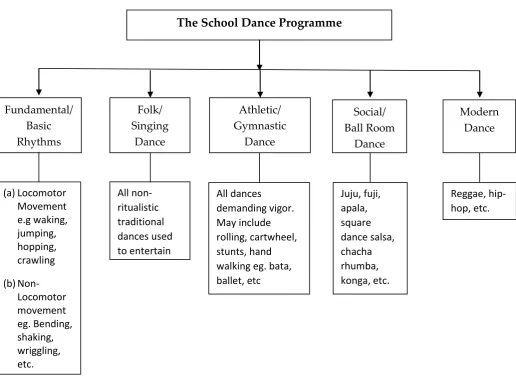
Dance as a form of physical activity means movement to agreeable noise. Movement here may either be locomotive or non-locomotive. While the former are those movements that involve transference of the whole body from a position to another (walking, running, sliding, rolling, cartwheeling etc.), the latter entails the movement of one or more body parts in any direction while on stationary position (e.g. bending stretching, nodding etc.). The use of agreeable noise in this definition also emphasizes the difference between organized, structured and harmonized noise generated from music and the industrial, vehicular noise or even the noise from the cry of a baby or wailing from the bereaved. Noise is agreeable when one can enjoy it, comprehend it, read meaning to it and lures one to move the body to it as it sounds. Although, there could be other categories of dance, but the total school dance programme is limited to five main categories as shown in Figure 1.
Figure 1: Components of the Total School Dance Programme
While some of these dances require slow movements, others like the gymnastic dances require very fast movements and are performed with vigor. Such dances involve a great deal of stunting, running, jumping forward and or backward rolling, head and hand stand and rotating movements. Today, dance has become so popular among children, adolescents, and young adults of both sexes, much that even the unborn child dances in its mother’s womb. However, the trend of dance among Nigerian youths has significantly drifted from the slow-tempo social Owambe dances of yesteryears to fast-tempo dances. Considering the nature of these dances, it could be concluded that dance is another form of physical exercise different from ball games.
Unfortunately, many adults and the aged term such rigorous dances as ‘dances of the devil’ which signify the end times’. Of course, this notion could be true, because of the body-revealing costumes worn by many female dancers and the sensuous messages sent across to their audience. However, beyond this thought, the impacts of such dances (either competitive or recreational) on the total wellbeing of the individual dancer and the economic, social and, psychological implications for the community and nation at large cannot be underrated. Whatever the situation, one thing is clear; either Nigerians like it or not, these dances have become part of the youth’s daily routine,
The School Dance Programme
much that the negative influence of many parents on children involvement in competitive dancing is fast giving way for the children interest in dance. Today, ‘dance is everywhere and everywhere is dance’. Dance is now used as a tool to address religious, social, political, educational and economic issues. Dance as an exercise and a form of sport is also pacing fast with other competitive sports including football, basketball and the like, though, Nigeria has not been following this pace as it should, perhaps its relevance to improving nation’s health and economy has not been well comprehended. It is therefore the intention of this study to:
(a) highlight the importance of aerobic dance in improving physical fitness; and (b)provide insight on how dance can impact on nation building.
2. Dance aerobics
From the standpoint of Physical and Health Education, a physical activity can be aerobic (presence of oxygen or anaerobic (no or little presence of oxygen). Dance as an aerobic exercise can be described as continuous movements, carried out at a prescribed pace requiring the body to utilize increased amount of oxygen, over an extended period of time. It utilizes large muscles and as a high calorie burner, aerobic dances demand a lot of energy. Compared to the risks in contact sports, aerobic dance seems safer, and friendlier because it creates fun and accompanied by preferred music.
2.1 Guidelines for effective aerobic dance
a. Warm up: In an aerobic dance session, a warm up of 5 -10minutes is sufficient enough to prepare the body;
b. Progression (simple to complex);
c. Dance routine: Three times (alternate days) a week; 30 – 60 minutes a session depending on your target: and for eight-week duration. Oduyale (2007) found that the effect aerobic training started to manifest after the eighth week of consistent and intensified dance training and by the 12th week, a complete manifestation of the dance effect should be evident enough to certification. It should be noted that exercise may not be stopped following positive results, but continue on individual basis to sustain the gains of aerobics. In his study, involving application of a 12-week intensive aerobic exercise, Astrand (1960) found a significant improvement in the maximum oxygen uptake (which is linked with respiratory efficiency) at posttest as compared to the pretest. Such correlation was also confirmed in current literature as shown in the study of (Dania, 2016);
d. Timing and Regularity: It is often advised that aerobics is better performed 6pm to 7pm. and the timing should be maintained for every session.
f. Proper Clothing: Smart and firm-soled footwear to prevent hindrance to movements;
g. No-magic issue: It is erroneous to think that involvement in aerobic dance will perform magic, as people do expect that achieving their objectives of becoming physically fit or reduction in weight within a day of exercise. It requires dancer to religiously adhere to the principles of aerobics. Some of the guidelines highlighted here were stated by Adewumi, Amaechi Ajibola (2012).
h. Space: Adequate and ventilated space should be used to avoid emergencies. i. Nutrition: Food should be adequate and well balanced, but must not be eaten
later than 2 hours before aerobic dance session commences to allow proper digestion before dance activity.
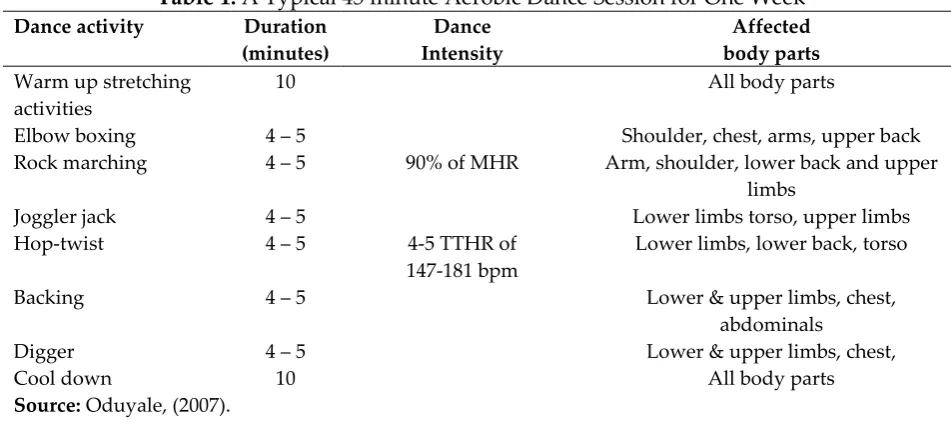
j. Cool down: These will include neck, shoulder, trunk, hip, lower limbs mobility and stretching activities. According to Adewumi, Amaechi Ajibola (2012), cool down after aerobics helps effective recovery from workout. Normally, the cool down has two phases designated for low intensity exercises like walking and stretching respectively. Table 2 presents a typical 45minute aerobic dance session for one week.
Table 1: A Typical 45 minute Aerobic Dance Session for One Week Dance activity Duration
(minutes)
Dance Intensity
Affected body parts
Warm up stretching activities
10 All body parts
Elbow boxing 4 – 5 Shoulder, chest, arms, upper back
Rock marching 4 – 5 90% of MHR Arm, shoulder, lower back and upper limbs
Joggler jack 4 – 5 Lower limbs torso, upper limbs
Hop-twist 4 – 5 4-5 TTHR of
147-181 bpm
Lower limbs, lower back, torso
Backing 4 – 5 Lower & upper limbs, chest,
abdominals
Digger 4 – 5 Lower & upper limbs, chest,
Cool down 10 All body parts
Source: Oduyale, (2007).
3. Dance and Physical Fitness: What relationship?
The effects of dance have been viewed from the health, economic and social perspectives.
3.1 Health perspective
__________________________________________________________
Death state Sick state Illness stat Normal state Optimal health state
Figure 2: The Health Line Continuum
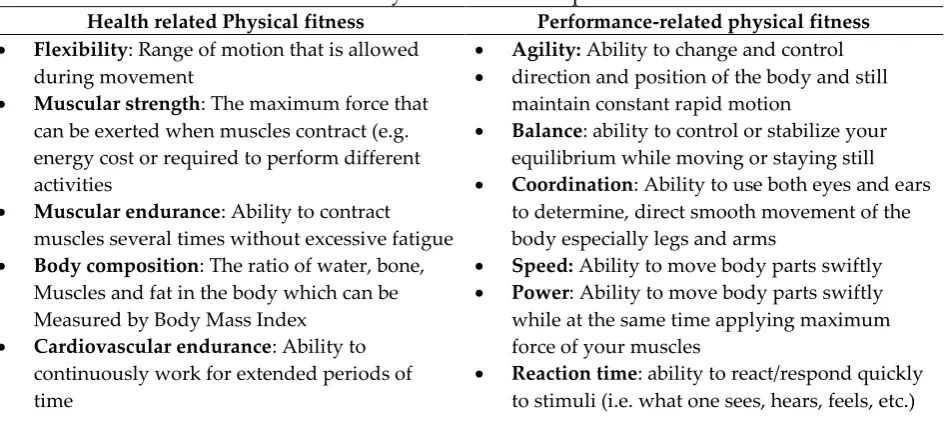
At the optimal health level, the individual is at the height of Physical fitness (PF) and researchers have found a strong relationship existing between dance and attainment and maintenance of physical fitness. Physical fitness as a part of total fitness (Ajeigbe, Ibraheem, Obiyemi & Muhammed, 2014) is the ability to perform daily activities in a continuum without undue fatigue (Asikhia and Blavo, 2007). Other definitions of PF went beyond ability to do daily tasks to further stress the ability of a person to have enough energy in reserve (after daily tasks) to recreate and satisfactorily meet the emergencies that call for physical exertion (Igbanugo cited by Nabofa (2012). Physical fitness has eleven components sub-divided into two categories:
(a) Health-related components (5) ; and (b)Performance-related components (6)
Table 2: Physical Fitness Components
Health related Physical fitness Performance-related physical fitness
Flexibility: Range of motion that is allowed during movement
Muscular strength: The maximum force that can be exerted when muscles contract (e.g. energy cost or required to perform different activities
Muscular endurance: Ability to contract muscles several times without excessive fatigue
Body composition: The ratio of water, bone, Muscles and fat in the body which can be Measured by Body Mass Index
Cardiovascular endurance: Ability to continuously work for extended periods of time
Agility: Ability to change and control
direction and position of the body and still maintain constant rapid motion
Balance: ability to control or stabilize your equilibrium while moving or staying still
Coordination: Ability to use both eyes and ears to determine, direct smooth movement of the body especially legs and arms
Speed: Ability to move body parts swiftly
Power: Ability to move body parts swiftly while at the same time applying maximum force of your muscles
Reaction time: ability to react/respond quickly to stimuli (i.e. what one sees, hears, feels, etc.)
Achieving all of these components is bound to aerobic dance as an exercise. This was earlier revealed by the American National Red Cross (1999), Gavallini, Wendt & Rice (2007) that involvement in activities like dance affords the dancer to attain high level physical fitness. However, achieving high level fitness through dance largely depends on the type of dance, the frequency/regularity and intensity of dance.
3.2 Dance and Physical Fitness benefits
prevented by regular dance exercises. Specifically, aerobic dance has been confirmed to be a major preventive (Ajayi & Olukokun, 2014) and rehabilitative approaches.
b. Accident prevention: In their study, Ajayi & Olukokun (2014) found that aerobic dance involving intermittent movements of the arms and continuous movements of the legs exercise programme for duration of 20 minutes (with 5 minutes warm up and 10 minutes cool down thrice weekly for 8 weeks resulted in improved balance, agility and strength of old women. It was further found that aerobic dance reduced the risks of falling among the women. Other physical and physiological effects of dance include: appetite boosting; weight reduction through burning of body fats; strengthens bones and keeps muscles very firm.
3.3 Psychological/Emotional Fitness benefits
In his definition of emotional health, Ademiju (2013) said it is concerned with the ability to have feeling for oneself and others. Dance helps team spirit, and contributes to the mental health of the dancer in many ways: Dance eliminates depression; anxiety (Yanda, 2006), and creates fun and entertainment, which often result in happiness. Awomodu reported that some mood altering brain chemicals like dopamine, epinephrine and serotonin can be affected too. Dance also reduces tension and creates room for relaxation. It was also found to improve self-control, self-confidence and helps promote self-esteem and positive self-image. In addition, the relationship between exercise and improvement in academic outcomes has been confirmed. Studies conducted by Chomitz, Slining, McGowan, Mitchell, Dawson & Hacker (2009) revealed that exercise has positive effects on cognition and concentration. This result could be explained by both physiological and psychological mechanisms. For instance, exercise is related to stress and anxiety reduction and building of confidence which are all related to enhanced academic performance.
3.4 Economic benefits
3.5 Dance and Social Wellness
Social wellness according to Ademiju (2013) is the ability to maintain healthy relationship. Dance has been found to improve communication (face-face). Ogwu (2013) attested that dance builds social networks and effective communication. Dancers establish friendship easily and are mostly opportune by their art to meet great persons. They are never shy to express themselves in public and they go places. They are usually well admired and many youths see them as models to be emulated because of their fame. Dancers create fun and provide avenue for others to relax after the stress placed on them by work and family issues etc.
4. Dance, fitness and Nation Building: Connection Point
Dance either as a school subject or used as a profession, works towards some specific standards which Adedeji (2007) enumerated as follows
a. Movement competence and proficiency; b. Knowledge and application of movements; c. Health enhancing fitness;
d. Physically active lifestyles;
e. Improved personal and social behavior.
Each of these set standards has a stake in nation building as well as providing avenue by which a nation achieves its goals. For instance, the Nigerian millennium development goals which include eradication of poverty, promoting gender equality, reducing mortality, and developing global partnership can be achieved through participation in dance being a social weapon in many ways:
a. Dance, fitness, and national health: Dance is positively related to fitness and the higher the level of fitness of a population, the better the national health.
b. Dance, fitness and economy: In his submission, Oloyede (1995) maintained that high level of fitness does not only increase the individual’s energy, but also empowerment and productivity. In essence, productivity of individuals in a nation means national wealth. In support, Ayoade & Blavo (2013) said that a healthy and physically fit population is an economic asset, since the nation will guarantee a ready supply of strong labour force, which is important in national development. Dance is not only a means to empower youths, but a strategy to increase nation’s productivity.
c. Dance, fitness and national unity: Dance can be used as a powerful tool of communication. It is a social connector. Oloyede (2012) asserted that dance is a silent but effective means of promoting national integration and international cooperation. Dance gives the assurance of peace, unity and cooperation among nations of the world and a good measure to fight against racism.
5. Conclusion
It is concluded that dance develops physical fitness which in turn builds a socially, psychologically, physically and economically healthy nation.
5.1 Recommendations
The following were recommended to boost the interest of youths and adults in dance in order to build a healthy and physically fit nation:
a. Curriculum planners should integrate dance programme into the general school curriculum at every level (primary, secondary and tertiary institutions including polytechnic and technical schools)
b. Dance therapy should be introduced in all health institutions including hospitals, clinics, maternity homes, etc. to be used as preventive and therapeutic approaches to solving health problems
c. Governmental, non-governmental bodies and interested individuals should collaborate to establish dance schools and colleges that will assist youths to realize their potentials to dance and explore it.
d. Gymnasia in Nigeria should expand their activities to cover dance.
References
Adedeji, J. A. 2007. ‚Teaching Quality Physical Education: A Commitment towards Enhancing Education Excellence in African Region in the New Millennium‛. Journal of International Council for Health, Physical Education, Recreation, Sports and
Dance. 2:1
Ademiju, P. U. 2013. ‚The Role of Physical Activity in the Achievement of Wellness‛. International Council for Health, Physical Education, Recreation, Sports and Dance
Journal of Research. 4: 111 – 115
Adewumi, C. M., Amechi, C. O. and Ajibola, G. S. 2012. ‚Regular Aerobic Activity as a Panacea for Promotion of Optimum Health‛. International Journal of
Multi-Disciplinary Studies and Sports Research. 3: 822 - 827
Ajayi, O. A. and Olukokun, O. T. 2014. ‚Effects of Aerobic Dance Exercise on the Improvement of Falling Risks in Older Women‛. International Journal of the 13th
West Africa University Games. 1, 1: 32 – 35
Ajeigbe, Y. I., Ibraheem, T. O., Obiyemi, O. O. and M. S. Mohammed, M. S. 2012. ‚Roles of Sports in Promoting the Fitness Status of the Students of Kwara State College of Education, Ilorin‛. International Journal of the 13th West Africa University
Games.11, 148 - 152
Awomodu, G. 2005. ‚Youth Development through Sports and Recreation‛. Growing up
Action Health Incorporated. 13:3
Chomitz, V. R., Slining, M. M., McGowan, R. J., Mitchell, S. E., Dawson, G. F. and Hacker, K. A. 2009. ‚Is There a Relationship Between Physical Fitness and Academic Achievement? Positive Results from Public School in the North-eastern United States‛. Official Journal of American School Health Association. 79:1 Gavallini, M. F., Wendt, J. C. and Rice, D. 2007. ‚Wellness and Exercise Principles in
Teacher Education Programme. The Journal of Physical Education, Recreation and
Dance. 7, 8:80
Oduyale, T. 2007. ‚Achieving Wellness for All Through Programmed Aerobic Dancing. Journal of International Council for Health, Physical Education, Recreation, Sports and
Dance. 2, 1: 4 - 9
Ogwu, T. N. 2013. ‚Physical Fitness and Aging: Exercise for Healthy Living‛. International Council for Health, Physical Education, Recreation, Sports and Dance
Journal of Research. 4: 118 - 123
Okwesa, F. U. 2007. ‚The Place of Dance in Goals of Education‛. Journal of International
Council for Health, Physical Education, Recreation, Sports and Dance. 2, 1: 90 - 93
Oloyede, R. O., and Adelusi, J. O. 2007. ‚Sports in the Holistic Development of Total Life of the Individual, Community and the Nation.‛ Journal of Sports Management and Educational Research 1:3
Olubayo-Fatiregun, M.A., Ayodele, R. B. and Olorunsola, H. K. 2014. ‚Health, Fitness and Physical Activity: A Key to Enhancing Wellness for All Ages in Building a Vibrant Nation‛ Asian Journal of Humanities and Social Sciences 2, 1: 77 - 84
Oniyangi, S. O., Ijaduola, T. K. and Olaitan, O. L. 2012. ‚Influence of Sports Participation on Psycho-Social and Health Status of Students of University of Ilorin, Nigeria.
The American Red Cross, Responding to Emergencies (New York: Mosby Life Line, 1996), 2nd edition.
Yanda, A. E. 2007. ‚The Implication of Health in Actualizing Nation Reform through Sports‛. Journal of Sports Management and Educational Research 1: 3
Creative Commons licensing terms
Authors will retain the copyright of their published articles agreeing that a Creative Commons Attribution 4.0 International License (CC BY 4.0) terms will be applied to their work. Under the terms of this license, no permission is required from the author(s) or publisher for members of the community to copy, distribute, transmit or adapt the article content, providing a proper, prominent and unambiguous attribution to the authors in a manner that makes clear that the materials are being reused under permission of a Creative Commons License. Views, opinions and conclusions expressed in this research article are views, opinions and conclusions of the author(s). Open Access Publishing Group and European Journal of Physical Education and Sport Science shall not be responsible or answerable for any loss, damage or liability caused in relation to/arising out of conflict of interests, copyright violations and inappropriate or inaccurate use of any kind content related or integrated on the research work. All the published works are meeting the Open Access Publishing requirements and can be freely accessed, shared, modified, distributed and used in educational, commercial and