ISSN: 2501 - 1235 ISSN-L: 2501 - 1235 Available on-line at: www.oapub.org/edu
DOI: 10.46827/ejpe.v6i6.3256 Volume 6 │ Issue 6 │ 2020
INVESTIGATION OF THE EFFECTS OF 8-WEEK FOOTBALL
TRAINING ON FINE MOTOR SKILLS AND SELECTED PHYSICAL
FITNESS ELEMENTS IN 11-13 YEARS OLD CHILDREN GROUP
Ömer Aksoy1i,
Özcan Saygın2 1İstanbul Gelişim University, School of Physical Education and Sports, İstanbul,
Turkey
2Muğla Sıtkı Koçman University, Faculty of Sports Sciences, Muğla,
Turkey
Abstract:
Keywords: football, training, physical fitness, fine motor skill
1. Introduction
Football is a game that is followed by millions of people of all ages in the world and played under certain rules with a high level of pleasure.To achieve the best performance in terms of physical, physiological, psychological, and technical-tactical football, training programs should be planned in accordance with every age group and regularly. Training programs to be applied especially to children and young people should be planned in a way to provide multi-directional development by taking into consideration the development periods, physiological, psychological, physical characteristics and loading principles of the age groups.
Football is a sports discipline where aerobic and anaerobic energy metabolism are used together, where motor and combined motor features affect performance together and are highly coordinated. Performance in football increases depending on technical-tactical, physiological, and psychological factors. These factors include the structure of the game, the skill levels, conditions, positionsof the players, and environmental conditions (Aslan and Koç, 2015). Also, one of the most important factors for achieving high performance level is physical fitness. If the feature of the physical structure is not specific to the sports branch, it does not allow the performance to be well displayed. Fatiguein athletes, which starts at the beginning of the training, disrupts the nerve-muscle cooperation that has an effect on increasing the performance to the highest level and makes it difficult for the performance to reach the desired level (Aslan et al., 2015). For footballers to adapt to these conditions, it is tried to maximize their motoric features
and body composition through training using scientific methods (İri et al. 2009).
Physical fitness refers to the condition of the body concerning the applying movements correctlyand physical endurance. According to this definition, the person with the highest physical fitness is the person who can move for the longest time without
getting tired (Zorba and Saygın, 2009). Determining the physical properties of children in advance contributes to directing them to the sports branch they are suitable for, and as a result, children can be successful by specializing in that branch (Çelik et al., 2013). The fact that the physical and motoric features are developed, and high quality also shows
the difference between other athletes (Taşkın et al., 2015). Besides, motor development gradually increases with the growth and maturation of children starting from infancy. However, this motor development takes place in a series of rows, first the child's gross motor skills and then fine motor skills develop. Fine motor skills are skills that require us to control small muscle groups in our body (Konter E., 2013). The motor skills that children acquire from infancy determine the quality of their future movements. Therefore, the development of these motor skills should be supported by directing children to sports (Duman G., 2019).
2. Material and Methods
This study is planned as an experimental study with pretest-posttest and control groups. A total of 60 volunteer male child participated in the study, including 30 male child who regularly play football in Marmaris, who do not have any health problems and sports injuries, and 30 male child who study at Salih Zeki Gür Secondary School and who do not have any health problems. Among the children participating in the study, male child playing football in Marmarisspor formed the experimental group (n: 30) and the male child studying at Salih Zeki Gür Secondary School formed the control group (n: 30).
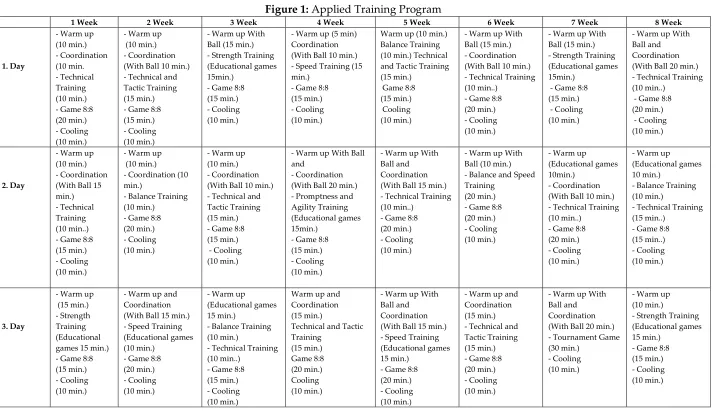
The footballers in the research group were trained for 8 weeks, 3 days a week, and 50-60 minutes, while the control group did not receive any training. The height, body weight, body mass index (BMI), aerobic capacity (ml/kg/min), strength, flexibility, balance, 30-meter sprint, and fine motor skills values of the research group participating in the study were recorded as pre-tests and post-tests.
The data obtained in the study are given as mean and standard deviation. The normality distribution of the experimental and control groups was examined with the Shapiro-Wilk test on the pretest and posttest values. The data were observed to show normal distribution. While the paired T-test was used to compare the pretest and posttest values of the experimental and control groups, the T-test was used in the independent groups to compare the experimental and control groups. In statistical evaluations, the level of significance was accepted as p <0.05. Statistical analysis of all data obtained in the study was done in SPSS (version 16.0) package program.
3. Data Collection Tools
3.1 Anthropometric Measurements
A. Body Weight and Height
While the weight was measured with an electronic scale with an accuracy of 0,1 kg, the height was measured with a digital height measuring instrument with a precision of 0,01 cm (Zorba E.,1999).
B. Body Mass Index
Body mass index has been calculated by taking advantage of the height and body weight of the children.
BMI= Weight (kg) / Height2 (m) (Zorba E., 1999).
C. Hand Grip Strength Test
Measurement was done with Takei brand digital handgrip dynamometer. When an external force was applied to the dynamometer, the steel wire was stretched, and the indicator moved. Handgrip force test was applied as follows:
• Squeezing size middle part of the middle finger can be placed at an almost right angle, the upper arm was asked to hold in an upright position.
• The wrist and forearm of the subject were asked to be kept in a half-bent position. • The subject was asked to apply force fast and maximum.
• The subjects were asked to apply force, two times with their right hand and two times with their left hand. In the trials between the same hand, a 30-second rest was given. The best of the two trials of the subjects were recorded as scores (Zorba
and Saygın 2009).
D. Sit and Reach (Flexibility) Test
The test bench (sit and reach box) in the research has the following features. The length of it is 35 cm, width is 45 cm, height is 32 cm. The upper surface measurements of the bench are length is 35 cm, width is 45 cm. The upper surfaces are 15 cm further than the surface on which the feet rest. The measurement ruler of 0.50 mt is determined on the upper surface with parallel line spacings of 5 cm each. The application of the test; 3-5 minutes of warm-up exercises were done before the subjects started the test. The subject is seated on the ground and the feet are flat on the test bench. Without bending the knees, the trunk is bent forward and extended forward. In this way, the subject stood at the farthest point and his scores were recorded (Sevim Y., 2006).
E. Balance Test
The measurement material of this test; Metal beam, 50 cm long, 4 cm high, and 3 cm wide, was used. The subjects were given detailed information about the test protocol. The subjects were asked to stay in balance by trying to climb on the balance device with their dominant feet and to stand in balance, bending the idle foot from the knee and pulling it towards the hip. During this process, the test leader assisted the subjects to stay in the proper position. Subjects were asked to stay on the balance device for 1 minute as soon as they were ready in this position. During this application, when the participant lost his balance, the time was stopped, and the test continued by maintaining his balance again. After these balance losses, all these processes continued within 1 minute. When the time expires, the error numbers of the subjects were written and recorded as a score (Özen G., 2014).
F. 30 Meter Sprint Test
G. 20 Meter Shuttle Run Test
To determine the running speed, a 20-meter shuttle running test cassette in accordance with the protocol was used. The test started at a running speed of 8,5 km / h. The participants ran the line on the 20-meter track by touching the line marked on the ground with their feet and continued the test until they made two mistakes in a row. Running speed increased by 0,5 km / h every minute. The level at which the participant stopped was recorded as a test result. By converting the obtained result to the total distance, the maximum VO2 value of the participants is found as ml/kg/min. (Leger and Lambert 1982; Günay et al. 2010).
H. Fine Motor Skill (Purdue Pegboard) Test
Figure 1: Applied Training Program
1 Week 2 Week 3 Week 4 Week 5 Week 6 Week 7 Week 8 Week
1. Day
- Warm up (10 min.) - Coordination (10 min. - Technical Training (10 min.) - Game 8:8 (20 min.) - Cooling (10 min.)
- Warm up (10 min.) - Coordination (With Ball 10 min.) - Technical and Tactic Training (15 min.) - Game 8:8 (15 min.) - Cooling (10 min.)
- Warm up With Ball (15 min.) - Strength Training (Educational games 15min.)
- Game 8:8 (15 min.) - Cooling (10 min.)
- Warm up (5 min) Coordination (With Ball 10 min.) - Speed Training (15 min.)
- Game 8:8 (15 min.) - Cooling (10 min.)
Warm up (10 min.) Balance Training (10 min.) Technical and Tactic Training (15 min.)
Game 8:8 (15 min.) Cooling (10 min.)
- Warm up With Ball (15 min.) - Coordination (With Ball 10 min.) - Technical Training (10 min..)
- Game 8:8 (20 min.) - Cooling (10 min.)
- Warm up With Ball (15 min.) - Strength Training (Educational games 15min.)
- Game 8:8 (15 min.) - Cooling (10 min.)
- Warm up With Ball and Coordination (With Ball 20 min.) - Technical Training (10 min..)
- Game 8:8 (20 min.) - Cooling (10 min.)
2. Day
- Warm up (10 min.) - Coordination (With Ball 15 min.) - Technical Training (10 min..) - Game 8:8 (15 min.) - Cooling (10 min.)
- Warm up (10 min.) - Coordination (10 min.)
- Balance Training (10 min.) - Game 8:8 (20 min.) - Cooling (10 min.)
- Warm up (10 min.) - Coordination (With Ball 10 min.) - Technical and Tactic Training (15 min.) - Game 8:8 (15 min.) - Cooling (10 min.)
- Warm up With Ball and
- Coordination (With Ball 20 min.) - Promptness and Agility Training (Educational games 15min.)
- Game 8:8 (15 min.) - Cooling (10 min.)
- Warm up With Ball and Coordination (With Ball 15 min.) - Technical Training (10 min..)
- Game 8:8 (20 min.) - Cooling (10 min.)
- Warm up With Ball (10 min.) - Balance and Speed Training
(20 min.) - Game 8:8 (20 min.) - Cooling (10 min.)
- Warm up (Educational games 10min.)
- Coordination (With Ball 10 min.) - Technical Training (10 min..)
- Game 8:8 (20 min.) - Cooling (10 min.)
- Warm up (Educational games 10 min.)
- Balance Training (10 min.)
- Technical Training (15 min..)
- Game 8:8 (15 min..) - Cooling (10 min.)
3. Day
- Warm up (15 min.) - Strength Training (Educational games 15 min.) - Game 8:8 (15 min.) - Cooling (10 min.)
- Warm up and Coordination (With Ball 15 min.) - Speed Training (Educational games (10 min.)
- Game 8:8 (20 min.) - Cooling (10 min.)
- Warm up (Educational games 15 min.)
- Balance Training (10 min.)
- Technical Training (10 min..)
- Game 8:8 (15 min.) - Cooling (10 min.)
Warm up and Coordination (15 min.)
Technical and Tactic Training (15 min.) Game 8:8 (20 min.) Cooling (10 min.)
- Warm up With Ball and Coordination (With Ball 15 min.) - Speed Training (Educational games 15 min.)
- Game 8:8 (20 min.) - Cooling (10 min.)
- Warm up and Coordination (15 min.) - Technical and Tactic Training (15 min.) - Game 8:8 (20 min.) - Cooling (10 min.)
- Warm up With Ball and Coordination (With Ball 20 min.) - Tournament Game (30 min.)
- Cooling (10 min.)
- Warm up (10 min.)
- Strength Training (Educational games 15 min.)
3. Results
Table 1: Comparison of physical fitness factors and fine motor skills pretest and posttest values of children in the experimental group
Variables Groups n X±SD t p
Body Weight (kg)
Pre-test 30 44,85 ± 12,56
-6,240 ,000**
Post-test 30 45,92 ± 12,65
Standing Height (cm)
Pre-test 30 151,97 ± 11,37
-8,707 ,000**
Post-test 30 153,01 ± 11,33
Body Mass İndex
(kg/m2)
Pre-test 30 18,94 ± 3,43
-3,658 001*
Post-test 30 19,26 ± 3,29
Hand Grip Strength (dominant hand) (kg)
Pre-test 30 20,52 ± 5,04
-7,561 ,000**
Post-test 30 22,34 ± 5,43
Balance
(number of errors)
Pre-test 30 4,16 ± 4,51
-5,189 ,000**
Post-test 30 1,80 ± 2,36
Fine Motor Skill
(dominant hand, number)
Pre-test 30 13,90 ± 1,78
-3,778 ,001*
Post-test 30 14,86± 2,19
30 m Sprint (sn)
Pre-test 30 5,38 ± ,33
-8,886 ,000**
Post-test 30 5,26 ± ,33
Aerobic Capacity (m/kg/dk)
Pre-test 30 31,16 ±5,26
-4,603 ,000**
Post-test 30 34,13 ± 4,96
Flexibility (cm)
Pre-test 30 19,65 ± 4,52
-13,716 000**
Post-test 30 21,92 ± 4,48
*p<0.05
Table 2: Comparison of physical fitness factors and fine motor skills pretest and posttest values of the children in the control group
Variables Groups n X±SD t p
Body Weight (kg)
Pre-test 30 37,59 ± 10,50
-3,793 ,001*
Post-test 30 38,41 ± 10,37
Standing Height (cm)
Pre-test 30 144,88 ± 8,52
-1,033 ,310
Post-test 30 145,40 ± 9,04
Body Mass İndex
(kg/m2)
Pre-test 30 17,66 ± 3,47
-1,494 ,146
Post-test 30 17,85 ± 3,40
Hand Grip Strength (dominant hand) (kg)
Pre-test 30 17,40 ± 5,45
-1,677 ,104
Post-test 30 17,96 ± 5,84
Balance
(number of errors)
Post-test 30 6,56 ± 5,67
,984 ,333
Post-test 30 6,30 ± 5,09
Fine Motor Skill (dominant hand) (number)
Pre-test 30 14,16 ± 1,44
,571 ,573
Post-test 30 14,06 ± ,94
30 m Sprint (sn)
Pre-test 30 6,25 ± ,74
-1,561 ,129
Post-test 30 6,31 ± ,71
Aerobic Capacity (m/kg/dk)
Pre-test 30 26,63 ± 5,51
0,374 0,71
Post-test 30 26,72 ± 5,15
Flexibility (cm)
Pre-test 30 17,75 ± 6,35
-5,123 000**
Post-test 30 19,26 ± 6,39
*p<0.05
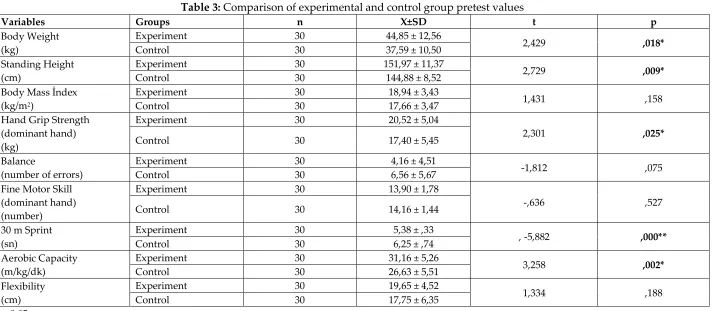
Table 3: Comparison of experimental and control group pretest values
Variables Groups n X±SD t p
Body Weight (kg)
Experiment 30 44,85 ± 12,56
2,429 ,018*
Control 30 37,59 ± 10,50
Standing Height (cm)
Experiment 30 151,97 ± 11,37
2,729 ,009*
Control 30 144,88 ± 8,52
Body Mass İndex
(kg/m2)
Experiment 30 18,94 ± 3,43
1,431 ,158
Control 30 17,66 ± 3,47
Hand Grip Strength (dominant hand) (kg)
Experiment 30 20,52 ± 5,04
2,301 ,025*
Control 30 17,40 ± 5,45
Balance
(number of errors)
Experiment 30 4,16 ± 4,51
-1,812 ,075
Control 30 6,56 ± 5,67
Fine Motor Skill (dominant hand) (number)
Experiment 30 13,90 ± 1,78
-,636 ,527
Control 30 14,16 ± 1,44
30 m Sprint (sn)
Experiment 30 5,38 ± ,33
, -5,882 ,000**
Control 30 6,25 ± ,74
Aerobic Capacity (m/kg/dk)
Experiment 30 31,16 ± 5,26
3,258 ,002*
Control 30 26,63 ± 5,51
Flexibility (cm)
Experiment 30 19,65 ± 4,52
1,334 ,188
Control 30 17,75 ± 6,35
*p<0.05
Table 4: Comparison of experimental and control group posttest values
Variables Groups n X±SD t p
Body Weight (kg)
Experiment 30 45,92 ± 12,65
2,516 ,015*
Control 30 38,41 ± 10,37
Standing Height (cm)
Experiment 30 153,01 ± 11,33
2,873 ,006*
Control 30 145,40 ± 9,04
Body Mass İndex
(kg/m2)
Experiment 30 19,26 ± 3,29
1,634 ,108
Control 30 17,85 ± 3,40
Hand Grip Strength (dominant hand) (kg)
Experiment 30 22,34 ± 5,43
3,005 ,004*
Control 30 17,96 ± 5,84
Balance
(number of errors)
Experiment 30 1,80 ± 2,36
-4,388 ,000**
Control 30 6,30 ± 5,09
Fine Motor Skill (dominant hand) (number)
Experiment 30 14,86 ± 2,19
1,835 ,074
Control 30 14,06 ± ,94
30 m sprint (sn)
Experiment 30 5,26 ± ,33
-7,304 ,000**
Control 30 6,31 ± ,71
Aerobic Capacity (m/kg/dk)
Experiment 30 34,13 ± 4,96
5,677 ,000**
Control 30 26,72 ± 5,15
Flexibility (cm)
Experiment 30 21,92 ± 4,48
1,864 ,068
Control 30 19,26 ± 6,39
*p<0.05
4. Discussion
This study was conducted to investigate the effects of 8-week football training on selected physical fitness and fine motor skills in 11-13-year-old children.
While the height pre-test average of the experimental group participating in our research was 151.97 ± 11,37 cm, the average of the post-test was 153.1 ± 11.33 cm. The length of the control group's pretest averages were 144, 88 ± 8,52 cm, while the posttest
averages were found as 145.40 ± 9.04 cm. İri, et al. (2009) found that soccer training they applied on 12-14 age group children had a significant difference in height (p <0.01).
While the pre-test bodyweight averages of the experimental group participating in our study were 44.85 ± 12,56 kg, the post-test averages were 45.92 ± 12,65 kg. While the bodyweight pre-test averages of the control group were 37.59 ± 10,50 kg, the post-test averages were 38.41 ± 10,37 kg. İbiş et al. (2004) in a study they conducted 12-14 years old children who attended summer football school and those who did not attend football school, according to the pre-test and post-test results, they expressed that there was a significant difference in body weight results of the children who did not attend summer football school. In their study conducted to determine the effect of six-week football training on the physical and physiological characteristics of male football players, Yıldız
et al. (2016) found that there was a statistically significant difference in the body values of the participants according to the results obtained (p<0.01).
While the pretest flexibility averages of the experimental group participating in our study were 19.65 ± 4,52 cm, the posttest averages were 21.92 ± 4.48 cm. While the flexibility pretest averages of the control group were 17.75, ± 6,35 cm, the posttest averages were 19.26 ± 6.39 cm. In their studies named 8-week core exercise effects on
some physical and physiological parameters, Doğan et al. (2016) found that there was a significant difference between flexibility pre-test and post-test values. Meliggas et al. (2015) found that there was a statistically significant difference in the values of the experimental and control groups after applying an 8-week static and dynamic stretching program in school-age children. These studies in the literature are in parallel with our study.
Skaggs et al. (2015) examined the flexibility relationship between speed and jumping performance and found no evidence that flexibility was associated with jumping. This study in the literature is not in line with our study.
In their study to examine the effect of 8-week core training on performance-related physical fitness variables in male football players, Dilber et al. (2016) found that the right-hand claw strength pretest 43.58 ± 5.00 and posttest 46.11 11.43 were statistically
significant. Sarıtaş et al. (2017) in their study conducted to compare some motoric and physiological features of primary school students, found a statistically significant difference in the right-hand grip strength of basketball players than those of sedentary students.
experimental group pretest-posttest and control group pretest-posttest values. Cerrah et al. (2016) found that there was a significant difference between the experimental group and the control group in their study to investigate the effects of functional balance training on the static-dynamic balance performances of adolescent footballers. Trecroci et al. (2015) found that in young footballers, there is a significant difference between the pre-test and post-test values of 8-week rope skipping workouts to improve balance and coordination.
Ulutaş et al. (2017) found that there was a significant difference between the experimental group and the control group in favor of the experimental group in the study of the effect of the motor development training program on the gross and fine motor skills of children aged 5-6. Keskin et al. (2017) performed an exercise program for autistic children aged 5-8 for 8 weeks. Comparing the fine motor skill test results before and after exercise, they found a significant difference.
Özgür et al. (2016) in the study where the effect of 6-week sprint training on speed and agility in football players was examined, they found that speed, agility, and maximal speed were analyzed and found that the training program affected speed. Kaplan et al. 2016 found that there was a significant relationship between age, height, and 30-meters sprint performance in their study where they examined the relationship between age, height, body weight, and speed, acceleration, and vertical jump performance in 9-13 aged group football players. Bucheeit et al. (2010) examined the repetitive sprint ability by applying a 10-week training program in young elite football players and found significant differences in speed values before and after training.
In their study titled the examination of the relationship between the intensity of physical activity and health-related physical fitness in 9-11-year-old boys, Karacabey et al. (2009) found that there was a significant relationship between moderate-intensity activities and maximal oxygen consumption capacity. Eler and Acar (2018) investigated the effects of skipping rope training programs on strength, speed, and maxVO2 in children in physical education classes. They found that there was a significant difference in maxVO2 between the experimental group pre-test and post-test values of rope skipping training in boys aged 10-12 who participated in the study. Marta et al. (2013) found in their study titled the investigation of the effects of 8-week training on plyometric strength and maxVO2 in children aged 10-11 that there was a significant difference in the values of the study group before and after the training. Paradisis et al. (2014) 20-meter shuttle run is a commonly used test to determine the athlete's maximal oxygen consumption and training intensity. Günay et al. (2010) stated that there is a significant change in breathing volume and frequency with training. They found an increase of over 10% in maxVO2 with 7-13 weeks of training.
the experimental and control group posttest values at the level of p <0.01. Arı (2012) in his master's thesis named the effect of 12-week plyometric training program on some physical and physiological parameters of 14-16-year-old female football players, 1.40% decrease in body mass index values of the experimental group after training was observed, but this difference was not found statistically significant. After the training program, a significant increase was observed in the body mass index values of the control group. The results of these studies in the literature are in line with our study.
5. Conclusions
Considering the findings of our study, 8-week football exercises applied to the athletes in the experimental group showed a significant effect on body weight, body mass index, flexibility, handgrip strength, balance, fine motor skill, 30-meter sprint, and aerobic capacity.
Pre-test body mass index, handgrip strength, balance, fine motor skill, 30-meter sprint and aerobic capacity features of the control group participating in the research and, after the post-test, while there is no statistically significant difference between pre and post-tests, there was no statistically significant difference between the pretest and posttests of body mass index, handgrip strength, balance, fine motor skill, 30-meter sprint, and aerobic capacity features, it was found that there was a significant difference between body weight and flexibility features (p <0.05).
As a result; the 8-week football training program applied in our study showed that it had a positive effect on body weight, body mass index, flexibility, handgrip strength, balance, 30-meter sprint, and aerobic capacity features and fine motor skills. It is thought that ensuring the multi-faceted development of footballers is important due to the positive factors of physical fitness and motor skills.
References
Aslan, S. C., Koç, H. 2015. Amatör futbolcuların seçilmiş fiziksel uygunluk ve motorik özelliklerinin mevkilerine göre karşılaştırılması. Celal Bayar Üniversitesi Beden
Eğitimi ve Spor Bilimleri Dergisi, 10 (1), 59.
Aslan, C. S., Koç, H., Karakollukçu, M. 2015. Voleybol 1. Liginde oynayan erkek
sporcuların seçilmiş fiziksel, fizyolojik ve motorik özelliklerinin belirlenmesi. İnönü Üniversitesi Beden Eğitimi ve Spor Bilimleri Dergisi, 2 (3), 1-13.
İri, R., Sevinç, H., Süel, E. 2009. 12-14 yaş grubu çocuklara uygulanan futbol becerisi antrenmanın temek motorik özelliklere etkisi, Uluslararası İnsan Bilimleri Dergisi
6 (2), 122-131
Çelik, A., Günay, E., Aksu, F. 2013. 7-9 yaş grubu ilköğretim öğrencilerinin fiziksel ve motorik özelliklerinin değerlendirilmesi, Dokuz Eylül Üniversitesi Tıp Fakültesi Dergisi, 27 (1). 8-9.
Taşkın, C., Karakoç, Ö., Nacaroğlu, E., Budak, C. 2015. Futbolcu çocuklarda seçilmiş motorik özellikler arasındaki ilişkinin incelenmesi, Spor ve Performans Araştırmaları Dergisi 6 (2). 101-102. doi: 10.17155/spd.74072
Konter, E. 2013. Eylemde bulunan bir varlık olarak insan neden oynar, Bassaray Matbaası, İzmir, Türkiye
Duman, G. 2019. Temel motor beceriler kazandırma eğitim programının analizi. Turkish Journal of Primary Education 4 (2). 112-120.
Zorba, E. 1999. Herkes için spor ve fiziksel uygunluk, GSGGM Eğitim Dairesi Yayınları,
Ankara, Türkiye
Sevim, Y. 2006. Antrenman bilgisi, Nobel Basımevi, Ankara, Türkiye
Özen, G., 2014. 8-10 Yaş Çocuklarda Doğum Ağırlığının Bazı Fiziksel Uygunluk
Parametreleri Üzerine Etkisi, Ankara Üniversitesi-İnönü Üniversitesi Beden Eğitimi Ve Spor Ana Bilim Dalı Ortak Yüksek Lisans Programı Yüksek Lisans Tezi,
Malatya
Günay, M., Tamer, K., Cicilioğlu, İ. 2010. Spor fizyolojisi ve performans ölçümü, Gazi
Kitapevi, Ankara, Türkiye
Buddenberg, L. A., Davis, C. 2000. Test–retest reliability of the Purdue Pegboard Test. American Journal of Occupational Therapy 54 (5). 555-558.
İbiş, S., Gökdemiz, K., İri, R. 2004. 12-14 yaş grubu futbol yaz okuluna katılan ve katılmayan çocukların bazı fiziksel ve fizyolojik parametrelerinin incelenmesi,
Eğitim dergisi, 12 (1). 285.
Yıldız, H., Biçer, M., Akcan, F., Mendeş, B. 2016. Ampute futbolcularda hazırlık dönemi çalışmalarının fiziksel ve fizyolojik parametreler üzerine etkileri, Spor ve
Performans Araştırmaları Dergisi 7 (1). 45-52.
Doğan, G., Mendeş, B., Akcan, F., Tepe, A. 2016. Futbolculara uygulanan sekiz haftalık core antrenmanın bazı fiziksel ve fizyolojik parametreler üzerine etkisi, Journal of
Physical Education & Sports Science/ Beden Eğitimi ve spor Bilimleri Dergisi 10
(1).
Meliggas, K., Papadopoulos, C., Gissis, I., Zakas, A., & Brabas, I. S. 2015, Effects of a Static and Dynamic Stretching Program on Flexibility, Strength, and Speed of School-Age Children. International Journal of Applied, 5 (3).
Skaggs, J. R., Joiner, E. R. A., Pace, J. L., Atc, M. S., & Skaggs, D. L. 2015. Is Flexibility Associated with Improved Sprint and Jump Performance. Ann. Sports Med. Res, 2 1-5.
Dilber, A., O., Lağap, B., Akyüz, Ö., Çoban, C., Akyüz, M., Murat, T.A.Ş., Özkan, A. 2016. Erkek futbolcularda 8 haftalık kor antrenmanının performansla ilgili fiziksel uygunluk değişkenleri üzerine, Celal Bayar Üüniversitesi, Beden Eğitimi ve Spor
Sarıtaş, N., Yıldız, K., Hayta, Ü. 2017. İlkokul öğrencilerinin bazı motorik ve fizyolojik özelliklerinin karşılaştırılması, Celal Bayar Üüniversitesi, Beden Eğitimi ve Spor
Bilimleri Dergisi, 12 (2). 117-127.
Güler, Ö., Eniseler, N. 2017. The effects of soccer specific balance training on agility and vertical jump performances in young soccer players, Journal of Physical Education
& Sports Science, Beden Eğitimi ve Spor Bilimleri Dergisi, 11 (3).
Cerrah, A. O., Bayram, İ., Yıldızer, G., Uğurlu, O., Şimşek, D., Ertan, H. 2016. Effects of
functional balance training on static and dynamic balance performance of adolescent soccer players, Uluslararası Spor Egzersiz ve Antrenman Bilimi
Dergisi, 2 (2). 73-81.
Trecroci, A., Cavaggioni, L., Caccia, R., Alberti, G. 2015. Jump rope training: Balance and motor coordination in preadolescent soccer players. Journal of sports science medicine, 14 (4), 792.
Ulutaş, A., Demir, E., Yayan, E. H. 2017. Motor gelişim eğitim programının 5-6 yaş çocukların kaba ve ince motor becerilerine etkisinin incelenmesi, Abant İzzet Baysal Üniversitesi Eğitim Fakültesi Dergisi.
Keskin, B., Hanbay, E., Kalyoncu, M. 2017, 5-8 yaş grubu otistik çocuklarda egzersiz uygulamalarının sportif performans üzerine etkileri, İstanbul Üniversitesi Spor
Bilimleri Dergisi, 7 (2), 50-58.
Özgür, B., Demirci, D., Özgür, T. 2016, Futbolcularda 6 haftalık sürat antrenmanının sürat ve çeviklik üzerine etkisi İstanbul Üniversitesi Spor Bilimleri Dergisi, 6 (4), 11-16. Kaplan, T., Taşkın, H., Akgül, M. Ş. 2016. 9-13 Yaş grubu futbolcularda yaş, boy ve vücut ağırlığı ile sürat, ivmelenme ve dikey sıçrama performansı arasındaki ilişki,
International Journal of Sport Culture and Science, 4 (Special Issue), (1). 31-38. Buchheit, M., Mendez-Villanueva, A., Delhomel, G., Brughelli, M., Ahmaidi, S. 2010.
Improving repeated sprint ability in young elite soccer players: repeated shuttle sprints vs. explosive strength training. The Journal of Strength & Conditioning Research, 24 (10). 2715-2722.
Karacabey, K. 2009. 9-11 Yaş erkek çocuklarda fiziksel aktivite yoğunluğu ve sağlıklı fiziksel uygunluk arasındaki ilişkinin incelenmesi, Sport Sciences, 4 (3). 218-225. Eler, N., Acar, H. 2018. The effects of the rope jump training program in physical
education lessons on strength, speed and VO2 max in children. Universal Journal of Educational Research, 6 (2). 340-345.
Marta, C., Marinho, D. A., Barbosa, T. M., Izquierdo, M., Marques, M. C. 2013. Effects of concurrent training on explosive strength and VO2max in prepubescent children. International journal of sports medicine, 34 (10). 888-896.
Paradisis, G. P., Zacharogiannis, E., Mandila, D., Smirtiotou, A., Argeitaki, P., Cooke, C. B. 2014. Multi-stage 20-m shuttle run fitness test, maximal oxygen uptake and velocity at maximal oxygen uptake. Journal of human kinetics, 41 (1). 81-87.
Günay, M., Tamer, K., Cicioğlu, İ. 2010. Spor fizyolojisi ve performans ölçümü. ÖzBaran
Polat, Y. 2003. Futbolcu çocukların fiziksel uygunluk düzeylerinin incelenmesi, İstanbul
Üniversitesi Spor Bilimleri Dergisi, (3).
Saygın, Ö., Polat, Y., Karacabey, K. 2005. Çocuklarda hareket eğitiminin fiziksel
uygunluk özelliklerine etkisi, Fırat Üniversitesi Sağlık Bilimleri Tıp Dergisi, 19 (3).
205-212.
Arı, Y. 2012. On iki haftalık pliometrik antrenman programının 14-16 yaş grubu bayan futbolcuların bazı fiziksel ve fizyolojik parametreleri üzerine etkisi. Gazi
Üniversitesi, Master Thesis, Ankara.
Creative Commons licensing terms