HPLC METHOD DEVELOPMENT FOR DETERMINATION OF
PYRAZINAMIDE AND RELATED SUBSTANCE BY USING
QUALITY BY DESIGN (QBD) APPROACH
Ashish Dalal,
[a]Mohammad Imran Anees,
[a]Faraz Khan,
[a]Mallinath Langade,
[b]Firoz A. Kalam Khan,
[c]Aniruddha Chabukswar
[d]and Jaiprakash N.
Sangshetti
[a]*
Keywords: Quality by Design (QbD); HPLC; Pyrazinamide; Box-Behnken design
A robust and simplified high-performance liquid chromatography (HPLC) method was developed for the estimation of Pyrazinamide and its related substance. A systematic approach, one of the parts of QbD (quality by design) was used in suitable analytical method development. The HPLC segregation method was carried out with C-18 Column (3.9x300 mm, I. D. 10 µm), a mobile phase of phosphate buffer: acetonitrile (pH 3.0) 90:10 v/v, detected at 270 nm. Optimization to this method was done by response surface methodology by applying a three-level Box Behnken design with three center points.
*Corresponding Authors
E-Mail: [email protected]
[a] Y. B. Chavan College of Pharmacy, Dr.Rafiq Zakaria
Campus, Rauza Baugh, Aurangabad 431001
[b] Jawahar Art, Commerce Science College Andur, Osmanabad
MS 413603
[c] Anjuman-I-Islam’s Kalsekar Technical Campus, School of
Pharmacy, Navi Mumbai 410206, M.S., India
[d] Maharashtra Institute of Pharmacy, Kothrud, Pune (MS),
India
Introduction
Analytical methods contribute to the design process, manufacturing of high-quality drug products and its development pattern. Hence analytical method should be accurate and specific as well as robust. Now a day’s QbD (quality by design) is applied to analytical techniques to get a reliable method to analyze the quality of the product. It
also provides better regulatory compliance.1-4 There was no
method reported for the HPLC development method in a QbD environment for Pyrazinamide (PZA) drug. Hence, in this systematic HPLC method using QbD principles was outstanding in ensuring the quality of the method throughout the product lifecycle. This issue has presented a new challenge to the analytical chemistry field. A precise and applicable component of the QbD is the understanding parameters and their interaction results by a desired set of experiments.
This current study involves the development of overall science and risk-based HPLC method and subsequent validation in the analysis of active pharmaceutical constituent. QbD is a systemic process for building into a product from the final output process. QbD process means a complete understanding of the product with its related process of manufacturing, overall involvement of an investment in time and resources upfront in the discovery and development of the product. For QbD the product and process knowledge base must include an understanding of the variability of raw material, the relationship between a process and product critical quality attributes (CQA) and the association between a CQA and products clinical properties.
QbD method of work deals with systematic science and depends upon product-based development and its risk factors affecting, its designing factors and techniques which should be according to ICH guidelines such as ICH Q8, Q9, and Q10. PZA is a first-line anti-tubercular agent. PZA tablets are used to treat active tuberculosis. WHO has listed this drug in the essential medicines category. PZA is applicable with a combination of other medications such as Rifampicin, Isoniazid, Streptomycin and Ethambutol. It is used in the first two months of the treatment to reduce the duration of treatment required. PZA is a potent antiuricosuric drug. It is used in hypouricemia and hyperuricosuria. It is safe in pregnancy. It is soluble in water, methanol and phosphate buffer. It possesses excellent oral absorption, metabolizing by the liver and is mainly
excreted in the urine.5 Pyrazinamide undergoes diffusion
process through the mycolic acid present within this bacteria and pyrazinamidase enzyme converts to active pyrazinoic acid from pyrazinamide and binds to S1 protein attached to the ribosome and hence it shows inhibition effect for the
killing of mycobacterium tuberculosi. In synthetic pathway6
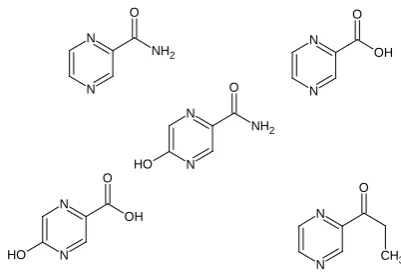
(Figure 1), Deamidation of PZA yields pyrazine-2-carboxylic acid. Ring oxidation is another major pathway, leading to 5-hydroxypyrazinamide, which in turn hydrolyzed to 5-hydroxypyrazinoic acid.
Figure 1. Pyrazinamide and its related impurities.
N
N O
NH2
N
N O
OH
N
N O
NH2
O H
N
N O
OH
O H
N
N O
Determination of pyrazinamide by HPLC Section A-Research paper
MATERIALS AND METHODS
Reference active pharmaceutical ingredient of Pyrazinamide was procured from Lupin Limited, Aurangabad. HPLC grade acetonitrile, phosphoric acid of Merck was used. All liquid solutions were prepared with HPLC grade ready water obtained in-house, through Milli-Q water purification system (Millipore, USA).
Instrumentation
HPLC analysis was done by using a Shimadzu HPLC
SILAD vp model chromatograph equipped with an LC20
AT isocratic delivery system (pump), SPD-10Avp detector,
and the analytical column was C-18 column (3.9 × 300 mm), 10 µm particle size). Data acquisition and processing
were performed using Class Vp 5.13 software. Deionized
water was prepared from a Milli-Q water purification system (Millipore, USA). The UV detection was done using SHIMADZU UV visible spectrophotometer (double beam), and the wavelength range of 200 to 400 nm.
Mobile phase system
The phosphate buffer solution was prepared by dissolving 6.8 g of potassium dihydrogen phosphate and 1.844 g of
sodium hydroxide into a 1000 mL volumetric flask and
dilute with water to produce final 1000 ml volume. Adjust
the pH 3.0 with phosphoric acid. The buffer solution was
degassed and sonicated and filtered prior to use for HPLC analysis. Dissolve 90 % of phosphate buffer solution in 10% of acetonitrile to produce mobile phase of the buffer: acetonitrile having concentration 90:10 v/v.
Pyrazinamide sample preparation
Pyrazinamide stock solution for optimization of experiments was prepared by accurately weighing 40 mg of Pyrazinamide and dissolving in 100 ml phosphate buffer to yield a final concentration of 400 µg mL Pyrazinamide. Transfer 10 ml standard stock into a 100 mL volumetric flask, dissolve and make up the volume with phosphate buffer. From the above stock solution, 4 µg mL samples were prepared for analysis
Wavelength selection for analysis
Appropriate dilutions of Pyrazinamide were prepared and samples were scanned using UV spectrometer in the range of 200 nm to 400 nm. An absorbance maximum was obtained at 270 nm.
Analytical target profile
A systematic approach for the development of product and
its process design is termed as QbD2 and hence
determination of systematic goal in product development is necessary for a better understanding of the process and
product development.7,8 Here method intent was to develop
HPLC method of Pyrazinamide which is robust, accurate, precise and USP resolution more than 2, a number of theoretical plates as per requirement and short analysis time,
i.e., less than 10 min as per QbD norms a robust method should be developed with the help of visualized a design space.
Risk assessment
It is commonly understood that risk is defined as the combination of the probability of occurrence of harm and severity of that harm. The quality of process and method used in QbD is a prime part in finding out the risk assessment system and it also determines the efforts taken during variable input and its process. Critical attributes can be found from the risk assessment system, which can affect the product quality at the final stage. In the effective communication between Industries, FDA, R&D, Mfg plant risk assessment system plays a vital role.
Various tools for risk assessment are as follows: Ishikawa or fishbone diagram, failure mode effect analysis (FMEA).
Initial chromatographic conditions
Chromatographic separation was carried out with C18 column, different mobile phases were tried starting with methanol and phosphate buffer, The separation was carried out by C-18 column (3.9×300 mm, 10-µm particle size) with mobile phase of buffer (pH-3.0): acetonitrile (90:10 v/v) degassed in a sonicator for 10 min and filtered through 0.2µ membrane filter before use. Peak was obtained with a retention time of 5.20 min and by the flow rate of 1 mL
min-1 and a column temperature of 30 °C. Before the process
of the injection of drug solution, the column was balanced with mobile phase flowing through the system. Detection was done using UV detector at 270 nm. Further changes were done according to the optimization model. pH was changed by using phosphoric acid.
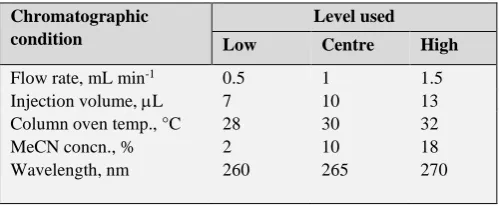
Table 1. Chromatographic factors and response variables for Plackett-Burman experimental design
Chromatographic condition
Level used
Low Centre High
Flow rate, mL min-1 0.5 1 1.5
Injection volume, µL 7 10 13
Column oven temp., °C 28 30 32
MeCN concn., % 2 10 18
Wavelength, nm 260 265 270
Method design
The screening was done by Plackett-Burman design using Design Expert 9 software.
Five factors were selected as follows: flow rate, injection
volume, column oven temperature, acetonitrile
Table 2. Plackett-Burman experimental design pyrazinamide
Optimization was done by response surface methodology, applying a three-level Box Behnken design with three-center
points (Table 3). Three factors selected were flow rate,
acetonitrile concentration and column oven temperature in the mobile phase. Evaluation of the main factor, their interaction and quadric effect on peak USP resolution factor were done. An injection volume of 10 µL, detection wavelength of 270 nm was kept constant as their effect on the resolution was less significant.
Table 3. Chromatographic factors and response variables for box-Behnken experimental design
Chromatographic conditions Level used
Low Centre High
Flow rate (X1) 0.8 1 1.2
Acetonitrile concentration, X2 8 10 12
Column oven temperature (X3) 28 30 32
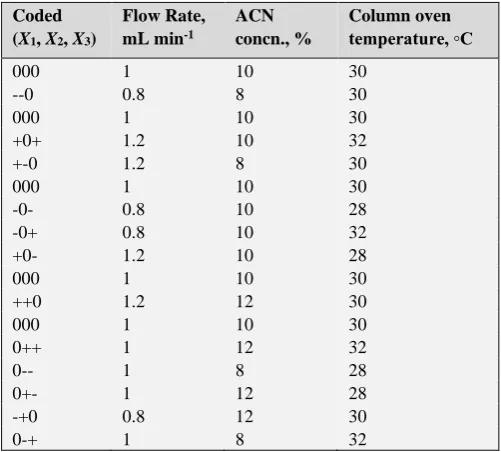
Experiments were conducted by making triplicate injections (total 51 runs) of standard Pyrazinamide solution and the average of USP Resolution was analyzed using
Design Expert 9 Software (Table 4). Application of
multivariate regression analysis resulted in a fitted full quadrate model for the average responses for peak USP resolution given by the equation:
Y=β0+β1X1+β2X2+β3X3+β11X12+β22X22+β33X32+β12X1X2+
β13X1X3+ β23X2X3
where
Y represent as a response,
β0 represents an arithmetic mean response,
β1β2 and β3 are regression coefficients of the factor X1,
X2 and X3 respectively.
β11, β22β33are squared coefficients β12, β13and β23 are
interaction coefficients.9,10
Table 4. Box-Behnken method sued for Pyranizamide
determination optimization
Critical quality attributes
From the software-generated result, the critical factors which affect the resolution and capacity factor were determined. Factor such as flow rate, wavelength and ACN concentration in the mobile phase found to be critical. Selection of the stationary phase was also a critical parameter. The nature of the drug is more retentive on C-18 than C-8.
Method validation
The optimized chromatographic method was validated according to the International Conference on Harmonization
(ICH) Q2 (R1)2-4 guidelines for linearity, range, precision
and robustness. For system suitability, a standard solution of
Factor 1 Factor 2 Factor 3 Factor 4 Factor 5 Response
A: Flow rate mL min-1
C: ACN concn., %
D: Column oven temperature, °C
B: Injection volume, µL
E: Detection wavelength, nm
Resolution
1 1.5 2 32 13 270 11.13
2 0.5 18 32 7 270 3.31
3 1.5 2 32 13 260 9.21
4 1.5 18 28 13 270 2.43
5 0.5 2 32 7 270 14.12
6 1.5 18 28 7 260 2.29
7 1.5 2 28 7 270 8.74
8 0.5 2 28 13 260 14.15
9 0.5 18 28 13 270 3.41
10 1.5 18 32 7 260 2.09
11 0.5 18 32 13 260 2.70
12 0.5 2 28 7 260 15.16
Coded (X1, X2, X3)
Flow Rate, mL min-1
ACN concn., %
Column oven
temperature, ◦C
000 1 10 30
--0 0.8 8 30
000 1 10 30
+0+ 1.2 10 32
+-0 1.2 8 30
000 1 10 30
-0- 0.8 10 28
-0+ 0.8 10 32
+0- 1.2 10 28
000 1 10 30
++0 1.2 12 30
000 1 10 30
0++ 1 12 32
0-- 1 8 28
0+- 1 12 28
-+0 0.8 12 30
Determination of pyrazinamide by HPLC Section A-Research paper
10 µg mL of Pyrazinamide was prepared by diluting and mixing the drug with methanol. Six replicate injection of the system standard solution were analyzed before sample analysis. The acceptance criteria for Pyrazinamide were less than 2 % relative standard deviation (RSD) for peak area, retention time, symmetry USP resolution factor more than 2 and number of theoretical plates greater than 2000 for all peaks.
Linearity
As per ICH guidelines, the linearity is defined as an analytical procedure which has its ability (within in a given range) to obtain test results and which are directly proportional with the concentration (amount) of analyte in the sample. Standard calibration curves were prepared by taking five different concentrations and then by making serial volume to volume dilution of stock solution with
methanol, over the range of 10, 20, 30, 40 and 50 µg mL-1.
Three replicate injections of each concentration were made to determine the linearity of Pyrazinamide over the concentration range. Linear concentration curves of peak area versus drug concentration were plotted by using a linear least squares regression and then evaluated for linearity.
Precision
According to ICH, Q2 guidelines, accuracy is defined as the percent relative standard concentration standard deviation of a set of responses. The precision of the method was evaluated for Pyrazinamide drug substance by analyzing standard samples prepared daily from the stock
solution. Three replicates of each low (10 µg mL-1),
intermediate (20 µg mL-1), high (30 µg mL-1) standard was
analyzed daily over three days as a part of validation and quality control. Precision was determined by analyzing the mean, standard deviation and relative standard deviation for peak areas and their resultant concentrations.
An acceptance criterion for precision is that the RSD of the standards should not be more than 2.
Robustness
The robustness of an analytical procedure is defined as a measurement of its capacity to remain unaffected by the small but deliberate change in method parameter and provide an indication of its reliability during normal
usage.3-6 There should be the reliability of an analysis with
respect to deliberate variation in method parameters such as
flow rate (±0.1mL min-1), pH (±0.1 units), and mobile phase
proportion.
RESULTS AND DISCUSSIONS
Pyrazinamide is used as an anti-tubercular agent. Different mobile phases were tried starting with methanol and water, the separation was carried on C-18 column (3.9 × 300 mm, 10 µm particle size) with mobile phase of disodium hydrogen phosphate buffer (pH 3.0): acetonitrile (90:10 v/v) Peak was obtained at retention time of 5.20 min, with flow
rate of 1mL min-1, column temperature of 30 °C, at 270 nm
wavelength. Further screening was done using Plackett-Burman design and Optimization was done by carrying runs as by Box-Behnken design.
Method design
Plackett-Burman design
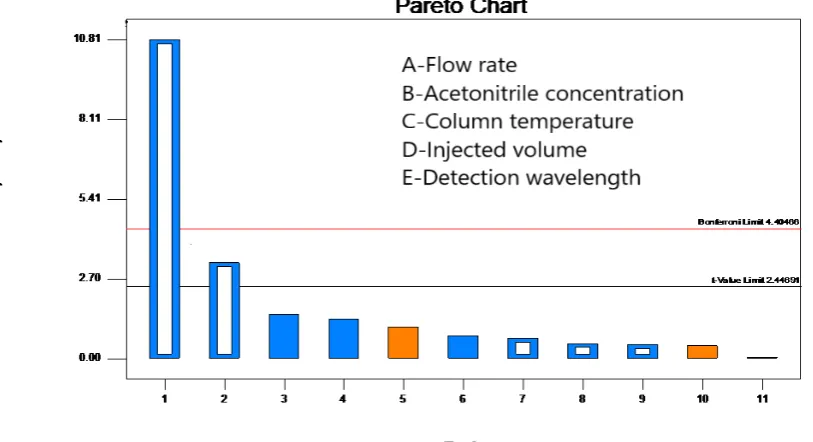
The screening was done by using Plackett-Burman design, which gives Pareto chart (Figure 2) and Probability values
(p-values) for flow rate, acetonitrile concentration, column
temperature, and injection volume and detection wavelength.
Figure 3. Response surface (3D) and contour plot showing the effects of acetonitrile concentration and flow Rate on USP resolution factor of Pyrazinamide (Plackett-Burman design)
Box Behnken design
Multivariate regression analysis was implemented and then fitted with a full quadratic model which was obtained for the USP Resolution factor of the peak. Factors considered here are column temperature, acetonitrile concentration and wavelength. Regression coefficient and p-values obtained from the software-generated report are
given in (Table 5).
Table 5. Regression coefficients and associated probability values
(p-values) for USP resolution of pyranizamide
Analysis of variance (ANOVA) was processed to analyze the significance of the factors and interaction terms on the
response, i.e., USP resolution of the peak, p-value provide
the cut-off beyond which we assert that the findings are
‘statistically significant' by convention, it is p<0.05.11-17
A value of probe >F was found to be less than 0.05, hence
model was found to be significant for prediction of response. The entire model was fitted well for optimization. A lack fit was not significant. Significant factors were found
i.e. flow rate (p-value 0.068765), acetonitrile concentration
(p-value 0.00000179), and column temperature (p-value
0.757273). Acetonitrile concentration was found to be the most significant.
Two of the factors were found to affect the resolution from their respective coefficients. ACN concentration, the flow rate is showing an inverse relationship with resolution.
Response surface and contour plot were studied to visualize the effect of factor to develop design space for robust method 3D graph are given below in Figure 4. From the graph, some facts about the impact of the factors and their interaction on the response can be found. Curvatures in the contour plot show a linear relationship between factors.
From Figure 4 showing the effect of ACN concentration
and flow rate where the wavelength is constant at 265 nm. ACN concentration should be between 8-12 % the Resolution was in limit and above and below this limit Resolution factor get increased. If Column Temperature and ACN concentration receives an increase, then the resolution gets affected. To obtain an optimum set of condition to achieve desired goal composite desirability parameters were applied. The response was set to maximum resolution between Pyrazinamide and the related substance above the target value of 2.
Figure 4. Response surface (3D) and contour plot showing the effects of acetonitrile concentration and flow rate on USP resolution factor of Pyrazinamide (Box-Behnken design)
The optimum condition having desirability was chosen from obtained runs, i.e., column temperature of 30 °C, ACN
concentration of 8 % and Flow Rate 0.8 mL min-1. Set of
conditions were analyzed to compare predicted response with the actual response.
The chromatogram for optimised condition is shown in Figure 5.
Figure 5. The chromatogram recorded at optimized conditions
Term Regression coefficient p-value
Intercept
3.59 0.0000157
Flow rate
-0.11 0.068765
Acetonitrile concentration
-0.45 0.00000179
Column temperature
-0.017 0.757273
Lack of fit 0.607521
Design-Expert® Software Factor Coding: Actual Resolution
15.16
2.09
X1 = A: Flow Rate X2 = B: Acetonitrile Conc Actual Factors C: Column Temp = 30 D: Inj Vol = 10 E: Detection Wavelength = 265 F: Dummy 1 = 0 G: Dummy 2 = 0 H: Dummy 3 = 0 J: Dummy 4 = 0 K: Dummy 5 = 0 L: Dummy 6 = 0
2 6 10 14 18 0.5 0.7
0.9 1.1 1.3 1.5 0 5 10 15 20 R es ol ut ion
A: Flow Rate (ml/min) B: Acetonitrile Conc (%)
Design-Expert® Software Factor Coding: Actual Resolution
Design points above predicted value Design points below predicted value 4.23
2.97
X1 = A: Flow Rate X2 = B: Acetonitrile Conc
Actual Factor C: Column Temp = 30
8 9 10 11 12 0.8 0.9 1 1.1 1.2 2.8 3 3.2 3.4 3.6 3.8 4 4.2 4.4 R es ol ut ion
Determination of pyrazinamide by HPLC Section A-Research paper
Method validation
Method validation was done according to the ICH
guideline Q2.2-5 Results were within the specified limit. This
method was found to be precisely accurate and robust and withstand according to ICH guidelines Validation results are given below in (Table 6).
Table 6. Validation of method in term of linearity and precision of Pyranizamide
Validation parameter
Result Acceptance
criteria
Linearity, 10 - 50
µg mL-1
Coefficient of correlation-0.9987
Coefficient of Correlation >0.999 Precision:
Repeatability RSD: 1.7320 % RSD less than 2%
Intraday 0.75%
Inter day 0.09%
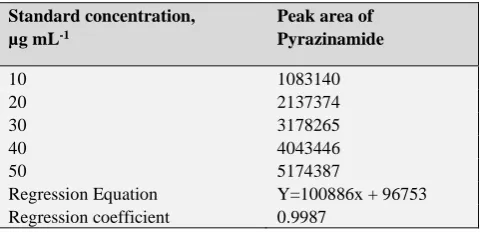
Linearity
A set of five solutions of Pyrazinamide at a concentration
ranging from 10-50 µg mL-1 were prepared. Each sample
was analyzed in triplicate; calibration curve was constructed by plotting the peak area versus the concentration using linear regression analysis. The correlation coefficient was found to be 0.998 (Table 7).
Table 7. Linearity of Pyranizamide
Standard concentration, µg mL-1
Peak area of Pyrazinamide
10 1083140
20 2137374
30 3178265
40 4043446
50 5174387
Regression Equation Y=100886x + 96753
Regression coefficient 0.9987
Repeatability
Repeatability was determined by running six replicates of samples and evaluating the average and %RSD for a sample
by comparing the peak area(Table 8).
Table 8. Repeatability of Pyranizamide
CONCLUSION
The quality by design approach has been successfully implemented for method development of Pyrazinamide API by using HPLC. All essential parameters of QbD were processed and then implemented in said study. A systematic approach was utilized for developing an efficient and robust method which involves beginning with the determination of target profile characteristics, instrument qualification, risk assessment, and design of the experiment. Interactions and quadratic effects of factors were studied with the least possible runs by using Box-Behnken model in conjunction with response surface methodology. Response surface diagrams and contour plots were studied for coming to a conclusion which factor are affecting response and their limits were recorded. Optimum conditions were obtained; the one with higher desirability was selected and a desirable function which was applied to determine the optimum conditions under a QbD approach.
ACKNOWLEDGMENT
The authors are thankful to Honorable chairman Mrs. Fatima Rafiq Zakaria, Maulana Azad Educational Trust Dr. Rafiq Zakaria campus Chairman Aurangabad, and Principal, Y.B. Chavan College of Pharmacy, Dr. Rafiq Zakaria Campus, Aurangabad 431 001 (M.S.), India for providing all the necessary laboratory facility.
REFERENCES
1Yan, L, Gerald, J. T., Alireza, S. K., A systematic approach to
RP-HPLC method development in a pharmaceutical QbD environment. http://Americanpharmaceuticalreview.com. Last accessed on 9.11.2016.
2ICH Harmonized tripartite guideline pharmaceutical development
Q8 (R2). www.ich.org. Last accessed on 20.9.2016.
3ICH Harmonized tripartite guideline pharmaceutical development
Q8 (R2). www.ich.org. Last accessed on 20.9.2016.
4ICH Harmonized tripartite guideline quality risk management Q9.
www.ich.org. Last accessed on 20.9.2016.
5www. Drugbank.com. Last accessed on 20.9.2016.
6Testa, B. and Mayer, J. M., Hydrolysis in Drug and Prodrug
Metabolism. Wiley-VCH, 2003, 101-102. ISBN-13: 978-3906390253
7Arnum, P. A., An FDA perspective on Quality by Design.
Pharmaceutical technology sourcing and management. 2007;
http://www.pharmtech.com/pharmtech/article/article last accessed on 21.03.2017.
8Schweitzer, M., Pohl, M., Hanna-Brown, M., Nethercutt, P.,
Bormann, P., Hansen, G., Smith, K., Larew, J., Implication and opportunities of applying QbD principles to analytical
measurements. Pharm. Technol., 2010, 52-59.
9Torrealday, N., Gonzalez, S., Alonso, R. M., Jimenez, R. M.,
Ortiz Lastra, E. O., Experimental Design Approach for the optimization of HPLC-fluorimetric method for the quantitation of the angiotensin II receptor antagonist in the
urine. J. Pharm. Biomed. Anal., 2003, 32, 847-857.
DOI:10.1016/s0731-7085(03)00187-0
10Awotwe, O. D., Agarabi, C., Faustino, P. J., Habib, M. J., Lee, S.,
Khan, M. A., Shah, R. B., Application of quality by design application method for the development and optimization of
protamine sulfate, J. Pharm. Biomed. Anal., 2012, 25, 61-67.
https://doi.org/10.1016/j.jpba.2012.01.002
Sr. No Concentration, µg mL-1 Peak area
1. 10 1082245
2. 10 1082257
3. 10 1082224
4. 10 1082274
5. 10 1082289
6. 10 1082237
Average 1082254.333
11Patil, S., Vijayakrishna, K., Sangshetti, J., Quality by Design
(QbD ) Approach towards the Development and Validation of HPLC Method for Gentamicin Content in Biodegradable
Implants. Der Pharma Chemica, 2016, 8(1), 282–288.
12Juran, J. M. Juran on quality by design: The new steps for
planning quality into goods and services, Revised Edition, free press, New York, 1992; 1-2.
13www.usp.org. Last accessed on 20.9.2016.
14Sangshetti, J., Deshpande, M., Zaheer, Z., Shinde, D., Arote, R.,
Quality by Design Approach, Regulatory need. Arabian J
Chem., 2014, 1-44.
https://doi.org/10.1016/j.arabjc.2014.01.025
15Habib, N. M., Ali, N. W., Abdelwhab, N. S., Abdelrahman, M.
M., Different Spectrophotometric and TLC-Densitometric Methods for Determination of Pyrazinamide in the presence
of Its Impurity. Bull. Fac. Pharm. Cairo Univ., 2017, 1-10.
http://dx.doi.org/10.1016/j.bfopcu.2017.02.004.
16Sangshetti, J. N., Zaheer, Z., Rana, Z. A., Kadam, V., Kadam, N.
S., A Systematic HPLC Method development for
Lucosamide Using Quality by Design (Qbd) Approach. J.
Med. Chem. Drug Disc.,2015, 344-354.
17Zaheer, Z., Sangshetti, J. N., Rana, Z. A., Kavhale, H., Kadam,
N., Use Of Quality By Design (Qbd) Approach in
Development of HPLC Method for Eprosartan. J. Med.
Chem. Drug Disc., 2015, 355-367.