ARTIGO ORIGINAL
Serum Erythropoietin as Prognostic Marker
in Myelodysplastic Syndromes
Eritropoietina Sérica como Marcador Prognóstico em Síndrome
Mielodisplásica
1. Serviço de Hematologia Clínica. Centro Hospitalar e Universitário de Coimbra. Coimbra. Portugal. 2. Serviço de Oncologia. Centro Hospitalar e Universitário de Coimbra. Coimbra. Portugal. 3. Centro de Investigação em Meio Ambiente, Genética e Oncobiologia. Coimbra. Portugal. 4. Serviço de Patologia Clínica. Centro Hospitalar de Coimbra. Coimbra. Portugal. 5. Faculdade de Medicina. Universidade de Coimbra. Coimbra. Portugal.
6. Serviço de Medicina Interna. Hospital Distrital da Figueira da Foz. Figueira da Foz. Portugal. Autor correspondente: Rita Tenreiro. [email protected]
Recebido: 15 de Abril de 2015 - Aceite: 10 de Agosto de 2015 | Copyright © Ordem dos Médicos 2015
Emília CORTESÃO1,3,5, Rita TENREIRO1, Sofia RAMOS1, Marta PEREIRA1,5, Paula CÉSAR1, José P. CARDA1,5, Marília GOMES1,5, Luís RITO1,5, Emília MAGALHÃES1, Ana C. GONÇALVES3,5, Nuno C. e SILVA4,5, Catarina
GERALDES1,3,5, Amélia PEREIRA6, Letícia RIBEIRO1, José M. NASCIMENTO COSTA2,3,5, Ana B. Sarmento RIBEIRO1,3,5
Acta Med Port 2015 Nov-Dec;28(6):720-725
RESUMO
Introdução: A síndrome mielodisplásica é uma doença heterogénea caracterizada por displasia, medula hipercelular, citopenias
e risco de evolução para leucemia aguda. Outros factores de prognóstico, nomeadamente, fibrose medular, elevação da enzima desidrogenase do lactato e β2-microglobulina têm sido descritos, contudo, a decisão terapêutica baseia-se no score do International Prognostic Scoring System.
Material e Métodos: Este trabalho teve como objectivo analisar a relevância da eritropoietina sérica ao diagnóstico, em doentes
com síndrome mielodisplásica de novo, avaliando o seu impacto na sobrevivência global e a sua implementação como factor de prognóstico. Recolhemos dados clínicos e laboratoriais de 102 doentes com síndrome mielodisplásica de novo diagnosticada entre outubro/2009 e março/2014. A análise de sobrevivência foi efectuada recorrendo à metodologia de Kaplan-Meier, de acordo com os valores de eritropoietina.
Resultados: A amostra, de 102 doentes, apresenta uma mediana de idades de 74 anos e relação masculino/feminino igual a 0,8. Os
doentes com o subtipo citopenia refratária com displasia unilinha apresentam, em média, valores de eritropoietina significativamente mais baixos, em oposição aos doentes com o subtipo 5q- que apresentam a média de eritropoietina sérica mais elevada (p < 0,05). Onze doentes evoluíram para leucemia aguda; estes têm, em média, eritropoietina sérica superior (p < 0,05). Adicionalmente, a eritropoietina sérica acima do limite superior da normalidade associa-se a menor sobrevivência (p = 0,0336). Após ajuste do modelo de regressão de Cox, o valor preditivo da eritropoietina para a sobrevivência global manteve-se (p < 0,001). Em análise multivariada, a eritropoietina sérica demonstrou ser um factor de prognóstico independente (p < 0,001).
Discussão: A eritropoietina sérica é um factor preditivo de resposta à terapêutica com eritropoietina subcutânea, sendo que os
doentes com síndrome mielodisplásica com valores mais elevados de eritropoietina apresentam uma pior resposta à administração de eritropoietina, mesmo com doses mais elevadas. A nossa amostra demonstra que a eritropoietina sérica apresenta também valor prognóstico, e em todos os subtipos de síndrome mielodisplásica. Além disso, isoladamente ou em associação com outros factores ou ABSTRACT
Introduction: This myelodysplastic syndromes are a heterogeneous entity characterized by dysplasia, hypercellular bone marrow,
cytopenias and risk of transformation to acute leukaemia. Prognostic factors, such as bone marrow fibrosis, lactate dehydrogenase and β2-microglobulin elevation have been described, but treatment is mainly based in the International Prognostic Scoring System.
Material and Methods: Our aim was to analyze serum´s erythropoietin at diagnosis in de novo myelodysplastic syndromes patients,
through its impact in overall survival and possible implementation as prognostic marker. Clinical and laboratorial data from 102 patients with de novo myelodysplastic syndromes diagnosed between October/2009 and March/2014 were collected. Survival analysis was performed according to serum erythropoietin level stratification, using Kaplan-Meier methodology.
Results: Our 102 patients had a median age of 74 years, with a male:female ratio of 0.8. Mean erythropoietin was significantly lower
in refractory cytopenia with unilineage dysplasia patients in contrast with the higher values observed in 5q- syndrome (p < 0.05). Eleven patients progressed to acute leukaemia; these have higher mean erythropoietin values (p < 0.05). In addition, elevated serum erythropoietin was associated with lower survival rates (p = 0.0336). Predictive value of serum erythropoietin was maintained after Cox regression adjustment. In multivariate analysis, serum erythropoietin is an independent survival predictor (p < 0.001).
Discussion: Serum erythropoietin is a predictive factor for response to therapy with subcutaneous erythropoietin, and patients with
myelodysplastic syndromes with higher values of erythropoietin have poorer response to administration of erythropoietin even at higher doses. Our sample shows that serum erythropoietin also has prognostic value, and in all myelodysplastic syndromes subtypes. Moreover, alone or in combination with other factors or prognostic indices, erythropoietin may enhance the prognostic indices such as the International Prognostic Scoring System, since high levels are associated with progression to acute leukemia and hence lower survival.
Conclusion: This study suggests that increased erythropoietin levels at diagnosis can by itself be a poor prognosis factor in
myelodysplastic syndromes patients, with higher values in patients with progression to acute leukaemia and decreased overall survival.
ARTIGO ORIGINAL
INTRODUCTION
Myelodysplastic syndrome (MDS) refers to a clonal stem cell disorder characterised by cell dysplasia, ineffective erythropoiesis with peripheral blood cytopenias, hypercellular bone marrow and abnormal blast proliferation. It is associated with a high risk of progression to an acute leukaemia with poor overall survival and resistant to standard therapies.
Therapeutic approach is currently based on the use of prognostic scores, from which the International Prognosis Scoring System (IPSS) is the most commonly used and validated.1 In addition to the items included
in this prognostic score (number of cytopenias, blasts percentage and karyotype), other prognostic factors have been described, namely the presence of bone marrow fibrosis, transfusion dependency, the presence of clusters of CD34+ cells, elevated lactate dehydrogenase (LDH)2 and
β2-microglobulin levels and, more recently, the presence of genetic and/or epigenetic mutations.3 The increasing
scientific knowledge in this area allowed for the design of new scoring systems over the last few years - the World Health Organization (WHO) Prognostic Scoring System (WPSS)4 and the Revised International Prognostic Scoring
System (IPSS-R)5 - which, due to their ever-increasing
complexity, have made its implementation in daily clinical practice increasingly difficult.
Erythropoietic growth factor therapy using erythropoietin and granulocyte colony-stimulating factor (EPO ± G-CSF) has been proven in retrospective studies to be beneficial. In addition, serum EPO levels < 500 IU/L have been considered as predictive factors of response in different studies, even though serum EPO did not show any impact on MDS transformation into acute leukaemia.6-10
The role of EPO levels as a prognostic risk factor in MDS has not yet been established.
Our study aimed to analyse the diagnostic relevance of serum EPO in a group of patients with de novo MDS, to assess its impact on the transformation into AML (acute myeloid leukaemia) and on patient’s overall survival, in order to determine its potential use as prognostic factor.
MATERIAL AND METHODS
Clinical and laboratory data from patients presenting with de novo DMS between October 2009 and March 2014 were collected. Blood and bone marrow samples collected along the diagnostic procedures over a 55-month period were analysed, upon informed consent approval by the Hospital Ethics Committee.
Complete blood count parameters through cytometry and cytology were obtained for all patients (leucocyte, neutrophil, monocyte, haemoglobin, platelet count), as well
as the following biochemical parameters: serum ferritin, LDH and EPO levels.
Patients were ranked according to the 2008 World Health Organization (WHO) classification and prognostic IPSS scoring system was used.
Survival analysis was made through logistic regression (multivariate analysis) according to serum EPO levels. Patients were ranked into five subgroups: lower-than-normal serum EPO levels, lower-than-normal, above lower-than-normal and <100 mlU/mL, 100-500 mlU/mL and >500 mlU/mL. Overall survival was based in Kaplan-Meier methodology and differences were assessed by Log-rank and Wilcoxon tests, considering p < 0.05 as statistical significant.
Receiver operating characteristic (ROC) curves allowed for the determination whether serum EPO allows for the discrimination of patients that progressed to acute leukaemia from the others.
RESULTS
Our study population included 102 Caucasian patients presenting with de novo MDS. A median age of 74 years of age was found (22-89) and 58 patients were female (0.8 male/female ratio).
MDS subtypes according to WHO ranked as follows: refractory cytopenia with multilineage dysplasia (RCMD) (52 patients), refractory cytopenia with unilineage dysplasia (RCUD) (12 patients), refractory anaemia with excess blasts – type 1 (RAEB-1) (eight patients), type 2 (RAEB-2) (eight patients), refractory anaemia and ringed syderoblasts (RARS (six patients), MDS associated with isolated del(5q) – 5q- syndrome - (four patients) and chronic myelomonocytic leukaemia (CMML) (twelve patients) (Fig. 1A).
Previously described prognostic factors were used to obtain IPSS, i.e. percentage of blasts in the bone marrow, cytogenetic changes and the number of cytopenias.1
This score allowed for the classification of patients with conclusive cytogenetic results (87 patients) into four risk categories: low (37 patients), intermediate-1 (39 patients), intermediate-2 (10 patients) and high risk (one patient) (Fig. 1B).
IPSS-R was also applied,5 using the following
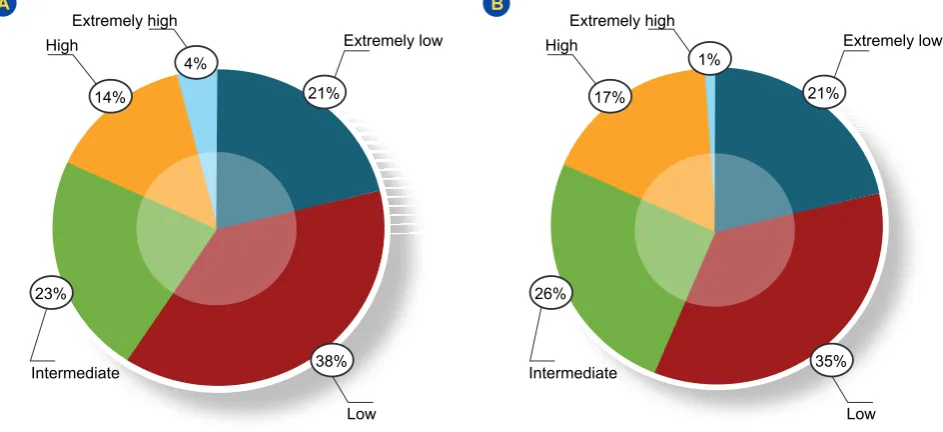
- cytogenetics, percentage of bone marrow blasts, haemoglobin, platelet and neutrophil counts – and five group risks were established, involving 86 patients: extremely low risk (20), low risk (32), intermediate risk (19), high risk (12) and extremely high risk (3 patients). These scores were not applied to 16 patients, due to inconclusive cytogenetics (n = 15) or to the presence of CMML with elevated leucocyte count (over 12 x 109 /L (n = 1)).
The WPSS score4 involves the cytogenetic analysis, as
índices de prognóstico, poderá melhorar o valor prognóstico de índices como o International Prognostic Scoring System, uma vez que valores elevados de eritropoietina estão associados a progressão para leucemia aguda e, consequentemente, a menor sobrevivência.
Conclusão: Os resultados sugerem que o aumento dos níveis séricos de eritropoietina ao diagnóstico pode constituir um factor de
mau prognóstico em doentes com síndrome mielodisplásica, associando-se a maior risco de evolução para leucemia aguda e menor sobrevivência global.
ARTIGO ORIGINAL
well as the MDS subtype according to the WHO classification and the need for transfusions. According to this score, our group of patients was divided into five groups: extremely low (16 patients), low (27 patients), intermediate (20 patients), high (13 patients) and extremely high score (one patient). Like the other scores, the presence of inconclusive cytogenetics or CMML prevented from the WPSS score to be established for 25 patients (Figs. 2A and 2B).
High average serum EPO levels were found in patients with the 5q- syndrome (164 mIU/mL) and low average levels in patients with refractory neutropenia (RN) subtype
(9 mIU/mL), when compared to the patients with other WHO subtypes (p < 0.05) (Fig. 3).
From our study group (102 patients), 11 progressed to AML and this subgroup included seven RAEB-2 patients, two RCMD, one RAEB-1 and another patient with CMML. It should be mentioned that the patients that progressed to AML had on average higher serum EPO levels. A statistically significant difference was found between the patients with progression to AML regarding serum EPO levels above 57.45 mIU/mL (p < 0.05) (Table 1).
Overall survival of the 102 patients with MDS was Figure 1 - Patient distribution according to the 2008 WHO classification (A) and to the International Prognostic Scoring System (IPSS) (B)
A B
50% 45%
6%
43% 4%
2%
8% 8%
12% 6% 4% 11% 1%
RCMD Int-1
RARS
Low
RAEB-1 RAEB-2
CMML RA RN Int-2 High
RT
5q-Figure 2 - CMDS patients according to the International Prognostic Scoring System – Revised (A) and the WHO Prognostic Scoring System (B)
A B
38% 35%
23%
14% 17%
4% 1%
21% 21%
Low Low
Intermediate Intermediate
High High
Extremely high Extremely high
Extremely low Extremely low
ARTIGO ORIGINAL
Low
Figure 3 - Serum EPO levels in patients with MDS, according to the WHO subtypes * p < 0.05; RA: refractory anaemia; RN: refractory neutropenia; RT: refractory thrombocytopenia.
RA -300
-200 -100
0 100 200 300 400 500
RN RT
Serum EPO, mIU/mL
5q- RARS RCMD RAEB-1 RAEB-2 CMML
analysed and, at 23 months of follow-up, 50% of the patients were alive and, at 36 months, only 32% were on follow-up. The group of 11 patients that progressed to AML showed a lower survival rate than those that did not show such progression, proven by a p-value < 0.01.
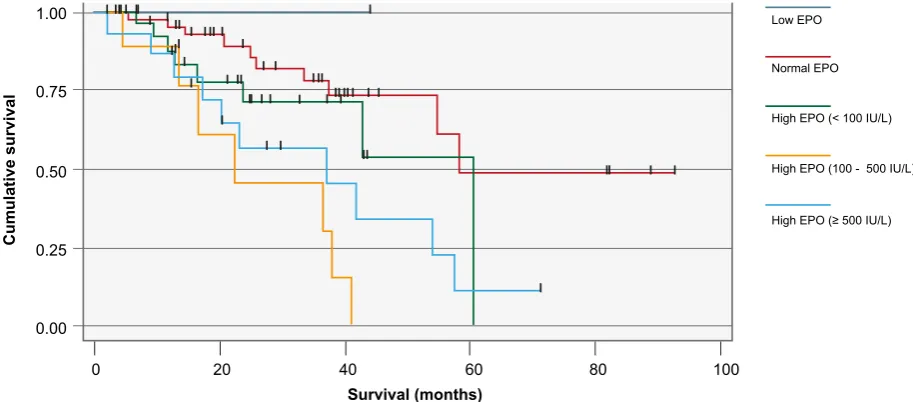
The analysis of survival according to the serum EPO levels allowed for patients to be ranked into five groups: below normal EPO levels (two patients), normal (42 patients), above normal and <100 mIU/mL (30 patients), 100 - 500 mIU/mL (nine patients) and >500 mIU/mL (two patients). A statistically significant different survival rate according to serum EPO levels was found (p = 0.0336), i.e. patients with over the upper limit of normal (41 patients) showed a lower survival when compared to patients with normal levels (44 patients) (Fig. 4).
The results of a Cox regression model after adjustment for LDH, patient’s age, IPSS, IPSS-R, haemoglobin, neutrophil, platelet, ferritin, β2-microglobulin and bone marrow blasts showed that the predictive value of EPO to overall survival remained the same (p < 0.001).
DISCUSSION
Our study was carried out along a 55-month period and involved 102 patients presenting with de novo MDS, with a median age of 74 years and a 0.8 male/female ratio. These data were in line with those already described, even though most studies described a mild male predominance.10,11 As regards the distribution of patients according to 2008 WHO subtypes, a predominance of patients with refractory cytopenias was found and in higher percentage than what has been described by other authors; RCMD subtype was
the most frequently found.12,13 Conversely, the percentage of patients with refractory anaemia and excess blasts (RAEB) and with CMML was lower to those described by other authors, while 5q- syndrome and RARS subtypes were in line with literature.12-15
This subtype distribution provided an estimate of prognosis, i. e. the predominance of patients with initial stage’s MDS correspond to patients showing low and intermediate prognostic scores. Therefore, the distribution according to the IPSS ranked our population into 87% of low-risk patients (including low and intermediate-1 risk), showing a higher predominance of low-risk patients when compared to 70% as described by other authors.1
Apart from IPSS and other prognostic scores (IPSS-R and WPSS), other prognostic parameters have been identified, namely the presence of bone marrow fibrosis, serum LDH and β2-microglobulin levels.2,5
Serum EPO levels have been used as a crucial parameter for therapeutic approach, even though the role as a prognostic marker has not yet been established.6-9 Therefore, we have analysed the relevance of serum EPO levels as prognostic marker in patients with de novo MDS.
Our results have shown that patients with different 2008 WHO MDS subtypes have statistically significant differences regarding the serum EPO level at the moment of diagnosis and this was related with survival.
Regardless of the ranking of EPO levels in subgroups (below normal, normal, high and <100 mIU/mL, 100-500 mIU/mL and >500 mIU/mL), the patients with serum EPO levels above the upper normal limit (above 29 mIU/mL)
Table 1 - Receiver operating characteristic (ROC) curves
95% CI p-value Cut-off Sensitivity Specificity Area under the curve
EPO 0.518 - 0.883 0.032 57.45 73% 80% 0.7
ARTIGO ORIGINAL
Figure 4 - Relationship between serum EPO and overall survival
0 20 40 60 80 100
Low EPO
Normal EPO
High EPO (< 100 IU/L)
High EPO (≥ 500 IU/L) High EPO (100 - 500 IU/L)
0.00 0.25 0.50 0.75 1.00
Cumulative survival
Survival (months)
show poorer survival (p = 0.0336). Its predictive values remained unchanged upon adjustment for LDH, patient’s age, IPSS, IPSS-R, haemoglobin, neutrophil, platelets, ferritin, β2-microglobulin and bone marrow blasts of the Cox regression model. Multivariate analysis identified EPO as predictive factor to overall survival (p < 0.001), showing it as an independent prognostic factor in MDS. In addition, we found that serum EPO levels >57.45 mIU/mL have an influence on the progression to acute leukaemia, suggesting the relevance of EPO as a possible marker of progression. The level of EPO in MDS has been described over the last few years as a predictive factor of response to EPO therapy. We currently know that patients with MDS and higher levels of EPO show a worse response to the administration of EPO, even with higher doses.16-19 Apart from the importance of serum EPO as an indicator of response to EPO therapy,6,8,9 the prognostic value of EPO was described in 2002 in a group of 68 patients in which patients with refractory anaemia (RA), RARS and RAEB were included.20 Our study population extended
these conclusions to all MDS subtypes in a larger group of patients, showing a prognostic role for EPO.
In addition, the use of EPO levels alone or associated to other prognostic factors of scores, in line with what has been described for LDH,2 it may improve the prognostic
values of scores like IPSS.
With this study, the role of EPO as predictor of overall survival and progression to acute leukaemia has a new expression, suggesting its importance as a prognostic factor that may eventually be used in daily clinical practice.
CONCLUSION
Our study showed the importance of serum EPO as an independent prognostic factor in a series of 102 patients with de novo MDS. The analysis of biochemical parameters allowed for the identification of serum high EPO levels as a marker of poor outcome and associated to patients with
progression to AML, as well as with lower survival rates. The recent introduction of new prognostic scores and the inclusion of specific genetic mutations have increased the complexity of prognostic assessment, making its implementation more difficult due to the lack of resources for the availability of such genetic studies in all the institutions and increasing healthcare-related costs. Even though the usefulness of these scoring systems in the clinical practice, we found that within the same risk group, some patients showed a particularly poor progression, suggesting the presence of prognostic factors not included in these systems. Further studies will be necessary to definitely confirm EPO’s prognostic value, with a larger sample and even establishing correlations with already known genetic mutations. Our study questioned whether some prognostic factors could be hidden within daily and easily used parameters that may be available in every healthcare institution.
HUMAN AND ANIMAL PROTECTION
The study was approved by the Ethics Research Committee of the Centro Hospitalar e Universitário de Coimbra.
DATA CONFIDENTIALITY
The authors declare that they have followed the protocols of their work centre on the publication of patient data.
CONFLICTS OF INTEREST
The authors declare that there were no conflicts of interest in writing this manuscript.
FINANCIAL SUPPORT
ARTIGO ORIGINAL
REFERENCES
1. Greenberg P, Cox C, LeBeau MM, Fenaux P, Morel P, Sanz G, et al. International scoring system for evaluating prognosis in myelodysplastic syndromes. Blood. 1997;89:2079-88.
2. Germing U, Hildebrandt B, Pfeilstöcker M, Nösslinger T, Valent P, Fonatsch C, et al. Refinement of the international prognostic scoring system (IPSS) by including LDH as an additional prognostic variable to improve risk assessment in patients with primary myelodysplastic syndromes (MDS). Leukemia. 2005;19:2223-31.
3. Zhang L, Padron E, Lancet J. The molecular basis and clinical significance of genetic mutations identified in myelodysplastic syndromes. Leuk Res. 2015;39:6-17.
4. Malcovati L, Germing U, Kuendgen A, Della Porta MG, Pascutto C, Invernizzi R, et al. Time-dependent prognostic scoring system for predicting survival and leukemic evolution in myelodysplastic syndromes. J Clin Oncol. 2007;25:3503-10.
5. Greenberg PL, Tuechler H, Schanz J, Sanz G, Garcia-Manero G, Solé F, et al. Revised international prognostic scoring system for myelodysplastic syndromes. Blood. 2012;120:2454-65.
6. Hellström-Lindberg E, Negrin R, Stein R, Krantz S, Lindberg G, Vardiman J, et al. Erythroid response to treatment with G-CSF plus erythropoietin for the anaemia of patients with myelodysplastic syndromes: proposal for a predictive model. Br J Haematol. 1997;99:344-51.
7. Jadersten M, Malcovati L, Dybedal I, Della Porta MG, Invernizzi R, Montgomery SM, et al. Erythropoietin and granulocyte-colony stimulating factor treatment associated with improved survival in myelodysplastic syndrome. J Clin Oncol. 2008;26:3607-13.
8. Santini V. Clinical use of erythropoietic stimulating agents in myelodysplastic syndromes. Oncologist. 2011;16:S35-42.
9. Park S, Grabar S, Kelaidi C, Beyne-Rauzy O, Picard F, Bardet V, et al. Predictive factors of response and survival in myelodysplastic syndrome treated with erythropoietin and G-CSF: the GFM experience. Blood. 2008;111:574-582.
10. Ma X, Does M, Raza A, Mayne ST. Myelodysplastic syndromes:
incidence and survival in the United States. Cancer. 2007;109:1536-42. 11. Ma X, Selvin S, Raza A, Foti K, Mayne ST. Clustering in the incidence of
myelodysplastic syndromes. Leuk Res. 2007;31:1683-6.
12. Germing U, Strupp C, Kuendgen A, Isa S, Knipp S, Hildebrandt B, et al. Prospective validation of the WHO proposals for the classification of myelodysplastic syndromes. Haematologica. 2006;91:1596-604. 13. Malcovati L, Della Porta MG, Pascutto C, Invernizzi R, Boni M, Travaglino
E, et al. Prognostic factors and life expectancy in myelodysplastic syndromes classified according to WHO criteria: a basis for clinical decision making. J Clin Oncol. 2005;23:7594-603.
14. Breccia M, Carmosino I, Biondo F, Mancini M, Russo E, Latagliata R, et al. Usefulness and prognostic impact on survival of WHO reclassification in FAB low risk myelodyplastic syndromes. Leuk Res. 2006;30:178-82. 15. Williamson PJ, Kruger AR, Reynolds PJ, Hamblin TJ, Oscier DG.
Establishing the incidence of myelodysplastic syndrome. Br J Haematol. 1994;87:743-5.
16. Filì C, Malagola M, Follo MY, Finelli C, Iacobucci I, Martinelli G, et al. Prospective phase II Study on 5-days azacitidine for treatment of symptomatic and/or erythropoietin unresponsive patients with low/INT-1-risk myelodysplastic syndromes. Clin Cancer Res. 2013;19:3297-308. 17. Nakazaki K, Nannya Y, Kurokawa M. Distribution of serum erythropoietin levels in lower risk myelodysplastic syndrome cases with anemia. Int J Hematol. 2014;99:53-6.
18. Santini V. The quest for the perfect MDS scoring system. Leuk Res. 2012;36:125-6.
19. Spinelli E, Caporale R, Buchi F, Masala E, Gozzini A, Sanna A, et al. Distinct signal transduction abnormalities and erythropoietin response in bone marrow hematopoietic cell subpopulations of myelodysplastic syndrome patients. Clin Cancer Res. 2012;18:3079-89.