DETERMINATION OF BIOACTIVE COMPOUND CONTENT
AND ANTIOXIDANT ACTIVITY OF THE LEBANESE
ERYNGIUM CRETICUM L.
Saeed Zeidan,
[a]Akram Hijazi,
[a,b]*Hassan Rammal,
[a,b,c]Ali Al Bazzal,
[a,c]Hussein Annan,
[a]and Abd Al- Ameer N. Al-Rekaby
[d]Keywords: Flavonoids; phenols; antioxidant activity; microwave-assisted extraction; bioactive compounds.
Polyphenolic compounds are bioactive substances widely distributed in the plant kingdom. They act as natural antioxidants and their presence contributes to the color, flavor, and aroma of food. Therefore, they are considered dietary antioxidants with interesting benefits to health. In this article the extraction of total phenolics, total flavonoids and antioxidants activity from Eryngium creticum was determined after obtaining the plant extracts by conventional and non-conventional extraction techniques. Also this study aims to determine the bioactive constituents present in E. creticum extracts by using GC-MS method. The results obtained show that microwave assisted extraction is the best technique used for the extraction of phenolic compounds and flavonoids from E. creticum giving a yield of 34.46 µg
mL-1 and 21.05 µg mL-1 respectively. However, the antioxidants activity, evaluated by the DPPH assay was low in all the extraction
techniques. Also the results showed the presence of 9 fatty acid derivatives, most of them have therapeutic effects on human health. These results explain the use of E. creticum in traditional medicine to treat various diseases.
* Corresponding Authors Tel: 0096171905768
E-Mail: [email protected]
[a] Doctoral School of Science and Technology, Research Platform for Environmental Science (PRASE), Lebanese University, Lebanon
[b] Laboratory of Materials and Phytochemistry, Lebanese University, Faculty of sciences.
[c xFaculty of Agriculture and Veterinary Science, Lebanese University, Lebanon
[d] Al Mustansiriya University, College of Science, Department of Biology, Irak
Introduction
Oxidative stress is involved in the pathology of cancer, arteriosclerosis, malaria and rheumatoid arthritis, and could play a role in neurodegenerative diseases and aging processes. Antioxidants perform multiple functions, including the defense against oxidative damage and cell signaling. One major function of antioxidants in the biological system is to prevent the cellular components’ damage by the reactive oxygen species.1
Bioactive compounds in plants are produced as secondary metabolites. These compounds are called so because they are related to substances that exert an effect on living tissues, and are dedicated to help the plants to increase their overall ability to survive and overcome local challenges 2. The bioactive compounds are ubiquitous in nature. They have been identified and isolated from diverse sources within the living organisms. For decades, organic extracts from various origins have been widely used in the traditional medicine, as well as in the food industry, and are considered to be generally safe. 2
Eryngium creticum, a perennial plant belonging to the family Umbellifereae, is considered a medicinal plant due to its antioxidant properties.3 The latter is characterized by the
presence of a wide variety of phenolic acids and flavonoids.
In addition to its ability to act as an efficient free radical scavengers, its natural origin is an advantage to all customers, unlike other synthetic antioxidants whose use is being restricted due to its carcinogenicity.5 E. creticum has
also showed an antioxidant property through inhibiting lipid peroxidase in the liver of rat. This plant was traditionally used as a diuretic (emmenagogue). Roots and seeds that are immersed in water, are drunk to treat kidney stones, infections, skin diseases, and tumors. It is also an antidote, in which it is used for treating snake bites. Moreover, E.
creticum has an antifungal activity, as well as a
hypoglycemic role in which the deduction from the aerial part of this plant showed a significant reduction in the concentration of blood sugar. Also, this plant has shown an anti-inflammatory, as well as an anti-microbial, activity and was also used for the treatment of poisoning, anemia and infertility.4,5 Finally, its was recently demonstrated that
Lebanese E. creticum has an antitumor activity on cervical cancer (HeLa) cell line. 6,7
This study aims to determine the following: the total phenolic content (TPC), the total flavonoid content (TFC), the antioxidant activity, the esterified fatty acids, the humidity, the ach content, and the alkaloid content of the Lebanese Eryngium creticum. In addition, it aims to establish a comparison between the conventional and non-conventional extraction techniques for the total amount of phenols, flavonoids, and antioxidant activity obtained.
Materials and Methods
Plant collection and preparation of the powder
grinder) until we obtain a powder form that is preserved in a black container, away from light, heat, and moisture for later use.
Preparation of crude extracts
5 grams of E. creticum powder were used in each of the extraction technique along with 250 mL of ethanol as a solvent. Maceration method was performed for 48 hours with stirring. Moreover, reflux and Soxhlet methods were performed for 4 hours under heat. On the other hand, microwave-assisted extraction was performed for 2 minutes under a power of 750 watt.
Standard curves preparation (gallic acid and rutin)
Stock solutions of gallic acid have been prepared as a standard for the quantification of the total amount of phenols (in mg per gram of dry plants powdered). Gallic acid (5 mg) was added to 50 mL of methanol (10 %) to prepare 0.1 mg mL-1 stock solution. Then different dilutions were done to
prepare several concentrations (5 to 40 μg mL-1) in order to
show the standard curve of gallic acid.
Stock solutions of rutin have been prepared as a standard for the quantification of the total amount of flavonoids (in mg per gram of dry powdered). This stock contains 5mg of rutin + 5 mL of methanol. Then, dilution (by twenty times) was done by taking 1.25 mL from this solution and diluting it in 25 mL methanol. Several concentrations (4 to 32 μg mL-1) were prepared in order to show the standard curve of
rutin.
Determination of the total phenolic content (TPC)
The Folin–Ciocalteau reagent method was used for estimating the total quantity of phenolic extracts. Five concentrations of all extracts of the used plant were prepared and then 100 µL were taken from each concentration and mixed with: 0.5 mL of Folin–Ciocalteau reagent (1/10 dilution) and 1.5 mL of Na2CO3 2% (w/v). The blend was
incubated in the dark at the room temperature for 15 min. The absorbance of blue-colored solution of all samples was measured at 765 nm using a Gene Quant 1300 UV-Vis spectrophotometer. The results were expressed according to the Gallic acid standard curve.8
Determination of the total flavonoid content (TFC)
The aluminium chloride method was used for determining the total flavonoids content of all extracts of the studied plant. 1 ml of the various concentrations of all crude extracts was mixed with 1 mL of 2 % methanolic aluminium chloride solution. After an incubation period (15 min) at the room temperature in the dark, the absorbance of all samples was determined at 430 nm using a Gene Quant 1300 UV-Vis spectrophotometer. The results were expressed according to Rutin standard curve.9
DPPH radical scavenging activity
1 mL of the different concentrations (0.1, 0.2, 0.3, 0.4, and 0.5 mg mL-1) from the diluted extracts of the plant’s parts in
ethanol was added to 1 mL of DPPH (0.15 mM in ethanol), and at the same time, a control consisting of 1mL DPPH with 1 mL of ethanol was prepared. The reaction mixtures were mixed very well (manually) and then were incubated in the dark at the room temperature for 30 min, and the absorbance was measured at 517 nm by a Gene Quant 1300 UV-Vis spectrophotometer. The ascorbic acid was used as a positive control and the ethanol was used as the blank. The DPPH scavenging ability (in %) of the plant extracts was calculated using the following equation:
where
Ac is the absorbance of DPPH + ethanol;
As is the absorbance of DPPH + sample.10
Extraction and esterification of the fatty acids
The extraction and esterification of the fatty acids was done according to the method of Abdul Hayee-memon et al.
11 with some modifications. To 20 g of the powdered plant
materials, 100 mL of petroleum ether has been added and was set in a water bath for 15 min at the room temperature (the extraction was repeated in triplicate). Then petroleum ether has been evaporated using a rotary evaporator at 40°C, under a low pressure. In a beaker, 250 mL of methanol were added to 29 g of NaOH and were dissolved by agitation at room temperature. For 0.5 mL of the extracts obtained from the powdered plant material, 20 mL of hexane and 100 mL of NaOH were added and dissolved in methanol. After the separation of the mixture, the hexane layer was taken and washed two times with distilled water. Finally, the obtained extracts were filtered and sent to GC-MS (Gas Chromatography-Mass Spectrometry) for the analysis of the esterified fatty acids.11
GC-MS analysis
GC-MS analysis was carried out on “Clarus 500 Perkin Elmer” system comprising the AOC-20i auto-sampler and the gas chromatograph that is interfaced to the mass spectrometer (GC-MS) instrument, employing the following conditions: an Elite-5MS (5 % diphenyl/95 % dimethyl poly siloxane) fused a capillary column (30 × 0.25 μm ID × 0.25 μmdf). For GC-MS detection, an electron ionization system was operated in a fast atomic bombardment mode using an ionization energy of 70 eV. Helium gas (99.999%) was used as a carrier gas at a constant flow rate of 1.4 mL min-1
through an injection of 50 mL min-1 (a split less mode). The
injector temperature was maintained at 220 °C, and the oven temperature was programmed at 45 °C for 5 min with an increase of 3 °C per min to reach a temperature of 220 °C, in which this temperature was maintained for 15 min. Mass spectra was taken at 70 eV; a scan interval of 0.3 s for all fragments mass. The solvent delay was 0 to 2 min and the total GC/MS running time was 80 min.
s c
c
100
A A
A
Determination of the Total Alkaloids amount
The quantification method for alkaloids determination has been used according to Harborne method12 with some
modifications. 100 mL of 10 % acetic acid in ethanol was added to 1 g of dry powdered plant. The extracts were then covered and allowed to stand for 4 hours. After that, the extracts were filtrated and concentrated in a water bath to 25 mL of its original volume. Droplets of concentrated ammonium hydroxide were added to the extract until the whole solution has precipitated. The precipitate was then washed by dilute ammonium hydroxide and filtered using whatman filter paper. The residues were dried in the oven at 40 °C and were weighed. The alkaloid content (CA, in %)
was determined using the following formula
where
mf is the final weight of the sample
mi is initial weight of the extract
The samples were done in triplicates.
Determination of the humidity content
1 gram of fresh plant material was taken and placed in an oven at 105 °C for 1 hour. Then, it was placed in a desiccator for half an hour and the mass was recorded after that. The following step was to place the plant again in the oven for another 1 hour. After heating, it was placed in the desiccators for half an hour. These steps led to obtaining a dry plant material in which the mass was recorded in order to calculate the percentage of humidity.13 The sample was
done in triplicates.
Determination of the ash content
1 gram of dried plant powder was placed (until being burnt) in a burning furnace (muffle furnace) at 550 °C for 5 hours until obtaining a powder with an ovary gray color. The residues were weighed and the percentage of ash was estimated according to the essential dry weight of plant powder.14 The sample was done in triplicates.
RESULTS AND DISCUSSION
Total phenolic content (TPC) and total flavonoid content (TFC)
After the preparation of the gallic acid standard curve (Fig.1 in Supplement, R2=0.9907) and rutin standard curve
(Fig.2 in Supplement, R2=0.9952), the TPC and TFC of each
technique have been demonstrated in Table 1. The results show that the highest amount of phenolic compounds (34.46 µg mL-1) was obtained by microwave-assisted extraction
(MAE) while the lowest amount of phenolic compounds (8.57 µg mL-1) was obtained by maceration. On the other
hand, the TPC was found to be 12.22 µg mL-1 and 17.68 µg
mL-1 by using the reflux and Soxhlet methods respectively.
Thus, the microwave-assisted extraction is the best method used for the extraction of phenolic compounds from dried plant material.
Concerning the TFC, the obtained results showed that most extraction techniques produced approximately the same values with slight variations between one extraction technique and the other, although the microwave-assisted extraction produced, as for the TPC, the highest yield of TFC 21.05 µg mL-1 as shown in Table 1.
Table 1. TPC and TFC expressed as a mean (±SD)
Extraction technique TPC, µg mL-1 TFC, µg mL-1 Maceration 8.57 0.006 18.61 0.023 Reflux 12.22 0.02 20.19 0.041 Soxhlet 17.68 0.0043 17.73 0.012 Microwave-assisted
extraction
0.0046 0.015
Antioxidants activity
Several reports regarding flavonoids, terpenoids, and polyphenols have proven that these biological compounds possess an antioxidant and free radical scavenging activity.15
These phyto-constituents may exert multiple biological effects against tumors, heart disease, AIDS, and many other different pathologies due to its free radical scavenging activity. Taking these facts into consideration, our study was conducted to evaluate the antioxidant power of the Lebanese plant, E. creticum using different extraction techniques. The easiest, most rapid and sensitive method for screening antioxidants in plant extracts is the free radical scavenging assay using the “DPPH assay”. In the presence of an antioxidant, DPPH radical gains one or more electrons and thus the absorbance decreases.8
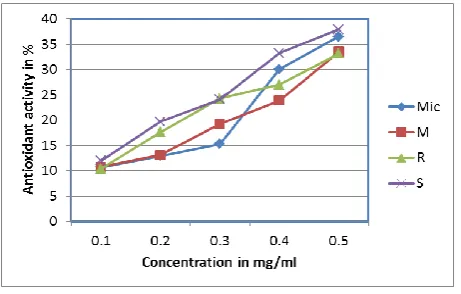
Figure 3. Antioxidant activity obtained by different extraction techniques. Mic = microwave, M=maceration, R=reflux and S= Soxhlet
Figure 1 shows the antioxidant activity obtained from different extraction techniques. The results indicate that there was a slight variation between one extraction technique and the other. In addition, the highest antioxidant
f A
i
100m
C
m
activity in all the extraction techniques was obtained at a concentration of 0.5 mg mL-1 and reached a maximum of 30
to 40 % in all of the extraction techniques. Therefore, the antioxidant activity of this plant was increasing with an increase in the concentrations.
Phytocomponents identified in E. creticum extracts after GC-MS
The GC-MS analysis (Fig.3 in Supplement) of E. creticum
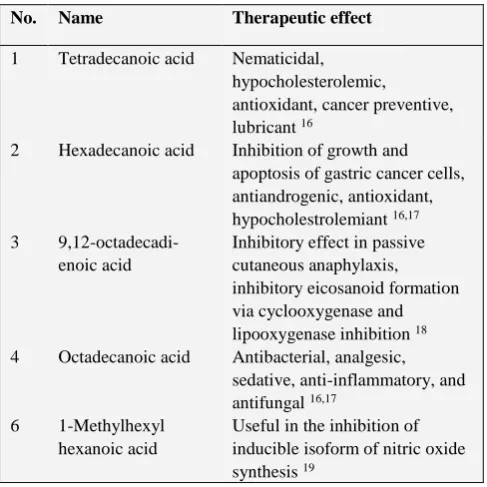
extracts revealed the presence of 9 fatty acid derivatives (Table 2), some of which have therapeutic uses (Table 3).
Table 2. Phytocomponents of E. creticum extracts based on GC-MS probability (in %)
No. Name MW, g mol-1
Content, %
Origin
1 Methyl tetradecanoate
242 32.56 Myristic acid 2 Methyl
hexadecanoate
270 49.34 Palmitic acid 3 Methyl
9,12-octadecanoate
294 8.59 Linoleic acid 4 Methyl
octadecanoate
298 13.89 Stearic acid 5 Cyclohexyl nonyl
oxalate
298 28.94 Oxalic acid 6 1-Methylhexyl
hexanoate
214 10.89 Hexanoic acid 7 Allyl nonyl
oxalate
256 4.23 Oxalic acid 8 2-propyl
tridecylsulphinate
306 2.93 Sulfurous acid 9 Methyl
4-hydroxy octadecanoate
314 5.84 Stearic acid
Table 3. Therapeutic uses of some phytocomponents obtained from E. creticum
No. Name Therapeutic effect
1 Tetradecanoic acid Nematicidal, hypocholesterolemic,
antioxidant, cancer preventive, lubricant 16
2 Hexadecanoic acid Inhibition of growth and apoptosis of gastric cancer cells, antiandrogenic, antioxidant, hypocholestrolemiant 16,17
3 9,12-octadecadi-enoic acid
Inhibitory effect in passive cutaneous anaphylaxis, inhibitory eicosanoid formation via cyclooxygenase and lipooxygenase inhibition 18
4 Octadecanoic acid Antibacterial, analgesic, sedative, anti-inflammatory, and antifungal 16,17
6 1-Methylhexyl hexanoic acid
Useful in the inhibition of inducible isoform of nitric oxide synthesis 19
They can be useful as an antimicrobial agent, an anti-inflammatory agent, a diuretic, a lubricant, an analgesic, an antifungal agent, an antioxidant, and also as a cancer preventive agent for the treatment of patients having cancer.
Active content of E. creticum
Table 4 shows the percentage of total alkaloids obtained in
E. creticum as well as the humidity content and the total ash percentage. E. creticum has a low amount of alkaloids (0.57 %), with a high humidity content (79.16 %) and ash content (18.10 %).
Table 4. Percentage of active content obtained from E. creticum
expressed as a mean (±SD)
Component Content, in wt. %
Total alkaloids 0.57 ± 0.0058 Humidity 79.16 ± 0.0078 Total ash 18.10 ± 0.0015
Conclusion
Eryngium creticum, besides having a high phenolic and flavonoid content, has an important antioxidant activity. The difference in the obtained results indicated that microwave assisted technique produced the highest amount of TPC and TFC and thus can be used for the extraction of flavonoids and phenolic compounds in high amounts. Also, the GC-MS analysis of E. creticum extracts revealed the presence of a variety of bioactive compounds which explains the possibility of using this plant in folk medicine for the treatment of several illnesses. Future studies need to be done on the use of these bioactive compounds as a source of multi resistant medicaments.
References
1Kris-Ethreton, P. M., Hecker, K. D., Bonanome, A., Coval, S. M.,
Binkoski, A. E., Holpert, K. F., Griel-Ethreton, T. D., Am. J. Med., 2002, 71s-81s. P: 11-17.
3Farhan, H., Malli, F., Rammal, H., Hijazi, A., Bassal, A., Ajouz,
N., Badran, B., Asian Pacific J. Trop. Biomed.,2012, 1-4.
4Abu-Rabia, A., Asian Pacific J. Cancer Prevent., 2005, 6, 404-7.
5Alkofahi, A., Sallal, A. J., Disi, A. M., Phytotherapy Res.,1997, 11, 540-2.
6Rammal, H., Farhan, H., Mohsen, M., Hijazi, A., Kobeissy, A.,
Daher, A., Badran, B., Int. Res. J. Pharm., 2013, 4, 132-136.
7Dirani, Z., Makki, R., Rammal, H., Naserddine, S., Hijazi, A.,
Kazan, H. F., Nasser, M., Daher, A. and Badran, B., Int. J. Biol. Pharm. Allied Sci., 2014, 3(10), 2199-2222.
8Lister, E., Wilson, P., Measurement of Total Phenolics and ABTS Assay for Antioxidant Activity. Crop Research Institute Lincoln, New Zealand, 2001.
9Quettier-Deleu, C., Gressier, B., Vasseur, J., Dine, T., Brunet, C.,
Luyckx, M., Cazin, M., Cazin, J. C., Baileul, F., Trotin, F., J. Ethnopharm., 2000,72, 35-42.
10Chew, Y. L, Goh, J. K., Lim, Y. Y, Food Chem.,2009, 119,
11Hayee-Memon, A., Shameel, M., Usmanghani, K., Ahmad, M.,
Ahmad, V. U., Pakistan J. Pharm. Sci., 1991, 4, 137-144.
12Harborne, J. B., Phytochemical methods. A guide to modern
techniques of plant analysis. 3rd ed. New Delhi: Spinger Pvt.
Ltd., 2005.
13American Association of Cereal Chemists (AACC). Method
08-01. The Association St. Paul MN. Approved Methods of the AACC, 8th Edition, 1984.
14Association of Official Analytical chemists (AOAC). Official Methods of Analysis, 13th ed. Washington D.C., 1980. 15Frankel, E., Nutritional benefits of flavonoids. Int. Conf. Food
Factors: Chem. Cancer Prevent., Hamamatsu, Japan abstracts, C6-2, 1995.
16Kalaivani, C. S., Sathish, S. S., Janakiraman, N., Johnson, M., Int. J. Med. Aromatic Plants. 2012,2, 69-74.
17Ponnamma, S. U., Manjunath, K., Int. J. Pharma Biosci., 2012, 3(3), 570-576.
18Stasi, L. C., Gomes, J. C., Vilegas, W., Chem. Pharm. Bull., 1999, 47, 890-893.
19Donald, W., Hansen, J. R., Skokie, I. L., (2002).
Homoiminopiperidinyl Hexanoic Acid Inhibitor of Induced Nitric Oxide Synthase, US 6495544.