International Journal Advances in Social Science and Humanities
Available Online at: www.ijassh.com
RESEARCH ARTICLE
An Adjudication of E-resources Among the Faculty Members of
Education Colleges in Chidambaram Taluk
Dr. K. Vijayakumar
Department of Library and Information Science, Annamalai University, Annamalai Nagar, Tamilnadu, India.
Abstract
The present study deals with usage of e-resources by the users in the faculty members of education colleges in Chidambaram taluk. It explains the introduction, objectives, hypothesis, methodology, sample selection, limitation, results and discussion.
Keywords: Designation- wise, Frequency, Location, Sources.
Information Technology
Information Technology is the aggregate of Scientific and Technical discipline basis to the production devices and systems for the capture transportation, storage, processing and retrieval of voice text, numerical and pictorial information. The advent of the modern IT has facilitated in the electronic storage and transmission of recorded knowledge.
E-Resources
E-resources is an electronic information resource that can access on the web, on or off campus. material (data and\ or programs) encoded for manipulation by a computerized devices. This material may require the use of
peripheral directly connected to a
computerized device (eg. CD-ROM device) or a connection to a computer network (eg. Internet).
Objectives of the Study
The objectives of the study are as follows
To study the respondents designation, time spent, frequency, purpose with the e-resources by the faculty members.
To find out the location, sources of the e-resources.
To identify the teaching of e-resources and use of electronic/ print format of e-resources.
To find out the problem and satisfaction of using e-resources.
Methodology
Data was collected using a questionnaire method. This survey covers education college faculty members. There are 5 education colleges in Chidambaram taluk. Which questionnaires were distributed to education faculty only? A total number of 100 questionnaires were distributed, a total of 90 valid questionnaires were collected from faculty members. The response rate was 90%.
Education Colleges in Chidambaram
Taluk
There are five education colleges in Chidambaram taluk, namely
Education College of Annamalai
University,
Kamaraj College of Education
Shree Ragavendra College of Education, Muna College of Education
Limitations
This study is confined is to the
examination of five education college
faculty members in chidambaram taluk.
The study is restricted from Guest
Lecturer, Assistant professors, Associate
professor only.
Table 1: Designation wise respondents
S.No Designation No.of Respondent Percentage
1 Guest Lecturer 38 42.00
2 Assistant Professor 36 40.00
3 Associate Professor 16
8.00
Total 90
100.00
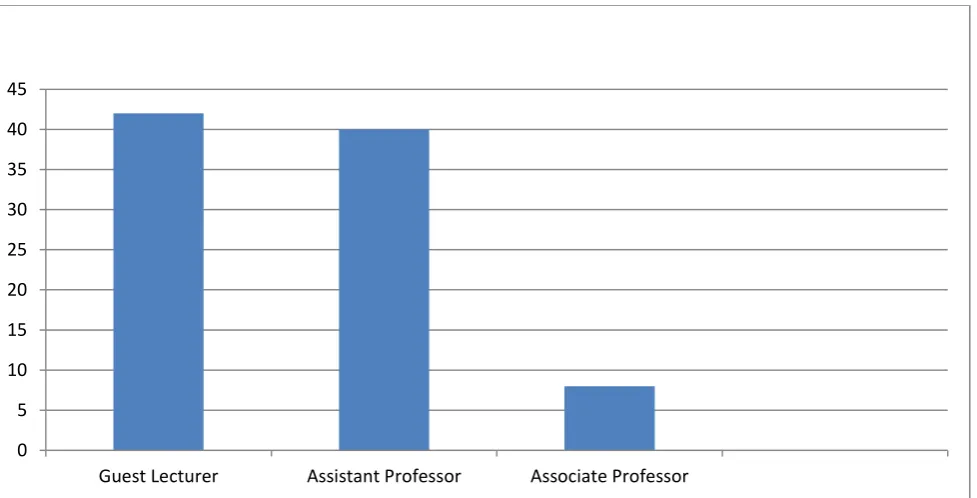
Table 1 shows designation wise distribution of faculty members, out 90 faculty members 38(42%) of the respondents are Guest
lecturer, 36(40%) of respondents are Assistant Professors and 16(8.00%) of the respondents are Associate Professors.
Figure1: Designation wise respondents
Table 2: Time spent of using E-Resources
S.No Time Guest
Lecturer Professor Assistant Professor Associate Total
1 One hour 16 (40) 12 (30) 12 (30) 40 (44.44)
2 Two hours 15 (42.85) 18 (51.42) 2 (5.71) 35 (38.38)
3 More than
three hours 7 (40.66) 6 (40) 2 (13.33) 15 (16.66) Total 38 (42.66) 36 (40) 16 (17.77) 90 (100.00)
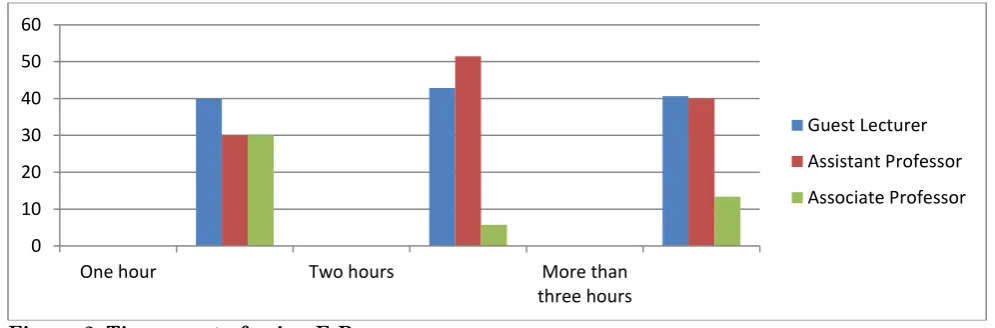
Data presented in the table-2 indicates that the time spent of using e-resources. The category wise analysis reveals the following facts. The majority of Assistant Professor
51.42% of them are using E-resources for two hours, Associate professor, guest lecturer respondents are using E-resources for one hour 30% and 40% respectively.
0
5 10 15 20 25 30 35 40 45
Figure 2: Time spent of using E-Resources
Table 3: Frequency of using E-Resources
S.No Frequency Guest
Lecturer Professor Assistant Professor Associate Total
1 Daily 30 (45.45) 28 (42.42) 8 (12.12) 66 (73.33)
2 Weekly 4 (36.36) 5 (45.45) 2 (18.18) 11 (12.22)
3 Monthly 2 (100) - - 2 (2.22)
4 Occasionally 2 (18.18) 3 (27.27) 6 (54.54) 11 (12.22) Total 38 (42.42) 36 (40) 16 (17.77) 90 (100)
Table-3 shows that the frequency of using E-resources. It could be noted that out of 90 respondents 66 (73.33) of them frequency of
using E-resources daily, 11(12.22) of them are using weekly only and 2(2.22) of them are using monthly.
Figure: 3 Frequency of using E-Resources
Table 4: Purpose of using E-Resources
S.No Purpose Guest
Lecturer Professor Assistant Associate Professor Total
1 Lecture notes 5 (100)
- - 5 (5.55)
2 Career
development 8 (44.44) 6 (33.33) 4 (22.22) 18 (20)
3 Current
information
12 (50)
10 (41.66)
2 (8.33)
24 (26.66)
4 Update
knowledge 7 (20) 20 (57.14) 8 (22.85) 35 (38.88) Searching
information 6 (75) - 2 (25) 8 (8.88)
Total 38 (42.42) 36 (40) 16 (17.77) 90 (100) 0
10 20 30 40 50 60
One hour Two hours More than
three hours
Guest Lecturer
Assistant Professor
Associate Professor
0 20 40 60 80 100 120
Daily Weekly Monthly Occasionally
Guest Lecturer
Assistant Professor
Table 4: discussed about purpose of using E-resources. The majority of Assistant Professor respondents 57.14% of them are using E-resources for update knowledge.
Associate Professor and guest lecturer respondents of them are using E-resources for update knowledge in cen percentage.
Table 5: Location of accessing E-Resources
S.No Location Guest
Lecturer Assistant Professor Associate Professor Total
1 Library 23 (44.23) 25 (48.07) 4 (7.62) 52 (57.77)
2 Department 7 (28) 8 (32) 10 (40) 25 (27.77)
3 Home 6 (54.54) 3 (27.27) 2 (18.18) 11 (12.22)
4 Computer
centre 2 (100) - - 2 (2.22)
Total 38 (42.22) 36 (40) 16 (17.77) 90 (100)
Table-5 indicates that the respondents location of accessing E-resources use from where the E-resources is mostly access by the faculty. A majority of the respondents 57.77 %percent of them access E-resources
from library, 27.77% percent of them access E-resources from department, 12.22% percent of them access E-resources from home and 2.22% percent of them access E-resources from computer Centre.
Table 6: Sources of using E-Resources
S.No Sources Guest
Lecturer Assistant Professor Associate Professor Total
1 CD-ROM 6 (54.54) 5 (45.45) - 11 (12.22)
2 E-book 7 (31.81) 11 (50) 4 (18.18) 22 (24.44)
3 E-journal 9 (40.90) 7 (31.81) 6 (27.27) 22 (24.24)
4 E-databases 13 (46.42) 9 (32.14) 6 (21.42) 28 (31.11) E-references 3 (42.85) 4 (57.14) - 7 (7.77) Total 38 (42.22) 36 (40) 16 (17.77) 90 (100)
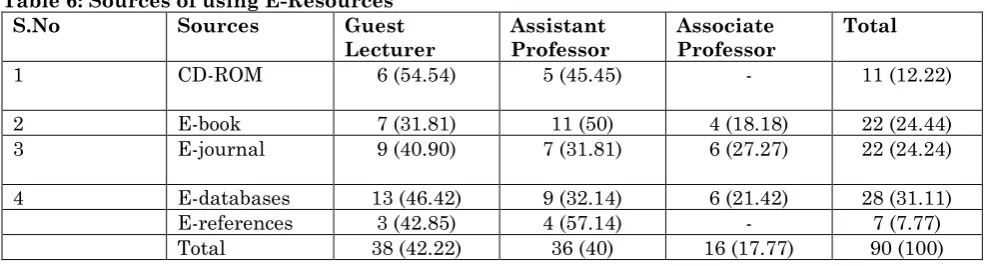
A data were analyzed in table-6 indicates sources of using E-resources. The Guest Lecturer respondents are using E-databases 46.42% occupies highest level and 42.85% e-references occupies the lowest level. Associate Professor respondents are using E-journal 27.27% occupies highest level and
18.18% E-books and E-databases occupies the lowest level. Assistant Professor respondents are using E-books occupies the highest level. E-references and CD-ROM sources are using the lowest level.
It could be seen clearly from the above discussion majority of the assistant professor are using E-books and E-databases
Table 7: Usage of E-Resources in teaching
S.No Teaching Guest
Lecturer Professor Assistant Professor Associate Total
1 Preparing
lecture (44.44) 20 21 (46.66) 4 (8.88) 45 (50)
2 Enriching
curriculum (34.98) 8 (21.73) 5 (43.47) 10 (25.55) 23
3 Lab classes 10 (45.45) 10 (45.45) 2 (9.09) 22 (24.44) Total 38 (42.42) 36 (40) 16 (17.77) 90 (100)
analysis reveals the following facts. The Assistant Professor respondents highest using of E-resources in teaching for preparing lecture methods 46.66%, Associate
Professor and Guest lecturer respondents highest using of E-resources in teaching enriching curriculum and 43.47% and 34.98 percentages.
Table 8: Problems of using E-Resources
S.No Problems Guest
Lecturer Professor Assistant Professor Associate Total
1 Slow speed 18 (45) 16 (40) 6(15) 40 (44.44)
2 System problem 8 (30.76) 10 (38.46) 8 (30.76) 26 (28.88) 3 Limited time 10 (58.82) 5 (29.41) 2 (11.76) 17 (20)
4 Problem on downloading
articles 2 (28.57) 5 (71.42) - 7 (7.77)
Total 38 (42.22) 36 (40) 16 (17.77) 90 (100)
Table-8 reveals that the problems faced by the E-resources. It could be noted that out of 90 respondents 40(44.44%) of them faced slow speed to access the E-resources 26(28.88%) of them faced system problem to
access E-resources, 17(20%) of them faced limited time to access E-resources and 7(7.77%) of them faced problem on downloading articles to access the E-resources.
Table 9: Satisfaction of E-Resources
S.No Satisfaction Guest Lecturer Assistant
Professor Associate Professor Total
1 Fully Satisfied 30 (46.15) 25 (38.46) 10 (15.38) 65 (72.22) 2 Partially satisfied 2 (16.66) 6 (50) 4 (33.33) 12 (13.33)
3 Not satisfied 6 (46.15) 5 (38.45) 2 (15.38) 13 (14.44)
Total 38 (42.42) 36 (40) 16 (17.77) 90 (100)
Tabl9 Shows that satisfaction of using e-resources. It could be noted that out of the 90 respondents 65(72.22%) of them are fully satisfied, 12(13.33%) of them are partially satisfied and 13(14.44%) of them are not satisfied.
Findings and Conclusion
From the analysis of collected data, some useful findings have drawn, which are represented in the following.
• It is formed that majority of the Guest Lecturer respondents occupies the first
position. The Assistant Professor
respondents occupies the second position and Associate Professor respondents occupies the third position
• In order to ascertain the respondents who spent time one hour of use e-resources occupies the first ,two has use the second position and more than three hours of using e-resources occupies the last position.
• The method of frequency of using e-resources daily occupies the first position, weekly and occasionally occupies the second position and monthly occupies the last position.
• It is evident that the respondents purpose of use e-resources for use e-resources for update information occupies the first position, lecture notes occupies the last position.
• It is formed that respondents location of accessing e-resources from library occupies the first position, from department occupies the second position, from home occupies the third position rest of them occupies the last position.
• The method of sources of using e-resources e-databases occupies the first position and e-references occupies the last position. • In order to ascertain the respondents of
the first position and lab classes occupies the last position
• It is formed that the problem of using e-resources slow speed occupies the first position and problem on downloading articles occupies the last position.
• In order to ascertain the satisfaction wise analysis guest lecturer are fully satisfied. so fully satisfied in first order, not satisfied in third order, in second order, partially satisfied in third order.
Suggestion
There are a number of suggestion as given by the respondents are represented below. To provide more number of CD-ROM services.
To provide more number of books and E-journals.
More number of personal computers with LAN connection are to be provided.
Sufficient time should be given to use E-resources.
To provide mailing list and subject gate ways.
To provide more number of E-databases. More number of trained staff should be engaged in their purposes [1-3].
Conclusion
The members of faculty of education have started using a variety of e-resources to prepare for classes and for assisting research. E-resources have changed the
traditional practices of library and
information centers in delivery of services to the end users. The ICT has now-a-days become an important technology in education institutions. As it plays an important role in meeting information needs of the members of the faculty and institutions as a whole. It becomes imperative for the members of faculty to use e-resources so as to keep themselves updated with latest information in their subjects
References
1 MS Lohar, TN Rooparrshree (2016) "Use of electronic resources by faculty members in B.I.E.T., Davanagere: A survey". SRELS journal of information management, 43(1):101-112.
2 Sajjad UR Rehman, Vivian Ramzy (2004) Awareness and use of electronic information resources at the Health sciences Centre of kuwait university. Library Review, 53(3):150-156.
3 Karen E. Fisher, Sanda Erdelezz. Mekchine, "
Theories of Information