Research Article
a
April
2018
Special Issue: National Conference on Emerging Trends in Engineering 2018
Conference Held at Sri Venkatesa Perumal College of Engineering & Technology, Puttur, A.P., India
Computer Science and Software Engineering
ISSN: 2277-128X (Volume-8, Issue-4)
Turbo Decoding Multi-ASIP Architecture for Multi
Standard
K. Madhuri1,M.Hema2, D.Moulika3
1, 2, 3
M.Tech, Assistant Professor, Sri Venkatesa Perumal College of Engineering and Technology Dept of ECE,
Abstract: Channel decoding is a key feature of a wireless communication standard.It allows reliable data transfer targeting high throu-ghput over unreliable communication channels. Among channel decoding techniques, Turbo codes are frequently adopted in the recent wireless standards to reach a very low bit error rate (BER). Furthermore, the high through put requirement of emerging services imposes the efficient exploitation of different parallelism levels of the underlying algorithms.
Index Terms: Application specific instruction-set processor (ASIP), dynamic configuration, turbo codes (TCs), wireless Communication.
I. INTRODUCTION
The need of mobile connectivity has hugely increased in the first decade of the 21st century. Homes, schools, businesses and people are now connected together for sharing information as soon as that information is produced. This permanent connectivity has lead to a growing number of connected mobile devices such as laptops, tablets, mobile phones, watches and plenty of other portable devices. Accompanying this mobile connectivity evolution, the last years have seen considerable evolutions of wireless communication standards in the domain of mobile telephone networks, local/wide wireless area networks, and Digital Video Broadcasting (DVB).
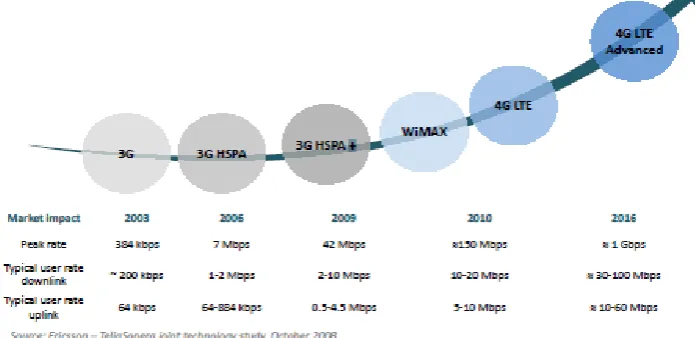
Fig 1: Communication standards evolution Figure 1 shows the evolution of standards for mobile since 2003 in terms of throughput requirements.
As an example, the fourth generation (4G) of cellular wireless standards aims at providing mobile broad band solution to laptop computer wireless modems, smart phones, and other mobile devices. Diverse features such as ultra broadband Internet access, IP telephony, gaming services, and streamed multimedia are provided.
Channel decoding is a key feature of a wireless communication standard. It allows reliable data transfer targeting high throughput over unreliable communication Channels.
Each usage scenario corresponds to particular requirements for example in terms of throughput, latency, error rates, and others. Figure 2 gives an example of such usage scenario which corresponds to a mobile terminal supporting different services (High Definition Multimedia, Web Browsing, and Voice Conversation) at different channel conditions.
II. PROBLEM STATEMENT
ISSN(E): 2277-128X, ISBN: 978-93-87396-07-4, pp. 158-162
Configuration optimization of the flexible DecASIP processor:
Proposal of efficient configuration parameters storage. Optimization of the configuration memory organization
in order to provide a low latency configuration information transfer.
Proposal of a generic program in order to reduce the configuration load.
Design of a configuration infrastructure for the UDec multi-ASIP architecture:
Optimizations of the platform controller and the interconnection structure of the UDec architecture in order to
increase its flexibility.
Implementation of a complete configuration infrastructure for high speed configuration of the multi-ASIP UDec
architecture.
Configuration management of the UDec architecture:
Definition of a configuration manage-ment where configuration information is stored in a global configuration
memory.
Proposal of two configuration management techniques where configuration information is generated at runtime.
These last contributions have not been yet published. Several papers are currently under revision and will be
submitted soon.
III. TURBO CHANNEL DECODER DESIGN
A. Context of Channel Coding:
Channel coding techniques are used in order to reduce the noise disturbances effects by introducing redundant information to the original message. These coding techniques seek to increase as much as possible the correction capabilities of the communication system to reach the theoretical limits defined by Shannon.
Fig 2: Elements of Digital communication systems.
B. Turbo Encoding:
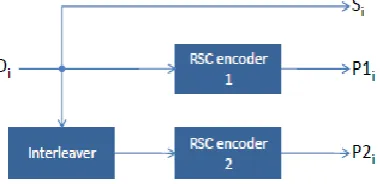
A Turbo encoder is usually built from the parallel concatenation of two Recursive Systematic Convolutional (RSC) encoders separated by an interleaver as shown in below figure.
In recent standards, we observe two types of RSC encoders: the Double Binary Turbo Code (DBTC) encoder and the Single Binary Turbo Code (SBTC) encoder.
Fig 3: Turbo encoder
C. Turbo Codes Interleavers:
ISSN(E): 2277-128X, ISBN: 978-93-87396-07-4, pp. 158-162
𝑆 = 𝑚𝑖𝑛 𝑖,𝑗
(│𝑖 − 𝑗│+│𝛱 𝑖 − 𝛱(𝑗)│)
The design of interleavers respecting a dispersion factor can be reasonably achieved through the S-random algorithm proposed.
D. Turbo decoding:
Turbo decoding principle is based on an exchange of probabilistic information, called extrinsic information between two (or more) component decoders dealing with the same received set of data. As shown in Figure 4, a typical Turbo decoder consists of two decoders operating iteratively on the received frame.
The first component (SISO decoder 0 in Figure 4) works in natural domain while the second (SISO decoder 1 in Figure 4) works in interleaved domain. The (SISO) decoders operate on soft information to improve the decoding performance.
Fig 4: Typical turbo decoder
IV. UDEC ARCHITECTURE
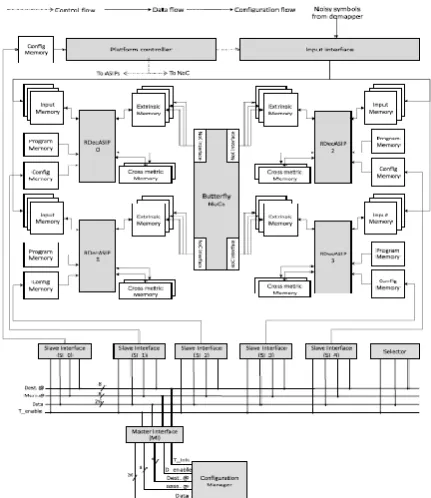
The proposed dynamic reconfigurable UDec turbo decoder architecture is shown in Fig. 5. Each row corresponds to a component decoder. In the example of Fig. 5, four ASIPs are organized in two component decoders, respectively, built with two ASIPs. Each ASIP can manage a maximum of 12 windows. Each ASIP can be configured through a 26 × 12 configuration memory. Since the RDecASIP is designed to work in multi-ASIP architecture as described. It requires several parameters to deal with a sub-block of the data frame and several parameters to configure the ASIP mode. Concerning the sub-block partitioning, each ASIP is configured with the size and the number of windows it has to decode. In a SBTC mode, the address of the tail bits in memory, the size, and the number of windows for the tail bits have to be configured. The entire configuration load represents 253 bits. Moreover, RDecASIP is associated with three memory banks of size 24 × 256 used to store the input channel Log Likelihood Ratio values. There are also three banks of size 30 × 256 used for extrinsic information storing. Each ASIP is further equipped with two 88 × 32 memories, which hold 11-bit state metric values and a 16 × 128 program memory that stores a unified program for turbo decoding modes. In a pipeline unidirectional bus implementing incremental burst, multicast, and broadcast mechanisms. It can be split in three functional blocks: 1) master interface (MI); 2) slave interface (SI); and 3) selector. Each configuration memory is connected to the bus
ISSN(E): 2277-128X, ISBN: 978-93-87396-07-4, pp. 158-162
The configuration manager deals with the configuration generation that is based on internal decisions and external information and commands. The MI provides an interface allowing the connection of the configuration manager to the bus. The SI provides an interface between the bus and the configuration memory. The selector provides a simple and efficient solution to select, at runtime, RDecASIPs that are targeted by the next configuration data. This solution allows the transfer of a data into the configuration memory with a latency of 5 clock cycles.
Flexible UDec architecture:
This section presents several techniques that we propose in order to increase the dynamic configuration ability in the context of multi-ASIP platform for flexible turbo decoding. These techniques concern the communication networks connecting the ASIPs and the multi-ASIP platform controller.
This specific number of RDecASIPs has been chosen in order to be able to illustrate all dynamic configuration issues that the UDec architecture has to face while keeping reasonable complexity for the clarity of the presentation.
a. ASIP number and location:
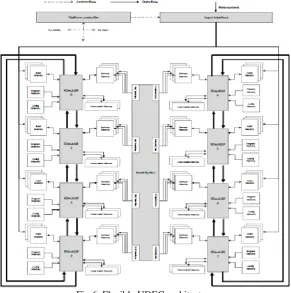
In a multi-mode and multi-standard context, the requirements in terms of throughput and BER evolve dynamically. Thus, depending of these requirements, the number of activated ASIPs has to be adapted at runtime. Obviously, this new flexibility impacts the different components of the architecture. In the initial UDec architecture, the number of ASIPs used for a given Configuration was fixed at design time and was equal to the total number of implemented Cores.
Fig 6: Flexible UDEC architecture
b. Ring buses adaptation:
The ring buses consist of direct connections between the ASIPs allowing exchanging boundary state metrics as shown in Figure 6. Figure 7 shows different examples of the ring buses adaptation for one component decoder. Figure 7(a) shows the case where only one ASIP is used in the component decoder while Figure 7(b) shows the case where two ASIPs are selected to perform the decoding task. Finally, Figure 7(c) shows the case where three ASIPs are selected and the location of the first ASIP has been shifted from RDecASIP0 to RDecASIP2.
ISSN(E): 2277-128X, ISBN: 978-93-87396-07-4, pp. 158-162
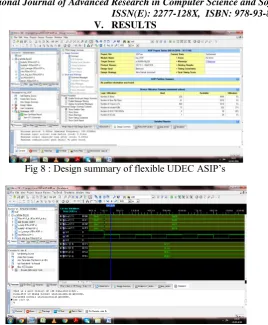
V. RESULTS
Fig 8 : Design summary of flexible UDEC ASIP’s
Fig 9 : Simulation Results of Flexible UDEC ASIP’s
VI. CONCLUSION
Channel coding is a key feature of a wireless standard allowing reliable data transfer. Among channel coding techniques, Turbo codes are frequently adopted to reach a very low bit error rate.
Results show that a dedicated memory organization taking into account the multi-processor context hugely reduces the configuration load (i.e. more than 90%) Logic synthesis results targeting 65 nm CMOS technology show that these optimizations introduce a low area overhead of 0.009 mm2 while the decoding performance and maximum clock frequency of the RDecASIP have remained identical to the initial implementation.
REFERENCES
[1] C. E. Shannon, \A mathematical theory of communication," Bell system technical journal, vol. vol .27, 1948.
[2] \3GPP TS 36.212: Multiplexing and channel coding, version 8.4.0," Sept. 2008.
[3] C. Berrou, A. Glavieux, and P. Thitimajshima, \Near Shannon limit error correcting coding and decoding:
Turbo-codes. 1," in IEEE International Conference on Communications, ICC 93., vol. 2, 1993, pp. 1064{1070 vol.2.
[4] IEEE Standard for Local and Metropolitan Area Networks Part 16: Air In- terface for Fixed and Mobile
Broadband Wireless Access Systems, Std., 2006.
[5] S. Lin and D. Costello, Jr., Error Control Coding: Fundamentals and Applications. Prentice Hall, Englewood