ISSN:1991-8178
Australian Journal of Basic and Applied Sciences
Journal home page: www.ajbasweb.com
Corresponding Author: Sophia Khariem Muhamed, Deparment of School of Medical Sciences, Health Campus Universiti
Sains Malaysia, 16150, Kubang Kerian, Kelantan.
Development of High Resolution Melting (HRM) Methods to Detect Dopamine
Transporter (DAT) Gene (SLC6A3) (rs27072) Polymorphisms in Human
1Sophia Khariem Muhamed, 2Imran Ahmad, 3Mohd Ros Sidek and 1Ruzilawati Abu Bakar
1Department of Pharmacology, School of Medical Sciences, Universiti Sains Malaysia, 16150, Kota Bharu, Kelantan, Malaysia. 2Department of Family Medicine, School of Medical Sciences, Universiti Sains Malaysia, 16150, Kota Bharu, Kelantan, Malaysia. 3Human Genome Center, School of Medical Sciences, Universiti Sains Malaysia, 16150, Kota Bharu, Kelantan, Malaysia.
A R T I C L E I N F O A B S T R A C T
Article history:
Received 10 October 2015 Accepted 30 November 2015 Available online 31 December 2015
Keywords:
Dopamine transporter
(DAT)gene, SLC6A3, polymorphisms, rs27072,high resolution melting
Background: Polymorphism of dopamine transporter (DAT) gene (SLC6A3) caused by variation occurring in variable number of tandem repeat (VNTR) is known to be associated with many genetic-diseases. rs27072 is one of the polymorphisms occurring in dopamine transporter (DAT) gene (SLC6A3) that is believed to be associated with nicotine dependence. PCR-based and PCR-RFLP analysis is a common method for genotyping the dopamine transporter gene (SLC6A3) polymorphisms in human. Although these methods are available but it still not considered as cost-effective and time-consuming. In this study, we have developed an alternative HRM-based technology without any post PCR to provide rapid and efficient investigation of dopamine transporter (SLC6A3) (rs 27072) gene polymorphism. Using the HRM analysis, optimization was done by first varying the annealing temperature and further optimized by varying the primer concentration and number of cycle. We found non-specific amplification presented in melting behaviour of the target amplicon was caused by the high concentration of primer used in the study. Additionally, we also discovered that insufficient number of cycles can lead to the late amplification of target amplicon. For future plan, other parameters that is known to influence optimization of HRM analysis such as DNA concentration, primer size, GC content and annealing/extension time will be tested and examined until good HRM analysis was obtained.
© 2015 AENSI Publisher All rights reserved. To Cite This Article: Sophia Khariem Muhamed, Imran Ahmad, Mohd Ros Sidek and Ruzilawati Abu Bakar., Development of High Resolution Melting (HRM) Methods to Detect Dopamine Transporter (DAT) Gene (SLC6A3) (rs27072) Polymorphisms in Human. Aust. J.
Basic & Appl. Sci., 9(37): 1-5, 2015
INTRODUCTION
Dopamine, a major neurotransmitter of the central nervous system is thought to be involved in the mesolimbic reward pathway (Wise et al., 1989; Koob et al., 1992). Thus, dopamine plays a major role in activating reward-motivated behaviour, one which affects the dopamine level in the brain. Many
addictive drugs are believed to enhance
dopaminergic neurotransmission by increasing the level of dopamine released (DA) in midbrain (Venton et al., 2006). One study done by Pontieri et
al., (1996) showed the presence and stimulation of
nicotinic receptors on dopaminergic cell bodies resulted in an increased release of dopamine in nucleus accumbens of the mesolimbic system.
Dopamine transporter (DAT) is a membrane-spanning protein that regulates the temporal and spatial activity of released dopamine (DA) through rapid uptake of dopamine neurotransmitter into presynaptic terminal. The dopamine transporter gene (SLC6A3) is an obligatory target for several
addictive psychostimulants including cocaine, and amphetamine (Giros et al., 1996; Kilty et al., 1991; Chang et al., 2001). Dopamine transporter gene (SLC6A3) contains variable number of tandem repeat (VNTR) in its 3'-untranslated region which is known to be associated with a variety numbers of disease-associated genes. Therefore, dopamine transporter (SLC6A3) gene polymorphism is raised from variability occurring in variable number of tandem repeat (VNTR). The variation of variable number of tandem repeat (VNTR) of SLC6A3 in terms of length and sequence was shown to affect the amount of DAT protein expressed in the brain (Miller and Madras, 2002: Fuke et al., 2001).
Several genotyping technologies are available for the determination of dopamine transporter SLC6A3 gene polymorphism, including PCR, and PCR-RFLP. In the presented study, we have
developed an alternative new HRM-based
employs dsDNA intercalating dye and its analysis is based on the form of thermodynamics difference between DNA fragments. HRM methods also are rapid, simple and efficient technique since the PCR amplification and HRM analysis is performed in one run. The objective of this study was to develop a high resolution melting methods for further use in the investigation of dopamine transporter gene (SLC6A3) (rs27072) polymorphisms. The successful optimization high resolution melting methods would result in good analysis of DAT gene polymorphisms.
MATERIALS AND METHODS
DNA Sample:
DNA samples were obtained from human adult. Prior to that, all subjects were given informed consent form to participate in the study. This study was approved by the Ethics Committee of School of Medical Sciences, Universiti Sains Malaysia.
DNA Extraction:
Genomic DNA was extracted from 200ul blood per sample using G-spin Total DNA Extraction Mini kit (iNtRON, Korea) and the genotyping from each sample was determined by the high resolution melting (HRM) analysis. Concentration of DNA was estimated using Qubit® dsDNA HS Assay kit (Invitrogen™, USA), while the DNA purity was assessed by spectrophotometer, Biophotometer
Uvette (Eppendorf, Germany), at 280 nm
absorbance.
Primer Design:
The rs27072 sequence of SLC6A3 is available
on the National Centre for Biotechnology
Information (NCBI) database (dbSNP cluster ID: rs27072). Primer3 programme (Rozen and Skaletsky, 2000) was used to design the primers. PCR primer was designed and had predicted length 114 bp. Then,
the primers were optimized for annealing
temperature. The specificity of primers were confirm with Primer BLAST.
PCR and HRM analysis:
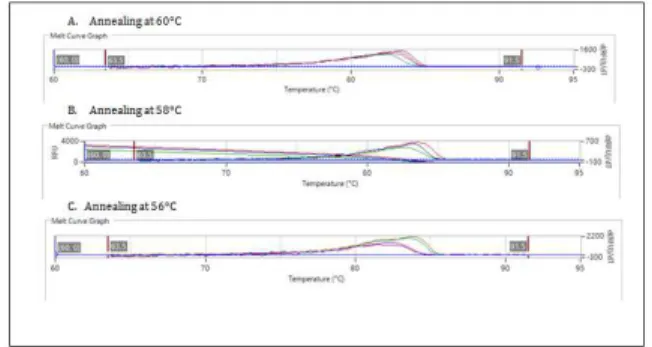
The PikoReal 96 Real-Time PCR system (Thermo Scientific, USA) was used for PCR amplification and high resolution melting (HRM) analysis. PCR amplifications were performed in 10 µl reaction volumes consisting of 2ul of genomic DNA template, 5ul of Luminaris Color HRM Master Mix (2x), and 0.5ul of forward and reverse primers (final concentration: 0.5 uM) and 2ul of nuclease free water. For HRM analysis, first step was to optimize and determine the optimum annealing temperature. Optimization was done by varying the annealing temperature using 3-step PCR cycling protocol as follows: an initial denaturation step for 10 min at 95 C, followed by 40 cycles of 10 sec at 95 C, 30 sec at 60°C,58°C and 56°C of annealing, and 30 sec final
extension at 72°C. HRM analysis was performed automatically after the PCR, and programmed to ramp temperature from 60 to 95°C, raised by 0.2 degree/step after the final extension step. Melt curves were analysis using the PikoReal software version
2.1(Thermo Scientific, USA). According to
Luminaris Color HRM Master Mix protocol, the DNA template concentration should not exceed 20 ng in the final volume. Both PCR amplification and high resolution melting (HRM) analysis was performed using the Luminaris Color Master Mix purchase from Research Instrument (Thermo Scientific, USA).
DNA Sequencing:
To validate the HRM methods, PCR purified products were performed using ABI 3130x1 Genetic Analyzer (Applied Biosystems, Foster City, CA) for sequencing.
RESULT AND DISCUSSION
High resolution melting analysis is a recently rapid, simple and efficient technique that intensively used in identifying sequence variation in human, plant, and microorganisms (Reed and Wittwer, 2004; Krypuy et al., 2007; Liu et al., 2014) In previous study, gene polymorphisms of dopamine transporter (SLC6A3) (rs 27072) were investigated by using PCR-RFLP methods (Ling et al., 2003). Therefore, in this study we have developed an alternative technique HRM analysis to provide better detection of dopamine transporter (DAT) gene (SLC6A3) (rs27072) polymorphisms. This highly sensitive method also has ability to detect accurately small differences in melting profile of interest amplicons (Liew et al., 2004). Additionally, with an access to HRM devices, PCR amplification and HRM analysis can be performed in one run thus making it a convenient and time-consuming application for genotyping. Good HRM assay is very critical for HRM analysis. Thus, most attention is given during the optimization of HRM assay development.
has potential to be the optimal Ta for genotyping the SLC6A3. Then, to observe the effect of varying the primer concentration and number of cycles on annealing temperature, we tested three samples of 20 ng of purified DNA using 0.2 µM (Figure 3) and 45 numbers of cycles (Figure 5).
The non-specific peak resolved when 0.2 µM of primer concentration was applied to the per PCR reaction (Figure 3). After using 45 number of cycle, the overall Cq value for all tested Ta was declined. Annealing at 58 °C (Cq value=22) showed the lowest Cq value compared to annealing at 56°C (Cq value=24) and 60°C (Cq value=26) (Figure 4). Hence, we obtained optimal primer concentration and number of cycle with 0.2 µM per PCR reaction tube and 45 cycles. We concluded that using excessive concentration of primers can increase the
chance of primers binding nonspecifically to undesired sites on the template. Increasing the number of amplification cycles can lead to the higher initial number of DNA molecules in the sample. Thus, the fluorescence will be detected in earlier cycles.
The non-specific amplicon and late
amplification performed in this study would greatly affect the overall final analysis of HRM in determining the variants of polymorphisms studied. Although annealing at 58 °C (Figure 6) showed different melting profiles of target amplicon, the analysis of different genotype group (homozygous SNP&heterozygotes) results still difficult to be distinguished. For future plan, primer size, GC content and annealing/extension time will be optimized to maximise good HRM analysis.
Fig. 1: HRM of a 114 bp product containing SNP rs27072 (C/T): this SNP is part of the haplotypes involved in determining dopamine transporter polymorphisms. This target was amplified using 30 sec annealing at 60°C, 58°C and 56°C. annealing temperature variation. Normalized melting curves and difference plots for the genotyping of rs 27072 from the HRM analysis program (40 cycles) are shown. 60°C, 58°C and 56°C of annealing temperature were tested.
Fig. 3: The melt curve graph of 0.2µM concentration of primer for annealing at 60°C, 58°C and 56°C.
Fig. 4: The Cq-value of 40 number of cycles for annealing at 60°C,58°C and 56°C .
Fig. 5: The Cq-value of 45 number of cycles for annealing at 60°C,58°C and 56°C .
Fig. 6: Normalized melting curves and difference plots for the genotyping of rs 27072 from the HRM analysis program, 0.2µM of primer concentration and 45 numbers of cycles are shown at 58°C of annealing temperature.
Conclusion:
As a conclusion, successful HRM assay development will help in dopamine transporter
(SLC6A3) (rs 27072) gene polymorphisms
investigations due to its efficiency in accurately
detecting the heterozygous and homozygous
nucleotide substitution (Lince et al., 2009). HRM analysis also is not laborious methods since no post-PCR was conducted after the post-PCR amplification.
However, the HRM genotyping methods
REFERENCES
Amara S.G. and M.S. Sonders., 1998.
Neorotransmitter transporter as molecular targets for
addictive drugs. Journal of Alcoholism
and Drug dependence, 51: 87-96.
Chang, L., G. Wang., J.S. Fowler. Ph. D and M. Leonido-yee, 2001. Association of Dopamine
Transporter Reduction with Psychomotor
Impairment in Methamphetamine Abusers, 158: 377–382.
Giros. B., M. Jaber, S.R. Jones, R.M. Wightman and M.G. Caron, 1996. Hyperlocomotion and indifference to cocaine and amphetamine in mice lacking the dopamine transporter. Nature, 379:606-12.
Koob, G.F., 1992. Drugs of abuse: anatomy, pharmacology and function of reward pathways. Trends in Pharmacological Sciences, 13: 177-184.
Krypuy, M., A.A. Ahmed, D. Etemadmoghadam and S.J. Hyland, 2007. High resolution melting for mutation scanning of TP53 exons 5-8. BMC Cancer, 7: 168.
Liew, M., R. Pryor, R. Palais, C. Meadows, M. Erali, E. Lyon and C. Wittwer, 2004. Genotyping of single-nucleotide polymorphisms by high-resolution melting of small amplicons, 50: 1156–1164.
Ling. D., T. Niu, Y. Feng, H. Xing and X. Xu, 2003. Association between polymorphism of the dopamine transporter gene and early smoking onset: an interaction risk on nicotine dependence. Journal of Human Genetics, 49: 35-39.
Liu, Y., J. Tang, P. Wakamatsu, H. Xue and J. Chen, 2014. High-resolution melting curve analysis, a rapid and affordable method for mutation analysis in childhood acute myeloid leukemia.
Miller, G.M. and B.K. Madras, 2002.
Polymorphisms in the 3’-untranslated region of human and monkey dopamine transporter genes affect reporter gene expression. Journal of Molecular Psychiatry, 7: 44-55.
Pontieri, F.E., G. Tanda, F. Orzi and G. Di Chiari, 1996. Effects of nicotine on the nucleus accumbens and similarity to those of addictive drugs. Nature, 382: 255-257.
Reed, G.H. and C.T. Wittwer, 2004. Sensitivity and specificity of single-nucleotide polymorphism scanning by high-resolution melting analysis, 50: 1748–1754.
Rozen, S. and H. Skaletsky, 2000. Primer3 on the WWW for general users and for biologist programmers. Methods in Molecular Biology, 132: 365-386
Venton, B.J., A.T. Seipel, P.E.M. Phillips, W.C. Wetsel, D. Gitler, P. Greengard and R.M. Wightman., 2006. Cocaine increases dopamine release by mobilization of a synapsin-dependent reserve pool. The Journal of Neuroscience, 26: 3206– 3209.
Wise, R.A. and P.P. Rompre, 1989. Brain