Dynamic Learning Maps
Essential Elements
English Language Arts
Version 2
2 COMMON CORE ESSENTIAL ELEMENTS AND ACHIEVEMENT DESCRIPTORS FOR KINDERGARTEN
Kindergarten English Language Arts Standards: Reading (Literature)
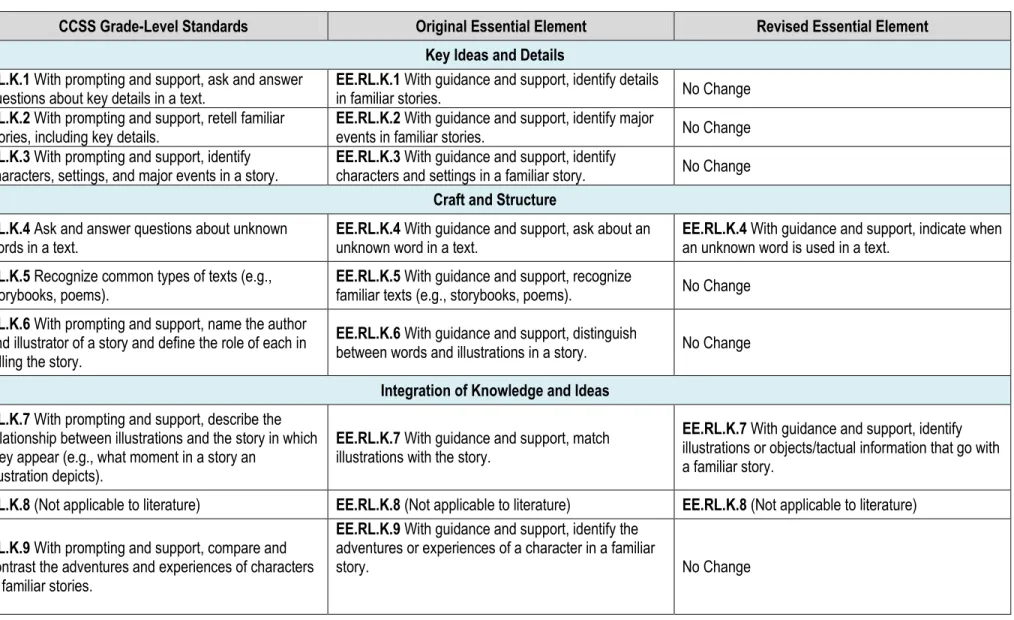
CCSS Grade-Level Standards Original Essential Element Revised Essential Element
Key Ideas and Details
RL.K.1 With prompting and support, ask and answer
questions about key details in a text. EE.RL.K.1 in familiar stories. With guidance and support, identify details No Change RL.K.2 With prompting and support, retell familiar
stories, including key details. EE.RL.K.2 events in familiar stories. With guidance and support, identify major No Change RL.K.3 With prompting and support, identify
characters, settings, and major events in a story. EE.RL.K.3 characters and settings in a familiar story. With guidance and support, identify No Change Craft and Structure
RL.K.4 Ask and answer questions about unknown
words in a text. EE.RL.K.4unknown word in a text. With guidance and support, ask about an EE.RL.K.4 an unknown word is used in a text.With guidance and support, indicate when RL.K.5 Recognize common types of texts (e.g.,
storybooks, poems). EE.RL.K.5 familiar texts (e.g., storybooks, poems). With guidance and support, recognize No Change
RL.K.6 With prompting and support, name the author
and illustrator of a story and define the role of each in telling the story.
EE.RL.K.6 With guidance and support, distinguish
between words and illustrations in a story. No Change Integration of Knowledge and Ideas
RL.K.7 With prompting and support, describe the relationship between illustrations and the story in which they appear (e.g., what moment in a story an
illustration depicts).
EE.RL.K.7 With guidance and support, match
illustrations with the story.
EE.RL.K.7 With guidance and support, identify illustrations or objects/tactual information that go with a familiar story.
RL.K.8 (Not applicable to literature) EE.RL.K.8 (Not applicable to literature) EE.RL.K.8 (Not applicable to literature)
RL.K.9 With prompting and support, compare and
contrast the adventures and experiences of characters in familiar stories.
EE.RL.K.9 With guidance and support, identify the adventures or experiences of a character in a familiar
3
CCSS Grade-Level Standards Original Essential Element Revised Essential Element
Range of Reading and Level of Text Complexity RL.K.10 Actively engage in group reading activities
4 Kindergarten English Language Arts Standards: Reading (Informational Text)
CCSS Grade-Level Standards Common Core Essential Elements Proposed EE
Key Ideas and Details
RI.K.1 With prompting and support, ask and answer
questions about key details in a text. EE.RI.K.1 in a familiar text. With guidance and support, identify a detail No Change RI.K.2 With prompting and support, identify the main
topic and retell key details of a text. EE.RI.K.2 of a familiar text. With guidance and support, identify the topic No Change RI.K.3 With prompting and support, describe the
connection between two individuals, events, ideas, or pieces of information in a text.
EE.RI.K.3 With guidance and support, identify individuals, events, or ideas in a familiar informational text.
EE.RI.K.3 With guidance and support, identify individuals, events, or details in a familiar informational text.
Craft and Structure
RI.K.4 With prompting and support, ask and answer
questions about unknown words in a text. EE.RI.K.4unknown word in a text. With guidance and support, ask about an EE.RI.K.4an unknown word is used in a text. With guidance and support, indicate when RI.K.5 Identify the front cover, back cover, and title
page of a book. EE.RI.K.5 a book. With guidance and support, identify parts of EE.RI.K.5front cover of a book. With guidance and support, identify the RI.K.6 Name the author and illustrator of a text and
define the role of each in presenting the ideas or information in a text.
EE.RI.K.6 With guidance and support, distinguish between print and illustrations in an informational text.
EE.RI.K.6 With guidance and support, distinguish between words and illustrations in an informational text.
Integration of Knowledge and Ideas RI.K.7 With prompting and support, describe the
relationship between illustrations and the text in which they appear (e.g., what person, place, thing, or idea in the text an illustration depicts).
EE.RI.K.7 With guidance and supports, match
illustrations to an informational text.
EE.RI.K.7 With guidance and support, identify illustrations or objects/tactual information that go with a familiar text.
RI.K.8 With prompting and support, identify the
reasons an author gives to support points in a text. EE.RI.K.8 the author makes in an informational text. With guidance and support, identify points No Change RI.K.9 With prompting and support, identify basic
similarities in and differences between two texts on the same topic (e.g., in illustrations, descriptions, or
5
CCSS Grade-Level Standards Common Core Essential Elements Proposed EE
Range of Reading and Level of Text Complexity RI.K.10 Actively engage in group reading activities with
6 Kindergarten English Language Arts Standards: Reading (Foundational Skills)
CCSS Grade-Level Standards Common Core Essential Elements Proposed EE
Print Concepts RF.K.1 Demonstrate understanding of the organization
and basic features of print.
a. Follow words from left to right, top to bottom, and page by page.
b. Recognize that spoken words are represented in written language by specific sequences of letters.
c. Understand that words are separated by spaces in print.
d. Recognize and name all upper- and lowercase letters of the alphabet.
EE.RF.K.1 With guidance and support, demonstrate
an emerging understanding of the organization and basic features of print.
a. With guidance and support during shared reading, turn pages one page at a time from beginning to end.
b. N/A c. N/A
d. With guidance and support, recognize first letter of own name in print.
EE.RF.K.1 Demonstrate emerging understanding of
the organization of print.
a. With guidance and support during shared reading, demonstrate understanding that books are read one page at a time from beginning to end.
b. No Change c. No Change d. DELETE Phonological Awareness
RF.K.2 Demonstrate understanding of spoken words,
syllables, and sounds (phonemes).
a. Recognize and produce rhyming words. b. Count, pronounce, blend, and segment
syllables in spoken words.
c. Blend and segment onsets and rimes of single-syllable spoken words. d. Isolate and pronounce the initial, medial
vowel, and final sounds (phonemes) in three-phoneme
(consonant-vowel-consonant, or CVC) words.* (This does not include CVCs ending with /l/, /r/, or /x/.)
e. Add or substitute individual sounds
(phonemes) in simple, one-syllable words to make new words.
EE.RF.K.2 With guidance and support, demonstrate
an emerging understanding of spoken words, syllables, and sounds (phonemes).
a. With guidance and support, recognize rhyming words.
b. With guidance and support, recognize the number of words in a spoken message. c. With guidance and support, identify
single-syllable spoken words with the same onset (beginning sound) as a familiar word. d. N/A
e. N/A
EE.RF.K.2 Demonstrate emerging understanding of
spoken words, syllables, and sounds (phonemes). a. No Change
b. No Change c. No Change d. No Change e. No Change
7
CCSS Grade-Level Standards Common Core Essential Elements Proposed EE
Phonics and Word Recognition
RF.K.3 Know and apply grade-level phonics and word
analysis skills in decoding words.
a. Demonstrate basic knowledge of one-to-one letter-sound correspondences by producing the primary or many of the most frequent sound for each consonant.
b. Associate the long and short sounds with common spellings (graphemes) for the five major vowels.
c. Read common high-frequency words by sight (e.g., the, of, to, you, she, my, is, are, do, does).
d. Distinguish between similarly spelled words by identifying the sounds of the letters that differ.
EE.RF.K.3 With guidance and support, apply letter name and letter-sound knowledge when decoding words during shared activities.
a. With guidance and support, recognize sound of first letter in own name.
b. N/A
c. With guidance and support, recognize common signs and/or symbols in the environment.
d. N/A
EE.RF.K.3 Demonstrate emerging awareness of
print.
a. With guidance and support, recognize first letter of own name in print.
b. No Change
c. With guidance and support, recognize environmental print.
d. No Change
Fluency
RF.K.4 Read emergent-reader texts with purpose and
understanding.
EE.RF.K.4 Engage in independent exploration of
books.
EE.RF.K.4 Engage in purposeful shared reading of
8 Kindergarten English Language Arts Standards: Writing
CCSS Grade-Level Standards Common Core Essential Elements Proposed EE
Text Types and Purposes W.K.1 Use a combination of drawing, dictating, and 1.
writing to compose opinion pieces in which they tell a reader the topic or the name of the book they are writing about and state an opinion or preference about the topic or book (e.g., My favorite book is . . .).
EE.W.K.1 With guidance and support, select a topic or book and use drawing, dictating, or writing to state an opinion about it.
EE.W.K.1 With guidance and support, select a familiar book and use drawing, dictating, or writing to state an opinion about it.
W.K.2 Use a combination of drawing, dictating, and writing to compose informative/explanatory texts in which they name what they are writing about and supply some information about the topic.
EE.W.K.2 With guidance and support, select a topic and use drawing, dictating, or writing to share information about the topic.
EE.W.K.2 With guidance and support, select a familiar topic and use drawing, dictating, or writing to share information about the topic.
W.K.3 Use a combination of drawing, dictating, and writing to narrate a single event or several loosely linked events, tell about the events in the order in which they occurred, and provide a reaction to what happened.
EE.W.K.3 With guidance and support, select an event
and use drawing, dictating, or writing to narrate information about it.
EE.W.K.3 With guidance and support, select an event and use drawing, dictating, or writing and share information about it.
Production and Distribution of Writing
W.K.4 (Begins in grade 3) EE.W.K.4 (Begins in grade 3) No Change
W.K.5 With guidance and support from adults, respond to questions and suggestions from peers and add
details to strengthen writing as needed. EE.W.K.5 (Begins in grade 1) No Change W.K.6 With guidance and support from adults, explore
a variety of digital tools to produce and publish writing, including in collaboration with peers.
EE.W.K.6 With guidance and support from adults, explore a variety of digital tools to produce writing.
EE.W.K.6 With guidance and support from adults, explore a variety of digital tools to produce individual or group writing.
Research to Build and Present Knowledge W.K.7 Participate in shared research and writing
projects (e.g., explore a number of books by a favorite author and express opinions about them).
EE.W.K.7 With guidance and support, participate in
9
CCSS Grade-Level Standards Common Core Essential Elements Proposed EE
W.K.8 With guidance and support from adults, recall information from experiences or gather information from provided sources to answer a question.
EE.W.K.8 With guidance and support from adults, identify information, objects, or events that relate to
personal experiences. No Change
W.K.9 (Begins in grade 4) EE.W.K.9 (Begins in grade 4) No Change
Range of Writing
10 Kindergarten English Language Arts Standards: Speaking and Listening
CCSS Grade-Level Standards Common Core Essential Elements Proposed EE
Comprehension and Collaboration SL.K.1 Participate in collaborative conversations with
diverse partners about kindergarten topics and texts with peers and adults in small and larger groups.
a. Follow agreed-upon rules for discussions (e.g., listening to others and taking turns speaking about the topics and texts under discussion).
b. Continue a conversation through multiple exchanges.
EE.SL.K.1 Participate in communication exchanges
with diverse partners.
a. Communicate directly with peers.
b. Participate in multiple-turn communication exchanges with adults.
EE.SL.K.1 Participate in conversations with adults. a. Communicate directly with supportive
adults.
b. Continue in multiple-turn communication exchanges with adults.
SL.K.2. Confirm understanding of a text read aloud or information presented orally or through other media by asking and answering questions about key details and requesting clarification if something is not understood.
EE.SL.K.2 Demonstrate an emerging understanding of
a familiar text read aloud or information presented
orally or through other media by answering questions. DELETE SL.K.3 Ask and answer questions in order to seek
help, get information, or clarify something that is not
understood. EE.SL.K.3 Ask for help when needed. No Change
Presentation of Knowledge and Ideas SL.K.4 Describe familiar people, places, things, and
events and, with prompting and support, provide additional detail.
EE.SL.K.4 With guidance and support, identify familiar
people, places, things, and events. No Change SL.K.5 Add drawings or other visual displays to
descriptions as desired to provide additional detail.
EE.SL.K.5 With guidance and support, add or select drawings or other visual or tactual displays that relate
to familiar people, places, things, and events. No Change SL.K.6 Speak audibly and express thoughts, feelings,
11 Kindergarten English Language Arts Standards: Language
CCSS Grade-Level Standards Common Core Essential Elements Proposed EE
Conventions of Standard English.
L.K.1. Demonstrate command of the conventions of
standard English grammar and usage when writing or speaking.
a. Print many upper- and lowercase letters. b. Use frequently occurring nouns and verbs. c. Form regular plural nouns orally by adding
/s/ or /es/ (e.g., dog, dogs; wish, wishes). d. Understand and use question words
(interrogatives) (e.g., who, what, where, when, why, how).
e. Use the most frequently occurring prepositions (e.g., to, from, in, out, on, off, for, of, by, with).
f. Produce and expand complete sentences in shared language activities.
EE.L.K.1 Demonstrate emerging understandings of
English grammar and word usage when communicating.
a. With guidance and support, distinguish between letters and other symbols or shapes. b. With guidance and support, identify objects or other symbols that represent familiar nouns. c. N/A
d. With guidance and support, answer simple questions (e.g., who, what).
e. With guidance and support, demonstrate understanding of common prepositions: on, off, in, out.
f. With guidance and support, link two or more words together in communication.
EE.L.K.1 Demonstrate emerging understanding of
letter and word use. a. No Change
b. With guidance and support, use frequently occurring nouns in communication. c. With guidance and support, use frequently
occurring plural nouns.
d. With guidance and support, identify answers to simple questions (e.g., who, what) from an array of choices.
e. No Change f. No Change
L.K.2 Demonstrate command of the conventions of
standard English capitalization, punctuation, and spelling when writing.
a. Capitalize the first word in a sentence and the pronoun I.
b. Recognize and name end punctuation. c. Write a letter or letters for most consonant
and short-vowel sounds (phonemes). d. Spell simple words phonetically, drawing
on knowledge of sound-letter relationships.
EE.L.K.2 Demonstrate emerging understandings of
writing.
a-d. Demonstrate emerging understandings of writing.
DELETE
Knowledge of Language
12
CCSS Grade-Level Standards Common Core Essential Elements Proposed EE
Vocabulary Acquisition and Use L.K.4 Determine or clarify the meaning of unknown
and multiple-meaning words and phrases based on kindergarten reading and content.
a. Identify new meanings for familiar words and apply them accurately (e.g., knowing duck is a bird and learning the verb to duck).
b. Use the most frequently occurring inflections and affixes (e.g., -ed, -s, re-, un-, pre-, ful, -less) as a clue to the meaning of an unknown word.
EE.L.K.4 Demonstrate an understanding of vocabulary
based on reading and other content.
a. Demonstrate an understanding of familiar words. b. N/A
EE.L.K.4 Demonstrate emerging knowledge of word
meanings.
a. With guidance and support, demonstrate understanding of words used in every day routines.
b. No Change L.K.5 With guidance and support from adults, explore
word relationships and nuances in word meanings. a. Sort common objects into categories (e.g.,
shapes, foods) to gain a sense of the concepts the categories represent. b. Demonstrate understanding of frequently
occurring verbs and adjectives by relating them to their opposites (antonyms). c. Identify real-life connections between words
and their use (e.g., note places at school that are colorful).
d. Distinguish shades of meaning among verbs describing the same general action (e.g., walk, march, strut, prance) by acting out the meanings.
EE.L.K.5 With guidance and support from adults, explore word relationships.
a. With guidance and support, sort common objects into familiar categories.
b. With guidance and support, demonstrate understanding of frequently occurring opposites.
c. With guidance and support, use words to communicate in real-life situations.
d. With guidance and support, demonstrate an understanding of common verbs.
EE.L.K.5 Demonstrate emerging understanding of
word relationships.
a. With guidance and support, sort common objects into familiar categories.
b. With guidance and support, demonstrate understanding of frequently occurring opposites.
c. With guidance and support, use words to communicate in real-life situations.
d. With guidance and support, demonstrate an understanding of common verbs.
L.K.6 Use words and phrases acquired through
conversations, reading and being read to, and responding to texts.
EE.L.K.6 Use words acquired through conversations,
being read to, and during shared reading activities.
EE.L.K.6 With guidance and support, use words
acquired through conversations, being read to, and during shared reading activities.
13 COMMON CORE ESSENTIAL ELEMENTS AND ACHIEVEMENT DESCRIPTORS FOR FIRST GRADE
First Grade English Language Arts Standards: Reading (Literature)
CCSS Grade-Level Standards Common Core Essential Elements Proposed EE
Key Ideas and Details RL.1.1. Ask and answer questions about key details in
a text. EE.RL.1.1 Identify details in familiar stories. No Change
RL.1.2 Retell stories, including key details, and demonstrate understanding of their central message or
lesson. EE.RL.1.2 Retell details from a familiar story.
EE.RL.1.2 With guidance and support, recount major events in familiar stories.
RL.1.3 Describe characters, settings, and major events
in a story, using key details. EE.RL.1.3 story. Identify characters and settings in a familiar No Change Craft and Structure
RL.1.4 Identify words and phrases in stories or poems
that suggest feelings or appeal to the senses. EE.RL.1.4familiar story. Identify sensory or feeling words in a EE.RL.1.4sensory or feeling words in a familiar story. With guidance and support, identify RL.1.5 Explain major differences between books that
tell stories and books that give information, drawing on a wide reading of a range of text types.
EE.RL.1.5 Classify reading materials into storybooks
and informational books. EE.RL.1.5as telling a story. With guidance and support, identify a text RL.1.6 Identify who is telling the story at various points
in a text. EE.RL.1.6 Identify a speaker in a familiar story. EE.RL.1.6 speaker within a familiar story. With guidance and support, identify a Integration of Knowledge and Ideas
RL.1.7 Use illustrations and details in a story to
describe its characters, setting, or events. EE.RL.1.7the characters or events in a familiar story. Identify details or illustrations that describe EE.RL.1.7information that go with a familiar story. Identify illustrations or objects/tactual
RL.1.8 (Not applicable to literature) EE.RL.1.8 (Not applicable to literature) No Change
RL.1.9 Compare and contrast the adventures and
experiences of characters in stories. EE.RL.1.9characters in a familiar story. Identify the adventures or experiences of
EE.RL.1.9 With guidance and support identify adventures or experiences of characters in a story as same or different.
14
CCSS Grade-Level Standards Common Core Essential Elements Proposed EE
RL.1.10 With prompting and support, read prose and
poetry of appropriate complexity for grade 1. EE.RL.1.10references all elements above. **This Literature Essential Element
EE.RL.1.10 With guidance and support, actively engage in shared reading for a clearly stated purpose.
15 First Grade English Language Arts Standards: Reading (Informational Text)
CCSS Grade-Level Standards Common Core Essential Elements Proposed EE
Key Ideas and Details RI.1.1 Ask and answer questions about key details in a
text. EE.RI.1.1 Identify details in familiar text. No Change
RI.1.2 Identify the main topic and retell key details of a
text. EE.RI.1.2 Retell details of a familiar text. EE.RI.1.2related to the topic of a text. With guidance and support, identify details RI.1.3 Describe the connection between two
individuals, events, ideas, or pieces of information in a text.
EE.RI.1.3 With guidance and support, identify events
or ideas in a familiar text. EE.RI.1.3familiar informational text. Identify individuals, events, or details in a Craft and Structure
RI.1.4 Ask and answer questions to help determine or
clarify the meaning of words and phrases in a text. EE.RI.1.4familiar text. Respond to questions about a new word in EE.RI.1.4clarify the meaning of a word in a text. With guidance and support, ask a reader to
RI.1.5 Know and use various text features (e.g., headings, tables of contents, glossaries, electronic menus, icons) to locate key facts or information in a text.
EE.RI.1.5 With guidance and support, recognize that
books have titles. EE.RI.1.5page of a book. Locate the front cover, back cover, and title
RI.1.6 Distinguish between information provided by pictures or other illustrations and information provided by the words in a text.
EE.RI.1.6 With guidance and support, distinguish
between text and illustrations in a text. EE.RI.1.6in a text. Distinguish between words and illustrations Integration of Knowledge and Ideas
RI.1.7 Use the illustrations and details in a text to
describe its key ideas. EE.RI.1.7is describing. Identify illustration that shows what the text EE.RI.1.7information that go with a familiar text. Identify illustrations or objects/tactual RI.1.8 Identify the reasons an author gives to support
points in a text. EE.RI.1.8that match the topic of a text. With guidance and support, identify details EE.RI.1.8familiar informational text. Identify points the author makes in a RI.1.9 Identify basic similarities in and differences
between two texts on the same topic (e.g., in illustrations, descriptions, or procedures).
EE.RI.1.9 With guidance and support, match similar
16
CCSS Grade-Level Standards Common Core Essential Elements Proposed EE
Range of Reading and Level of Text Complexity RI.1.10 With prompting and support read informational
17 First Grade English Language Arts Standards: Reading (Foundational Skills)
CCSS Grade-Level Standards Common Core Essential Elements Proposed EE
Print Concepts
RF.1.1 Demonstrate understanding of the organization and basic features of print.
a. Recognize the distinguishing features of a sentence (e.g., first word, capitalization, ending punctuation).
EE.RF.1.1 Demonstrate an understanding of the
organization and basic features of print.
a. Interact with books one page at a time from beginning to end.
b. Follow print from left to right. c. Follow print from top to bottom.
EE.RF.1.1 Demonstrate emerging understanding of
the organization of print.
a. Demonstrate understanding of the organization and basic features of print (e.g., left-to-right, top-to-bottom orientation of print, one-to-one correspondence between written and spoken word), b. DELETE
c. DELETE Phonological Awareness
RF.1.2 Demonstrate understanding of spoken words,
syllables, and sounds (phonemes).
a. Distinguish long from short vowel sounds in spoken single-syllable words.
b. Orally produce single-syllable words by blending sounds (phonemes), including consonant blends.
c. Isolate and pronounce initial, medial vowel, and final sounds (phonemes) in spoken single-syllable words.
d. Segment spoken single-syllable words into their complete sequence of individual sounds (phonemes).
EE.RF.1.2 Demonstrate understanding of spoken
words, syllables, and sounds (phonemes). a. Identify spoken rhyming words.
b. With guidance and support, indicate the number of syllables in a spoken word. c. Identify a single syllable spoken word with the
same onset (beginning sound) as a familiar word.
d. Match orally presented segmented phonemes to pictures that are labeled orally first by an adult.
EE.RF.1.2 Demonstrate emerging understanding of
spoken words, syllables, and sounds (phonemes). a. Recognize rhyming words.
b. With guidance and support, match orally presented segmented phonemes (e.g., C-A-T) to pictures or words illustrating the corresponding word.
c. No Change
d. With guidance and support, substitute individual sounds (phonemes) in simple, one-syllable words to make new words. Phonics and Word Recognition
18
CCSS Grade-Level Standards Common Core Essential Elements Proposed EE
RF.1.3 Know and apply grade-level phonics and word
analysis skills in decoding words.
a. Know the spelling-sound correspondences for common consonant digraphs.
b. Decode regularly spelled one-syllable words. c. Know final -e and common vowel team
conventions for representing long vowel sounds.
d. Use knowledge that every syllable must have a vowel sound to determine the number of syllables in a printed word.
e. Decode two-syllable words following basic patterns by breaking the words into syllables. f. Read words with inflectional endings. g. Recognize and read grade-appropriate
irregularly spelled words.
EE.RF.1.3 Apply letter name and letter-sound knowledge when decoding words during shared activities.
a. Identify words that begin with a single-consonant phoneme that is spoken by an adult. b. N/A c. N/A d. N/A e. N/A f. N/A g. N/A
EE.RF.1.3 Demonstrate emerging letter and word
identification skills.
a. Identify upper case letters of the alphabet. b. With guidance and support, recognize
familiar words that are used in every day routines.
c. No Change d. No Change e. No Change f. No Change g. No Change
Fluency RF.1.4 Read with sufficient accuracy and fluency to
support comprehension.
a. Read on-level text with purpose and understanding.
b. Read on-level text orally with accuracy, appropriate rate, and expression on successive readings.
c. Use context to confirm or self-correct word recognition and understanding, rereading as necessary.
EE.RF.1.4 Engage in sustained independent study of books (e.g., studies a book one page at a time).
a. Independently engage in exploring a book or navigating pages in a multimedia book. b. Sustain attention to a variety of reading
materials reflecting a variety of text genre. c. N/A
EE.RF.1.4 Begin to attend to words in print.
a. Engage in sustained, independent study of books.
b. Participate in shared reading of a variety of reading materials reflecting a variety of text genre.
19 First Grade English Language Arts Standards: Writing
CCSS Grade-Level Standards Common Core Essential Elements Proposed EE
Production and Distribution of Writing W.1.1 Write opinion pieces in which they introduce the
topic or name the book they are writing about, state an opinion, supply a reason for the opinion, and provide some sense of closure.
EE.W.1.1 Select a book and use drawing, dictating, or
writing to state an opinion about it. EE.W.1.1 dictating, or writing to state an opinion about it.Select a familiar book and use drawing,
W.1.2 Write informative/explanatory texts in which they name a topic, supply some facts about the topic, and provide some sense of closure.
EE.W.1.2 Select a topic and use drawing, dictating, or
writing to share information about it. EE.W.1.2 dictating, or writing to share information about it.Select a familiar topic and use drawing, W.1.3 Write narratives in which they recount two or
more appropriately sequenced events, include some details regarding what happened, use temporal words to signal event order, and provide some sense of closure.
EE.W.1.3 Select an event and use drawing, dictating,
or writing to share information about it. No Change
W.1.4 (Begins in grade 3) EE.W.1.4 (Begins in grade 3) No Change
W.1.5 With guidance and support from adults, focus on a topic, respond to questions and suggestions from peers, and add details to strengthen writing as needed.
EE.W.1.5 With guidance and support from adults, add
more information to own drawing, dictating, or writing to strengthen it.
EE.W.1.5 With guidance and support from adults, add more information to own drawing, dictation, or writing to strengthen it.
W.1.6. With guidance and support from adults, use a variety of digital tools to produce and publish writing, including in collaboration with peers.
EE.W.1.6 With guidance and support from adults, use
a variety of digital tools to produce writing, including in collaboration with peers.
EEW.1.6 With guidance and support from adults,
explore a variety of digital tools to produce individual or group writing.
Research to Build and Present Knowledge W.1.7. Participate in shared research and writing
projects (e.g., explore a number of “how-to” books on a given topic and use them to write a sequence of instructions).
EE.W.1.7 Participate in shared research and writing
20
CCSS Grade-Level Standards Common Core Essential Elements Proposed EE
W.1.8 With guidance and support from adults, recall information from experiences or gather information from provided sources to answer a question.
EE.W.1.8 With guidance and support from adults, identify information related to personal experiences
and answer simple questions about those experiences. No Change
W.1.9 (Begins in grade 4) EE.W.1.9 (Begins in grade 4) No Change
21 First Grade English Language Arts Standards: Speaking and Listening
CCSS Grade-Level Standards Common Core Essential Elements Proposed EE
Comprehension and Collaboration. SL.1.1 Participate in collaborative conversations with
diverse partners about grade 1 topics and texts with peers and adults in small and larger groups.
a. Follow agreed-upon rules for discussions (e.g., listening to others with care, speaking one at a time about the topics and texts under
discussion).
b. Build on others’ talk in conversations by responding to the comments of others through multiple exchanges.
c. Ask questions to clear up any confusion about the topics and texts under discussion.
EE.SL.1.1 Participate in conversations with peers and adults.
a. Engage in multiple- turn exchanges with peers.
b. Build on comments or topics initiated by an adult.
c. Uses one or two words to ask questions related to personally relevant topics.
EE.SL.1.1 Participate in conversations with adults.
a. Engage in multiple-turn exchanges with supportive adults.
b. No Change c. No Change
SL.1.2 Ask and answer questions about key details in a text read aloud or information presented orally or through other media.
EE.SL.1.2 During shared reading activities, answer questions about details presented orally or through
other media. No Change
SL.1.3 Ask and answer questions about what a
speaker says in order to gather additional information
or clarify something that is not understood. EE.SL.1.3 Ask for help when needed.
EE.SL.1.3 Communicate confusion or lack of
understanding ("I don't know."). Presentation of Knowledge and Ideas
SL.1.4 Describe people, places, things, and events with relevant details, expressing ideas and feelings clearly.
EE.SL.1.4 With guidance and support, identify familiar
people, places, things, and events. EE.SL.1.4and events. Identify familiar people, places, things, SL.1.5 Add drawings or other visual displays to
descriptions when appropriate to clarify ideas, thoughts, and feelings.
EE.SL.1.5 Communicate own thoughts, feelings, or
ideas.
EE.SL.1.5 Add or select drawings or other visual or tactual displays that relate to familiar people, places, things, and events.
SL.1.6 Produce complete sentences when appropriate
23 First Grade English Language Arts Standards: Language
CCSS Grade-Level Standards Common Core Essential Elements Proposed EE
Conventions of Standard English
L.1.1 Demonstrate command of the conventions of
standard English grammar and usage when writing or speaking.
a. Print all upper- and lowercase letters. b. Use common, proper, and possessive nouns. c. Use singular and plural nouns with matching
verbs in basic sentences (e.g., He hops; We hop).
d. Use personal, possessive, and indefinite pronouns (e.g., I, me, my; they, them, their; anyone, everything).
e. Use verbs to convey a sense of past, present, and future (e.g., Yesterday I walked home; Today I walk home; Tomorrow I will walk home).
f. Use frequently occurring adjectives. g. Use frequently occurring conjunctions (e.g.,
g. and, but, or, so, because). h. Use determiners
(e.g., articles,
h. demonstratives). i. Use frequently occurring prepositions (e.g.,
i. during, beyond, toward).
j. Produce and expand complete simple and compound declarative, interrogative, imperative, and exclamatory sentences in response to prompts.
EE.L.1.1 Demonstrate emerging understandings of
standard English usage when communicating. a. Write letters from own name.
b. With guidance and support, use familiar nouns (e.g., own name, Mom, dog) in isolation.
c. With guidance and support, produce noun + verb or verb + noun combinations.
d. With guidance and support, use familiar personal pronouns (e.g., I, me, and you). e. With guidance and support, use familiar
present tense verbs.
f. With guidance and support, use familiar frequently occurring adjectives. (e.g., big, hot). g. N/A
h. N/A
i. With guidance and support, use frequently occurring prepositions: in, out, on, off. j. With guidance and support, use simple
question words (interrogatives) (e.g., who, what).
EE.L.1.1 Demonstrate emerging understanding of
letter and word use. a. No Change
b. Use frequently occurring nouns in communication.
c. Use frequently occurring plural nouns in communication.
d. No Change
e. Use familiar present tense verbs. f. No Change
g. No Change h. No Change
i. With guidance and support, use common prepositions: on, off, in, out.
24
CCSS Grade-Level Standards Common Core Essential Elements Proposed EE
L.1.2 Demonstrate command of the conventions of
standard English capitalization, punctuation, and spelling when writing.
a. Capitalize dates and names of people. b. Use end punctuation for sentences.
c. Use commas in dates and to separate single words in a series.
d. Use conventional spelling for words with common spelling patterns and for frequently occurring irregular words.
e. Spell untaught words phonetically, drawing on phonemic awareness and spelling
conventions.
EE.L.1.2 Demonstrate emerging understandings of the
use of conventions of standard English during communication.
a. Locate first letter in own name when presented with name.
b. N/A c. N/A
d. With guidance and support, recognize that letters are used to create words.
e. N/A
EE.L.1.2 Demonstrate emerging understanding of
conventions of standard English. a. DELETE
b. With guidance and support during shared writing, put a period at the end of a sentence.
c. No Change
d. With guidance and support, use letters to create words.
e. With guidance and support during shared writing, identify the letters that represent sounds needed to spell words.
Knowledge of Language
L.1.3 (Begins in grade 2) EE.L.1.3 (Begins in grade 2) No Change
Vocabulary Acquisition and Use L.1.4 Determine or clarify the meaning of unknown and
multiple-meaning words and phrases based on grade 1 reading and content, choosing flexibly from an array of strategies.
a. Use sentence-level context as a clue to the meaning of a word or phrase.
b. Use frequently occurring affixes as a clue to the meaning of a word.
c. Identify frequently occurring root words (e.g., look) and their inflectional forms (e.g., looks, looked, looking).
EE.L.1.4
a. With guidance and support, demonstrate understanding of the meaning of newly acquired vocabulary.
b. N/A c. N/A
EE.L.1.4 Demonstrate emerging knowledge of
word meanings.
a. Demonstrate understanding of words used in every day routines.
b. No Change c. No Change
25
CCSS Grade-Level Standards Common Core Essential Elements Proposed EE
L.1.5 With guidance and support from adults, demonstrate understanding of word relationships and nuances in word meanings.
a. Sort words into categories (e.g., colors, clothing) to gain a sense of the concepts the categories represent.
b. Define words by category and by one or more key attributes (e.g., a duck is a bird that swims; a tiger is a large cat with stripes). c. Identify real-life connections between words
and their use (e.g., note places at home that are cozy).
d. Distinguish shades of meaning among verbs differing in manner (e.g., look, peek, glance, stare, glare, scowl) and adjectives differing in intensity (e.g., large, gigantic) by defining or choosing them or by acting out the meanings.
EE.L.1.5 With guidance and support from adults, demonstrate emerging understandings of word relationships.
a. With guidance and support from adults, sort common objects into familiar categories. b. With guidance and support from adults,
identify attributes of familiar words. c. With guidance and support from adults,
demonstrate understanding of words by identifying real-life connections between words and their use.
d. N/A
EE.L.1.5 Demonstrate emerging understanding of
word relationships.
a. With guidance and support, sort common objects into familiar categories.
b. With guidance and support, identify attributes of familiar words.
c. With guidance and support, demonstrate understanding of words by identifying real-life connections between words and their use.
d. No Change
L.1.6 Use words and phrases acquired through
conversations, reading and being read to, and responding to texts, including using frequently occurring conjunctions to signal simple relationships (e.g., because).
EE.L.1.6 N/A EE.L.1.6acquired through conversations, being read to, and With guidance and support, use words during shared reading activities.
26 COMMON CORE ESSENTIAL ELEMENTS AND ACHIEVEMENT DESCRIPTORS FOR SECOND GRADE
Second Grade English Language Arts Standards: Reading (Literature)
CCSS Grade-Level Standards Common Core Essential Elements Proposed EE
Key Ideas and Details RL.2.1 Ask and answer such questions as who, what,
where, when, why, and how to demonstrate
understanding of key details in a text.
EE.RL.2.1 Answer who and where questions to
demonstrate understanding of details in a familiar text. No Change RL.2.2 Recount stories, including fables and folktales
from diverse cultures, and determine their central message, lesson, or moral.
EE.RL.2.2 Retell familiar stories from diverse cultures, including two or more elements from different parts of the story.
EE.RL.2.2 Using details from the text, recount events from familiar stories from diverse cultures. RL.2.3 Describe how characters in a story respond to
major events and challenges. EE.RL.2.3 characters in a familiar story. Identify the actions and feelings of the EE.RL.2.3 story. Identify the actions of the characters in a Craft and Structure
RL.2.4 Describe how words and phrases (e.g., regular beats, alliteration, rhymes, repeated lines) supply rhythm and meaning in a story, poem, or song.
EE.RL.2.4 Identify rhyming words or repeated phrases in a familiar story, poem, or song.
EE.RL.2.4 Use rhyming or repetition to identify words that meaningfully complete a familiar story, poem, or song.
RL.2.5 Describe the overall structure of a story, including describing how the beginning introduces the story and the ending concludes the action.
EE.RL.2.5 Determine the beginning and ending of a story.
EE.RL.2.5 Determine the beginning and ending of a familiar story with a logical order.
RL.2.6 Acknowledge differences in the points of view of characters, including by speaking in a different voice for each character when reading dialogue aloud.
EE.RL.2.6 Identify the speakers in a dialogue. No Change
Integration of Knowledge and Ideas RL.2.7 Use information gained from the illustrations
and words in a print or digital text to demonstrate understanding of its characters, setting, or plot.
EE.RL.2.7 Use illustrations in print or digital text to identify characters and settings.
EE.RL.2.7 Identify illustrations or objects/tactual information in print or digital text that depict characters.
RL.2.8 (Not applicable to literature) EE.RL.2.8 (Not applicable to literature) No Change
RL.2.9 Compare and contrast two or more versions of
the same story (e.g., Cinderella stories) by different authors or from different cultures.
EE.RL.2.9 Identify similarities in two versions of the
27
CCSS Grade-Level Standards Common Core Essential Elements Proposed EE
Range of Reading and Level of Text Complexity
RL.2.10 By the end of the year, read and comprehend
literature, including stories and poetry, in the grades 2– 3 text complexity band proficiently, with scaffolding as needed at the high end of the range.
EE.RL.2.10 **This Literature Essential Element
28 Second Grade English Language Arts Standards: Reading (Informational Text)
CCSS Grade-Level Standards Common Core Essential Elements Proposed EE
Key Ideas and Details RI.2.1 Ask and answer such questions as who, what,
where, when, why, and how to demonstrate
understanding of key details in a text.
EE.RI.2.1 Answer who and what questions to
demonstrate understanding of details in a familiar text. No Change RI.2.2 Identify the main topic of a multi-paragraph text
as well as the focus of specific paragraphs within the text.
EE.RI.2.2 Identify the topic of the text. No Change
RI.2.3 Describe the connection between a series of historical events, scientific ideas or concepts, or steps in technical procedures in a text.
EE.RI.2.3 Sequence at least two steps in a procedure or ideas/incidents in an event.
EE.RI.2.3 Identify individuals, events, or details in an informational text.
Craft and Structure RI.2.4 Determine the meaning of words and phrases in
a text relevant to a grade 2 topic or subject area.
EE.RI.2.4 Identify words related to a topic of a text.
No Change RI.2.5 Know and use various text features (e.g.,
captions, bold print, subheadings, glossaries, indexes, electronic menus, icons) to locate key facts or information in a text efficiently.
EE.RI.2.5 Locate facts or information in a familiar text. EE.RI.2.5illustrations Identify details in informational text or its
RI.2.6 Identify the main purpose of a text, including
what the author wants to answer, explain, or describe. EE.RI.2.6 Identify purpose of a text.
EE.RI.2.6 Identify the role of the author and the illustrator.
Integration of Knowledge and Ideas RI.2.7 Explain how specific images (e.g., a diagram
showing how a machine works) contribute to and clarify a text.
EE.RI.2.7 Demonstrate understanding of how images
relate to a familiar informational text. EE.RI.2.7information that go with a text. Identify illustrations or objects/tactual RI.2.8 Describe how reasons support specific points
the author makes in a text. EE.RI.2.8 N/A (See EE.RI.2.1). EE.RI.2.8informational text. Identify points the author makes in an RI.2.9 Compare and contrast the most important points
29
CCSS Grade-Level Standards Common Core Essential Elements Proposed EE
Range of Reading and Level of Text Complexity RI.2.10 By the end of year, read and comprehend
informational texts, including history/social studies, science, and technical texts, in the grades 2–3 text complexity band proficiently, with scaffolding as needed at the high end of the range.
EE.RI.2.10 **This Informational Text Essential Element references all elements above.
EE.RI.2.10 Actively engage in shared reading of informational text including history/SS, science, and technical texts.
30 Second Grade English Language Arts Standards: Reading (Foundational Skills)
CCSS Grade-Level Standards Common Core Essential Elements Proposed EE
Phonics and Word Recognition.
RF.2.3 Know and apply grade-level phonics and word
analysis skills in decoding words.
a. Distinguish long and short vowels when reading regularly spelled one-syllable words. b. Know spelling-sound correspondences for
additional common vowel teams.
c. Decode regularly spelled two-syllable words with long vowels.
d. Decode words with common prefixes and suffixes.
e. Identify words with inconsistent but common spelling-sound correspondences.
f. Recognize and read grade-appropriate irregularly spelled words.
EE.RF.2.3
a-c. Apply letter-sound and word analysis skills in decoding words. In context, identify 18 or more letter-sound associations.
d-e. Identify the beginning sound of familiar words beginning with a single consonant sound.
f. Recognize 10 or more written words.
EE.RF.2.3 Demonstrate emerging use of
letter-sound knowledge to read words.
a. Identify the lower case letters of the alphabet.
b. Identify letter sound correspondence for single consonants.
c. DELETE d. DELETE e. DELETE f. No Change Fluency
RF.2.4 Read with sufficient accuracy and fluency to support comprehension.
a. Read on-level text with purpose and understanding.
b. Read on-level text orally with accuracy, appropriate rate, and expression on successive readings.
c. Use context to confirm or self-correct word recognition and understanding, rereading as necessary.
EE.RF.2.4 Read a shared-reading selection.
EE.RF.2.4 Begin to attend to words in print.
a. Read familiar text comprised of known words.
b. N/A c. N/A
31 Second Grade English Language Arts Standards: Writing
CCSS Grade-Level Standards Common Core Essential Elements Proposed EE
Research to Build and Present Knowledge W.2.1 Write opinion pieces in which they introduce the
topic or book they are writing about, state an opinion, supply reasons that support the opinion, use linking words (e.g., because, and, also) to connect opinion and reasons, and provide a concluding statement or section.
EE.W.2.1 Select a book and write, draw, or dictate to state an opinion about it and one reason to support the opinion.
EE.W.2.1 Select a book and write, draw, or dictate to state an opinion about it.
W.2.2 Write informative/explanatory texts in which they introduce a topic, use facts and definitions to develop points, and provide a concluding statement or section.
EE.W.2.2 Select a topic and use drawing, dictating, or writing to compose a message with one fact about the
topic. No Change
W.2.3 Write narratives in which they recount a well- elaborated event or short sequence of events, include details to describe actions, thoughts, and feelings, use temporal words to signal event order, and provide a sense of closure.
EE.W.2.3 Select an event or personal experience and use drawing, writing, or dictating to compose a
message about it. No Change
Production and Distribution of Writing
W.2.4 (Begins in grade 3) EE.W.2.4 (Begins in grade 3) No Change
W.2.5 With guidance and support from adults and peers, focus on a topic and strengthen writing as needed by revising and editing.
EE.W.2.5 With guidance and support from adults and
peers, add more information to own drawing, dictating, or writing to strengthen the message.
EE.W.2.5 With guidance and support from adults
and peers, add more information to own drawing, dictation, or writing to strengthen the message. W.2.6 With guidance and support from adults, use a
variety of digital tools to produce and publish writing, including in collaboration with peers.
EE.W.2.6 With guidance and support from adults and
peers, use technology (including assistive
technologies) to produce and publish writing. No Change W.2.7 Participate in shared research and writing
projects (e.g., read a number of books on a single topic to produce a report; record science observations).
EE.W.2.7 Participate in shared writing projects -
communicate a message to add information. EE.W.2.7projects. Participate in shared research and writing Research to Build and Present Knowledge
W.2.8 Recall information from experiences or gather information from provided sources to answer a question.
EE.W.2.8 Identify information related to personal experiences and answer simple questions about those
32
CCSS Grade-Level Standards Common Core Essential Elements Proposed EE
W.2.9 (Begins in grade 4) EE.W.2.9 (Begins in grade 4) No Change
Range of Writing
33 Second Grade English Language Arts Standards: Speaking and Listening
CCSS Grade-Level Standards Common Core Essential Elements Proposed EE
Comprehension and Collaboration SL.2.1 Participate in collaborative conversations with
diverse partners about grade 2 topics and texts with peers and adults in small and larger groups.
a. Follow agreed-upon rules for discussions (e.g., gaining the floor in respectful ways, listening to others with care, speaking one at a time about the topics and texts under discussion).
b. Build on others’ talk in conversations by linking their comments to the remarks of others.
c. c. Ask for clarification and further explanation as needed about the topics and texts under discussion.
EE.SL.2.1 Participate in conversations with peers and adults in small groups.
a. Engage in multiple- turn exchanges with peers and adults in small groups. b. Build on comments or topics initiated by
adults and peers.
c. Ask questions related to a prescribed topic or text.
EE.SL.2.1 Participate in conversations with adults and peers.
a. Engage in multiple-turn exchanges with peers with support from an adult. b. No Change
c. No Change
SL.2.2 Recount or describe key ideas or details from a text read aloud or information presented orally or through other media.
EE.SL.2.2 Ask and answer questions about key details from a text read aloud or information presented orally or through other media.
EE.SL.2.2 During shared reading activities, ask and answer questions about details presented orally or through other media.
SL.2.3 Ask and answer questions about what a
speaker says in order to clarify comprehension, gather additional information, or deepen understanding of a topic or issue.
EE.SL.2.3 Answer questions about what a speaker
says. EE.SL.2.3 provided by the speaker.Answer questions about the details
Presentation of Knowledge and Ideas. SL.2.4 Tell a story or recount an experience with
appropriate facts and relevant, descriptive details, speaking audibly in coherent sentences.
EE.SL.2.4 Identify a photograph or object that reflects
a personal experience and tell one detail about it. No Change SL.2.5 Create audio recordings of stories or poems;
add drawings or other visual displays to stories or recounts of experiences when appropriate to clarify ideas, thoughts, and feelings.
EE.SL.2.5 Select a visual, audio, or tactual
representation to depict an experience, thoughts, or feelings.
EE.SL.2.5 Select visual, audio, or tactual representations to depict a personal experience.
34
CCSS Grade-Level Standards Common Core Essential Elements Proposed EE
SL.2.6. Produce complete sentences when appropriate
to task and situation in order to provide requested
detail or clarification. EE.SL.2.6 Communicate to provide clarification.
EE.SL.2.6 Combine words when communicating to
35 Second Grade English Language Arts Standards: Language
CCSS Grade-Level Standards Common Core Essential Elements Proposed EE
Conventions of Standard English
L.2.1 Demonstrate command of the conventions of
standard English grammar and usage when writing or speaking.
a. Use collective nouns (e.g., group).
b. Form and use frequently occurring irregular plural nouns (e.g., feet, children, teeth, mice, fish).
c. Use reflexive pronouns (e.g., myself,
ourselves). d. Form and use the past tense of frequently
d. occurring irregular verbs (e.g., sat, hid, told). e. Use adjectives and adverbs, and choose e. between them depending on what is to be
modified.
f. f. Produce, expand, and rearrange complete simple and compound sentences (e.g., The boy watched the movie; The little boy watched the movie; The action movie was watched by the little boy).
EE.L.2.1 Communicate to convey information.
a-f. Produce all letters.
a-b. Use frequently occurring nouns (e.g., mom, dad, boy, girl).
c. Use frequently occurring pronouns to refer to self and others (e.g., we, they, him, her, them).
d. Use frequently occurring verbs. e. Use frequently occurring adjectives. f. Link two or more words together in communication.
EE.L.2.1 Demonstrate understanding of letter and word use.
a. Produce all upper case letters.
b. Use common nouns (e.g., mom, dad, boy, girl) in communication.
c. No Change d. No Change e. No Change
f. Combine two or more words together in communication.
36
CCSS Grade-Level Standards Common Core Essential Elements Proposed EE
L.2.2 Demonstrate command of the conventions of
standard English capitalization, punctuation, and spelling when writing.
a. Capitalize holidays, product names, and geographic names.
b. Use commas in greetings and closings of letters.
c. Use an apostrophe to form contractions and frequently occurring possessives.
d. Generalize learned spelling patterns when writing words (e.g., cage → badge; boy → boil).
e. Consult reference materials, including beginning dictionaries, as needed to check and correct spellings.
EE.L.2.2 Use conventions of spelling when communicating.
a. Capitalize the first letter of familiar names. b. N/A
c. N/A
d. Identify printed rhyming words with the same spelling pattern.
e. Consult print in the environment to support reading and spelling.
EE.L.2.2 Demonstrate emerging understanding of
conventions of standard English.
a. With guidance and support, capitalize the first letter of familiar names.
b. No Change c. No Change d. No Change e. No Change
Knowledge of Language L.2.3. Use knowledge of language and its conventions
when writing, speaking, reading, or listening. a. Compare formal and informal uses of
English.
EE.L.2.3 Use informal language when communicating.
EE.L.2.3 Use language to achieve desired outcomes
when communicating.
a. Use symbolic language when communicating.
37
CCSS Grade-Level Standards Common Core Essential Elements Proposed EE
L.2.4 Determine or clarify the meaning of unknown and multiple-meaning words and phrases based on grade 2 reading and content, choosing flexibly from an array of strategies.
a. Use sentence-level context as a clue to the meaning of a word or phrase.
b. Determine the meaning of the new word formed when a known prefix is added to a known word (e.g., happy/unhappy, tell/retell). c. Use a known root word as a clue to the
meaning of an unknown word with the same root (e.g., addition, additional).
d. Use knowledge of the meaning of individual words to predict the meaning of compound words (e.g., birdhouse, lighthouse, housefly; bookshelf, notebook, bookmark).
e. Use glossaries and beginning dictionaries, both print and digital, to determine or clarify the meaning of words and phrases.
EE.L.2.4 Demonstrate knowledge of new vocabulary
drawn from reading and content areas. a-b. Use newly acquired vocabulary. c. Sort words into familiar categories. d. NOT APPLICABLE
e. Ask about an unknown word.
EE.L.2.4 Demonstrate knowledge of word
meanings.
a. Demonstrate knowledge of new vocabulary drawn from reading and content areas. b. DELETE
c. DELETE
d. Identify the words comprising compound words.
e. DELETE
L.2.5 Demonstrate understanding of word relationships and nuances in word meanings.
a. Identify real-life connections between words and their use (e.g., describe foods that are spicy or juicy).
b. Distinguish shades of meaning among closely related verbs (e.g., toss, throw, hurl) and closely related adjectives (e.g., thin, slender, skinny, scrawny).
EE.L.2.5 Demonstrate understanding of word
relationships.
a. Identify real-life connections between words and their use (e.g., happy: “I am happy.”). b. Identify the function of common nouns.
EE.L.2.5 Demonstrate understanding of word
relationships and use. a. No Change
b. Demonstrate understanding of the meaning of common verbs.
L.2.6. Use words and phrases acquired through conversations, reading and being read to, and responding to texts, including using adjectives and adverbs to describe (e.g., When other kids are happy
that makes me happy).
EE.L.2.6 Use adjectives and adverbs from texts that
39 Common Core Essential Elements and Achievement Descriptors for Third Grade
Third Grade English Language Arts Standards: Reading (Literature)
CCSS Grade-Level Standards Common Core Essential Elements Proposed EE
Key Ideas and Details
RL.3.1 Ask and answer questions to demonstrate
understanding of a text, referring explicitly to the text as the basis for the answers.
EE.RL.3.1 Answer questions to demonstrate
understanding of text. EE.RL.3.1demonstrate understanding of details in a text. Answer who and what questions to RL.3.2 Recount stories, including fables, folktales, and
myths from diverse cultures; determine the central message, lesson, or moral and explain how it is conveyed through key details in the text.
EE.RL.3.2 Retell stories, including fables, folktales, and myths from diverse cultures including details from the text.
EE.RL.3.2 Using details from the text, recount events in stories from diverse cultures.
RL.3.3 Describe characters in a story (e.g., their traits, motivations, or feelings) and explain how their actions contribute to the sequence of events.
EE.RL.3.3 Identify the traits, motivations, or feelings of
characters in a story. EE.RL.3.3story. Identify the feelings of characters in a Craft and Structure.
RL.3.4 Determine the meaning of words and phrases
as they are used in a text, distinguishing literal from non-literal language.
EE.RL.3.4 Determine whether something described in
the text could be true. EE.RL.3.4complete literal sentences in a text. Determine words and phrases that RL.3.5 Refer to parts of stories, dramas, and poems
when writing or speaking about a text, using terms such as chapter, scene, and stanza; describe how each successive part builds on earlier sections.
EE.RL.3.5 Determine the beginning, middle, and end
of a story. EE.RL.3.5of a familiar story with a logical order. Determine the beginning, middle, and end
RL.3.6 Distinguish their own point of view from that of
the narrator or those of the characters. EE.RL.3.6character or the narrator. Identify personal point of view about a EE.RL.3.6text. Identify personal point of view about a Integration of Knowledge and Ideas
RL.3.7 Explain how specific aspects of a text’s illustrations contribute to what is conveyed by the words in a story (e.g., create mood, emphasize aspects of a character or setting).
EE.RL.3.7 Identify parts of illustrations that depict a
particular mood, setting, or character. EE.RL.3.7information that depict a particular setting, or event. Identify parts of illustrations or tactual
40
CCSS Grade-Level Standards Common Core Essential Elements Proposed EE
RL.3.9 Compare and contrast the themes, settings, and plots of stories written by the same author about the same or similar characters (e.g., in books from a series).
EE.RL.3.9 Identify similarities in the settings of two
stories by the same author. EE.RL.3.9in a series. Identify common elements in two stories
Range of Reading and Level of Text Complexity
RL.3.10 By the end of the year, read and comprehend
literature, including stories, dramas, and poetry, at the high end of the grades 2–3 text complexity band independently and proficiently.
EE.RL.3.10 **This Literature Essential Element references all elements above.
EE.RL.3.10 Demonstrate understanding while
actively engaged in shared reading of stories, dramas, and poetry.
41 Third Grade English Language Arts Standards: Reading (Informational Text)
CCSS Grade-Level Standards Common Core Essential Elements Proposed EE
Key Ideas and Details
RI.3.1 Ask and answer questions to demonstrate
understanding of a text, referring explicitly to the text as
the basis for the answers. EE.RI.3.1 Answer questions related to a familiar text.
EE.RI.3.1 Answer who and what questions to
demonstrate understanding of details in a text. RI.3.2 Determine the main idea of a text; recount the
key details and explain how they support the main idea. EE.RI.3.2 Identify a detail of a text. EE.RI.3.2 Identify details in a text. RI.3.3 Describe the relationship between a series of
historical events, scientific ideas or concepts, or steps in technical procedures in a text, using language that pertains to time, sequence, and cause/effect.
EE.RI.3.3 List the progression of a series of events. EE.RI.3.3“next.” Order two events from a text as “first” and
Craft and Structure
RI.3.4 Determine the meaning of general academic and
domain-specific words and phrases in a text relevant to a grade 3 topics or subject area.
EE.RI.3.4 Determine the meaning of vocabulary
related to a familiar text. EE.RI.3.4complete literal sentences in a text. Determine words and phrases that RI.3.5 Use text features and search tools (e.g., key
words, sidebars, hyperlinks) to locate information
relevant to a given topic efficiently. EE.RI.3.5 Identify text features and search tools.
EE.RI.3.5 With guidance and support, use text features including headings and key words to locate information in a text.
RI.3.6 Distinguish their own point of view from that of
the author of a text. EE.RI.3.6 Identify a personal point of view about a text. EE.RI.3.6 Identify personal point of view about a text. Integration of Knowledge and Ideas
RI.3.7 Use information gained from illustrations (e.g., maps, photographs) and the words in a text to demonstrate understanding of the text (e.g., where, when, why, and how key events occur).
EE.RI.3.7 Demonstrate an understanding of text by connecting a visual element.
EE.RI.3.7 Use information gained from visual elements and words in the text to answer explicit who and what questions.
RI.3.8 Describe the logical connection between particular sentences and paragraphs in a text (e.g., comparison, cause/effect, first/second/third in a sequence).