Sharif University of Technology
Scientia IranicaTransactions A: Civil Engineering www.scientiairanica.com
Structural damage identication based on incomplete
static responses as an optimization problem
S.S. Kourehli
a;, A. Bagheri
b, G. Ghodrati Amiri
cand M. Ghafory-Ashtiany
d a. Department of Civil Engineering, College of Engineering, Ahar Branch, Islamic Azad University, Ahar, Iran. b. Department of Civil and Environmental Engineering, University of Pittsburgh, Pittsburgh, PA 15261, USA.c. Center of Excellence for Fundamental Studies in Structural Engineering, School of Civil Engineering, Iran University of Science and Technology, Tehran, Iran.
d. Structural Department, International Institute of Earthquake Engineering and Seismology, Tehran, Iran. Received 16 March 2012; received in revised form 24 July 2013; accepted 4 November 2013
KEYWORDS Damage detection; Incomplete static response; Optimization; Pattern search algorithm.
Abstract. Damage detection and estimation in structures using incomplete static responses are presented in this study. In the proposed approach, damage location and severity is determined by solving an optimization problem using a pattern search algorithm. Therefore, an objective function is formulated using incomplete static responses. Because of limitations in using sensors and diculties in sensing all degrees of freedom, the eect of using incomplete responses has been evaluated. The performance of the proposed method was evaluated using three numerical examples, namely, a simply supported beam, a three-story plane frame, and a plane bridge with and without noise in measured displacement and containing one or several damages. The results indicate that the proposed method is eective and robust in the detection and estimation of damage in spite of the incomplete responses.
c
2014 Sharif University of Technology. All rights reserved.
1. Introduction
Structural damage detection in civil and mechanical en-gineering structures during their service life has drawn wide attention during last few decades. Structural damage can be identied as a weakening of the struc-ture that causes negative changes in its performance. Damage may also be considered as any change in the property of the material and the original geometry of the structure that creates undesirable stress, displace-ment and vibrations in the structure. Consequently, most damage detection methods are based on changes in dynamic characteristics and static responses [1].
Static responses are more sensitive to damage than dynamic responses [2,3], and the equipment used for static testing and for precise static displacement
*. Corresponding author. Tel.: +98 411 4750414
E-mail address: [email protected] (S.S. Kourehli)
of structures can be obtained rapidly and economi-cally [1]. However, there are two main drawbacks in the static damage identication methods: (1) Static testing provides less information compared to dynamic testing; (2) The eect of damage on static responses for damage detection may be cryptic due to limited load paths [1].
Some researchers have used static responses for the damage detection of structures. To identify damage error, force error and displacement error estimators for a static parameter grouping scheme, using least square minimization, was presented by Banan et al. [4]. Hjelmstad and Shin [3] proposed a data perturbation scheme for the baseline structure to establish the dam-age threshold between noise and the damdam-aged structure to compare the damage indices. Hwu and Liang [5] used static strain measurement from multiple loading models for identication of the holes and cracks in linear anisotropy elastic materials with nonlinear
opti-mization. Hajela and Soeiro [6] presented a damage de-tection algorithm based on static displacements, mode shapes, and frequencies. To solve an unconstrained optimization problem, an iterative non-linear program-ming method was developed. Paola and Bilello [7] proposed a damage identication procedure based on a least-square constrained nonlinear minimization problem for Euler-Bernoulli beams under static loads. Hwu and Liang [8] used static strain measurement from multiple loading models for identication of the hole and cracks in linear anisotropy elastic materials with nonlinear optimization. Yam et al. [9] proposed sensitivity analyses in static and dynamic parameter damage indices quantication for their identication capabilities over plate-like structures. Hua et al. [10] proposed a new damage detection procedure for cable-stayed bridges by changes in cable forces. Also, Lee et al. [11] developed a method using continuous strain data from ber optic sensors and neural network models. Recently, Cao et al. [12] investigated the sensitivity of fundamental mode shapes and static deection for damage identication in cantilever beams whose features are extremely similar in conguration.
In this paper, a new method for localizing and estimating the severity of structural damage is intro-duced. Damage identication is carried out through applying a pattern search algorithm to minimize the objective function derived from incomplete static char-acteristics of the damaged structure. Numerical exam-ples show that the proposed method can be considered a exible and robust approach to the damage identi-cation of structures.
2. Proposed method
In this section, the proposed method for structural damage detection and estimation is illustrated. In the presented method, an objective function is formulated using a static residue force vector. Then, a pattern search optimization algorithm for minimizing the ob-jective functions is presented.
2.1. Formulation of objective function
The static equilibrium equation of a structure in a displacement based nite element framework can be expressed as follows:
bKudcfxg = fFg; (1)
where Kud, F, and x are undamaged stiness matrix,
and the force and displacement vectors, respectively. One of the simplest techniques to determine damage-induced alteration stiness is the degradation in Young's modulus of an element as follows:
Ed
j = Ejud(1 dj); (2)
where Ed
j and Ejud are the damaged and undamaged
Young's modulus of the jth element in the nite ele-ment model, respectively, and dj indicates the damage
severity at the jth element in the nite element model whose values are between 0 for an element without damage and 1 for a ruptured element.
Moreover, it is assumed that no change will occur after damage in the mass matrix, which seems to be reasonable in most real problems.
From Eq. (1), the static equilibrium equation of a damaged structure can be obtained as:
bKdcfxdg = fFg; (3)
where superscript d is noted as the damage state. As the number of sensors used to measure static responses is normally limited and is usually less than the number of DOFs in the nite element model, the model reduction method should be used to match the incomplete measured static responses. In fact, not all displacements in xd can be measured. Therefore,
Eq. (3) is partitioned into the master and slave coordi-nates as follows:
Kd
mm Kdms
Kd
sm Kdss
xd m xd s = Fm Fs ; (4)
in which the subscripts m and s are the master and slave coordinates, respectively. The vector of slaved displacements, xd
s, is condensed out following static
condensation, and Eq. (3) reduces to the following:
Kd r
fxd
mg = fFrg; (5)
where: [Kd
r] =
[Kd
mm] [Kdms][Kdss] 1[Kdsm]
fxd
mg; (6)
fFrg = fFmg [Kdms][Kdss] 1fFmg; (7)
in which Kd
rand Fr are the condensed stiness matrix
and the condensed load vector of the damaged struc-ture, respectively.
Finally, the objective function is formed as a static residue force vector as follows:
f(d) =k(Fr KrdXmd)k2
0 d1 1; 0 d2 1; :::; 0 dNe 1;
(8) where k k represents the Euclidean length, and Ne is
the number of elements.
2.2. Optimization using pattern search method The pattern search method is a subclass of direct search methods that was rst introduced in the 1950s [13].
However, in 1991, there was a growth of interest in the direct search method. Since then, two things have become increasingly clear [14]:
1. Direct search methods stay an eective option, and sometimes the only choice for several varieties of dicult optimization problems.
2. For a large number of direct search methods, it is possible to provide a thorough guarantee of convergence.
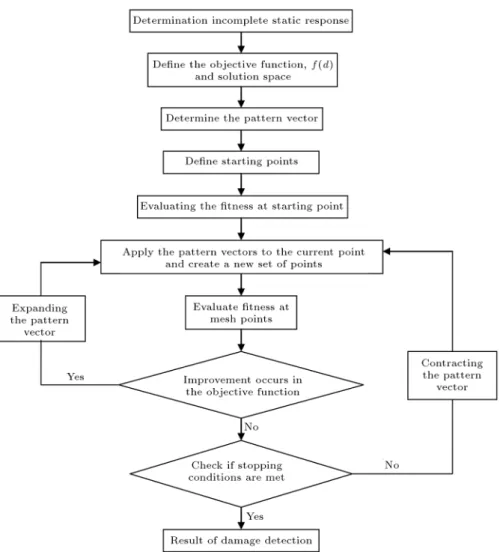
The pattern search method is a derivative-free method for solving a variety of optimization problems, where typical optimization methods are not so eective. The main idea of this procedure is to generate a sequence of iterates that considers the behavior of the objective function at a pattern of points, all of which lie on a logical lattice without utilizing any information about derivatives, including gradient and second-order derivatives of the objective function.
The pattern search method can be briey ex-plained in such a way that starts by establishing a set of points, called mesh, around a given point, which can be computed from previous steps of the iteration or from the initial starting point provided by the user. The mesh is created by adding a scalar multiple set of vectors, called a pattern, to the current point, which, then, searches a set of points (mesh) around the current point of the parameters to nd a point where the objective function has a lower value. After a point with a lower objective function value is detected, the algorithm sets the point as its current point and the iteration can be considered successful. Then, the algorithm goes on to the next iteration with extended mesh size, which is induced by an expansion factor. If the algorithm does not nd a point that improves the objective function, the iteration is called unsuccessful. The current points stay the same in the next iteration and the mesh size decreases due to the contraction factor [15]. The pattern search optimization algorithm stops when any of the following situations occur [16]:
The number of iterations or the evaluation of the objective function reaches the max value.
The mesh size becomes less than mesh tolerance.
The distance between two successful points obtained in two consecutive iterations is less that the given tolerance.
Alteration in the improvement of the objective function is less than the function tolerance.
The optimization problem is formulated as a minimization of the objective function. The pattern search method is applied to Eq. (8) to nd an optimal solution using incomplete static responses, which leads to localizing and quantifying damage. Figure 1 shows
the owchart of the proposed method for estimation and localization of the damage via a pattern search method.
3. Verication examples
In this section, the eciency and eectiveness of the proposed method is evaluated through some numer-ically damaged identication examples, using incom-plete static responses. A simply supported beam, a three-story plane frame, and a plane bridge are chosen, with three dierent scenarios of damage for each of them for this purpose.
3.1. Simply supported beam
A simply supported beam, as illustrated in Figure 2, with a nite-element model consisting of 10 beam elements and 11 nodes is considered. For the consid-ered concrete beam, the material properties include a Young's modulus of E = 25 GPa, and mass density of = 2500 kg/m3. The cross-sectional area and the
second moment of inertia of the beam are A = 0:12 m2
and I = 0:0016 m4, respectively.
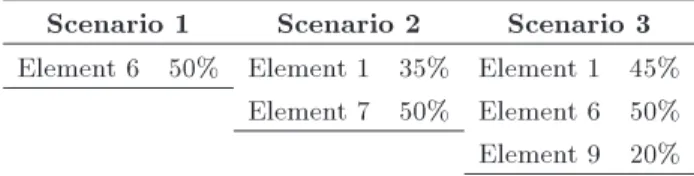
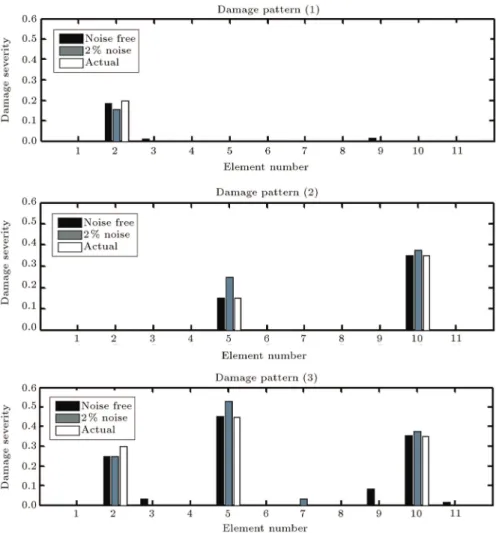
In this example, three damage scenarios are represented as elements with a reduction in Young's modulus. The damage severity in each element is given by the reduction factor listed in Table 1. In this case, only 9 translational DOFs are selected as measured DOFs.
Damage in the beam can be determined by using the proposed method. The pattern search method input parameters adopted for the following analyses are summarized in Table 2.
To be more suited to real cases, an examination has been performed in which the measured
displace-Table 1. Damage scenarios for the simply supported beam.
Scenario 1 Scenario 2 Scenario 3 Element 6 50% Element 1 35% Element 1 45%
Element 7 50% Element 6 50% Element 9 20% Table 2. Input parameters for the pattern search method.
Maximum iteration 200-20000 Maximum function evaluations 40000-100000
Bind tolerance 0.001
X tolerance 1.00E-20
Function tolerance 1.00E-20 Nonlinear constrain tolerance 1.00E-20
Expansion factor 2
Contraction factor 0.5
Figure 1. Flowchart of the damage detection method using the pattern search method.
Figure 2. The simply supported beam with the nite element model.
ments of the damaged structure with 2% noise are utilized for damage identication considering the same patterns mentioned before. To perform this, some random noise has been added to the theoretically calculated measured displacements. The contaminated displacement with noise can be obtained from the dis-placement without noise using the following equation:
(xd
m)noisy= (xdm)(1 + rand[ 1; 1]); (9)
where (xd
m)noisy and (xdm) are the measured
displace-ments of the damaged structure contaminated with noise and without noise, respectively; is the noise level (e.g., 0.02 relates to a 2% noise level), and rand is a random number in the range [-1 1].
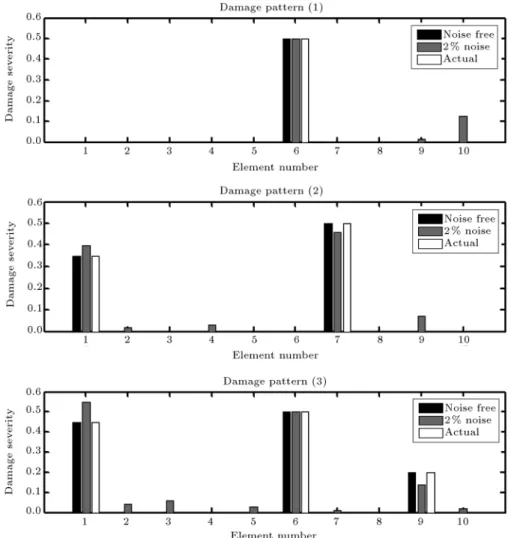
The obtained results of damage detection and quantication using the proposed objective function, which are based on incomplete static responses of the structure, are shown in Figure 3. The results show that the proposed method is robust and promising in localizing and quantifying dierent damage scenar-ios.
3.2. Three-story plane frame
A three-story plane steel frame, as illustrated in Figure 4, with a nite-element model consisting of nine elements (six columns and three beams) and six free nodes is considered. For the considered steel frame, the material properties of the steel include a Young's modulus of E = 200 GPa, and mass density of = 7850 kg/m3. The mass per unit length, the
second moment of inertia, and cross-sectional area of the columns are: m = 117:75 kg/m, I = 3:3 10 4 m4
and A = 1:5 10 2 m2, respectively. For the beams,
they are: m = 119:71 kg/m, I = 3:69 10 4 m4 and
A = 1:52 10 2 m2. Also, the damage severity in
each element is given by the reduction factor listed in Table 3. In this case, only 6 translational DOFs are
Figure 3. The obtained results for three damage patterns of the simply supported beam.
Figure 4. The three-story plane frame with the nite element model.
Table 3. Damage scenarios for the three-story plane frame.
Scenario 1 Scenario 2 Scenario 3 Element 5 15% Element 1 30% Element 1 40%
Element 7 20% Element 6 30% Element 8 45%
selected as measured DOFs in the process of damage detection and quantication.
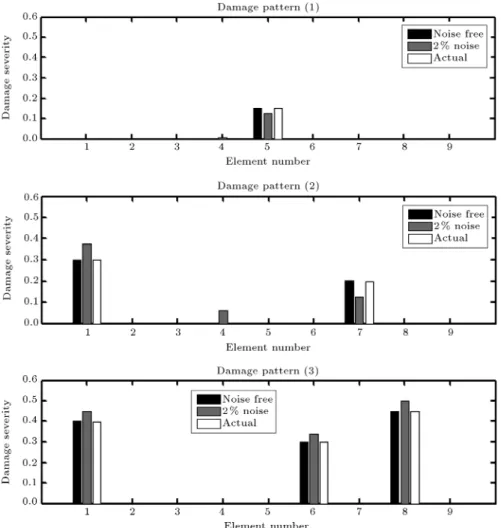
Figure 5 shows the identied damaged elements using the proposed objective function. It can be seen that the damage severity and locations can be obtained correctly for the three dierent scenarios.
3.3. Plane steel bridge
A plane steel bridge, as illustrated in Figure 6, with a nite-element model consisting of elements 1 to 4, as beam-column elements, 5 to 8 as beam elements, and 9 to 11 as column elements is considered. A uniformly distributed load of 50 kN/m has been used on the beam elements. For the considered steel bridge, the material properties of the steel include a Young's modulus of E = 200 GPa. The cross-sectional area of the columns
Figure 5. The obtained results for three damage patterns of the three-story plane frame.
Figure 6. The plane bridge with the nite element model.
is A = 150 10 4 m4. The second moment of inertia
and the cross-sectional area of the beam-columns are I = 189813:3 10 8 m4 and A = 280 10 4 m2,
respectively. The moment of inertia of the beams is I = 189813:3 10 8 m4. Also, the damage severity
in each element is given by the reduction factor listed in Table 4. In this case, only the last 6 DOFs of the bridge are selected as measured DOFs in the process of damage detection and quantication.
The proposed method was applied to detect the damage in the plane steel bridge. Figure 7 shows the capability of the proposed method for detection and estimation of damage in the plane steel bridge for three dierent damage patterns. The obtained
Table 4. Damage scenarios for the plane bridge. Scenario 1 Scenario 2 Scenario 3 Element 2 20% Element 5 15% Element 2 30%
Element 10 35% Element 5 45% Element 10 35%
results for damage detection present a good agreement between actual and estimated damage in the structure. The results indicate that the proposed method can be characterized as a robust and viable method for damage detection in bridge structures.
4. Conclusions
In this paper, a method was developed for the de-tection and estimation of damage in structures on the basis of the incomplete static responses of the damaged structure using an optimization problem. In this method, a pattern search algorithm was used to determine the damage in structures by optimizing a cost function.
For damage detection and estimation, the pro-posed method was applied to three dierent problems,
Figure 7. The obtained results for three damage patterns of the plane bridge.
namely, a simply supported concrete beam, a three-story plane steel frame, and a plane steel bridge, with and without noise in measured displacement and containing one or several damages. The obtained results indicate that the proposed method is a strong and viable method in the problem of detection and es-timation of damage in structures. The results revealed the high sensitivity of the proposed method to damage, in spite incomplete measurements.
References
1. He, R.S. and Hwang, S.F. \Damage detection by a hybrid real-parameter genetic algorithm under the assistance of grey relation analysis", Engineering Ap-plication of Articial Intelligence., 20, pp. 980-992 (2007).
2. Li, G.Q., Hao, K.C., Lu, Y. and Chen, S.W. \A exibility approach damage identication of cantilever-type structures with bending and shear deformation", Comput Struct., 73, pp. 565-572 (1999).
3. Hjelmstad, K.D. and Shin, S. \Damage detection and assessment of structures from static test data", Journal of Engineering Mechanics, 123(6), pp. 568-576 (1997).
4. Banan, M.R., Banan, M.R. and Hjelmstad, K.D. \Pa-rameter estimation of structures from static response, II: numerical simulation studies", Journal of Structural Engineering, 120(11), pp. 3259-3283 (1994).
5. Hwu, C. and Liang, Y.C. \Hole crack identication by static strains from multiple loading modes", AIAA Journal, 39(2), pp. 315-324 (2001).
6. Hajela, P. and Soeiro, F.J. \Structural damage de-tection based on static and modal analysis", AIAA Journal., 28(6), pp. 1110-1115 (1990).
7. Paola, M.D. and Bilello, C. \An integral equation for damage identication of Euler-Bernoulli beams un-der static loads", Journal of Engineering Mechanics., 130(2), pp. 225-234 (2004).
8. Hwu, C. and Liang Y.C. \Hole crack identication by static strains from multiple loading modes", AIAA Journal., 39(2), pp. 315-324 (2001).
9. Yam, L.H., Li, Y.Y. and Wong, W.O. \Sensitivity studies of parameters for damage detection of plate-like structures using static and dynamic approaches", Engineering Structures., 24(11), pp. 1465-1475 (2002).
10. Hua, X.G., Ni, Y.Q., Chen, Z.Q. and Ko, J.M. \Structural damage detection of cable-stayed bridges
using changes in cable forces and model updating", J. Struct. Eng., 135(9), pp. 1093-1107 (2009).
11. Lee, J.W., Choi, K.H. and Huh, Y.C. \Damage detection method for large structures using static and dynamic strain data from distributed ber optic sensor", International Journal of Steel Structures, 10, pp. 91-97 (2010).
12. Cao, M., Ye, L., Zhou, L., Su, Z. and Bai, R. \Sensi-tivity of fundamental mode shape and static deection for damage identication in cantilever beams", Mech. Syst. Signal Process, 25(2), pp. 630-643 (2011).
13. Box GEP \Evolutionary operation: A method for increasing industrial productivity", J. Appl. Stat., 6(2), pp. 81-101 (1957).
14. Kolda, T.G., Lewis, R.M. and Torczon, V. \Opti-mization by direct search: New perspectives on some classical and modern methods", SIAM Review, 45(3), pp. 385-482 (2003).
15. Lewis, R.M. and Torczon, V. \A globally conver-gent augmented Lagrangian pattern search algorithm for optimization with general constraints and simple bounds", SIAM J. Optimiz., 12(4), pp. 1075-1089 (2002).
16. Coelho, L.S. and Mariani, V.C. \Combining of chaotic dierential evolution and quadratic programming for economic dispatch optimization with valve-point ef-fect", IEEE T. Power. Syst., 21(2), pp. 989-996 (2006).
Biographies
Seyed Sina Kourehli was born in 1983 in Tabriz, Iran. He obtained his BS degree in Civil Engineering from Azerbaijan Shahid Madani University, Tabriz, Iran, in 2005, his MS degree in Earthquake Engineer-ing from the BuildEngineer-ing and HousEngineer-ing Research Center, Tehran, Iran, in 2006, and a PhD degree in Earthquake Engineering from the Science and Research Branch of Islamic Azad University, Tehran, Iran, in 2012. His research interests include structural health monitoring and damage detection.
Abdollah Bagheri received an MS degree in Earth-quake Engineering from Iran University of Science and Technology, Tehran, Iran, in 2005, and joined the Department of Civil and Environmental Engineering at the University of Pittsburgh, Pittsburgh, USA, in 2011,
to pursue a PhD degree. His current research interests are nanomaterials, mrcro/nano manufacturing, and structural health monitoring.
Gholamreza Ghodrati Amiri received a BS degree in Civil Engineering, in 1989, an MS degree in Struc-tural Engineering, in 1992, from Sharif University of Technology, Tehran, Iran, and a PhD degree in Earth-quake Engineering, in 1997, from McGill University, Canada. He is currently Professor in the School of Civil Engineering in Iran University of Science & Technology. Mohsen Ghafory-Ashtiany received BS, MS and PhD degrees (honors) in Structural Dynamics and Earthquake Engineering from VA. Tech, USA. He founded the International Institute of Earthquake En-gineering and Seismology (IIEES) in Iran in 1989, and was its president until December 2006. He is the author of more than 250 papers, 3 books and 40 research reports in the eld of seismic hazard and risk anal-ysis, risk modeling, risk management, risk reduction policy development, socio-economic vulnerability and resilience, and as well as random vibration, earthquake engineering, and strong ground motion seismology. He was Chief Editor of JSEE and Chairman of the In-ternational Conference on Seismology and Earthquake Engineering from 1991-2007. He is now Co-Editor of IDRiM Journal, Editor of the Earthquake Engineering Journal (EEJ) and member of the Editorial Board of many other journals. He is one of the founders of the Iranian Earthquake Engineering Association (IEEA) and a pioneer in Risk mitigation activities in Iran. He has served as a member of Iran's Natural Disas-ter Prevention and Management HeadquarDisas-ters, Iran's Risk Reduction Commission, Iran Scientic Research Council, and the National Building Code Council, etc. Currently, he is Professor of Earthquake Engineering and Risk Management at IIEES, Adjunct Professor and Associate Director of the World Institute of Dis-aster Risk Management in Virginia Tech (USA), since 2012, Aliate Member of Iran Academy of Sciences, Chairman of SP Insurance Risk Management Institute. President of IEEA, Director of the International Asso-ciation of Earthquake Engineering (IAEE), Chairman of Earthquake Strong Ground Motion, Hazard and Risk Commission of IASPEI, member of UNISDR Science and Technical Commission, and member of EERI, ASCE, IASBEI, GEM, EMME, etc.