Vol. 14, No. 1, 2016, 73-82
Mapping the Intellectual Structure of Knowledge Management Subject Area: A Co-citation Network Analysis
Rasoul Zavaraqi
Assistant professor, Department of Knowledge and Information Science, University of Tabriz, Iran
Abstract
The aim of the research is mapping the intellectual structure of knowledge management subject area to explore more its past and present. This Scientometric research has been done by author co-citation analysis of KM during time span of 1990-2014. We also used new social network indicators to understand the field better. The findings showed that different specialties can be recognized in the KM field. Half of the specialties are interrelated which shows the interdisciplinary nature of the KM fields. The results also showed that the impact of works written by Davenport, Polanyi and Brown with 928, 650 and 513 citation is more than other core authors of the field, and the stability of Drucker, Schon, Nelson, and Polanyi Theories with 36, 29, 26 and 25 citation half-life is more than other theories.
Keywords: Knowledge Management, Knowledge Domain Visualization, Co-citation.
Introduction
Knowledge management is an evolving subject area which has affected different domains such as management, Information science, industrial engineering and other related domains. This field of science is the process of creating value from an organization‘s intangible assets. Intangible assets, also referred to as intellectual capital, include human capital, structural capital, and customer or relationship capital. This subject area in the last 4 decades has developed and divided into different sub-domains which we name them specialties. Nevertheless there are fewer consensuses about its definition, origin, nature, and pioneers.
Some experts have asserted that knowledge management discourse is affected by different paradigms based on different point of views toward knowledge and its management. However there is no evidence to this asserts. Thus the aim of the research is investigating the dominant paradigms of knowledge management theories and theorists.
We use author co-citation analysis alongside social network analysis techniques to investigate the mentioned premise.
Methodologies
analysis, multi-dimensional scaling, and factor analysis). Heavily co-cited authors appear grouped in space, with authors having many links occupying central locations on the maps and authors with weaker links (fewer co-citations) are appeared on the periphery of maps. Thus the mentioned method is the most powerful in representing school of thoughts and shared concepts, methodologies, approaches, and frameworks in a domain.
The population of the research is references of papers in topic of knowledge management published in ISI ranked journals and indexed in WOS during time span of 1990-2014. To understand the concept better, the time span is divided to 5 five-year-slices. The time slices are 1990-1994, 1995-1999, 2000-2004, 2005-2009, and 2010-2014. By these divisions we can better understand the origin, nature and pioneers of KM and its dominant paradigms in these periods of time. The search is done on 25th March 2014.
The source of data was WOS database. We searched "knowledge management" query in topic field and filter the results to time span of 1990-2013. Finally 5826 records were retrieved. The references of papers downloaded as Citespace software (provided by Chaomei Chen) Input format. Then we applied author co-citation analysis technique as one of powerful techniques for representation intellectual structure of a domain.
We prune the data with pathfinder network algorithms.
We selected 30 top more cited authors (as representatives of dominant paradigms and specialties) in specific time spans to compare them based on their network position and social network analysis indicators.
We also analyzed top more cited authors as representatives of dominant paradigms based on social network analysis techniques and methodologies.
After mapping the map of the domain in independent sliced and merged mode we tried to compare the networks in addition of their theoreticians and specialties based on new structural, temporal and citation indicators.
It is expected that the comparison of the networks, specialties and theoreticians (core authors) based on mentioned indicators can be useful in evaluating their paradigm shift, interdisciplinarity, dynamics, cohesion, consensus, impact, diversity in the 5 mentioned slice of time.
Structural indicators used in the research are Betweenness Centrality, Modularity and Silhouette.
Betweenness Centrality measures the percentage of the number of shortest paths in a network to which a given node belongs. Nodes with high-Betweenness Centrality tend to be found in paths connecting different clusters (Chen, 2006). Accordingly a base author with high Betweenness Centrality score is a turning point in a domain.
The modularity Q measures the extent to which a network can be divided into independent blocks, i.e. modules (Newman, 2006; Shibata, Kajikawa & Matsushima, 2007). The modularity score ranges from 0 to 1. A low modularity suggests a network that cannot be reduced to clusters with clear boundaries, whereas a high modularity may imply a well-structured network (Chen and Ibekwe-SanJuan, 2010).
indicates the uncertainty that one needs to take into account when interpreting the nature of the cluster. The value of 1 represents a perfect separation from other clusters.
Temporal indicators are citation Burstness and sigma. Burst detection determines whether a given frequency function has statistically significant fluctuations during a short time interval within the overall time period. It is valuable for citation analysts to detect whether and when the citation count of a particular reference has surged.
Sigma (∑) is introduced in (Chen, Chen, Horowitz, Hou, Liu, & Pellegrino, 2009) as a measure of scientific novelty. It identifies scientific publications that are likely to represent novel ideas according to two criteria of transformative discovery. As demonstrated in case studies (Chen et al., 2009), Nobel Prize and other award winning research tends to have highest values of this measure.
Social network analysis (such as page-rank) and other indicators such as density, cited-half-life, and average citation received are other indicators used in the research.
Page-rank algorithm is one of powerful algorithms which indicate the prestige and influence of a base author in a domain. On the other hand the authors or theoretician with high page-rank score are authors with high consensus in a domain.
The density is an indicator which shows the topology of a network. If the topology of a network be similar to small world networks, the network is mature one.
Other indicators such as citation and cited-half-life show the impact and stability of his/her theories.
The author believes that such comprehensive view based on mentioned indicators and methodologies toward knowledge management can be lightening the dark faces of the domain and show dominant paradigms and show how, when and by whom, paradigms are shifted.
Findings
The finding showed that we can cluster knowledge Management in 12 related or unrelated specialty.
Table 1
Clustering the Knowledge management subject area into 13 clusters (Specialties)
Cluster Label Base authors Mean
Year Silhouette 1 Causal ambiguity; firm; technology;
innovation
Fornell C
Podsakoff PM 1992 1
2 organizational learning.; knowledge workers; information resource management;
work; organizational memory
Wiig KM
Stein EW 1995 1
3
dialog; organizations; perspective; collaboration; environment
Brown JS Wenger E Lave J
1992 1
4
management-systems; information-technology; media; capability; dynamic
capabilities
Hansen MT Davenport T H
Zack MH Liebowitz J
Cluster Label Base authors Mean
Year Silhouette [Anonymous]
Drucker PF Nahapiet J Von Krogh G
Odell C Stewart TA
Gold AH Mcdermott R Orlikowski WJ
Tsoukas H Gupta AK Ruggles R Leonard-barton D
Malhotra Y Prusak L Wasko MM
Leonard D Bontis N Sanchez R Hammer M
Steels L Rouse WB
Date CJ Carayannis E
Mattos NM Doyle J Maule R Puppe F Brodie ML
Harder T Childs DL 5
databases; decision; Agrawal R
Toroslu IH 1991 1
6 Information product development;
knowledge management system; publishing industry; knowledge integration; decision-support; technology; innovation; retrieval; contextualized access to knowledge; knowledge-based systems; interface design; expert systems; explanations; framework; agents; memory; rule;
Conklin J
Biennier F 1988 1
7 ontology; database management, logical design; heterogeneous databases; distributed artificial intelligence; object-oriented programming; rdf; artificial intelligence; human learning; organizational learning; mind; holistic/heuristic model; classification framework; thought-pattern; self-organizing system; networks;
Chen Q Banerjee J
Salvini S
Cluster Label Base authors Mean
Year Silhouette 8
Architecture; firms; strategic performance; organizational knowledge; technological
learning Kogut B Szulanski G Argote L Huber GP Weick KE Hamel G
1992 0.92
9
organizational knowledge; strategic performance; technological learning; multitechnology corporations;
research-and-development Grant RM Teece DJ Cohen WM Spender JC Eisenhardt KM Barney J Zahra SA Mintzberg H Dodgson M
1993 .953
10 Process improvement; software development; supply chain management;
information exchange; exchange
Senge PM Argyris C Quinn JB Drucker P
1993 .955
11
Architecture; taxonomy; model management; value chain; trading
Holsapple CW Simon HA Sprague RH Applegate LM Bonczek RH Blanning RW Binbiasioglu M
1977 .86
12
organizational learning.; knowledge workers; information resource management;
it tools; human resource management
Nonaka I Alavi M Davenport TH Davenport T Polanyi M Nelson RR Hedlund G
1989 .81
13
design; network; software, web-based applications Gaines BR Clancey WJ Boehm BW Skuce D Boose J Artificial Intelligence
Laboratory of the University of Ottawa
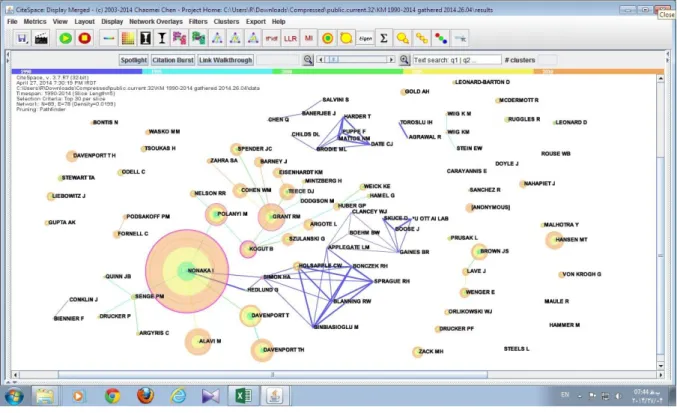
Figure 1. The author co-citation network of KM field
The table 1 and figure 1 show that Knowledge Management subject area can be divided to 13 clusters which 6 clusters (half of them) are independent from the network cores. The most pivotal cluster is 8th. In this cluster the role of Kogut is not neglectable. Thus he is one of pivotal authors of KM subject area. The older cluster is 11th one and the roles of Simon and Applgate as pioneers of KM are prominent. The newest cluster is second and is about organizational memory. The works of Wiig is well known in this cluster. The most important cluster is 12th and the role of top KM authors such as Nanoka, Davenport and Polanyi is prominent. The 10th cluster is a Management oriented KM and is dominated by works of Senge, Argris, Quinn and Drucker works. While it seems that 7th cluster be more technology oriented specialty of knowledge management. The prominent base authors of the specialty are Chen, Banerjee, and Salvini.
Table 2
The Bursted core authors of the KM field
#Key Times
cited Burst
Publication Year
Burst Begin
Burst
End Span HalfLife
OLEARY DE 141 7.62 1998 1990 2005 16 8
HEDLUND G 145 9.06 1994 1994 2004 11 12
QUINN JB 152 19.42 1996 1996 2004 9 9
DRUCKER P 164 10.45 1992 1996 2004 9 14
DAVENPORT T 611 39.59 1998 1998 2005 8 8
SVEIBY K E 142 4.66 2001 1997 2004 8 7
SCHON D A 133 8.97 1978 1998 2004 7 29
PRUSAK L 175 13.75 2001 1999 2005 7 5
PRAHALAD CK 177 3.35 1990 1994 2000 7 19
LEONARD-BARTON D 181 15.93 1995 1998 2004 7 11
NELSON RR 259 3.84 1982 1994 2000 7 26
ARGYRIS C 195 6.63 1996 1997 2003 7 11
RUGGLES R 183 12.84 1998 1999 2004 6 8
HUBER GP 280 3.85 1991 1993 1998 6 17
STEWART TA 226 20.57 1997 1997 2002 6 9
MINTZBERG H 187 3.72 1990 1996 2001 6 18
WIIG K M 158 5.38 1994 1996 2000 5 15
SENGE PM 224 13.34 2006 1996 2000 5 1
HAMEL G 177 8.03 1991 1996 2000 5 16
DAVENPORT T H 317 26.42 1998 2010 2014 5 13
DRUCKER PF 295 3.75 1973 1996 2000 5 36
SANCHEZ R 145 5.09 1996 1999 2002 4 13
PODSAKOFF PM 204 10.59 2003 2011 2014 4 8
WIIG KM 186 5.51 2004 1997 2000 4 4
FORNELL C 234 9.53 1987 2011 2014 4 24
BROWN JS 513 10.08 1991 2001 2003 3 16
BOCK GW 156 11.60 2005 2012 2014 3 6
BLACKLER F 167 4.52 1995 2001 2003 3 12
LEONARD D 155 10.35 1998 2000 2002 3 8
MALHOTRA Y 213 4.36 2005 2004 2006 3 2
LEE H 140 8.31 2003 2011 2012 2 8
EDVINSSON L 171 5.21 1997 1999 2000 2 12
TSAI WP 173 4.35 2001 2010 2011 2 10
POLANYI M 650 7.67 1983 2002 2003 2 25
GROVER V 127 4.52 2001 2005 2005 1 7
LAVE J 291 3.29 1998 2002 2002 1 11
HAIR J 127 3.46 1998 2011 2011 1 13
ZAHRA SA 197 5.95 2006 2010 2010 1 4
GOLD AH 204 3.49 2001 2011 2011 1 9
Burst detection determines whether a given frequency function has statistically significant fluctuations during a short time interval within the overall time period. It is valuable for citation analysts to detect whether and when the citation count of a particular reference has surged. Table 2 shows that works written by Davenport is the most core works cited in KM. this attention has started since 1998-2005 and 2010-2014. Total citations of him are 928 (317+611). The table also shows that works written by Oleary, Hedlung, and Quinn had more fluctuations during the time and their works were base in KM subject area 16, 11, and 9 years.
If we accept this that citations and cited-half-life show the impact and stability of the theories, we can say that the impact of works written by Davenport, Polanyi and Brown with 928, 650 and 513 citation is more than other core authors of the field, and the stability of Drucker, Schon, Nelson, and Polanyi Theories with 36, 29, 26 and 25 citation half-life is more than other theories.
Accordingly a base author with high Betweenness centrality score is a turning point in a domain. Table 3 shows the centralities of core author of KM.
Table 3
The score of core authors of KM field based on centrality indicator
Number Author Centrality
1 Nonaka I 0.25
2 Kogut B 0.2
3 Polanyi M 0.19
4 Simon HA 0.16
5 Grant RM 0.14
6 Applegate LM 0.1
7 Senge PM 0.06
8 Gaines BR 0.05
9 Huber GP 0.04
10 Sprague RH 0.03
11 Bonczek RH 0.03
12 Blanning RW 0.03
13 Binbiasioglu M 0.03
14 Davenport T 0.02
15 Dodgson M 0.02
16 Szulanski G 0.02
17 Teece DJ 0.02
18 Cohen WM 0.02
Table 4
The score of core authors of KM field based on Sigma indicator
Number Author Sigma
1 Polanyi M 2.38
2 Senge PM 1.94
3 Davenport T 1.91
4 Gaines BR 1.29
5 Dodgson M 1.11
As we said Sigma (∑) is introduced in (Chen, et. Al, 2009a) as a measure of scientific novelty. It identifies scientific publications that are likely to represent novel ideas according to two criteria of transformative discovery. Thus the novelty of core authors of KM such as Polanyi, Sange, Davenport, Gaines and Dodgson is more than all other core authors of the field.
Conclusions
The findings showed that different specialties can be recognized in the KM field. Half of the specialties are interrelated which shows the interdisciplinary nature of the KM fields. The most important cluster is 12th and the role of top KM authors such as Nanoka, Davenport and Polanyi is prominent. The 10th cluster is a Management oriented KM and is dominated by works of Senge, Argris, Quinn and Drucker works. While it seems that 7th cluster be more technology oriented specialty of knowledge management. The prominent core authors of the specialty are Chen, Banerjee, and Salvini.
If we accept this that citation and cited-half-life show the impact and stability of his/her theories, we can say that the impact of works written by Davenport, Polanyi and Brown with 928, 650 and 513 citation is more than other core authors of the field, and the stability of Drucker, Schon, Nelson, and Polanyi Theories with 36, 29, 26 and 25 citation half-life is more than other theories.
References
Chen, C. (2006). CiteSpace II: Detecting and Visualizing Emerging Trends. Journal of the American Society for Information Science, 57(3), 359–377. doi:10.1002/asi
Chen, C.; Chen, Y.; Horowitz, M.; Hou, H.; Liu, Z. & Pellegrino, D. (2009). Towards an explanatory and computational theory of scientific discovery. Journal of Infometrics, 3(3), 191–209.
Chen, C., & Ibekwe-sanjuan, F. (2010). The Structure and Dynamics of Co-citation Clusters: A Multiple-Perspective Co-citation Analysis. Journal of the American Society for Information Science, 61(7), 1386–1409. doi:10.1002/asi
Newman, M. E. J. (2006). Modularity and community structure in networks. Proceedings of the National Academy of Sciences of the United States of America, 103(23), 8577-8582. Rousseeuw, P. (1987). Silhouettes: a graphical aid to the interpretation and validation of
networks to discover the future core articles. Journal of the American Society for Information Science and Technology, 58(6), 872-882.