Sharif University of Technology
Scientia IranicaTransactions E: Industrial Engineering www.scientiairanica.com
A novel Pareto-based multi-objective vibration
damping optimization algorithm to solve
multi-objective optimization problems
V. Hajipour
a;, E. Mehdizadeh
band R. Tavakkoli-Moghaddam
c a. Young Researchers and Elite Club, Qazvin Branch, Islamic Azad University, Qazvin, Iran.b. Department of Industrial and Mechanical Engineering, Qazvin Branch, Islamic Azad University, Qazvin, Iran. c. School of Industrial Engineering, College of Engineering, University of Tehran, Tehran, Iran.
Received 9 January 2013; received in revised form 27 October 2013; accepted 23 November 2013 KEYWORDS
Multi-objective optimization; Vibration damping optimization; Pareto optimal solution; NSGA-II; MOSA.
Abstract. This paper presents a Vibration Damping Optimization (VDO) algorithm to solve multi-objective optimization problems for the rst time. To do this, fast non-dominated sorting and crowding distance concepts were used in order to nd and manage the Pareto-optimal solution. The proposed VDO is validated using several examples taken from the literature. The results were compared with Multi-Objective Simulated Annealing (MOSA) and Non-dominated Sorting Genetic Algorithms (NSGA-II) presented as state-of-the-art in evolutionary multi-objective optimization algorithms. The results indicate that Multi-Objective VDO (MOVDO) gives better performance with a signicant dierence in terms of computational time, while NSGA-II is better in nding Pareto solutions. In other standard metrics, MOVDO is able to generate true and well-distributed Pareto optimal solutions and compete with NSGA-II and MOSA.
© 2014 Sharif University of Technology. All rights reserved.
1. Introduction
Nowadays, most problems encountered by Decision Makers (DMs) in the real world are recognized to be multi-objective optimizations. In fact, the DM likes to pursue more than one target or consider more than one factor or measure. Unlike single optimization problems, which deal with only one global optimum value, there is a set of solutions, called the Pareto solution, in the area of multi-objective optimization [1]. Unlike hard computing schemes, which strive for exactness and full truth, soft computing deals with imprecision, uncertainty, partial truth, and approxi-mation to achieve practicability, robustness and low solution cost. Components of soft computing include terms such as neural networks, fuzzy logic,
Evolution-*. Corresponding author. Tel./Fax: +98 281 3665275 E-mail address: [email protected] (V. Hajipour)
ary Computation (EC), and ideas about probability (Bayesian network, Chaos theory, and perceptron). Among these terms, EC is a practicable and common method to solve the problems. Several evolutionary algorithms have been developed which combine rules and randomness mimicking natural phenomena. These phenomena include biological evolutionary processes; for example, evolutionary algorithms [2], Genetic Al-gorithms (GA) [3,4], animal behavior [5-7], physical annealing processes [8], and the musical process of searching for a perfect state of harmony [9,10]. Many researchers have studied these meta-heuristics to solve various optimization problems recently.
Classical optimization methods suggest convert-ing the multi-objective optimization problem to a single-objective one by emphasizing one particular Pareto-optimal solution at a time, such as classical weighted sum [11], desirability function [12], and Lp-metric [13]. On the other hand, such a method can
be utilized to nd multiple solutions. Over the past decades, a number of Multi-Objective Evolutionary Algorithms (MOEAs) have been suggested [14-18]. It is worth noting that the main reason for the popularity of evolutionary algorithms for solving multi-objective optimization is their population-based nature and their ability to nd multiple optima simultaneously. The Non-dominated Sorting Genetic Algorithm (NSGA-II) introduced by Deb et al. [19] is an MOEA that has been applied to nd Pareto front solutions in dierent elds of study, such as facility location prob-lems [20], scheduling probprob-lems [21] and inventory con-trol problems [22]. Moreover, in addition to the earlier aggregating approaches of Multi-Objective Simulated Annealing (MOSA), there have been a few methods that incorporate the concept of Pareto dominance. Some of these methods are proposed in [23,24], which use Pareto-domination based acceptance criterion in MOSA. A good review of several MOSA algorithms and their comparative performance analysis can be found in [25]. Several researchers developed multi-objective algorithms and justied them by comparing with NSGA-II and MOSA. Rahmati et al. [10] devel-oped a multi-objective harmony search algorithm and compare it with NSGA-II and a non-dominated ranking genetic algorithm (NRGA). Sadeghi et al. [26] solved their bi-objective model with NSGA-II and NRGA. Bandyopadhyay et al. [27] developed a special type of MOSA and demonstrated its performance in contrast with NSGA-II.
Mehdizadeh and Tavakkoli-Moghaddam [28] pro-posed a new meta-heuristic optimization algorithm, namely, Vibration Damping Optimization (VDO), which is based on the concept of vibration damping in mechanical vibration. This algorithm simulates the vi-bration phenomenon. They rst utilized the VDO algo-rithm to solve the parallel machine scheduling problem. To demonstrate the performance of VDO, they applied GA. They showed that when problems are small, the proposed VDO and GA have the same results. But, with increasing problem sizes, the VDO algorithm nds a better solution in terms of computational time and average objective function values. Mehdizadeh et al. [29] proposed a hybrid VDO algorithm to solve the multi-facility stochastic-fuzzy capacitated location allocation problem. Following this, Mousavi et al. [30] developed a special type of VDO algorithm to solve a capacitated multi-facility location{allocation problem with probabilistic customer locations and demands. They formulated their mathematical model in the frameworks of the Expected Value Model (EVM) and the Chance-Constrained Programming (CCP) based on two dierent distance measures. They demonstrated the performance of their proposed algorithm with GA. Based on their results analysis in 16 test problems, it was shown that there was no statistical signicant
dif-ference between the performance of the two algorithms; it seems that not only does VDO perform better than GA for the CCP model with Euclidean distance, but also has better performance for both CCP and EVM models with squared Euclidean distance.
In this paper, the VDO algorithm is extended using Fast Non-Dominated Sorting (FNDS) and rank-ing procedures to nd Pareto-optimal solutions for multi-objective optimization problems with conict-ing objectives. Thus, this paper proposes the rst proposal of applying multi-objective versions of the VDO algorithm in the literature. In fact, FNDS and Crowding Distance (CD) have been used to nd and manage the Pareto-optimal front. The proposed Multi-Objective VDO (MOVDO) algorithm was tested on multi-objective facility location problems with com-peting objectives presented in [13]. To demonstrate the performance of the MOVDO, two well-developed MOEAs, including NSGA-II and MOSA, were applied. The remainder of this paper is as follows. Section 2 provides some main concepts and denitions of multi-objective optimization algorithms. In Section 3, the rst proposal of the multi-objective version of the VDO algorithm is illustrated in detail. In Section 4, the results are analyzed and discussed by graphical and statistical comparisons. Finally, Section 5 presents the conclusions.
2. Concepts and denitions
A mono-objective optimization algorithm will be ter-minated upon to obtain an optimal solution, yet it is unlikely to nd a single solution for a multi-objective problem. Since objectives are contradictory, we gener-ally nd a set of solutions. In order to clarify the point, some basic multi-objective concepts are required to be reviewed [31]. Consider a multi-objective model with a set of conict objectives as follows:
f (~x) = [f1(~x) ; ; fm(~x)] ;
S.t.:
gi(~x) 0; i = 1; 2; ; I; ~x 2 X; (1)
where ~x denotes m-dimensional vectors that can get real, integer, or even Boolean values, and X is the feasible region. Then, for a minimization model, we say solution ~a dominates solution ~b(~a;~b 2 X) if:
(I) fi(~a) fi
~b, 8i = 1; 2; ; m
(II) 9i 2 f1; 2; ; mg : fi(~a) < fi
~b.
Moreover, a set of solutions that cannot dominate one other is called the Pareto solutions set or Pareto front. The main goal of multi-objective problems are stated
as appropriate convergence and appropriate diversity, which forms a good Pareto front. Accordingly, Pareto-based algorithms aim to achieve the Pareto-optimal front during the evolution process. The Pareto-optimal front is called to the front of the last iteration of the algorithms. This front is expected to have the most convergence and the highest diversity [17]. In fact, two major problems should be addressed when an evolutionary algorithm is applied to multi-objective optimization. The rst is how to accomplish tness assignment and selection, respectively, to guide the search towards the Pareto-optimal front; and the sec-ond is how to maintain a diverse population to prevent premature convergence and achieve a well-distributed trade-o front [1].
3. Proposed methodology
In this section, we rst introduce the multi-objective version of the Vibration Damping Optimization (VDO) algorithm to solve the multi-objective optimization problem. Then, to demonstrate the performance of MOVDO, two well-developed Pareto-based MOEAs, including NSGA-II and MOSA, are employed.
3.1. Multi-Objective Vibration Damping Optimization (MOVDO)
In the vibration theory, the concept of vibration can be considered to be the oscillation. If the damping is small, it has very little inuence on the natural frequencies of the system, and, hence, the calculation for the natural frequencies is nearly made on the basis of no damping [32]. In the VDO algorithm, at high amplitudes, the scope of a solution is bigger and the probability of obtaining a new solution is further away. Therefore, when the amplitude is reduced, the probability of obtaining a new solution decreases, and then the system stops from the amplitude state [28-30]. In the analogy between an optimization problem and the vibration damping process,
- The states of the oscillation system represent feasible solutions of the optimization problem;
- The energies of the states correspond to the objective function value computed at those solutions;
- The minimum energy state corresponds to the op-timal solution to the problem, and rapid quenching can be viewed as local optimization.
The VDO algorithm starts working by generating random solutions in search space. Then, the algorithm parameters, including initial amplitude (A0), max of
iteration at each amplitude (L), damping coecient () and standard deviation (), are initialized. Then, the solutions are evaluated by means of the Objective Function Value (OFV). The algorithm contains two
main loops. The rst loop generates a solution ran-domly and then, using a neighborhood structure, new solutions are obtained and the best is chosen. However, similar to the SA algorithm, the solution with a worse OFV can be selected, with regards to the Rayleigh distribution function. At given amplitude, it states the probability of an oscillatory system determined by the Rayleigh probability distribution function. In fact, the new solution is accepted if =OFV (new solution)-OFV (current solution) < 0. Besides, if > 0, a random number (r) is selected between (0, 1). When r is less than or equal to this function, the worse solution is chosen. This approach causes escape from local and convergence to global optimum:
r < 1 exp
A2
22
: (2)
The second loop adjusts the amplitude, which is used for reducing amplitude at each iteration. The algo-rithm is stopped when the stopping criterion is met:
At= A0exp
t
2
: (3)
After brief illustration of the VDO algorithm, we in-troduce the rst proposal of applying a multi-objective version of the VDO algorithm, called MOVDO, to solve and manage Pareto-optimal solutions. To do so, we apply two main concepts of multi-objective meta-heuristics, namely, Fast Non-Dominated Sorting (FNDS) and Crowding Distance (CD), to compare the solutions. In FNDS, R initial populations are compared and sorted. To do this, all chromosomes in the rst non-dominated front are rst found. Assuming that all objective functions are of a minimization type, the chromosomes are chosen using the concept of domination, in which solution xi is said to dominate
solution xj. If 8o 2 f1; 2g, we have Zo(xi) Zo(xj)
and 9o 2 f1; 2g, such that Zo(xi) < Zo(xj). In this
case, we say xi is the non-dominated solution within
the solution set, fxi; xjg. Otherwise, it is not. Then,
in order to nd the chromosomes in the next non-dominated front, the solutions of the previous fronts are disregarded temporarily. This procedure is repeated until all solutions are set into fronts.
After sorting the populations, a CD measure is dened to evaluate solution fronts of populations in terms of the relative density of individual solutions [19]. To do this, consider Z and fk; k = 1; 2; ; M as
the number of non-dominated solutions in a particular front (F ) and the objective functions, respectively. Besides, let di and dj be the value of the CD on
the solutions, i and j, respectively. Then, the CD is obtained using the following steps:
(II) Sort all objective functions, fk; k = 1; 2; ; M,
in ascending order;
(III) The CD for end solutions in each front (d1 and
dZ) are d1= dZ ! 1;
(IV) The crowding distance for dj; j = 2; 3; ; (Z
1) are dj= dj+ (fkj+1 fkj 1).
To select individuals of the next generation, the crowded tournament selection operator, \", is ap-plied [18]. In order to do that, the following steps are required to be carried out:
Step 1: Choose n individuals in the population randomly.
Step 2: The non-dominated rank of each individual should be obtained and the CD of the solutions having equal non-dominated rank is calculated.
Step 3: The solutions with the least rank are those selected. Moreover, if more than one individual share the least rank, the individual with the highest CD should be selected.
In other words, the comparison criterion of MOVDO algorithm's solutions can be written as: If rx< ry or (rx = ry and dx> dy), then x y, where
rx and ry are the ranks, and dx and dy are the CDs.
In this paper, a polynomial neighborhood structure for the selected chromosome is performed.
After operating the aforementioned concepts and operators, the parents and ospring population should be combined to ensure the elitism. Since the combined population size is naturally greater than the original population size, N, once more, non-domination sorting is performed. In fact, chromosomes with higher ranks are selected and added to the population until the population size becomes N. The last front also consists of the population based on the crowding distance. The algorithm stops when a predetermined number of iterations (or any stopping criteria) is reached.
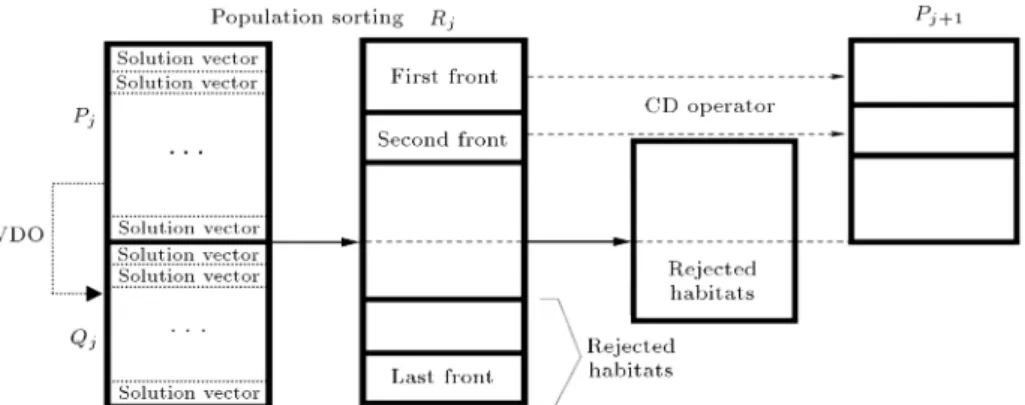
Figure 1 illustrates the evolution process of the proposed MOVDO schematically. The process is
started by initializing the initial population of the solution vectors, Pj. Then, the new operators are
implemented on Pj to create a new population, Qj.
The combination of Pj and Qj creates Rj for keeping
elitism in the algorithm. In this step, vectors of Rj are
sorted in several fronts based on FNDS and CD. Using the proposed selection method, a population of the next iteration, Pj+1, is chosen to have a predetermined
size.
It is worth mentioning that by using Pareto domi-nance solutions, it becomes a computationally ecient algorithm, implementing the idea of a selection method based on classes of dominance of all the solutions. In order to clarify the trend of the proposed algorithm, we represent a pseudo code of MOVDO, as shown in Figure 2.
To demonstrate the performance of the proposed MOVDO, two Pareto-based MOEAs, including NSGA-II and MOSA, are applied. The main dierence between NSGA-II and MOSA in comparison with MOVDO is the evolution process of the algorithms from Pt to Qt. Furthermore, NSGA-II and MOSA
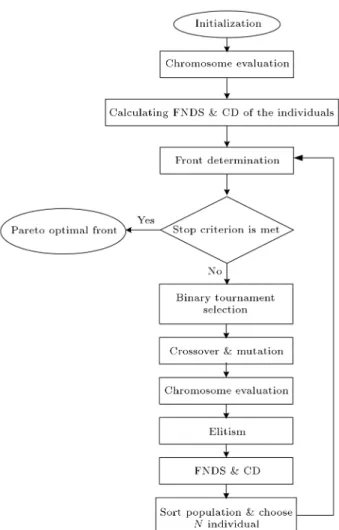
are dierent in their selection strategies. NSGA-II uses a binary tournament selection and MOSA uses the roulette wheel selection strategy. Accordingly, after generating or modifying populations by means of single-objective operators of the algorithms (e.g., GA, SA or VDO), the population is dealt in a multi-objective way in a similar fashion in all algorithms. Besides, to minimize the impact of using dierent operators on the performance comparison process of the algorithms, operators are designed identically. To do so, the neighborhood structure of the proposed MOVDO is designed similar to the mutation operator of NSGA-II and the neighborhood structure of MOSA. Moreover, in NSGA-II, the crossover operator is also designed similarly using a uniform crossover opera-tor [33]. A ow chart of the proposed NSGA-II is depicted in Figure 3. Moreover, to clarify the trend of the proposed MOSA, Figure 4 represents a pseudo code of this algorithm.
In the next section, we analyze the results and
Figure 2. Pseudo code of MOVDO.
Figure 3. Flowchart of NSGA-II.
demonstrate the performance of the proposed MOVDO in the area of multi-objective optimization problems. 4. Result analysis and comparisons
To evaluate the performances of the proposed MOVDO, ve standard metrics of multi-objective al-gorithms are applied as follows:
Diversity: Measures the extension of the Pareto front, in which bigger value is better [34].
Spacing: measures the standard deviation of the distances among solutions of the Pareto front, in which smaller value is better [35].
Mean Ideal Distance (MID): Measures the conver-gence rate of Pareto fronts to a certain point (0, 0), in which smaller value is better [34].
Number Of found Solutions (NOS): Counts the number of Pareto solutions in the Pareto optimal front in which bigger value is better [35].
The computational (CPU) time of running the algorithms to reach near optimum solutions. As mentioned before, the proposed multi-objective algorithm is applied to solve multi objective facil-ity location problems in the literature [13]. The experiments are implemented on 20 test problems. Furthermore, to eliminate uncertainties of the solutions obtained, each problem is used three times under dierent random environments. Then, the averages of
Figure 4. Pseudo code of MOSA.
these three runs are treated as the ultimate responses. Then, we compare the proposed MOVDO algorithm with MOSA and NSGA-II, as the most applicable Pareto-based MOEAs in the literature, to demonstrate the performance of the proposed algorithm in solving multi-objective optimization problems. It should be mentioned that the input parameters of the algorithms are reported in Table 1.
To evaluate the performance of the proposed MOVDO, Table 2 reports the multi-objective metric amounts on the 20 test problems, in which \NAS" shows that the algorithm cannot nd the Pareto front in the reported time. It is noted that MATLAB software [36] has been used to code the proposed meta-heuristic algorithms, and the programs have been executed on a 2 GHz laptop with eight GB RAM.
Table 1. Values of algorithms parameters along with their tuning procedure.
Multi-objective algorithms
Algorithm parameters
Optimum amount
Selected policy
NSGA-II
nP op 25
RSM [13]
Pc 0.6
Pm 0.4
Ngen 100
MOSA
T0 500
RSM [13] P opsize 5
Ngen 500
0.99
MOVDO
nP op 5
Taguchi [30]
A0 6
L 40
1.5
0.05
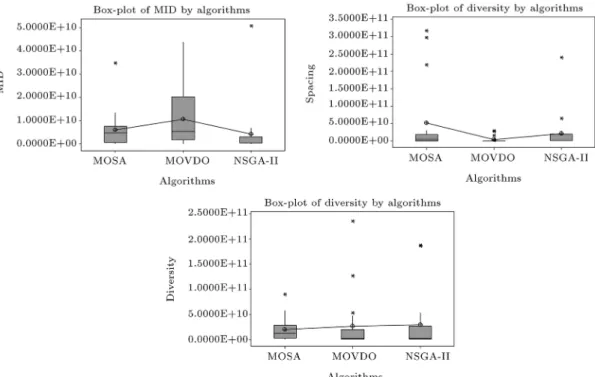
The algorithms are statistically compared based on the properties of their obtained solutions via the analysis of variance (ANOVA) test. These outputs are reported in Tables 3 to 7 in terms of dened metrics. In these tables, the abbreviation of rst row show Degrees of Freedom (DF), Sum of Squares (SS), Mean Square (MS), F-value test (F), P-value (P). In order to clarify our statistical results, box-plots are represented in Figures 5 and 6. Moreover, graphical comparisons of all metrics on 20 test problems are shown in Figure 7.
Based on the statistical outputs in Tables 3 and 4, along with Figure 5, NSGA-II shows better perfor-mances, in terms of NOS, while MOVDO has better performance in terms of CPU time. Moreover, Tables 4 to 7, along with Figure 6, show the comparability of MOVDO, in comparison with NSGA-II and MOSA, on MID, spacing, and diversity metrics in which the algorithms have no signicant dierences and, statis-tically, work the same. It should be mentioned that this conclusion is conrmed at 95% condence level. Based on the outputs in Table 2, with increasing the size of problems, in test problems 19 and 20 and in test problem 20, NSGA-II and MOSA cannot nd the Pareto front, respectively. However, in these large sizes, MOVDO can nd the Pareto front. The MOVDO algorithm performs better in terms of CPUT metric. These features conclude the robustness of the proposed MOVDO in large-sized problems in the area of multi-objective optimization problems.
To increase the readability of the proposed MOVDO, Figure 8 represents the non-dominated solu-tions of a single run of the proposed MOVDO algorithm in the initial and nal iterations in the left and right sides, respectively. These two gures indicate the
Table 2. Multi-objective metrics computed for three proposed MOEAs.
Problem
no. Time NOS MID Spacing Diversity
NSGA-I
I
MOSA MO
VDO
NSGA-I
I
MOSA MO
VDO
NSGA-I
I
MOSA MO
VDO
NSGA-I
I
MOSA MO
VDO
NSGA-I
I
MOSA MO
VDO
1 17.76 16.43 11.33 24 6 5 2.40E+07 2.46E+07 2.14E+07 2.55E+08 3.46E+07 1.78E+07 2.15E+08 2.20E+08 1.34E+07 2 32.67 25.23 13.11 20 4 8 4.57E+08 2.89E+08 3.21E+08 3.89E+08 4.52E+08 4.17E+05 1.89E+09 2.74E+09 2.38E+07 3 35.98 22.13 18.73 24 5 6 5.69E+08 5.91E+09 4.32E+09 3.94E+08 8.98E+09 8.32E+06 1.98E+09 1.78E+09 5.62E+07 4 33.57 29.12 18.31 21 6 5 2.47E+08 2.20E+08 1.43E+09 2.76E+09 2.40E+09 3.17E+06 4.52E+07 1.57E+10 2.62E+07 5 33.94 29.91 17.13 23 4 6 3.99E+08 7.55E+09 8.91E+09 2.47E+08 2.98E+10 2.36E+06 3.50E+09 5.85E+09 8.18E+08 6 31.83 28.12 19.84 22 5 6 2.89E+08 4.87E+09 5.32E+09 2.47E+08 2.19E+11 4.69E+07 1.57E+09 8.92E+10 2.35E+09 7 44.87 31.13 22.90 23 6 7 3.98E+08 8.77E+09 7.40E+09 2.41E+11 3.18E+11 4.72E+06 5.19E+10 8.92E+09 2.19E+09 8 40.90 32.24 22.73 25 NAS 6 6.69E+09 NAS 5.49E+09 2.93E+10 NAS 5.84E+06 1.87E+11 NAS 9.27E+08 9 44.23 29.44 29.82 25 7 7 1.29E+08 5.70E+08 4.32E+08 6.78E+08 8.80E+07 6.22E+06 2.35E+08 2.90E+09 1.23E+09 10 48.98 33.92 27.61 24 5 8 3.71E+08 3.85E+08 2.25E+08 3.43E+09 9.46E+06 2.68E+07 2.32E+08 2.40E+08 2.16E+09 11 59.47 39.23 29.28 24 4 8 3.28E+08 1.34E+10 2.49E+10 3.39E+08 7.96E+09 3.62E+07 1.84E+08 2.18E+10 2.80E+08 12 61.11 44.23 25.88 22 5 6 3.29E+08 2.85E+09 2.82E+10 5.48E+08 1.49E+10 2.34E+07 1.24E+09 5.72E+10 2.71E+08 13 75.12 55.32 30.91 21 4 8 7.80E+08 3.49E+10 2.39E+10 2.39E+08 2.98E+11 1.32E+07 1.94E+08 4.18E+10 4.18E+09 14 77.10 51.13 31.99 22 6 6 1.99E+09 2.26E+09 2.46E+09 6.88E+08 1.87E+08 1.48E+07 2.20E+10 1.87E+09 5.20E+10 15 98.13 77.22 39.51 25 6 7 3.66E+09 6.46E+09 5.88E+09 6.49E+10 3.42E+09 1.44E+07 2.99E+10 2.72E+10 4.62E+10 16 89.49 73.21 37.91 25 7 8 2.87E+09 2.86E+09 2.45E+09 1.89E+09 7.69E+07 5.88E+07 2.87E+09 1.48E+09 8.92E+09 17 92.13 89.12 45.60 25 5 7 5.06E+09 4.88E+09 4.38E+10 2.01E+10 4.67E+08 2.61E+09 2.43E+10 2.72E+10 1.63E+10 18 99.71 99.74 62.12 19 4 8 5.08E+10 5.68E+09 5.37E+09 1.90E+10 6.54E+09 2.70E+10 1.86E+11 1.90E+10 2.36E+11 19 165.89 101.88 77.19 NAS 5 8 NAS 7.64E+09 8.54E+09 NAS 5.87E+09 1.57E+10 NAS 1.43E+10 1.96E+10 20 264.42 232.83 123.88 NAS NAS 7 NAS NAS 3.42E+10 NAS NAS 2.92E+10 NAS NAS 1.26E+11
Figure 5. Box-plots of metrics with signicant dierence. Table 3. Analysis of variance for the time metric.
Source DF SS MS F P
Algorithms 2 13887 6944 3.28 0.045 Error 57 120615 2116
Total 59 134502
Table 4. Analysis of variance for the NOS metric.
Source DF SS MS F P
Algorithms 2 3522.32 1761.16 955.77 0.000
Error 53 97.66 1.84
Total 55 3619.98
Table 5. Analysis of variance for the MID metric.
Source DF SS MS F P
Algorithms 2 4.27263E+20 2.13631E+20 1.71 0.191 Error 53 6.62076E+21 1.24920E+20
Total 55 7.04802E+21
Table 6. Analysis of variance for the spacing metric.
Source DF SS MS F P
Algorithms 2 2.13294E+22 1.06647E+22 2.26 0.114 Error 53 2.49807E+23 4.71334E+21
Figure 6. Comparability of MOVDO in comparison with NSGA-II and MOSA on MID, spacing, and diversity metrics.
Figure 8. Pareto solutions obtained by the proposed MOVDO. Table 7. Analysis of variance for the diversity metric.
Source DF SS MS F P
Algorithms 2 9.23360E+20 4.61680E+20 0.18 0.832 Error 53 1.32671E+23 2.50322E+21
Total 55 1.33594E+23
intelligence of the proposed algorithm for solving multi-objective Pareto-based meta-heuristic algorithms. 5. Conclusions
In this paper, a Vibration Damping Optimization (VDO)-based multi-objective meta-heuristic algorithm has been presented. In this respect, the concept of domination has been used in solving the multi-objective optimization problems. In the Multi-Objective Vi-bration Damping Optimization (MOVDO), two main concepts (i.e., Fast Non-Dominated Sorting (FNDS) and Crowding Distance (CD)) have been considered in order to introduce the proposed MOVDO. In or-der to demonstrate the applicability of the proposed MOVDO, multi-objective facility location problems are applied. The results show the capability of the MOVDO algorithm to solve the multi-objective prob-lems. To justify this, NSGA-II and MOSA algorithms have been implemented to evaluate the performance of the proposed MOVDO. The eciency of MOVDO in large-size problems has been demonstrated, although, only the CPU time metric has been statistically dier-ent in comparison with NSGA-II and MOSA. As future research, one can compare the proposed MOVDO with other multi-objective algorithms (e.g., MOPSO or MOTS) in various optimization problems.
Acknowledgment
The authors would like to thank the Editor-in-Chief of the \Scientia Iranica" and anonymous referees for their helpful comments and suggestions, which greatly improved the presentation of this paper. Additionally, the third author would like to acknowledge the partially
nancial support of the University of Tehran for this research under Grant No. 8106043/1/23.
References
1. Coello, C., Veldhuizen, D.V. and Lamont, G., Evolu-tionary Algorithms for Solving Multi-Objective Prob-lems, Norwell, MA, Kluwer (2002).
2. Fogel, L.J., Owens, A.J. and Walsh, M.J., Articial Intelligence Through Simulated Evolution, John Wiley, Chichester, UK (1966).
3. Holland, J.H., Adaptation in Natural and Articial Systems, University of Michigan Press, Ann Arbor, MI (1975).
4. Goldberg, D.E., Genetic Algorithms in Search, Op-timization and Machine Learning, Addison Wesley, Boston, MA (1989).
5. Glover, F. \Heuristic for integer programming using surrogate constraints", Decis. Sci., 8(1), pp. 156-166 (1977).
6. Poli, R., Kennedy, J. and Blackwell, T. \Particle swarm optimization An overview", Swarm Intell, 1, pp. 33-57 (2007).
7. Oftadeh, R., Mahjoob, M.J. and Shariatpanahi, M. \A novel meta-heuristic optimization algorithm inspired by group hunting of animals: Hunting search", Com-puters and Mathematics with Applications, 60, pp. 2087-2098 (2010).
8. Kirkpatrick, S., Gelatt, C. and Vecchi, M. \Optimiza-tion by simulated annealing", Science, 220, pp. 671-680 (1983).
9. Geem, Z.W., Kim, J.H. and Loganathan, G.V. \A new heuristic optimization algorithm: harmony search", Simulation, 76(2), pp. 60-68 (2001).
10. Rahmati, S.H.A., Hajipour, V. and Niaki, S.T.A. \A soft-computing Pareto-based meta-heuristic algorithm for a multi-objective multi-server facility location prob-lem", Applied Soft Computing, 13(4), pp. 1728-1740 (2013).
11. Zhang, G., Shao, X., Li, P. and Gao, L. \An eec-tive hybrid particle swarm optimization algorithm for multi-objective exible job-shop scheduling problem",
Computers & Industrial Engineering, 56, pp. 1309-1318 (2009).
12. Pasandideh, S.H.R and Niaki, S.T.A. \Genetic ap-plication in a facility location problem with random demand within queuing framework", Journal of Intel-ligent Manufacturing, 23(3), pp. 651-659 (2012).
13. Pasandideh, S.H.R., Niaki, S.T.A. and Hajipour, V. \A multi-objective facility location model with batch arrivals: Two parameter-tuned meta-heuristic algo-rithms", Journal of Intelligent Manufacturing, 24(2), pp. 331-348 (2013).
14. Fonseca, C.M. and Fleming, P.J. \Genetic algorithms for multiobjective optimization: formulation, discus-sion and generalization", Proc. of the Fifth Int. Conf. on Genetic Algorithms, San Mateo, CA, pp. 416-423 (1993).
15. Horn, J., Nafploitis, N. and Goldberg, D.E. \A niched Pareto genetic algorithm for multiobjective optimiza-tion", Proc. of the 1st IEEE Conf. Evolutionary Com-putation, IEEE Press, pp. 82-87 (1994).
16. Srinivas, N. and Deb, K. \Multiobjective function optimization using nondominated sorting genetic al-gorithms", Evol. Comput., 2(3), pp. 221-248 (1995).
17. Deb, K., Multiobjective Optimization Using Evolution-ary Algorithms, New York, Wiley (2001).
18. Coello, C.A., Lamont, G.B. and Van Veldhuizen, D.A., Evolutionary Algorithms for Solving Multi-Objective Problems, 2nd Edn., Springer (2007).
19. Deb, K., Pratap, A., Agarwal, S. and Meyarivan, T. \A fast and elitist multiobjective genetic algorithm: NSGA-II", IEEE Transactions on Evolutionary Com-putation, 6, pp. 182-197 (2002).
20. Bhattacharya, R. and Bandyopadhyay, S. \Solving conicting bi-objective facility location problem by NSGA II evolutionary algorithm", International Jour-nal of Advanced Manufacturing Technology, 51, pp. 397-414 (2010).
21. Yuan, X. and Quanfeng, L. \Bicriteria parallel ma-chines scheduling problem with fuzzy due dates based on NSGA-II", Intelligent Computing and Intelligent Systems, 3, pp. 520-524 (2010).
22. Amodeo, L., Chen, H. and El-Hadji, A. \Supply chain inventory optimization with multiple objectives: An industrial case study", Advances in Computational Intelligence in Transport, Logistics, and Supply Chain Management, 144, pp. 211-230 (2008).
23. Smith, K., Everson, R. and Fieldsend, J. \Dominance measures for multi-objective simulated annealing", Proc. of the IEEE Congress on Evolutionary Compu-tation, pp. 23-30 (2004).
24. Suman, B. \Study of self-stopping PDMOSA and performance measure in multiobjective optimization", Comput. Chem. Eng., 29(5), pp. 1131-1147 (2005).
25. Suman, B. and Kumar, P. \A survey of simulated annealing as a tool for single and multiobjective opti-mization", J. of Oper. Res. Soc., 57(10), pp. 1143-1160 (2006).
26. Sadeghi, J., Sadeghi, S. and Niaki, S.T.A. \A hybrid vendor managed inventory and redundancy allocation optimization problem in supply chain management: An NSGA-II with tuned parameters", Computers and Operations Research, 41(1), pp. 53-64 (2014).
27. Bandyopadhyay S., Maulik U. and Chakraborty R. \Incorporating -dominance in AMOSA: Application to multiobjective 0/1 knapsack problem and clustering gene expression data", Applied Soft Computing, 13(5), pp. 2405-2411 (2013).
28. Mehdizadeh, E. and Tavakkoli-Moghaddam, R. \Vi-bration damping optimization algorithm for an identi-cal parallel machine scheduling problem", Proc. of the 2nd Int. Conf. of Iranian Operations Research Society, Babolsar, Iran, May 20-22 (2009).
29. Mehdizadeh, E., Tavarroth, M.R. and Hajipour, V. \A new hybrid algorithm to optimize stochastic-fuzzy ca-pacitated multi-facility location-allocation problem", Journal of Optimization in Industrial Engineering, 7, pp. 71-80 (2011).
30. Mousavi, S.M., Niaki, S.T.A., Mehdizadeh, E. and Tavarroth, M.R. \The capacitated multi-facility location-allocation problem with probabilistic cus-tomer location and demand: Two hybrid meta-heuristic algorithms", International Journal of Sys-tems Science, 44(10), pp. 1897-1912 (2013).
31. Ehrgott, M. and Gandibleux, X., Multiple Criteria Optimization: State of the Art Annotated Bibliographic Surveys, New York, Boston, Dordrecht, London, Moscow (2003).
32. Palm, W.J., Mechanical Vibration, John Wiley & Sons Inc, New York (2007).
33. Haupt, R.L. and Haupt, S.E., Practical Genetic Algo-rithms, 2nd Ed., John Wiley & Sons (2004).
34. Zitzler, E. and Thiele, L. \Multiobjective optimization using evolutionary algorithms - A comparative case study", Parallel Problem Solving From Nature, Ger-many, pp. 292-301 (1998).
35. Zitzler, E., Laumanns, M. and Thiele, L. \SPEA2: Im-proving the strength Pareto evolutionary algorithm", Evolutionary Methods for Design, Optimization and Control with Applications to Industrial Problems, Greece, pp. 95-100 (2001).
36. MATLAB Version 7.10.0.499 (R2010a). The Math-Works, Inc. Protected by U.S. and International Patents (2010).
Biographies
Vahid Hajipour holds both MS and BS degrees in In-dustrial Engineering from the Islamic Azad University (IAU), Iran, and is currently a doctoral degree student and visiting professor in the Department of Industrial Engineering at Bu-Ali Sina University and in the De-partment of Industrial and Mechanical Engineering of (IAU), Iran. He is member of the Iranian National Elite
Foundation and Young Researchers Club, and recipient of the 2011 and 2013 Distinguished Young Researcher Award at, IAU, Qazvin, Iran. His research interests in-clude queuing theory, facility location, multi-objective optimization, computational intelligence, reliability en-gineering theory, and fuzzy sets theory.
Vahid Hajipour has published a number of papers in journals such as Applied Mathematical Modelling, IEEE Transaction of Engineering Management, Com-puter and Industrial Engineering, Journal of Intelligent Manufacturing, Applied Soft Computing, International Journal of System Science, Measurement, International Journal of Advanced Manufacturing Technology, Scien-tia Iranica, among others.
Esmaeil Mehdizadeh obtained a BS degree in In-dustrial Engineering from the Islamic Azad University, Qazvin, Iran, in 1996, an MS degree in Industrial Engineering from the Islamic Azad University, South Tehran, in 1998, and a PhD degree in Industrial Engineering from Islamic Azad University, Science & Research Branch, in 2008. He is currently Assistant Professor and General Research Manager in the De-partment of Industrial Engineering at Islamic Azad University, Qazvin. Iran. His research interests are
in the areas of production planning, scheduling, fuzzy set theory, meta-heuristic algorithms and operations research.
Reza Tavakkoli-Moghaddam obtained his BS de-gree in Industrial Engineering from Iran University of Science and Technology, Tehran, Iran, in 1989, his MS degree in Industrial Engineering from the University of Melbourne, Australia, in 1994, and his PhD degree in Industrial Engineering from Swinburne University of Technology, Melbourne, Australia in 1998. He is currently Professor of Industrial Engineering in the College of Engineering at the University of Tehran, Iran. He serves on the Editorial Board of the Interna-tional Journal of Engineering and the Iranian Journal of Operations Research, and is Executive Member of the Board of the Iranian Operations Research Society. He is recipient of the 2009 and 2011 Distinguished Researcher Award and the 2010 Distinguished Applied Research Award at the University of Tehran, Iran, and was selected National Iranian Distinguished Researcher for 2008 and 2010. Professor Tavakkoli-Moghaddam has published 3 books, 12 book chapters, and more than 480 papers in reputable academic journals and conferences.