R E S E A R C H
Open Access
A conceptual framework for teaching
computational thinking in personalized
OERs
Jewoong Moon
1, Jaewoo Do
2*, Daeyeoul Lee
3and Gi Woong Choi
4* Correspondence:jaewoo.do@ gmail.com
2Korean Educational Development
Institute(KEDI), 7, Gyohak-ro, Deoksan-eup, Jincheon-gun, Chungcheongbuk-do, Republic of Korea
Full list of author information is available at the end of the article
Abstract
Interests towards teaching programming skills have risen recently in the realm of computing education. Learning how to program not only enables learners to develop computing applications, but it can also enhance learners’computational thinking (CT) practice. CT refers to learners’ability to approach ill-structured tasks systematically based on algorithmic thinking in computing. Along with growing academic interests towards CT in recent studies, researchers have emphasized the role of teaching programming in facilitating learners’problem-solving skills. Emerging OERs have expanded learners’ opportunities to engage in hands-on programming exercises; yet a challenge still remains as to how learners’programming exercises can be tailored to accommodate individual differences in terms of learners’digital literacy skills. There is still a lack of in-depth discussions on how to support learners’personalized learning experiences during programming exercises associated with CT. This study hence proposes a conceptual framework that seeks to consider how to promotelearners’personalized learning experiences and enhance their CT skills in OERs. Through extensive reviewing of literature, this study provides several implications for further research.
Keywords:Open Educational Resource, Computational Thinking, Personalization,
Learning Analytics
Growing interests towards twenty-first-century skills have brought scholars’ attention to the further role of smart learning environments in improving students’digital liter-acies. Learners’digital literacies span beyond becoming familiar with particular tech-nologies, and encompass comprehensive skills to implement and apply technologies in learners’ problem-solving contexts (Griffin & Care, 2014), that are closely associated with learners’computational thinking (CT). CT refers to a way of problem-solving, in-cluding systematic analyses and implementations (Shute, Sun, & Asbell-Clarke,2017). CT aims to enhance learners’potentials in solving ill-structured problems by enabling learners to go through a series of computing executions based on computational logic. CT is not just about computer skills, it is a set of thinking skills—such as algorithmic, design, and mathematical thinking that are vital to solving problems using a computer (Lee et al.,2011, p.32).
This study focused on learners’ programming exercises in developing personalized OER design framework for learners’CT development. While we highlight that CT goes beyond mere acquisition of programming skills (Shute et al., 2017), it is still useful to
© The Author(s). 2020Open AccessThis article is distributed under the terms of the Creative Commons Attribution 4.0 International
License (http://creativecommons.org/licenses/by/4.0/), which permits unrestricted use, distribution, and reproduction in any medium,
utilize programming exercises as a way to improve CT competencies (Hoppe & Werne-burg, 2019; Lye & Koh, 2014). Engaging learners in programming exercises not only improve their skills in a specific programming language, it could enhance their CT competencies. CT is not a single entity, but a multifaceted concept—comprising mul-tiple abilities that are needed when applying skills for computing-application develop-ments. Attaining a sense of CT requires learners’ thorough understanding of a particular problem context, as well as programming languages and algorithms. Prior re-search indicated that the first objective of CT is to learn how to solve a real-world issue by constructing computing applications (Aho, 2012). Constructionists have concen-trated on leveraging learners’ CT through hands-on programming exercises that con-tain genuine and complicated problem-solving tasks.
Many online platforms as open educational resources (OERs) have emerged to teach CT, —ranging from Massive Open Online Course (MOOC) (Bonk, Lee, Reeves, & Reynolds, 2015) to gamified coding platforms such asCodeCombat(Saines, Erickson, & Winter, 2013), Hour of Code(Wilson, 2014), and ctGameStudio (Werneburg, Manske, & Hoppe,2018). These OERs have widened individuals’learning opportunities for com-puter programming. The emergence of visual programming and smart-computing tech-nologies empowered learners to easily apply their programming skills to their daily lives. Compared to traditional face-to-face environments, which are mostly instructor-led within classroom-like settings, online OER platforms enable learners to practice programming languages without constraints on time and location. Such OERs on com-puting education have become potential environments where learners can choose edu-cational materials that are tailored to their eduedu-cational needs.
OERs on computing education have evolved to promote students’deeper understand-ing of CT via highly-interactive programmunderstand-ing exercises. A collection of block-based programming platforms enabled learners to deeply engage with manipulating program-ming language (Resnick et al., 2009; Wilkerson-Jerde, Wagh, & Wilensky, 2015). Agent-based and gameful learning contexts in programming platforms (Werneburg et al., 2018; Wilensky, 1999) also contributed to enhancing students’situated learning in CT. Others allowed learners to engage in how their programming exercises can be connected with other disciplines (e.g., Science, Technology, Engineering, and Mathematics (STEM)) (Sengupta & Farris, 2012; Sengupta, Kinnebrew, Basu, Biswas, & Clark,2013). However, despite increasing developments of OERs on computing education, there are still challenges to overcome. While OER platforms enable learners to be pervasively in-volved in programming exercises online, a way to systematically enhance learners’ CT through programming exercises is not well understood. When considering the multifa-ceted and complex nature of CT, additional support to personalize learners’experiences is essential. Conceptualizing a framework to lay out how learners’CT is assessed and pro-moted provides a better understanding of how to further design and develop personalized OERs with programming exercises. With this in mind, this study explores how OERs can be designed to support learners’CT improvements through personalized instruction.
Purpose
This study proposes a learning-analytics approach to integrating personalization within an OER framework. Based on extensive literature reviews, this study explored latent attributes of CT and illustrated how learning analytics (LA) can enhance learners’CT in OERs. This study has an overarching research question as follows: What is a conceptual framework for executing personalized OERs to support learners’CT improvement?
Underlying foundations
Computational thinking
Essential elements of computational thinking
As early constructionist scholars revealed the impact of programming exercises in edu-cation (Harel & Papert, 1991; Kafai,2006; Kafai & Burke,2013; Papert & Harel,1991), researchers have continuously investigated how learners’programming exercises would promote learners’CT. After Wing (2006) came up with the termcomputational thinking, scholars have explored how programming exercises can enhance learners’ CT. Initially, programming exercises were considered to be learning activities that only focus on building computing applications, but the concept of CT has expanded such a notion.
Generally, CT is described as learners’ capabilities to solve genuine and complex problems using a way of thinking as either computer or computer scientist approach. CT is not limited to logical actions for computer programming but broadly describes the approach to systematically perform their problem-solving skills toward various challenges. There have been scholarly discussions surrounding the definition of CT. According to Brennan and Resnick (2012), CT is associated with the essence of programming skills. Brennan and Resnick stated several CT concepts: (a) sequence, (b) loops, (c) parallelism, (d) events, (e) conditionals, (f) operators, and (g) data. Both sequence and loop stand for learners’procedures to develop programming codes. Parallelism addresses the design of multi-processors of information. Events refer to the code development of how computing applications detect external inputs by users. Conditionals are a set of thresholds to operate the request based on different computing circumstances. Operators are a set of computer codes that are represented by numerical signs. Lastly, data stands for information that requires additional decoding. Shute et al. (2017) explained that CT is a way to resolve complicated problems strategically. Their review addressed a total of six CT facets: (1) decomposition, (2) abstraction, (3) algorithms, (4) debugging, (5) iteration, and (6) generalization. Both decomposition and abstraction include patterning a problem as manageable chunks and then extracting features. Algorithms represent learners’ logical reasonings to approach a confined problem. Debugging and iteration are the steps to evaluate their works to find, correct, and refine the errors when implementing a solution. Lastly, generalization is an action seeking opportunities to transfer the solution to broader contexts. Compared to Brennan and Resnick (2012)’s view, their classification takes into consideration CT features that are related to generic problem-solving. Four iterative actions of students which can improve CT that are commonly discussed by researchers are problem decomposition, reformulation, implementations, and evaluations.
Learning environments to enhance computational thinking
improve CT, researchers highlighted the importance of identifying an ill-defined problem (Wing,2011), formulating a prototype (Settle et al.,2012), and evaluating its functionality (Ota, Morimoto, & Kato, 2016) during programming exercises. Through iterative evaluations in programming exercises, learners can gradually acquire a sense of CT.
Such notions are reflected in constructionist computing platforms. Ever since the introduction of LOGO (Papert & Harel, 1991), NetLogo (Wilensky, 1999) and many other OERs on CT education have been introduced to promote learners’CT competen-cies systematically. The key objective of these OERs was to assist students in identifying the logic of computational processing. These platforms were designed and developed to better support students’ intuitive understandings of CT. One of the ways to support such understandings is through visual representations. For instance, Scratch (Resnick et al.,2009),AgentSheets(Repenning & Sumner,1995), andViMap(Sengupta & Farris,
2012) have utilized the blocks of functions as visual representations to help students understand how computational logics are structured. Oftentimes, these block-based programming settings are integrated into a gamified learning environment. For ex-ample, Werneburg et al. (2018) provided guided discovery for learners in their environ-ment where learners are guided and prompted to make decisions on which programming codes should be implemented to solve their in-game challenges.
Beyond current computer-aided and unplugged practices (Bell, Alexander, Freeman, & Grimley,2009; Wohl, Porter, & Clinch,2015), several computerized OER platforms also expanded opportunities to engage the public in computer programming. MIT App Inventoraimed to promote novice students’awareness of CT when building a computer application. Using Scratch, the system encourages learners to experience the self-development of mobile software via their hands-on visual programming practices (Abelson, Wolber, Morelli, Gray, & Uche,2012). The platformHour of CodebyCode.org
has offered online interactive modules for programming practices. This online platform was designed for K-12 learners to familiarize themselves with coding practices and practice with gameful online exercises. Similarly, in France, a group of researchers initiated their national project Class’Codes, which offers multiple web-interactive programming modules (Informatics Europe,2017). This self-paced online environment is specialized to offer responsive interfaces of programming exercises (e.g., robotics, network system, information processing, and creative programming).
Formative assessments and adaptations of teaching computational thinking
Learners’ challenges in CT have been a major issue in computing education. Re-searchers consistently raised a question on how to support learners’acquisition of CTs throughout programming exercises (Lye & Koh, 2014). Researchers have explored ways to measure learners’ CT competency developments during programming exercises. Prior smart learning environments mostly aimed to promote learners’interactive pro-gramming exercises; however, their assessments failed to observe learners’ in-situ and meaningful improvements of CT in programming exercises (Grover, Cooper, & Pea,
2014; Lee et al.,2012).
Relevant to this claim, researchers have explored ways to develop and implement as-sessments for CT competencies. Hosseini (2017) attempted to evaluate learners’ pro-gramming behaviors by using the evidence-centered design (ECD) framework. The ECD framework is a conceptual model that illustrates how learners’ knowledge, skills, and abilities (KSA) appear in correspondence to major task features (Mislevy & Haertel,
2006). Under this framework, this study classified key observable variables that are re-lated to learners’ programming skills: prior programming experiences, aptitude in mathematics and sciences, and intrinsic motivation and comfort level. The study sug-gested several programming task products: code compatibility, the correctness of the program, the number of programming code lines, number of learners’ requests, time-duration of the code writing, and the basic programming concepts.
Researchers have assessed computational thinking by using diverse methods observ-ing the evidence of CT-associated behaviors. For example, Koh, Basawapatna, Nicker-son, and Repenning (2014) developed the computational-thinking pattern analysis (CTPA)—using the latent semantic analysis to detect computational thinking patterns within game design contexts. CTPA enables researchers to find nine computational thinking patterns: user control, generation, absorption, collision, transportation, push, pull, diffusion, and hill-climbing by creating a graph. Wilson, Hainey, and Connolly (2012) refined and used a coding scheme to assess students’ CT when using Scratch. The coding scheme consists of three main categories: programming concepts, code organization, and designing for usability.
a certain way. The heatmap of the visualization enabled researchers to indicate the frequencies of how learners used specific types of coding blocks that implicate their fluency of programming skills. Wiggins et al. (2015) and Wiggins, Grafsgaard, Boyer, Wiebe, and Lester (2017) introduced the JavaTutor, which is an intelligent tutoring system to present a personalized computing education platform that mostly considers students’ cognitive and affective states. The platform features data-driven adaptations of tasks tailored to students’ contextual needs. This system adopts the concept of multimodal LA driven by following data collection: gestures, interaction logs, physiological responses, and facial expressions.
Although prior studies have increasingly highlighted CT assessments in many OERs, those approaches rarely suggested how to provide learners with personalized environ-ments associated with their CT competency level. Aligned with this challenge, there are further questions that need be explored: (1) How does an OER observe learners’CT de-velopments without interrupting their flow in programming exercises?; (2) What OER features could support learners’ CT developments in personalized instruction?; and (3) How does an OER provide personalized learning experiences based on their CT im-provement? These questions coherently emphasize how OERs need to be designed to personalize and support learners’meaningful experiences that are associated with CT.
OERs and personalization
Flexible provisions of OER
OER is defined as“the open provision of educational resources, enabled by information and communication technologies, for consultation, use, and adaptation by a community of users for non-commercial purposes.” (UNESCO, 2002, p.24). In other words, OER is educational materials distributed in an open format that can be freely accessed by any-one. Researchers have proven the effectiveness of OER in teaching and learning. One representative benefit of OER is its flexibility (Geser, 2007; Hylén, 2006). OER encour-ages instructors and learners to choose teaching and learning materials based on their preferences and needs. Instructors can access the best possible teaching resources and have flexibility in using those materials (Blomgren, 2018; Hylén, 2006). Learners can se-lect individual units or courses of the topic by refse-lecting on their needs and level (Yuan, MacNeill, & Kraan,2008). Thus, the effective uses of OER support the practice of open learning principle which suggests that “learning provision should be flexible so that learners can increasingly choose where, when, what, and how they learn as well as the pace at which they will learn”(Butcher, 2015, p. 6).
Currently, the flexibility of OER enabled researchers and educators to utilize OER to teach CT. MOOC, which is one of the most popular forms of OER, has been used as a tool/ method for teaching and learning computational thinking (e.g. Gao, 2016; Mullen et al.,
students studied about the topic before class and then interacted with their instructor dur-ing the class time. These studies utilized the flexibility of OER to support learner’s personal-ized learning in teaching CT. Although OERs in MOOC environments occurred associated with programming exercises, they were limited in proposing how feasible adoptions can be implemented to purposefully enhance learners’CT skills.
Personalized learning
Recent smart learning environments have proposed their future role as personalized learning support. Both highly-interactive and technology-enriched learning environment contexts enable educators to seek various ways to execute personalized learning. Although personalized learning has received a considerable amount of attention from educators and researchers (Butoianu, Vidal, Verbert, Duval, & Broisin,2010; Song, Wong, & Looi,2012), there has been no widely accepted definition of it. The first use of the term“personalized” could be seen in the Personalized System of Instruction (PSI) proposed by Fred Keller and his colleagues for college learners in 1962 (Keefe,2007). The U.S. Department of Educa-tion (2017) recently defined personalized learning as “instruction in which the pace of learning and the instructional approach are optimized for the needs of each learner” (p. 9). Bill and Melinda Gates Foundation (2014) explained that personalized learning has four characteristics: competency-based education, flexible learning environments, per-sonal learning plans, and learner profiles. The purpose of perper-sonalized learning is to“build a‘profile’of each student’s strength, weakness, and pace of learning”(Educause Learning Initiative (ELI),2015).
The rapid development of information communication technology (ICT) has made personalized learning feasible (Dawson, Heathcote, & Poole, 2010). Specifically, the de-velopments of both intelligent web-based learning systems (Chen,2008) and e-learning systems (Chen, Lee, & Chen, 2005) have contributed to supporting learners’ personal-ized learning in online learning environments. Brusilovsky (1999) recommended that personalized learning systems have mechanisms of adaptive learning based on the fol-lowing rationales: a learning system should offer an optimal learning path for individual learners with different knowledge and learning abilities, but traditional web-based learning systems provide learning materials disregarding the learners’ needs. A recent systematic review study on technology-enhanced personalized learning found that per-sonalized data sources including learners’preferences, learner profiles, learning achieve-ments, and learning logs were the main parameters to support personalized learning (Xie, Chu, Hwang, & Wang,2019). This mechanism suggested how personalized learn-ing can be integrated and implemented in the context of OERs.
Associated with learners’CT, designing personalized online learning environments is necessary to support learners’meaningful practices when learning programming. Previ-ous studies confirmed that novice learners are likely to be overwhelmed by highly com-plex structures of programming codes (Eckerdal, 2009). Reading and writing programming codes demands learners’ prerequisite identifications of both program-ming functions and grammars to be implemented. Unless learners attain mindful awareness of programming logic, they could not clearly understand basic concepts and their relationships among codes (Chookaew, Panjaburee, Wanichsan, & Laosinchai,
computer programming can also be a determinant that personalized learning modules should be delivered.
Several case studies demonstrated the implementation examples of personalized on-line learning environments. Chookaew et al. (2014) proposed a personalized e-learning environment based on learning problems, learning styles, and performance levels. In their personalized e-learning environment, the concept-effect model (Panjaburee, Hwang, Triampo, & Shih, 2010) was used to identify learners’learning problems. The Index of Learning Style (ILS) (Felder & Solomon, 1988) questionnaire was conducted to identify each student’s learning style. Based on the index score, they categorized learners’ groups (high-, middle-, and low-performance groups) depending on the cor-rectness of the learners’responses (Yan, Hara, Nakano, Kazuma, & He,2016). However, precedent research on personalized learning was still limited in explaining how learners’behavior metrics can be processed, analyzed, and represented in correspond-ence with learners’diverse needs and learning paths in programming contexts.
Role of LA to support personalized learning
Another area that has impacted personalized learning is LA. Because of their capabil-ities to accommodate individual student needs, adaptive learning systems are essential in bringing personalized learning. In his discussion of future for adaptive learning sys-tems, Essa (2016) suggests seven characteristics:
– Cost-effectiveto build, maintain, and support;
– Accuratein its assessment of learner characteristics and learner knowledge state; – Efficientin carrying out decisions and recommendations, such as identifying optimal
instructional resources and activities for each learner at each moment in time; – Able toscaleto support hundreds of thousands, if not millions, for simultaneous
users;
– Flexiblein being able to integrate with enterprise systems based on open standards; – Generalizableto domains beyond STEM disciplines
– Able to supporttransparentopen learner models to encourage learners to take greater control and responsibility for their own learning(p. 1).
LA plays a crucial role in bringing these requirements into reality. With the advance-ment of machine learning techniques and computing power to process big data, LA en-abled researchers and educators to develop and create more effective adaptive learning systems.
adaptive learning system called ALEKS (Assessment and Learning in Knowledge Spaces). They used the propensity score matching technique to conduct quasi-experiment to remove bias and discovered that adaptive learning system is, in fact, helpful in terms of learners’pass/fail rate. As illustrated by the examples, LA enables identifying and evaluating factors that impact student learning as well as assessing the overall impact of adaptive learning systems.
Second, researchers and educators have been implementing LA more directly by de-signing and developing adaptive learning system powered by LA. LA can benefit learners in a number of ways. Adapting from Ifenthaler and Widanapathirana’s (2014) categorization, Schumacher and Ifenthaler (2018), lists three benefit types of LA as summative, real-time, and predictive. Summative benefits refer to understanding learners in multiple angles such as learning habits, learning paths, and learning goals. Real-time benefits refer to LA’s capabilities to instantly assess learners and intervene in learners’behaviors through feedbacks. Lastly, predictive benefits refer to LA’s capabil-ities in predicting learner outcomes and providing recommendations based on those predictions to increase learner success rate.
Because of these benefits, LA can help building more effective adaptive learning sys-tems. For instance, with their integrated course-adapted student LA framework, Aljo-hani et al. (2019) created a prototype of a student-centered analytical dashboard that provides integrated information on learners’Blackboard usage. The tool would provide integrated feedback in three forms: statistical feedback, textual feedback, and visual feedback. The results suggest that providing personalized feedback for enhanced stu-dent engagement is crucial. On the other hand, Gong and Liu (2019) developed and implemented a personalized learning system for a blended learning environment that provided different types of interventions based on LA. The intervention would be a combination of individual and group interventions, online and offline interventions, and systematic and human interventions. The analyses on achievement, online learning behavior, and self-measuring learning engagement suggested that interventions based on LA could help improve learners’ performance and engagement, especially for risky learners. Vesin, Mangaroska, and Giannakos (2018) developed a programming tutoring system called ProTuS that consist of following features: interactive visualizations of learner activities, personalization options that can provide personalized recommenda-tions of learning resources for learners and customization oprecommenda-tions to tailor user inter-face appearance. In their usability evaluation of LA component of ProTuS, learners found ProTuS to be useful, particularly the interactive visualization features that can potentially increase student engagement. However, they also pointed out that inter-activity could increase the complexity of the system. These examples illustrate how LA allowed researchers to develop adaptive learning systems that are more effective and ef-ficient in terms of learner success.
Design framework
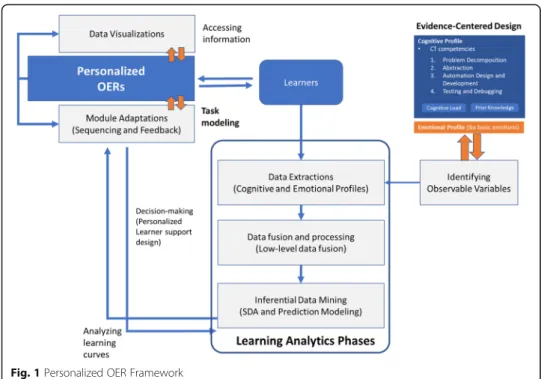
in online learning environments. This design framework comprises steps to collect, mine, and analyze learners’interaction data in an OER system. Following sections ex-plain how learners’ online profiles are defined, sampled, and processed in the frame-work. Figure1portrays the proposed personalized OER design framework.
Data extractions
In this stage, an OER system specifies the extent of data extractions for collecting learners’profiles when computer programming. This framework addresses two types of learners’profiles: cognitive profiles and emotional profiles. The cognitive profiles refer to their mental processing—relating to their CT competencies and related attributes (cognitive load and prior knowledge), the emotional profiles address learners’affective flow. Table 1 is the example matrix that mapped out learners’profiles, key attributes and observable variables in the proposed framework.
Cognitive profile
Identifying learners’cognitive profiles requires systematic implementations of LA mea-sures. Hence, this framework adopted the evidence-centered design model (ECD) (Mis-levy & Haertel, 2006). Following the ECD model, we distilled target CT competencies relating to programming exercises.
CT competencies
– Problem decomposition:If a problem statement in an online learning task is
presented within individual programming exercises, learners are asked to decompose a target problem to multiple smaller chunks of programming tasks. Learners are requested to identify the essential features of the problem and then to
propose how individual solutions for smaller problems are interconnected with performing computing algorithms.
– Abstraction:Abstraction explains learners’pattern recognitions and developments
when editing programming codes. This competency stands for learners’capabilities
of conceptualizing programming code designs.
– Automation design and development:After identification of a problem
statement, learners are required to conduct symbolic representations of their programming codes to simulate automated algorithms.
– Testing and debugging:Testing indicates the executions of initial programming
artifacts. Testing aims to examine unexpected errors during the artifact’s
executions. Based on the results of testing, debugging is conducted. Debugging is the refinements of previous programming implementations until the data
processing of the artifact successfully runs. Testing focuses on learners’ act of
the evaluation, and debugging is defined as learners’ attempts to modify their
programming structures to be advanced.
Cognitive load and prior knowledge In addition to key CT competencies, other
cognitive attributes can also be considered for data collection: cognitive load and prior knowledge (skills). Whereas cognitive load indicates students’ either mental exertions or extraneous loads in their computerized programming tasks, students’ prior knowledge or skills on computer programming estimates how students already become familiar with their programming environments.
Emotional profile
Emotional states in this framework refer to learners’engagement and motivation when using OERs. Analyzing learners’emotional states is to indicate how learners’task perse-verance changes during a series of programming exercise modules. Specifically, an in-creasing level of learners’ interest indicates their enhancement of mental exertions during their programming exercises, and frustration is indicative of learners’decreasing motivation. For example, Vail, Grafsgaard, Boyer, Wiebe, and Lester (2016) evidenced how multimodal LA can predict their emotions in an intelligent tutor-based OER. For emotion classification, this study used multiple multimodal data features: facial expres-sion, gesture and physical distance from the workstation. Moreover, using a bag-of-word and latent-semantic indexing models, Colneriĉ and Demsar (2018) proposed the emotion recognition algorithm that detects key emotional states from verbal utterances.
Data fusion and processing
profile category. Benchmarked by the idea of the JDL data-fusion classification model (Steinberg, Bowman, & White, 1999), this framework stores the fused data in database management systems that can be retrieved for further inferential data mining, as well as module adaptations. Table 1shows how the proposed framework includes multiple data channels that represents observable variables associated target attributes of the competency assessment.
Inferential data mining
Inferential data mining investigates how collected learners’profile data is interpreted to provide future learning modules. This step needs automatic decision-making based on learners’profile data (i.e., cognitive and emotional profiles) depending on the analytics’ purposes. First, sequential data analytics (SDA) (e.g., sequential analysis and sequential pattern mining) can be implemented to measure how students’ programming actions resemble those of experts (Moon & Liu, 2019). As an example, sequential pattern min-ing (SPM) is useful to indicate how closely students’procedural behaviors for program-ming are similar to those from experts. This result may indicate students’ skill acquisition level. Evidence supports that prior constructivist pedagogical interventions aimed to capture how expert-like scientific understanding emerges by students’ in-process actions (Sengupta et al., 2013). Second, machine-learning-based prediction modeling, such as recurrent neural network (RNN: Mao et al., 2019) and Bayesian knowledge tracing(BKT: Jiang, Ye, & Zhang,2018), enables researchers to estimate how likely individuals improve their competencies. Whereas SDA aims to disclose students’ action patterns and consequences, prediction modeling approaches aim at their future improvements of target competencies.
Results from those approaches are evidence of how to deliver personalization to indi-vidual learners. To run all approaches aforementioned for determining adaptation types, the accurate estimation of the threshold-based model is important. To set the ac-curate threshold range for the competency states for automatic decision-making (i.e., high. Intermediate, and low), supervised dimensionality-reduction techniques can be used—such as linear discriminant analysis (LDA).
Module adaptations and data visualizations
Task modeling
all the activity logs are archived in the learning-task database to determine the level of personalization—indicating which tasks should be presented.
Task module adaptation and visualization
Derived from the threshold-based model, which specifies how task modules are pre-sented, this framework envisions two personalization approaches: sequencing and feed-back. First, the module adaptations can be executed by sequencing design (e.g., topical sequencing, whole-to-part sequencing, and part-to-whole sequencing) (Reigeluth,
1999). Either individual sequencing or its combinations can be taken into consideration depending on learners’CT improvement during programming exercises. For example, in learners’ modeling and simulation tasks, if their emotional profile is lower than the threshold range, different contexts or scenarios of modeling tasks would be displayed for individual learners. Second, in-situ feedback during learners’practices is given. De-livering just-in-time (JIT) feedback indicating rules and grammar is considered to pro-mote learners’ modifications of programming codes effectively. For example, using intelligent tutors gives JIT cues that correct students’errors in their exercises. If the re-sults of students’cognitive profile data are lower than the threshold range, more hints and clues can be delivered for the target individuals.
In addition to module adaptations, data visualizations provide information on learners’skill progression during programming exercises. As an assessment for learning (Black, Harrison, & Lee, 2003), this step aims to enhance students’ CT by promoting their self-monitoring of learning outcomes. For instance, data visualizations can include interactive diagrams that can be accessed by learners to obtain information on which knowledge and skills should be improved.
Discussion
The proposed framework in this study provides a guideline for using LA as one of the ways to support personalized learning in OER. Prior research has mainly focused on producing and sharing OER (Wiley, Bliss, & McEwen, 2014). Although it has been ex-plained that OERs have the potentials to support personalized learning (Yuan et al.,
2008), specific guidelines or frameworks that inform the implementation are lacking. This framework can be a starting point for discussions of such guidelines and frameworks.
In terms of content designs in OERs, future research needs to consider the inte-gration of instructional design (ID) elements for personalization. First, discussions on contextualized instruction designs for teaching CT in OERs are essential. Previ-ous research on MOOCs have focused on accessing the platform’s benefits, such as free and open access to learning materials, self-paced learning with time and place-independent online courses, as well as freedom in the selection of learning mate-rials (Gao, 2016; Mullen et al., 2017). As shown in Sunar, Abdullah, White, and Davis’s (2015) review, there have been efforts to propose and implement personalization in MOOCs. For example, researchers have introduced designing learners’ personalized repositories in MOOCs, which used as book collections and Web 2.0 tools with bibliographical indices that enable learners to better search for their preferred learning materials (Cohen, Reisman, & Sperling, 2015; Mikroyanni-dis & Connolly, 2015). However, existing OER designs and implementations are still limited in enhancing learners’ CT during web-based programming exercises. Future design-based research is necessary to explore how OERs can be tailored to teaching and learning CT. Moreover, while the present study stated the role of content-sequencing and feedback designs in the OER framework, we could not thoroughly discuss how those design implementations can be better coordinated in teaching CT. There is still a gap in coordinating between data-mining approaches from LA and personalized ID implementations during programming exercises. For example, novice learners in programming exercises are likely to experience high cognitive load as they interpret and create programming codes, but implications on how to reduce novice learners’ cognitive load.
The purpose of the study was to propose a conceptual framework that illustrates how to support learners’CT developments through personalized designs of OERs. With this in mind, study aimed to provide a groundwork for designing personalized OERS that support learners in developing CT competencies. In order to achieve the goal, several foundational literatures have been reviewed. First, through the review of literatures on computational thinking, we have identified essential elements of computational think-ing, introduced computing platforms and learning environments that are designed and built to support and enhance computational thinking, and explored cases of formative assessments and adaptations of teaching computational thinking. Second, we also reviewed literatures on OERs, personalized learning, and learning analytics and their implications in enhancing CT for learners.
Acknowledgements
Not applicable.
Authors’contributions
All authors read and approved the final manuscript. JM drafted the overall manuscripts. Specifically, he designed and developed a conceptual framework for this study. JD supported drafting this manuscript and then participated in the review of OER environments. DL helped in developing the concept of personalization and contributed to the design of a conceptual framework in this study. GWC participated in the reviews and designs of learning analytics in this paper.
Authors’information
Jewoong Moon is a Ph.D. Candidate in the Department of Educational Psychology and Learning Systems at Florida State University. His research interests include digital game-based learning, inclusive e-learning design, learning analyt-ics, and educational data mining.
Jaewoo Do is an associate research fellow at Korean Educational Development Institute. His research interests include synchronous online course design, design thinking, equity in education and qualitative research.
Daeyeoul Lee is a Ph.D. Candidate at the Department of Curriculum and Instruction at Purdue University. His main research interest is self-regulated learning, motivation, online learning, and MOOCs.
Gi Woong Choi is an assistant professor of human-computer interaction at State University of New York at Oswego. His current research interests include educational affordances of emerging technologies, mobile learning, problem-solving, AR/VR, and AI in education.
Funding
This research was not supported by any funding institutions.
Availability of data and materials
Not applicable.
Competing interests
The authors declare that they have no competing interests.
Author details
1
Educational Psychology and Learning Systems, Florida State University, Tallahassee, United States.2Korean Educational Development Institute(KEDI), 7, Gyohak-ro, Deoksan-eup, Jincheon-gun, Chungcheongbuk-do, Republic of Korea.
3
Department of Curriculum and Instruction, Purdue University, West Lafayette, United States.4HCI Program, Department of Computer Science, State University of New York at Oswego, Oswego, United States.
Received: 13 October 2019 Accepted: 5 December 2019
References
Abelson, H., Wolber, D., Morelli, R., Gray, J., & Uche, C. (2012). Teaching with app inventor for android. InProceedings of the
43rd ACM Technical Symposium on Computer Science Education(p. 681). New York: ACM.
Aho, A. V. (2012). Computation and computational thinking.The Computer Journal, 55(7), 832–835.
Aljohani, N. R., Daud, A., Abbasi, R. A., Alowibdi, J. S., Basheri, M., & Aslam, M. A. (2019). An integrated framework for course
adapted student learning analytics dashboard.Computers in Human Behavior, 92, 679–690.https://doi.org/10.1016/j.chb.
2018.03.035.
Andrade, A., Delandshere, G., & Danish, J. A. (2016). Using multimodal learning analytics to model student behavior: A
systematic analysis of epistemological framing.Journal of Learning Analytics, 3(2), 282–306.
Author (2019). Blinded for peer review.
Bell, T., Alexander, J., Freeman, I., & Grimley, M. (2009). Computer science unplugged: School students doing real computing
without computers.The New Zealand Journal of Applied Computing and Information Technology, 13(1), 20–29.
Bill & Melinda Gates Foundation, A. P, Eli and Edythe Broad Foundation, CEE Trust, Christensen Institute for Disruptive Innovation, Charter School Growth Fund, . . . Silicon Schools. (2014). Personalized learning: A working definition.
Education week. Retrieved from
https://www.edweek.org/ew/collections/personalized-learning-special-report-2014/a-working-definition.html
Black, P., Harrison, C., & Lee, C. (2003).Assessment for learning: Putting it into practice. UK: McGraw-Hill Education.
Blikstein, P. (2011). Using learning analytics to assess students’behavior in open-ended programming tasks. InProceedings of
the 1st international conference on learning analytics and knowledge(pp. 110–116). New York: ACM.
Bonk, C. J., Lee, M. M., Reeves, T. C., & Reynolds, T. H. (2015).MOOCs and open education around the world. New York:
Routledge.
Brennan, K., & Resnick, M. (2012). New frameworks for studying and assessing the development of computational thinking. In Paper presented at the proceedings of the 2012 annual meeting of the American Educational Research Association, Vancouver, Canada.
Brusilovsky, P. (1999). Adaptive and intelligent technologies for web-based eduction.Ki, 13(4), 19–25.
Butoianu, V., Vidal, P., Verbert, K., Duval, E., & Broisin, J. (2010). User context and personalized learning: A federation of
contextualized attention metadata.Journal of Universal Computer Science, 16(16), 2252–2271.
Chen, C.-M. (2008). Intelligent web-based learning system with personalized learning path guidance.Computers & Education,
51(2), 787–814.
Chen, C.-M., Lee, H.-M., & Chen, Y.-H. (2005). Personalized e-learning system using item response theory.Computers &
Chookaew, S., Panjaburee, P., Wanichsan, D., & Laosinchai, P. (2014). A personalized e-learning environment to promote
student's conceptual learning on basic computer programming.Procedia-Social and Behavioral Sciences, 116, 815–819.
Cohen, A., Reisman, S., & Sperling, B. B. (2015). Personal spaces in public repositories as a facilitator for open educational
resource usage.The International Review of Research in Open and Distributed Learning, 16(4), 156–176.
Colneriĉ, N., & Demsar, J. (2018). Emotion recognition on twitter: Comparative study and training a unison model.IEEE
Transactions on Affective Computing.https://doi.org/10.1109/TAFFC.2018.2807817.
Corbalan, G., Kester, L., & van Merriënboer, J. J. (2006). Towards a personalized task selection model with shared instructional
control.Instructional Science, 34(5), 399–422.
Dawson, S., Heathcote, L., & Poole, G. (2010). Harnessing ICT potential: The adoption and analysis of ICT systems for
enhancing the student learning experience.International Journal of Educational Management, 24(2), 116–128.
Eckerdal, A. (2009).Novice programming students’learning of concepts and practise. Acta Universitatis Upsaliensis Retrieved
fromhttps://pdfs.semanticscholar.org/bccc/7fb6b4080d8c01aedf2b0f701989f7b9841d.pdf.
Educause Learning Initiative (ELI) (2015). 7 things you should know about personalized learning. Retrieved fromhttps://
library.educause.edu/resources/2015/9/7-things-you-should-know-about-personalized-learning
Gao, Q. (2016). Computational thinking and MOOC-oriented computer courses teaching mode for non-computer major. In 3d international conference on applied social science research (ICASSR 2015). Atlantis Press.
Gong, L., & Liu, Y. (2019). Design and application of intervention model based on learning analytics under blended learning
environment. InProceedings of the 2019 7th international conference on information and education technology - ICIET 2019
(pp. 225–229).https://doi.org/10.1145/3323771.3323825.
Griffin, P., & Care, E. (2014).Assessment and teaching of 21st century skills: Methods and approach. Dordrecht: Springer.
Grover, S., Cooper, S., & Pea, R. (2014). Assessing computational learning in K-12. InPaper presented at the proceedings of the
2014 conference on innovation & technology in computer science education.
Gunathilaka, T. A. U., Fernando, M. S. D., & Pasqual, H. (2017). Identification of the learning behavior of the students for
education personalization. In2017 international conference on I-SMAC (IoT in Social, Mobile, Analytics and Cloud)(I-SMAC)
(pp. 364–370). IEEE.
Harel, I. E., & Papert, S. E. (1991).Constructionism. Norwood: Ablex Publishing.
Hoppe H., & Werneburg S. (2019).Computational Thinking—More Than a Variant of Scientific Inquiry!. In: Kong SC., Abelson H.
(eds) Computational Thinking Education. Singapore: Springer.
Hosseini, R. (2017). Assessing programming behaviors through evidence-centered design. Analytics for Learning (A4L).
Retrieved fromhttps://a4li.sri.com/archive/papers/Hosseini_2017_Problem_Solving.pdf.
Ifenthaler, D., & Widanapathirana, C. (2014). Development and validation of a learning analytics framework: Two case studies using
support vector machines.Technology, Knowledge and Learning, 19(1–2), 221–240.https://doi.org/10.1007/s10758-014-9226-4.
Informatics Europe. (2017). Class’Code wins 2017 best practices in education award. Retrieved from
https://www.informatics-europe.org/news/395-class-code.html
Jiang, B., Ye, Y., & Zhang, H. (2018). Knowledge tracing within single programming exercise using process data. InProceedings
of the 26th international conference on computers in education(pp. 89–94).
Kafai, Y. B. (2006). Playing and making games for learning: Instructionist and constructionist perspectives for game studies. Games and Culture, 1(1), 36–40.
Kafai, Y. B., & Burke, Q. (2013). The social turn in K-12 programming: moving from computational thinking to computational
participation. InPaper presented at the proceeding of the 44th ACM technical symposium on computer science education.
Keefe, J. W. (2007). What is personalization?Phi Delta Kappan, 89(3), 217–223.
Koh, K. H., Basawapatna, A., Nickerson, H., & Repenning, A. (2014). Real time assessment of computational thinking. In2014
IEEE symposium on Visual Languages and Human-Centric Computing (VL/HCC)(pp. 49–52). Melbourne: IEEE.
Lee, I., Martin, F., Denner, J., Coulter, B., Allan, W., Erickson, J., et al. (2011). Computational thinking for youth in practice.Acm
Inroads, 2(1), 32–37.
Lee, T. Y., Mauriello, M. L., Ingraham, J., Sopan, A., Ahn, J., & Bederson, B. B. (2012). CTArcade: learning computational thinking
while training virtual characters through game play. InPaper presented at the CHI’12 extended abstracts on human factors
in computing systems.
Liu, M., Kang, J., Zou, W., Lee, H., Pan, Z., & Corliss, S. (2017). Using data to understand how to better design adaptive learning. Technology, Knowledge and Learning, 22(3), 271–298.https://doi.org/10.1007/s10758-017-9326-z.
Lye, S. Y., & Koh, J. H. L. (2014). Review on teaching and learning of computational thinking through programming: What is
next for K-12?Computers in Human Behavior, 41, 51–61.
Mao, Y., Zhi, R., Khoshnevisan, F., Price, T. W., Barnes, T., & Chi, M. (2019). One minute is enough: Early prediction of student
success and event-level difficulty during a novice programming task. InProceedings of the 12th international conference
on educational data mining(pp. 119–128).
Mikroyannidis, A., & Connolly, T. (2015). Case study 3: Exploring open educational resources for informal learning. In Responsive open learning environments(pp. 135–158). Cham: Springer.
Mislevy, R. J., & Haertel, G. D. (2006). Implications of evidence-centered design for educational testing.Educational
Measurement: Issues and Practice, 25(4), 6–20.
Mojarad, S., Essa, A., Mojarad, S., & Baker, R. S. (2018). Studying adaptive learning efficacy using propensity score matching. In Companion proceedings 8th international conference on learning analytics & knowledge(pp. 1–8). Sydney: ACM. Mullen, J., Byun, C., Gadepally, V., Samsi, S., Reuther, A., & Kepner, J. (2017). Learning by doing, high performance computing
education in the MOOC era.Journal of Parallel and Distributed Computing, 105, 105–115.
Ota, G., Morimoto, Y., & Kato, H. (2016). Ninja code village for scratch: Function samples/function analyser and automatic
assessment of computational thinking concepts. InPaper presented at the 2016 IEEE symposium on visual languages and
human-centric computing (VL/HCC).
Panjaburee, P., Hwang, G.-J., Triampo, W., & Shih, B.-Y. (2010). A multi-expert approach for developing testing and diagnostic
systems based on the concept-effect model.Computers & Education, 55(2), 527–540.
Papert, S. (1999). What is logo? Who needs it. Logo philosophy and implementation. Retrieved fromhttp://www.microworlds.
com/support/logo-philosophy-papert.html.
Reigeluth, C. M. (1999). The elaboration theory: Guidance for scope and sequence decisions.Instructional design theories and models: A new paradigm of instructional theory, 2, 425–453.
Repenning, A., & Sumner, T. (1995). Agentsheets: A medium for creating domain-oriented visual languages.Computer, 28(3),
17–25.
Resnick, M., Maloney, J., Monroy-Hernández, A., Rusk, N., Eastmond, E., Brennan, K., et al. (2009). Scratch: Programming for all. Communications of the ACM, 52(11), 60–67.
Saines, G., Erickson, S., & Winter, N. (2013).Codecombat. Silicon Valley: CodeCombat.
Schumacher, C., & Ifenthaler, D. (2018). Features students really expect from learning analytics.Computers in Human Behavior,
78, 397–407.https://doi.org/10.1016/j.chb.2017.06.030.
Sengupta, P., & Farris, A. V. (2012). Learning kinematics in elementary grades using agent-based computational modeling: A
visual programming-based approach. InProceedings of the 11th international conference on interaction design and children
(pp. 78–87). Bremen: ACM.
Sengupta, P., Kinnebrew, J. S., Basu, S., Biswas, G., & Clark, D. (2013). Integrating computational thinking with K-12 science
education using agent-based computation: A theoretical framework.Education and Information Technologies, 18(2), 351–380.
Settle, A., Franke, B., Hansen, R., Spaltro, F., Jurisson, C., Rennert-May, C., & Wildeman, B. (2012). Infusing computational
thinking into the middle-and high-school curriculum. InPaper presented at the proceedings of the 17th ACM annual
conference on innovation and technology in computer science education.
Shute, V. J., Sun, C., & Asbell-Clarke, J. (2017). Demystifying computational thinking.Educational Research Review, 22, 142–158.
Song, Y., Wong, L.-H., & Looi, C.-K. (2012). Fostering personalized learning in science inquiry supported by mobile
technologies.Educational Technology Research and Development, 60(4), 679–701.
Steinberg, A. N., Bowman, C. L., & White, F. E. (1999). Revisions to the JDL data fusion model. InSensor fusion: Architectures,
algorithms, and applications III(Vol. 3719, pp. 430–441). Orlando: International Society for Optics and Photonics.
Sunar, A. S., Abdullah, N. A., White, S., & Davis, H. C. (2015). Personalisation of MOOCs–The state of the art. In M. Helfert, M. T.
Restivo, S. Zvacek, & J. Uhomoibhi (Eds.),Proceedings of the seventh international conference on computer supported
education (CSEDU’15)(pp. 88–97). Setúbal: Science and Technology Publications.
Sung, W., Ahn, J., & Black, J. B. (2017). Introducing computational thinking to young learners: Practicing computational
perspectives through embodiment in mathematics education.Technology, Knowledge and Learning, 22(3), 443–463.
U. S. Department of Education (2017). Reimaging the role of technology in education: 2017 national education technology
plan update. Retrieved fromhttps://tech.ed.gov/files/2017/01/NETP17.pdf
Vail, A. K., Grafsgaard, J. F., Boyer, K. E., Wiebe, E. N., & Lester, J. C. (2016). Predicting learning from student affective response
to tutor questions. InInternational conference on intelligent tutoring systems(pp. 154–164). Cham: Springer.
Vesin, B., Mangaroska, K., & Giannakos, M. (2018). Learning in smart environments: User-centered design and analytics of an
adaptive learning system.Smart Learning Environments, 5(1), 5–24.
Werneburg, S., Manske, S., & Hoppe, H. U. (2018). ctGameStudio–A game-based learning environment to foster computational
thinking. In26th international conference on computers in education, Philippines.
Wiggins, J. B., Boyer, K. E., Baikadi, A., Ezen-Can, A., Grafsgaard, J. F., Ha, E. Y., et al. (2015). JavaTutor: an intelligent tutoring
system that adapts to cognitive and affective states during computer programming. InProceedings of the 46th acm
technical symposium on computer science education(p. 599). Kansas City: ACM.
Wiggins, J. B., Grafsgaard, J. F., Boyer, K. E., Wiebe, E. N., & Lester, J. C. (2017). Do you think you can? The influence of student
self-efficacy on the effectiveness of tutorial dialogue for computer science.International Journal of Artificial Intelligence in
Education, 27(1), 130–153.
Wilensky, U. (1999). NetLogo (and NetLogo user manual). Center for connected learning and computer-based modeling,
Northwestern University.http://ccl.northwestern.edu/netlogo.
Wiley, D., Bliss, T.J., McEwen, M. (2014). Open Educational Resources: A Review of the Literature. In: Spector J., Merrill M., Elen J., Bishop M. (eds). Handbook of research on educational communications and technology. New York: Springer. Wilkerson-Jerde, M., Wagh, A., & Wilensky, U. (2015). Balancing curricular and pedagogical needs in computational
construction kits: Lessons from the DeltaTick project.Science Education, 99(3), 465–499.
Wilson, A., Hainey, T., & Connolly, T. (2012). Evaluation of computer games developed by primary school children to gauge
understanding of programming concepts. In6th European conference on games-based learning (ECGBL)(pp. 4–5).
Wilson, C. (2014). Hour of code: We can solve the diversity problem in computer science.Inroads, 5(4), 22.
Wing, J. (2011). Research notebook: Computational thinking—What and why? The Link Magazine, Spring. Carnegie Mellon
University, Pittsburgh. Retrieved fromhttp://link.cs.cmu.edu/article.php?a=600
Wing, J. M. (2006). Computational thinking.Communications of the ACM, 49(3), 33–35.
Wohl, B., Porter, B., & Clinch, S. (2015). Teaching computer science to 5–7 year-olds: An initial study with scratch, cubelets and
unplugged computing. InPaper presented at the proceedings of the workshop in primary and secondary computing
education.
Xie, H., Chu, H.-C., Hwang, G.-J., & Wang, C.-C. (2019). Trends and development in technology-enhanced adaptive/
personalized learning: A systematic review of journal publications from 2007 to 2017.Computers & Education, 103599.
Yan, Y., Hara, K., Nakano, H., Kazuma, T., & He, A. (2016). A method to describe student learning status for personalized
computer programming e-learning environment. InPaper presented at the 2016 IEEE 30th international conference on
advanced information networking and applications (AINA).
Yuan, L., MacNeill, S., & Kraan, W. G. (2008).Open educational resources-opportunities and challenges for higher education. JISC
CETIS Retrieved fromhttp://ubir.bolton.ac.uk/290/.
Publisher’s Note