Original Research Article
Parental stress: a neglected entity
Nusrat R. Inamdar
1*, Anvesh S. Tamboli
1, Anupama V. Mauskar
1, Suchit Tamboli
2INTRODUCTION
All parents are susceptible to emotional distress. They feel very stressed when their child is sick and in Intensive care unit.1-4 One of the greatest stressors for parents in the
Paediatric Intensive Care Unit (PICU) is the alteration or loss of the parental role, including physical separation, limited opportunities to care for the child, and no longer being the independent, primary decision maker in charge of the child’s care.5 Parents are required to make the
transition from parents of a well-child to parents of an acutely ill child. This can be an extremely difficult process. In the past two decades, there were many studies
on parental stress which brought out various stressors like not knowing how to help their child, seeing their child frightened or in pain, and not being able to be with their crying child.3,6,7
The clinicians must be aware of the parents’ expectations, experiences and satisfaction. Not until then can they optimize family-directed care, meet the needs and increase satisfaction with care.8,9
Most of the studies done about parental stress in PICU are from resource replete countries.4,10 Since the family
preferences and clinician’s delivery of care are affected
1Department of Pediatrics, HBTMC & DR R N Cooper Hospital, Mumbai, Maharashtra, India
2Director, Chiranjiv Child Development Centre, Developmental Pediatrician, Ahmednagar, Maharashtra, India
Received: 17 September 2019
Accepted: 23 September 2019
*Correspondence:
Dr. Nusrat R Inamdar,
E-mail: [email protected]
Copyright: © the author(s), publisher and licensee Medip Academy. This is an open-access article distributed under the terms of the Creative Commons Attribution Non-Commercial License, which permits unrestricted non-commercial use, distribution, and reproduction in any medium, provided the original work is properly cited.
ABSTRACT
Background: Parents feel very stressed when their child is sick and in Intensive care unit. Objectives of study were to identify common parental stressors during their child’s critical illness and to examine its relationship with demographic variables.
Methods: It’s a Cross-sectional questionnaire based study done in PICU & NICU of a tertiary care medical college hospital in Mumbai, 62 parents of children admitted to PICU and NICU for at least 24 hours were interviewed using the Parental Stress Scale. The demographic variables were also recorded.
The data analyzed using Cluster Analysis, Kruskal Wallis test, Chi- square test and spearman correlation.
Results: The main cause of parental stress was to witness the child’s sufferings (unresponsiveness/pain, procedures, tubes, monitors around child) (median of standardized score = 3.9, IQR = 0.5, p <0.005). The median of standardised stress score due to hospital environmental factors (monitor alarms, nurses, doctors around baby, other sick children) was 3.7 (IQR = 0.5) and that due to lack of intimacy with child was 3.6 (IQR =0.4). Age of parent inversely correlated with the level of stress (r = -0.638) and parents of infants were more stressed (p = 0.005). Number of children, socioeconomic status didn’t affect the stress levels.
Conclusions: Young parents and parents of infants were more stressful. Socioeconomic status, residential area and parental sex didn’t affect stress. Few stress factors need remedial steps to meet parental needs. The clinician’s awareness about these stressors, may help to provide optimized family-directed care.
Keywords: Coping skills, Critically ill children, Family care, Sociodemographic factors
by regional, religious and cultural influences, the data from India is different. There are only a few studies of this kind done in India.5,11
Hence this study will help to determine the clinical and sociodemographic factors leading to stress among parents of children admitted in intensive care unit of a tertiary care hospital in Mumbai. Identification of few of such modifiable stress factors, will be of great help to improve family directed care.12-15
Objectives of the study
• To identify common parental stressors during their child’s critical illness
• To examine its relationship with demographic variables.
METHODS
The study was carried out during 4 months from September 2018 to December 2018.
Sampling technique
Universal sampling, parents of consecutive patients (meeting inclusion criteria) admitted in Neonatal Intensive Care unit (NICU) and PICU during study duration were included.
Age group of parents were 18 yrs to 45 yrs.
It was a Cross-sectional questionnaire based study done in PICU and NICU of a tertiary care medical college hospital in Mumbai. 62 parents of children admitted to PICU and NICU for at least 24 hours were interviewed using the Parental Stress Scale. The demographic variables were also recorded.
Statistical analysis
The data was analyzed using Cluster Analysis, Kruskal Wallis test, Chi- square test and spearman correlation. A cluster analysis was also performed on data collected to study underlying pattern of stressful experiences in parents of a sick child.
Inclusion criteria
Parents whose children had been admitted to ICU for at least 24 hours as medical emergency cases.
Exclusion criteria
• parents of child getting readmitted to ICU in the study period
• unavailability of parental consent
• Parents with pre- existing psychiatric illness/ other chronic medical illness
Institutional Ethics Committee (IEC) permission was taken.
After taking parental consent, the demographic and clinical characteristics of critically sick children admitted in Intensive Care Unit was recorded. Socio economic status calculated according to revised Kuppuswamy scale.16
For the assessment of parental stress we have used the parental stress score (PSS) developed by Carter and Miles.17 The PSS scale covers three broad areas:
personal-family, situational and environmental stressors. The parents were interviewed using the Parental Stress Scale (PSS), which rates 22 factors on a scale from 1 (not stressful) to 5 (extremely stressful).
Annexure I
• Category A: Personal-Family (8 factors) Lack of Intimacy with child
• Category B: Situational (8 factors) Witnessing Child’s distress
• Category C: Environmental (6 factors) Watching Child in Hospital Environment
Cluster analysis
A cluster analysis was performed to study underlying pattern of stressful experiences in parents of a sick child. The Hierarchal clustering method was used with construction of a dendrogram, to categorize cases in two groups based on scores in the following categories:
• Lack of Intimacy with child • Witnessing Child’s distress
• Watching Child in hospital environment. Segmentation
The k-means clustering technique was used to categorize these cases into the two groups.
RESULTS
A total of 62 parents were interviewed with 33 mothers and 29 fathers. The age of the parents varied from 18 to 45 years; younger one was 18year & oldest parent was 44year old. Socio economic status was low in majority of enrolled 28 (45 %).
Demographic details of the parents has been shown in Table 1.
The main cause of parental stress was to witness the
child’s sufferings (median of standardized score = 3.9, IQR = 0.5, p <0.005).
Table 1: Sociodemographic details of parents.
Factor Number Percentage Statistical parameters
Mean Median Standard
deviation
Interquartile range
Age of parents (years)
<20 4 6.45
27.7yrs 27yrs 0.7 8
20-30 41 30.64
30-40 15 35.48
40-45 2 3.22
Gender of parents
Male 29 46.77
Female 33 53.22
Number of children
1 29 46.77
1.8 2 0.1 1
2 22 35.48
3 8 12.90
4 2 3.22
5 1 1.61
Socio-economic status
Lower 28 45
Lower middle 21 33.87 Upper middle 13 20.96 Age of patient
(years)
1 Month 12 19.35
2.2 yrs 0.6 yrs 0.4 3.9 1-12 months 23 37
1-5 yrs 20 32.3 5-12yrs 7 11.3 Gender of the
child Male Female 34 28
Table 2: PSS across the major categories.
Descriptive
Category A: Lack of intimacy with child
Category B: Witnessing child’s distress
Category C:
Watching Child in hospital environment
Total score
Median 29 31.5 22 82
IQR 3 4 3 7
Number of components 8 8 6 22
Standardised median 3.6 3.9 * 3.7
Standardised IQR 0.4 0.5 0.5
p value (Kruskal Wallis test) <0.005
*Highest parental stress level observed due to witnessing child’s distress.
Table 3: Correlation between demographic variables and major PSS categories.
Variable Category A Score Category B Score Category C Score Total Score
Child Age
Correlation
Coefficient -0.229 -0.416
*
-0.331* -0.419# Sig. (2-tailed) 0.074 0.001 0.009 0.001 Parent Age
Correlation
Coefficient -0.409
*
-0.441* -0.586* -0.638* Sig. (2-tailed) 0.001 <0.0005 <0.0005 <0.0005 No. of Children
Correlation
Coefficient -0.335
*
-0.305* -0.415* -0.416$ Sig. (2-tailed) 0.008 0.016 0.001 0.001
*There was moderately inverse correlation of parental age with total stress score.
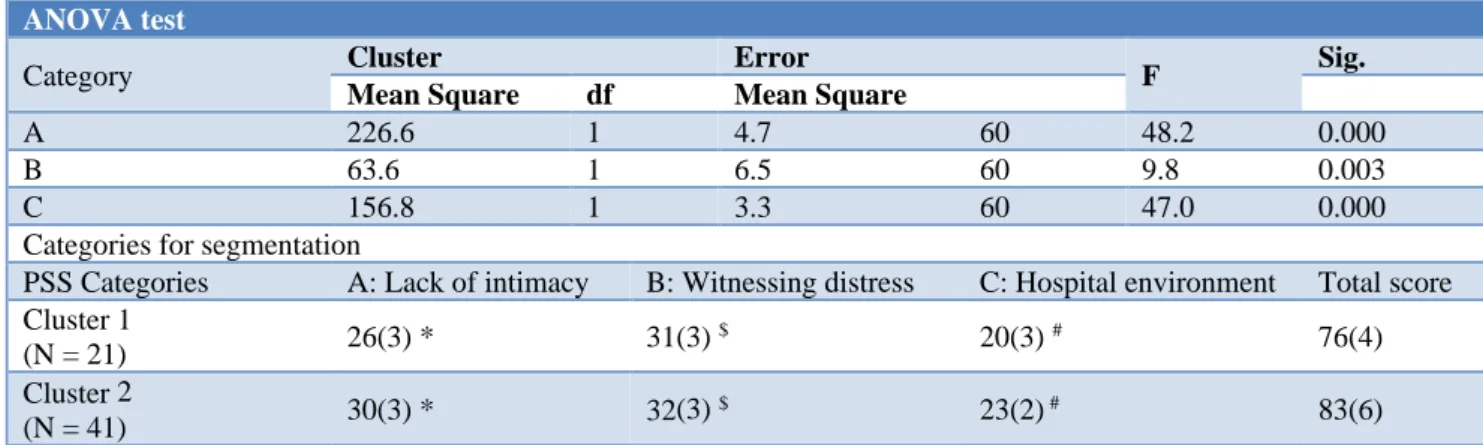
Table 4: Cluster analysis.
ANOVA test
Category Cluster Error F Sig.
Mean Square df Mean Square
A 226.6 1 4.7 60 48.2 0.000
B 63.6 1 6.5 60 9.8 0.003
C 156.8 1 3.3 60 47.0 0.000
Categories for segmentation
PSS Categories A: Lack of intimacy B: Witnessing distress C: Hospital environment Total score Cluster 1
(N = 21) 26(3) * 31(3)
$ 20(3) # 76(4)
Cluster 2
(N = 41) 30(3) * 32(3)
$ 23(2) # 83(6)
*,# The clusters differed mainly in Lack of intimacy and Watching the child in hospital environment.
$ All parents were stressed to witness the child’s distress and that shows even in this clustering that the clusters showed lower difference in level of stress due to this category.
The median of standardized stress score due to hospital environmental factors (monitor alarms, nurses, doctors around baby, other sick children) was 3.7 (IQR = 0.5) and that due to lack of intimacy with child was 3.6 (IQR =0.4). Age of parent inversely correlated with the level of stress (r = -0.638) and parents of infants were more stressed (p = 0.005) (Table 3). Socioeconomic status did not affect the stress levels.
In Cluster Analysis cases were categorized in two groups The Hierarchal clustering method was used with construction of a dendrogram which showed two clusters of parents based on their scores in different questionnaire categories
ANOVA test showed significant difference between the clusters based on all three categories i.e. Higher scores were observed for cluster 2 (Table 4). Higher F ratios were observed for Category A and C (Table 4).
Hence, we can undertake segmentation of parents based on the categories A and C. Hence, these two areas may be studied further to find means to reduce the amount of parental stress.
DISCUSSION
Parents feel very stressed when their child is sick and in Intensive care unit. All parents are susceptible to emotional distress. It gets more exaggerated due to uncertain outcome, painful procedures and Intensive care Unit environment having equipments, monitors, and tubing’s around the child.
There are numerous studies from developed countries, which have emphasized the role of addressing parental stress and concerns in PICU in addition to routine care of patients. 3,4,6,7 ,14,18-21
In India the studies on Parental stress from Mangalore by Kumar BS et al, and from Ludhiana, by Pooni et al, they found that there is significant stress among parents of children admitted in PICU.5,11
In the present study it is observed that the main cause of parental stress was to witness the child’s sufferings i.e. unresponsiveness/pain, procedures, tubes and monitors around child.
Stress score due to hospital environmental factors i.e. monitor alarms, nurses, doctors around baby, other sick children was statically significant in our study, but stress was less than that due to witnessing the child’s sufferings. Factors relating to lack of intimacy with child i.e. not being able to regularly care, not being able to share baby with family and friends and not being able to protect baby from pain and painful procedures did contribute statically significantly to parental stress in our study. But stress was less compared to that due to child’s sufferings and due to hospital environmental factors.
In a study on Parental stress from Mangalore, India by Kumar BS et al, all three categories resulted in extreme parental stress.
Parents of infants were more stressed in our study. Similar observations were found in the study at Punjab by Pooni et al, and study at Mangalore by Kumar BS et al. We also noted age of parent inversely correlated with the level of stress resulting higher stress in younger parents. Similar observations were found by Pooni et al.
Socioeconomic status did not contribute to overall parental stress. Parents from upper middle, lower middle and lower socioeconomic status were almost equally stressed. Though we did not have any parents belonging to upper Socioeconomic class. The study by Kumar BS et al revealed equal stress levels in the parents of all Socioeconomic classes.
CONCLUSION
There is significant stress among parents of children admitted to PICU. Segmentation of parents in category A and C may be studied further to find means to reduce the amount of parental stress. Provision of counsellors for parent counselling may help improving parental health and coping skills.
The limitations of this study include lack of follow up, authors did not analyze parents of those who got readmitted and those who expired within 24 hrs of admission during PICU/NICU stay.
ACKNOWLEDGEMENTS
We are thankful to our Dean, Head of the department and Institutional Ethics committee for permitting to conduct the study. We gratefully acknowledge the efforts of our PICU and NICU Resident doctors and Nursing staff at H.B.T.M.C and Dr. R.N. Cooper Hospital, in helping and coordinating in the process of interview and counseling of parents. We wish to specially acknowledge the parents who contributed to this study without which this study would not have been possible.
Funding: No funding sources Conflict of interest: None declared
Ethical approval: The study was approved by the Institutional Ethics Committee
REFERENCES
1. Shudy M, De Almeida ML, Ly S, Landon C, Groft S, Jenkins TL, Nicholson CE. Impact of pediatric critical illness and injury on families: a systematic literature review. Pediatrics. 2006 Dec 1;118(Supplement 3):S203-18.
2. Meyer EC, Snelling LK, Myren-Manbeck LK. Pediatric intensive care: The parents’ experience. AACN Advanced Critical Care. 1998 Feb 1;9(1):64-74.
3. LaMontagne LL, Pawlak R. Stress and coping of parents of children in a pediatric intensive care unit. Heart and lung: J Crit Care. 1990 Jul;19(4):416-21. 4. Nizam M, Norzila MZ. Stress among parents with
acutely ill children. Med J Malaysia. 2001 Dec;56(4):428-34.
5. Aamir M, Mittal K, Kaushik JS, Kashyap H, Kaur G. Predictors of stress among parents in pediatric intensive care unit: a prospective observational study.Ind J Pediatrics. 2014 Nov 1;81(11):1167-70.
6. Miles MS, Carter MC. Coping strategies used by parents during their child's hospitalization in an intensive care unit. Children's Health Care. 1985 Jun 1;14(1):14-21.
7. Miles MS, Carter MC, Spicher C, Hassanein R. Maternal and paternal stress reactions when a child is hospitalized in a pediatric intensive care unit. Issues Comprehen Pediatr Nurs. 1984 Jan 1;7(6):333-42.
8. Romer LH, Nichols DG, Mesman J, Woods Barthel C, Norvell M, Sacco MJ, et al. Impact of Pediatric Critical Care on the Family, Community, and Society. Roger’s Textbook of Pedriatric Care 5th edition. 2016 Jan 1:11-22.
9. Fisher MD. Identified needs of parents in a pediatric intensive care unit. Critical care nurse. 1994 Jun;14(3):82-90.
10. Shudy M, De Almeida ML, Ly S, Landon C, Groft S, Jenkins TL, Nicholson CE. Impact of pediatric critical illness and injury on families: a systematic literature review. Pediatr. 2006 Dec 1;118(Supplement 3):S203-18.
11. Pooni PA, Singh D, Bains HS, Misra BP, Soni RK. Parental stress in a paediatric intensive care unit in Punjab, India. J Paediatr Child Heal. 2013 Mar;49(3):204-9.
12. Heyland DK, Rocker GM, Dodek PM, Kutsogiannis DJ, Konopad E, Cook DJ, et al. Family satisfaction with care in the intensive care unit: results of a multiple center study. Critical Care Med. 2002 Jul 1;30(7):1413-8.
13. Latour JM, Haines C. Families in the ICU: do we truly consider their needs, experiences and satisfaction?. Nurs Crit Care. 2011;12(4).
14. Miles MS, Mathes M. Preparation of parents for the ICU experience: what are we missing? Children's health care. 1991 Jun 1;20(3):132-7.
15. Meert KL, Schim SM, Briller SH. Parental bereavement needs in the pediatric intensive care unit: review of available measures. J Palliat Med. 2011 Aug 1;14(8):951-64.
16. Kumar N, Gupta N, Kishore J. Kuppuswamy’s socioeconomic scale: updating income ranges for the year 2012. Indian J Public Health. 2012;56:103-4.
17. Carter MC, Miles MS. The parental stressor scale: pediatric intensive care unit. Maternal-child nursing J. 1989;18(3):187-98.
18. Scott LD. Perceived needs of parents of critically ill children. J Special Pediatric Nursing. 1998 Jan;3(1):4-12.
19. Eberly TW, Miles MS, Carter MC, Hennessey J, Riddle I. Parental stress after the unexpected admission of a child to the intensive care unit. Critical Care Quarterly. 1985 Jun;8:57-65.
21. Kasper JW, Nyamathi AM. Parents of children in the pediatric intensive care unit: what are their needs?. Heart & lung: J Critical Care. 1988 Sep;17(5):574-81.
ANNEXURE 1
Questions in Parental Stress Scale
Category A: Personal-Family Lack of Intimacy with child How stressful are the following experiences?
1. Being separated from your baby
2. Not being able to regularly care for your baby 3. Not having a chance to be alone with your baby
4. Not being able to share your baby with family and friends
5. Not being able to protect your baby from pain and painful procedures 6. Not being able to comfort/help your baby
7. The nurses and other staff seeming closer to the baby than you are 8. Not being able to hold your baby
Category B: Situational -Witnessing Child’s distress How stressed are you by the way your baby looks to you? 1. Seeing your baby with tubes or IV lines on him/her 2. Seeing your child in pain
3. Having your child look afraid, be upset or cry a lot 4. Seeing your baby look sad
5. Seeing a needle or tube put in your baby 6. Seeing your baby have problems breathing
7. Seeing your baby surrounded by machinery and having medical treatments 8. When your baby cannot respond to you
Category C: Environmental- Watching Child in Hospital Environment How stressful are the things you might see or hear?
1. Monitors and equipment in the room 2. The sudden sound of monitor alarms 3. The other sick children in the room
4. Large number of nurses, doctors and other staff who work with your child staff who work with your child 5. When other children in the hospital have a crisis?