THE RELATIONSHIP BETWEEN EARLY WORD READING AND READING COMPREHENSION GROWTH FOR LANGUAGE-MINORITY LEARNERS AND
NATIVE-ENGLISH-SPEAKING STUDENTS: A SEVEN-YEAR LONGITUDINAL STUDY
Jackie Eunjung Relyea
A dissertation submitted to the faculty of the University of North Carolina at Chapel Hill in partial fulfillment of the requirements for the degree of Doctor of Philosophy in the School of
Education.
Chapel Hill 2015
Approved by:
Jill Fitzgerald
Steve J. Amendum
Robin Baker
Mollie W. Lloyd
ii © 2015
iii
ABSTRACT
JACKIE EUNJUNG RELYEA: The Relationship between Early Word Reading and Reading Comprehension Growth for Language-Minority Learners and Native-English-Speaking Students:
A Seven-Year Longitudinal Study (Under the direction of Dr. Jill Fitzgerald)
The significant role of early word-reading ability in reading comprehension development
for monolingual native-English-speaking (NE) children has long been theoretically and
empirically recognized. Yet, whether this is the case for language-minority (LM) learners who
learn to read in a second or additional language has yet to be thoroughly established in the
research literature. The purpose of the present study was to examine whether the relationship
between first-grade word reading and reading comprehension growth through eighth grade
varied as a function of children’s language status (i.e., LM learners and NE students). Using
seven-year longitudinal data from a nationally representative sample of children from the Early
Childhood Longitudinal Study–Kindergarten Class of 1998-1999, growth trajectories of
English-reading comprehension proficiency for LM learners (n = 992) and NE students (n = 7,188) of
differing initial English word-reading proficiency were examined. A series of Hierarchical
Generalized Linear Modeling growth curve analyses was conducted.
The main conclusion was that children with initially high Word-Reading Proficiency
demonstrated more growth than children with initially low Word-Reading Proficiency, but the
effect of initial Word-Reading Proficiency was especially impactful for LM learners as compared
to NE learners. Specifically, LM learners with initially high Word-Reading Proficiency had
Word-iv
Reading Proficiency in first grade, but Reading-Comprehension Proficiency growth trajectories
of the two groups converged by the end of eighth grade. In contrast, LM learners with initially
low Word-Reading Proficiency had a relatively lower Reading-Comprehension Proficiency in
first grade and had significantly less growth as compared to NE students with low Word-Reading
Proficiency, thereby leading to a large gap between the two groups by the end of eighth grade.
Results emphasize enhanced instructional opportunities for LM learners that focus on promoting
v
ACKNOWLEDGEMENTS
My dissertation completion would not have been possible without the generous help and
support of many people in every phrase of the project. First and foremost, I would like to
express my deepest gratitude to my advisor, Dr. Jill Fitzgerald, for her extraordinary mentorship
and extensive support and patiencethrough every stage of my academic development. She has
provided me with insightful and priceless advice and innumerable opportunities for my
professional and personal growth as a writer, researcher, and teacher. Her constant efforts and
encouragement to ensure that the quality of my work reaches the highest possible level represent
what it means to be a scholar, mentor, and educator.
I would like to extend my sincere appreciation to my committee members, Dr. Steve
Amendum, Dr. Robin Baker, Dr. Mollie Lloyd, and Dr. William B. Ware, for their invaluable
support, expertise, time, and insights that have greatly influenced my dissertation.
I must thank my mentors, colleagues, and dear friends: Dr. Soo-yong Byun, Dr. Claudia
Cervantes-Soon, Dr. Ji-yeon Jo, Dr. Ki-hyun (Kelly) Ryoo, Dr. Marta Sanchez, Mina Lee,
Thomas Bothwell, Hye-young Hwang, Jung-in Kim, Dong-soo Bang, and my undergraduate-
and graduate-level students at UNC-Chapel Hill, who have been incredibly supportive in both
my professional and personal growth. My special gratitude goes to my family for their steadfast
involvement in my education. My parents have been a constant source of support and motivation
throughout all of my educational endeavors. I am truly grateful for their love.
Finally, my most heart-felt love and never enough thanks go to my wonderful husband,
vi
TABLE OF CONTENTS
LIST OF TABLES……….xi
LIST OF FIGURES..………xii
Chapter I. INTRODUCTION AND RATIONALE ………..………...1
Rationale………..1
What is Known about Language-Minority (LM) Learners’ English-Reading Growth?………...6
Significance of the Study……….…....6
Re-Statement of the Research Question and Hypothesis for the Present Study……..……8
Definitions of Terms………8
II. REVIEW OF THE LITERATURE………11
Theoretical Perspectives………11
How Might Early Word Reading be Related to Reading Comprehension Growth?………..……...11
How Might Language Status and Other Factors Moderate the Relationship between Early Word Reading and Reading Comprehension Growth?…………15
Language Status……….15
Other Factors………..16
What is known about Relationship between Word Reading and Reading Comprehension?………18
Monolingual Children………..18
Static Cross-Sectional Correlational Relationship……….18
vii
Language-Minority Learners………20
Static Cross-Sectional Correlational Relationship………...20
Longitudinal Relationship.………21
What is Known about Reading-Comprehension/Reading-Achievement Development for Monolinguals and LM Learners?………..23
Monolingual Children………..…..23
Language-Minority Learners………...……..23
Summary………...……….24
III. METHODOLOGY………26
Design………26
Data Source: Early Childhood Longitudinal Study-Kindergarten Class of 1998-1999 (ECLS-K)………...…27
ECLS-K Study Sample and Sampling Design………...28
Instruments and Procedures………...30
ECLS-K English-Reading Assessment and its Development………31
Summary Description of the ECLS-K English-Reading Assessment…...31
Framework for the ECLS-K Assessment………...33
Item Development for the ECLS-K Reading Test……….34
ECLS-K Procedures for Administering the English-Reading Assessment……….…34
ECLS-K Proficiency Level Scores..………..35
Validation of the ECLS-K Scale....………36
Parent Interview..………....………..37
Home Language Background..………..37
Gender, Race/ethnicity, and SES..………...38
viii
Variables (and Reliabilities) Used in the Current Study..………..39
English Reading: Word-Reading Proficiency and Reading-Comprehension Proficiency Variables for the Study..……….40
Word-Reading Proficiency………...………...…………..40
Reading-Comprehension Proficiency..………...………...41
Reliability..………...………...………....42
Time..………...………...………...43
Language Status..………...………...………...43
Control Variables..………...………...………....44
Gender, Race/ethnicity, and SES...………...………...44
Time to Oral English-Language Proficiency..………...44
Sample for the Current Study..………...………...45
Criteria for Sample Selection for the Present Study..………...45
Description of the Selected Sample for the Present Study..………..46
Data Analytic Approach..………...………...47
Data Preparation..………...………...47
Handling Missing Data..………...………47
Sampling Weights..………...………48
Preliminary Data Analysis..………...………...49
The HierarchicalGeneralized Linear Modeling (HGLM) Analysis………..49
Modeling Strategy..………...………52
Specifications of Two-Level HGLM Models..………..…53
Fitting the Two-Level Model for Change To Data..………..56
Model Comparisons..………...……….57
IV. RESULTS..………...………..………...59
ix
Descriptive Statistics..………...………60
Correlations and Collinearity..………...………...62
Selecting a Functional Form for Growth..………...……….65
Unconditional Means Model (Model A)...………...…66
Unconditional Linear Growth Model (Model B)...………...66
Unconditional Quadratic Growth Model (Model C).………...66
Model Comparisons..………...……...…68
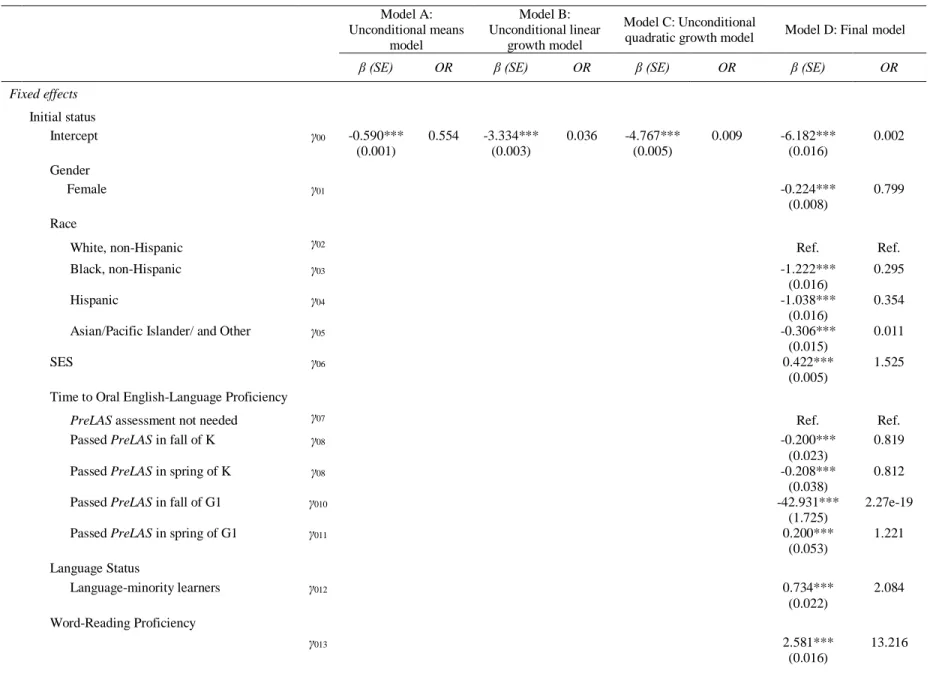
HGLM Final Analyses Results..………...……...…68
Is the Relationship between First-Grade Word-Reading Proficiency and Reading-Comprehension-Proficiency Growth through Eighth Grade Different for LM Learners as Compared to Their NE Peers?..………...…69
Interaction Effects of Language Status and Word-Reading Proficiency……….………69
Main Effects of Language Status and Word-Reading Proficiency………72
Main Effects for the Control Variables………..73
Summary of the Main Finding………...80
V. CONCLUSION AND DISCUSSION……….……...82
Conclusion………..………...82
Limitations………..………...83
Discussion………..………....83
The Relationship between Early Word Reading and Reading Comprehension Growth: The Moderating Effect of Language Status……….83
Comparing the LM Learners’ Relationship between Early Word Reading and Comprehension Growth to Prior Findings………….………87
The Relationship between Early Word Reading and Comprehension Growth, Regardless of Language Status………..87
The Effects of Control Variables………….………...88
x
Implications for Instruction………….………...90
Implications for Theory………….………...93
Implications for Research………….………...94
xi
LIST OF TABLES
Table
3.1. Number (Percentage) of Children Who Met and Did Not
Meet Each Inclusion Criterion by Language-Status Groups …..…………...…………97
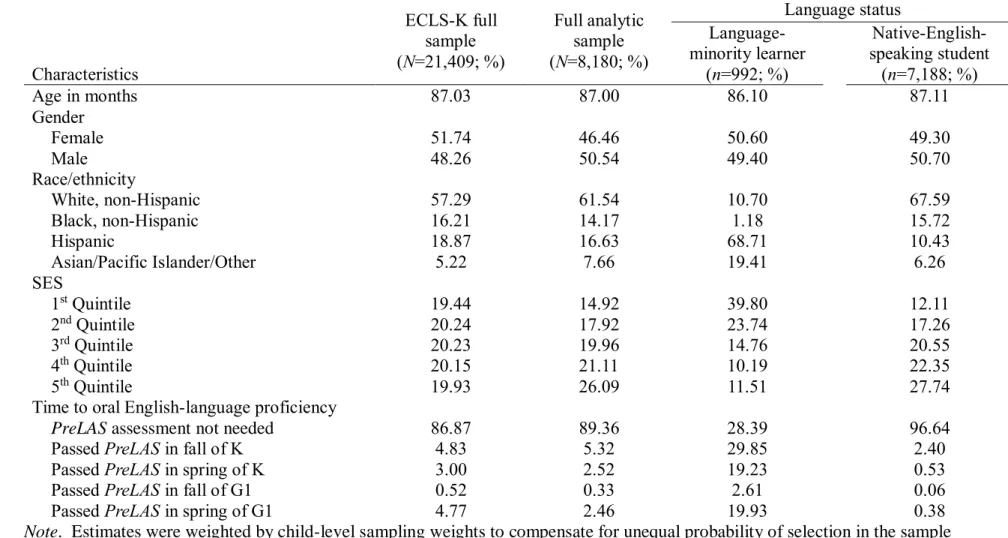
3.2. Percentage Distribution of ECLS-K Full Sample, Full Final
Analytic Sample, and Two Sub-samples (Language-Minority Learners and Native English-Speaking Students) by Child Characteristics
in the Spring of First Grade………....98
3.3. English-Reading Proficiency Levels and Descriptions……….………..99
3.4. Parent Interview Questions on Indicators of Socioeconomic Status (SES)
and Response Options: Spring-First grade (Spring 2000) ……….………..…100
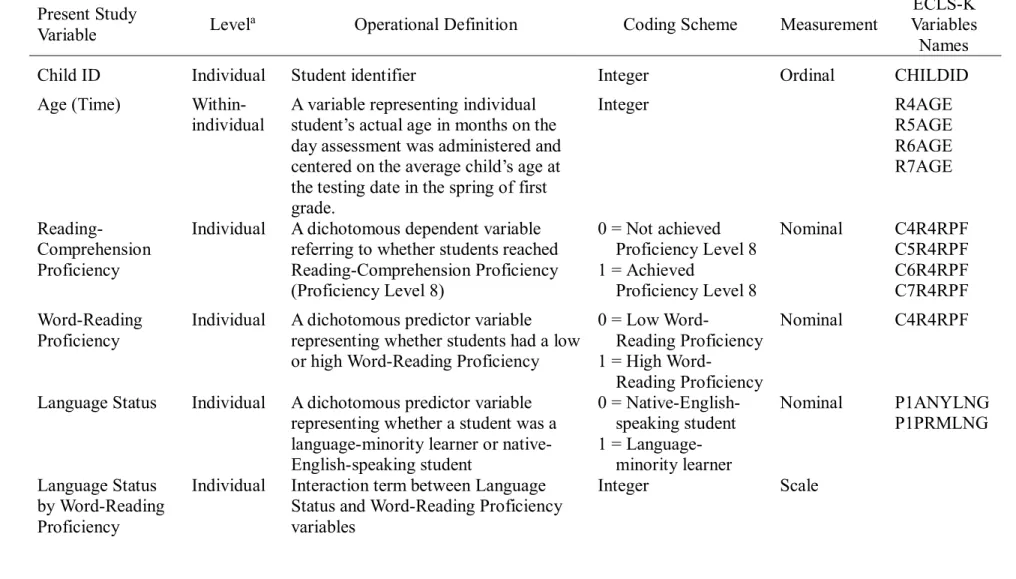
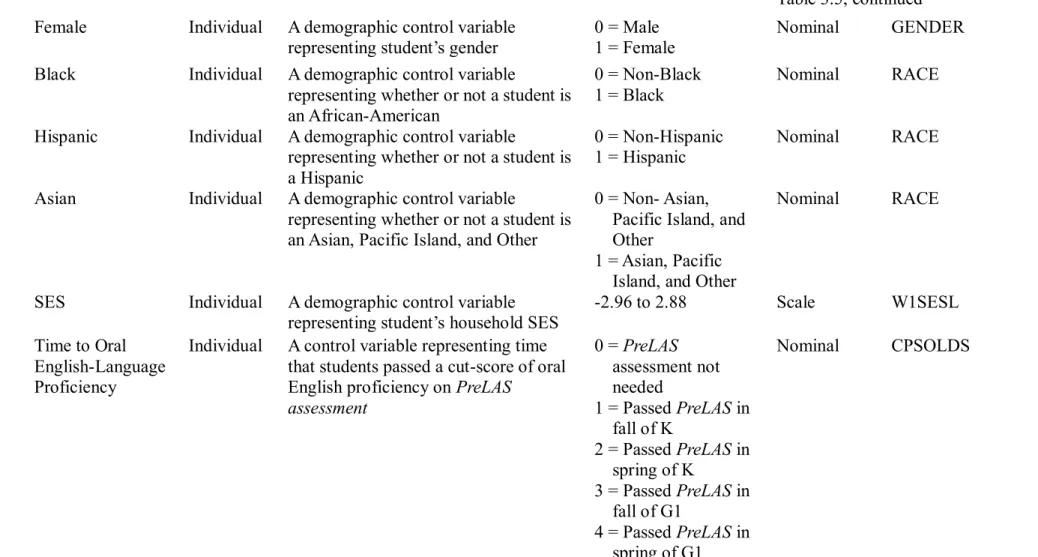
3.5. Present Study Variables, Level in the HGLM Analysis, Definitions, Coding Scheme, Measurement Scale, and Corresponding ECLS-K
Variables………...…….102
3.6. Number (Percentage) of Students in Two Groups According to
Word-Reading Proficiency by Full Sample and Subsamples of First Grade…………104
3.7. Taxonomy of the Four Multilevel Logistic Models for Change………...105
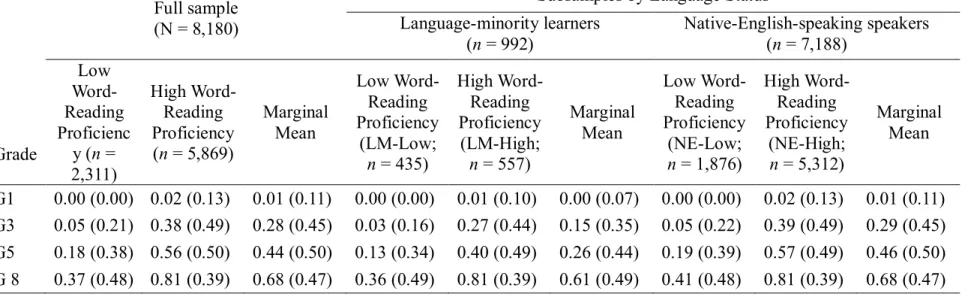
4.1. Proportions (Standard Deviations) of Achieving
Reading-Comprehension Proficiency in the First, Third, Fifth, and Eighth Grades by Full Sample, Language-Status Subsamples,
and Word-Reading Proficiency Groups………106
4.2. Number (Percentage) of Students in Two Groups According to
Time to Oral English-Language Proficiency by Full Sample and Subsamples………107
4.3. Correlation Coefficients among Predictor
and Outcome Variable at Each Time Point………...108
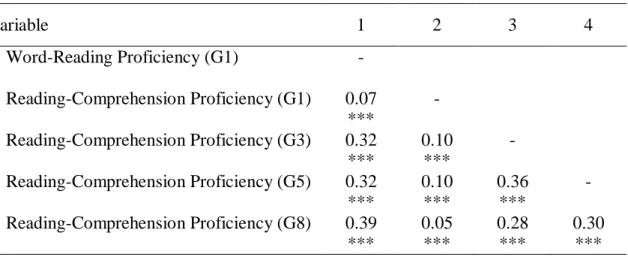
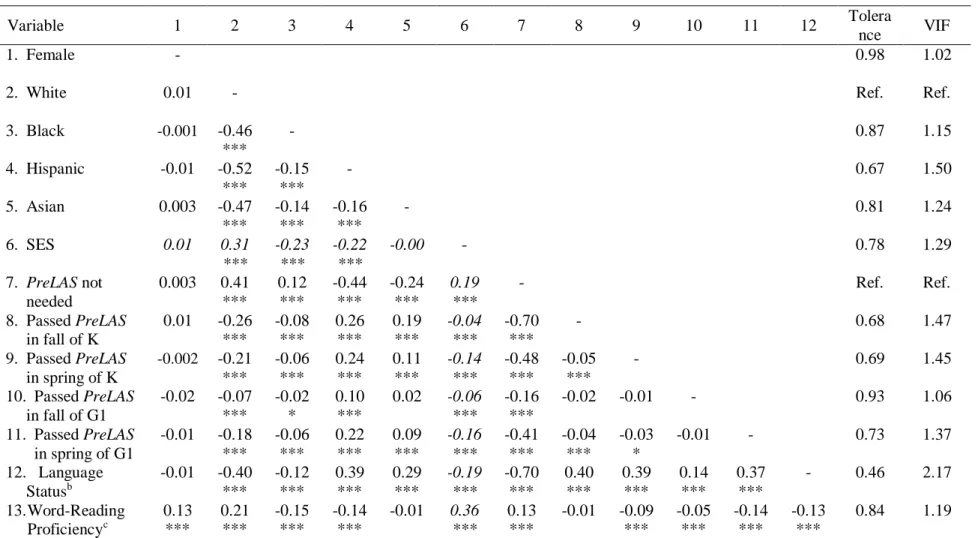
4.4. Correlation Coefficients, Tolerance, and Variance Inflation Factor (VIF) Values
for Predictor and Control Variables………..109
xii
LIST OF FIGURES
Figure
3.1. Levels and Items Administered for Associated Grades ………..….114
4.1. Observed Proportions of Achieving Reading-Comprehension Proficiency for Language-Minority Learners and Native-English-speaking Students
in the First, Third, Fifth, and Eighth Grades ………..……….115
4.2. Predicted Growth in the Probabilities of Achieving Reading-Comprehension
Proficiency Over Time (N = 8,180). ………116
4.3. Effects of Language Status and Word-Reading Proficiency on Expected Growth in the Probabilities of Achieving
Reading-Comprehension Proficiency (N = 8,180)………...…117
4.4. Predicted Growth in the Probabilities of Achieving Reading-Comprehension Proficiency for Language-Minority Learners
and Native-English-peaking Students (N = 8,180)..……….………118
4.5. Predicted Growth in the Probabilities of Achieving Reading-Comprehension Proficiency for Children with High Word-Reading Proficiency
1 CHAPTER 1
INTRODUCTION AND RATIONALE
The purpose of the present study was to examine the association between word-reading
proficiency in the spring of first grade and reading-comprehension proficiency growth across the
spring of first, third, fifth, and eighth grades for language-minority (LM) learners and
native-English-speaking (NE) students. The specific research question guiding the study was: Is the
relationship between first-grade word-reading proficiency and reading-comprehension
proficiency growth through eighth grade different for LM learners as compared to their NE
peers? The current study was a secondary analysis of longitudinal data from a nationally
representative sample of children of U.S. elementary schools from the Early Childhood
Longitudinal Study Kindergarten Class of 1998-1999 (ECLS-K).
The current chapter begins with the rationale for the present study. Then, significance of
the study and hypothesis are presented. Finally, definitions for key terms are provided.
Rationale
The number of school-age LM learners has increased immensely over the past decades.
LM learners refers to children who come from home and community in which a language other
than English is spoken (August & Shanahan, 2006). There were approximately two million LM
learners in public schools in 1990, but the number grew to nearly 11 million in 2009,
representing 1 of every 21 school-age students in the United States (U.S. Department of
Education, 2011). LM learners, typically classified as English language learners (ELLs), come
2
learners come from Spanish-speaking backgrounds, and Asian-language-speaking (e.g.,
Vietnamese, Hmong, Cantonese, Korean, and Khmer) children make up most of the rest of the
LM population (Goldenberg, 2011). With a burgeoning influx of LM learners who are learning
English as a new language in the United States, issues concerning their English-language
academic performance have received unprecedented attention from educators, researchers and
policy makers across the nation (e.g., August & Hakuta, 1997; August & Shanahan, 2006;
Goldenberg, 2011; National Clearinghouse of English Language Acquisition [NCELA], 2007).
According to results of the 2013 What’s Hot, What’s Not survey polled by the International
Reading Association (Cassidy & Grote-Garcia, 2012), ELLs/English as a second language (ESL)
was rated as one of the “hot” topics and should be a very hot issue in literacy education.
Of particular concern is that LM learners encounter considerable difficulties with reading
and understanding complex text written in English (Carlo, August, McLaughlin, Snow, Dressler,
Lippman, Lively, & White, 2004; Lesaux & Siegel, 2003). According to the recent National
Assessment of Educational Progress (NAEP) reading assessment, fourth-grade LM learner’s
reading performance was significantly lower than their native English-speaking peers (National
Center for Education Statistics [NCES], 2011), and large and persistent gaps consistently exist
between LM learners and native English-speaking children in reading achievement performance
over the course of the school years. Moreover, LM learners who achieve below the basic
English-reading comprehension level are at substantial risk for difficulties in almost all subject
content areas and behavioral and social success in school, and are more likely to drop out than
are native English-speaking students (Fry, 2007; Genesee, Lindholm-Leary, Saunders, &
Christian, 2006; Kaufman, Alt, & Chapman, 2001; Reardon, 2003; Ruiz-de-Velasco & Fix, 2000;
3
vital goal of formal reading education among educators and researchers at the local and nation
levels (August & Shanahan, 2006).
Despite the pressing need to serve this ever-growing population, there is a limited scope
of sound empirical work needed to inform educational practice and policy. A major issue is that
little is known about the developmental pattern of LM learners’ reading comprehension.
Although the number is increasingly sharply, only a handful of researchers have modeled LM
learners’ English-reading growth, and very little research has provided insight into the growth
trajectories of their English-reading comprehension over time or into early predictors of that
comprehension growth. The approach to examining a componential reading sub-skill and its
relationship to long-term reading-ability growth is particularly important to understanding the
complexity and difficulty inherent in LM learners’ second-language reading development
(Lesaux, 2006; McCardle, Mele-McCarthy, Cutting, Leos, & D’Emilio, 2005).
In addition, while a great deal of large-scale research and intervention funding projects
that support LM learners’ English-reading development have focused on those at primary grade
levels, relatively less attention has been paid to those beyond the primary grades (e.g., August &
Shanahan, 2006; Bailey, 2007; RAND Reading Study Group, 2002; Snow & Uccelli, 2009).
Furthermore, few studies have examined early factors that might be associated with LM learners’
developmental change in English-reading comprehension. It is thus unclear whether and to what
extent early reading-related skills contribute to LM learners’ success or struggles in reading
comprehension growth over short or lengthy time periods.
Early word-reading ability is widely recognized as one of the most salient predictors of
reading comprehension success for monolingual English-speaking children (e.g., Adam, 1990;
4
2000; Perfetti, 2007; Stanovich, 2000). The relationship between word reading and ability to
comprehend text has been theoretically and empirically established in various ways for
monolinguals (e.g., Baumann, 2005; Beck & McKeown, 2007; Beck, Perfetti, & McKeown,
1982; Davis, 1994; Juel, Griffith, & Gough, 1986; Nagy, Anderson, & Herman, 1987; Snow,
Burns, & Griffin, 1998; Stanovich, Cunningham, & Freeman, 1984; Tannenbaum, Torgesen, &
Wagner, 2006). Not only does a strong correlation exist between the two constructs, but causal
evidence indicates that word reading plays a critical role in increasing text comprehension ability
(e.g., Anderson & Freebody, 1981; Blanchard, 1980; Cunningham & Stanovich, 1997; Herman,
1985; Lesgold, Resnick, & Hammond, 1985; McKeown, Beck, Omanson, & Pople, 1985;
Scarborough, 2001; Stanovich, 1985). For instance, readers with well-developed automatic word
recognition competence do not focus unduly on lower-level processing skills (e.g., word
identification), and, consequently, more attention can be paid to integration of new information
with background knowledge and critical evaluation of the information being read (e.g., Beebe,
1980; Biemiller, 1970; Cain, Oakhill, & Bryant, 2000; Calfee & Piontkowsky, 1981; Juel, 1991;
Lomax, 1983; Stanovich, 1991). Moreover, early word reading influences text comprehension in
a cumulative manner (Chall, Jacobs, & Baldwin, 1990; Stahl & Nagy, 2006). The more words
children recognize and understand, the more opportunity they have to spend time engaged with
texts, to learn about the world and new words, and to understand richer texts. Thus, reading
comprehension competence at upper grade levels is likely to hinge upon the accumulated
knowledge from early experiences with words (Cunningham & Stanovich, 1997; RAND Reading
Study Group, 2002).
Nevertheless, whether this is the case for LM-learner population has yet to be
5
have documented that while LM learners often perform on a par with monolingual
English-speaking students in English word-level reading in the primary grades, the great majority of LM
learners underperform their monolingual English-speaking peers on English-reading
comprehension in the upper elementary and middle grades (Lesaux, Koda, Siegel, & Shanahan,
2006, for a review; NCES, 2007). However, far less is known as to whether early English-word
reading is an essential prerequisite to LM learners’ long-term development of English-reading
comprehension, and whether early English word-reading ability contributes to the persistence of
reading comprehension success or difficulties across upper elementary and middle grades.
The use of a longitudinal research design rather than cross-sectional design is
particularly essential in the study of LM learners’ reading development. Although the snapshot
approach provides a basic understanding about reading achievement levels at one or two points
in time, it does not address critical questions about LM learners’ English-reading growth that
occurs in a slow and gradual manner, nor does it reveal their developmental pattern over long
periods of time (Mancilla-Martinez, Kieffer, Biancarosa, Christodoulou, & Snow, 2011;
Mancilla-Martinez & Lesaux, 2010). Longitudinal research findings accomplished with sound
methodology will help to provide a more in-depth perspective on the reading developmental
process of LM learners who typically make the transition from learning-read to reading-
to-learn stages in a slow and gradual manner over time.
The analysis of LM learners’ developmental trajectories in reading comprehension using
precursor reading skills could serve as a primary source of identifying and diagnosing students at
risk for reading difficulties (Francis, Shaywitz, Stuebing, Shaywitz, & Fletcher, 1996). The
existing reading research with monolingual English-speaking students has established the
6
skills (e.g., Lyon, 1998; Satz & Fletcher, 1988; Schenck, Fitzimmons, Bullard, Taylor, & Satz,
1980; Strag, 1972). Early screening and detection could be the key to providing preventive and
sound instruction before students experience serious failure throughout the school years (e.g.,
Fuchs & Fuchs, 2006; Snow et al., 1998; Torgesen & Burgess, 1998).
What is Known about LM Learners’ English-Reading Growth?
Monolingual native English-speaking children’s reading growth trajectories tend to
demonstrate quadratic developmental patterns that have steeper ascending slopes in the earlier
phases, followed by decelerating growth rates, reaching a plateau at older ages (e.g., Catts,
Bridges, Little, & Tomblin, 2008; Francis et al, 1996; Williamson, Fitzgerald, & Stenner, 2014).
Similar developmental patterns have also been found in LM learner studies. For instance, from
preschool through fifth grade, Spanish-speaking LM learners’ English vocabulary, verbal
short-term language memory, and word reading accelerated rapidly originally, and then decelerated
(e.g., Mancilla-Martinez & Lesaux, 2011; Nakamoto, Lindsey, & Manis, 2007).
Among the handful of studies that have modeled reading growth of LM learners, only a
few researchers have investigated the association of reading-related predictor variables with
initial status and growth rates of global reading achievement and specific reading sub-skills.
While LM learners’ English-reading growth rates have been studied in relation to several
predictive factors such as socioeconomic status (SES; D’Angiulli, Siegel, & Maggi, 2004;
Kieffer, 2008), initial English oral proficiency (e.g. Fitzgerald, Amendum, Relyea, & Garcia, in
press; Kieffer, 2011), or first-language backgrounds (e.g., Roberts, Mohammed, & Vaughn,
2010), very little research has been done that provides insight into the predictive relationship
between early reading-related sub-skill variables and later reading outcome growth.
7
Public schools in the United States have experienced phenomenal and rapid growth in the
number of LM learners who often lag far behind their monolingual English-speaking peers in
English reading over the past few decades. Consequently, fostering LM learners’
English-reading comprehension has become a vital goal of formal English-reading education at the national, state,
and local levels. Despite the nationwide attention focused on the improvement of LM learners’
English-reading comprehension ability, knowledge of developmental patterns of English-reading
comprehension during the elementary and middle grades still remains lacking. In addition,
although the extant literature on LM learners’ reading has documented the predictive relationship
between English-word reading on reading comprehension at one time point or over a short
period, far less is known as to whether and to what extent LM learners’ early English
word-reading ability contributes to developmental patterns of English-word-reading comprehension over
time.
To my knowledge, the present study is the first study to empirically address the
association between LM students’ early word-reading ability and English-reading comprehension
growth in comparison to those for NE students over lengthy time periods. Although an emerging
number of studies has begun to focus on growth trajectories of LM learners’ overall
English-reading achievement using large-scale longitudinal data (i.e., ECLS-K) in recent years (e.g.,
Halle, Hair, Wandner, McNamara, & Chien, 2011; Han & Bridglall, 2009; Kieffer, 2008, 2011),
no researchers to date have investigated the growth trajectories of a specific reading sub-skill in
relation to other early reading sub-skill. The potential results from the current study would make
unique contributions to growing knowledge about LM learners’ reading comprehension
8
findings from the study may have important implications for curriculum decisions and
instructional approaches to address individual LM learner’s unique literacy learning needs.
Re-Statement of the Research Question and Hypothesis for the Present Study
The research question guiding the study was: Is the relationship between first-grade
word-reading proficiency and reading-comprehension proficiency growth through eighth grade
different for LM learners as compared to their NE peers?
The major hypothesis for the study was that the relationship between children’s
word-reading proficiency and word-reading-comprehension proficiency growth over time would vary as a
function of children’s language status (i.e., LM learners versus NE students). Thus, an ordinal
interaction between initial word-reading proficiency and language status was expected. More
specifically, I hypothesized that LM learners who had initially higher word-reading ability would
experience greater growth in reading-comprehension proficiency as compared to LM learners
and NE peers who had initially lower word-reading ability. LM learners with initially higher
word-reading ability would start out at a lower level than their NE peers with initially higher
word-reading ability in the spring of first grade. Additionally, I expected that LM learners with
initially higher word-reading ability would follow a growth trajectory similar to that of their NE
peers with initially higher word-reading ability such that high-performing LM learners would
eventually catch up with their high-performing NE peers in reading-comprehension proficiency.
On the other hand, LM learners who had initially lower word-reading ability would experience
slower growth in reading-comprehension proficiency and lag increasingly behind not only their
NE peers who had initially lower word-reading ability but LM learners with initially
well-established word-reading ability.
9
Language-minority learners refers to students who come from a home and community
setting in which a language other than English is primarily spoken and may have developed
some extent of home-language proficiency (e.g., August & Shanahan, 2006; Kieffer, 2008).
Native-English-Speaking Students refers to students who were born in the United States
or any other English-speaking country and come from home and community where only English
is spoken.
Word Reading refers to the ability to read (a) words by sight as whole units by accessing
information stored in lexical memory (Ehri & Robbins, 1992; Perfetti, 1985), and/or (b) words
through word analysis strategies such as by using context cues to make predictions about
upcoming words (Rumelhart, 1977; Ehri, 1994).
Reading Comprehension is a multifaceted cognitive process in which a reader constructs
meaning through interaction with text. The RAND Reading Study Group report (2001) stated
that reading comprehension is “the process of simultaneously extracting and constructing
meaning through interaction and involvement with written language” (p. 11). In a similar vein,
the NAEP (2009) Reading Framework Committee defines reading comprehension as “an active
and complex process that involves understanding written text, developing and interpreting
meaning, and using meaning as appropriate to type of text, purpose and situation” (National
Center for Educational Statistics, 2005, p. 2). The reading comprehension measure developed
for the ECLS-K study and used in the present study was based on the RAND Reading Study
definition of reading comprehension.
Oral English-Language Proficiency refers to the ability to use English language
accurately and appropriately in its oral forms in various settings (Cloud, Genesee, & Hamayan,
10
English-proficiency assessment were listening comprehension, productive vocabulary, and
11 CHAPTER 2
REVIEW OF THE LITERATURE
The purpose of the present study was to examine the relationship between word-reading
proficiency in the spring of first grade and reading-comprehension proficiency growth across the
spring of first, third, fifth and eighth grades for language-minority (LM) learners and
native-English-speaking (NE) students. The research question guiding the study was: Is the relationship
between first-grade word-reading proficiency and reading-comprehension proficiency growth
through eighth grade different for LM learners as compared to their NE peers?
In the current chapter, I first provide theoretical perspectives pertaining to the
relationship between word reading and reading comprehension growth and moderating factors on
the relationship. Next, I provide empirical research findings regarding (a) correlational
relationships between word reading and reading comprehension among monolingual children
and LM learners and (b) reading-comprehension/reading-achievement development for
Monolinguals and LM Learners. Last, I provide a summary statement.
Theoretical Perspectives
In the following sections, I provide a theoretical discussion of (a) how early word reading
might be related to reading comprehension growth and (b) how language status and other factors
may moderate the relationship between early word reading and reading comprehension growth.
How Might Early Word Reading be Related to Reading Comprehension Growth?
Early word-reading ability for monolinguals is related to later comprehension
12
move from lower-level word-reading skills to constructing meaning of complex text in a
sequential and cumulative manner (e.g., Chall, 1996). Initial acquisition of lower-level word
reading skills (i.e., code-breaking) with automaticity and accuracy during the primary grades
facilitates reading practice and provides opportunities to gain the various types of knowledge,
which in turn leads to developmental improvements in the higher-order processing involved in
construction of the meaning-based representation of the texts in the later school years (e.g., Juel,
Griffith, & Gough, 1986; Perfetti & Hogaboam, 1975; RAND Reading Study Group, 2002;
Stanovich, 2000).
Given the cumulative nature of reading skills, if children have difficulties in word reading
in the primary grades, they are likely to experience greater challenge and struggle with text
comprehension and fall further behind their same-age peers as they reach the upper elementary
or middle school grades (Alexander, Entwisle, & Horsey, 1997; Juel, 1988; Oakhill, Yuill, &
Parkin, 1986). The ability to read words fluently and accurately is closely related to the
cognitive resources that can be devoted to the processes involved in comprehending and making
meaning from text (e.g., Frederiksen & Warren, 1987; Jenkins, Fuchs, van den Broek, Espin, &
Deno, 2003; Just & Carpenter, 1987; Perfetti, 1985). Therefore, word reading is an important
prerequisite and consequence for successful reading comprehension and should be considered as
a potential causal factor (e.g., Chen & Vellutino, 1997; Conners, 2009; Francis, Fletcher, Catts,
& Tomblin, 2005; Cutting & Scarborough, 2006; Georgiou, Das, & Hayward, 2009; Gough,
Hoover, & Peterson, 1996; Jenkins & Jewell, 1993; Kirby & Savage, 2008; Joshi & Aaron, 2000;
Vellutino, Tunmer, Jaccard, & Chen, 2007).
One theoretical position that can explain the cognitive mechanism between word reading
13
support because they share common cognitive processes and draw on the same knowledge
sources in working memory (Guttentag & Haith, 1978; LaBerge & Samuels, 1974). Within this
view, children who lack the ability to read words quickly and accurately either in isolation or in
connected text may have significant demands on cognitive processes, particularly in the area of
working memory, while devoting significant attention to decoding the words. Thus, relatively
little cognitive processing resources are directed to constructing meaning and monitoring
meanings already apprehended (Perfetti, 1985). If children can read words from working
memory by sight in a fast and less intrusive way, more sources drawn from working memory can
contribute to reading comprehension processes (Frederiksen & Warren, 1987; Jenkins, Fuchs,
van den Broek, Espin, & Deno, 2003; Just & Carpenter, 1987; Perfetti, 1985; Walczyk, 2000).
Therefore, learning to read by sight and building a vocabulary of sight words in memory is one
of several essentials in reading instruction for beginning readers to promote the development of
word reading and reading comprehension skills (Ehri & Snowling, 2004).
Two contradictory theoretical models of reading development in general mainly
conceived for monolingual children—the cumulative growth model (e.g., Bast & Reitsma, 1998;
Stanovich, 1986; Walberg & Tsai, 1983) and the developmental lagmodel (e.g., Aunola,
Leskinen, Lerkkanen, & Nurmi, 2004; Francis et al., 1996). To my knowledge, there have been
no studies in which two aforementioned models are hypothesized and tested to address the
relationship between word reading and reading comprehension growth, although one prior study
tested the two hypothetical models for overall initial reading level and its growth pattern among
LM learners (cf. Kieffer, 2008). In particular, to date, no one has incorporated the
14
The cumulative growth model,better known as the Matthew effect (e.g., Bast & Reitsma,
1998; Stanovich, 1986; Walberg & Tsai, 1983), addresses the importance of acquiring early
reading skills in general, not specifically the importance of early word reading. However,
implications for the significance of early word reading arise from the model. According to the
cumulative growth model, more-skilled readers at the early reading acquisition stage grow at
more advanced speeds over the years than the less-skilled readers by taking advantage of greater
involvement in reading-related activities (Stanovich, 1986). As a result, the gap between
children who are initially lesser skilled readers as compared to more skilled readers gradually
widens (Pfost, Hattie, Dörfler, & Artelt, 2014). Although the model describes the relationship
between initial reading level and their intraindividual reading gains in general, it also applies to
the relationship between early word-reading ability and reading comprehension growth,
specifically. Based on the conceptual perspective of the model, it is expected that an initially
higher word-reading ability would be advantage in reading comprehension development, while
initially lower word-reading ability would be disadvantages. Thus, a widening gap in reading
comprehension outcomes would occur over school years between children who initially have
higher and those who initially have lower word-reading abilities.
Alternatively, according to the developmental lag model, as children receive systematic
reading instruction in school, less-skilled readers initially start out with lower reading
achievement but tend to make greater gains through escalating speed to acquire reading
knowledge and skills more rapidly than those who demonstrate better initial reading.
Consequently, initially less-skilled readers are able to catch up to more-skilled peers over time or
at least close the achievement gap between the two groups (e.g., Stanovich, Nathan, &
15
of overall reading can be also explained in the particular relationship between early word-reading
ability and reading comprehension growth. Children who start elementary school with lower
word-reading ability might show lower growth rates in reading comprehension at an early point
in time as compared to those who start with higher word-reading ability. However, despite the
early increasing competence gap, children with initially lower word-reading ability might
gradually accelerate growth rates in reading comprehension and catch up to those with initially
higher word-reading ability, therefore narrowing the gap.
How Might Language Status and Other Factors Moderate the Relationship between Early Word Reading and Reading Comprehension Growth?
Language status. The deep and close relationship between early word-reading skills and reading comprehension development for monolingual children has long been theoretically well
established (Perfetti & Hogaboam, 1975; Snow, Burns, & Griffin, 1998). However, despite the
widely held view of the relationship between the two constructs, given the lack of theoretical and
empirical research on LM learners’ reading comprehension development, very little is known
about whether the role of early word reading for long-term reading comprehension development
also pertains to LM learners who learn to read in a second or additional language.
Hypothetically speaking, the association between early word reading and reading
comprehension growth may differ between LM learners and their NE peers. There are two
possible explanations for the relative influence of children’s language status on the relationship
between word reading and reading comprehension growth. First, LM learners expend a great
deal of cognitive energy and resources to the task of learning to read (e.g., phonological,
syntactic, and lexical skills) in a language that they have yet to master. The acquisition of
word-reading skills for LM learners may require more processing time as compared to their
16
However, it is viable to assume that those LM learners who acquire strong early word
reading skills would show similar reading comprehension growth to that of their monolingual
peers. Or, alternatively, even for those LM learners who acquire strong early word reading
skills, their lesser exposure to English relative to monolingual NE peers may result in limited
syntactic sensitivities and morphological knowledge that is a presumably a consequence of delay
in reading comprehension growth (Kieffer, 2012).
Second, in addition to linguistic and cognitive factors, LM learners’ background
knowledge may influence the strength of the relationship between word reading and reading
comprehension growth. Language-Minority learners are more likely than their NE peers to lack
sufficient background knowledge of the topic of a text (e.g., Droop & Verhoeven, 1998;
Hacquebord, 1994). Having sufficient type and amount of prior knowledge of the topic to be
read plays a strong role in understanding and constructing meaning from text. Some LM learners
with limited or interrupted prior educational experiences may possess a lack of background
knowledge required to understand much of what is read, resulting in great comprehension
difficulty. Even for other LM learners with a high degree of academic schooling in their native
language or country, their cultural perspectives and culturally-based assumptions may not match
the background knowledge assumed or required in the U.S. classrooms.
Other factors. Two prominent domains—LM learners’ oral language proficiency and child’s socio-demographic characteristics (e.g., gender, race/ethnicity, and family SES)—may
influence the strength of the predictive association between word reading and reading
comprehension growth. Thus, they should be taken into consideration in examining the
17
First, the relationship between LM learners’ English word-reading ability and reading
comprehension growth can be largely constrained by initial English oral-language competence.
Consistently, as has been the case for monolingual children (Anderson & Freebody, 1981; Roth,
Speece, & Cooper, 2002; Vellutino, Scanlon, Small, & Tansman, 1991; Storch & Whitehurst,
2002), elementary school-age LM learners’ early oral English-language proficiency is closely
interwoven with English-reading performance. Thus, those LM learners who are not yet
proficient in oral English language are likely to exhibit difficulties in learning to read in English
in the primary grades and attain relatively low levels of English-reading outcomes than their
native-English-speaking peers (Kieffer, 2011) or initially proficient LM counterparts (Fitzgerald,
Amendum, Relyea, & Garcia, 2015).
Second, the association of LM learners’ English word-reading ability with reading
comprehension growth can be confounded by child’s socio-demographic characteristics such as
gender, race/ethnicity, and family SES. Although indicators of family SES, in particular, are
significant factors that affect students’ literacy attainment in the general population (Aikens &
Barbarin; 2008, Chatterji, 2006; Entwisle & Alexander, & Olson, 2005; Fryer & Levitt, 2004;
Kaplan & Walpole, 2005; Perie, Grigg, & Donahue, 2005; Snow et al., 1998), such phenomenon
is particularly prevalent among LM learners in the United States who are most likely to be from
low-income and immigrant backgrounds (Goldenberg, Rueda, & August, 2006; Kieffer, 2012;
Roberts, Mohammed, & Vaughn, 2010). Language-minority learners from low SES families
often have parents with low levels of formal education, lack of home/family literacy experiences
and inadequate access to educational resources, which, as a result, negatively influence
second-language literacy development (Cobo-Lewis, Pearson, Eilers, & Umbel, 2002; Goldenberg,
18
What is known about Relationship between Word Reading and Reading Comprehension?
The following sections provide empirical research findings regarding static
cross-sectional correlational relationship and longitudinal relationship between word reading and
reading comprehension among monolingual children and LM learners.
Monolingual Children
Static cross-sectional correlational relationship. The findings on the static relationship between measures of word reading and reading comprehension of monolingual English-language
speakers are mixed. First, a large number of studies that have focused on the relationship
between word reading and reading comprehension have reported that there are moderate to high
positive correlations between the two constructs (National Reading Panel, 2000). In addition,
word reading has been found to predict unique variance in reading comprehension tasks (e.g.,
Snow et al., 1998). However, despite the well-established body of research confirming that word
reading and reading comprehension are strongly related, substantial variability has been found in
the strength of the association between word reading and comprehension. For example, in
Gough, Hoover, and Peterson’s (1996) review of 10 studies, correlations between word reading
and reading comprehension ranged from r = .18 to r = .83 across the first grade through college
students. Also, there has been considerable variability in the magnitude of variance in reading
comprehension explained by word reading. Some researchers reported the proportion of
variance (R2 values) in the range of .0001 or .0005 (e.g., Berninger, Abbott, Vermeulen, &
Fulton, 2006), whereas others reported in the range of .90 (e.g., Katzir, Kim, Wolf, Kennedy,
Lovett, & Morris, 2006).
A close look at the studies that have explored the correlational relationship between word
19
several reader-related factors. First, the correlations between word reading and reading
comprehension differ by the ages of the participants. Cross-sectional research for monolingual
English-speaking readers has indicated that the relative contribution of word reading to reading
comprehension is stronger among younger readers than older ones (Gough et al., 1996; Keenan,
Betjemann, & Olson, 2008).
Second, monolingual readers’ oral-language proficiency might also influence the strength
of the association between word reading and reading comprehension. Guided by the Simple
View of Reading (SVR; Gough & Tunmer, 1986; Hoover & Gough, 1990) framework that
contends that reading comprehension is best predicted by word reading and listening (linguistic)
comprehension and their cross-product, researchers have provided evidence that oral language
proficiency predicts a greater proportion of variance in reading comprehension among
monolingual English-speaking students (e.g., Anderson & Freebody, 1981; Cutting &
Scarborough, 2006; Johnston & Kirby, 2006; Joshi & Aaron, 2000; Savage, 2006; Savage &
Wolforth, 2007; Tunmer & Hoover, 1992; Vellutino, Tunmer, Jaccard, & Chen, 2007).
In addition to reader-related characteristics, variance in the magnitude of the correlations
may be attributed to different measures or tasks used to assess the two constructs (e.g., Best,
Floyd, & McNamara, 2008; Cutting & Scarborough, 2006; Johnston & Kirby, 2006; Keenan et
al., 2008). For example, Best and colleagues (2008) found that the amount of variance in reading
comprehension explained by word reading skills varied according to comprehension measures,
with greater relations evident when a narrative text was used (R2 values ranging from .39 to .42) as compared to when an expository text was used (R2 values from .04 to .23).
20
widely studied, but findings are divergent and seemingly contradictory. Specifically, some
studies show that initial word reading exerts increasingly weaker influence on reading
comprehension with increasing age (e.g., Abbott, Berninger, & Fayol, 2010; Burgoyne,
Whiteley, & Hutchinson, 2011; Deacon & Kirby, 2004; Juel, 1988; Kim, Wagner, & Lopez,
2012). That is, once children develop a sufficient level of word-reading skills during the primary
grades, the relative contribution of word reading to reading comprehension gradually decreases
due to less variability in children’s word-reading skills during the elementary and middle school
years.
On the other hand, previous research guided by the SVR framework has demonstrated
that measures of oral language skills (i.e., vocabulary and listening comprehension) exert an
increasingly stronger influence on reading comprehension (e.g., Ouellette & Beers, 2010; Storch
& Whitehurst, 2002). Still, other longitudinal studies have demonstrated that the magnitudes of
the correlations between early word reading and later reading comprehension are similarly
retained from the first to the last time point among native-English-speaking students (e.g., Cain
& Oakhill, 2011; Cain, Oakhill, & Bryant, 2004; Compton, Fuchs, Fuchs, Elleman, & Gilbert,
2008; Torgesen, Wagner, Rashotte, Burgess, & Hecht, 1997).
Language-Minority Learners
Static cross-sectional correlational relationship. Language-minority learners’ second-language word reading has also been found to be strongly correlated with second-second-language
comprehension when measured at static time points. Several empirical studies have sought to
apply the SVR framework to a sample of LM learners (e.g., Droop & Verhoeven, 2003; Erdos,
Genesee, Savage, Haigh, 2011; Hoover & Gough, 1990; Jared, Cormier, Levy, &
21
Proctor, August, Carlo, & Snow, 2005). In support of the SVR framework, the studies have
provided evidence that young LM learners’ second-language word reading explains some of the
variability in second-language comprehension.
Despite the strong correlation evident between word reading and comprehension among
LM learners, like monolingual readers, the average amount and range of variance in reading
comprehension accounted for by word reading tends to vary depending on several factors—age,
native and new-language oral proficiency, and measures and tasks used for assessment. For
example, Lesaux and colleagues (2010), who investigated the word reading with
reading-comprehension relationship among fourth-grade Spanish-speaking LM learners, found that word
reading was more strongly predictive of comprehension when comprehension was measured
using a cloze procedure (i.e., Woodcock Language Proficiency Battery-Revised [Woodcock,
1991]) than when measured with reading passages and corresponding questions (i.e., Gates–
MacGinitie Reading Test).
Longitudinal relationship. Although there is a small number of studies involving LM learners over time (e.g., Droop & Verhoeven, 2003; Gottardo & Mueller, 2009; Hoover &
Gough, 1990; Proctor et al., 2005; Reese, et al., 2000; Verhoeven, 1990, 2011), the studies were
conducted with LM learners only in the primary grades by using predictor-to-later-outcome
correlational approaches rather than examining growth patterns of reading comprehension in
relation to word reading over time. The findings from the correlational studies have revealed
that LM learners’ age is a significant moderator of the word-reading-comprehension relationship.
Specifically, LM learners’ word reading accounts for the bulk of variance in reading
22
with increasing chronological age, while the influence of second-language oral proficiency on
reading comprehension becomes increasingly stronger.
There is one recent longitudinal study, in whicha growth-curve modeling approach was
used in examining the predictive role of LM learners’ initial word reading in
English-reading comprehension growth, but only focusing on Spanish-speaking LM learners in middle
schools (e.g., Martinez, Kieffer, Biancarosa, Christodoulou, & Snow, 2010).
Mancilla-Martinez and colleagues (2010) reported that Spanish-speaking adolescent LM learners’ initial
English-word reading significantly predicted rate of growth in English-reading comprehension.
Students designated as low-, middle-, and high-performing word readers in fifth grade followed
parallel trajectories of English-reading comprehension between fifth and seventh grade. The
comprehension trajectories for LM learners with low performance in word reading in fifth grade
were far below from those of middle- and high-performing LM learners. In short, LM learners
with initially low performance in word reading continued to struggle with English-reading
comprehension during the middle school years. Although the study provided valuable evidence
about the development of native-Spanish speaker LM learners’ word-reading–comprehension
relationship, the investigation was limited to middle-school native Spanish-speaking students,
with no comparison NE peers. Without a comparison group of NE speakers, it is unclear to what
extent the association of initial word reading with reading comprehension growth differs between
LM learners and NE students. As well, there is a need to address very early word-reading during
the emergent reading phase in relation to longer-term reading comprehension.
23
The following sections provide a review of extant research focused on the development
of reading comprehension as well as global reading achievement for both monolingual children
and LM learners.
Monolingual Children
Several prior longitudinal findings have suggested that reading comprehension growth
patterns among school-aged monolingual English-speaking students can be well characterized by
quadratic shape functions. That is, trajectories in reading comprehension are initially linear with
a high rate of growth, but rate of growth starts declining over time after high initial acceleration,
resulting in an eventual plateau around middle grades (Catts, Bridges, Little, & Tomblin, 2008;
Francis, Shaywitz, Stuebing, Shaywitz, & Fletcher, 1996; Speece, Ritchey, Cooper, Roth, &
Schatshneider, 2004; Williamson, Fitzgerald, & Stenner, 2014). For example, Francis and
colleagues (1996), who examined monolingual reading achievement growth from first grade
through ninth grade, found that the reading trajectory followed a quadratic function in that
children initially showed the most rapid growth in reading and began to decrease thereafter.
Consistent with Francis and colleagues (1996), Catts and colleagues (2008) also reported that
quadratic models provided the best fit to reading achievement growth among monolingual
English-speaking children with language impairments tracked from kindergarten through tenth
grade.
Language-Minority Learners
Given the limited number of empirical studies examining LM learners’ reading
comprehension development over time, far less is known about the developmental processes of
reading comprehension for LM learners relative to NE peers. While LM learners and NE
24
grades (Chiappe & Siegel, 1999; Lesaux & Siegel, 2003), LM learners gradually struggle with
reading comprehension and fall behind their peers in later grades (Lesaux, et al., 2006). Indeed,
previous cross-sectional studies reported that LM learners perform substantially lower than NE
students on reading comprehension outcomes (e.g., Gottardo & Mueller, 2009; Hutchinson,
Whiteley, Smith, & Conors, 2003).
Nakamoto and colleagues (2007) investigated Spanish-speaking LM learners’
English-reading comprehension growth following a same cohort from the first grade through sixth grade.
Consistent with the trend observed by research evidence on monolingual children’s reading
comprehension growth, they found an initially rapid growth followed by gradually decreasing
growth thereafter among LM learners across the six years. However, their findings further
indicated that LM learners’ English-reading comprehension scores were comparable to the
national averages in the first and second grades but fell increasingly behind the normative sample
of NE students and remained behind by sixth grade. Thus, despite the similar shapes of growth
trajectories of English-reading comprehension between LM learners and NE peers in the primary
grades, the trajectories gradually showed divergent paths by increasing a gap between the two
populations as text demands increased.
Summary
In short, a general consensus in theoretical and empirical research conducted with
monolingual readers is that reading comprehension performance and development are highly
dependent on monolingual children’s early word-reading ability. Monolingual children with
well-developed word-reading ability tend to show relatively advanced reading comprehension as
compared to peers with slow, inefficient, and inaccurate word-reading ability (Ehri, 1979;
25
development, far less is known about whether LM learners’ well-established English-word
reading ability also has a positive impact on English-reading comprehension development.
The relationship between early word reading and reading comprehension growth is
expected to vary as a function of language status—LM learners and monolingual NE students.
One explanation is that the acquisition of word-reading skills for LM learners learning to read in
a second or additional language requires more processing time and cognitive demands as
compared to their monolingual peers who draw upon substantial oral language skills to reading
(Verhoeven, 2011). However, it is viable to assume that those LM learners who initially
establish strong word-reading skills would show similar reading comprehension growth to their
monolingual peers who also have strong word-reading skills.
The current study extends prior research by addressing reading-comprehension growth in
relation to early word-reading ability for a sample of LM learners in comparison to NE peers
over the course of elementary and middle school. Findings may provide a conceptual foundation
for understanding of whether early word-reading predicts difficulties in English-reading
comprehension development for LM learners and inform classroom teachers and future theory
26 CHAPTER 3
METHODOLOGY
Design
Using eight-year longitudinal data from a nationally representative sample of children
from the Early Childhood Longitudinal Study–Kindergarten Class of 1998-1999 (ECLS-K:
1998-1999) dataset, the relationship between the first-grade word-reading proficiency and
reading-comprehension proficiency growth across the spring of first, third, fifth and eighth
grades was examined. The sample included 992 first-grade LM learners and 7,188 first-grade
native-English-speaking (NE) students in 2000 who were followed into third (2002), fifth (2004),
and eighth grades (2007).
Three ECLS-K data sources were used: (a) English-reading assessment (basic early
reading skills [letter recognition, beginning and ending sounds], word reading, and reading
comprehension); (b) parts of a parent interview; and (c) oral English-language proficiency
assessment (selected subtests of the Pre-Language Assessment Scales [PreLAS;Duncan &
DeAvila, 1998]). The present study involved six variables. First, drawing upon English-reading
assessment data from the ECLS-K dataset, the following two variables were created by the
researcher: (a) Word-Reading Proficiency in the spring of first grade (a dichotomous variable
indicating two groups—low and high Word-Reading Proficiency); and (b)
Comprehension Proficiency (a dichotomous variable—whether or not a child passed
Reading-Comprehension Proficiency). In addition, the following two sets of variables were directly taken
27
Race/Ethnicity (a categorical variable), and Socioeconomic Status (SES) (a continuous variable)
that were all collected during the parent interview; and (b) Time to Oral English-Language
Proficiency (a categorical variable grouping children based on which of four time points
[fall/spring kindergarten, and fall/spring first grade] a child passed the ECLS-K pre-established
cut-score on the oral English-language assessment, PreLAS).
A series of Hierarchical Generalized Linear Modeling (HGLM; Raudenbush & Bryk,
2002) analyses for longitudinal data was conducted. The independent variable was
Word-Reading Proficiency at first grade, and the dependent variable was Word-Reading-Comprehension
Proficiency, with Reading-Comprehension Proficiency repeated at first, third, fifth, and eighth
grade. The control variables were child’s Gender, Race/ethnicity, SES, and Time to Oral
English-Language Proficiency.
Data Sources: The ECLS-K
Data for the present study were drawn from the ECLS-K study, sponsored by the U.S.
Department of Education, National Center for Education Statistics (NCES) along with supports
offered by the Survey Research Center, School of Education at the University of Michigan and
Educational Testing Services (ETS). In conducting the ECLS-K study, NCES gathered data from
a large-scale, nationally representative sample of U.S. students entering kindergarten in the
1998-99 school year and continuing through eighth grade.
The ECLS-K study is a multifaceted and longitudinal study, designed to capture
information on a wide range of individual child, home, and school characteristics collected from
student assessment, parent interviews, and teacher and school administration surveys. The
ECLS-K study is an effort to better understand children’s status at entry to kindergarten in the
28
eighth-grade school years, and to provide important implications with respect to educational
policy and classroom practice. The main objectives and potential applications of the ECLS-K
study are outlined as:
1) a study of achievement in the elementary and middle school years;
2) an assessment of the developmental status of children in the United States at the start of
their formal schooling and at key points during the elementary and middle school;
3) a cross-sectional study of the nature and quality of kindergarten programs in the United
States; and
4) a study of the relationship of family, preschool, and school experiences to children’s
developmental status at school entry and their progress during kindergarten, elementary
school, and middle school (Tourangeau, Nord, Lê, Sorongon, & Najarian, 2009, p. 1-4).
There are positive benefits to using the ECLS-K database for the current study. The
ECLS-K is a national dataset in which information on children who came from a non-English
speaking background was included. Thus, the ECLS-K data is suitable for studying LM learners’
English-reading performance. In addition, the present study design fully took advantage of the
multi-wave longitudinal nature of the ECLS-K data. It provides an invaluable opportunity to
observe students’ growth trajectories in reading-comprehension proficiency for a relatively long
period of time, which is not available from cross-sectional studies.
ECLS-K Study Sample and Sampling Design
The ECLS-K sample includes 21,409 children who attended both public and private
kindergartens offering full- and part-day programs across approximately 3,500 classrooms in
1,280 schools during the 1998-99 academic year. Of 21,409 children originally recruited for the
29
Pollack, & Atkins-Burnett, 2006). The sampling process was conducted by using a multistage
probabilistic sampling design that includes three main stages: (a) Primary Sampling Units (PSUs,
counties or groups of counties within the United States); (b) schools within sampled PSUs; and
(c) students from these schools. In the first stage, the 1990 county-level population data was
used to construct PSUs in which contained 1,404 counties or groups of contiguous counties with
minimum 15,000 persons. The existing PSU frame was then updated with 1994 population
estimates of five-year-olds by race/ethnicity by using the U.S. Census Bureau. The eligibility
criterion for the selection of a PSU was to have at least 320 five-year-olds children. Each PSU
that did not meet this requirement was collapsed with an adjacent PSU. After collapsing, 1,335 PSUs remained in the sampling frame.
In the second stage of sampling, a sample of representative schools offering
kindergarten programs was systematically selected with probability proportional to the measure
of size within the 100 PSUs. A total of 1,280 schools (934 public and 346 private schools) were
determined from 1,335 PSUs using the school universe files: 1995-96 Common Core of Data
(CCD), Private School Universe Survey (PSS), Bureau of Indian Affairs, and the Department of
Defense. The minimum required sample size of children for a school to be included was 24
children for public schools and 12 children for private schools. Asians and Pacific Islanders
(APIs) were over-sampled to ensure adequate sample sizes for statistical subgroup comparisons.
Finally, the student sample was obtained from 1,280 schools.
After the first data collection wave in the fall of first grade, sample attrition was
observed due to high mobility among the children who were initially selected. In the spring of
first grade, thus the sample was refreshed to restore the reduced sample size and to have a
30
kindergarten in 1998 and thus would not have been selected during 1998-99 academic year. As a
result, 165 new children were added to the sample in the spring of first grade. However, at third
grade, the sample was not representative of third grade students because children who had just
arrived to the United States were not included in the sample. Thus, the third grade data was only
representative of the population cohort who participated in the ECLS-K study, but not
representative of all third grade children in the United States in 2001-2002. Population cohort
references the entire group of children who began kindergarten during the 1998-1999 school year
in the United and were following over the several years while participating in the ECLS-K study
(Tourangeau et al., 2009).
Instruments and Procedures
In the present section, ECLS-K instruments and procedures are described. In a following
section, variables (and reliabilities) used in the present study are portrayed, including variables
that were created from ECLS-K variables and variables that were taken directly from ECLS-K.
Three ECLS-K instruments were selected to create the variables for the present study: (a)
English-reading assessment, (b) parts of a parent interview, and (c) oral English-language
proficiency. The NCES field staff collected both reading assessment and oral
English-language proficiency data from the participating children and information about family and
children’s characteristics from the children’s parents/guardians. A majority of the field staff was
mostly former educators or teachers, and experienced in working with children and conducting
assessments. They had in-person training sessions before collecting data. The field staff was
divided into 100 geographic areas selected for the ECLS-K study as a data collection team
consisting of one field supervisor and three assessors. The teams had responsibility for all data