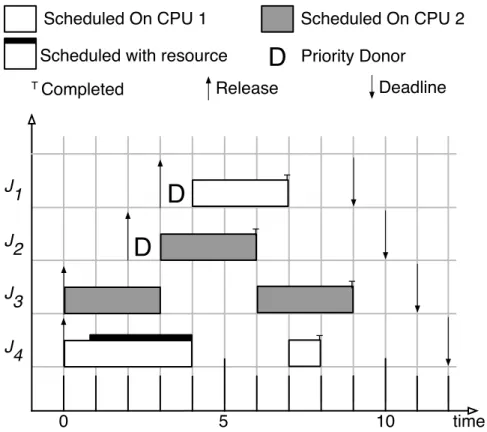
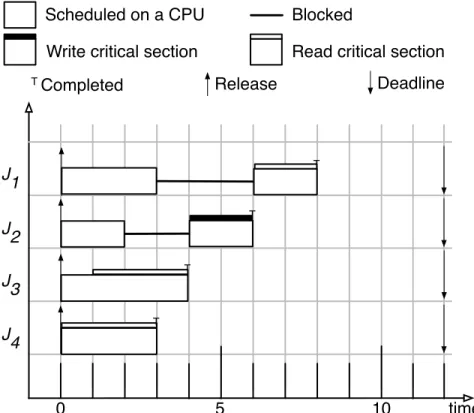
SHARING NON-PROCESSOR RESOURCES IN MULTIPROCESSOR REAL-TIME SYSTEMS
Bryan C. Ward
A dissertation submitted to the faculty at the University of North Carolina at Chapel Hill in partial fulfillment of the requirements for the degree of Doctor of Philosophy in the Department of Computer Science.
Chapel Hill 2016
Approved by: James H. Anderson Sanjoy K. Baruah Bj¨orn B. Brandenburg Alan Burns
ABSTRACT
BRYAN C. WARD: Sharing Non-Processor Resources in Multiprocessor Real-Time Systems (Under the direction of James H. Anderson)
Computing devices are increasingly being leveraged in cyber-physical systems, in which computing devices sense, control, and interact with the physical world. Associated with many such real-world interactions are strict timing constraints, which if unsatisfied, can lead to catastrophic consequences. Modern examples of such timing constraints are prevalent in automotive systems, such as airbag controllers, anti-lock brakes, and new autonomous features. In all of these examples, a failure to correctly respond to an event in a timely fashion could lead to a crash, damage, injury and even loss of life. Systems with imperative timing constraints are called real-time systems, and are broadly the subject of this dissertation.
Much previous work on real-time systems and scheduling theory assumes that computing tasks are independent,i.e., the only resource they share is the platform upon which they are executed. In practice, however, tasks share many resources, ranging from more overt resources such as shared memory objects, to less overt ones, including data buses and other hardware and I/O devices. Accesses to some such resources must besynchronized to ensuresafety, i.e., logical correctness, while other resources may exhibit better run-time performance if accesses are explicitly synchronized. The goal of this dissertation was to develop new synchronization algorithms and associated analysis techniques that can be used to synchronize access to many classes of resources, while improving the overall resource utilization, specifically as measured by real-time schedulability.
Towards that goal, theReal-Time Nested Locking Protocol(RNLP), the first multiprocessor real-time locking protocol that supports lock nesting or fine-grained locking is proposed and analyzed. Furthermore, theRNLPis extended to support reader/writer locking, as well ask-exclusion locking. All presentedRNLP
variants are proven optimal. Furthermore, experimental results demonstrate the schedulability-related benefits of theRNLP.
ACKNOWLEDGEMENTS
This dissertation would not have been possible without the help and support of many people. First and foremost, I would like to thank my advisor Jim Anderson for his guidance and patience during the course of my time at UNC. I’d also like to thank my dissertation committee, Sanjoy Baruah, Bj¨orn Brandenburg, Alan Burns, and Don Smith, for their feedback on my research and this document.
I’d also like to thank all of my co-authors, Micaiah Chisholm, Glenn Elliott, Jeremy Erickson, Cheng-Yang Fu, Jonathan Herman, Chris Kenna, Namhoon Kim, Catherine Nemitz, Nathan Otterness, and Abhilash Thekkilakattil, who all helped me on many different projects, and often stayed up late into the night and even early into the morning to polish a paper before a last-minute submission deadline. I’d like to also thank the rest of the UNC real-time systems group, who provided helpful conversations and feedback on ideas and presentations.
Outside of research, I am tremendously thankful for the friends I have made throughout my time at UNC, including Jacob Bartel, Bipasa Chattopadhyay, Glenn Elliot, Victor Heorhiadi, Jonathan Herman, Chris Kenna, Alan Kuntz, Pavel Krajcevski and Adam Domby. Finally, I’d like to thank my parents for their love and support through both graduate school and the entirety of my life. And lastly, I cannot express how thankful I am for my wife, Heather, who has been so loving and supportive throughout the trials and tribulations of graduate school.
TABLE OF CONTENTS
LIST OF TABLES . . . xi
LIST OF FIGURES . . . xii
LIST OF ABBREVIATIONS . . . xvi
Chapter 1: Introduction . . . 1
1.1 Real-Time Systems . . . 1
1.2 Multicore Architectures . . . 3
1.3 Synchronization . . . 4
1.4 Thesis Statement . . . 6
1.5 Contributions . . . 6
1.5.1 RNLPFamily of Asymptotically Optimal Fine-Grained Multiprocessor Locking Protocols . . . 6
1.5.2 Synchronization Algorithms for Shared Hardware Resources . . . 7
1.5.3 Idleness Analysis . . . 7
1.5.4 Evaluation . . . 8
1.6 Organization . . . 8
Chapter 2: Background and Prior Work . . . 9
2.1 Real-Time Scheduling . . . 9
2.1.1 Task Model . . . 9
2.1.2 Scheduling . . . 11
2.1.3 Schedulability . . . 12
2.2 Real-Time Synchronization . . . 18
2.2.2 Blocking Analysis . . . 20
2.2.3 Prior Real-Time Synchronization Algorithms . . . 23
2.2.3.1 Priority Inheritance Protocol (PIP) . . . 23
2.2.3.2 Priority Ceiling Protocol (PCP) . . . 24
2.2.3.3 Stack Resource Policy (SRP) . . . 25
2.2.3.4 Multiprocessor and Distributed Priority Ceiling Protocols (MPCP andDPCP) . . . 26
2.2.3.5 Multiprocessor Stack Resource Policy (MSRP) . . . 27
2.2.3.6 Flexible Multiprocessor Locking Protocol (FMLP) . . . 28
2.2.3.7 FIFO Multiprocessor Locking Protocol (FMLP+) . . . 29
2.2.3.8 O(m)Multiprocessor Locking Protocol (OMLP) . . . 31
2.2.3.9 Multiprocessor Resource-Sharing Protocol (MrsP) . . . 34
2.2.3.10 Multiprocessor Bandwidth Inheritance (M-BWI) . . . 35
2.2.3.11 Phase-Fair Reader-Writer Locking . . . 35
2.2.4 Summary of Prior Multiprocessor Locking Protocols . . . 38
2.3 Multiprocessor Hardware Platforms . . . 39
2.3.1 Multicore-Architecture Considerations . . . 39
2.3.1.1 Processing Cores . . . 40
2.3.1.2 Memory . . . 40
2.3.1.3 Caches . . . 42
2.3.1.4 I/O Devices and Accelerators . . . 45
2.3.2 Mitigating Shared-Hardware Interference . . . 45
2.3.2.1 Caches . . . 46
2.3.2.2 Memory . . . 47
2.3.2.3 GPUs and Accelerators . . . 48
2.4 Chapter Summary . . . 49
Chapter 3: Real-Time Nested Locking Protocol (RNLP) . . . 50
3.1.1 Nesting . . . 51
3.1.2 Dynamic Group Locks . . . 52
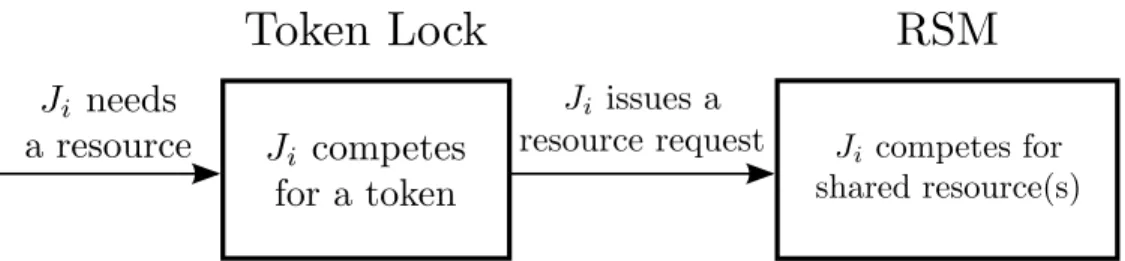
3.2 RNLPArchitecture . . . 53
3.3 Request Satisfaction Mechanisms . . . 58
3.3.1 Spinning . . . 59
3.3.2 Unrestricted Boosting . . . 59
3.3.3 Restricted Segment Boosting . . . 60
3.3.4 Inheritance . . . 61
3.3.5 Donation . . . 63
3.4 Token Locks . . . 64
3.4.1 SpinT-exclusion . . . 64
3.4.2 CK-OMLP for Clustered Systems . . . 65
3.4.3 Trivial Token Lock for S-Aware Analysis . . . 67
3.5 Dynamic Group Locks . . . 69
3.5.1 Dynamic Group Lock Rules . . . 69
3.5.2 Dynamic Group Lock Analysis . . . 70
3.6 Fine-Grained Blocking Analysis . . . 72
3.7 Chapter Summary . . . 77
Chapter 4:RNLPExtensions . . . 79
4.1 R/W RNLP . . . 82
4.1.1 R/W RNLPArchitecture . . . 84
4.1.2 Analysis . . . 90
4.1.2.1 Entitlement Analaysis . . . 90
4.1.2.2 Blocking Analysis . . . 94
4.1.2.3 Fine-grainedR/W RNLPBlocking Analysis . . . 96
4.1.3 R/W RNLPOptimizations . . . 101
4.1.3.2 R/W Mixing . . . 101
4.1.3.3 R-to-W Upgrading . . . 102
4.1.3.4 Incremental Locking . . . 103
4.1.4 Implementation. . . 104
4.2 Multi-Unit Multi-Resource Locking . . . 107
4.3 Evaluation . . . 109
4.3.1 R/W RNLPEvaluation . . . 109
4.3.2 k-exclusionRNLPEvaluation . . . 113
4.4 Chapter Summary . . . 118
Chapter 5: Synchronization Algorithms for Shared Hardware Resources . . . 119
5.1 k-exclusion . . . 121
5.1.1 Resource Model . . . 121
5.1.2 Replica-Request Priority Donation . . . 122
5.1.3 R2DGLP. . . 126
5.1.4 R2DGLPEvaluation . . . 130
5.2 Preemptive Mutual Exclusion . . . 135
5.2.1 Resource Model . . . 135
5.2.2 Preemptive Mutual Exclusion on Uniprocessors . . . 137
5.2.3 Preemptive Mutual Exclusion on Multiprocessors . . . 138
5.2.4 Schedulability Analysis . . . 138
5.2.4.1 Demand . . . 141
5.2.4.2 Idleness . . . 143
5.2.4.3 Run-Time Complexity . . . 145
5.3 Half-Protected Exclusion . . . 147
5.4 Evaluation . . . 155
5.5 Chapter Summary . . . 158
6.1 Summary of Results . . . 160
6.2 Other Related Work . . . 162
6.2.1 Shared-Hardware Management and Analysis . . . 163
6.2.2 Contention-Sensitive Locking . . . 165
6.2.3 Improved Soft Real-Time Tardiness Bounds . . . 166
6.3 Future Work . . . 166
6.3.1 GPUs . . . 166
LIST OF TABLES
2.1 Summary of existing single-resource locking protocols and their blocking com-plexity. The column “PMR Pi-Blocking” indicates how long any job in the system (whether it accesses shared resources or not) can be progress-mechanism-related pi-blocked. The column “Per-Request Pi-Blocking” indicates how long a job can
be pi-blocked per request. All listed protocols are asymptotically optimal. . . 38 2.2 Access latency for different levels in the memory hierarchy in the ARM Cortex A9
platform considered in (Kim et al., 2016) as measured using lmbench (McVoy and Staelin, 1996). The L1 is the cache closest to the CPU, and is split between the L1-I, which stores instructions, and the L1-D which stores data. The L2 cache is a
second level further from the CPU than the L1. . . 43
3.1 Configuration and worst-case pi-blocking of theRNLPon various platforms. The columns “Token Lock” and “RSM” describe an instantiation of theRNLPthat pairs a token lock with an RSM. The remaining columns show the blocking complexity
of the resulting locking protocol under the given assumptions just as in Table 2.1. . . 64
4.1 Lock and unlock overheads for read and write requests. The worst-case overhead
reported is the 99thpercentile, to filter the effects of interrupts and other spurious behavior. . . 111
LIST OF FIGURES
1.1 Common architecture for multicore processors. Note that the LLC and memory
banks are shared among all cores. . . 4
2.1 This schedule is possible for the example task system described in Example 2.1. In this particular example,EDFandFPproduce the same scheduling decisions,
assuming tasks are indexed in decreasing priority order. . . 12 2.2 Visual depictions of partitioned, clustered, and global scheduling. . . 14 2.3 Example schedule demonstrating that the example task system in Example 2.2 is
feasible to schedule on two processors. Note thatJ1migrates from CPU 1 to CPU
2 in this schedule. . . 15 2.4 ExampleG-EDFschedule. This schedule depicts the example task system described
in Example 2.3. In this particular example,G-EDFandG-FPproduce the same
scheduling decisions, assuming tasks are indexed in decreasing priority order. . . 17 2.5 Illustration adapted from (Brandenburg and Anderson, 2010a) of the difference
between s-oblivious and s-aware analysis.G-EDFscheduling is assumed. . . 21 2.6 Example of an unbounded priority inversion, described in Example 2.5. . . 23 2.7 Queue structure of thek-FMLPwithk=4. Notably, thek-FMLPgeneralizes the
FMLPby allowingk>1. Each queue is FIFO ordered. Priority inheritance is used
to ensure progress within each wait queue. . . 29 2.8 Illustration of independent and request segments forRSB. . . 30 2.9 Example schedule depicting boosting and co-boosting in RSB. This schedule
depicts only one cluster, of sizec=2, in a larger system. Within the clusterG-EDF
is assumed withRSB. . . 31 2.10 Figure depicting the queue structure of theG-OMLP. The triangular queue structure
represents a priority queue, while the rectangular queue represents a FIFO queue. . . 32 2.11 Example schedule depicting priority donation on two processors scheduled
accord-ing toG-EDF. . . 33 2.12 Example schedule depictingPFlocking. In this example, four tasks are scheduled
on four processors, and therefore the scheduler is inconsequential, allowing us to
2.15 Figure depicting the architecture of a DRAM bank. Data is fetched one row at a time into the row buffer, which acts as a cache of the contents of that row,
accelerating memory lookups until another row is loaded in. . . 42
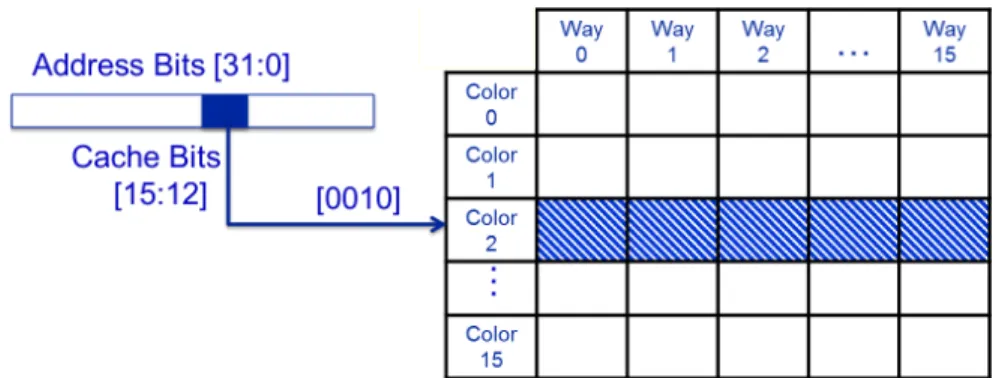
2.16 Depicting the architecture of the set-associative cache in the ARM Cortex A9 platform. Each column represents a way of set associativity, and the 16 colors correspond to 2048 cache sets, 128 cache sets per color. . . 43
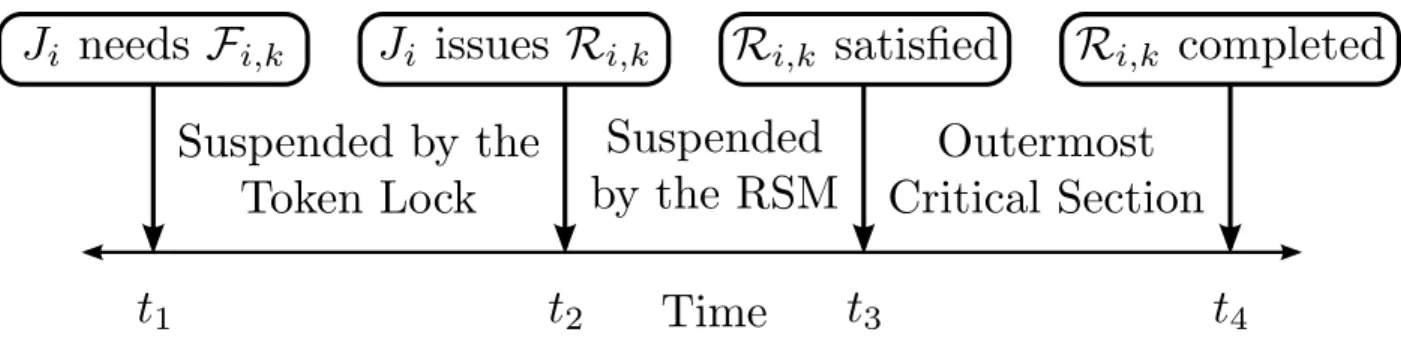
3.1 Illustration of a jobJi’s outermost critical section. At timet1,Jiacquires resource `a. At timet2,Ji issues a nested resource request for`b, and is blocked during the interval[t2,t3). At timet4,Ji releases`a.Ji’s outermost critical section spans from t1tot5whenJino longer holds any shared resources. . . 52
3.2 Architecture of theRNLP. . . 53
3.3 Depiction of the the stages of a request in theRNLP. . . 54
3.4 Illustration of Example 3.1. . . 55
3.5 Illustration of Example 3.2. . . 57
3.6 Phases of a resource request in theRNLP. . . 58
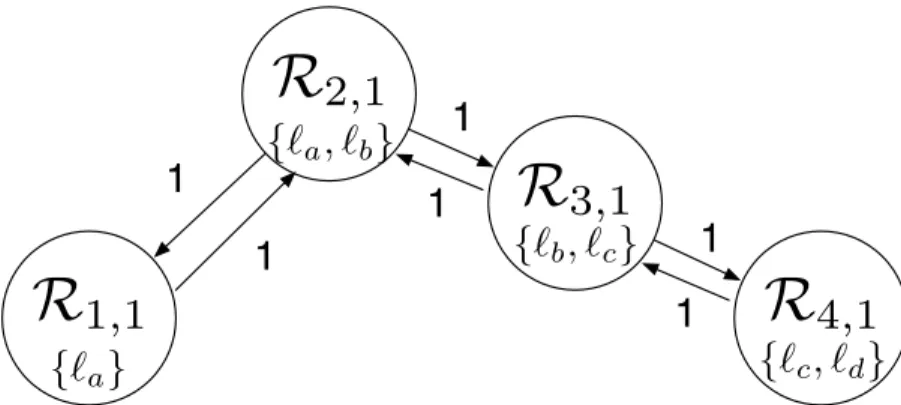
3.7 Depiction of the blocking graph for Example 3.6 whereLx,y=1 for allRx,y. . . 74
3.8 Depiction of the blocking graph for Example 3.6 whereL1,1=2 andL2,1=L3,1= L4,1=1. . . 76
4.1 Illustration of the R/W ordering dilemma. The left and right side of the figure depict alternative places to insert a new write requestRw 4 into the wait-for graph depicted in the middle. . . 81
4.2 Queue structure in the R/W RSM. For each resource`a∈ {`1, . . . , `q}, there is a read queueQraand a write queueQwa. . . 84
4.3 Illustration of the running example. . . 86
4.4 Illustrations of the wait-for graphs of entitled read and write requests. Inset (a) corresponds toRr 5at timet=8, and inset (b) corresponds to Rw2 at timet=7 in Figure 4.3. Note that in inset (a),Rr 5is blocked by at least one satisfied write request, and in inset (b)Rw2 is blocked by at least one satisfied write request. . . 88
4.5 Depiction of the blocking graph G(Γ,Rw5,1,pΓ) corresponding to Example 4.2 assuming that for allτi∈Γ,Lri =Lwi =1. . . 98
4.6 Depiction of the blocking graphG(Γ,Rr4,pΓ)corresponding to Example 4.2 as-sumingLri =Lwi =1 for allτi∈Γ. . . 99
4.8 Figure illustrating the basic queue structure used in previousk-exclusion locking protocols. The arbitration mechanisms in these protocols behave similar to the
token lock of theRNLP. . . 108 4.9 Figure illustrating how DGL can be used to request replicas of different resources. . . 110 4.10 Schedulability results. . . 114 4.11 Sample schedulability results. Inset (a) demonstrates that fine-grained nesting, in
some cases provides little if any advantage over coarse-grained nesting. Inset (b) demonstrates that in other cases, fine-grained nesting can provide more significant
schedulability benefits over coarse-grained nesting. . . 116 4.12 Illustration of the improved schedulability made possible with a higher degree
of resource replication. In this figure, periods are long, per-task utilizations are
medium, andN=2. . . 117 4.13 Illustration of the effect of the number of resources accessed within an
outer-most critical section on schedulability. In this figure, periods are short, per-task
utilizations are heavy, andk=2. . . 117
5.1 Example of the effects of release-blocking under JRPD on aG-EDF-scheduled system withm=2 processors.J4is release-blocked at timet=1 while it donates its priority toJ1. This release-blocking causesJ4to miss its deadline. If instead,J4 had preemptedJ1,J1andJ2would finish three time units later, but still meet their
deadlines. Also, at timet=1,J2is request-blocked byJ1, which holds the shared resource. . . 120 5.2 Phases of a replica acquisition under RRPD. . . 122 5.3 Queue structure used by the CK-OMLP, which is suboptimal when used with
RRPD. Under JRPD, the progress mechanism employed by the CK-OMLP, all replica-holding jobs are scheduled, and thus the total pi-blocking is at mostd(m− k)/keLmax. However, under RRPD, ifJhis the only job with sufficient effective priority to be scheduled, then only one replica-holding job will be scheduled. Thus
Jhmust wait in the wait queue for max((m−k−1)Lmax,0)time, which is suboptimal. . . 126 5.4 Queue structure of theR2DGLP. . . 127 5.5 Figure depicting the task system in Example 5.1. In this example,k=2 andm=4. . . 128 5.6 TheR2DGLPdominates both theCK-OMLPandO-KGLP. This scenario highlights
that release-blocking affects negatively affect theCK-OMLP. . . 132 5.7 TheR2DGLPdominates both theCK-OMLPandO-KGLP. TheO-KGLPperforms
poorly due to additional blocking for resource-using tasks . . . 132 5.8 TheR2DGLPdominates both theCK-OMLPandO-KGLP, and theO-KGLP
dom-inates theCK-OMLP. However, thek-FMLP outperforms theR2DGLP(occurred
5.9 Release-blocking imposes a minimum response time on all tasks. This negatively
affects schedulability of tasks with varying response-time constraints. . . 136 5.10 Comparison of non-preemptive and preemptive scheduling of a shared resource.
Induced idleness (Definition 5.6) occurs when a processor is idle and there are at
leastmpending jobs. . . 139 5.11 Depiction of the overall proof framework. . . 142 5.12 Example schedule depicting half-protected sharing. . . 148 5.13 Three example schedulability graphs. (a) is drawn from the bus synchronization
experiment, and (b) and (c) are from the locking experiment. Task utilizations are
LIST OF ABBREVIATIONS
Abi This has to be removed eventually
DGL Dynamic Group Lock
C-EDF Clustered EDF
DGL Dynamic Group Lock(ing)
DRAM Dynamic Random Access Memory EDF Earliest Deadline First
FIFO First-In, First-Out
FP Fixed Priority
G-EDF Global EDF
GPU Graphics Processing Unit
HRT Hard Real Time
I/O Input/Output
IPC Inter-Process Communication IPI Inter-Processor Interrupt JLFP Job-Level Fixed Priority
L1 Level 1 Cache
L1-I Level 1 Instruction Cache L1-D Level 1 Data Cache
L2 Level 2 Cache
LIFO Last-In, First-Out
LLC Last-Level Cache
LP Linear Program
MMU Memory Management Unit
PCIe Peripheral Component Interconnect Express
PF Phase Fair
P-FP Partitioned Fixed Priority
RAM Random Access Memeory
RSB Restricted Segment Boosting TLB Translation Lookaside Buffer
SOC System On Chip
SRT Soft Real Time
SWaP Size, Weight, and Power
RNLP Real-time Nested Locking Protocol WCET Worst-Case Execution Time
CHAPTER 1: INTRODUCTION
Increasingly, computing systems are being used to sense and interact with the physical world. Examples of such systems include automotive and avionic systems, among many others. In many such systems, computations must be performed within precise time constraints, otherwise there may be catastrophic consequences. These systems are calledreal-time systems. Designers of real-time systems must leverage highly predictable algorithms that can be rigorously shown to realize such timing constraints.
To support the ever-increasingly complex real-time applications that our society demands (e.g., au-tonomous vehicles), more computational power is needed. Multiprocessor and multicore technologies offer the promise of such computational power. Indeed, multiprocessor technologies have enabled huge advances in general-purpose and throughput-oriented application domains where strict timing constraints are absent. In contrast, in real-time systems where tight timing constraints exist and must be rigorously shown to be satisfied, there are a number of challenges associated with leveraging multiprocessor platforms. Many of these challenges chiefly relate to the sharing of resources. While there exists a number of ways to safely share such resources, this dissertation provides many new methods to support such sharing in ways that allow for improved platform utilization.
We begin this chapter with a brief introduction to real-time systems and synchronization. We then describe common multiprocessor architectures and highlight the challenges they impose in the context of real-time applications. We then present the thesis of this dissertation as well as its contributions. Finally, we outline the remainder of the dissertation.
1.1 Real-Time Systems
are hard, if a job may miss a deadline, the system must be characterized asincorrect. There are numerous soft-real-time correctness conditions. Erickson (2014) gave a complete review of soft-real-time correctness conditions in his dissertation.
These types of real-time requirements are common in safety-critical applications, in which the violation of timing constraints may have catastrophic consequences. For example, the airbag controller in a car must detect a crash and deploy the airbag within a predefined time interval so as to ensure the airbag protects the passenger. Missing the deadline in this application can have catastrophic consequences including loss of life, and therefore assurances must be built into the design process to ensure such deadlines will never be missed. In contrast, in many alternative application domains, a system may be considered “real-time” if it permits a seamless user experience. For example, in computer graphics, an application may be considered “real-time” if frames are rendered at approximately 30 frames per second (FPS), resulting in a smooth, realistic user experience. In such applications, there are often no performance assurances (e.g., 30FPS), but in extensive testing, the applications perform well enough to be useful in practice. McKenney (2009) coined the term “real fast” to distinguish such applications from real-time applications with strict timing requirements. The phrase “real time” is also sometimes casually used to refer to information or behaviors that are “live” or very recent. For example, the websitehttp://trendsmap.comprovides “real-time local Twitter trends” showing the most common twitter words or hashtags used in different regions of the world recently.
In the remainder of this dissertation, we exclusively use the term real-time to denote systems in which there exist strict timing requirements. In particular, as will be formalized later in Chapter 2, we consider a real-time workload ortask setconsisting of a set of computationaltasks. Each task is composed of a sequence ofjobs, each of which is a piece of work or computation, associated with which is a deadline by which the job must complete. Jobs arereleasedor made available to execute at a predictable rate or time interval. The jobs arescheduledupon a processor according to a real-time scheduling algorithm. For example,earliest deadline first(EDF)is a well studied real-time scheduling algorithm in which the job with the earliest deadline is always scheduled. A task set, or collection of tasks is deemedschedulablewhen it can be rigorously and mathematically proven that all timing constraints will be satisfied, andunschedulableotherwise.
schedulability analysis can lead toutilization loss, in which some task systems that do not fully utilize the system resources may be deemed unschedulable. Advances in real-time systems seek to minimize utilization loss, so as to better utilize system resources. In turn, this allows for real-time systems to be designed and developed within tighter size, weight, and power (SWaP) constraints.
1.2 Multicore Architectures
Another means of reducing the SWAP of a system is through advances in computer architectures. One of the most important and influential recent advances in computer architecture is the advent of the multicore platform. In a multicore platform, two or more processors are contained within a single integrated circuit. Processor architectures have shifted away from single-core to multicore designs as a result of diminishing returns in instruction-level parallelism, as well as the increasing power demands of higher clock frequencies (Hennessy and Patterson, 2007). Multicore architectures have trickled down from high-performance systems all the way to embedded and real-time systems. For example, many modern commodity phones include as many as eight cores, and the European Space Agency has developed the Next-Generation Multiprocessor (NGMP), a quad-core processor designed for real-time computations, specifically in space-based applications (Fern`andez et al., 2012).
CPU 0
…
L1-I32KB
L1-D 32KB
CPU 3
L1-I 32KB
L1-D 32KB
L2 1MB
DRAM Bank 0 128 MB
DRAM Bank 7 128 MB
…
Figure 1.1: Common architecture for multicore processors. Note that the LLC and memory banks are shared among all cores.
receive only a fraction of the available memory bandwidth. Such contention may seriously affect the timing behavior of real-time tasks by introducing significantanalysis pessimism. This analysis pessimism results in reduced platform utilization as a result of the inability to tightly characterize and analyze the behavior of the system.
This issue of cross-core interference has resulted in what we have coined the “one-out-of-m” problem: when validating real-time constraints on anm-core platform, excessive analysis pessimism can effectively negate the processing capacity of the additionalm−1 cores so that only “one core’s worth” of capacity is available (Erickson et al., 2015; Kim et al., 2016). In fact, due precisely to such effects, the current best practice in safety-critical domains such as avionics is to turn off all but one core in a multicore processor. To address this issue, the U.S. Federal Aviation Administration (FAA) Certification Authorities Software Team (CAST) (2014) recently released a position paper (known in the community as CAST-32) on multicore processors that identifies sources of shared-hardware interference, and suggests that the effects of such interference be identified, analyzed, and certifiably mitigated. Several of the core objectives in my dissertation address these concerns through new models for mitigating such shared-hardware interference.
1.3 Synchronization
Indeed, with the advent of the multicore era, in order to leverage the computing capacity of additional cores, workloads must be parallelized to execute on multiple cores concurrently. All but the simplest parallel algorithms require shared state or communication among concurrently executing threads. In order to realize the benefits of the increased computational capacity of modern multicore platforms in the context of real-time systems, synchronization algorithms are required that allow for run-time parallelism that can be reflected in improved analytical worst-case behaviors. In turn, bounds on the worst-case behavior are then incorporated into schedulability analysis. Therefore, improving the worst-case synchronization behavior affords better overall platform utilization.
Many synchronization algorithms have been developed for multiprocessor real-time systems,e.g., (Block et al., 2007; Brandenburg, 2014; Brandenburg and Anderson, 2014; Gai et al., 2001; Rajkumar, 1991). However, one serious limitation of most previous multiprocessor synchronization algorithms is their lack of support forfine-grained locking, orlock nesting, for resources shared among multiple processors. Nested requests, which are commonly employed in practice to improve run-time parallelism, are only indirectly supported through the use of coarse-grained locking techniques such asgroup locks. A group lock treats a set of shared resources as a single resource, and arbitrates access to the group using a single-resource locking protocol (Block et al., 2007; Rajkumar, 1990). In contrast, under fine-grained locking, different resources are locked individually, which enables concurrent accesses of separate resources. Clearly, fine-grained locking is desirable in practice, and should result in improved worst-case performance.
1.4 Thesis Statement
The thesis supported by this dissertation is broadly motivated by the need to solve the “one-out-of-m” problem. While there are many avenues to address this important problem, in this dissertation we focus on the issues that arise due to resource sharing among cores. We thus consider resources that are shared explicitly via semaphores, as well as shared hardware resources that are often shared implicitly,i.e., contention for the resource may be managed (suboptimally) in hardware. Towards this end, we present the following thesis statement:
“Dependencies among tasks in real-time systems through shared resources, both memory objects, as well as shared hardware resources, can be managed through synchronization protocols. Such protocols can be designed to exploit the inherent sharing constraints of the managed resources in order to achieve improved resource utilization.”
To support this thesis, we have designed and developed new synchronization algorithms, formalized new sharing constraints, and evaluated the proposed algorithms with respect to real-time schedulability.
1.5 Contributions
In the remainder of this chapter, we overview the contributions that support this thesis, and overview the organization of the remainder of the dissertation.
1.5.1 RNLPFamily of Asymptotically Optimal Fine-Grained Multiprocessor Locking Protocols
In Chapter 3, we present the firstfine-grainedmultiprocessor real-time locking protocol, theReal-Time Nested Locking Protocol(R/W RNLP). This solves a glaring open problem raised by previous work on multiprocessor real-time synchronization, that one job could not hold two locks simultaneously. As a result, onlycoarse-grainedlocking was allowed, in which resources that may need to be accessed concurrently were grouped, and the group was treated as a single lockable entity. In contrast, with fine-grained locking as provided by theRNLP, resources may be individually locked, reducing blocking and improving platform utilization.
analysis-assumption combination, theRNLPcan be configured to achieve asymptotically optimal worst-case blocking. All of the differentRNLPconfigurations give rise to a family of mutual exclusion (mutex) locking protocols. In Chapter 4, we present extensions of theRNLPthat support alternative sharing constraints including reader/writer andkexclusion. These alternative sharing constraints allow for improved blocking in many cases, and can be used to improve overall platform utilization.
1.5.2 Synchronization Algorithms for Shared Hardware Resources
While theRNLP family of protocols and extensions thereof were primarily designed to be used to arbitrate access to shared memory objects, it has been used to in the context of shared hardware resources as well (Ward et al., 2013b). Through the application of theRNLPin this domain, we learned that shared hardware resources have inherently different synchronization requirements than shared memory objects. In Chapter 5, we present two new resource-sharing constraints (e.g., mutex, k-exclusion, reader/writer), designed expressly for arbitrating access to shared hardware resources in an effort to improve the temporal predictability of tasks using those resources. The first such sharing constraint is call premptive mutual exclusion, and it is motivated the need to manage resources such as data buses. The second sharing constraint is calledhalf protected exclusion, and it is motivated by the need to manage access to caches.
Additionally, we present theR2DGLP, an optimalk-exclusion locking protocol that has been applied and proven highly useful in the context of predictably controlling access to multiple graphics processing units(GPUs)(Elliott, 2015; Elliott et al., 2013). Furthermore, theR2DGLPcan be used as a “plug-and-play” component in theRNLPto achieve improved blocking bounds in some cases.
1.5.3 Idleness Analysis
Traditionally, to incorporate the effects of synchronization algorithms into schedulability analysis, blocking analysisis conducted to determine the worst-case blocking behavior, and the results of blocking analysis are incorporated into schedulability analysis. In Chapter 5, we present an alternative analysis framework for incorporating the effects of synchronization into schedulability analysis. We call this analysis technique,idleness analysis. By directly analyzing idleness, we “flip the analysis.” Instead of asking “how long can this request be blocked?” we instead ask “how much idleness can this request cause?”
other synchronization algorithms. We explore empirically how idleness analysis compares with traditional blocking analysis, and show cases in which each approach is superior to the other.
1.5.4 Evaluation
In Chapters 4, and 5 we present results from schedulability studies were conducted to evaluate the improved platform utilization made possible through the aforementioned synchronization algorithms and associated analysis techniques. In this schedulability study, task systems are randomly generated based on a number of task-system parameters, and then evaluated for schedulability assuming a number of combinations of synchronization and scheduling algorithms. This is thede factostandard means of evaluating the proposed synchronization algorithms and analysis techniques.
The results of these schedulability studies reinforce that analytical conclusions drawn in previous chapters, and demonstrate the extent to which platform utilization can be improved through the techniques presented in this dissertation.
1.6 Organization
CHAPTER 2: BACKGROUND AND PRIOR WORK
In this chapter, we present the requisite background material for understanding the contributions of this dissertation. We begin with real-time task models and schedulability. We then define models for shared resources, and cover related work on real-time synchronization. Finally, we present relevant features and functionality of shared caches, memory buses, and GPUs, which motivate the synchronization problems and solutions presented in Chapter 5.
2.1 Real-Time Scheduling
Before we can describe synchronization-related resource models, we must first formally define models for tasks. To begin, we present these task models assuming that all tasks are independent. Later, we extend such models to consider shared resources. Formally specifying the task and resource models is a necessary first step towards towards formal schedulability analysis.
2.1.1 Task Model
In this dissertation, we consider the well-studied sporadic task model (Mok, 1983). In this model, a task systemΓis composed ofn sporadic tasksΓ={τ1, . . . ,τn}that are scheduled onmprocessors.1 Each task
τiis composed of a (potentially infinite) sequence of jobsJi,1,Ji,2, . . ., which are released sequentially. For convenience of notation, we letJidenote a job ofτi, when the job index is inconsequential. Each taskτiis characterized by a tupleτi= (ei,di,pi). Theworst-case execution time(WCET)of any job ofτiis denotedei. A jobJi,j is released (arrives) at timeai,j, and successive jobs ofτiare released with a minimum separation2 ofpi,i.e.,
ai,j−ai,j−1≥pi. (2.1)
1We use the terms “processor,” ”core,” and “CPU.” interchangeably.
2The sporadic task model is an extension of theperiodic task model(Liu and Layland, 1973), which specifies anexactrelease
JobJi,jcompletes (finishes) at time fi,j. Therelative deadline diofτispecifies the time after the job release ai,jby whichJi,jmust complete, called theabsolute deadlineofJi,jdenotedDi,j.
Di,j,ai,j+di (2.2)
Task systems with pi=di for all tasks are called implicit deadline, and are sometimes denoted using a two-tupleτi= (ei,pi)notation for simplicity. Task systems withdi≤piare calledconstrained deadline, and task systems containing tasks withdi>piare calledarbitrary deadline.
There exists aprecedence constraintbetween successive jobs in thatJi,j cannot be scheduled before Ji,j−1completes. Theresponse time ri,jof a jobJi,jis the time between its release and its completion.
ri,j, fi,j−ai,j (2.3)
Theutilizationofτi isui=ei/pi, and the total processor utilization isU=∑ni=1ui.
For hard real-time (HRT) schedulability, the response time of each jobJi,jmust satisfyri,j≤di. However, for soft real-time (SRT) scheduling, some deadline misses are acceptable. In this dissertation, we adopt the notation for lateness and tardiness as defined by (Devi, 2006; Erickson, 2014).Latenessis defined by
li,j, fi,j−Di,j. (2.4)
Lateness is negative for a job completing before its deadline.Tardinessis defined to be non-negative lateness.
xi,j,max(0,li,j) (2.5)
2.1.2 Scheduling
There exist a number of different policies for scheduling the aforementioned tasks onmprocessors. We begin our review of such schemes by considering the single-processor case, in whichm=1. A scheduling policy can be viewed as a prioritization scheme, and the highest-priority job is scheduled at any given point in time. One such well-studied prioritization scheme isfixed priority(FP), in which each task is assigned a static priority.RMscheduling is aFPscheduling policy in which tasks are prioritized in decreasing order by period,i.e., the shortest-period job is assigned the highest priority. Another well-studied prioritization scheme isearliest deadline first(EDF), in which each job is prioritized by its deadline, with the job with the earliest deadline having the highest priority.EDFis an example of adynamic-priorityscheduling algorithm, as different jobs of the same task may have different priorities. In this dissertation, we considerjob-level fixed-priority(JLFP)schedulers, in which the priority of each job is fixed. BothEDFandFPscheduling are examples of JLFP schedulers.
Example 2.1. Consider the example task system depicted in Figure 2.1. In this task system, τ1= (1,3),
τ2= (2,6), andτ3= (4,12). UnderFPscheduling, assuming lower-indexed tasks are higher priority,τ1is scheduled at time 0. When it completes at timet=1,τ2executes until it completes at timet=3. Also at t=3, the next job ofτ1 is released, which has the highest priority and therefore begins running. At time t=4,τ1completes its second job. Becauseτ2has no ready job,τ3begins running. At timet=6, another job ofτ1 is released, and it begins running. This is an example of apreemption, in whichτ3was “paused” to allow the higher-priority task to execute. The schedule continues in a similar fashion until timet=10, when
τ3resumes execution, and runs until its completion at timet=12.
Note that if jobs were instead prioritized by deadlines with ties broken in favor of the lower-indexed task, the same schedule would result in this particular example task system. In general,EDFandFPdo not
produce the same schedule. ♦
Non-T T T T
T
Scheduled
𝜏1
𝜏2 𝜏3
Deadline Release
TCompleted
T T
0 5 10 time
Figure 2.1: This schedule is possible for the example task system described in Example 2.1. In this particular example,EDFandFPproduce the same scheduling decisions, assuming tasks are indexed in decreasing priority order.
preemptive blocking can lead to poor resource utilization, and therefore, unless otherwise specified, we focus on preemptive schedulers in this dissertation.
2.1.3 Schedulability
To use a given scheduling algorithm in a real-time system, a schedulability testmust be applied to evaluate whether all jobs will provably satisfy their timing constraints. If a schedulability test returns true (false), we say the task system isschedulable(unschedulable). In our discussion of schedulability, we begin by describing the uniprocessor case before addressing the complexities that arise when adding additional processors.
Clearly, a task system that overutilizes the processor,i.e., has a utilization exceeding one, cannot meet its timing constraints as jobs will complete progressively later and later. This is an example of a task system that isinfeasible, or impossible to schedule such that all timing constraints are satisfied. If a scheduling algorithm exists that can schedule a task system while satisfying all timing constraints, then that task system isfeasible. In the seminal work of Liu and Layland (1973), it was shown that underEDFscheduling an implicit-deadline task system is HRT schedulable if and only if
U≤1. (2.6)
A schedulability test may be eitherexact, orsufficient. A sufficient schedulability test is one in which the task systemmaybe correctly scheduled, but due to pessimistic or imprecise analysis, the schedulability test cannot show the task system to be schedulable. If a task system can be correctly scheduled, then an exact schedulability test must return that the task system is schedulable. Therefore, the aforementionedEDF
schedulability test in (2.6) is an exact schedulability test. Liu and Layland (1973) presented a sufficient schedulability condition forRMscheduling of implicit-deadline task systems:
U≤n(21n−1). (2.7)
A task system with utilizationn(21n −1)<U≤1 is feasible to schedule, and indeed schedulable withEDF, but is not deemed schedulable by this schedulability condition. We call thisutilization loss, as it represents processor utilization that cannot be used, at least analytically, either due to pessimistic schedulability analysis, or a suboptimal scheduling algorithm. Work on scheduling and schedulability tests, a central theme of work in real-time system research, strives to minimize utilization loss. This is a particularly active area of research for multiprocessor systems, where additional processors add significant complexity to scheduling and schedulability analysis.
Response-time analysis. The schedulability conditions in (2.6) and (2.7) are bothutilization-based schedu-lability tests, in that they only consider the total task-system utilization in determining scheduschedu-lability. Utilization-based schedulability tests are very easy to check, usually in polynomial time, but are often subject to greater utilization loss than other schedulability tests. Schedulability conditions based onresponse-time analysis (RTA) often reduce utilization loss at the expense of more complex analysis. RTA is used to determine an upper bound on the response time of any job of each task. Such bounds are compared to the relative deadline of the corresponding task to determine if the task system is schedulable. Joseph and Pandya (1986) presented the first RTA forFPscheduling.
Theorem 2.1. (Joseph and Pandya, 1986). LetΓ={τ1, . . . ,τn}denote a set of constrained-deadline sporadic tasks indexed in order of decreasing priority. On a uniprocessor, underFPscheduling, the response timeri of taskτiis bounded by the smallestRi≥ei, that satisfies the following equation:
Ri=ei+ i−1
∑
j=1Ri pj
Ready Queue
Processors
Ready Queue
Ready Queue
Ready Queue
(a) Partitioned.
Ready Queue
Processors
Ready Queue
C
lu
st
e
r
1
C
lu
st
e
r
2
(b) Clustered.
Ready Queue
Processors
(c) Global.
Figure 2.2: Visual depictions of partitioned, clustered, and global scheduling.
This recurrence can be iteratively computed starting withRi=eiand re-evaluating until both the left and right sides of the equation converge. This convergence is guaranteed ifU≤1 (Joseph and Pandya, 1986). Furthermore, this convergence will occur in a pseudo-polynomial number of operations. RTA forms the basis of many schedulability tests for a number of different schedulers and extended task models.
Multiprocessor schedulability. In the multiprocessor case, in whichm>1, there are additional factors to consider in the development of scheduling algorithms. Underglobal scheduling, themhighest-priority jobs are scheduled at any given time. Alternatively, underpartitioned scheduling, tasks are statically assigned to processors, and each processor is scheduled according to a uniprocessor scheduling algorithm. Clustered schedulingis a hybrid of these two approaches in which tasks are assigned to a specific group or cluster of processors, and global scheduling is applied within each cluster. These three scheduling approaches are visually depicted in Figure 2.2. Notationally, we letcbe the size of each cluster, and therefore there are mc clusters. With this notation, global and partitioned scheduling are special cases of clustered scheduling in whichc=mandc=1, respectively. These different scheduling alternatives give rise to different challenges with respect to synchronization, as we will discuss in more detail later.
Scheduled On CPU 1
J1
J2
J3
Deadline Release
TCompleted
0 5 10 time
Scheduled On CPU 2
T T
T
Figure 2.3: Example schedule demonstrating that the example task system in Example 2.2 is feasible to schedule on two processors. Note thatJ1migrates from CPU 1 to CPU 2 in this schedule.
Example 2.2. Consider a task system with three tasks,Γ={(2,3),(2,3),(2,3)}. The total utilization of this task system is two, but there is no partitioning of tasks to two processors that does not overutilize at least one processor—every partitioning has one processor with at least two tasks; that processor is thus overutilized with a utilization of 43. This task system is therefore infeasible under partitioned scheduling. However, as depicted in Figure 2.3, the task system is feasible to schedule on two processors. ♦
Global scheduling. An alternative to partitioned scheduling and the aforementioned bin-packing-related utilization loss is global scheduling. However, global scheduling requires new schedulers and schedulability analysis that considers the task system being scheduled on multiple processors. (Global schedulability analysis is also applied to each cluster withc>1, similarly to how uniprocessor schedulability analysis is applied to each partition withc=1.) Given the observation of bin-packing-related utilization loss in Example 2.2, is there a global scheduling algorithm that is optimal, similar toEDFon a uniprocessor?
1996) algorithms such asPD2 (Srinivasan and Anderson, 2002), andRUN(Regnier et al., 2011), which are optimal for implicit-deadline task systems. One common trait of all optimal multiprocessor schedulers is that they arejob-level dynamic priority(JLDP)schedulers, and therefore the priority of individual jobs may change during execution.JLDPalgorithms often incur more preemptions thanJLFPalgorithms, and incur higher runtime overheads due to the need to change job priorities (Brandenburg, 2011). More efficient optimal scheduling algorithms are an active area of research, and we refer the reader to Nellisen (2012) for an excellent presentation of several such algorithms, as well as a discussion of optimal multiprocessor scheduling.
In addition to the increased overheads associated with JLDPscheduling, priority changes also add complexity to the design of synchronization algorithms. While there do exist techniques for synchronization in some optimal schedulers (Holman and Anderson, 2006), the vast majority of work on real-time synchro-nization focuses onJLFPschedulers, which are more efficient in practice. For these reasons, we also focus exclusively onJLFPschedulers in the remainder of this dissertation.
Global JLFPschedulers. Suboptimal schedulers inherently suffer from utilization loss. However, the runtime efficiency of the scheduling algorithm itself, as well as the accuracy of the associated schedulability analysis can make suboptimal schedulers preferable to optimal schedulers in practice. This is indeed the case for two well-studied global scheduling algorithms,global fixed priority(G-FP)andglobal earliest-deadline first (G-EDF). Both G-FPand G-EDF generalize their uniprocessor counterparts by scheduling them highest-priority jobs at any given point in time.
Example 2.3. Consider again the example task system described in Example 2.1. If instead that task system were scheduled on two processors, the resulting schedule would be that depicted in Figure 2.4. At timet=0, bothJ1,1andJ2,1are scheduled. At timet=1,J1,1completes, allowingJ3,1to begin. At timet=3 when J1,2is released, it need not preempt another job, as in Example 2.1, but instead may be scheduled on the idle
processor. The schedule proceeds similarly. ♦
T T T T
T
Scheduled on CPU 1
Deadline Release
TCompleted
T
Scheduled on CPU 2
T
𝜏1
𝜏2 𝜏3
0 5 10 time
Figure 2.4: ExampleG-EDFschedule. This schedule depicts the example task system described in Exam-ple 2.3. In this particular examExam-ple,G-EDFandG-FPproduce the same scheduling decisions, assuming tasks are indexed in decreasing priority order.
multiprocessor schedulability conditions. Bertogna and Baruah (2011) provide a summary of seven different incomparableG-EDFschedulability conditions. Many of these conditions are implemented in the publicly available library SchedCAT(SchedCAT, 2016), which is used in the evaluation in subsequent chapters. Specifics concerning the derivation of these schedulability conditions are not essential background to the contributions of this dissertation, so we refer the interested reader to (Baruah et al., 2015; Bertogna and Baruah, 2011; Brandenburg, 2011) for further discussion.
Soft real-time schedulability. There exist many applications in which some deadline misses are acceptable, particularly if allowing for such deadline misses reduces utilization loss. Many multimedia applications fall into this domain—some deadline misses may degrade the user experience and should be avoided, but do not have catastrophic consequences.
Devi and Anderson (2005) showed that under the bounded-deadlines-tardiness definition of SRT schedul-ing,G-EDFhas no utilization loss and is therefore optimal. Therefore, under SRT timing constraints, the
G-EDFschedulability condition is
U≤m. (2.9)
Furthermore, Devi and Anderson (2005) showed that, assuming 2.9 holds, the deadlines tardinessxiof any job is upper bounded by
xi=ei+
Em−1−emin m−Um−1
whereEm−1andUm−1denote the sum of the largestm−1 execution times and per-task utilizations, respec-tively, andemin denotes the smallestei. In subsequent work, tardiness bounds were improved (Erickson, 2014), and computed on a per-task basis. Furthermore, it has been shown that if tasks are prioritized by apriority pointor “pseudo deadline” in a fashion similar toG-EDF, then tardiness bounds can be further reduced. Erickson et al. (2014) showed how these priority points can be set via a linear program (LP). This LP framework allows the LP solver to optimize the priority-point settings subject to different optimization objectives (e.g., maximum per-task tardiness), and/or tardiness-bound constraints (e.g.,xi≤10 ms). In the context of this dissertation, however, we consider only SRT schedulability, and assume that the tardiness bounds derived via the above methods are sufficient.
2.2 Real-Time Synchronization
In the previous discussion, and indeed much of the published scheduling-theory literature, tasks are assumed to beindependent, in that they do not share resources or otherwise have any dependencies among them. However, in practice many dependencies exist, and the aforementioned models and analysis techniques must be extended to support such dependencies. In this dissertation, we exclusively consider dependencies that arise due to resource sharing.
2.2.1 Resource Model
requests to be satisfied. A job that has been released but has not yet completed ispending. A job that can be scheduled isready; thus, a job that is suspended and waiting for a shared resource is pending but not ready. Granularity of locking. A resource is a logical abstraction of a single lockable entity. This entity may itself be composed of a number of other elements or abstractions. For example, a list data structure may be a resource that is treated as a single lockable entity, even though it consists of a number of list elements. If resources are logical abstractions of large or complex objects or data structures, we say that the synchronization iscoarse-grained. In contrast,fine-grainedlocking allows for individual elements within a larger data structure to be accessed individually. Perhaps the best example of coarse-grained locking is older versions of the Linux kernel (e.g., versions 2.0–2.2), which employed abig kernel lock, with the functions lock kernel()andunlock kernel(), which guard access to most of the linux-kernel data structures as a single resource. The granularity of locking in this example is very coarse. Over time the kernel was modified to use fine-granularity locking (notably in versions between 2.4 and 2.5), and eventually the big kernel lock was completely removed (version 2.6.37).
Coarse-grained locking is much easier to use as a developer, as developers need not concern themselves with possible states that may arise when different tasks access different resources concurrently. However, coarse-grained locking serializes potentially non-conflicting requests, or requests that do not operate on the same resources. Therefore, fine-grained locking can reduce the blocking that tasks experience while waiting for shared resources. To support fine-grained locking, it is necessary tonestlock requests, or allow a resource-holding job to issue a request for another resource within its critical section. While in practice the granularity of locking is application specific, for the purpose of this dissertation, we say that a locking protocol that supports a single job holding multiple resources concurrently supports fine-grained locking. Protocols that do not support fine-grained locking are coarse-grained locking protocols.
Locking protocols can cause tasks to wait orblockwhile others execute critical sections. Apriority inversionoccurs if a high-priority job is blocked waiting for a low-priority job to complete its critical section. Such blocking is an example ofpriority-inversion blocking(pi-blocking). This can affect the scheduling decisions that are made, and therefore must be incorporated into schedulability analysis. The first step in this process, is to formally analyze priority-inversion blocking.
2.2.2 Blocking Analysis
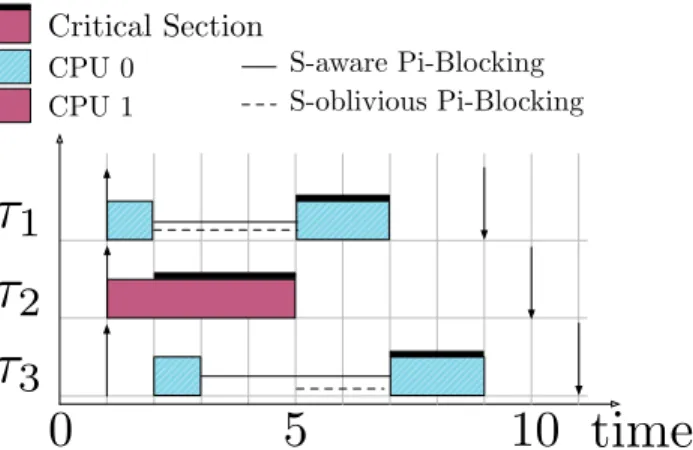
Brandenburg and Anderson (Brandenburg and Anderson, 2014) formalized two classes of techniques to incorporate the effects of priority-inversion blocking into schedulability analysis for suspension-based locking protocols:suspension-oblivious(s-oblivious)analysis, in which suspensions due to pi-blocking are modeled as computation, andsuspension-aware(s-aware)analysis, in which suspensions due to pi-blocking are incorporated directly into schedulability analysis. These techniques rely upon different definitions of pi-blocking given next, which are visually compared in Figure 2.5.
Definition 2.1. Unders-awareschedulability analysis, a jobJiincurss-aware pi-blockingat timetifJiis pending but not scheduled and fewer thanmhigher-priority jobs areready.
Definition 2.2. Unders-obliviousschedulability analysis, a jobJiincurss-oblivious pi-blockingat timetif Jiis pending but not scheduled and fewer thanmhigher-priority jobs arepending.
For spin-based locking protocols, there is a third type of pi-blocking.
Definition 2.3. A jobJiincursspin-based blocking(s-blocking)at timetifJiis spinning (and thus scheduled) waiting for a resource.
Note that spin-based blocking is computation, as the task actually occupies a processor while spinning. In comparison, both s-oblivious and s-aware pi-blocking bound times in which the task is suspended and therefore not executing.
0
5
10
⌧
1
⌧
2
⌧
3
CPU 0
CPU 1 S-oblivious Pi-Blocking
S-aware Pi-Blocking Critical Section
time
Figure 2.5: Illustration adapted from (Brandenburg and Anderson, 2010a) of the difference between s-oblivious and s-aware analysis.G-EDFscheduling is assumed.
Now let us consider the blocking that occurs in this schedule. First, consider the blocking byτ1during t∈[2,5).τ1is the highest priority job and therefore there are no higher-priority pending or ready jobs, so by Definitions 2.1 and 2.2,τ1is both s-aware and s-oblivious pi-blocked during this interval.
Next consider the blocking byτ3duringt∈[3,5).τ1is pending but not ready, as it is suspended, and therefore only one higher-priority task,τ2is ready. By Definition 2.1,τ3is s-aware pi-blocked during this interval. However, bothτ1andτ2are pending duringt∈[3,5), and therefore by Definition 2.2,τ3 is not s-oblivious pi-blocked. Afterτ2completes at timet=5,τ3becomes both s-aware and s-oblivious pi-blocked.
♦
An intuitive way to think about s-oblivious vs. s-aware pi-blocking is to consider the suspensions of higher-priority jobs as if they occupied a processor. If a taskτiis blocked but allmprocessors are busy, either with actual computation, or the suspensions of higher-priority jobs, which we are thinking of as occupying a processor, thenτiis not s-oblivious pi-blocked. This observation is reflected in the following corollary to Definition 2.2
Corollary 2.1. A jobJimay only be s-oblivious pi-blocked if it is among the topmhighest-priority pending jobs.
This corollary in particular informs the design of many locking protocols, which we will discuss later in this section.
protocols employ a progress mechanism such as priority inheritanceor priority boosting (described in more detail later) to ensure that a resource-holding job is scheduled. These progress mechanisms work by increasing the priority of a task from its original or base priority, to a highereffective priority. For example, if a low-priority resource-holding job is priority boosted (or scheduled at the highest priority) to ensure progress, then a high-priority non-resource-accessing job may be pi-blocked, as it is pending but not scheduled. This gives rise toprogress-mechanism-related(PMR)pi-blocking,3as a lower-priority job can execute while a higher-priority job is forced to wait, even if it has not issued a resource request. This second source of blocking can introduce a great deal of analysis pessimism, as it affects all tasks, regardless of whether they access shared resources or not. Brandenburg (2013a) defined a locking protocol with no progress-mechanism-related pi-blocking to beindependence preserving, because independent tasks are not affected by the progress mechanism of the dependent, resource-using tasks.
Incorporating blocking into schedulability analysis. S-oblivious and s-aware pi-blocking bounds are used in different schedulability tests. S-oblivious pi-blocking bounds can be incorporated into schedulability tests that do not explicitly model suspensions by inflating the execution time of each task by its s-oblivious pi-blocking bound. Analytically treating suspensions as computation is safe as the corresponding schedule without suspensions will have response-time bounds at least that of the schedule with suspensions. This s-oblivious approach allows for blocking bounds to be easily applied in the context of many schedulability tests developed for independent systems, discussed in the previous section.
Alternatively, schedulability analysis may besuspension-aware. In such s-aware schedulability tests, the maximum suspension length is incorporated into the task model, and the effects of those suspensions are dealt with explicitly in the schedulability test. Such tests can be used to account for the effects of blocking by treating s-aware blocking bounds as the suspension lengths. For example, Liu and Anderson (2013) extended the schedulability test of Baruah (2007) to consider tasks that suspend. Suspensions are notoriously difficult to tightly analyze, and indeed such analysis is NP-complete in the strong sense (Ridouard et al., 2004). Consequently, there exist fewer s-aware schedulability tests, especially for multiprocessor systems. Furthermore, many studies have shown s-oblivious blocking analysis to be competitive, if not preferable to, s-aware analysis in many cases (Brandenburg, 2011, 2014; Ward, 2015). For a more complete discussion 3Under some locking protocols and analysis assumptions, PMR pi-blocking can only occur at job release, and in such cases is
Scheduled
T1
T2
T3
Deadline Release
TCompleted
0 5 10
Scheduled with resource
T
T
T
time
Figure 2.6: Example of an unbounded priority inversion, described in Example 2.5.
of suspensions and suspension-aware schedulability analysis, we refer the interested reader to (Chen et al., 2016) and (Liu, 2013).
2.2.3 Prior Real-Time Synchronization Algorithms
Next we review prior real-time synchronization algorithms. As in previous discussions, we start again with results for uniprocessor platforms, before we review multiprocessor algorithms.
2.2.3.1 Priority Inheritance Protocol (PIP) (Sha et al., 1990)
To illustrate the key properties of thePIP, we first illustrate the challenges that were faced in the design of the first real-time locking protocols, which motivate the design of thePIP.
Example 2.5. Consider the example uniprocessorEDFschedule depicted in Figure 2.6. The lowest-priority jobJ3locks a resource at timet=1, and is then preempted at timet=2 byJ1. At timet=3,J1issues a request for the locked resource, and is blocked.J2as the highest-priority ready job is then scheduled until its completion at timet=7. Only then canJ3resume its critical section.J1can only resume afterJ3completes its critical section at timet=8.
Note thatJ1is blocked for the entire duration ofJ2. This is an example ofunbounded priority inversion, as any medium-priority job, even ones that do not access shared resources, can delay the resource acquisition
of the higher-priority job arbitrarily. ♦
blocks. Therefore, if priority inheritance were applied to the previous example,J3would resume execution at timet=3 and execute at the priority ofJ1until it completed its critical section at timet=4. This prevents unbounded priority inversion for the higher-priority jobJ1. Notably, however,J2 experiences an s-aware priority inversion in this case as the lower-priority jobJ3executes even thoughJ2is ready.
The priority-inheritance progress mechanism is used in many real-time locking protocols, both unipro-cessor and multiprounipro-cessor.
2.2.3.2 Priority Ceiling Protocol (PCP) (Sha et al., 1990)
While thePIPsolves the problem of unbounded priority inversion, it is still subject to the possibility ofdeadlock. Deadlock occurs when resource-holding jobs cannot make progress. Consider the following classic example of deadlock.
Example 2.6. Consider a situation in whichJ1holds`aandJ2holds`b. IfJ1 issues a nested request for
`bandJ2 issues a nested request for`a, then the system is deadlocked. `awill not be unlocked until`bis acquired, but`bis waiting for`ato be unlocked. Therefore, neitherJ1 norJ2can make progress and the
system is deadlocked. ♦
ThePCPextends thePIPin such a way so as to prevent the possibility of deadlock. To do so, thePCP
requires that the set of resources that are accessed by each task are knowna priori. This information is used to set thepriority ceilingof each resource`qas the priority of the highest-priority task that accesses`q. When a task locks a resource, thesystem priority ceilingis defined to be the highest priority ceiling of any locked resource.
The goal of the system priority ceiling is to prevent a situation in which deadlock can occur. To do so, a taskτi’s request for an unlocked resource is denied or delayed if its priority is lower than the system priority ceiling (unlessτiwas the task that set the system priority ceiling). Referring back to the previous example, the priority-ceiling rules would prevent the scenario in whichJ1held`aandJ2held`b. Instead, one of these two jobs’s request would be denied thereby preventing the deadlock.
key properties combine to limit the maximum duration of s-aware pi-blocking to at most the duration of one outermost critical section.
2.2.3.3 Stack Resource Policy (SRP) (Baker, 1991)
TheSRPis a clever extension of thePCPthat allows a single runtime stack to be used for all tasks. To show how multiple tasks can share the same stack, we first consider stack sharing in the absence of any synchronization.
If independent tasks are scheduled with a preemptiveFPscheduling algorithm, they can share the same runtime stack. Consider a lower-priority task being preempted by a higher-priority task. The higher-priority task adds its own frame(s) to the runtime stack above the stack frame(s) of the lower-priority job. However, when the lower-priority job resumes, the higher-priority job will have completed, and popped its stack frames off the stack, leaving the stack in the same state as when the preemption occurred. Note, however, that if the higher-priority job ever suspended, for example, to block on a shared resource, then a lower-priority job would resume, but the high-priority job’s stack frames would still be present on the stack. This behavior is seen in Example 2.5 and Figure 2.6.τ1suspends at timet=3, and the preempted lower-priority jobτ3 resumes at timet=7 whileτ1is still on the stack. For this reason, if using thePIPor thePCP, each task must maintain its own runtime stack.
TheSRPallows all tasks to share the same runtime stack, just as in the case of preemptively scheduled independent task systems. To highlight the difference between thePCPand theSRP, let us focus on the scheduling of independent tasks, in a system employing thePCP. The rules of thePCPdo not apply to independent tasks; only tasks that access resources are affected by the rules of thePCP. In theSRP, both independent and resource-using tasks are prevented from executing if their priority does not exceed the system priority ceiling. The system priority ceiling is set just the same as in thePCP.
in practice, thereby reducing overheads, in addition to better utilizing memory by sharing a common runtime stack.4
2.2.3.4 Multiprocessor and Distributed Priority Ceiling Protocol (MPCP) (Rajkumar et al., 1988; Rajkumar, 1990; Sha et al., 1990; Rajkumar, 1991)
The first multiprocessor real-time locking protocols, themultiprocessor priority ceiling protocol(MPCP) and the distributed priority ceiling protocol(DPCP), are both extensions of the uniprocessor PCP for multiprocessor systems (Rajkumar et al., 1988; Rajkumar, 1990; Sha et al., 1990; Rajkumar, 1991).5 The
DPCPis designed for distributed-memory multiprocessors, while theMPCPis designed for shared-memory multiprocessors. Despite the different design objectives, theDPCPis also compatible with shared-memory platforms and so we consider it in our discussion here.
Both theMPCPand theDPCPassumeP-FPscheduling. Resources are classified as eitherlocalif they are shared only by tasks within one partition, andglobalif they are shared among tasks in different partitions. Given the strong synchronization results for uniprocessors discussed previously in thePCPand theSRP, both theMPCPand theDPCPleverage the uniprocessorPCPfor local resources. Global resources, however, are more difficult, as will be described next, and therefore must be handled differently. Specifically, nesting resource requests of global resources is prohibited.
One of the key challenges in the design of multiprocessor synchronization algorithms is the design of the progress mechanism. For partitioned or clustered scheduling, priority inheritance is ineffective in ensuring progress and therefore bounded priority inversions. Intuitively, this is because a taskτl may have a relatively low priority with respect to its processor, but have sufficient priority to be scheduled, while a relatively high-priority taskτhmay not have sufficient priority to execute on another processor due to the presence of other even-higher-priority tasks. Ifτhholds a resource thereby blockingτl, inheritingτl’s priority will not ensure progress. This example demonstrates how priority inheritance is insufficient to ensure resource-holder progress across partitions.
4Sharing a common runtime stack is not a fundamental requirement of theSRP, and indeed it can be implemented with each task
having its own stack.
5TheDPCPwas originally referred to as the “multiprocessorPCP” in (Rajkumar et al., 1988) and theMPCPwas called the “shared
To address this issue, both theMPCPand theDPCPemploy a different progress mechanism called priority boosting. To ensure resource-holder progress, priority boosting unconditionally raises the priority of a resource-holding job to the maximum priority, such that it cannot be preempted by non-resource-using tasks.
In both theMPCPand theDPCP, requests for global resources are satisfied in order of their base priority. The major difference between the two protocols lies in where and how the critical sections are actually executed. In theDPCP, which was designed for distributed memory platforms, each resource is pinned to a single processor. Aremote procedure callis used to request theagentof the resource to actually execute the critical section on the resource. The agent executes these requests with a boosted priority on the processor on which the resource resides, and in the order of the priority of the requesting tasks.
In comparison, theMPCPassumes a shared-memory model, which allows critical sections to be executed directly by the requesting task from any processor. Throughout the duration of any of its critical sections, a global-resource-holding task is priority-boosted. Similar to theDPCP, requests are satisfied in priority order using the priority of the requesting tasks.
For brevity, we omit detailed discussion concerning the blocking analysis of both theMPCPand the
DPCP. However, we note that the original blocking analysis (Rajkumar, 1991)6has since been significantly improved (Lakshmanan et al., 2009).
2.2.3.5 Multiprocessor Stack Resource Policy (MSRP) (Gai et al., 2001)
Just as theMPCPextends thePCPto partitioned multiprocessor platforms, theMSRPalso extends the
SRPto partitioned multiprocessor platforms. As such, there are many commonalities between theMSRPand theMPCP. Resources are classified as either local or global resources, and there can be no nested requests for global resources. TheSRPis used to arbitrate access to all local resources, and non-preemptivefirst-in first-out(FIFO)spinlocks are used to arbitrate access to all global resources. These last two properties are the most significant difference between theMSRPand theMPCP—FIFO queuing is used for global resources instead of priority queueing, and waiting is realized via non-preemptive spinning, instead of suspensions.