Development within Multiple Modernities: Place-based Oppositions to Development Projects along the Ganges River and their Significance
Georgina Drew
A thesis submitted to the faculty of the University of North Carolina at Chapel Hill in partial fulfillment of the requirements for the degree of Master of Arts in the Department of
Anthropology
Chapel Hill 2007
Approved by:
Abstract
GEORGINA DREW: Development within Multiple Modernities: Place-Based Oppositions to Development Projects along the Ganges River and their Significance
(Under the direction of Dorothy Holland, Arturo Escobar, and Charles Price)
Acknowledgements
The journey to writing this paper began in San Francisco where I worked with the International Forum on Globalization in 2003. Through them, I was introduced to Dr. Vandana Shiva. I went on to support her three NGOs in India in 2004. The experience was rewarding even as (and arguably because) it was a crash course on Indian culture, politics, and environmental resource management challenges. As the links continued, I later found myself in the fortunate position of entering the graduate program of anthropology at the University of North Carolina, Chapel Hill. A friendly yet rigorous program full of highly proficient and intelligent people, it has fostered my intellectual growth while providing a valued community of colleagues.
Since entering the program, I have received five Foreign Language Area Studies (FLAS) fellowships for Hindi/Urdu through the North Carolina Center for South Asia Studies (NCCSAS). Through these fellowships, I have improved on language skills needed for work in the northern part of India while expanding my knowledge of South Asia in area studies courses. It was through such a course on the British colonial experience of India at Duke with Professor John Richards that I began looking at the history of development projects along the Ganges.
especially generous with her time. Beyond reading multiple versions of the paper and helping me clean up the pages, she asked me the tough questions I needed to hear and helped me approach some of the answers. M.A. papers teach students how to speak to, and yet beyond, their chosen disciple. With gracious help from Dr. Holland, I believe I was able to achieve this feat. I express my sincere gratitude to Dr. Holland and the other professors that encouraged me.
Numerous other individuals have inspired this work. Jason Drew, Carol Clinton, Chad Clinton, Dorothy Perkins, and Milton Perkins have been lifting me up and dusting me off since I first tried to walk. Through countless acts of compassion, they have taught me about unconditional love and acceptance for others. The department of anthropology at Santa Clara University and the department of international relations at San Francisco State University also helped fuel my intellectual and political drives. Other sources of inspiration include the Social Movements Working Group at the UNC, Chapel Hill and the community members of the Bolin Creek Housing Cooperative in Carrboro, NC.
Table of Contents
List of Figures and Photos viii
Part I. Introduction 1
The Significance of Water for Social Science 3
A Post “Development” Encounter in Tehri 5
On Modernity and Development 8
Places, Nature, and Sites of Connection 12
The Importance of Understanding Human Relationships with Natural Entities 13
Part II. Canal Irrigation Along the Northern Ganges 16
The Ganges River: Physical and Historical Significance 16
British Rule 18
Canal Irrigation as a Colonial Tool 24
Defending a Sacred Place: The Case of Har-ki-pauri Ghat 25
Part III. The Tehri Dam in the Himalayas 30
India Post-Independence: Changes and Challenges 30
Tehri Dam in the Context of Development 33
Opposition to the Tehri Dam 35
To Dam a Goddess… and a Mother? 38
Ecological Concerns 40
Development within Multiple Modernities? 44 Part IV. Looking Forward: The Implications of Honoring Diverse Connections
with Natural Entities 46
List of Figures and Photos
Figure 1: Identifications of the Ganges (“Ganga”) River (in Equilibrium) 2 Photo 1: Sunderlal Bahuguna at his residence above Tehri dam 6 Photo 2: View of the Tehri dam and the reservoir from the porch looking in
the direction of Sunderlal’s gaze 6
Photo 3: Front view of Har-Ki-Pauri Ghat 25
Photo 4: View from Har-Ki-Pauri Ghat 25
Photo 5: Tehri dam before completion 35
Photo 6: The valley above Tehri dam showing the aftermath of the resource
extraction for the earth and rock fill dam 35
“There is just one area of concern… How do we see Ganga?1 Is it a holy river? Is it a river that is treating millions of acres of land for irrigation and so on or is it just a river that is for hydro power generation?... How are we viewing it? What is in our mind?”(Interview with Swami Janardananda, June 13, 2006)2
“The Indian reverence for rivers and mountains can no more be treated as superstitions. In any people-centered development program, the perceptions of the people assume paramount importance” (Bose 1997: 232).
Part I. Introduction
Anthropologists and other social scientists are increasingly applying their analytical tools to explore relationships between humans and other entities in times of social, political, and ecological change. The socio-cultural study of human intersections with water is one area of budding interest and is one of my primary concerns as an anthropologist working in South Asia. Building on historical and contemporary scholarship in preparation for my dissertation research, this paper examines opposition to development projects along the Ganges. It argues that the opposition movements can be seen as placed-based efforts to maintain cultural, religious, and ecological connections with a river that has been an object of reverence in India for millennia. By studying two development projects along the northern part of the Ganges in the colonial and the post-colonial eras, this paper attempts to understand the ways that the distinctive type of modernity brought to India first via colonialism and then
1 “Ganga” is the common name for the Ganges River in India.
neoliberal capitalism has transformed human relationships with the river. The intention is to address the impact of modernity and its projects of development on human connections with natural entities while highlighting proposed and possible alternatives in the case of development along the Ganges.
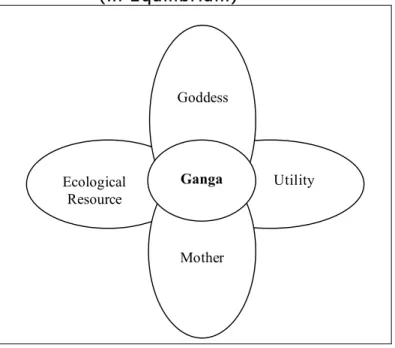
Based on analysis of the opposition to canal works in the early 1900s and the construction of the Tehri dam in the late 1900s, I suggest that the inhabitants near the river were not against “development” as long as they perceived they could maintain their cultural, religious, and ecological connections with the river while receiving improved livelihoods through the benefits of new technologies. This, I believe, is an indication that the kind of development sought was one that was inclusive of multiple modernities and respectful of the various identifications of the river who, as a multi-faceted entity, is not only seen as a utility and an ecological resource but also an embodiment of the divine and a maternal symbol. Figure 1 below is presented to illustrate some of the main identifications of the river. It demonstrates why the term “nature” alone is inadequate to describe the Ganges River.
Figure 1: Identifications of the Ganges (“Ganga”) River (In Equilibrium)
Ecological Resource
Utility
Mother Goddess
The choice of topic is influenced by my concerns about the health of our natural environment and my desire to support the equal access of people to natural resources such as water. The motivation for comparing the two development projects is to situate contemporary approaches to water resource management in India within a historical framework. Influenced by the work of subaltern school of thought, I am aware of my position as a white female of American origin writing on issues that occurred in a distant continent. As Guha (1997) reminds us, all attempts at historical explanation are subjectively construed through an interpretation of the past that includes an irreducible ideological component in every account.
The Significance of Water for Social Science
Water is a necessity for all life. As dependent on water as all other life forms, humans have either organized settlements near water sources or they have come up with the technology to harness and channel water in order to support themselves and their livelihoods. While the amount of freshwater available to humans on the planet has remained the same for millions of years the availability of water per capita has declined due to numerous factors such as population growth, polluting practices, and increased demand for water for agriculture and the generation of electricity. In the case of India—where 16% of the human population lives but where only 4% of the world’s freshwater resources can be found—water is in especially high demand and its management is often a subject of heated debate (UNWWDR 2003).
surrounding river and other water resources. Of all the rivers in India, the Ganges is often cited as being among the most important in the Hindu cosmology since it is honored in classical texts like the Mahabharata and the Ramayana. Historically, it has provided vital nourishment and transportation for the growth and maintenance of settlements. As part of the colonial legacy (see below) the northern part of the Ganges, especially in the region known as the Doab, has been important for irrigating crops and supporting the growth of human populations. Today, nearly 500 million people are estimated to live in the Gangetic basin (Shiva & Jalees 2003).
A Post “Development” Encounter in Tehri
On June 10, 2006, I met with Sunderlal Bahuguna at his home just above the rising reservoir next to the newly completed 260.5 meter (855 feet) tall Tehri dam. The highest dam in Asia, the Tehri dam submerged the historic town of Tehri, including the royal palace of the aristocracy that once ruled the region. It dams the Bhagirathi and the Bhilangana Rivers, two of the first tributaries of the Ganges.3 The dam is the result of two and a half decades of intermittent construction. Its completion follows three decades of opposition efforts that, despite a few victories, were unable to block the completion of the dam and the displacement of more than 100,000 people.
The town of Tehri was once Sunderlal’s home but he was forced to relocate as the rising waters submerged the village. Sunderlal and his wife, Vimala, were among the town’s most famous residents outside of the aristocracy. They gained prominence through their opposition to the construction of the Tehri dam and their prior involvement with the historic Chipko4 (“tree hugging”) movement to preserve Himalayan forests in the area.
3 Some believe that the river only becomes “Ganga” at Devprayag downstream where the Bhagirathi/Bhilangana meets the Alaknanda River but this is a point of controversy.
5 6 Sunderlal’s house, a two story building with wide verandas painted in a bright yellow, serves as an ashram. It is an abode for rest, work, and spiritual growth. From the veranda, the hillside view takes in the girth of the first few kilometers of the reservoir. The vista includes abandoned buildings, junkyards of scrap metal, mounds of soil, and the now idle earth-moving machines that were used to turn the river basin into a cratered wasteland that supplied the “rock and sand fill” for the pyramid-like structure that is the Tehri dam (additional photos in Part III).
Although the day was warm and sunny, the house felt gloomy in its perch on the mountainside. In contrast to the sound of heavy machinery and rushing waters that I had heard in my visit of 18 months prior, a conspicuous silence weighed upon the scene. The only distinguishable noises were the occasional chirping of a passing bird and the sounds of distant cars moving along the road above that passes through the government-built town of New Tehri. The lack of noise punctuated the sense of change. The river no longer flowed freely and the dam’s turbines were scheduled to start the following month.
5 Sunderlal Bahuguna at his residence above Tehri dam. June 2006. Photo by Georgina Drew.
I exchanged pleasantries with Sunderlal before asking him what he was doing to pass the time. He responded in Hindi, “Kuch nahi. Betha rehta hoon. Nadi ko dekhta hoon. Ganga mar gayi.” “Nothing,” he said, “I sit here. I watch the river. Ganga has died.”7
The statement of inaction was perhaps an exaggeration coming from a man that continues to argue on behalf of the displaced for compensation and for the importance of reforestation. In light of this, his emphasis on immobility seemed to be a statement underlining defeat. While saying that he watches the river, he pointed to the waters of the filling reservoir and acknowledged its physical presence. In referring to Ganga, however, his reference was to the divine embodiment of the river. The Goddess is dead, he was saying. After he spoke, he took another look out onto the reservoir in front of us and shrugged his shoulders.
For people like Sunderlal, the completion of the dam represents a loss that is culturally, religiously, and ecologically significant. In the three decades that he was involved in the opposition, Sunderlal spoke and wrote extensively on these issues (see below, Part III). For others, however, the Tehri dam represented something altogether different. Whereas for opponents like Sunderlal, the dam was seen as a regression and a sign of moral decay in an age of materialism, many of the proponents saw the dam as a symbol of India’s “progress” for its productive capacity to provide energy and water to support the country’s rapid growth and development, especially in urban areas like New Delhi. While the stakes were high and many people living along the area set for submergence faced the loss of their homes, their lands, and their “traditional” means of livelihood, some supported the dam in hopes that it would bring them bikas (development). Others saw the dam as a forgone conclusion. Backed
by business and political interests, the project ultimately won the support of policy makers despite warnings that the dam would be unsafe due to its location in a dangerously active seismic zone.
An earlier alteration of the river unfolded with different results. In the early 1900s during the time when the British ruled India, a successful campaign was waged to prevent the loss of a culturally and religiously significant place only a few hundred miles down from the Tehri dam in the town of Haridwar. In that time and place, the British attempted to change the course of the Ganges River, impacting the flow past one of the most important places of worship along the river. As we shall see, a successful campaign was launched to prevent the loss of the site of religious connection between the Ganga and her worshippers. While the documentation is scant, the dearth of reports is a reflection of the low rates of literacy among Indians at the time and the dominance of records in English that reflected colonial interests.
The case of canal irrigation adds historical depth to the analysis of water related development projects in India. It indicates a shift in approach and scale in the management of water resources that the British instituted in India. Projects such as canal irrigation, I argue, were a reflection of British notions of their scientific advancement in an age of modernity. Development projects were tools for promoting modernist notions of “progress”.
On Modernity and Development
inferior past. In this ideology, the values of rationality, linearity, individuality, and the domination of humankind over nature were and are emphasized. Modernity, these scholars argue, shaped the West’s encounters with the non-West by bringing scientific and technical innovations as “development” in the name of “progress”.
The so-called post-development scholars point to the post-World War II era, with its global emphasis on bringing development to the “underdeveloped”, as the birth of powerful discourses that produced subjects in need of the type of development exemplified by Western industrialized countries. The effect of such scholarship has been to encourage the critical examination of the normative salience of development discourses and their limited vision of how the people and resources of the world should be perceived and organized. Given this historical context, the dominant notion of development is understood in this paper as a project operating within the ideology of modernity to promote a notion of progress through
the implementation of technological innovations where the Western experience of
industrialization is the model.
Scholars have offered rebuttals, challenges, and modifications to the critique of development as a project of Western modernity. Some, for instance, question the perception that the West has a monopoly on rationality, individuality, and the dominance of nature. Gidwani (2002) is among those that criticize what he considers the Orientalist logic of post-development scholarship by arguing that, despite attacks on Eurocentrism and modernization theory, such scholarship remains trapped within the “straightjacket” of Eurocentric, modernist thinking. In so saying, he points to archival evidence to assert that “modern” rationalizing processes within economy and society have arisen at different times, over different scales, and in different cultural forms in various regions of the world autonomously of European influence (12). Others complicate the monolithic portrayal of modernist thinking by asserting that India provides examples of “regional modernities” as diverse ethnic, religious, social, and geo-political variations within regions that interact differently with development projects (Shivaramakrishnan & Agarwal, 2003). Arce and Long (2003) also seek to complicate the notion of modernity. In so doing, they call for modernity to be understood as a “heterogeneous dynamism” wherein ambivalence and ambiguity make it possible for differences of interest and knowledge to be contained within provisional arrangements that allow for the resolution of the practicalities of everyday life (3). For them, this means that the actions inspired by modernity can also be appropriated and re-embedded in locally-situated practices. In such processes, the fragmentation and dispersal of modernity enables “constantly proliferating modernities” (1).
the “goodness” (or lack thereof) of development projects is linked to processes of “place-making” set in motion or enabled by development that can transform places in both liberating and oppressive ways (2002: 26). Other scholars, also drawing from examples in South Asia, use the concept of “transnational development regimes” to problematize the assertion that there is a dominating power dynamic emanating exclusively from the West. Such arguments assert that the “subjects” of development (among others) also play important roles in the processes of development (Sinha in press). These assertions attempt to expand apparatuses beyond the state to include the role of non-governmental organizations and “civil society” while adding multi-scalar analyses to articulate the effects of development.
While modernity’s focus on “progress” via development and capitalism was part of a dominant discourse as per post-development scholarship, the Indian context indicates multi-scalar agency with opposition movements trying to shape the size and form of development projects. That is to say, while hierarchical systems operated to make certain discourses dominant, diverse actors were still able to engage with, and sometimes even influence, the debate over development. I suggest, furthermore, that the cases presented here show how opponents of development projects along the Ganges argued, in effect, for the acceptance of multiple modernities by asking for development to be of a scale that would allow the retention of cultural, religious, and ecological connections to the river. Their arguments point to the importance of place as they were, in my understanding, place-based efforts to defend human connections with the river.
Places in Nature as Sites of Connection
of knowing, imagining, experiencing, and investigating nature. Natural objects such as rivers are always in the “being-made”? as they are indissoluble in place and multiply interpellated. Relevant, but for now tangential, is the assertion that nature “resides in people as fully as people reside in it” (8).
These comments point to the fluidity of notions of place and the possibility that rivers can be seen as places. To this, I add that places in nature such as rivers are experienced as sites of connection that link humans with natural entities in ways that are culturally, religiously, and ecologically meaningful. Since development projects are also place-based and involved in the process of place-making and place-altering, it is this connection that the oppositional efforts to development projects along the upper reaches of the Ganga were organized to defend.
pollution in the Yamuna River, his work also supports the importance of understanding relationships between discourses, perception, and actions towards natural entities like rivers.
A reminder of such scholarship is that social scientists should pay more attention to the lives of plants, animals, and other entities. “We tap into literatures on symbols and meanings, on class and colonialism, on commodification and the penetration of capitalism, “ writes Tsing (2004), “but these literatures do little to help us understand nature: its diversity, its power and constraints, or its multifaceted way of entering human histories” (173). A better approach, Tsing argues, would be to look at the historical and cultural variety of relations between people, plants, animals, and natural entities. In her study of landscapes, the author reminds us that, although colonialism no longer waves an imperial flag, systems of domination continue. Anthropologists can help prevent further subjugation by representing diverse voices along with the conversations that are taking place between human and “nonhuman” actors.8
The interviews I took in June of 2006 along the Ganges with followers of the Hindu religion demonstrate that some Indians are also stressing diverse conversations with, and understandings of, entities such as rivers. In one interview, a Swami speaking in his residential home in the Himalayas argued for the importance of nurturing diverse ways of relating to the Ganges River in order to cultivate different approaches towards its management. As the opening quote by the Swami asserts, the issue is one of perception. “How do we see Ganga?” he asked. “Is it a holy river? Is it a river that is treating millions of
8 Actor Network Theory (ANT) is a point of analysis that also recognizes agency in
acres of land for irrigation and so on or is it just a river that is for hydro power generation?... How are we viewing it? What is in our mind?”9 Taking the question as a point of entry, the next section considers the fundamental issue of multiple subjectivities in relation to the river while adding historical complexities concerning development along the Ganges.
The goal of using such points of analysis is to consider other ways of being and knowing outside of a singular framework of modernity. Inspired by the intellectual Manuel Quintin Lame (1883-1967), Walsh, too, argues for a defense of diverse ways of seeing the world that includes learning from nature to “think thought” (pensar el pensar). In such a view, nature is a place of knowledge and wisdom with its own epistemological logic and condition (in press, 6). The idea is echoed in literature, as well. One of the central features of Herman Hesse’s 1922 novel Siddhartha, for instance, is its depiction of the moment of Siddhartha Gautama’s enlightenment (1998). By living with the river and thinking with the river, the mortal passes beyond a bounded sense of self into the wisdom of non-rationality, un-individuation, and non-linearity. Following such logics, entities like rivers have knowledge and messages from which humans can learn. This, I suggest, points to ways that humans can move beyond the dominant notion of modernity that humankind is in a role of dominion over natural resources.
Part II . Canal Irrigation along the Northern Ganges
The Ganges has inspired millions over the millennia to sing her praise and worship at her banks. In the Hindu religion, she is revered as a living Goddess with purifying and healing powers. The writings of Indian scholars and the accounts of travelers in India support the contention that the river has had a prominent role in the Indian ethos for centuries. With the transition to colonial rule, the British treatment of the Ganges expanded the identification of the river to include a focus on its potential for increasing the productive capacity of agriculture for cash crops. Contrasting the religious significance of the river with its utilization value in canal irrigation, Part II draws upon the historical record to explore the impact that canal irrigation had on the meanings assigned to the Ganges. I argue that place-based oppositions emerged as cultural and religious connections with the river were threatened.
The Ganges River: Physical and Historical Significance
and cities distributed over the length of the ten Gangetic States. As of 2003, 62.5 percent of the land in the Ganges Basin was under cultivation (Shiva & Jalees 2003). Such a feat was achieved through canal irrigation.
For over two and a half millennia, the Ganges has played a vital role in Hindu ceremonies marking important passages such as births, marriage, and death. As a Goddess, she has assumed many roles in the Hindu tradition. She is the child of Brahma; the wife of Shiva; the metaphysical product of Vishnu (she is believed to have sprung from his foot)10; and the mother of Vasus and Karttikeya (the God of war). Whatever story is told, the Ganges offers a benediction, a blessing to the world.
In one account from the Hindu classic the Ramayana by Valmiki, the origin of the Ganges is associated with her concession to descend from the heavens to purify the ashes of King Sagara’s 60,000 sons who died at the hands of a great sage. After practicing great austerities and deep meditation, a descendant of the king, Bhagiratha, convinces the Goddess Ganga to come down to earth in the form of a river. The matted locks of Shiva (symbolizing the Himalayas) break her fall. Following Bhagiratha, the river then carves out a path to the Ocean.
As Ganga fell, she split into seven streams… and the seventh stream followed Bhagiratha’s chariot. The royal sage went forward in his chariot and the Ganga followed him… Wherever the king went, Ganga, the destroyer of bad deeds and the greatest of all rivers, went, too. Followed by the Ganga, Bhagiratha reached the ocean and entered the region where his ancestors had been reduced to ashes. He threw the ashes in the river. Then Brahma said to him, ‘Best of men, the sixty thousands sons of Sagara have crossed over into heaven and have been saved. As long as the waters of the ocean remain on earth, so long will Sagara’s sons remain in heaven with the gods (Sattar 1996: 68).
In this explanation of the Ganges’ purifying capacity, the river is recognized as a divine spiritual bridge to heaven. For this reason, Hindus often throw the ashes of the deceased in her waters in the belief that the Ganges will take them to a celestial resting place. The role of the Ganges in the Hindu tradition is amplified by the importance of water itself. Writes Darian, “Among the many symbols of India endowed with spirituality, water is the most sacred, at once the purifier and the origin of the mystery. It is the real and imagined source of life” (Darian 1978: 14). For those suffering from a lack of water, this essential connection is as much practical as it is ideological. In the hot climate of Northern India, water is an essential part of daily life whose absence is dearly noted in times of scarcity and drought. Even the Katha Upanishad, a Hindu religious text, equates life with being born of water. Thus, for Hindus, devotion to a body of water has real significance; it is both a prayer for water and for life.
British Rule
pre-British India had its own modernist logic since it drew upon scientific models for the control of natural resources such as water.
Whereas the British were concerned with massive irrigation to increase crop production and revenue, pre-British water technologies were more concerned with water-storage. This is evidenced by the fact that, although medieval canals were operating when the British arrived, they were not used as the most important means of irrigation. Explains Verma, “Because of a lurking danger of a freak and fragile monsoon which has the maximum of three to four months duration in the Indian sub-continent, the storage of water as a matter of necessity has always been a deep concern of the people and the state” (2001: 5). For this reason, wells were often used for irrigation prior to the British. Even today, more than 25 distinct irrigation and drinking water systems are found in India’s diverse communities (Shiva 2002: 12).
The implementation of canal irrigation complemented the ideological as well as economic goals of the colonial rulers. Speaking of British perceptions of India’s development, Whitecombe wrote, “The power of the monsoon over the life and death of the land, and the powerlessness of the peasantry to change its course, illustrated India’s benighted condition to Western observers. The fickleness with which monsoon irregularities disrupted cultivation could only accentuate this impression” (1972: 5). An excerpt from the North American Review in 1853 supports this assertion as well as demonstrating British ideas of superiority: “The idea of making the great sacred river the source of prosperity and civilization to the people who had so long regarded it with superstitious veneration, of making it pour benignant waters over the fields of those who so long ignorantly worshipped its unused stream, is one that possesses a fine element of poetry, which will always add a beauty to its noble practical application.”12 Beyond providing a “poetic” commentary, the British remarked upon the productive benefits of canal irrigation calling them “great moral agents” as “promoters of peace and civilizations” that bring fertility and plenty.1314 An additionally alluring feature of canal irrigation, of course, was the promise of financial returns from increased agricultural productivity and new navigation channels.
With these objectives in mind, Cautley found a location in 1838 that ran under the Siwalik Hills where the canal could direct water down a line to the Indian town of Haridwar. The process of planning was not easy and Cautley had to mitigate multiple concerns:
12 “Canals of Irrigation in India,” North American Review 77(161) (1853), 453-455. 13 Ibid., 463.
14 Canal irrigation in South Asia has some parallels with the colonial control of water
Every kind of difficulty had to be overcome: orders and counter orders came from the authorities, civil and military, in bewildering succession. At one moment, it was to be an irrigation canal, the next for navigation only. What was worse, a formidable opposition arose to the idea of the canal at all; notwithstanding the fact that the East Jumna Canal which had originally been built by the Mughals in the eighteenth century had been extremely successful in combating famine in the country which it passed through. It was said that the earthquakes would destroy viaducts, that miasmas would hang over the irrigated land, that malaria would become rife, and that the navigation of the Ganges would be affected (Newby 1966: 61).
Despite the controversies, Cautley began work and the canal was completed in 1854. Within twenty years of its creation, the Ganges Canal was the second largest canal system in India and in the world. It included 5,601 miles of main lines and distributaries. By 1877-8, it supplied an estimated irrigated area of 1,500,000 acres (Whitcombe 1972: 6).
According to some accounts, local reaction to the completion of the Upper Ganges Canal was positive. At least one folk song raised Cautley to divine status in a variant on the myth of the Bhagiratha. The song elaborates that the peasants initially opposed all interference with the river, but were grateful to Cautley for leading the waters into their parched fields.15 The reverence for the controllers of water resources was evident elsewhere, too. In the area of the West Jumna Canal, local officials of the canal administration were referred to as “Naib-Khuda” or “Deputy God” (10). This indicates that there was a positive reception to the introduction of canal irrigation for the labor saving and productive benefits it brought.
Despite the praise, Cautley’s work eventually came under public criticism when Sir Arthur Cotton announced that the Upper Ganges Canal had been improperly constructed. Among the charges, Cotton noted that there were five fundamental flaws and fourteen minor
mistakes in the canal’s design. Cotton cited that the slope designed at Haridwar was excessive and led to increased velocity, bed scouring, erosion, and bank damage (Stone 1986: 53-54). The flaws of the canal’s design were a reflection of the inexperience of European engineers in India and the tight budget under which they were operating to build a canal bigger than any in Europe. Thus, “the development of the basic irrigation infrastructure was essentially based on trial and error” (35). As Cautley discovered, it was especially challenging to direct sufficient water flow past the sacred Haridwar ghats during the low season while keeping it from flooding during the monsoon.
With an emphasis on science and scientific methods of the variety approved in Europe, Australia, and the United States, many hydraulic engineers relied on a mathematical discourse of irrigation science that had little value for native knowledge. Writes Gilmartin: “Viewed in mathematical terms, the hydraulics of irrigation channels and the mechanics of dam construction were the same whether applied in California or the Indus Basin. From this perspective, ‘local knowledge’ counted for little” (1994: 1136). Thus, although British engineers realized that they were new to the Indian context, they assigned their own inexperience little value.
malaria rate rose.16 Additional areas of concern included the loss of well-based social systems of water management that predated canal irrigation17 and an uneven distribution of financial gains.
The British failure to fully address the need for long-term improvements illustrated to some the colonial emphasis on financial interests over public welfare (Watts 1999: 154-155). In other assessments, some scholars underscore the economic benefits of the canal as promoters of Indian wellbeing. Such arguments point to the increase in per capita income that was as high as 42% between 1860 and 1914 in some provinces in India (Derybshire 1987: 522). Such increases, however, were likely due to other factors such as railroad technology and world economic conditions that were favorable to colonial India. In addition to increasing land value, irrigation technology also facilitated revenue collection (Singh 2005: 75).
Despite the economic returns, the Nationalists (Indian proponents of self rule) charged that the British failed to foster significant industrialization or to grapple with land reform. Such individuals would later blame the lack of structural transformation under the British as a reason to call for independence. Instead of promoting lasting development, Nationalists argued that the British preferred to content themselves with half a century of political peace based upon the ‘automatic development’ brought by canals and railways and were oblivious to the problems that would arise because of this passivity (Derbyshire 1987: 544-545).
16 For a discussion on the politics of Malaria in British India, see Sheldon Watts, “British Policies and Malaria in India 1897-c. 1929,” Past and Present 165 (1999), 141-181.
Canal Irrigation as a Colonial Tool
Whatever the assessment of canal irrigation, its implementation supported colonial interests. As Chapman and Thompson assert, canal systems are designed engineering features and they are also human political structures that direct environmental resources in both good and bad ways. In their assessment, canal irrigation worked better than the irrigation systems that it replaced but it did so within a political hegemony in which the managerial class held great power (1995: 112). Stone supports this political analysis of canal irrigation in India:
As with any technology, canal irrigation was not ‘neutral’ in its effects. It was intended to serve the perceived interests of its masters, in much the same way as the earlier irrigation works were. In its design, modes of operation, and intended effects, canal irrigation was ultimately a cultural expression, representing the priorities and aspirations of its western architects, and was inextricably bound up with some of the most vital aspects of colonial rule. It was related directly to the concern exhibited for the spread of commercial crops—and was thus tied up with official efforts at ‘agricultural improvement’—as well as having an important bearing upon land revenue (frequently regarded as the point of most contact between rulers and ruled), political security, and famine prevention. It existed, in fact, at the very interface between the colonial presence and peasant society: the water trickling into the field kiaris was as tangible as any of the western innovations which filtered down to the village level—and more tangible and pervasive than most (1986: 8).
Defending a Sacred Place: The Case of Har-ki-pauri Ghat
In the early 1900s, residents of the city of Haridwar in northern India and other leaders from across the country waged a successful opposition to maintain water flow at the Har-ki-pauri ghat.18 Located just above the mouth of the Upper Ganges Canal where the canal borders a branch of the Ganges’ stream, the site is important because Hindus believe that Haridwar is a gateway to earth for the Goddess. On festivals and holy days, the town swells to enormous proportions and religious activity is concentrated on the Hari-ki-pauri ghat.19
20 21
As previously noted, the construction of the Upper Ganges Canal was faulty. The engineering defects forced officials to close the plant every year for maintenance work. In addition, boulders and shingles settled in the riverbed after the rainy season every September/October. This blocked the river’s flow, required additional engineering intervention, and added to the cost of the canal’s maintenance.
18 A Ghat is a set of wide steps leading to water used in bathing and worship.
19 One every ten years for the Kumbha Mela, a religious festival, Haridwar is said to accommodate millions of pilgrims in temporary settlements along the river.
In 1909, with an eye towards improving the function of the canal, engineers of the Irrigation Department of Uttar Pradesh developed plans to create permanent works above Haridwar. They hoped to better regulate the flow of water in the supply channel by constructing a masonry dam across the main stream of the Ganges with a regulator above that dam. This would direct water to the supply channel.
According to Alley, British officials failed to anticipate how the Hindu “community” would react to the obstruction of the free flow of the river.22 She writes, “…the public perceived a drastic shift in canal engineering and responded to that perception” (2002: 101). On June 5 of 1914, opponents demanded that the flow of water past the ghat remain uninterrupted. The government approved the funds for the plan despite public dissent. This increased public agitation and amplified Nationalist demands for self-rule.
The second wave of opposition forced a meeting with the lieutenant governor of Uttar Pradesh on November 5th of the same year. Numerous individuals, including Indian leaders, were present. Attendees included the maharaja of Jaipur; a minister of the maharaja of Alwar; the maharaja of Darbhanga; Justice Chatterjee of the Calcutta High Court, Lala Sukbir Sinha, the secretary of the All-India Hindu Sabha; Mahant Lakshman Das of the Sikh Gurudwara, Dehradu; and other prominent public figures. The pressure from the opposition at this and a subsequent meeting was strong and it attracted the sympathies of some colonial officials.
One Maharaj (king), Malaviya, pleaded in a speech to the government of India that the religious place must be respected. He is quoted as saying that, no matter the costs, the
feelings of the people should be soothed, as “no Hindu would place his material prosperity above the dictates of his conscience and his religion.” Hindus, he reminded, come form great distances and undergo great discomfort to be with the river as a matter of faith (quoted in Alley 2002: 11). In such terms, Indian leaders stressed the importance of the Ganges in Hindu ideology to contest a reduction in her flow below 1,000 cusecs or the proposed drastic alteration of her physical landscape near the Har-ki-pauri ghat in Haridwar.
Under pressure, the government of India agreed to keep the supply channel opening free from any blockade or sluice, even though some shoaling would have to be cleared annually. Officials also agreed to keep a free opening in the weir over the main stream of the Ganges to allow for the unobstructed supply of water for worshippers and bathers. A final concession was an accord to refrain from lining the canal with masonry in order to avoid it taking on the appearance of a canal.
The example of opposition efforts in response to proposed flow changes around Har-ki-pauri ghat demonstrates that much of the motivation for the opposition was place-based. When the engineering plan threatened to drastically alter a place designated as sacred, people gathered to retain what they believed was a right to maintain cultural and religious connections with the river. The disagreement over the management of the Ganges canal in this instance exemplifies an assertion of religious rights in the face of colonial concerns for profit maximization:
The conflict over the canal works had to do with defending Hindu interpretations of the meaning and use of the Ganga (Ganges) against the scientific-colonial interest in exploiting the river for agricultural gain. The leaders of the resistance were not in favor of diverting the river at all and were especially against rerouting the flow away from Haridwar and Har-ki-pauri ghat. In the early twentieth century, opposition to scientific control of the river aimed to defend sacred space and ensure the unobstructed flow of the Ganga through it (Alley 2002: 118).
Part III. The Tehri Dam in the Himalayan Mountains
The debate over the Tehri dam has not received as much attention from social scientists outside of India as dam related controversies in other parts of India. The Sardar Sarovar dam in western India, for example, and its main opposition group, the Narmada
Bachao Andolan (Save Narmada Movement), has been addressed by numerous social
scientists within and outside of India. Even when the opposition to the Tehri dam has attracted media or scholarly attention, concerns over population displacement and environmental impact have usually been the focus (Jayal 1998, Sinha 1992, Singh & Sharma 1998) instead of the threats to religious and cultural relationships with the river that I argue also motivated opposition. The point of revisiting the debate over the Tehri dam is to examine how some perceived the development project as altering connections with the river. I focus on what protestors believed was at stake. In order to delimit my focus, I must set aside debates over the idea of community, the literature on communal action, and the nuances of power among the various actors involved.
India Post-Independence: Changes and Challenges
most expediently overcome the years of subjugation under British rule by becoming a world power.23
Thus, in the aftermath of World War II and in the context of the call of America’s President Truman for “development,” industrialization was on the mind of the Prime Minister Jawaharlal Nehru and his staff in India. While Nehru respected his fellow nationalist comrade Mohandas (“Mahatma”) Gandhi and his arguments in favor of India’s poor, he felt that industrialization was the key to success of the nation. He, therefore, prioritized policies that would achieve this end over the promotion of small-scale or “cottage” industries that he and others associated with stagnation and atrophy in the name of “tradition”. Such Nationalists argued that it was necessary to emulate the West intellectually through the infusion of modern science and materially through the adoption of large-scale industrialization (Gadgil & Guha 1992: 183). This Westerly gaze, I argue, indicates that post-colonial India adopted the values of Eurocentric notions of modernity and that they were— either directly or indirectly—influenced by the dominant international discourses of “development” and “underdevelopment”.
Beginning first with a socialist pattern of economic development, the government emphasized building economic self-sufficiency through state investment in social services, infrastructure, industry, and commerce. Influenced by the perception that industrialization would lift all proverbial boats, including those of India’s poor, Nehru encouraged the construction of dams across the country and famously equated them with modern temples.
The industrialization efforts were lopsided in their distribution of financial benefits (with the rural poor maintaining low levels of income and education) but, within the logic of
capitalist and later, neoliberal, economics, there were economic “successes”. For its performance from 1965 to 1999, the World Bank listed India among the top fastest growing economies. In 1991, under the economic advice of the Finance Minister, Manmohan Singh,24 the country shifted from the import-substitution industrialization (ISI) policies that sought to build Indian industry to market liberalization policies. By 2003, India was second to China with an annual 7-8% growth rate in its gross domestic product (Assaf 2004: 10-13). The current goal of the administration, one that requires a vast amount of energy resources to service a population of over one billion people, is to become a “developed” country by the year 2020.25 It is in such a context that the debate over the Tehri dam must be situated.
While the government of India undertook these efforts with the goal of modernization in mind, that they were guided by theories of neoliberal economics further indicates their immersion in the larger context of modernity. In the dominant neoliberal economic model, entities like rivers and the services they provide can be bought and sold for profit. The prevalence of the market model is such that many people, operating in spheres where such a model is dominant, do not question its logic.26 The pronounced emphasis on the economic system can, of course, be linked back to the legacy of colonization as outlined in the case of canal irrigation.
24 Manmohan Singh became Prime Minister as a member of the Congress Party in 2004. 25 With over 300 million people below the poverty line and 65% of the population engaged in agricultural livelihoods, the means and the parameters for the achievement of such a goal remain unclear and a source of concern for civil society, environmentalists, and NGOs.
The emphasis on industrialization and modernization influenced the cultural construction and orientation of India’s rural inhabitants, as well.27 As Pigg writes, “It is important to remember that the ideology of modernization… accompanies the nation’s pursuit of bikas.28 The politics embedded in the representation of the villager is entwined with the politics of development itself” (1992: 492). Since to be excluded from development or bikas means to lose out of the material and economic opportunities it promises, “everyone wants a piece of the development pie” (492). The development mandate successfully infiltrated the rural areas of India even up in the Himalayas to the point that some villagers acquiesce to development projects knowing that they will not bring immediate benefits (such as electricity and water in the case of the Tehri dam).29 For such people, the hope is that the secondary or tertiary benefits will bring them into the realm of bikasi (developed).
The Tehri Dam in the Context of Development
In such a historical context, the Ganges was presented as a tool for the country’s material advancement and the Tehri dam became part of a nationalist project of development. The dam, standing at 260.5 meters (855 feet) was designed to be the highest in Asia and the fifth tallest in the world. It’s designers and proponents boasted that the dam would have a peaking power capacity of 2400 MW, enough to annually generate 6532 million units of energy while providing water to irrigate 270,000 hectares of land and further stabilizing
27 In the case of rural Nepal, Shrestha (1995) draws on personal experiences to discuss the processes and (self) perceptions involved in becoming a development category.
28Bikas is a Hindi and Nepali word for development commonly used in the Himalayas. 29 The electricity produced by Tehri dam is earmarked for the consumption in New Delhi and a pipeline directs large amounts of water to service the needs of the city’s 16 million
600,000 hectares of irrigation. Water from the dam would also be used to provide 270 million gallons of water to industrializing locations downstream in the plains with 162 million gallons going to New Delhi to service 4 million of the city’s residents. Whereas the initial projected costs of the dam were estimated to be 4 million USD, the actual expenditure was closer to 1 billion USD.30
The dam’s construction came in starts and stops and was surrounded by controversy. Despite investigations on the hazards of the dam and concerns over displacement, the Planning Commission approved the project. Although the former Prime Minister Indira Gandhi briefly stopped the dam’s construction in the 1980’s, operations resumed with the help of the USSR. The state’s Irrigation Department was responsible for the project until 1989 when the Tehri Hydro Development Corporation Limited (THDC) was created. In the wake of the fallen USSR, the project even received a period of support from the World Bank. The story of the Tehri Dam’s construction cannot be outlined in its entirety here. What I want to stress is that the urgency to complete the dam was often framed in the context of providing needed irrigation, electricity, and drinking water for the “developing” country and voices of dissent were seen as holding India back from reaching its full potential. Taking an extreme position, a manager of the Tehri Hydro-electric Development Corporation (THDC) was quoted as saying of the opposition movements to the dam, “Environmentalists are anti-national and should not be allowed to interfere in matters that engineers know best.”31
Implicit in such arguments is the presumed superiority of rational, science-based approaches to the manipulation of natural objects in the service of national goals.
32 33
Opposition to the Tehri Dam
While the Tehri dam project earned the support of corporations, politicians, and even some segments of the population in the Himalayas, it was also subject to decades of opposition. Chief among the complaints was the threats to the land and the some 100,000 people in the 112 villages and the historic town of Tehri that would be affected by the dam’s 45 kilometer reservoir in the Bhagirathi River and the 23 kilometer reservoir of the Bhilangana River. While the concern for the displaced populations was present in many of the arguments against the dam, it is the threats the dam posed to the cultural, religious, and ecological significance of the river that I want to point out here. While displacement was indeed a pressing issue, I believe these other threats did not receive enough attention. The religious, ecological, and cultural arguments to be examined are intertwined, but they will be approached separately (as much as possible) in an effort to outline each position. Similar to
32Tehri dam before completion. October 2004. Photo by Georgina Drew.
the case of canal irrigation, I argue that voices of opposition reveal limits to what they were willing to sacrifice for development.
Although the opposition lasted decades, documentation of the protests in English are scant. For this reason, it is not possible to say how large the opposition was. Dogra (1992) presents the early years of opposition as being organized and effective. The movement began officially in 1978 with the creation of an anti-dam organization known as the Tehri Bandh Virodhi Sangarsh Samiti (TBVSS), known in English as the Tehri Dam Opposition Struggle Committee. Virendra Dutt Saklani was the first Chairman of the committee. Under his leadership, the initial years of protest saw the collection of substantial amounts of dam-related information by the TBVSS from which education campaigns, petitions, and “massive” demonstrations arose (Dogra 1992: 60-63; Mukerji 1997: 15). Over the years, however, support dwindled as the movement failed to make headway and the dam came to be increasingly regarded as a fait accompli (15).
an intentional live of austerity alongside the villagers whose lifestyle he admired. As for the narratives he used, I cite them knowing that they do not express the feelings of all the people impacted by the dam. Sunderlal, however, was not alone in voicing the opinions he expressed and I argue that his statements add to our understanding of how some people viewed the dam.
Now in his eighties, Sunderlal is one of India’s leading environmental activists. He was greatly influenced by Vinod Bhave and Mirabehn, two of the most prominent followers of Gandhi. Sunderlal adopted the Gandhian way of life as a youth by emphasizing the spiritual journey above the acquisition and consumption of material goods. Such an approach supports small-scale industries; rural and “traditional” Indian livelihoods; and nonviolence as the foundation for a healthy society. Due to his involvement with the Chipko movement, Sunderlal was already a visible character on the national scene by the time construction on the Tehri dam began in 1978.
In his opposition to the dam, Sunderlal combined political experience and a Gandhian approach of non-violent dissent to write articles, meet with prominent political figures, hold town meetings, embark on long padyatras (walking journeys that go from village to village to raise awareness about issues), and endure extended fasts.34 Unswayed by the project’s aim to provide water and electricity for the urban residents of New Delhi hundreds of kilometers/miles away, Sunderlal and other members of the opposition framed the dam as taking away from rather than adding to the Himalayan region. Like the environmentalist position commented upon below, they also questioned the logic of building Asia’s tallest dam in an earthquake prone area while displacing over 100,000 people. An argument that
features prominently in the words of Sunderlal and his peers, however, is the appeal to oppose the dam on religious grounds.
To Dam a Goddess… and a Mother?
For many followers of the Hindu faith, including Sunderlal, the river is a true Goddess. One of the central reasons for opposing the Tehri dam was the threat it posed to the river’s deity. The Goddess-centric arguments predominated in the speeches and writings of people like Sunderlal. They pointed to the river’s divinity in Hindu holy texts and the cultural traditions that worship the divine embodied by the river. The defense of the river as a Goddess recognizes that, in the Hindu tradition, God takes multiple forms. Some of these, like rivers, are observable in nature. Importantly, the Ganges as Goddess is also equated as a motherly figure that is constantly giving to her children unconditionally and with unending love (Sunderlal 1997; Alley 2002; Haberman 2006). In one interview, Sunderlal described the Ganges by saying, “Ganga is a Goddess because like a mother she feeds everyone. She is always prepared to come for her children, but when you dam a river and change its course, you deny people and other beings access to their mother” (Haberman 2006: 71). According to such a perspective, the Tehri dam threatened to break this connection between humans and the Goddess/Mother.
Using strong language to argue that the dam would kill the life force of the river by stopping its flow, the description given by Sunderlal shows how significant he perceived the battle against the dam to be. Arguing on behalf of the Goddess, the fight was presented as one between her and the “demons” (forces of “materialistic civilization”). Because of the human dependence on nature, the threat to the river was also presented as a threat to the human right to livelihood in the Himalayas (71). Development projects such as Tehri, after all, disrupt what Kothari calls “sites of spiritual regeneration” as well as sites of livelihood.35 As the ethnographic encounter mentioned earlieir indicated, for Sunderlal, the completion of the Tehri dam signaled the death of the Goddess Ganga. When the Tehri dam was finished, Sunderlal performed a shradda ritual (a funeral rite that a son performs on the occasion of his mother’s death). This, I believe, provides a powerful image to support the argument that, for the resistance, the very foundation of religion was at stake (Bose 1992: 235).
While Sunderlal and the people that supported his approach were against large-scale dams, they were not opposed to the obstruction of rivers especially if such projects were not designed to drastically alter water flow. Dams, as long as they were small-scale and built with the intention of providing electricity and water resources for surrounding areas, were understood as serving a need for the betterment of human livelihoods. These were presented as less damaging to the health and shakti of the river and its tributaries. This affirms that people like Sunderlal were not “anti” development. In arguing for the implementation of small hydro-electric schemes, Sunderlal himself once wrote, “Not a single source from which power can be generated should be left untapped” (1997: 23). The issue, prominent in the
ecological debates as well, was thus over the scaleof development that should be pursued. Following Gandhian ideals, the vision for the Ganges that people like Sunderlal had in mind was one that would support the co-existence of the Goddess while implementing smaller hydro-electric projects that would be of most benefit to the people living closest to the river.
Ecological Concerns
Before and during the dam’s construction, several feasibility assessments were conducted. Many of the reports that assessed the viability of the Tehri dam, such as the Environmental Action Plans, cautioned that the construction of the dam was unwise and that the project should be abandoned (Rao 1992). Among the major concerns was the dam’s location in a seismic zone. While the dam’s architects argue that it can withstand an earthquake of 7-8.0 Richter (M) in magnitude, the area has experienced an earthquake of 6.1 as recently as the early 1990s (Jayal 1998). If the dam were to break, a flood of water would inundate the two Hindu holy towns of Rishikesh and Haridwar within an hour’s time. Beyond the seismic movement that already occurs in the area, another fear is that the reservoir created by the dam will induce seismic activity, a phenomenon that has been observed in 30 percent of dams within the height range of 150-200 meters. Since the Tehri dam is 260.5 meters high, the risks of inducing seismic activity are even greater (Dogra 1992: 82).
very concerned about the ecological impact the dam would have and the wisdom of building a dam in a seismic zone. The environmentalists’ vision of development was one that was methodically phased, small scale, and based on precautionary principles with concern for the best interest of the Himalayas and its inhabitants. These included prescriptions for reforestation; soil and water conservation; the strengthening of agriculture and animal husbandry; and the implementation of measures to reduce the hazards of landslides in the mountainous area (72).
A prominent feature of the environmentalist approach argued that development projects should be pursued with the intention of promoting sustainable ecologies. Such positions emphasized the Ganges River as a vital resource needed to support a healthy ecosystem. With such a focus, the concern was over the potential adverse impacts of the dam’s reservoir such as the loss of fertile soil and increased landslides due to added moisture in the area. Biodiversity, it was argued, would also suffer with a corresponding impact on social justice as, “Biodiversity and social justice are closely linked to each other. Sustainability becomes meaningless unless it is laden with the value of justice, not only for human society, but, indeed, for all living beings” (Singh 1998: 62). The arguments to convince the government to build small-scale dams instead of the massive Tehri dam were, thus, also linked to an environmental discourse that draws from Indian religious traditions emphasizing self realization through unity with all beings.36 Such ideas draw inspiration from the Vedas.37 This concern was even extended to the river’s beneficial bacteria, a likely cause
36 See Arne Naess (1974, 1995) who covers the rise of environmental discourse and the influence of Mohandas Gandhi in the growth of the “deep ecology” movement.
for the extraordinary self-purificatory capacity of the river, which some feared—and fear— will be diminished or destroyed due to the massive obstruction in the water’s flow and increased siltation. 38 The focus in such articulations of the environmental opposition was, thus, on sustainable ecologies as a form of justice.
Threats to the Loss of Cultural Heritage
Concerned about environmental catastrophe from the likelihood of the dam’s rupture, appeals emanating from participants in the opposition also reminded policy makers and civil society that the country’s cultural heritage was at stake. Often denouncing the business and political interests who stood to benefit financially from the project at the risk of the nation’s cultural preservation, such accusations were meant to mobilize public involvement and protest. In such a vein, Rao (1992) passionately pleaded that the environmentalists, intellectuals, and the people’s representatives debate the ecological and economically disastrous consequences of the Tehri dam project. If not, he argued, they would be disabling the government from taking a “right” decision. Such an oversight would, he feared, lead to the destruction of millions of people living the Gangetic basin if the dam were to break. This would also signal the loss of numerous sacred places and temples of inestimable value to the cultural heritage of the nation (3). Such appeals were a reminder that lives, property, and places of cultural significance were at stake. Another writer put it thus: “…the river worshipped as ‘the holy mother Ganga’ represents an apex of human experience through times immemorial based on the symbiosis between mankind and life support systems.” As
such, “The conservation and preservation of this unique heritage is therefore a national responsibility” (Bahadur 1998, xx).
39
Focusing on the Himalayas, Sunderlal equated the success or failure of the opposition to the Tehri dam with the very survival of the region. Linking its importance with verses from the Mahabharata, he lamented the loss of the Himalayas as a place of inestimable cultural importance as the former abode of the gods; a symbol of divinity; and a place of penance where sages and saints meditated over the problems of humankind. Damming its rivers, he wrote, would sound the death knell to the dying Himalaya while making its inhabitants “refugees of development.” For Sunderlal, the loss of human’s relationship to the free flowing river was symptomatic of the country’s moral and cultural decay. “The rivers,” he lamented, “have no more remained our mothers” (21).
Pritish Nandy, in agreement with the sentiments of Sunderlal, wrote that a country willing to destroy its rivers, mountains and forests has nothing left to live for. “If the Tehri dam is indeed built,” he elaborated, “if these two rivers are strangulated by the neck till they choke into a godless and dead reservoir, we shall have one reason less to have children, one reason less to hope. If the murder of the two rivers and the wonderful green valley through which they now pass is development, what remains thereafter?” (1992: 11). In such a
perspective, the Tehri dam threatened to break vital connections of human relationships with the river and, thus, disrupted the idea of development-related progress implicit in the dominant notion of modernity.
Development within Multiple Modernities?
Part IV. Looking Forward: The Implications of Honoring Diverse Connections with Natural Entities
While not using the language of “modernity”, others are pointing to the possibility of different ways of inhabiting and cohabiting the world outside of the dominant modes. Further above Tehri, in the town of Uttarkashi, Swami Janardananda speaks from the vantage of Hinduism to question the value of the progress brought by development projects. While people can enjoy the electricity made by dams, he argues, the fact that most of the financial benefits of such projects go to a minority of the population in a system with rampant corruption does not mean that the quality of life is better. In his estimation, having electricity is not an improvement if people no longer have access to the river. Like the Gandhians, the Swami asserts that the benchmark should be the improvement of life standards for all. Using the metaphor of a plant, he reminds that the roots (symbolizing the multitudes) must be watered and nurtured for the plant to grow tall and bear fruit. Conversely, if there is growth but faltering support from the roots, the foliage will weaken, not strengthen, the organism.