EXPERT REVIEW
Toward a conceptual framework for early brain and behavior
development in autism
J Piven1,2, JT Elison3and MJ Zylka1,4
Studies of infant siblings of older autistic probands, who are at elevated risk for autism, have demonstrated that the defining features of autism are not present in thefirst year of life but emerge late in thefirst and into the second year. A recent longitudinal neuroimaging study of high-risk siblings revealed a specific pattern of brain development in infants later diagnosed with autism, characterized by cortical surface area hyper-expansion in thefirst year followed by brain volume overgrowth in the second year that is associated with the emergence of autistic social deficits. Together with new observations from genetically defined autism risk alleles and rodent models, thesefindings suggest a conceptual framework for the early, post-natal development of autism. This framework postulates that an increase in the proliferation of neural progenitor cells and hyper-expansion of cortical surface area in thefirst year, occurring during a pre-symptomatic period characterized by disrupted sensorimotor and attentional experience, leads to altered experience-dependent neuronal development and decreased elimination of neuronal processes. This process is linked to brain volume overgrowth and disruption of the refinement of neural circuit connections and is associated with the emergence of autistic social deficits in the second year of life. A better understanding of the timing of developmental brain and behavior mechanisms in autism during infancy, a period which precedes the emergence of the defining features of this disorder, will likely have important implications for designing rational approaches to early intervention.
Molecular Psychiatry(2017)00,000–000. doi:10.1038/mp.2017.131
Studies employing the high familial risk for autism‘infant sibling’ paradigm add substantially to our understanding of behavioral development in autism over the first few years of life.1 Chief among thesefindings is the overarching idea that the defining behaviors of autism spectrum disorder (ASD) are not evident in thefirst 6 months of life, but emerge during the latter part of the
first and second years. The diagnostic features of autism, in high-risk (HR) infant siblings, appear to consolidate between 18 and 36 months of age. Relevant findings from prospective, long-itudinal brain imaging studies of HR infant siblings are now becoming available. Findings from these studies, when combined with recent discoveries related to genetic and environmental risks for autism, enrich our understanding of possible neurodevelop-mental mechanisms underlying very early brain and behavior development in autism. In this paper we propose a conceptual framework for the early, post-natal development of autism that integrates behavioral and brain imaging findings from HR, prospective infant sibling studies of autism. This developmental framework postulates that early increased proliferation of neuro-progenitor cells leads to a non-uniform, hyper-expansion of cortical surface area that links to early deficits in visual receptive/ visual attention abilities which alter subsequent experience-dependent neuronal development more broadly in the brain. Cortical overgrowth results in a disruption in the refinement of selected neural circuit development and is associated with the emergence of social deficits in autism. Better understanding of the timing of developmental brain and behavior mechanisms in
autism during infancy, a period which precedes the emergence of the defining features of this disorder, will likely have important implications for designing rational approaches to early intervention.
THE ONSET OF THE DEFINING BEHAVIORS IN THE SYNDROME OF AUTISM
Genetic and environmental studies suggest that the patho-physiology of autism initiates pre-natally during mid-fetal development2,3and implicate excitatory neurons of the cerebral cortex.4,5 However, there is now consensus in the field that the
defining symptoms of autism emerge during the latter part of the
first and second years of life. Several studies take a syndromic approach to assessing early manifestations of autism in infants employing the Autism Observation Scale for Infants (AOSI).1,6This direct behavioral assessment procedure revealed no differences at 6 months of age between HR infants who go on to be diagnosed with autism (HR-ASD), HR infants who are not later diagnosed as having autism (HR-negative) and low-risk (LR) infants.1,7 Modest
but significant differences on the AOSI were observed, however, in HR-ASD infants by 12 months of age in comparison to HR infants who do not go on to develop autism and low familial risk infants.1,7,8
Complementing the syndromic approach noted above, differ-ences between select behavioral dimensions associated with autism were detected between groups at 12 months, but not
1
Carolina Institute for Developmental Disabilities, The University of North Carolina School of Medicine, Chapel Hill, NC, USA;2
Department of Psychiatry, The University of North Carolina, Chapel Hill, NC, USA;3
Institute of Child Development and Department of Pediatrics, University of Minnesota, Minneapolis, MN, USA and4
Department of Cell Biology and Physiology, and UNC Neuroscience Center, The University of North Carolina, Chapel Hill, NC, USA. Correspondence: Dr J Piven, Carolina Institute for Developmental Disabilities, The University of North Carolina School Of Medicine, 101 Renee Lynne Ct, Chapel Hill, NC 27599, USA.
E-mail: [email protected]
Received 23 January 2017; revised 19 April 2017; accepted 24 April 2017
earlier. For example, several studies reported that HR-ASD children differ from HR-negative and LR 12 month-olds in emerging language abilities,7,9–11 aspects of social-cognition,12,13 and repetitive behaviors.14–16 With few exceptions, the majority of studies examining the early emerging ASD behavioral phenotype
are hindered by small sample sizes and methodological/con-ceptual variations in study design (Text Box 1).
PRODROMAL FEATURES OF AUTISM
Although observable behavior does not differentiate HR-ASD infants from their HR-negative and LR peers during the first six months of life, a number of preliminary studies highlight the importance of basic attentional operations and sensorimotor function in the early HR-ASD phenotype. Elisonet al26postulated that many of the observable signs of ASD in 12-month-olds (for example, inconsistently orienting to one’s name, diminished response to bids for joint attention, diminished spontaneous gaze to the face to extract social information, and inconsistently making eye contact), implicate behaviors associated withflexibly and efficiently allocating processing resources to salient or biologically relevant information in the environment. Indeed, several studies using eye tracking technology report that HR-ASD infants as young as 6 months of age allocate attentional resources to salient stimuli in a manner that differs from comparison groups in a disorder-specific fashion.26,30,36,40 While the hypothesis stated above requires further exposition, visual orienting deficits have been identified in seven26and 12-month-old later diagnosed with ASD.31,41 Further, in LR infants, Elison, Paterson26 identified a specific association between visual orienting latencies and individual differences in organization of a white matterfiber bundle (the splenium of the corpus callosum) that projects through cortical areas important for visual and attentional processing,42including posterior parietal and occipital cortices.43This functional coupling was not observed in the HR-ASD group, suggesting atypical cortical function in this area that is critical for subsequent cognitive development.44,45The splenium also projects through the posterior hub of the default mode network, which has been characterized as early as the neonatal period,46 suggesting that this may be an important target for
subsequent research on its role in the very early development of autism.
Differences infine and gross motor skills observed at 6 months of age in HR-ASD children7 suggest that motor development in the first year of life may have a role in the development of autism.7,32 The presence of increased motor stereotypes in HR-ASD infants14 at 12 months of age also points to abnormal development of motor systems, suggesting that processes that regulate diminishing gross motor rhythmic stereotypies between 6 and 12 months may be abnormal. Indeed sensorimotor systems that integrate and transform visual and auditory information into motor commands during the infant period play a prominent role in a recent computational model of ASD emergence.47This model is augmented by preliminary evidence of abnormal neonatal brainstem function in graduates of the neonatal intensive care unit (NICU) who subsequently develop autism.48 Sensorimotor deficits and accompanying brain changes in associated regions are widely reported in autism beyond the infant period,49–57 as
well as in first-degree relatives, supporting the sensorimotor domain as an endophenotype in autism.58
Taken together, this body of work indicates that the defining features of autism are not present at 6 months of age, but begin to emerge in the second year of life and appear to consolidate between 18 and 36 months. There is a striking paucity of data at 9–10 months of age, which may eventually alter what we currently know about the developmental emergence of defining character-istics of autism (but see refs. 29,59,60). To date, the majority of pre-symptomatic behavioral markers of autism, investigated in the
first year of life, have been characterized with eye tracking technology. Attentional and sensorimotor functioning that sup-ports basic information processing capacities, motor function, as well asflexibly and efficiently allocating processing resources to salient or biologically relevant information, represent critical Box 1 Infant Sibling Studies: methodologic and conceptual
challenges
Several recent reviews summarize findings from the infant-sibling paradigm.17–19 Approximately 10–20% of younger siblings of probands with autism will meet diagnostic criteria for the disorder themselves.20–22 In addition, a substantial
proportion of high-risk siblings not diagnosed with autism show other developmental/clinical concerns.23–25Following the initial
publication of results that tracked behavioral development from 6 to 24/36 months in a high familial risk cohort,1a number of research groups pulled together preliminary results for publica-tion. This period, from 2005 to 2012, was appropriately a period of discovery for those working in this paradigm. However, subtle methodological/ conceptual decisions made during this period present challenges to summarizing the state of thefield. Many papers have been published that do not include diagnostic outcome data or some other clinical stratification between 18-36 months of age. Unlike studies of unaffected family members during adolescence or adulthood, these studies cannot deter-mine whether observed differences between HR and LR groups are due to a general familial factor inherited by HR children or a subgroup of individuals who will later meet diagnostic criteria for ASD or some other diagnostic outcome.23 If there is no difference between groups, it cannot be determined whether a true disorder-specific effect is obfuscated by examining a HR group in aggregate.
Even when clinical characterization strategies meet reproducible standards, challenges with interpretation can arise. Statistically significant main effects reported from group based analyses (with 3 or more groups) retain clinical meaning only after planned post hoc between-group analyses, controlling for family-wise error rate, have been described. For example, planned post-hoc comparisons that reveal group differences between LR and HR-ASD groups (for example, oculomotor function;26 fixation duration,;27 motor development,;7 ERP components,28) provide minimal interpretable information if the HR-negative group falls at an intermediary position and doesn’t statistically differ from either LR or HR-ASD groups. Indeed, there are very few studies that elucidate clear and interpretable evidence for a disorder-specific effect (that is, LR = HR-negative≠HR-ASD), a familial effect (that is, LR≠ HR-negative = HR-ASD), or an endophenotypic effect (that is, LR≠HR-negative≠HR-ASD). Without planned between-group post hoccomparisons, accompanied by effect sizes, significant main effects of ‘group’ are especially difficult to include in a summary of HR infant siblings (for example, Elsabbagh, Mercure.29
Finally, a number of published reports revealed provocative results with fewer than 20 HR-ASD children.1,26,27,29–36While all of these data represent important preliminary results, they should be considered preliminary approaches to discovery science until sample sizes capable of representing the hetero-geneity inherent in autism are ascertained, studied, and reported –and then these studies are replicated. The autism
field is not immune to the reproducibility crisis37 but with increased vigilance, researcher working within the infant-sibling paradigm holds great promise for elucidating reliable patterns of early development.38,39
targets for further investigation. This behavioral evidence also points to relevant neural systems implicated or associated with these behaviors, including the precuneus,61,62 the posterior cingulate cortex,42 the intraparietal sulcus,63,64 the corpus callosum26,65,66 and the cerebellum.67 Whether these structures play a foundational role in a cascade of downstream events, resulting in autism, is currently unclear.
CORTICAL SURFACE AREA, BRAIN OVERGROWTH AND THE EMERGENCE OF AUTISTIC BEHAVIOR
One of the most consistentfindings from studies of toddlers with autism has been a modest but significant increase in overall brain volume.68–70 Findings from a retrospective head circumference and prospective brain imaging study of two year olds with autism, followed up at age four years, indirectly suggested that brain enlargement was not present at birth but emerged at the end of the first and second year of life.71 Increased brain volume was associated with a stable increase in cortical surface area (but not cortical thickness) from two to four years of age.71The presence of an early increase in surface area in association with brain enlargement, was also recently reported by Ohta and Nordahl.72
Hazlett, Gu73 prospectively assessed infants at high and low
familial risk for autism, with brain imaging and cognitive-behavioral measures at 6, 12 and 24 months of age.73HR subjects who were diagnosed with autism at 24 months of age were observed to have significant brain enlargement in comparison to both HR children who did not develop autism and those at LR with typical development. Brain enlargement was not present at 6 or 12 months of age, indicating that brain overgrowth at 24 months of age was the result of an accelerated rate of brain growth in the second year of life. HR infants later diagnosed with autism also showed an increased growth rate of cortical surface area from 6 to 12, but not 12 to 24 months of age in comparison to both the HR without autism and LR groups. No group differences were seen in cortical thickness across the 6-24 month interval. Exploratory analyses revealed that the greatest differences in surface area growth rate in HR-ASD infants were observed in the right middle occipital gyrus and left cuneus in visual cortex. This develop-mental perspective on individual-level change in brain growth rate, over a specific time period, as opposed to the finding of cross-sectional brain enlargement, has implications for our understanding of the number of autistic individuals potentially affected by this phenomenon and its relevance to understanding etiologic heterogeneity and pathogenesis in this disorder (see Text Box 2).
Surface area growth rate from 6 to 12 months in HR-ASD infants was significantly correlated with total brain volume growth rate from 12 to 24 months of age. Change in total brain volume from 12 to 24 (but not 6 to 12) months of age was associated with increased severity of autistic-like social deficits at 24 months on the Autism Diagnostic Observation Schedule (ADOS).74 Similar findings in severity of social deficits were observed at 12–24 but not 6–24 months of age, as measured on the Communication and Symbolic Behavior Scales.75 No significant relationship was observed between brain volume and repetitive behavior on the ADOS.
THE PATHOPHYSIOLOGY OF EARLY AUTISM
Taken together thefindings described above suggest a temporal sequence of events in the developing brain of autistic individuals whereby hyper-expansion of surface area, beyond the non-uniform expansion of surface area noted in typically developing infants,82 co-occurs temporally with a prodromal period of behavioral (that is, motor-sensory and visual orienting) differences from 6 to 12 months of age. Subsequent brain overgrowth occurs
in the second year of life, at a time when autistic social deficits are emerging and becoming more robust13(Figure 1).
Hyper-expansion of surface area and brain volume
Early expansion of cortical surface area was initially thought to be due to the symmetrical, proliferation of neuronal progenitor cells, according to the radial unit hypothesis of Rakic.83 More recent refinements relevant to gyrencephalic mammals suggest that a specialized type of progenitor cell, exclusive to mammals with a folded cerebral cortex and referred to as the intermediate radial glia cell, is generated in the outer subventricular zone. Fan-like expansion of these radially migrating neurons is thought to drive tangential surface area growth and play a fundamental role in the ontogenetic and evolutionary expansion of the mammalian cerebral cortex.84–87 The production of neurons through inter-mediate progenitor cells may precede development of the Box 2 Accelerated brain growth rate, brain enlargement and etiologic heterogeneity
Etiologic heterogeneity is well documented in the behaviorally defined syndrome of autism.76Cross-sectional studies of brain volume in autistic individuals suggest that brain enlargement is present in a small subgroup of children with autism and thus may have relevance for understanding pathogenesis in that subgroup alone. This determination is based on using a statistical cutoff for defining enlargement of greater than 1.5 standard deviations beyond the mean of a non-autism comparison group.77–79As would be expected by using such a statistical cutoff, some studies have identified that brain enlargement is present in ~ 15% of autistic children. This approach to understanding the overall significance of the phenomenon of brain overgrowth is reminiscent of the use of a threshold of head circumference greater than the 98th percentile to define macrocephaly, a standard measurement in pediatric clinical practice.80
Individual rather than group level, prospective studies suggest an alternative way of conceptualizing this phenomenon and its relevance for understanding heterogeneity in autism. Acceler-ated brain growth rate in autism (that is, increased rate of brain growth between 12 and 24 months as described by Hazlett and Gu73 suggests that rather than cross-sectional volumes, it is
change over time in brain volume, in an individual relative to themselves, across a specific interval of time, that may be most relevant to understanding the pathogenesis of autism and its relationship to the unfolding symptoms and cascading brain changes over time. As an illustration, a substantial change from an initial brain volume in the 30th percentile of the population to brain volume in the 60th percentile would not identify an individual as having brain enlargement or megalencephaly, yet this two-fold accelerated rate of brain volume growth over time is substantial and may be of greater significance than absolute volume viewed cross-sectionally. Data from Hazlettet al73and corresponding pre-clinical studies by Fanget al81 suggest that substantial change over time (rather than cross-sectional measures of enlargement that may or may not be due to an accelerated growth rate in infancy) may adversely affect development of neural circuitry and result in the appearance of the social deficits characteristic of autism. This developmental perspective on the significance of brain overgrowth complicates interpretations of the relevance of brain enlargement over time with respect to etiologic heterogeneity in autism and may indicate that this mechanism is relevant to a greater proportion of affected individuals than would be observed with a statistical cutoff defining cross-sectional brain enlargement.
subventricular zone such that expanded numbers of intermediate progenitor cells that later lead to an increase in cortical surface area occurs before the onset of neurogenesis and without increasing the size of the ventricular zone.85,88
Studies in mice have identified molecular contributors to progenitor cell proliferation and cortical surface area expansion such as β-catenin,89,90 ARHGAP11B 91 and FGF signaling.92
Although it should be noted that mechanisms underlying surface area expansion in the gyrencephalic brains of humans may not fully correspond to those contributing to surface area expansion in the lissencephalic brains of rodent models; and thus rodent models of cortical surface area growth may not model all aspects of human neocortical brain development. Non-human primate models may prove especially important in this regard.
The genetic architecture of surface area has been described in humans,93 and differs from that underlying changes in cortical
thickness.94–96 Genes involved with regulation of neuronal proliferation have also been linked to autism,97,98 including a relationship to the social and stereotypical behaviors of autism in a mouse model dysregulating theβ-catenin/Brn2/Tbr2 transcrip-tional cascade that results in expansion of basal neural progenitor cells.99 Indeed in a review of the genetics and post-mortem literature, Packer100recently suggested that proliferation of neural progenitor cells potentially plays a central role in the pathogenesis of autism.
A recent large-scale, longitudinal, brain imaging study in human infants101observed that early, post-natal surface area expansion in infancy is a principal driving factor in the growth of cortical volume at two years of age in the general population. Increased numbers of pre-frontal cortical neurons are reported in one post-mortem study102 of older children and adolescents with ASD, although differences in neuron number are not reported in others.103,104While proliferation of neural progenitor cells is not the only factor affecting cortical dimensions, it is considered a major early determinant. According to the“radial unit model”of Rakic83 cortical surface area is directly related to the number of radial units or so-called,“cortical mini-columns”. The report of an increased number of narrow, cortical mini-columns in the brains of autistic individuals is consistent with the above suggestion of an early increase in number of neurons in the brain in autism.105
However, these findings were not confirmed in a larger post-mortem study, where mini-columns in autistic subjects were found to be wider than controls, with more robust differences being found at younger ages.106
The early post-natal period in human brain development is also noted to be a time for sculpting of neuronal processes through pruning and apoptosis, largely beginning at the end of thefirst year.107 Decreased post-natal spine pruning resulting in an increased number of spines, was reported in a recent post-mortem study of ASD,108suggesting this as a potential contributor
to brain overgrowth and refinement of neural circuitry. Spine density was correlated with the hyper-activated mechanistic target of rapamycin (mTOR) and decreased neuronal autophagy. An autism mouse model of over-activated mTOR resulted in decreased postnatal spine pruning and autism-like social deficits that was corrected by the mTOR inhibitor rapamycin.108The mTOR signaling pathway has been implicated in a number of genetically defined autistic syndromes such as PTEN-associated ASD (or Cowden Syndrome), a condition associated with macrocephaly and altered brain growth trajectory.94,109 Kwon, Luikart110 demonstrated that inactivation of PTEN led to reduced social interaction and hyper-responsiveness to sensory stimuli in mice. PTEN mutants also have neuronal hypertrophy and macrocephaly. Conditional deletion of PTEN in lineages that generate interneur-ons increases the ratio of parvalbumin to somatostatin interneurons.111 Intriguingly, PTEN+/− mice show macrocephaly
and an excess of cortical neurons at birth, and early brain overgrowth is driven by excess Wnt/β-catenin signaling.94
Other manipulations that alter Wnt/β-catenin pathway activity drive cortical overgrowth. The small molecule WNT pathway inhibitor XAV939 induced a transient amplification of intermediate progenitors, when injected into the developing neocortex of embryonic mice, followed by excessive production of excitatory pyramidal neurons in neocortical layers 2/3, and autism-like behaviors.81,112 The excess of excitatory neurons impaired dendrite and spine development and affected the laminar distribution of interneurons. Dysregulation of neuronal develop-ment consequently altered excitatory and inhibitory synaptic connections and strength, causing an imbalance between synaptic excitation and inhibition, consistent with the Excitatory/ Inhibitory Imbalance Theory of autism.113,114 Mice exhibited
autistic-like behavioral changes in social interaction and repetitive behaviors, suggesting a mechanistic link between early over-proliferation of cortical neurons and development of neuronal processes that impacts functional circuitry and produces an autistic-like behavior profile. Likewise, in utero exposure to the anti-epileptic valproic acid, known to increase risk for autism in humans2 and a well-recognized animal model of autistic behaviors,115 leads to expansion of upper layer cortical neurons.116
Consistent with the hypothesis that brain enlargement in autism is due to altered progenitor cell proliferation leading to network dysregulation are the recent findings by Marchetto, Belinson117 examining induced pluripotent stem cells, neural progenitor cells and neurons from individuals with ASD who demonstrated early brain overgrowth on MRI. ASD-derived neurons showed abnormal neurogenesis and reduced synapto-genesis, leading to functional deficits in neuronal networks. This process was reversed with administration of insulin-like growth factor 1 (IGF-1) suggesting a potential underlying cellular mechanism for targeted intervention.
Converging evidence from studies of genetically defined autistic conditions
Etiological heterogeneity is ubiquitous in autism. The framework put forward in this paper derives largely fromfindings in HR infant sibling studies and is therefore defined by the subset of infants who presumably have ‘idiopathic’ autism and a high familial liability for this condition. While etiologies differ in autistic indivi-duals, there is likely to be more convergence at a mechanistic level with at least some other subgroups of autistic individuals.
Several genetically defined autism syndromes (for example, 16p11 deletion, PTEN, and Chd8 mutations) are associated with increased brain volume and macrocephaly 118.110,119 Qureshi,
Mueller119 reported brain volume enlargement and expanded
cortical surface area (but not cortical thickness) in individuals with deletion 16p11, a copy number variant associated with autism;120 Figure 1. Early temporal relationships of brain and behavior
whereas brain volume and surface area were decreased in those with duplication 16p11. Examination of a murine model of human 16p11 deletion revealed enhanced neuro-progenitor cell pro-liferation and premature cell-cycle exit.121 Wang and Lin122 examinedChd8in induced pluripotent stem cells (iPSCs) to better mimic the loss-of-function status that would exist in the developing human embryo prior to neuronal differentiation. Genome-wide association studies by these investigators identified seven of the twelve genes associated with human brain volume or head size were dysregulated inChd8(+/−) neural progenitors and neurons, as well as finding differential expression of β-catenin signaling. Transcriptomic profiling revealed that Chd8 regulates multiple genes implicated in ASD as well as brain volume. Finally, Chd8-deficient mice showed slight activation of Wnt/β-catenin signaling embryonically, an enlarged brain and autism-like phenotypes,123 whileChd8knockdown early in cortical develop-ment (E13) impaired progenitor proliferation and led to depletion of the progenitor pool, which would ultimately reduce neuron number.124Future studies will be needed to evaluate the cellular basis for brain overgrowth inChd8mutant mice, and to evaluate developmental stage and cell context-dependent effects of WNT signaling on brain overgrowth.125
Considered together these studies suggest a potential cellular mechanism underlying brain overgrowth in autism –a primary increase in intermediate neural progenitor cells, possibly driven by abnormal Wnt pathway activation, leading to an increase in cortical neuron number, an increase in brain volume and an imbalance in neural connectivity.126 There is increasing recogni-tion that some high confidence autism-linked mutations, like DYRK1, cause microcephaly.127 Consistent with the clinical and
etiologic heterogeneity known to be present in the behaviorally defined syndrome of autism, and consistent with the above referenced study showing decreased cortical surface area and brain volume in duplication 16p11, it should be emphasized that a primary increase in intermediate neural progenitor cells, may not be an underlying mechanism seen in autistic individuals who show no signs of macrocephaly or increased rate of brain growth and instead are microcephalic.119
A CONCEPTUAL FRAMEWORK FOR EARLY BRAIN AND BEHAVIOR DEVELOPMENT IN AUTISM
Integrating brain and behavior
In typically developing infants, expansion of cortical surface area in thefirst year of life is most robust in visual cortex.82Surface area
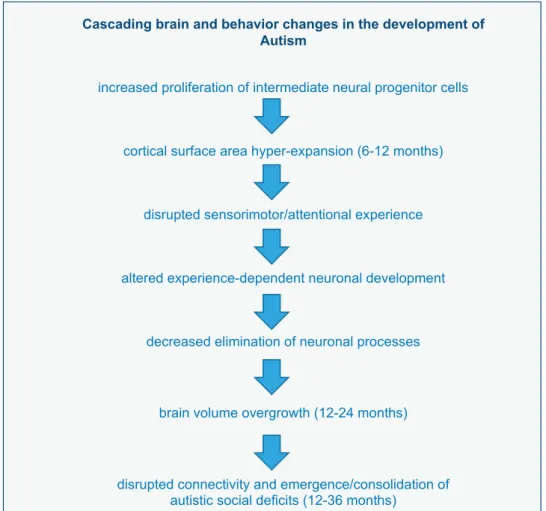
expansion in this same region is even more robust in infants later diagnosed with autism.73Hyper-expansion of surface area in visual cortex during the latter part of the first year may underlie the sensorimotor and visual orienting deficits observed during this period in infants later diagnosed with autism.26 These sensory/ attentional deficits may alter experience-dependent neuronal development resulting in decreased sculpting of neuronal processes and brain overgrowth and disruption of selected brain connections, which in turn leads to the development of autistic-like social deficits (see Figure 2). Alternatively, a primary increase in intermediate neural progenitor cells leading to an increase in neuron number, may directly result in a downstream increase in brain volume. Increases in neuron number may reduce efficient sensorimotor and attentional functioning observed in thefirst year of life. As suggested by the work of Fanget al81 and Marchetto
Figure 2. Cascading brain and behavior changes in the development in autism.
et al,117 abnormal brain overgrowth could disrupt synapse
function and contribute to the emergence of autistic-like social and cognitive deficits in the early post-natal period.7
Other brain characteristics in autism during infancy
The above conceptual framework describes a sequence of events in the pathogenesis of brain overgrowth and the emergence of social deficits in autism. While we have built a story around two key findings newly emerging in the HR infant sibling brain imaging literature, other early brain differences have been identified in HR infant siblings in infancy. In HR-ASD infants generalized (multiplefiber tracts throughout the brain) abnorm-alities in white matter organizational structure have been reported65,128as early as 6 months of age. Aberrant white matter organizational structure has been observed by 6 months of age in the genu of the corpus callosum65and white matter organization in the genu and cerebellar peduncles is significantly associated with sensory hypo- and hyper-responsivity at 24 months of age.129 In addition, other reports have demonstrated that increased extra-axial cerebrospinalfluid volume (EA-CSF) is present by 6 months of age in HR infants who are later diagnosed with autism at 24 months of age.38,39 Enlargement of the extra-axial fluid compartment suggests diminished uptake andflow of cerebrosp-inal fluid (CSF) with accumulation of brain metabolites (for example, β-amyloid and pro-inflamatory cytokines).130,131
Increased extra-axial fluid volume in infancy has been linked to motor deficits39,132–134 as well as over-proliferation of neuronal
progenitor cells.135 This latter observation led Lehtinen, Zappaterra135to suggest that CSF composition may have critical relevance to the pathogenesis of neurodevelopmental disorders and is consistent with the findings by Hazlett, Gu73suggesting early post-natal hyper-proliferation in autism.
In a small study, disrupted connectivity measured via quasi-resting electroencephalography (EEG) differentiated HR in 14-month-old infants later diagnosed with autism from a HR-negative group and LR controls.136 Interestingly, oscillations in the alpha wave are thought to reflect processes related to visual and/or attentional engagement. While source localization of scalp recorded electrophysiological activity remains an enduring challenge, EEG and ERP studies have the potential to elucidate processing differences in the early autism phenotype. Indeed, there is a growing body of work comparing HR and LR infants (Text Box 1), yet there are very few EEG/ERP studies that directly compare processing between outcome groups (ASD, HR-negative and LR) in thefirst year of life.29,137
The potential for time-dependent pathophysiological mechan-isms to instantiate cascading neurobiological processes is consistent with the theoretical framework for neurobehavioral development,‘Interactive Specialization’.138This model presumes that instantiating pathophysiology is transient99 and/or likely to be obfuscated by subsequent cascading neurobiological effects or disease progression. ASD imaging studies have revealed decreas-ing cortical thickness but no change in surface area, in older autistic individuals,139,140 suggesting a protracted period of dynamic, neurobiological development in autism, throughout childhood and into the adult years. The impact of the intersection of life experiences and accumulating effects of autistic social, cognitive and sensory impairments must be considered as perhaps having an additional, intermediate and long-term role in experience-dependent brain development at later ages.141
Regional surface area hyper-expansion, sensory deficits and excitatory/inhibitory imbalance
Hazlett, Gu73 observed the most robust and significant surface area hyper-expansion in HR-ASD infants to occur in right middle occipital gyrus (Brodman Area 18) and the left cuneus (Brodman Area 17), both involved with visual processing. Increased surface
area in primary visual cortex has been linked to increased GABA concentration in medial occipital cortex.142 Mariani et al143 conducted whole genome sequencing on IPSC lines derived from macrocephalic individuals with ASD and detected significantly perturbed transcriptomic signatures involving regulation of cell proliferation and neuronal differentiation that appeared to be due to a decrease in cell-cycle length. Further analyses suggested a greater proportion of GABAergic neurons in cortical organoids from ASD-derived neurons. These authors concluded that there is an early increase in proliferation of GABAergic neuronal progeni-tor cells in ASD-derived organoids that give rise to an increased proportion of mature GABAergic interneurons.
Experience during critical periods in early postnatal life refines cortical circuitry. Critical periods are regulated by the balance of excitatory and inhibitory (E/I) neurotransmission in the brain during development.144 Rubenstein and Merzenich113 first
pro-posed an E/I imbalance in autism. More recently, it has been proposed that alteration of the expression and/or timing of critical period circuit refinement in primary sensory brain areas may significantly contribute to autistic phenotypes, including cognitive and behavioral impairments.145The timing and location of surface area changes in the early development of autism suggests that regional hyper-proliferation of neural progenitor cells leading to brain overgrowth and disruption of vulnerable neural circuits may play a fundamental role in the development of autism. Consistent with the role of sensory experiences in the development of autism,146 Angelman syndrome model mice deficient in Ube3a, were observed to have profound impairments in neocortical plasticity in visual cortex, however plasticity was preserved during dark rearing. Altered early sensory experience may indeed be a primary deficit in autism resulting in downstream changes that we more traditionally associate with the defining features of autism e.g., social deficits. Understanding the impact of aberrant sensory function and experience in the first year of life may provide insights relevant to early intervention. Indeed a small, pilot study employing the Early Start Denver behavior intervention model, an approach that is heavily based on reinforcing and synchronizing selected sensory inputs in infants with autism as well as those at risk for autism, suggested that this type of very early intervention may be particularly beneficial.147 Wass, Porayska-Pomsta148 employed a gaze-contingent eye tracking paradigm and demon-strated ability to train attentional control in 11-month-old infants. Given the findings by Elison, Paterson26 and others regarding altered early visual orienting in infants who later demonstrate the defining features of autism, this approach offers a plausible avenue for targeted prodromal intervention in autism.
CAVEATS AND FUTURE DIRECTIONS
Findings regarding accelerated growth rate of cortical surface area and brain volume require replication. As discussed in Text Box 2, the concept of increased brain growth rate within individuals has implications for understanding the etiologic heterogeneity in autism and specifically the number of affected individuals for whom this mechanism is relevant. Future studies will also need to examine the specificity of increased brain growth rate to autism versus other neurodevelopmental disorders both in etiologically (for example, Fragile X Syndrome) and phenotypically (for example, language and learning disorders) defined conditions. Large-scale prospective studies will provide additional insights into risk and protective factors in the cascading brain and behavior changes that result in autism in 2–3 years old infants, including the effects of genes, exposure to environmental toxins and experience. Finally, links to mechanisms require further exploration e.g., examination of the relationship betweenfindings from induced pluripotent stem cells and cellular development to more refined phenotypes such as hyper-expansion of cortical surface area in thefirst year of life.
In summary, a conceptual framework for the early, post-natal development of autism is proposed that integrates behavioral and brain imagingfindings from HR, prospective infant sibling studies of autism. Thesefindings are consistent with brain and behavior studies about autism at older ages, post-mortem studies, as well as findings from genetically defined autistic syndromes and corresponding mouse models. This developmental framework postulates that early increased proliferation of neuro-progenitor cells leads to a non-uniform, hyper-expansion of cortical surface area that leads to early deficits in visual receptive/visual attention abilities that alter subsequent experience-dependent neuronal development more broadly in the brain. Cortical overgrowth results in a disruption in the refinement of selected neural circuit development and is associated with the emergence of social deficits in autism. Thus autism appears to primarily be a disorder of early sensory-motor-attention impairment, associated with hyper-proliferation of neuronal progenitor cells; and secondarily resulting in the defining features of autism and, in particular, social deficits. Better understanding of the timing of developmental brain and behavior mechanisms in autism during infancy, a period which precedes the emergence of the defining features of this disorder, will likely have important implications for designing rational approaches to early intervention.
CONFLICT OF INTEREST
The authors declare no conflict of interest.
ACKNOWLEDGMENTS
This work was supported by an NIH Autism Center of Excellence grant (NIMH and NICHD #HD055741 to J.P); NIMH #MH104324 (JTE), the Angelman Syndrome Foundation (MJZ) and a NIH Pioneer Award DP1ES024088 (MJZ).
REFERENCES
1 Zwaigenbaum L, Bryson S, Rogers T, Roberts W, Brian J, Szatmari P. Behavioral manifestations of autism in thefirst year of life.Int J Dev Neurosci2005;23: 143–152.
2 Christensen J, Gronborg TK, Sorensen MJ, Schendel D, Parner ET, Pedersen LH
et al.Prenatal valproate exposure and risk of autism spectrum disorders and childhood autism.JAMA2013;309: 1696–1703.
3 Fujiwara T, Morisaki N, Honda Y, Sampei M, Tani Y. Chemicals, nutrition, and autism spectrum disorder: a mini-review.Front Neurosci2016;10: 174. 4 Willsey AJ, Sanders SJ, Li M, Dong S, Tebbenkamp AT, Muhle RAet al.
Coex-pression networks implicate human midfetal deep cortical projection neurons in the pathogenesis of autism.Cell2013;155: 997–1007.
5 Parikshak NN, Luo R, Zhang A, Won H, Lowe JK, Chandran Vet al.Integrative functional genomic analyses implicate specific molecular pathways and circuits in autism.Cell2013;155: 1008–1021.
6 Bryson SE, Zwaigenbaum L, McDermott C, Rombough V, Brian J. The Autism Observation Scale for Infants: scale development and reliability data.J Autism Dev Disord2008;38: 731–738.
7 Estes A, Zwaigenbaum L, Gu H St, John T, Paterson S, Elison JTet al.Behavioral, cognitive, and adaptive development in infants with autism spectrum disorder in thefirst 2 years of life.J Neurodev Disord2015;7: 24.
8 Gammer I, Bedford R, Elsabbagh M, Garwood H, Pasco G, Tucker L. Behavioural markers for autism in infancy: scores on the Autism Observational Scale for Infants in a prospective study of at-risk siblings.Infant Behav Dev2015; 38. 9 Ozonoff S, Young GS, Belding A, Hill M, Hill A, Hutman T. The broader autism
phenotype in infancy: when does it emerge?J Am Acad Child Adolesc Psychiatry
2014;53: 398–407.
10 Mitchell S, Brian J, Zwaigenbaum L, Roberts W, Szatmari P, Smith I. Early lan-guage and communication development of infants later diagnosed with autism spectrum disorder.J Develop Behavior Pediatr2006;27: S69–S78.
11 Lazenby DC, Sideridis GD, Huntington N, Prante M, Dale PS, Curtin Set al.
Language Differences at 12 Months in Infants Who Develop Autism Spectrum Disorder.J Autism Dev Disord2016;46: 899–909.
12 Landa RJ, Holman KC, Garrett-Mayer E. Social and communication development in toddlers with early and later diagnosis of autism spectrum disorders.Arch Gen Psychiatry2007;64: 853–864.
13 Ozonoff S, Iosif A, Baguio F, Cook IC, Hill MM, Hutman T. A prospective study of the emergence of early behavioral signs of autism.J Am Acad Child Adolesc Psychiatry.2010;49: 256–266.
14 Elison JT, Wolff JJ, Reznick JS, Botteron KN, Estes AM, Gu H. Repetitive behavior in 12-month-olds later classified with autism spectrum disorder.J Am Acad Child Adolesc Psychiatry2014;53: 1216–1224.
15 Ozonoff S, Heung K, Byrd R, Hansen R, Hertz-Picciotto I. The onset of autism: patterns of symptom emergence in thefirst years of life.Autism Res2008;1: 320–328.
16 Wolff JJ, Botteron KN, Dager SR, Elison JT, Estes AM, Gu Het al.Longitudinal patterns of repetitive behavior in toddlers with autism.J Child Psychol Psychiatry
2014;55: 945–953.
17 Johnson MH, Gliga T, Jones E, Charman T. Annual research review: Infant development, autism, and ADHD--early pathways to emerging disorders.J Child Psychol Psychiatry2015;56: 228–247.
18 Szatmari P, Chawarska K, Dawson G, Georgiades S, Landa R, Lord Cet al. Pro-spective longitudinal studies of infant siblings of children with autism: lessons learned and future directions.J Am Acad Child Adolesc Psychiatry 2016;55: 179–187.
19 Klin A, Shultz S, Jones W. Social visual engagement in infants and toddlers with autism: early developmental transitions and a model of pathogenesis.Neurosci Biobehav Rev2015;50: 189–203.
20 Messinger DS, Young GS, Webb SJ, Ozonoff S, Bryson SE, Carter Aet al.Early sex differences are not autism-specific: A Baby Siblings Research Consortium (BSRC) study.Mol Autism2015;6: 32.
21 Ozonoff S, Young GS, Carter A, Messinger D, Yirmiya N, Zwaigenbaum Let al.
Recurrence risk for autism spectrum disorders: a Baby Siblings Research Consortium study.Pediatrics2011;128: e488–e495.
22 Sandin S, Lichtenstein P, Kuja-Halkola R, Larsson H, Hultman CM, Reichenberg A. The familial risk of autism.JAMA2014;311: 1770–1777.
23 Charman T, Young GS, Brian J, Carter A, Carver LJ, Chawarska Ket al.Non-ASD outcomes at 36 months in siblings at familial risk for autism spectrum disorder (ASD): A baby siblings research consortium (BSRC) study.Autism Res2016;10: 169–178.
24 Messinger D, Young GS, Ozonoff S, Dobkins K, Carter A, Zwaigenbaum Let al.
Beyond autism: a baby siblings research consortium study of high-risk children at three years of age.J Am Acad Child Adolesc Psychiatry2013;52: 300–308, e1. 25 Ozonoff S, Young GS, Belding A, Hill M, Hill A, Hutman Tet al.The broader autism phenotype in infancy: when does it emerge?J Am Acad Child Adolesc Psychiatry
2014;53: 398–407, e2.
26 Elison JT, Paterson SJ, Wolff JJ, Reznick JS, Sasson NJ, Gu Het al.White matter microstructure and atypical visual orienting in 7-month-olds at risk for autism.
Am J Psychiatry2013;170: 899–908.
27 Wass SV, Jones EJ, Gliga T, Smith TJ, Charman T, Johnson MH. Shorter sponta-neousfixation durations in infants with later emerging autism.Sci Rep2015;5: 8284.
28 Finch KH, Seery AM, Talbott MR, Nelson CA, Tager-Flusberg H. Lateralization of ERPs to speech and handedness in the early development of Autism Spectrum Disorder.J Neurodev Disord2017;9: 4.
29 Elsabbagh M, Mercure E, Hudry K, Chandler S, Pasco G, Charman Tet al.Infant neural sensitivity to dynamic eye gaze is associated with later emerging autism.
Curr Biol2012;22: 338–342.
30 Chawarska K, Macari S, Shic F. Decreased spontaneous attention to social scenes in 6-month-old infants later diagnosed with autism spectrum disorders.Biol Psychiatry2013;74: 195–203.
31 Elsabbagh M, Fernandes J, Jane Webb S, Dawson G, Charman T, Johnson MH. Disengagement of visual attention in infancy is associated with emerging autism in toddlerhood.Biol Psychiatry2013;74: 189–194.
32 Flanagan JE, Landa R, Bhat A, Bauman M. Head lag in infants at risk for autism: a preliminary study.Am J Occup Ther.2012;66: 577–585.
33 Jones W, Klin A. Attention to eyes is present but in decline in 2-6-month-old infants later diagnosed with autism.Nature2013;504: 427–431.
34 Keehn B, Vogel-Farley V, Tager-Flusberg H, Nelson CA. Atypical hemispheric specialization for faces in infants at risk for autism spectrum disorder.Autism Res
2015;8: 187–198.
35 Paul R, Fuerst Y, Ramsay G, Chawarska K, Klin A. Out of the mouths of babes: vocal production in infant siblings of children with ASD.J Child Psychol Psychiatry
2011;52: 588–598.
36 Shic F, Macari S, Chawarska K. Speech disturbs face scanning in 6-month-old infants who develop autism spectrum disorder.Biol Psychiatry2014;75: 231–237. 37 Open Science Collaboration. PSYCHOLOGY. Estimating the reproducibility of
psychological science.Science (New York, NY)2015;349: aac4716.
38 Shen MD, Nordahl CW, Young GS, Wootton-Gorges SL, Lee A, Liston SEet al.
Early brain enlargement and elevated extra-axialfluid in infants who develop autism spectrum disorder.Brain2013;136: 2825–2835.
39 Shen MD, Styner MA, Swanson MR, Wolff JJ, Elison JT, Graves MM et al.A Longitudinal MRI Study of Subcortical Brain Development in Infants Who Develop Autism and Infants with Fragile X Syndrome.Biological psychiatry2016 in press.
40 Jones W, Klin A. Attention to eyes is present but in decline in 2–6 month-olds later diagnosed with autism.Nature2013;504: 427–431.
41 Sacrey L-AR, Armstrong VL, Bryson SE, Zwaigenbaum L. Impairments to visual disengagement in autism spectrum disorder: a review of experimental studies from infancy to adulthood.Neurosci Biobehav Rev2014;47: 559–577. 42 Hayden BY, Smith DV, Platt ML. Electrophysiological correlates of default-mode
processing in macaque posterior cingulate cortex.Proc Natl Acad Sci USA2009;
106: 5948–5953.
43 Putnam MC, Steven MS, Doron KW, Riggall AC, Gazzaniga MS. Cortical projection topography of the human splenium: Hemispheric asymmetry and individual differences.J Cogn Neurosci2010;22: 1662–1669.
44 Deoni SC, O'Muircheartaigh J, Elison JT, Walker L, Doernberg E, Waskiewicz N
et al.White matter maturation profiles through early childhood predict general cognitive ability.Brain Struct Funct2016;221: 1189–1203.
45 Swanson MR, Wolff JJ, Elison JT, Gu H, Hazlett HC, Botteron K et al.
Splenium development and early spoken language in human infants.Dev Sci
2015;20.
46 Gao W, Zhu H, Giovanello KS, Smith JK, Shen D, Gilmore JHet al.Evidence on the emergence of the brain's default network from 2-week-old to 2-year-old healthy pediatric subjects.Proc Natl Acad Sci USA2009;106: 6790–6795.
47 Thomas MS, Davis R, Karmiloff-Smith A, Knowland VC, Charman T. The over-pruning hypothesis of autism.Dev Sci2016;19: 284–305.
48 Cohen IL, Gardner JM, Karmel BZ, Phan HT, Kittler P, Gomez TRet al.Neonatal brainstem function and 4-month arousal-modulated attention are jointly asso-ciated with autism.Autism Res2013;6: 11–22.
49 Pryweller JR, Schauder KB, Anderson AW, Heacock JL, Foss-Feig JH, Newsom CR
et al.White matter correlates of sensory processing in autism spectrum dis-orders.NeuroImage Clin2014;6: 379–387.
50 Nebel MB, Joel SE, Muschelli J, Barber AD, Caffo BS, Pekar JJet al.Disruption of functional organization within the primary motor cortex in children with autism.
Hum Brain Mapping2014;35: 567–580.
51 Mosconi MW, Sweeney JA. Sensorimotor dysfunctions as primary features of autism spectrum disorders.Sci China Life Sci2015;58: 1016–1023.
52 Neely KA, Mohanty S, Schmitt LM, Wang Z, Sweeney JA, Mosconi MW. Motor memory deficits contribute to motor impairments in autism spectrum disorder.
J Autism Dev Disord2016.
53 Floris DL, Barber AD, Nebel MB, Martinelli M, Lai MC, Crocetti Det al.Atypical lateralization of motor circuit functional connectivity in children with autism is associated with motor deficits.Mol Autism2016;7: 35.
54 Nebel MB, Eloyan A, Nettles CA, Sweeney KL, Ament K, Ward REet al.Intrinsic visual-motor synchrony correlates with social deficits in autism.Biol Psychiatry
2016;79: 633–641.
55 Green SA, Hernandez L, Bookheimer SY, Dapretto M. Salience network connectivity in autism is related to brain and behavioral markers of sensory overresponsivity.J Am Acad Child Adolesc Psychiatry.2016;557: 618–626, e1. 56 Green SA, Hernandez L, Tottenham N, Krasileva K, Bookheimer SY, Dapretto M.
Neurobiology of Sensory Overresponsivity in Youth With Autism Spectrum Disorders.JAMA Psychiatry2015;72: 778–786.
57 Whyatt C, Craig C. Sensory-motor problems in Autism. Front Integr Neurosci
2013; 7.
58 Mosconi MW, Kay M, D'Cruz AM, Guter S, Kapur K, Macmillan Cet al. Neuro-behavioral abnormalities infirst-degree relatives of individuals with autism.Arch Gen Psychiatry2010;67: 830–840.
59 Ibanez LV, Grantz CJ, Messinger DS. The development of referential communication and autism symptomatology in high-risk infants.Infancy2013;
18: 5.
60 Miller M, Iosif AM, Hill M, Young GS, Schwichtenberg AJ, Ozonoff S. Response to name in infants developing autism spectrum disorder: A Prospective Study.
J Pediatr2017;183: 141–146.
61 Cavanna AE, Trimble MR. The precuneus: a review of its functional anatomy and behavioural correlatesBrain2006; 129: 564–583.
62 Margulies DS, Vincent JL, Kelly C, Lohmann G, Uddin LQ, Biswal BBet al. Pre-cuneus shares intrinsic functional architecture in humans and monkeys.Proc Natl Acad Sci USA2009;106: 20069–20074.
63 Duhamel JR, Colby CL, Goldberg ME. The updating of the representation of visual space in parietal cortex by intended eye movements.Science (New York, NY)1992;255: 90–92.
64 Seltzer B, Pandya DN. Converging visual and somatic sensory cortical input to the intraparietal sulcus of the rhesus monkey.Brain Res1980; 192: 339–351.
65 Wolff JJ, Gerig G, Lewis JD, Soda T, Styner MA, Vachet Cet al.Altered corpus callosum morphology associated with autism over thefirst 2 years of lifeBrain
2015; 138: 2046–2058.
66 Wolff JJ SM, Elison JT, Gerig G, Pruett JR Jr., Styner MA, Vachet Cet al.The IBIS Network. Neural circuitry at age 6 months associated with later repetitive behavior and sensory features in autism.Mol Autism2017;8: 8.
67 Wang Samuel SH, Kloth Alexander D, Badura A. The cerebellum, sensitive peri-ods, and autism.Neuron2014;83: 518–532.
68 Courchesne E, Karns CM, Davis HR, Ziccardi R, Carper RA, Tigue ZDet al.Unusual brain growth patterns in early life in patients with autistic disorder: an MRI study.
Neurology2001;57: 245–254.
69 Sparks BF, Friedman SD, Shaw DW, Aylward EH, Echelard D, Artru AAet al.Brain structural abnormalities in young children with autism spectrum disorder.
Neurology2002;59: 184–192.
70 Hazlett HC, Poe M, Gerig G, Smith RG, Provenzale J, Ross Aet al.Magnetic resonance imaging and head circumference study of brain size in autism: birth through age 2 years.Arch Gen Psychiatry2005;62: 1366–1376.
71 Hazlett HC, Poe MD, Gerig G, Styner M, Chappell C, Smith RGet al.Early brain overgrowth in autism associated with an increase in cortical surface area before age 2 years.Arch Gen Psychiatry2011;68: 467–476.
72 Ohta H, Nordahl CW, Iosif AM, Lee A, Rogers S, Amaral DG. Increased surface area, but not cortical thickness, in a subset of young boys with autism spectrum disorder.Autism Res2016;9: 232–248.
73 Hazlett H, Gu H, Munsell B, Kim S, Styner M, Wolff Jet al.Early brain development in infants at high risk of autism spectrum disorder. .Nature2017;542: 348–351. 74 Lord C, Risi S, Lambrecht L, Cook EH Jr., Leventhal BL, DiLavore PCet al.The autism diagnostic observation schedule-generic: a standard measure of social and communication deficits associated with the spectrum of autism.J Autism Dev Disord2000;30: 205–223.
75 Wetherby AM, Allen L, Cleary J, Kublin K, Goldstein H. Validity and reliability of the communication and symbolic behavior scales developmental profile with very young children.J Speech Lang Hear Res2002;45: 1202–1218.
76 Betancur C. Etiological heterogeneity in autism spectrum disorders: more than 100 genetic and genomic disorders and still counting.Brain Res2011;1380: 42–77.
77 Nordahl CW, Lange N, Li DD, Barnett LA, Lee A, Buonocore MHet al.Brain enlargement is associated with regression in preschool-age boys with autism spectrum disorders.Proc Natl Acad Sci USA2011;108: 20195–20200. 78 Libero LE, Nordahl CW, Li DD, Ferrer E, Rogers SJ, Amaral DG. Persistence of
megalencephaly in a subgroup of young boys with autism spectrum disorder.
Autism Res2016;9: 1169–1182.
79 Amaral DG, Li D, Libero L, Solomon M, Van de Water J, Mastergeorge Aet al.In pursuit of neurophenotypes: The consequences of having autism and a big brain.Autism Res2017;10: 711–722.
80 Jones KL, Jones MC.Smith's Recognizable Patterns of Human Malformation7th ednSaunders, 2013; 1016, p.
81 Fang WQ, Chen WW, Jiang L, Liu K, Yung WH, Fu AKet al.Overproduction of upper-layer neurons in the neocortex leads to autism-like features in mice.Cell Rep2014;9: 1635–1643.
82 Li G, Nie J, Wang L, Shi F, Lin W, Gilmore JHet al.Mapping region-specific longitudinal cortical surface expansion from birth to 2 years of age.Cereb Cortex
2013;23: 2724–2733.
83 Rakic P. Radial versus tangential migration of neuronal clones in the developing cerebral cortex.Proc Natl Acad Sci USA1995;92: 11323–11327.
84 Reillo I, de Juan Romero C, Garcia-Cabezas MA, Borrell V. A role for intermediate radial glia in the tangential expansion of the mammalian cerebral cortex.Cereb Cortex2011;21: 1674–1694.
85 Lui JH, Hansen DV, Kriegstein AR. Development and evolution of the human neocortex.Cell2011;146: 18–36.
86 LaMonica BE, Lui JH, Wang X, Kriegstein AR. OSVZ progenitors in the human cortex: an updated perspective on neurodevelopmental disease. Curr Opin Neurobiol2012;22: 747–753.
87 Hansen DV, Lui JH, Parker PRL, Kriegstein AR. Neurogenic radial glia in the outer subventricular zone of human neocortex.Nature2010;464: 554–561. 88 Kriegstein A, Noctor S, Martinez-Cerdeno V. Patterns of neural stem and
pro-genitor cell division may underlie evolutionary cortical expansion. Nat Rev Neurosci2006;7: 883–890.
89 Woodhead GJ, Mutch CA, Olson EC, Chenn A. Cell-autonomous beta-catenin signaling regulates cortical precursor proliferation. J Neurosci 2006; 26: 12620–12630.
90 Chenn A, Walsh CA. Regulation of cerebral cortical size by control of cell cycle exit in neural precursors.Science2002;297: 365–369.
91 Florio M, Albert M, Taverna E, Namba T, Brandl H, Lewitus Eet al.Human-specific gene ARHGAP11B promotes basal progenitor amplification and neocortex expansion.Science2015;347: 1465–1470.
92 Rubenstein JL. Three hypotheses for developmental defects that may underlie some forms of autism spectrum disorder.Curr Opin Neurol2010;23: 118–123. 93 Docherty AR, Hagler DJ Jr., Panizzon MS, Neale MC, Eyler LT, Fennema-Notestine
Cet al.Does degree of gyrification underlie the phenotypic and genetic asso-ciations between cortical surface area and cognitive ability?NeuroImage2015;
106: 154–160.
94 Chen CH, Peng Q, Schork AJ, Lo MT, Fan CC, Wang Yet al.Large-scale genomics unveil polygenic architecture of human cortical surface area.Nat Commun2015;
6: 7549.
95 Chen CH, Fiecas M, Gutierrez ED, Panizzon MS, Eyler LT, Vuoksimaa Eet al.
Genetic topography of brain morphology.Proc Natl Acad Sci USA2013;110: 17089–17094.
96 Panizzon MS, Fennema-Notestine C, Eyler LT, Jernigan TL, Prom-Wormley E, Neale Met al.Distinct genetic influences on cortical surface area and cortical thickness.Cereb Cortex2009;19: 2728–2735.
97 Stein JL, de la Torre-Ubieta L, Tian Y, Parikshak NN, Hernandez IA, Marchetto MC
et al.A quantitative framework to evaluate modeling of cortical development by neural stem cells.Neuron2014;83: 69–86.
98 Pan X, Chang X, Leung C, Zhou Z, Cao F, Xie Wet al.PAK1 regulates cortical development via promoting neuronal migration and progenitor cell prolifera-tion.Mol Brain2015;8: 36.
99 Belinson H, Nakatani J, Babineau BA, Birnbaum RY, Ellegood J, Bershteyn Met al.
Prenatal beta-catenin/Brn2/Tbr2 transcriptional cascade regulates adult social and stereotypic behaviors.Mol Psychiatry2016;21: 1417–1433.
100 Packer A. Neocortical neurogenesis and the etiology of autism spectrum dis-order.Neurosci Biobehav Rev2016;64: 185–195.
101 Lyall AE, Shi F, Geng X, Woolson S, Li G, Wang Let al.Dynamic development of regional cortical thickness and surface area in early childhood.Cereb Cortex
2015;25: 2204–2212.
102 Courchesne E, Mouton PR, Calhoun ME, Semendeferi K, Ahrens-Barbeau C, Hallet MJet al.Neuron number and size in prefrontal cortex of children with autism.
JAMA2011;306: 2001–2010.
103 Kim E, Camacho J, Combs Z, Ariza J, Lechpammer M, Noctor SCet al.Preliminary
findings suggest the number and volume of supragranular and infragranular pyramidal neurons are similar in the anterior superior temporal area of control subjects and subjects with autism.Neurosci Lett2015;589: 98–103.
104 Jacot-Descombes S, Uppal N, Wicinski B, Santos M, Schmeidler J, Giannako-poulos Pet al.Decreased pyramidal neuron size in Brodmann areas 44 and 45 in patients with autism.Acta Neuropathol2012;124: 67–79.
105 Casanova MF, van Kooten IA, Switala AE, van Engeland H, Heinsen H, Steinbusch HWet al.Minicolumnar abnormalities in autism.Acta Neuropathol2006;112: 287–303.
106 McKavanagh R, Buckley E, Chance SA. Wider minicolumns in autism: a neural basis for altered processing?Brain2015;138: 2034–2045.
107 Huttenlocher PR. Morphometric study of human cerebral cortex development.
Neuropsychologia1990;28: 517–527.
108 Tang G, Gudsnuk K, Kuo SH, Cotrina ML, Rosoklija G, Sosunov Aet al.Loss of mTOR-dependent macroautophagy causes autistic-like synaptic pruning deficits.
Neuron2014;83: 1131–1143.
109 Frazier TW, Embacher R, Tilot AK, Koenig K, Mester J, Eng C. Molecular and phenotypic abnormalities in individuals with germline heterozygous PTEN mutations and autism.Mol Psychiatry2015;20: 1132–1138.
110 Kwon CH, Luikart BW, Powell CM, Zhou J, Matheny SA, Zhang Wet al.Pten regulates neuronal arborization and social interaction in mice.Neuron2006;50: 377–388.
111 Vogt D, Cho KK, Lee AT, Sohal VS, Rubenstein JL. The parvalbumin/somatostatin ratio is increased in Pten mutant mice and by human PTEN ASD alleles.Cell Rep
2015;11: 944–956.
112 Fang WQ, Chen WW, Fu AK, Ip NY. Axin directs the amplification and differ-entiation of intermediate progenitors in the developing cerebral cortex.Neuron
2013;79: 665–679.
113 Rubenstein JL, Merzenich MM. Model of autism: increased ratio of excitation/ inhibition in key neural systems.Genes Brain Behav2003;2: 255–267. 114 Hensch TK. Critical period plasticity in local cortical circuits.Nat Rev Neurosci
2005;6: 877–888.
115 Roullet FI, Lai JK, Foster JA. In utero exposure to valproic acid and autism--a current review of clinical and animal studies.Neurotoxicol Teratol2013; 36: 47–56.
116 Fujimura K, Mitsuhashi T, Shibata S, Shimozato S, Takahashi T. In utero exposure to valproic acid induces neocortical dysgenesis via dysregulation of neural progenitor cell proliferation/differentiation.J Neurosci2016;36: 10908–10919.
117 Marchetto MC, Belinson H, Tian Y, Freitas BC, Fu C, Vadodaria KCet al.Altered proliferation and networks in neural cells derived from idiopathic autistic indi-viduals.Mol Psychiatry2016;22: 820–835.
118 Bernier R, Golzio C, Xiong B, Stessman HA, Coe BP, Penn Oet al.Disruptive CHD8 mutations define a subtype of autism early in development.Cell2014;158: 263–276.
119 Qureshi AY, Mueller S, Snyder AZ, Mukherjee P, Berman JI, Roberts TPLet al.
Opposing brain differences in 16p11.2 deletion and duplication carriers.
J Neurosci2014;34: 11199–11211.
120 Weiss LA, Shen Y, Korn JM, Arking DE, Miller DT, Fossdal Ret al.Association between microdeletion and microduplication at 16p11.2 and autism.N Engl J Med2008;358: 667–675.
121 Pucilowska J, Vithayathil J, Tavares EJ, Kelly C, Karlo JC, Landreth GE. The 16p11.2 deletion mouse model of autism exhibits altered cortical progenitor proliferation and brain cytoarchitecture linked to the ERK MAPK pathway.J Neurosci2015;35: 3190–3200.
122 Wang P, Lin M, Pedrosa E, Hrabovsky A, Zhang Z, Guo W et al.
CRISPR/Cas9-mediated heterozygous knockout of the autism gene CHD8 and characterization of its transcriptional networks in neurodevelopment.Mol Autism
2015;6: 55.
123 Katayama Y, Nishiyama M, Shoji H, Ohkawa Y, Kawamura A, Sato Tet al.CHD8 haploinsufficiency results in autistic-like phenotypes in mice.Nature2016;537: 675–679.
124 Durak O, Gao F, Kaeser-Woo YJ, Rueda R, Martorell AJ, Nott Aet al. Chd8 mediates cortical neurogenesis via transcriptional regulation of cell cycle and Wnt signaling.Nat Neurosci2016;19: 1477–1488.
125 Lien WH, Fuchs E. Wnt some lose some: transcriptional governance of stem cells by Wnt/beta-catenin signaling.Genes Dev2014;28: 1517–1532.
126 Huang WC, Chen Y, Page DT. Hyperconnectivity of prefrontal cortex to amygdala projections in a mouse model of macrocephaly/autism syndrome.Nat Commun
2016;7: 13421.
127 van Bon BW, Coe BP, Bernier R, Green C, Gerdts J, Witherspoon Ket al.Disruptive de novo mutations of DYRK1A lead to a syndromic form of autism and ID.Mol Psychiatry2016;21: 126–132.
128 Wolff JJ, Gu H, Gerig G, Elison JT, Styner M, Gouttard S. Differences in white matter fiber tract development present from 6 to 24 months in infants with autism.Am J Psychiatry2012;169: 589–600.
129 Wolff J, Swanson MR, Elison JT, Gerig G, Pruett JR J, Styner MAet al.Neural circuitry at age 6 months associated with later repetitive behavior and sensory features in autism.Mol Autism2016;8: 8, in revision.
130 Johanson CE, Duncan JA 3rd, Klinge PM, Brinker T, Stopa EG, Silverberg GD. Multiplicity of cerebrospinalfluid functions: New challenges in health and dis-ease.Cerebrospinal Fluid Res2008;5: 10.
131 Iliff JJ, Wang M, Liao Y, Plogg BA, Peng W, Gundersen GAet al.A paravascular pathway facilitates CSFflow through the brain parenchyma and the clearance of interstitial solutes, including amyloid beta.Sci Transl Med2012;4: 147ra11. 132 Nickel RE, Gallenstein JS. Developmental prognosis for infants with benign
enlargement of the subarachnoid spaces. Dev Med Child Neurol 1987; 29: 181–186.
133 Lorch SA, D'Agostino J, Zimmerman R, Bernbaum J. "benign" extra-axialfluid in survivors of neonatal intensive care. Arch Pediatr Adolesc Med 2004; 158: 178–182.
134 Hellbusch LC. Benign extracerebral fluid collections in infancy: clinical pre-sentation and long-term follow-up.J Neurosurg2007;107: 119–125. 135 Lehtinen MK, Zappaterra MW, Chen X, Yang YJ, Hill AD, Lun Met al.The
cere-brospinalfluid provides a proliferative niche for neural progenitor cells.Neuron
2011;69: 893–905.
136 Orekhova EV, Elsabbagh M, Jones EJ, Dawson G, Charman T, Johnson MH. EEG hyper-connectivity in high-risk infants is associated with later autism.J Neurodev Disord2014;6: 40.
137 Jones EJ, Venema K, Earl R, Lowy R, Barnes K, Estes Aet al.Reduced engagement with social stimuli in 6-month-old infants with later autism spectrum disorder: a longitudinal prospective study of infants at high familial risk.J Neurodev Disord
2016;8: 7.
138 Johnson MH. Interactive specialization: a domain-general framework for human functional brain development?Dev Cogn Neurosci2011;1: 7–21.
139 Zielinski BA, Prigge MB, Nielsen JA, Froehlich AL, Abildskov TJ, Anderson JSet al.
Longitudinal changes in cortical thickness in autism and typical development.
Brain2014;137: 1799–1812.
140 Ecker C, Ginestet C, Feng Y, Johnston P, Lombardo MV, Lai MCet al.Brain surface anatomy in adults with autism: the relationship between surface area, cortical thickness, and autistic symptoms.JAMA Psychiatry2013;70: 59–70.
141 Chevallier C, Kohls G, Troiani V, Brodkin ES, Schultz RT. The social motivation theory of autism.Trends Cogn Sci2012;16: 231–239.
142 Bergmann J, Pilatus U, Genc E, Kohler A, Singer W, Pearson J. V1 surface size predicts GABA concentration in medial occipital cortex.NeuroImage2016;124: 654–662.
143 Mariani J, Coppola G, Zhang P, Abyzov A, Provini L, Tomasini Let al. FOXG1-dependent dysregulation of gaba/glutamate neuron differentiation in autism spectrum disorders.Cell2015;162: 375–390.
144 Hensch TK. Critical period mechanisms in developing visual cortex.Curr Top Dev Biol2005;69: 215–237.
145 LeBlanc JJ, Fagiolini M. Autism: a "critical period" disorder?Neural Plast2011;
2011: 921680.
146 Yashiro K, Riday TT, Condon KH, Roberts AC, Bernardo DR, Prakash Ret al.Ube3a is required for experience-dependent maturation of the neocortex.Nat Neurosci
2009;12: 777–783.
147 Rogers SJ, Vismara L, Wagner AL, McCormick C, Young G, Ozonoff S. Autism treatment in the first year of life: a pilot study of infant start, a parent-implemented intervention for symptomatic infants.J Autism Dev Disord2014;44: 2981–2995.
148 Wass S, Porayska-Pomsta K, Johnson MH. Training attentional control in infancy.
Curr Biol2011;21: 1543–1547.
This work is licensed under a Creative Commons Attribution-NonCommercial-NoDerivs 4.0 International License. The images or other third party material in this article are included in the article’s Creative Commons license, unless indicated otherwise in the credit line; if the material is not included under the Creative Commons license, users will need to obtain permission from the license holder to reproduce the material. To view a copy of this license, visit http:// creativecommons.org/licenses/by-nc-nd/4.0/
© The Author(s) 2017