https://doi.org/10.1177/0956797617716922 Psychological Science
2017, Vol. 28(12) 1763 –1772 © The Author(s) 2017
Reprints and permissions:
sagepub.com/journalsPermissions.nav DOI: 10.1177/0956797617716922 www.psychologicalscience.org/PS Research Article
One of the most provocative series of studies implicat-ing oxytocin in social bonds involved comparison of microtine rodent (vole) species. Building on observa-tions of differential regional brain expression of oxy-tocin receptors in monogamous prairie voles versus non-monogamous montane voles (Insel & Shapiro, 1992), experimenters were able to systematically enhance or disrupt female prairie voles’ formation of a preference for a specific male prairie vole (i.e., a pair bond) by manipulating oxytocin in the central nervous system of the female (Williams, Carter, & Insel, 1992). Shifting from voles to humans, other theorists have suggested that the same biobehavioral system that coevolved to promote close bonds between infant and caregivers had been co-opted for use in creating close adult romantic bonds as well (e.g., Diamond, 2004). Though a key biological component of that evolved system was thought to be oxytocin (see Gonzaga, Turner, Keltner, Campos, & Altemus, 2006), now a quar-ter century afquar-ter the initial prairie-vole findings (Williams et al., 1992), there are exceptionally few data points to
address whether or how oxytocin facilitates bonding in the context of adult human attachment.
This dearth of evidence may be driven in part by the lack of well-specified operational definitions of the bonding process in adult humans (Carter, Williams, Witt, & Insel, 1992). Given recent meta-analytic evi-dence documenting the robust association between high-quality relationships and longevity—an effect size as large as that for smoking and larger than for obesity (Holt-Lunstad, Smith, & Layton, 2010)—basic research on the specific biopsychosocial mechanisms through which bonds are forged and strengthened becomes all the more important.
Corresponding Author:
Sara B. Algoe, The University of North Carolina at Chapel Hill, Department of Psychology and Neuroscience, Campus Box 3270, Davie Hall, 235 E. Cameron Ave., Chapel Hill, NC 27599 E-mail: [email protected]
Oxytocin and Social Bonds: The Role
of Oxytocin in Perceptions of Romantic
Partners’ Bonding Behavior
Sara B. Algoe, Laura E. Kurtz, and Karen Grewen
Department of Psychology and Neuroscience, The University of North Carolina at Chapel Hill
Abstract
In this research, we tested hypotheses about the role of oxytocin in adult human bonding. Inspired by revisiting the research on pair bonding in microtine voles that fueled psychologists’ interest in the role of oxytocin in social life, we drew on recent theory from affective and relationship science to identify a well-defined bonding context for human romantic relationships. We then paired these behaviors and subjective psychological responses with a measure of naturally circulating oxytocin. In 129 romantically involved adults whose partner expressed gratitude to them in the lab, greater oxytocin over the prior 24 hr was associated with greater perceptions of the expresser’s responsiveness and gratitude, as well as greater experienced love, but not general affective reward. Moreover, in this one-time conversation, higher oxytocin acted like rose-colored glasses, attenuating the effect of a partner’s behaviorally coded expressive behavior on perceptions of the expresser’s responsiveness. These results justify future research on the role of oxytocin in psychological aspects of growth processes.
Keywords
emotions, interpersonal interaction, neuroendocrinology, relationship quality, social perception
Theoretical Specificity for Bonding and
Growth Processes in Adult Humans
In the past two decades, it has become clear that of the wide variety of beneficial behaviors and processes within ongoing relationships (e.g., arguing respectfully; Gottman & Levenson, 1992), some are especially well-suited to promote the bond between two individuals (e.g., Algoe, Fredrickson, & Gable, 2013; Fredrickson, 2013; Gable & Reis, 2001). For example, affective sci-ence has shown that, as a category, positive emotions are well-suited for promoting intrapersonal and inter-personal growth (Fredrickson, Cohn, Coffey, Pek, & Finkel, 2008). Moreover, research specifying distinct functions for distinct positive emotions identifies two— love and gratitude—uniquely suited for bonding (Algoe, Gable, & Maisel, 2010; Gonzaga, Keltner, Londahl, & Smith, 2001).1
Then, building on the relationship-science tradition, a recent theoretical account of gratitude emphasizes the cross-partner nature of the bonding process (Algoe, 2012). While gratitude is initially caused by the kind actions of a benefactor, this account posits that the subsequent behavior of the grateful person can further draw the benefactor into the relationship. Specifically, the grateful person’s behavior toward the benefactor is likely to be perceived as responsive, which involves feeling understood, validated, and cared for by the grateful person (Reis, Clark, & Holmes, 2004); theoreti-cally, this perception should make the benefactor more interested and invested in the grateful person, which would, over similar repeated interactions, grow the relationship. Supporting this hypothesis, two previous studies showed that benefactors who perceived respon-siveness when a romantic partner expressed gratitude to them in a one-time laboratory conversation reported increased relationship satisfaction 1 or 6 months later (Algoe et al., 2013; Algoe & Zhaoyang, 2015). Critically, this effect was independent from effects of perceiving responsiveness after various other types of interactions with the partner, which suggests that the behavior of expressing gratitude and perceptions of the grateful expresser’s responsiveness uniquely foster relational growth.
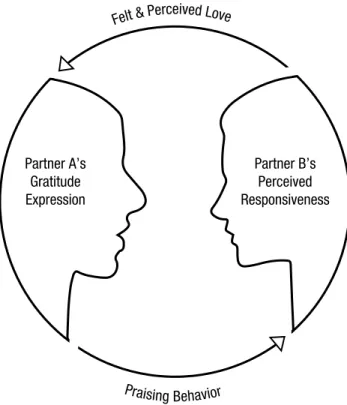
Considering these findings, we more recently con-ducted a careful investigation of expressions of grati-tude to understand how likely they are to impact the key outcome of perceived expresser responsiveness (Algoe, Kurtz, & Hilaire, 2016). By focusing on specific behavioral and subjective psychological components of the process, this work contributed to the operational definition of adult human bonding that we rely on in the current study (see Fig. 1). Specifically, building on research differentiating the social consequences of
gratitude versus other positive emotions (Algoe & Haidt, 2009), researchers behaviorally coded video-recorded expressions of gratitude between romantic partners in the lab for the extent to which the expresser praised the benefactor’s actions. As predicted, the extent to which the expresser used this behavior was positively correlated with the extent to which the benefactor reported feeling understood, validated, and cared for by the expresser (i.e., perceived expresser responsive-ness). Additional analyses revealed two secondary path-ways through which praise within a gratitude expression may draw in a benefactor: by making the benefactor feel loved and rewarded (Algoe et al., 2016).
Evidence for Oxytocin in the Romantic
Bonding Process
Though many researchers study the role of oxytocin in social life, adult attachment relationships are qualita-tively different from other relationship types (e.g., Hazan & Diamond, 2000), and we take seriously the conclusions from recent reviews that context matters
Felt & PerceivedLove
Partner A’s Gratitude Expression
Partner B’s Perceived Responsiveness
Praising Behavior
for understanding oxytocin’s effects (e.g., Bartz, Zaki, Bolger, & Ochsner, 2011). Therefore, we focused our literature search according to the theoretical question at hand (e.g., Williams et al., 1992): Only four studies measured or manipulated oxytocin and subsequently measured behavior or subjective responses related to interpersonal bonding processes in human adult roman-tic relationships. All provide promising evidence in sup-port of the thesis that oxytocin facilitates the bonding process; for example, one study positively links plasma oxytocin with self-reported hugging of the partner (Light, Grewen, & Amico, 2005), and another study links it with the couples’ collective behaviors in a live social interaction (Schneiderman, Zagoory-Sharon, Leckman, & Feldman, 2012).2
Here, we were interested in the subjective psycho-logical response to the interaction, focusing on theoreti-cal specificity among “good” outcomes, as well as dependence of these responses on partner behavior, to highlight the cross-partner nature of the bonding pro-cess. Notably, two of the four studies mentioned in the previous paragraph imply that oxytocin favorably colors the subjective psychological experiences caused by the bonding-relevant interactions of either expressed grati-tude or sexual activity (Algoe & Way, 2014, using geno-typing of CD38; Behnia et al., 2014, using intranasal oxytocin administration). At first blush, such positive associations may seem to run contrary to well-cited evidence regarding associations between oxytocin in women’s global ratings of interpersonal distress (Taylor, Saphire-Bernstein, & Seeman, 2010). However, we reiter-ate that the present research question is different: When one is given an opportunity for bonding, such as when receiving an expression of gratitude, does oxytocin offer rose-colored glasses to facilitate that process?
Moreover, a novel question we address here focuses on the role of oxytocin in the cross-partner process of bonding: Does oxytocin influence the previously docu-mented positive association between an expresser’s praising behavior and the benefactor’s perception of the expresser’s responsiveness (Algoe et al., 2016)? If higher oxytocin levels lead to more favorable situational partner evaluations, such evaluations may not be as contingent on an expresser’s behavior for people with higher levels of oxytocin, relative to those with lower oxytocin levels (i.e., offering rose-colored glasses for bonding opportunities). Alternatively, perhaps people with higher circulating oxytocin are acutely attuned to the social information conveyed by the expresser’s behavior (i.e., the social-salience hypothesis; Shamay-Tsoory & Abu-Akel, 2016), which would suggest a stronger association between the partner’s praise and the benefactor’s perceptions of responsiveness with higher oxytocin levels. Whichever pattern may be
correct, we tested the hypothesis that the previously documented association between expressers’ praise and benefactors’ perceptions of expressers’ responsiveness is moderated by benefactors’ oxytocin.
The Current Research
Building on early research (Williams et al., 1992), our study advances the conversation about oxytocin’s role in promoting close adult bonds by taking a robust peripheral measure of cumulative oxytocin, observing romantic couples in a well-specified bonding context— that is, when one person expresses gratitude to the other—and measuring theoretically specified subjective psychological responses to hearing an expression of gratitude. Specifically, we predicted significant positive associations between benefactors’ oxytocin and the pri-mary outcome of perceived expresser responsiveness as well as the secondary outcome of experienced love, but not with general affective reward (see Algoe & Way, 2014). We explored associations between oxytocin and the novel outcome of perceived emotions of the expresser, namely perceived expresser gratitude, love, and general affective reward. Finally, we tested the hypothesis that oxytocin moderates the previously observed cross-partner association between expressers’ praising behavior and the key outcome of benefactors’ perceptions of expresser responsiveness (Algoe et al., 2016).
Method
Participants
Design and procedure
In this observational study, each member of the couple collected his or her total urine output over the 24-hr period before attending the laboratory session together. This 24-hr urine-sampling method was selected because it is noninvasive, free from the stress and pain of having blood drawn (which may independently affect oxytocin levels; Eliava et al., 2016), and may more accurately reflect participants’ oxytocin levels as they go about their daily life. Additionally, the acidic environment of urine is more likely to preserve peptides such as oxy-tocin, whereas enzymatic degradation is more likely in plasma (Amico, Ulbrecht, & Robinson, 1987). Oxytocin release may also be pulsatile and responsive to endo-crine and psychological states, as well as various stimuli throughout the day (e.g., Eliava et al., 2016; Stuebe, Grewen, & Meltzer-Brody, 2013). Therefore, a urinary mean over 24 hr may more likely reflect participants’ overall peripheral levels and serve as a cumulative index of oxytocin (Reyes et al., 2014).
At the lab session, one member of the couple was randomly selected to express gratitude to the other in a video-recorded conversation; after the conversation, the target of the expression of gratitude (i.e., the bene-factor, who had previously done a kind thing for the expresser) reported his or her positive emotions, ceptions of the expresser’s positive emotions, and per-ceptions of the expresser’s responsiveness. (We use the term target rather than benefactor throughout the Method and Results to reflect this person’s specific role as a relatively passive recipient in the situation we were studying.) Each video recording was later viewed by four trained judges, who coded the expresser’s other-praising behavior. Urine was assayed for oxytocin and creatinine. Oxytocin was expressed as a ratio of oxy-tocin to creatinine to adjust for between-persons dif-ferences in urine concentration (see Reyes et al., 2014). Our hypotheses and analyses focused on the urinary oxytocin of the target of the gratitude expression. These methods were used in the context of a larger study; sample size from that study was determined to be sufficient to detect the hypothesized associations between oxytocin and targets’ perceptions if the effect were moderate in size, at 94% power, so all available urine samples were assayed. See the Supplemental Material available online for information about other procedures.
Behavioral-gratitude task
Using a standard paradigm for observing naturalistic couple conversations, we asked participants to pick something their partner had done for them recently, for
which they felt grateful; instructions for this specific task are documented elsewhere (Algoe et al., 2013; Algoe et al., 2016; Algoe & Way, 2014; Algoe & Zhaoyang, 2015). Each person selected the event and rated its importance before he or she was informed which couple member was randomly selected to be the expresser. The original study included an experimental manipulation for a different purpose (reported in Algoe et al., 2016): In an attempt to influence targets’ percep-tions of responsiveness, we asked expressers in one condition to focus more on the praiseworthiness of the target’s actions (e.g., how thoughtful the target was), whereas in the other condition, expressers were asked to focus more on how the event benefited them (e.g., making the grateful person happy). Because it was documented in the prior publication that the manipula-tion did not affect percepmanipula-tions of partner responsive-ness, we did not have predictions that the proposed effects in the current study would be moderated by condition; we therefore collapsed data across condi-tions but controlled for this factor in analyses (see the Supplemental Material for more information as well as the Results section below for reports on exploratory tests for moderation by condition). After the manipula-tion, once they were in the lab room together, just prior to the conversation, the experimenter told the couple the following:
While you’re interacting, please feel free to talk about anything related to the positive thing [the target] did for [the expresser]. Some suggestions for the person who has the event would be to discuss why the event was appreciated and how it made you feel. When your partner is thanking you for the thing you did, you can respond to, add to, or talk about as much or as little as you would under normal circumstances. You can stop talking and let me know when you feel the conversation has come to a natural end. If five minutes pass, I will signal you to wrap it up.
Measures
Specifically, immediately after the interaction, targets indicated their own positive emotions and their percep-tions of the expresser’s positive emopercep-tions, in succes-sion, on a scale ranging from 0 (not at all true/never true) to 6 (very true/true all of the time). The emotions were satisfied, loving, warm, appreciative, admiring, peaceful, open, amused, grateful, proud, and inspired. Then the target rated 10 items to assess perceived responsiveness; example items included “My partner saw the ‘real’ me,” “My partner valued my abilities and opinions,” and “My partner respected me” (Gable, Gonzaga, & Strachman, 2006). These 10 items were averaged to create the primary outcome of perceived expresser responsiveness (α = .94). Regarding the emo-tion terms, analyses focused on the target’s experienced love (secondary outcome) as well as his or her percep-tion that the expresser experienced “loving” and “grate-ful” feelings while expressing his or her emotions (exploratory outcomes). To assess affective reward, we computed an average of the eight emotion terms not representing love or gratitude, both as experienced by the target (i.e., experienced reward) and perceived to be experienced by the expresser (i.e., perceived reward; αs = .72 and .79, respectively).
Because of a procedural error, these ratings were not obtained from 1 participant. Evaluation of outliers revealed that while there were some scores greater than 3 standard deviations below the mean for all dependent measures, an obvious gap separated the low outliers from the rest of the distribution in three variables in particular. Because, empirically as well as conceptually, these extremely low outlying scores did not represent the theoretical space under investigation, they were not included in analyses on the relevant variables. This resulted in three excluded values for perceived expresser responsiveness, two for experienced reward, and one for perceptions of partner’s reward.3 To be
conservative, we retained all values for the individual emotion-term items (i.e., secondary and exploratory outcomes of experienced love and perceived expresser love and gratitude) because there was not a gap in the distribution accompanying the designation of greater than 3 standard deviations to corroborate the cutoff point for the conceptual difference of these low values from those in the rest of the sample.
Urine collection and storage procedure. At least 48 hr prior to the laboratory session, participants picked up a urine collection kit and received instructions from a member of the research team. The kit contained a plastic-lined cooler with ice packs, four opaque 1 L sealable bottles, and instructions. Each 1 L bottle contained sodium metabisulfite powder (~0.03 ounces/L), which served as a preservative and prevented oxidation over the 24-hr
collection period. The day before the lab session, partici-pants were asked to void their bladders on waking, note the time, and then collect all the urine they produced over the next 24-hr period, storing it in the bottles pro-vided and keeping it cooled in a refrigerator or in the cooler. Participants returned urine in the coolers. On return, urine volume was combined and measured. For each analyte (oxytocin and creatinine), individual samples were centrifuged and stored at −80° C until all samples could be assayed in one batch.
Urinary oxytocin and creatinine assays. Urinary oxytocin was assayed using a commercial enzyme-linked immunosorbent assay (ELISA) kit (Enzo Life Sciences, Farmingdale, NY), purchased in May 2013. We employed the extraction procedure, which reduces matrix interfer-ence and concentrates the sample, as has been described previously (Grewen, Davenport, & Light, 2010); this approach is consistent with a growing consensus about recommended best practices (McCullough, Churchland, & Mendez, 2013, though see Carter, 2014). The lower level of detection for oxytocin was 1.2 pg/ml after extrac-tion; extraction efficiency was 99%. Intra- and interassay coefficients of variation were 4.8% and 8%, respectively.
Oxytocin of the targets was the focus of the current investigation. One participant did not provide urine. Two other participants’ oxytocin values were above the level the assay could detect, and we did not receive values from the analyst. These 3 participants were thus not included in analyses. Six values were just below the lowest level of detection (i.e., .98–1.05 pg/ml), and these values were Winsorized to 1.2 for analysis. Cre-atinine was assayed using the VITROS CREA slide method (Ortho-Clinical Diagnostics, Rochester, NY). Oxytocin values were computed by dividing oxytocin concentration (pg of oxytocin/ml of urine) by creati-nine concentration (mg creaticreati-nine/dL urine), and are expressed as a ratio of oxytocin to creatinine (oxytocin pg/mg creatinine). This ratio was log-transformed to normalize the positively skewed distribution for statisti-cal analyses.
Observed praising behavior of expressers. The
Results
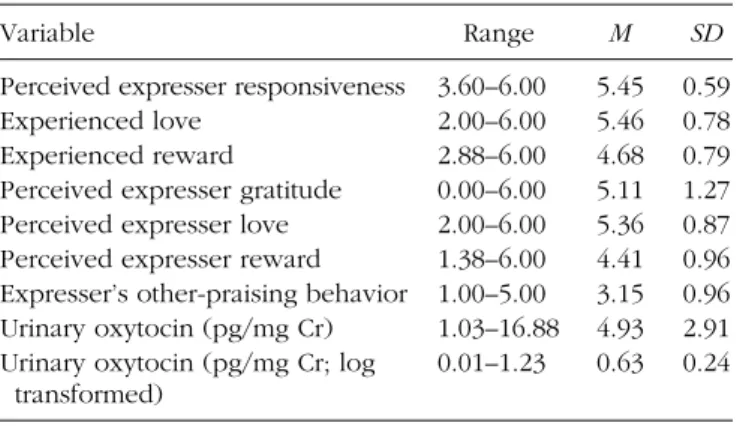
See Table 1 for means and standard deviations for each dependent and independent variable. See Table S1 in the Supplemental Material for correlations between variables.
Oxytocin and psychological responses
To test the main effects of targets’ urinary oxytocin on each outcome of interest, we conducted linear regressions with urinary oxytocin as the primary predictor and condi-tion and gender as the control variables. See Table 2 for unstandardized regression coefficients and confidence intervals (CIs). Results from these models were consistent with hypotheses. Urinary oxytocin was significantly posi-tively associated with the primary and secondary out-comes of interest, perceived expresser responsiveness (p = .005) and experienced loving as a result of the con-versation (p = .001). In addition, exploratory analyses showed that oxytocin was significantly positively
associated with perceptions of the theoretically relevant emotions of the partner—how grateful (p = .027) and loving (p = .009) the expresser felt. It was not, however, associated with the more general aggregated measures of experienced reward (p > .250), nor perceived expresser reward (p > .250).
Controlling for conversation duration, whether the couple lived together, or whether they were dating ver-sus committed to the long term (i.e., engaged, married, or cohabiting) did not change the conclusions of any of these analyses. Controlling for relationship satisfac-tion did not change the conclusions about primary, sec-ondary, or discriminant outcomes; however, the target’s perceptions that the expresser felt grateful (b = 0.92, p = .078, 95% CI = [−0.11, 1.95]) and loving (b = 0.64, p = .064, 95% CI = [−0.04, 1.31]) were no longer significantly associated with oxytocin in these analyses.
Given our sample size and prior findings (Algoe et al., 2016; Algoe & Way, 2014), we had no predictions that gender or condition would moderate this main effect, but we tested that possibility for exploratory purposes. Neither gender nor condition moderated the association between urinary oxytocin and any of these outcomes, except in the case of perceptions of express-ers’ affective reward.4
Targets’ Oxytocin × Expressers’
Other-Praising Behavior
Previous research documented the cross-partner effect of expressers’ other-praising behavior on the key out-come of the targets’ perception of expresser responsive-ness (Algoe et al., 2016), and here we tested whether this effect was moderated by targets’ oxytocin. (See the Supplemental Material for exploratory tests of this effect on the secondary and exploratory outcomes, which were not the original focus of this research question.) To do so, we added two variables to the model used in the previous analyses: expressers’ other-praising Table 1. Descriptive Statistics for Study Variables
Variable Range M SD
Perceived expresser responsiveness 3.60–6.00 5.45 0.59 Experienced love 2.00–6.00 5.46 0.78 Experienced reward 2.88–6.00 4.68 0.79 Perceived expresser gratitude 0.00–6.00 5.11 1.27 Perceived expresser love 2.00–6.00 5.36 0.87 Perceived expresser reward 1.38–6.00 4.41 0.96 Expresser’s other-praising behavior 1.00–5.00 3.15 0.96 Urinary oxytocin (pg/mg Cr) 1.03–16.88 4.93 2.91 Urinary oxytocin (pg/mg Cr; log
transformed)
0.01–1.23 0.63 0.24
Note: Values shown are for targets. Outliers greater than 3 standard deviations below the mean are excluded. The urinary oxytocin metric is oxytocin pg/mg creatinine (CR); nontransformed values are provided for reference, but log-transformed values were used in the analyses.
Table 2. Unstandardized Regression Coefficients From Models Predicting Oxytocin’s Effect on Targets’ Psychological Responses to Expressers’ Praise
Outcome Oxytocin (pg/mg Cr) Condition Gender
Perceived partner responsiveness 0.69 [0.211, 1.177]** −0.10 [−0.307, 0.118] 0.20 [−0.031, 0.438] Experienced love 1.07 [0.456, 1.691]** −0.05 [−0.315, 0.225] 0.10 [−0.196, 0.398] Experienced reward 0.33 [−0.329, 0.991] −0.14 [−0.432, 0.145] 0.24 [−0.072, 0.560] Perceived expresser gratitude 1.16 [0.136, 2.183]* −0.50 [−0.951, −0.054] −0.10 [−0.594, −0.394] Perceived expresser love 0.97 [0.248, 1.691]** 0.01 [−0.303, 0.328] 0.19 [−0.153, 0.541] Perceived expresser reward 0.29 [−0.514, 1.093] −0.03 [−0.320, 0.382] 0.12 [−0.265, 0.505]
Note: Total df in these models ranged from 117 to 120. Values given in brackets are 95% confidence intervals. Condition and gender were included as covariates in all analyses. CR = creatinine.
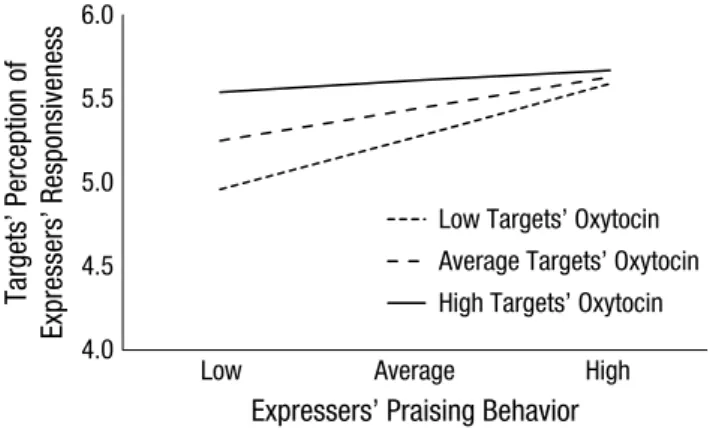
behavior and the interaction term computed by multi-plying expressers’ other-praising behavior with targets’ oxytocin. We used the PROCESS macro in SPSS (Hayes, 2013), which allowed us to automatically center the variables to facilitate interpretation of the data, to use bootstrapping to estimate the average effect from 5,000 samples, and to test simple slopes within the interaction if the overall interaction was significant. The interaction term was significant, b = −0.58, p = .037, 95% CI = [−1.12, −0.04], t(107) = −2.11. See Figure 2 for a depic-tion of the interacdepic-tion at, above, and below 1 standard deviation from the mean of oxytocin.
The pattern of interaction is consistent with the pos-sibility that high levels of circulating oxytocin, indexed by 24-hr urine concentration, facilitated perceptions of expresser responsiveness: For targets with high oxyto-cin, perceptions of the expresser’s responsiveness did not depend on the expresser’s behavior in that specific interaction, b = 0.07, p = .410, 95% CI = [−0.10, 0.23], t(107) = 0.83. However, for targets with average or low levels of oxytocin, the expresser’s behavior mattered: Only those targets whose partners made use of other-praising behavior perceived that expression of gratitude as being responsive. For targets with average and low levels of oxytocin, the simple effect was statistically significant—average: b = 0.21, p = .001, 95% CI = [0.09, 0.32], t(107) = 3.50; low: b = 0.35, p < .001, 95% CI = [0.16, 0.53], t(107) = 3.71.
All conclusions held when we controlled for conver-sation duration, relationship satisfaction, whether the couple lived together, or whether they were dating ver-sus committed to the long term (i.e., engaged, married, or cohabiting). Additionally, out of curiosity, we used the Johnson-Neyman technique ( Johnson & Fay, 1950) to further assess the implications of these findings: This analysis showed that about 29% of this sample had
oxytocin levels high enough that perceptions of their partner’s responsiveness were not significantly associ-ated with the partner’s behavior. That translates to oxy-tocin pg/mg creatinine values greater than about 5.72 in our sample.
Discussion
We provide the first evidence linking levels of naturally occurring oxytocin with subsequent subjective psycho-logical responses to a social behavior—expressed gratitude—that is uniquely implicated in promoting bonds between human adult romantic partners. These specific psychological responses are precisely those that should prompt the person’s future investment and interest in the relationship (e.g., Algoe et al., 2013; Gonzaga et al., 2001; Reis et al., 2004). Notably, for people with high circulating oxytocin over the prior 24 hr, their partner’s behavior when expressing grati-tude was not associated with perceptions of that part-ner’s responsiveness. One limitation of these cross-sectional correlational data is that our hypotheses are about oxytocin’s causal role in facilitating bonding, but we cannot rule out the possibility that habitual high-quality interactions were the cause of greater cumulative levels of oxytocin. Our statistical controls help alleviate this concern somewhat, but this is the kind of important empirical question that we hope the present theoretical and methodological approaches will help address in future research.
Specifically, rather than focus on global evaluations of the relationship, we took a cue from original work (Williams et al., 1992) that examined proximal mecha-nisms for bonding, and we focused on the specific affective and relationship constructs involved in that process; in the future, such an approach may help address equivocal results regarding oxytocin’s effects on relationship outcomes, broadly defined (e.g., Taylor et al., 2010). Additionally, one prior experiment, show-ing that intranasal oxytocin increased subjective experi-ences of attraction but not positive mood after participants viewed photos of male and female strang-ers, raises the possibility that the dissociated effects among “good” outcomes of perceived responsiveness and affective reward seen here and in the findings of Algoe and Way (2014) will generalize beyond the close-relationship context (Theodoridou, Rowe, Penton-Voak, & Rogers, 2009).
The pattern of the interaction between targets’ oxy-tocin and expressers’ praise predicting perceived respon-siveness (and love; see the Supplemental Material) appears more consistent with the possibility that oxyto-cin offers “rose-colored glasses” for bonding opportuni-ties with close others than that it makes people more 4.0
4.5 5.0 5.5 6.0
Low Average High
Targets’ Perception of
Expressers’ Responsiveness
Expressers’ Praising Behavior Low Targets’ Oxytocin Average Targets’ Oxytocin High Targets’ Oxytocin
attuned to their social cues (Shamay-Tsoory & Abu-Akel, 2016). However, the latter social-salience hypothesis draws heavily from considerations of dopamine and reward, and it does appear more consistent with the pattern of effects presented in the Supplemental Material for the specific outcome of affective reward. There are multiple pathways to bonding, and we look forward to future research on this possible dissociation with regard to the effects of oxytocin on positive outcomes. The current study did not directly test hypotheses from any of the several prominent accounts of oxytocin’s role in social life (e.g., see the thoughtful review of three expla-nations by Bartz et al., 2011); however, we are hopeful that the additional theoretical considerations we discuss here, from affective and relationship science, will help inform such reviews going forward. In addition, all the tested interactions—including those used to investigate gender differences—would benefit from increased sam-ple sizes to further enhance the reliability of estimates and confidence in conclusions.
Though we await replication of our findings, we see the current data as promising initial evidence for the coevolved proximal mechanisms through which oxyto-cin facilitates potentially life-enhanoxyto-cing connections (Holt-Lunstad et al., 2010). The current findings are also a useful jumping-off point for future research targeting oxytocin’s role not only in attenuating negative and physically distressing responses (e.g., Ditzen et al., 2009), but in growth processes as well (Lestanova et al., 2016).
Action Editor
Steven W. Gangestad served as action editor for this article.
Author Contributions
S. B. Algoe conceived and designed the study. K. Grewen helped develop the method for collecting 24-hr urine and oversaw data collection, storage of urine, and assay of oxyto-cin and creatinine. L. E. Kurtz helped collect the data. S. B. Algoe analyzed the data and drafted the manuscript, and L. E. Kurtz and K. Grewen provided critical revisions. All authors approved the final version of the manuscript for submission.
Acknowledgments
The names of the hardworking members of the research team that contributed to this project can be found on the website of the first author. In addition, we greatly appreciate proce-dural guidance from Ann Firestine regarding collection of 24-hr urine samples, as well as helpful feedback on this manuscript from the members of the first author’s lab and Barbara Fredrickson.
Declaration of Conflicting Interests
The authors declared that they had no conflicts of interest with respect to their authorship or the publication of this article.
Funding
This research was supported by the Expanding the Science and Practice of Gratitude project run by University of Cali-fornia, Berkeley’s Greater Good Science Center in partnership with University of California, Davis, with funding from the John Templeton Foundation.
Supplemental Material
Additional supporting information can be found at http:// journals.sagepub.com/doi/suppl/10.1177/0956797617716922
Open Practices
As discussed by Finkel, Easwick, and Reis (2015), publicly shar-ing data from studies of romantic couples risks violatshar-ing par-ticipants’ confidentiality, as one spouse may identify his or her partner’s data. In addition, our consent agreement with partici-pants did not state that their data would be widely distributed. For these reasons, we chose not to apply for an Open Data badge. The instructions for reproducing some of the methods (e.g., processing of the urine samples) requires specialized training by an experienced laboratory technician. We can pro-vide interested researchers with all verbal instructions given to participants and the questionnaires they responded to, but not the additional training required, so we did not apply for an Open Materials badge. The complete Open Practices Disclosure for this article can be found at http://journals.sagepub.com/ doi/suppl/10.1177/0956797617716922. More information about the Open Practices badges can be found at http://www.psycho logicalscience.org/publications/badges.
Notes
1. We consider love and gratitude as two different facets of the bonding process, on the basis of emotion theory; though the present study was not designed to test differences between them, that theorizing informs our methodological rationale. 2. We acknowledge that the study by Schneiderman et al. (2012) relied on unextracted samples of oxytocin, a method that has generated criticism (McCullough et al., 2013) and defense (Carter, 2014). In fact, each study reviewed in this section relied on a different method for measuring or manipulating the oxyto-cin system, and researchers agree that each has its strengths and limitations for inference. This further justifies our conclusion that more data are needed on oxytocin’s role in adult human bonding processes before strong conclusions can be drawn. The current study uses yet another method (see the Design and Procedure section) to carefully build on recent findings. 3. See the Supplemental Material for results when these values are included.
CI = [−0.06, 1.96]). Given the unexpected nature of the finding and the marginally significant trend, we will not interpret this further.
References
Algoe, S. B. (2012). Find, remind, and bind: The functions of gratitude in everyday relationships. Social & Personality Psychology Compass, 6, 455–469. doi:10.1111/j.1751-9004.2012.00439.x
Algoe, S. B., Fredrickson, B. L., & Gable, S. L. (2013). The social functions of the emotion of gratitude via expres-sion. Emotion, 13, 605–609. doi:10.1037/a0032701 Algoe, S. B., Gable, S. L., & Maisel, N. C. (2010). It’s the little
things: Everyday gratitude as a booster shot for romantic relationships. Personal Relationships, 17, 217–233. doi: 10.1111/j.1475-6811.2010.01273.x
Algoe, S. B., & Haidt, J. (2009). Witnessing excellence in action: The “other-praising” emotions of elevation, grati-tude, and admiration. Journal of Positive Psychology, 4, 105–127. doi:10.1080/17439760802650519
Algoe, S. B., Kurtz, L. E., & Hilaire, N. (2016). Putting the “you” in “thank you”: Other-praising behavior explains the role of expressed gratitude in social life. Social Psychological and Personality Science, 7, 658–666.
Algoe, S. B., & Way, B. M. (2014). Evidence for a role of the oxytocin system, indexed by genetic variation in CD38, in the social bonding effects of expressed gratitude. Social Cognitive and Affective Neuroscience, 9, 1855–1861. doi:10.1093/scan/nst182
Algoe, S. B., & Zhaoyang, R. (2015). Positive psychology in context: Effects of expressing gratitude in ongoing rela-tionships depend on perceptions of enactor responsive-ness. The Journal of Positive Psychology, 11, 399–415. doi: 10.1080/17439760.2015.1117131
Amico, J. A., Ulbrecht, J. S., & Robinson, A. G. (1987). Clearance studies of oxytocin in humans using radioimmunoassay measurements of the hormone in plasma and urine. The Journal of Clinical Endocrinology & Metabolism, 64, 340– 345. doi:10.1210/jcem-64-2-340#sthash.3QUSwnhu.dpuf Bartz, J. A., Zaki, J., Bolger, N., & Ochsner, K. N. (2011).
Social effects of oxytocin in humans: Context and person matter. Trends in Cognitive Sciences, 15, 301–309. Behnia, B., Heinrichs, M., Bergmann, W., Jung, S., Germann,
J., Schedlowski, M., . . . Kruger, T. H. C. (2014). Differential effects of intranasal oxytocin on sexual experiences and partner interactions in couples. Hormones and Behavior, 65, 308–318.
Carter, C. S. (2014). Oxytocin pathways and the evolution of human behavior. Annual Review of Psychology, 65, 17–39. Carter, C. S., Williams, J. R., Witt, D. M., & Insel, T. R. (1992).
Oxytocin and social bonding. Annals of the New York Academy of Sciences, 652, 204–211. doi:10.1111/j .1749-6632.1992.tb34356.x
Diamond, L. M. (2004). Emerging perspectives on distinc-tions between romantic love and sexual desire. Current Directions in Psychological Science, 13, 116–119. doi: 10.1111/j.0963-7214.2004.00287.x
Ditzen, B., Schaer, M., Gabriel, B., Bodenmann, G., Ehlert, U., & Heinrichs, M. (2009). Intranasal oxytocin increases
positive communication and reduces cortisol levels dur-ing couple conflict. Biological Psychiatry, 65, 728–731. doi:10.1016/j.biopsych.2008.10.011
Eliava, M., Melchior, M., Knobloch-Bollmann, H. S., Wahis, J., da Silva Gouveia, M., Tang, Y., . . . Grinevich, V. (2016). A new population of parvocellular oxytocin neurons con-trolling magnocellular neuron activity and inflammatory pain processing. Neuron, 89, 1291–1304. doi:10.1016/j .neuron.2016.01.041
Finkel, E. J., Eastwick, P. W., & Reis, H. T. (2015). Best research practices in psychology: Illustrating epistemological and pragmatic considerations with the case of relationship science. Journal of Personality and Social Psychology, 108, 275–297. http://dx.doi.org/10.1037/pspi0000007
Fredrickson, B. L. (2013). Positive emotions broaden and build. In P. Devine & A. Plant (Eds.), Advances in experi-mental social psychology (Vol. 47, pp. 1–53). San Diego, CA: Academic Press.
Fredrickson, B. L., Cohn, M. A., Coffey, K. A., Pek, J., & Finkel, S. M. (2008). Open hearts build lives: Positive emotions, induced through loving-kindness medita-tion, build consequential personal resources. Journal of Personality and Social Psychology, 95, 1045–1062. doi:10.1037/a0013262
Gable, S. L., Gonzaga, G. C., & Strachman, A. (2006). Will you be there for me when things go right? Supportive responses to positive event disclosures. Journal of Personality and Social Psychology, 91, 904–917. doi:10.1037/0022-3514.91.5.904
Gable, S. L., & Reis, H. T. (2001). Appetitive and aversive social interaction. In J. Harvey & A. Wenzel (Eds.), Close romantic relationships: Maintenance and enhancement (pp. 169–194). Mahwah, NJ: Erlbaum.
Gonzaga, G. C., Keltner, D., Londahl, E. A., & Smith, M. D. (2001). Love and the commitment problem in romantic relations and friendship. Journal of Personality and Social Psychology, 81, 247–262. doi:10.1037/0022-3514.81.2.247 Gonzaga, G. C., Turner, R. A., Keltner, D., Campos, B., &
Altemus, M. (2006). Romantic love and sexual desire in close relationships. Emotion, 6, 163–179. doi:10.1037/1528-3542.6.2.163
Gottman, J. M., & Levenson, R. W. (1992). Marital processes predictive of later dissolution: Behavior, physiology, and health. Journal of Personality and Social Psychology, 63, 221–233.
Grewen, K. M., Davenport, R. E., & Light, K. C. (2010). An investigation of plasma and salivary oxytocin responses in breast- and formula-feeding mothers of infants. Psychophysiology, 47, 625–632. doi:10.1111/j.1469-8986 .2009.00968.x
Hayes, A. F. (2013). Introduction to mediation, moderation, and conditional process analysis: A regression-based approach. New York, NY: Guilford Press.
Hazan, C., & Diamond, L. M. (2000). The role of attachment in human mating. Review of General Psychology, 4, 186–204. Holt-Lunstad, J., Smith, T. B., & Layton, J. B. (2010). Social
Insel, T. R., & Shapiro, L. E. (1992). Oxytocin receptor distri-bution reflects social organization in monogamous and polygamous voles. Proceedings of the National Academy of Sciences, USA, 89, 5981–5985.
Johnson, P. O., & Fay, L. C. (1950). The Johnson-Neyman tech-nique, its theory and application. Psychometrika, 15, 349–367. Lestanova, Z., Bacova, Z., Kiss, A., Havranek, T., Strbak, V.,
& Bakos, J. (2016). Oxytocin increases neurite length and expression of cytoskeletal proteins associated with neuronal growth. Journal of Molecular Neuroscience, 59, 184–192. doi:10.1007/s12031-015-0664-9
Light, K. C., Grewen, K. M., & Amico, J. A. (2005). More fre-quent partner hugs and higher oxytocin levels are linked to lower blood pressure and heart rate in premenopausal women. Biological Psychology, 69, 5–21. doi:10.1016/j .biopsycho.2004.11.002
McCullough, M. E., Churchland, P. S., & Mendez, A. J. (2013). Problems with measuring peripheral oxytocin: Can the data on oxytocin and human behavior be trusted? Neuroscience & Biobehavioral Reviews, 37, 1485–1492. doi:10.1016/j.neubiorev.2013.04.018
Reis, H., Clark, M. S., & Holmes, J. G. (2004). Perceived partner responsiveness as an organizing construct in the study of intimacy and closeness. In D. J. Mashek & A. P. Aron (Eds.), Handbook of closeness and intimacy (pp. 201–225). Mahwah, NJ: Erlbaum.
Reyes, T. L., Galinsky, A. M., Hoffmann, J. N., You, H. M., Ziegler, T. E., & McClintock, M. K. (2014). Social peptides: Measuring urinary oxytocin and vasopressin in a home
field study of older adults at risk for dehydration. The Journals of Gerontology, Series B: Psychological Sciences & Social Sciences, 69(Suppl. 2), S229–S237. doi:10.1093/ geronb/gbu104
Schneiderman, I., Zagoory-Sharon, O., Leckman, J. F., & Feldman, R. (2012). Oxytocin during the initial stages of romantic attachment: Relations to couples’ interactive reciprocity. Psychoneuroendocrinology, 37, 1277–1285. doi:10.1016/j.psyneuen.2011.12.021
Shamay-Tsoory, S. G., & Abu-Akel, A. (2016). The social salience hypothesis of oxytocin. Biological Psychiatry, 79, 194–202.
Stuebe, A. M., Grewen, K., & Meltzer-Brody, S. (2013). Association between maternal mood and oxytocin response to breastfeeding. Journal of Women’s Health, 22, 352–361. doi:10.1089/jwh.2012.3768
Taylor, S. E., Saphire-Bernstein, S., & Seeman, T. E. (2010). Are plasma oxytocin in women and plasma vasopressin in men biomarkers of distressed pair-bond relationships? Psychological Science, 21, 3–7.
Theodoridou, A., Rowe, A. C., Penton-Voak, I. S., & Rogers, P. J. (2009). Oxytocin and social perception: Oxytocin increases perceived facial trustworthiness and attractive-ness. Hormones and Behavior, 56, 128–132.