Relationship Between Excessive Gestational Weight Gain and
Neonatal Adiposity in Women With Mild Gestational Diabetes
Mellitus
Sean C. Blackwell, M.D., Mark B. Landon, M.D., Lisa Mele, Sc.M., Uma M. Reddy, M.D. M.P.H., Brian M. Casey, M.D., Ronald J. Wapner, M.D., Michael W. Varner, M.D., Dwight J. Rouse, M.D., John M. Thorp Jr., M.D., Anthony Sciscione, D.O., Patrick Catalano, M.D., George Saade, M.D., Steve N. Caritis, M.D., Yoram Sorokin, M.D., William A. Grobman, M.D., M.B.A., and the Eunice Kennedy Shriver National Institute of Child Health and Human Development (NICHD) Maternal-Fetal Medicine Units (MFMU) Network*
Departments of Obstetrics and Gynecology at The University of Texas Health Science Center at Houston-Children's Memorial Hermann Hospital, Houston, TX (SCB), The Ohio State University (MBL); The University of Texas Southwestern Medical Center, Dallas, TX (BMC); Columbia University, New York, NY (RJW); University of Utah, Salt Lake City, UT (MWV); University of Alabama at Birmingham, Birmingham, AL (DJR); University of North Carolina, Chapel Hill, NC (JMT); Drexel University, Philadelphia, PA (AS); Case Western Reserve University, Cleveland, OH (PC); University of Texas Medical Branch, Galveston, TX (GS, GBA); University of Pittsburgh, Pittsburgh, PA (SNC); Wayne State University, Detroit, MI (YS); Northwestern University, Chicago, IL (WAG); and The George Washington University Biostatistics Center, Washington, DC (LM); and the Eunice Kennedy Shriver National Institute of Child Health and Human Development, Bethesda, MD (UMR)
Abstract
OBJECTIVE—To evaluate the relationships between excessive gestational weight gain, neonatal adiposity, and adverse obstetric outcomes in women with mild gestational diabetes mellitus (GDM).
METHODS—This is a secondary analysis of a multicenter randomized clinical trial of women with mild GDM. Based on self-reported prepregnancy body weight, gestational weight gain was categorized as excessive if it was greater than 2009 Institute of Medicine guidelines. Maternal outcomes and neonatal anthropomorphic characteristics were compared between women with excessive weight gain and those without excessive weight gain. Multiple linear and logistic regression analyses were performed to adjust for confounding factors.
RESULTS—We studied 841 women who participated in the main trial and had prepregnancy BMI and delivery information available (n= 431 treatment group, n= 410 no treatment). After
Corresponding author: Sean C. Blackwell, M.D., Department of Obstetrics, Gynecology and Reproductive Sciences, University of Texas Health Science Center at Houston, 6431 Fannin, Suite 3.286, Houston, Texas 77030, [email protected], Office: 713-500-6415, FAX: 713-500-0799.
*For a list of the other members of the Eunice Kennedy Shriver NICHD MFMU Network, see Appendix 1 online at
HHS Public Access
Author manuscript
Obstet Gynecol
. Author manuscript; available in PMC 2017 December 01.Published in final edited form as:
Obstet Gynecol. 2016 December ; 128(6): 1325–1332. doi:10.1097/AOG.0000000000001773.
A
uthor Man
uscr
ipt
A
uthor Man
uscr
ipt
A
uthor Man
uscr
ipt
A
uthor Man
uscr
adjustment for factors including treatment and prepregnancy BMI, excessive weight gain remained associated with LGA (aOR 2.94, 95% CI 1.81-4.93), BW > 4000 grams (aOR 2.56, 95% CI 1.54-4.40), preeclampsia (aOR 2.96, 95% CI 1.35-7.03) and cesarean delivery for labor arrest (aOR 2.37, 95% CI 1.30-4.44). In addition, excessive weight gain was independently associated with increased total neonatal fat (p < 0.001) and birth weight (p < 0.001).
CONCLUSION—In women with both treated and untreated mild GDM, excessive gestational weight gain was independently associated with both greater birth weight and adiposity.
Introduction
Excessive gestational weight gain is defined as weight gain during pregnancy beyond the recommended thresholds from the 2009 Institute of Medicine (IOM) guidelines.1,2 It is estimated that approximately 40-50% of all pregnant women have excessive gestational weight gain.3 There is ample literature that describes an increased risk for both maternal and newborn adverse outcomes in women with excessive weight gain.4-6 This includes the risk for excessive fetal growth (e.g. large for gestational age [LGA] and macrosomia) which can then predispose the offspring to obesity later in life. Several studies have linked maternal weight gain during pregnancy and to child obesity and adiposity.7-9
Women with gestational diabetes mellitus (GDM) have an increased risk for LGA and macrosomic birth weights (compared to women without GDM).10,11 Although there are robust data regarding the interaction of weight gain and maternal obesity in non-diabetic women, there is limited information regarding the impact of excessive weight gain on pregnancy outcomes in women with mild GDM (who make up a large portion of all women with GDM). This data is important to clinicians to know whether IOM guidelines for weight gain in pregnancy apply to women with mild GDM.
Because of the potential short and long-term impact of excessive fetal growth in utero, we performed this analysis to evaluate the relationship between excessive gestational weight gain and measures of newborn growth and adiposity in women with both treated and untreated mild GDM. Our secondary goal was to evaluate the relationship between excessive gestational weight gain and various perinatal outcomes.
Materials & Methods
This is a secondary analysis of a randomized clinical trial (RCT) for women with mild GDM (enrollment October 2002-November 2007).12 The study was approved by the human subjects committee at each participating center; all women enrolled provided written informed consent. This secondary analysis was approved by the Committee for Protection of Human Subjects at the University of Texas Health Sciences Center at Houston. Women across all clinical sites were included in the analysis. Women eligible for the RCT had a singleton pregnancy, gestational age between 24 weeks 0 days and 30 weeks 6 days gestation, and met criteria for mild GDM. Mild GDM was defined as a fasting glucose less than 95 mg/dl with two or three timed glucose measurements exceeding the pre-defined thresholds (one hour ≥180 mg/dl, two hour ≥155 mg/dl, and three hour ≥140 mg/dl). Treatment included either formal nutritional counseling plus diet therapy (along with insulin
A
uthor Man
uscr
ipt
A
uthor Man
uscr
ipt
A
uthor Man
uscr
ipt
A
uthor Man
uscr
therapy if required) versus no treatment. Women were excluded from the trial if they had pre-existing diabetes, abnormal glucose screening prior to 24 weeks, GDM in a prior pregnancy, history of stillbirth, known fetal anomaly, current or planned corticosteroid use, asthma, chronic hypertension, chronic medical disease, and maternal or fetal conditions likely to require imminent or preterm delivery.
Women in the treatment arm received formal nutritional counseling and performed daily self-blood glucose monitoring (fasting and 2-hour postprandial measurements). Insulin was prescribed if the majority of values between study visits were elevated (fasting glucose ≥95 mg/dl, two-hour post-meal glucose ≥120 mg/dl). Clinical management including the timing and mode of delivery were at the discretion of the patient's attending physician. Those in the no treatment arm were managed in routine fashion, as caregivers, patients, and research staff were unaware of whether or not the subject met criteria for mild GDM or had normal OGTT testing.
Self-reported pre-pregnancy BMI (kg/m2) and gestational weight gain (pounds) were recorded for each study participant. Women were categorized as underweight (BMI < 18.5 kg/m2), normal weight (BMI 18.5-24.9 kg/m2), overweight (BMI 25-29.9 kg/m2), and obese (BMI ≥ 30 kg/m2).13 Gestational weight gain was defined as excessive if it exceeded the total weight gain recommendations from the IOM (underweight women > 40 lbs., normal weight > 35 lbs., overweight > 25 lbs., and obese > 20 lbs.).2 Demographic and clinical characteristics, perinatal outcomes, and neonatal anthropomorphic measures were compared between women who had “excessive weight gain” versus those with “normal weight gain.” Given the rarity of weight gain being less than IOM recommendations, we collapsed those with less than targeted range and those with normal weight gain into same group.
Pre-specified study definitions and outcome measures were used for the study. Preeclampsia was defined as elevation in blood pressure (systolic ≥ 140 mm Hg or diastolic value ≥ 90 mm Hg on two occasions at least 4 hours apart or one elevated blood pressure value subsequently treated with antihypertensive medication) and proteinuria (urine collection ≥ 300 mg/24 hours or ≥ 2+ on dipstick in the absence of a 24-hour collection). Elevated blood pressure with either elevated liver enzymes (SGOT ≥ 100 U/L) or thrombocytopenia (platelet count <100,000/mm3) also signified preeclampsia. Shoulder dystocia was defined clinically and required documentation of maneuvers specifically employed to disimpact the fetal shoulders. Large for gestational age (birth weight > 90th percentile) and small for gestational age (birth weight<10th percentile) were based on prior published normative values.14 Cesarean delivery for labor arrest was defined as cesarean done for any of the following indications: cephalopelvic disproportion, failure to progress, failed induction, failed forceps/vacuum or arrest of descent. Using a standardized approach, flank skin fold measurement, length, head circumference and upper mid-arm circumference were performed (within 72 hours if possible) and neonatal fat mass was calculated.15 Neonatal fat mass was reported as both total fat mass in grams as well as percentage of total weight (fat mass [grams] / total weight [grams]).
Statistical analysis was performed with SAS software. Chi-square or Fisher's exact test (in the case of infrequent outcomes) was used to compare categorical variables, Student's T test
A
uthor Man
uscr
ipt
A
uthor Man
uscr
ipt
A
uthor Man
uscr
ipt
A
uthor Man
uscr
or Wilcoxon Rank Sum test (in the case on non-normal distribution) was used to compare continuous variables. Presence of an interaction between treatment group and excessive weight gain with the outcomes, or between treatment group and pre-pregnancy BMI category [≥ 30 kg/ m2 vs. <30 kg/ m2] with the outcomes, was tested using the Breslow-Day test for homogeneity of the odds ratios for categorical variables and analysis of variance for continuous variables. Multivariable linear regression was performed to evaluate continuous dependent variables (neonatal birth weight, fat mass, and percent fat mass) adjusting for independent variables (maternal race/ethnicity [Hispanic vs. not Hispanic], maternal age, gestational age at enrollment, parity [nulliparous vs. multiparous], gestational age at delivery, treatment group, pre-pregnancy BMI category [≥ 30 kg/ m2 vs. <30 kg/ m2], and gestational weight gain [excessive vs. normal]. Multivariable logistic regression was performed with dependent variables, BW > 4000 grams, preeclampsia, cesarean delivery, and chorioamnionitis including the same independent variables, and for LGA and SGA including the same independent variables except for gestational age at delivery. Separate regression models by treatment group were generated for any outcome where there was a significant interaction between excessive weight gain and treatment group or between excessive weight gain and pre-pregnancy BMI category. A nominal 2-sided P value of < 0.05 was considered to indicate statistical significance, and no adjustments were made for multiple comparisons.
Results
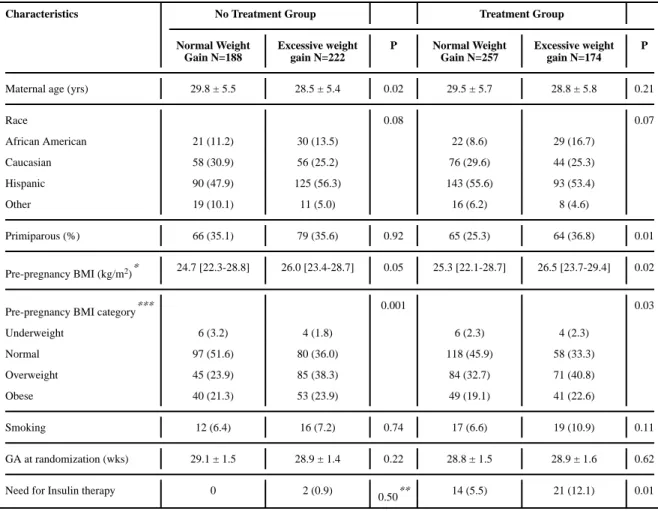
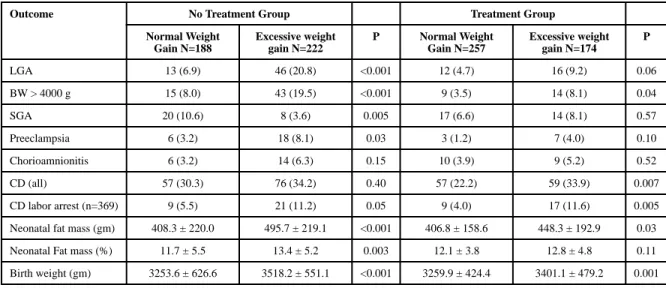
There were 958 enrolled in the RCT and delivery data was available for 932 women. Of these, 841 women had data pre-pregnancy BMI information and were included in this secondary analysis (n= 431 treatment group, n= 410 no treatment). Treatment was associated with a lower rate of excessive weight gain in the cohort (40.4% vs. 54.2%; RR=0.75, 95% CI 0.65 - 0.86; p<0.001). The demographic and clinical characteristics of the study population are described in Table I. Selected maternal and neonatal outcomes based on the presence or absence of excessive weight gain are summarized in Table II. Women with excessive weight gain who did not receive treatment for GDM had newborns with greater birth weight, higher frequency of LGA, BW > 4000 grams, and greater newborn fat mass. In addition, they were more likely to be diagnosed with preeclampsia.
Women with excessive weight gain in the treatment arm were more likely to have birth weight > 4000 grams, and have greater birth weight and fat mass. They were also more likely to undergo cesarean delivery.
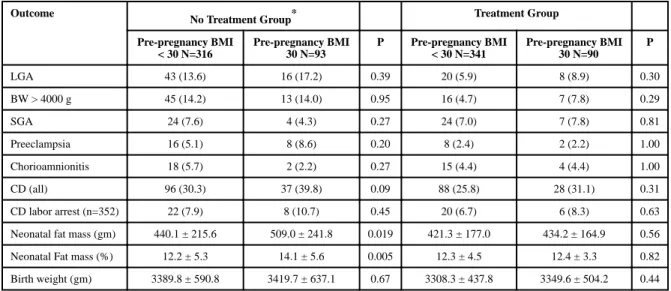
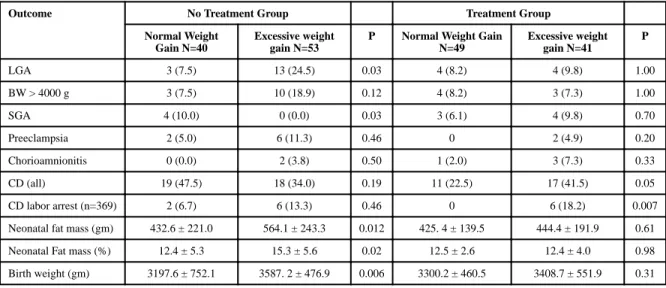
Listed in Table III are the perinatal outcomes for study participants based on presence or absence of pre-pregnancy maternal obesity. In those who underwent GDM treatment there were no differences in obstetrical outcomes or indices of neonatal anthropomorphics based on maternal obesity. However, in those without treatment, offspring of obese mothers had greater neonatal fat mass (p=0.019) and fat mass percentage (p= 0.005). Table IV describes outcomes only for obese women and compares perinatal outcomes based on normal or excessive weight gain by treatment group. In untreated obese women, excessive weight gain was associated with greater neonatal fat mass, neonatal fat mass percentage, and birth weight. However, in those who were treated there were no differences in neonatal fat mass
A
uthor Man
uscr
ipt
A
uthor Man
uscr
ipt
A
uthor Man
uscr
ipt
A
uthor Man
uscr
or birth weight. The only difference in outcomes for those with treatment was that those with excessive weight gain had greater risk for cesarean delivery for labor arrest (p = 0.007).
Multiple logistic and linear regression analyses were performed to adjust for confounding factors including GDM treatment and pre-pregnancy BMI (obese versus non-obese) in order to evaluate the effects of weight gainon perinatal outcomes and neonatal anthropometric characteristics. Separate models by GDM treatment group were generated for the outcome SGA, since there was a significant interaction between treatment group and weight gain with SGA (p=0.015), and for the outcome fat mass percent, since there was a significant
interaction between treatment group and pre-pregnancy BMI category with fat mass percent (p=0.04). Table V describes the associations between excessive weight gain and selected neonatal and maternal outcomes: After adjustment for confounding factors, excessive weight gain was significantly associated with the following outcomes: LGA (aOR 2.94, 95% CI 1.81-4.93), BW > 4000 grams (aOR 2.56, 95% CI 1.54-4.40), preeclampsia (aOR 2.96, 95% CI 1.35-7.03) and cesarean delivery for labor arrest (aOR 2.37, 95% CI 1.30-4.44). In these same models, once we adjusted for excessive weight gain, pre-pregnancy obesity was not significantly associated with an increased risk for adverse outcomes. Multiple linear
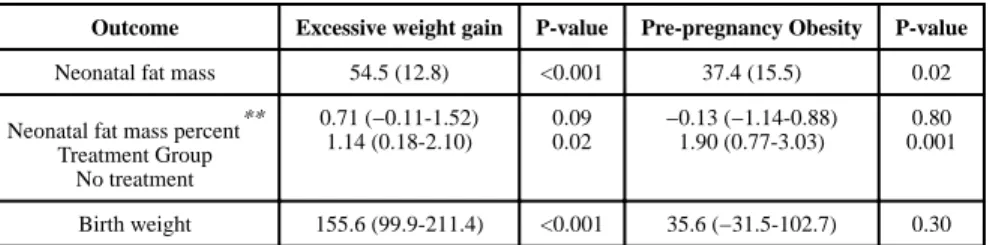
regression analyses were performed to assess the associations between excessive weight gain and maternal obesity on neonatal anthropomorphic characteristics. After adjustment for key variables, excessive weight gain was independently associated with increased total neonatal fat, neonatal fat mass percentage (in those without treatment), and birth weight. Pre-pregnancy maternal obesity was also associated with increased total neonatal fat, neonatal fat mass percentage (in those without treatment), but not overall newborn birth weight (Table VI).
Discussion
We found in our secondary analysis that 1) GDM treatment decreases maternal weight gain, 2) the rate of excessive weight gain remains relatively high at 40.1% despite GDM
treatment, 3) after adjustments for important clinical factors including GDM treatment and maternal obesity, if excessive weight gain developed there was increased neonatal fat mass, risk for LGA, and overall increased birth weight, 4) excessive weight gain was associated with increased risk for cesarean delivery for labor arrest regardless of GDM treatment and 5) after adjustment of important clinical factors including excessive weight gain, maternal obesity was not associated with adverse perinatal outcomes but was associated with
abnormal fetal growth patterns. Moreover, the key finding was that development of excessive weight gain was associated with increased risk of abnormal fetal growth independent of maternal BMI and GDM treatment, thus emphasizing the clinical relevance of this potentially modifiable factor.
Epidemiologic data links excessive weight gain to excessive fetal growth (e.g. LGA and macrosomia) as well as childhood and later life obesity in offspring. 6-8,16 In non-diabetic women several observational studies have demonstrated an association between excessive weight gain and short and long-term measures of excessive offspring growth.17-21 Few studies have evaluated these relationships in women with gestational and pre-gestational diabetes. In the DEPOSIT study (Diabetes Endocrine Pregnancy Outcome Study in
A
uthor Man
uscr
ipt
A
uthor Man
uscr
ipt
A
uthor Man
uscr
ipt
A
uthor Man
uscr
Toronto), Ray and colleagues prospectively studied 428 women with gestational and 196 women with pre-gestational diabetes over a 5-year period.22 They found that weight gain and pre-pregnancy BMI were independent risk factors for adverse neonatal outcomes. Cheng et al. evaluated data from 31,074 women with treated GDM who participated in the Sweet Success California Diabetes and Pregnancy Program from 2001-2004.23 Women who had weight gain above IOM guidelines had higher odds of having LGA newborns (adjusted OR 1.72, 95% CI 1.53-1.93). Egan and colleagues published data from their cohort
(ATLANTIC-DIP) in Ireland, which included 543 women with GDM.24 Of these women 57% had excessive weight gain and after adjustment for confounding factors, in 5 kg interval weight gain increments weight gain was associated with increased risk for LGA (aOR 1.3, 95%CI 1.1–1.6).
A major strength of our study is the evaluation of neonatal fat mass and not just the measure of birth weight. The clinical significance and prediction of fetal adiposity for development of childhood obesity is greater than birthweight alone; neonatal fat mass is strongly associated with development of obesity and metabolic syndrome.25 Additional strengths include use of standardized definitions for clinical and outcome variables as well as linear and logistic regression analyses to adjust for confounding factors. One limitation of the analysis is the fact that measurement of weight gain was in part based on self-reported pre-pregnancy weight, since women were not enrolled into the parent trial until the late second trimester. Some studies have shown good correlation with maternal recall of prior pregnancy events and characteristics (up to 30 years prior) while others have shown lower reliability of maternal recall of pre pregnancy weight and weight gain from prior pregnancies.26,27 Finally, although our findings have generalizability with respect to maternal race/ethnicity and maternal size, our findings are limited to women with treated and untreated mild GDM, and not all women with GDM or pre-gestational DM.
In summary, excessive weight gain remains frequent in women with mild GDM despite treatment and the effects of excessive weight gain on newborn size and anthropometrics are independent of maternal BMI. Future clinical trials are warranted to determine whether additional interventions specifically designed to limit excessive weight gain in mild GDM are beneficial to women and their offspring.
Supplementary Material
Refer to Web version on PubMed Central for supplementary material.
Acknowledgments
The project described was supported by grants from the Eunice Kennedy Shriver National Institute of Child Health and Human Development (NICHD) [HD27915, HD34116, HD40485, HD34208, HD27869, HD40500, HD40560, HD34136, HD40544, HD27860, HD40545, HD53097, HD21410, HD27917, HD40512, HD53118, HD36801], General Clinical Research Centers Grant [M01-RR00034] and the National Center for Research Resources [UL1-RR024989, M01-RR00080, UL1-RR025764, C06-RR11234]. Comments and views of the authors do not necessarily represent views of the NICHD.
The authors thank Julia Zachary for data management; Francee Johnson, R.N., B.S.N. and Jo-Ann Tillinghast, R.N., M.S.N. for protocol development and coordination between clinical research centers; Elizabeth Thom, Ph.D. for protocol/data management and statistical analysis; Marshall W. Carpenter, M.D., Susan M. Ramin, M.D., and
A
uthor Man
uscr
ipt
A
uthor Man
uscr
ipt
A
uthor Man
uscr
ipt
A
uthor Man
uscr
Catherine Y. Spong, M.D. for study design and protocol development; and Susan Tolivaisa for coordination between clinical research centers.
Reference
1. Artal R, Lockwood CJ, Brown HL. Weight gain recommendations in pregnancy and the obesity epidemic. Obstet Gynecol. Jan; 2010 115(1):152–155. [PubMed: 20027048]
2. Rasmussen, KM.; Yaktine, AL., editors. Weight Gain During Pregnancy: Reexamining the Guidelines. Washington (DC: 2009.
3. Chu SY, Callaghan WM, Bish CL, D'Angelo D. Gestational weight gain by body mass index among US women delivering live births, 2004-2005: fueling future obesity. Am J Obstet Gynecol. Mar; 2009 200(3):271, e271–277. [PubMed: 19136091]
4. Zilko CE, Rehkopf D, Abrams B. Association of maternal gestational weight gain with short- and long-term maternal and child health outcomes. Am J Obstet Gynecol. Feb 2.2010
5. Schack-Nielsen L, Michaelsen KF, Gamborg M, Mortensen EL, Sorensen TI. Gestational weight gain in relation to offspring body mass index and obesity from infancy through adulthood. Int J Obes (Lond). Jan; 2010 34(1):67–74. [PubMed: 19918246]
6. Siega-Riz AM, Viswanathan M, Moos MK, et al. A systematic review of outcomes of maternal weight gain according to the Institute of Medicine recommendations: birthweight, fetal growth, and postpartum weight retention. Am J Obstet Gynecol. Oct; 2009 201(4):339, e331–314. [PubMed: 19788965]
7. Oken E, Taveras EM, Kleinman KP, Rich-Edwards JW, Gillman MW. Gestational weight gain and child adiposity at age 3 years. Am J Obstet Gynecol. Apr; 2007 196(4):322, e321–328. [PubMed: 17403405]
8. Oken E, Rifas-Shiman SL, Field AE, Frazier AL, Gillman MW. Maternal gestational weight gain and offspring weight in adolescence. Obstet Gynecol. Nov; 2008 112(5):999–1006. [PubMed: 18978098]
9. Oken E. Maternal and child obesity: the causal link. Obstet Gynecol Clin North Am. Jun; 2009 36(2):361–377, ix-x. [PubMed: 19501319]
10. Higgins M, Mc Auliffe F. A review of maternal and fetal growth factors in diabetic pregnancy. Curr Diabetes Rev. Mar; 2010 6(2):116–125. [PubMed: 20034366]
11. Catalano PM, Thomas A, Huston-Presley L, Amini SB. Phenotype of infants of mothers with gestational diabetes. Diabetes Care. Jul; 2007 30(Suppl 2):S156–160. [PubMed: 17596465] 12. Landon MB, Spong CY, Thom E, et al. A multicenter, randomized trial of treatment for mild
gestational diabetes. N Engl J Med. Oct 1; 2009 361(14):1339–1348. [PubMed: 19797280] 13. Cedergren MI. Optimal gestational weight gain for body mass index categories. Obstet Gynecol.
Oct; 2007 110(4):759–764. [PubMed: 17906006]
14. Alexander GR, Kogan MD, Himes JH. 1994-1996 U.S. singleton birth weight percentiles for gestational age by race, Hispanic origin, and gender. Matern Child Health J. Dec; 1999 3(4):225– 231. [PubMed: 10791363]
15. Catalano PM, Thomas AJ, Avallone DA, Amini SB. Anthropometric estimation of neonatal body composition. Am J Obstet Gynecol. Oct; 1995 173(4):1176–1181. [PubMed: 7485315]
16. Oken E. Excess gestational weight gain amplifies risks among obese mothers. Epidemiology. Jan; 2009 20(1):82–83. [PubMed: 18813018]
17. Hedderson MM, Weiss NS, Sacks DA, et al. Pregnancy weight gain and risk of neonatal complications: macrosomia, hypoglycemia, and hyperbilirubinemia. Obstet Gynecol. Nov; 2006 108(5):1153–1161. [PubMed: 17077237]
18. Stotland NE, Cheng YW, Hopkins LM, Caughey AB. Gestational weight gain and adverse neonatal outcome among term infants. Obstet Gynecol. Sep; 2006 108(3 Pt 1):635–643. [PubMed:
16946225]
19. Nohr EA, Vaeth M, Baker JL, Sorensen T, Olsen J, Rasmussen KM. Combined associations of prepregnancy body mass index and gestational weight gain with the outcome of pregnancy. Am J Clin Nutr. Jun; 2008 87(6):1750–1759. [PubMed: 18541565]
A
uthor Man
uscr
ipt
A
uthor Man
uscr
ipt
A
uthor Man
uscr
ipt
A
uthor Man
uscr
20. Crane JM, White J, Murphy P, Burrage L, Hutchens D. The effect of gestational weight gain by body mass index on maternal and neonatal outcomes. J Obstet Gynaecol Can. Jan; 2009 31(1):28– 35. [PubMed: 19208280]
21. Cedergren M. Effects of gestational weight gain and body mass index on obstetric outcome in Sweden. Int J Gynaecol Obstet. Jun; 2006 93(3):269–274. [PubMed: 16626716]
22. Ray JG, Vermeulen MJ, Shapiro JL, Kenshole AB. Maternal and neonatal outcomes in
pregestational and gestational diabetes mellitus, and the influence of maternal obesity and weight gain: the DEPOSIT study. Diabetes Endocrine Pregnancy Outcome Study in Toronto. QJM. Jul; 2001 94(7):347–356. [PubMed: 11435630]
23. Cheng YW, Chung JH, Kurbisch-Block I, Inturrisi M, Shafer S, Caughey AB. Gestational weight gain and gestational diabetes mellitus: perinatal outcomes. Obstet Gynecol. Nov; 2008 112(5): 1015–1022. [PubMed: 18978100]
24. Egan AM, Dennedy MC, Al-Ramli W, Heerey A, Avalos G, Dunne F. ATLANTIC-DIP: excessive gestational weight gain and pregnancy outcomes in women with gestational or pregestational diabetes mellitus. J Clin Endocrinol Metab. Jan; 2014 99(1):212–219. [PubMed: 24187402] 25. Catalano PM, Thomas A, Huston-Presley L, Amini SB. Increased fetal adiposity: a very sensitive
marker of abnormal in utero development. Am J Obstet Gynecol. Dec; 2003 189(6):1698–1704. [PubMed: 14710101]
26. Tomeo CA, Rich-Edwards JW, Michels KB, et al. Reproducibility and validity of maternal recall of pregnancy-related events. Epidemiology. Nov; 1999 10(6):774–777. [PubMed: 10535796] 27. Russell A, Gillespie S, Satya S, Gaudet LM. Assessing the accuracy of pregnant women in
recalling pre-pregnancy weight and gestational weight gain. J Obstet Gynaecol Can. Sep; 2013 35(9):802–809. [PubMed: 24099445]
A
uthor Man
uscr
ipt
A
uthor Man
uscr
ipt
A
uthor Man
uscr
ipt
A
uthor Man
uscr
A
uthor Man
uscr
ipt
A
uthor Man
uscr
ipt
A
uthor Man
uscr
ipt
A
uthor Man
uscr
ipt
Table I
Selected demographic and clinical characteristics
Characteristics No Treatment Group Treatment Group
Normal Weight Gain N=188
Excessive weight gain N=222
P Normal Weight Gain N=257
Excessive weight gain N=174
P
Maternal age (yrs) 29.8 ± 5.5 28.5 ± 5.4 0.02 29.5 ± 5.7 28.8 ± 5.8 0.21
Race 0.08 0.07
African American 21 (11.2) 30 (13.5) 22 (8.6) 29 (16.7)
Caucasian 58 (30.9) 56 (25.2) 76 (29.6) 44 (25.3)
Hispanic 90 (47.9) 125 (56.3) 143 (55.6) 93 (53.4)
Other 19 (10.1) 11 (5.0) 16 (6.2) 8 (4.6)
Primiparous (%) 66 (35.1) 79 (35.6) 0.92 65 (25.3) 64 (36.8) 0.01
Pre-pregnancy BMI (kg/m2)* 24.7 [22.3-28.8] 26.0 [23.4-28.7] 0.05 25.3 [22.1-28.7] 26.5 [23.7-29.4] 0.02
Pre-pregnancy BMI category*** 0.001 0.03
Underweight 6 (3.2) 4 (1.8) 6 (2.3) 4 (2.3)
Normal 97 (51.6) 80 (36.0) 118 (45.9) 58 (33.3)
Overweight 45 (23.9) 85 (38.3) 84 (32.7) 71 (40.8)
Obese 40 (21.3) 53 (23.9) 49 (19.1) 41 (22.6)
Smoking 12 (6.4) 16 (7.2) 0.74 17 (6.6) 19 (10.9) 0.11
GA at randomization (wks) 29.1 ± 1.5 28.9 ± 1.4 0.22 28.8 ± 1.5 28.9 ± 1.6 0.62
Need for Insulin therapy 0 2 (0.9)
0.50** 14 (5.5) 21 (12.1) 0.01
Data expressed as n (%), mean ± standard deviation, or median [interquartile range]
*
P-value determined by the Wilcoxon rank sum test
**
P-value determined by Fisher's exact test
***
A
uthor Man
uscr
ipt
A
uthor Man
uscr
ipt
A
uthor Man
uscr
ipt
A
uthor Man
uscr
ipt
Table II
Selected perinatal outcomes for study participants based on presence or absence of excessive weight gain by treatment group.
Outcome No Treatment Group Treatment Group
Normal Weight Gain N=188
Excessive weight gain N=222
P Normal Weight Gain N=257
Excessive weight gain N=174
P
LGA 13 (6.9) 46 (20.8) <0.001 12 (4.7) 16 (9.2) 0.06
BW > 4000 g 15 (8.0) 43 (19.5) <0.001 9 (3.5) 14 (8.1) 0.04
SGA 20 (10.6) 8 (3.6) 0.005 17 (6.6) 14 (8.1) 0.57
Preeclampsia 6 (3.2) 18 (8.1) 0.03 3 (1.2) 7 (4.0) 0.10
Chorioamnionitis 6 (3.2) 14 (6.3) 0.15 10 (3.9) 9 (5.2) 0.52
CD (all) 57 (30.3) 76 (34.2) 0.40 57 (22.2) 59 (33.9) 0.007
CD labor arrest (n=369) 9 (5.5) 21 (11.2) 0.05 9 (4.0) 17 (11.6) 0.005
Neonatal fat mass (gm) 408.3 ± 220.0 495.7 ± 219.1 <0.001 406.8 ± 158.6 448.3 ± 192.9 0.03
Neonatal Fat mass (%) 11.7 ± 5.5 13.4 ± 5.2 0.003 12.1 ± 3.8 12.8 ± 4.8 0.11
Birth weight (gm) 3253.6 ± 626.6 3518.2 ± 551.1 <0.001 3259.9 ± 424.4 3401.1 ± 479.2 0.001
A
uthor Man
uscr
ipt
A
uthor Man
uscr
ipt
A
uthor Man
uscr
ipt
A
uthor Man
uscr
ipt
Table III
Selected perinatal outcomes for study participants based on presence or absence of maternal obesity by treatment group.
Outcome
No Treatment Group* Treatment Group
Pre-pregnancy BMI < 30 N=316
Pre-pregnancy BMI ≥ 30 N=93
P Pre-pregnancy BMI < 30 N=341
Pre-pregnancy BMI ≥ 30 N=90
P
LGA 43 (13.6) 16 (17.2) 0.39 20 (5.9) 8 (8.9) 0.30
BW > 4000 g 45 (14.2) 13 (14.0) 0.95 16 (4.7) 7 (7.8) 0.29
SGA 24 (7.6) 4 (4.3) 0.27 24 (7.0) 7 (7.8) 0.81
Preeclampsia 16 (5.1) 8 (8.6) 0.20 8 (2.4) 2 (2.2) 1.00
Chorioamnionitis 18 (5.7) 2 (2.2) 0.27 15 (4.4) 4 (4.4) 1.00
CD (all) 96 (30.3) 37 (39.8) 0.09 88 (25.8) 28 (31.1) 0.31
CD labor arrest (n=352) 22 (7.9) 8 (10.7) 0.45 20 (6.7) 6 (8.3) 0.63
Neonatal fat mass (gm) 440.1 ± 215.6 509.0 ± 241.8 0.019 421.3 ± 177.0 434.2 ± 164.9 0.56
Neonatal Fat mass (%) 12.2 ± 5.3 14.1 ± 5.6 0.005 12.3 ± 4.5 12.4 ± 3.3 0.82
Birth weight (gm) 3389.8 ± 590.8 3419.7 ± 637.1 0.67 3308.3 ± 437.8 3349.6 ± 504.2 0.44
Data expressed as n (%) or mean ± standard deviation
*
A
uthor Man
uscr
ipt
A
uthor Man
uscr
ipt
A
uthor Man
uscr
ipt
A
uthor Man
uscr
ipt
Table IV
Selected perinatal outcomes for obese women (BMI ≥ 30 kg/m2) based on presence or absence of excessive weight gain by treatment group.
Outcome No Treatment Group Treatment Group
Normal Weight Gain N=40
Excessive weight gain N=53
P Normal Weight Gain N=49
Excessive weight gain N=41
P
LGA 3 (7.5) 13 (24.5) 0.03 4 (8.2) 4 (9.8) 1.00
BW > 4000 g 3 (7.5) 10 (18.9) 0.12 4 (8.2) 3 (7.3) 1.00
SGA 4 (10.0) 0 (0.0) 0.03 3 (6.1) 4 (9.8) 0.70
Preeclampsia 2 (5.0) 6 (11.3) 0.46 0 2 (4.9) 0.20
Chorioamnionitis 0 (0.0) 2 (3.8) 0.50 1 (2.0) 3 (7.3) 0.33
CD (all) 19 (47.5) 18 (34.0) 0.19 11 (22.5) 17 (41.5) 0.05
CD labor arrest (n=369) 2 (6.7) 6 (13.3) 0.46 0 6 (18.2) 0.007
Neonatal fat mass (gm) 432.6 ± 221.0 564.1 ± 243.3 0.012 425. 4 ± 139.5 444.4 ± 191.9 0.61
Neonatal Fat mass (%) 12.4 ± 5.3 15.3 ± 5.6 0.02 12.5 ± 2.6 12.4 ± 4.0 0.98
Birth weight (gm) 3197.6 ± 752.1 3587. 2 ± 476.9 0.006 3300.2 ± 460.5 3408.7 ± 551.9 0.31
A
uthor Man
uscr
ipt
A
uthor Man
uscr
ipt
A
uthor Man
uscr
ipt
A
uthor Man
uscr
ipt
Table VLogistic regression analysis results for association of excessive weight gain and of pre-pregnancy obesity with selected perinatal outcomes.
Outcome Odds Ratio (95% CI) for Excessive weight gain Adjusted/Unadjusted
P-value Odds Ratio (95% CI) for Pre-pregnancy Obesity Adjusted/Unadjusted
P-value
LGA 2.94 (1.81-4.93)
3.13 (1.92-5.09)
<0.001 <0.001
1.26 (0.73-2.12) 1.42 (0.86, 2.35)
0.39 0.17
BW > 4000 g 2.56 (1.54-4.40)
2.96 (1.80-4.87) 0.0004 <0.001 1.14 (0.63-1.99) 1.20 (0.70-2.05) 0.66 0.51
Preeclampsia 2.96 (1.35-7.03)
3.26 (1.51-7.08) 0.01 0.003 1.78 (0.75-4.02) 1.53 (0.72-3.25) 0.17 0.28
Chorioamnionitis 1.47 (0.74-2.97)
1.65 (0.86, 3.18)
0.28 0.13 0.77 (0.27-1.86) 0.64 (0.27-1.56) 0.58 0.33
CD (all) 1.58 (1.16-2.17)
1.50 (1.12-2.02) 0.004 0.007 1.28 (0.89-1.84) 1.42 (1.00-2.01) 0.18 0.05
CD labor arrest 2.37 (1.30-4.44)
2.65 (1.48-4.74) 0.006 0.001 1.24 (0.60-2.41) 1.33 (0.71-2.51) 0.55 0.37 SGA** Treatment Group No treatment 1.16 (0.54-2.45) 1.24 (0.59-2.58) 0.32 (0.13-0.73) 0.32 (0.14-0.73) 0.69 0.57 0.009 0.007 1.14 (0.43-2.69) 1.11 (0.46-2.68) 0.60 (0.17-1.66) 0.55 (0.19-1.62) 0.77 0.81 0.36 0.28
*Regression models included maternal race/ethnicity, maternal age, gestational age at enrollment, parity, pre-pregnancy BMI category (obese vs. non-obese), gestational age at delivery, gestational weight gain, and treatment group. Regression models for LGA and SGA excluded gestational age at delivery.
**
A
uthor Man
uscr
ipt
A
uthor Man
uscr
ipt
A
uthor Man
uscr
ipt
A
uthor Man
uscr
ipt
Table VI
Linear regression analysis results for association of excessive weight gain and of pre-pregnancy obesity with neonatal anthropomorphic characteristics.
Outcome Excessive weight gain P-value Pre-pregnancy Obesity P-value
Neonatal fat mass 54.5 (12.8) <0.001 37.4 (15.5) 0.02
Neonatal fat mass percent** Treatment Group
No treatment
0.71 (−0.11-1.52) 1.14 (0.18-2.10)
0.09 0.02
−0.13 (−1.14-0.88) 1.90 (0.77-3.03)
0.80 0.001
Birth weight 155.6 (99.9-211.4) <0.001 35.6 (−31.5-102.7) 0.30
Data expressed as mean change (95% Confidence Interval)
*Regression models included maternal race/ethnicity, maternal age, gestational age at enrollment, parity, pre-pregnancy BMI category (obese vs. non-obese), gestational age at delivery, gestational weight gain, and treatment group.
**