arXiv:1704.01056v2 [hep-ph] 7 Sep 2017
Kayla Redmond1,∗ and Adrienne L. Erickcek,†
1Department of Physics and Astronomy, University of North Carolina at Chapel Hill,
Phillips Hall CB3255, Chapel Hill, NC 27599 USA
Our ignorance of the period between the end of inflation and the beginning of Big Bang Nucleosyn-thesis limits our understanding of the origins and evolution of dark matter. One possibility is that the Universe’s energy density was dominated by a fast-rolling scalar field while the radiation bath was hot enough to thermally produce dark matter. We investigate the evolution of the dark matter density and derive analytic expressions for the dark matter relic abundance generated during such a period of kination. Kination scenarios in which dark matter does not reach thermal equilibrium requirehσvi<2.7×10−38cm3s−1to generate the observed dark matter density while allowing the Universe to become radiation dominated by a temperature of 3 MeV. Kination scenarios in which dark matter does reach thermal equilibrium requirehσvi>3×10⁻²⁶cm3s−1 in order to generate the observed dark matter abundance. We use observations of dwarf spheroidal galaxies by the Fermi Gamma-Ray Telescope and observations of the Galactic Center by the High Energy Stereoscopic System to constrain these kination scenarios. Combining the unitarity constraint onhσviwith these observational constraints sets a lower limit on the temperature at which the Universe can become radiation dominated following a period of kination ifhσvi>3×10⁻³¹cm3s−1. This lower limit is between 0.05 GeV and 1 GeV, depending on the dark matter annihilation channel.
I. INTRODUCTION
The expansion history of the Universe before Big Bang Nucleosynthesis (BBN) is uncertain. The fact that the primordial curvature perturbation spectrum is almost scale invariant strongly suggests that shortly after the Big Bang, the Universe experienced a period of inflation [1–3]. The energy scale of inflation is not known, but it is generally assumed to be greater than 1010GeV. The
successful BBN prediction of the abundances of light ele-ments only requires that the Universe be radiation dom-inated at a temperature of 3 MeV [4–8]. Thus, there is a gap in the cosmological record between the theorized energy scale of inflation and 3 MeV.
In the simplest model, inflation is powered by a scalar field defined as the inflaton, and the Universe becomes radiation dominated when the inflaton decays into rela-tivistic particles [9–11]. Another possibility is that a dif-ferent scalar field dominates the Universe after inflation [12]. If either of these scalar fields oscillates around the minimum of their potential, it behaves like a pressure-less fluid and the Universe would be in an early-matter-dominated era [12–23]. An alternative scenario is that a fast-rolling scalar field (a kinaton) dominates the energy density of the Universe prior to the onset of radiation domination. When the kinaton’s energy density is dom-inant, the Universe is said to be in a period of kination [24–26]. Kination was initially proposed as an inflation-ary model that does not require the complete conversion of the false vacuum energy into radiation to initiate the onset of radiation domination [24]. Kination also facil-itates baryogenesis; if the electroweak phase transition
∗Electronic address: [email protected] †Electronic address: [email protected]
occurs during kination, then baryogenesis is possible dur-ing a second-order phase transition [25]. Finally, if the kinaton’s potential energy becomes dominant at very late times, it can accelerate the expansion of the Universe and mimic the effects of a cosmological constant [26–30].
The uncertainties in the thermal history of the Uni-verse prior to BBN limit our understanding of the origins of dark matter [12, 15, 16, 20, 23, 31–34]. We study the effects of kination on the thermal production of dark mat-ter. We derive analytic expressions for the dark matter relic abundance generated during kination and confirm that our analytic results match the numeric solutions to the Boltzmann equation. Our relic abundance expres-sions depend on the dark matter massmχ, the
velocity-averaged dark matter annihilation cross sectionhσvi, and the temperature at which the Universe becomes radiation dominated, TRH. Our analytic expressions allow us to
solve for thehσvivalues that will generate the observed dark matter abundance. We determine that in order to achieve the observed dark matter abundance, kination models in which dark matter reaches thermal equilibrium requirehσvivalues that would underproduce dark matter during radiation domination. In contrast, kination mod-els in which dark matter does not reach thermal equi-librium requirehσvivalues that would overproduce dark matter during radiation domination. Using the most re-cent constraints onmχandhσvifrom Fermi-LAT PASS-8
observations of dwarf spheroidal galaxies [35] and High Energy Stereoscopic System (H.E.S.S.) observations of the Galactic Center [36], we constrainTRH for kination
While these prior works did place constraints on dark matter parameters, those constraints were dependent on the specified kinaton potential. Our relic abundance ex-pressions are independent of the kinaton potential, and our constraints onmχ, TRH, andhσvi are applicable to
all kination scenarios in which dark matter is a ther-mal relic. Furthermore, improvements in the observa-tional constraints on hσvi over the past six years allow us to place tighter constraints than previous works. We determine that kination scenarios in which dark matter reaches thermal equilibrium have a minimum allowed re-heat temperature between 0.05 GeV and 1 GeV, depend-ing on the dark matter annihilation channel.
In Section II A, we discuss the evolution equations that govern the thermal production of dark matter during ki-nation. In Sections II B and II C, we present analytic derivations of the dark matter relic abundance for dark matter that does and does not reach thermal equilib-rium. In Section III, we use observational data from Fermi-LAT and H.E.S.S. to constrainmχ,TRH, andhσvi.
In Section IV, we summarize our results. Natural units (~=c=kB= 1) are used throughout this work.
II. THERMAL DARK MATTER DURING KINATION
A. Kinaton Cosmology
The scenario we consider consists of a fast-rolling scalar field (the kinaton) that dominates the energy density of the Universe prior to BBN. The kinaton’s energy density is dominated by its kinetic energy, meaning that the ki-naton’s energy density equals its pressure and that the equation of state parameter isw= 1. Therefore, the ki-naton’s energy density scales asa−6, whereais the scale
factor, and will eventually become subdominant to radi-ation, whose energy density scales as a−4. Reheating is
defined as the point at which the radiation energy den-sity becomes the dominant component of the Universe. It is important to note, however, that during kination, the temperature of the radiation bath is higher than the temperature at reheating. Therefore, it is possible to thermally produce dark matter prior to the onset of ra-diation domination.
We consider three energy density components during kination: dark matter, radiation, and the kinaton. The evolution of these energy densities are governed by three free parameters: the dark matter mass mχ, the reheat
temperatureTRH, and the velocity-averaged dark matter
annihilation cross section hσvi. Throughout this work, we assumes-wave dark matter annihilation. In kination scenarios,TRH is the temperature at which the radiation
energy density equals the kinaton energy density. We assume that the kinaton does not decay nor interact with dark matter or radiation (see Ref. [39] for an analysis of decaying kinaton cosmologies). Radiation and dark matter on the other hand are thermally coupled via pair
10-35 10-30 10-25 10-20 10-15 10-10 10-5 100
100 101 102 103 104 105 106 107 108
ρ
/
ρinitial
scale factor (a/aI) Kinaton Radiation Dark Matter
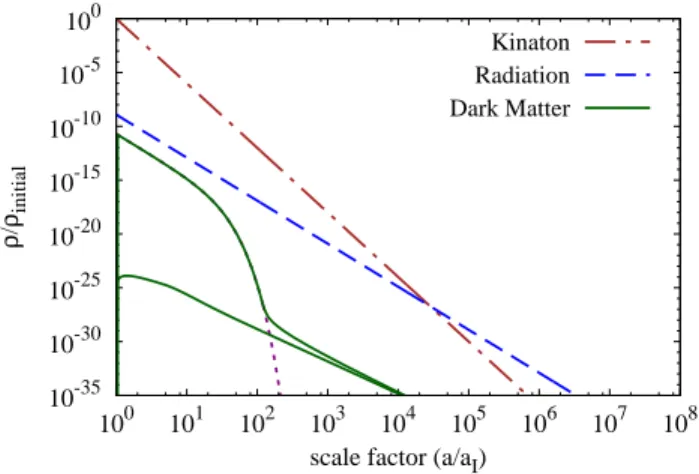
FIG. 1: The density evolution of the kinaton, radiation, and dark matter. In this figure,mχ= 104GeV, and reheating
oc-curs whena/aI= 2.7×10⁴; the reheat temperature is 2 GeV.
The two solid curves show the evolution ofρχfor the two
val-ues ofhσvi that produce the observed dark matter density: Ωχh2= 0.12 [44]. The top solid curve corresponds to the
freeze-out scenario withhσvi= 7.5×10⁻²⁵cm3s−1, whereas the bottom solid curve corresponds to the freeze-in scenario withhσvi= 6.7×10−46cm3s−1. The dotted line shows the equilibrium dark matter density,ρχ,eq=hEχinχ,eq.
production and annihilation. Therefore, the equations for the energy density of the scalar fieldρφ, the radiation
energy densityρr, and the dark matter number density nχ are
d
dtρφ=−6Hρφ, (1a)
d
dtnχ =−3Hnχ− hσvi(n
2
χ−n2χ,eq), (1b)
d
dtρr=−4Hρr+hσviEχ(n
2
χ−n2χ,eq), (1c)
wherehEχi=ρχ/nχis the average energy of a dark
mat-ter particle andnχ,eqis the number density of dark
mat-ter particles in thermal equilibrium.1 For a dark matter
particle with massmχ and internal degrees of freedom gχ within a thermal bath of temperatureT,
nχ,eq=
gχ
2π2 Z ∞
mχ
q
E2−m2 χ
eE/T+ 1 EdE. (2)
When evaluating the average energy of a dark matter particle, we make the approximation that
hEχi ≃
q
m2
χ+ (3.151T)2, which matches ρχ/nχ to
within 10%.
1Throughout this work, we assume that the dark matter is
Figure 1 shows the evolution of the kinaton, radia-tion, and dark matter densities obtained by numerically solving Eq. (1). Initially, the kinaton’s energy density is dominant, but since it scales away more quickly than the radiation energy density, it eventually becomes subdom-inant. Figure 1 shows that the radiation energy density scales asa−4and is unaffected by dark matter
annihila-tion or pair producannihila-tion. Sinceρrandρφevolve
indepen-dently ofnχ, we can solve for their evolution analytically.
We then use these solutions to numerically solve Eq. (1b) and calculate the dark matter relic abundance.
To accurately describe the evolution of ρr, we need
to take into account the energy injection that occurs when Standard Model particles become nonrelativistic. When a particle species becomes nonrelativistic, its en-tropy is transferred to the remaining relativistic parti-cles. Entropy is conserved during kination; therefore, the universal entropysa3 must remain constant, where s is
the entropy density: s≡(2π2/45)T3g
∗s(T), and g∗s(T)
is the effective number of degrees of freedom that con-tribute to the entropy density. Due to the conservation of entropy, radiation cools during kination according to the same proportionality as during radiation domination: T ∝g∗s(T)−1/3a−1.
To evaluate the temperature of the radiation bath, we set a maximum temperature of TMAX at which ρχ= 0.
We set TMAX = 8mχ to ensure that if the dark matter
is capable of reaching thermal equilibrium, it will have adequate time to do so. If the dark matter cannot reach thermal equilibrium, setting TMAX= 8mχ ensures there
will be enough time for maximal pair production. There-fore, the dark matter relic abundance will not be sensitive toTMAX. UsingTMAX, we construct an expression for the
temperature evolution during kination that accounts for changes ing∗s(T):
T =TMAX g
∗s(TMAX)
g∗s(T)
1/3 a
I
a , (3)
whereaI is the scale factor value whenT =TMAX.
The final step in evaluating ρr is to connect Eq. (3)
and the definition of ρr. The radiation energy density
is ρr ≡(π2/30)g∗(T)T4, where g∗(T) is the number of
relativistic degrees of freedom at temperatureT. Using this definition ofρrand Eq. (3), we see that the evolution
ofρrduring kination is
ρr= π 2
30g∗(T)T
4 MAX
g∗s(TMAX)
g∗s(T)
4/3 aI
a
4
. (4)
Next, we analytically solve for ρφ. Solving Eq. (1a)
yields ρφ=ρφ,I(aI/a)6, whereρφ,I is ρφ when a= aI.
By definingaRH as the scale factor value at the onset of
radiation domination we see thatρφevaluated at
reheat-ing equalsρφ,I(aI/aRH)6. Using Eq. (4), we can evaluate
ρr at reheating. Considering that at reheating ρφ=ρr,
this implies that
ρφ,I = π2
30g∗(TRH)T
4 MAX
g
∗s(TMAX)
g∗s(TRH)
4/3a RH
aI
2
.
(5)
Using Eq. (3) to relateaRHtoTRH, we obtain the
evolu-tion ofρφ during kination:
ρφ = π2
30
T3 MAX
TRH 2g
∗s(TMAX)
g∗s(TRH) 2
g∗(TRH) aI
a
6
. (6)
Now that we have obtained expressions forT(a),ρr(a)
andρφ(a), we have the necessary components to
numer-ically solve Eq. (1b) for nχ(a), as shown in Figure 2.
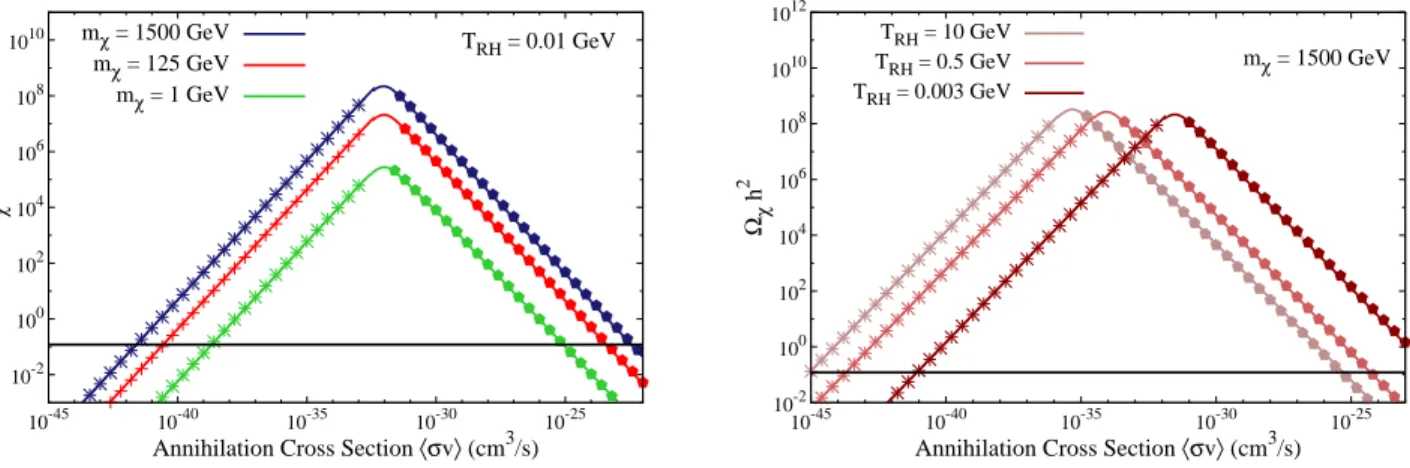
Figure 3 shows the dark matter relic abundance as a function ofhσvi for several values of TRH and mχ. For
smallhσvivalues, the dark matter cannot reach thermal equilibrium, and Figure 3 shows that as hσvi increases the dark matter relic abundance increases. Once hσvi becomes large enough, pair production will bringnχ up
to its thermal equilibrium value. If dark matter reaches thermal equilibrium, we see from Figure 3 that as hσvi increases, the dark matter relic abundance decreases. In the following sections, we derive analytic expressions for the dark matter relic abundance generated during kina-tion and analyze how the relic abundance is influenced byTRH.
B. Freeze-Out
Ifhσviis sufficiently large, then pair production brings dark matter into thermal equilibrium:nχ =nχ,eq, as
de-fined in Eq. (2). Once H ≃ hσvinχ,eq, the dark matter
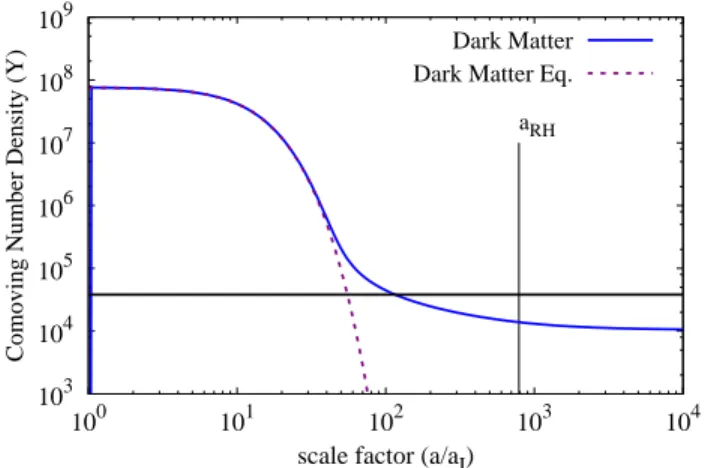
deviates from equilibrium and “freezes out”. If dark mat-ter freezes out during radiation domination, nearly all dark matter annihilations cease at freeze-out. However, if dark matter freezes out during kination, we see from Figure 2 that we need to take dark matter annihilations between the time of freeze-out and reheating into account to get an accurate relic abundance.
To analytically solve for the evolution of the dark matter number density between freeze-out and reheat-ing, we define a dimensionless comoving number density Y ≡nχ(a/aI)3TRH−3. Equation (1b) is rewritten as
dY
da =hσvi T3
RHa 3 I Ha4 (Y
2 eq−Y
2). (7)
After the dark matter freezes out,Y2≫Y2
eq. Since
dur-ing kinationH =H(aI)[aI/a]3, we simplify Eq. (7) to
dY da =
−λKD
a Y
2, (8)
whereλKD=TRH3 hσvi/H(aI). Integrating Eq. (8) from
freeze-out to reheating yields 1
YF
− 1
YRH
=−λKD ln
aRH
aF
103 104 105 106 107 108 109
100 101 102 103 104
Comoving Number Density (Y)
scale factor (a/aI) Dark Matter Dark Matter Eq.
aRH
FIG. 2: The evolution of the comoving dark matter number density and equilibrium number density withTRH= 20 GeV, mχ= 3000 GeV, andhσvi= 10−32cm3s−1. The vertical line
represents the point of reheating ataRH/aI= 800. The solid
horizontal line shows the comoving number density at the point of freeze-out solved fromH(TF) =hσvinχ,eq. This fig-ure demonstrates that dark matter annihilations after freeze-out significantly decrease the dark matter number density.
whereYFandYRHare the comoving dark matter number
densities at out and reheating. Therefore, if freeze-out occurs during kination, the dark matter comoving number density experiences a logarithmic decrease be-tween freeze-out and reheating.
To evaluate the current dark matter density we need to reevaluate Eq. (7) during radiation domina-tion and solve for Y at some late time. During radia-tion dominaradia-tion H =H(aRH)[aRH/a]2, and by defining
λRD= [TRH3 hσvi/H(aRH)]×[a3I/a2RH], Eq. (7) simplifies
to
dY da =
−λRD
a2 Y
2. (10)
Solving Eq. (10) from reheating to a very late time yields
1 YRH
− 1
YLT
=−λRD 1
aRH
, (11)
where YLT is the comoving dark matter number density
at some late time (a = aLT). To obtain Eq. (11), we
use the fact that aLT≫aRH. Therefore, if dark matter
freezes out during kination,Y experiences a logarithmic decrease between freeze-out and reheating, after whichY approaches a constant value.
Utilizing YRH from Eq. (9) and rewriting Eq. (11) in
terms of the dark matter number density yields
nχ,LT=
hσvia3 LT
H(aI)a3I
ln
a RH
aF
+ 1
+ a
3 LT
nχ,F a3F −1
.
(12)
We wish to express Eq. (12) in terms of our free parame-tersmχ,TRH, andhσvi. We can expressH(aI) andaRH
in terms ofTRHandTMAX using Eqs. (3) and (5). In
ad-dition, sincenχ,F≃nχ,eq,nχ,F≃H(TF)/hσvi. If
freeze-out occurs during kination,H2≃(8πG/3)ρ
φ; combining
this with Eqs. (3) and (6) allows us to solve forH(TF):
H(TF) = 4π3
45
1/2 T3 F
mplTRH
g∗sF
g∗sRH
g∗RH1/2 , (13)
whereg∗sRH =g∗s(TRH) andg∗RH=g∗(TRH). These
re-lations allow us to rewrite Eq. (12) as
nχ,LT=
4π3
45
1/2
T3
LTg∗sLTg 1/2 ∗RH
hσvimplTRHg∗sRH
(14)
× ln
"
TF
TRH g
∗sF
g∗sRH 1/3#
+ 2
!−1
,
where TF is obtained by numerically solving
H(TF) =hσvinχ,eq. For kination scenarios, mχ/TF
is roughly between 20 and 30.
AfteraLT,nχ∝a−3, which allows us to relate the dark
matter density ataLT to today:
ρχ,0=ρχ,LT
aLT
a0 3
=ρχ,LT
T0
TLT 3
g∗s0
g∗sLT
, (15)
where T0 is the radiation temperature today and
g∗s0= 3.91. Bringing all of the previous components
to-gether and scaling our analytic expression by a factor of 1.22, thereby ensuring that it matches the numeric solu-tion of Eq. (1b) within 20% formχ/TRH>100, we obtain
an analytic expression for the freeze-out dark matter relic abundance:
Ωχh2= 6.06
3×10⁻²⁶cm3s−1
hσvi
g1∗RH/2 g∗sRH
mχ/TRH
150
× ln
"
TF/TRH
10
g ∗sF
g∗sRH 1/3#
+ 4.3
!−1
. (16)
Equation (16) indicates that decreasingTRHincreases the
relic abundance. DecreasingTRH requires increasing the
kinaton energy density, which increases the Hubble pa-rameter during kination. Since nχ,F≃H(TF)/hσvi,
in-creasing the Hubble parameter increases the dark matter number density at freeze-out and thus increases the relic abundance. Furthermore, in our calculation of YRH we
showed that dark matter annihilations do not cease dur-ing kination. As a result, Eq. (16) includes an inverse logarithmic term that depends on the ratioTF/TRH.
Figure 3 shows the dark matter relic abundance as a function of hσvi for several values of TRH and mχ.
10-2
100
102
104
106
108
1010
10-45 10-40 10-35 10-30 10-25
Ωχ
h
2
Annihilation Cross Section 〈σv〉 (cm3/s)
mχ = 1500 GeV
mχ = 125 GeV
mχ = 1 GeV
TRH = 0.01 GeV
10-2
100
102
104
106
108
1010
1012
10-45 10-40 10-35 10-30 10-25
Ωχ
h
2
Annihilation Cross Section 〈σv〉 (cm3/s)
TRH = 10 GeV
TRH = 0.5 GeV
TRH = 0.003 GeV
mχ = 1500 GeV
FIG. 3: The observed dark matter abundance Ωχh2 as a function of the dark matter velocity-averaged annihilation cross
section hσvi. Dark matter freezes in at small hσvi where Ωχh2∝ hσvi, whereas dark matter freezes out at largehσvi where
Ωχh2∝ hσvi−1. In the left panel we see that decreasing mχ decreases Ωχh2 for both cases. In the right panel we see that
decreasingTRHdecreases Ωχh2for the freeze-in case but increases Ωχh2 for the freeze-out case. In both panels the solid curves
represent the numerical solutions to Eq. (1), while the symbols represent the analytic approximations represented by Eqs. (16) and (21). The solid black line represents the Planck measurement for the observed dark matter abundance, Ωχh2= 0.12 [44].
dark matter freezes out, H(TF) =hσvinχ,eq, and we
can rewrite this equation in terms of a new variable x, where x ≡ mχ/TF. Assuming that dark matter
is nonrelativistic, H(TF) =hσvinχ,eq can be rewritten
as x−3/2exg
∗s(mχ/x) =constant× hσvi. The left-hand
side of this equation has a minimum value nearx∼1.5 which implies that there is a minimumhσvifor which a solution will exist. This lower bound onhσviis
hσvi>9.37×10⁻³³cm3s−1
2
gχ
×
3 MeV
TRH
g1/2 ∗RH
g∗sRH !
g∗s(mχ/1.5). (17)
The horizontal line in Figure 3 represents the Planck measurement of the observed dark matter abundance. To reproduce the observed dark matter abundance, freeze-out cases during kination require larger hσvi than that required if freeze-out occurs during radiation domination. This comes from the fact that at a given temperature the Hubble parameter during kination is always higher than it is during radiation domination, which causes freeze-out to occur earlier. In order to compensate for the earlier freeze-out and reproduce the observed dark mat-ter abundance, freeze-out scenarios during kination re-quire hσvi>3×10⁻²⁶cm3s−1. Since this lower bound
onhσviis more stringent than Eq. (17), Eq. (16) is ap-plicable to all freeze-out scenarios that generate the ob-served dark matter abundance.
C. Freeze-In
For cross sections that violate Eq. (17), dark matter pair production is not sufficient to bring the dark matter
into thermal equilibrium. Once pair production ceases, the dark matter “freezes in” and the comoving dark mat-ter number density remains constant. The first step in determining the freeze-in dark matter relic abundance is to calculate the comoving dark matter number density when pair production ceases.
In freeze-in scenarios, the dark matter number density does not reach thermal equilibrium, sonχ≪nχ,eq. The
dimensionless comoving dark matter equilibrium number density is Yeq≡nχ,eqTRH−3(a/aI)
3, and for freeze-in
sce-nariosYeq≫Y. Therefore, Eq. (7) reduces to
dY da =
hσviT3
RH
H(aI)a Y2
eq (18)
for freeze-in scenarios during kination.
Equation (18) implies thatdY /dadiverges asa→0 if hσviis independent of temperature. The same divergence occurs if the Universe is radiation dominated during dark matter production, and it would make the freeze-in abun-dance of dark matter dependent on TMAX. Previous
analyses of the freeze-in process avoided this sensitiv-ity to high-energy physics by assuming thathσvi ∝1/ T2
for relativistic particles [45, 46]. We take the same ap-proach and set hσvi=hσvis(mχ/T)2 for T > mχ and hσvi=hσvisforT < mχ, wherehσvisis thes-wave dark
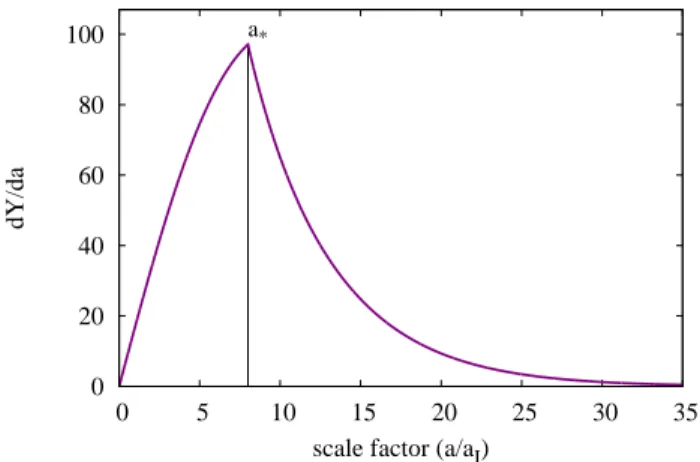
matter annihilation cross section for massive particles. With this scaling, dY /da→0 as a→0, and the pro-duction of dark matter is finite during kination even if TMAX → ∞. Figure 4 shows that dY /da increases until
a=a∗, which we define as the scale factor value at which
pair production peaks. The temperature at which pair production peaks isT∗=mχ. Therefore,dY /dareaches
its maximum whena∗/aI= 8[g∗s(TMAX)/g∗s(T∗)]1/3.
produc-tion becomes less and less efficient. However, Eq. (18) is only valid during kination, so it will only provide an ac-curate dark matter density if nearly all the pair produc-tion occurs prior to reheating. Truncating the integra-tion of dY /daat aPP, whereT(aPP) = mχ/3.9, reduces
the value of Y by less than 1% compared to integrat-ing dY /da out to a = ∞. Therefore, pair production has effectively halted whenT < mχ/3.9, and we can use
Eq. (18) to compute the relic abundance of dark matter provided thatTRH < mχ/3.9. Integrating Eq. (18) from
0 to aPP, while taking into account the fact that hσvi
changes fromhσvis(mχ/T)2to hσvis atT =mχ, gives
YPP= 3.1×10⁻⁴ T
MAX/TRH
150
3 T RH
5 GeV
g
χ
2
2
×
hσvi
s
10−45cm3s−1
g
∗sRH
g1∗RH/2
!
g∗sMAX
g2 ∗s(mχ)
.
(19)
After pair production ends, Y remains nearly constant, and thusYPP=YRH. Therefore, the dark matter density
at reheating can be written as
ρχ,RH=mχYPPTRH3 (aI/aRH) 3
. (20)
Equation (3) indicates that (aI/aRH)3 ∝TMAX−3 g−1∗sMAX.
As a result, inserting Eq. (19) into Eq. (20) seems to indicate thatρχ,RH is independent of TMAX, but this is
not generically true. When integrating Eq. (18) from a = 0 to aPP to obtain Eq. (19), we effectively
inte-grated from T=∞ to T =mχ/3.9. However,
integrat-ing instead fromT = 8mχ to T =mχ/3.9 does not
sig-nificantly change the result. Therefore, ifTMAX≥8mχ,
the freeze-in dark matter abundance does not depend on TMAX. Conversely, ifTMAX <8mχ,ρχ,RH will decrease
as TMAX decreases because maximal pair production is
not reached.
After reheating, nχ ∝ a−3, and we can use Eq. (15)
to evolve ρχ from reheating to today. Combining the
previous expressions and scaling our analytic expression by a factor of 0.95 to match the numeric solution of Eq. (1b) provides an analytic expression for the freeze-in dark matter relic abundance:
Ωχh2= 1.08
mχ
1 GeV
TRH
100 GeV
g
χ
2
2
×
hσvis
10−45cm3s−1
g∗sRH
g∗RH1/2
!
g−2∗s(mχ). (21)
Equation (21) indicates that increasing TRH leads to a
larger relic abundance. To understand how the freeze-in dark matter relic abundance relates to TRH we need to
investigate hownχrelates to the Hubble parameter. The
connection between the Hubble parameter andnχ stems
from the cooling rate dT /dt. During kination T ∝a−1,
and thereforedT /dt=−HT. Rewritingdn/dtas a func-tion of temperature yields dn/dt= (dT /dt) (dn/dT) =
0 20 40 60 80 100
0 5 10 15 20 25 30 35
dY/da
scale factor (a/aI)
a*
FIG. 4: The evolution of dY /da given TRH= 1 GeV, mχ= 5×10⁴GeV, and hσvis= 10−47cm3s−1. The
verti-cal line represents the sverti-cale factor at which pair production peaks, defined asa∗. For kination scenarios where dark mat-ter freezes in andTMAX= 8mχ,a∗/aI≃8.
f(T), wheref(T) is the right-hand side of Eq. (1b). This allows us to expressdn/dT as
dn dT =
−f(T)
HT , (22)
which implies that n∝1/H. Since increasing TRH
de-creases H during kination, it also decreases the cooling rate, leaving more time for pair production and thereby increasing the dark matter number density.
In order to reach the observed dark matter abundance, scenarios in which dark matter freezes in during kination require largerhσvisvalues than if freeze-in occurs during
radiation domination. For example, given a dark mat-ter mass of 100 GeV, a freeze-in scenario during radia-tion dominaradia-tion requireshσvis= 10−47cm3s−1in order
for Ωχh2= 0.12 [44, 47]. For the samemχ, a freeze-in
scenario during kination withTRH = 0.033 GeV requires hσvis= 10−41cm3s−1. Freeze-in scenarios during
kina-tion require largerhσvisvalues to generate the observed
dark matter abundance because the increased cooling rate during kination leaves less time for pair production. In Figure 3, we see that for sufficiently small cross sec-tions the dark matter relic abundances from Eq. (21), represented by the star symbols, match the numeric so-lutions to Eq. (1b), represented by the curves. We have already discussed how freeze-in requires the dark matter particles to never reach thermal equilibrium. For this to hold true, the dark matter number density at the end of pair production must be less than the dark matter equi-librium number density at the peak of pair production: Y(TPP)< Yeq(T∗). To solve for the largest hσvis that
being nonrelativistic:
Yeq(a) =gχ
a aI
3
TRH−3
mχT
2π
3/2
e−mχ/T. (23)
Evaluating Eq. (23) ata∗ and equating that to Eq. (19)
gives us the cross sections that will result in dark matter freezing in during kination:
hσvis≤8.5×10⁻³⁴cm3s−1
g1∗RH/2 g∗sRH
!
×g∗s(mχ)
2
gχ
3 MeV TRH
. (24)
Figure 3 demonstrates that there is a range of hσvis
values for each reheat temperature where neither a freeze-out nor freeze-in scenario will result in the observed dark matter abundance. The left panel of Fig. 3 shows that, at a fixed reheat temperature, decreasing mχ increases the
freeze-in cross section and decreases the freeze-out cross section that generates the observed dark matter abun-dance. However, oncemχ .3TRH, dark matter will no
longer freeze in during kination, and as discussed in Sec-tion II B, hσvi>3×10⁻²⁶cm3s−1 is required to
gener-ate the observed dark matter abundance if dark matter freezes out during kination.
The right panel of Fig. 3 shows that decreasingTRH
in-creases the cross section that generates the observed dark matter abundance via the freeze-in mechanism. There-fore, setting TRH= 3 MeV gives an upper bound on the
cross sections that can generate the observed dark matter abundance in freeze-in scenarios:
hσvis<2.66×10−38cm3s−1
0.175 GeV
mχ
. (25)
This maximal cross section is calculated using g∗s(mχ) =g∗s(0.175 GeV). When deriving Eq. (21) we
assumed thatg∗s(T) was approximately constant during
pair production, which implies that Ωχh2∝g−2∗s(mχ).
If dark matter freezes in during kination and mχ is
less than 0.17 GeV, then the QCD phase transition occurs before the peak of pair production. At the QCD phase transition g∗s(T) sharply decreases, resulting in
an increase in the relic abundance as given by Eq. (21). To compensate for the increased relic abundance, freeze-in scenarios with mχ≤0.17 GeV require cross
sections smaller than the one calculated in Eq. (25). Therefore, the largest cross section that can generate the observed dark matter abundance in freeze-in scenarios is 2.7×10−38cm3s−1.
The relic abundances from Eq. (21) are within 20% of the solutions to Eq. (1b) for mχ >0.17 GeV and TRH < mχ/3.9. Ifmχ≤0.17 GeV, we need to take into
consideration the evolution of g∗s(T) to accurately
cal-culate the relic abundance. Allowing for the evolution of
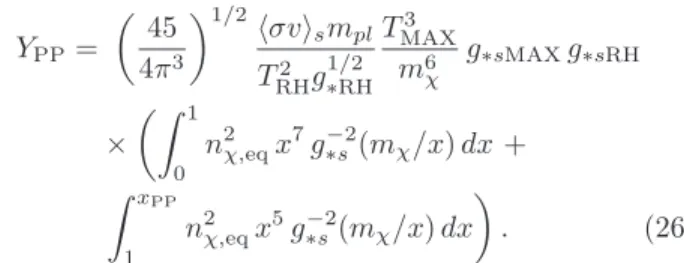
g∗s(T),YPP is rewritten as
YPP=
45 4π3
1/2
hσvismpl
T2 RHg
1/2 ∗RH
T3 MAX
m6 χ
g∗sMAXg∗sRH
×
Z 1
0
n2χ,eqx 7
g∗−2s(mχ/x)dx +
Z xPP
1
n2 χ,eqx
5g−2
∗s(mχ/x)dx
. (26)
Using this expression forYPP and a scaling factor of 0.4,
we construct a modified relic abundance expression that takes into account the evolution of g∗s(T). For
freeze-in scenarios with mχ≤0.17 GeV and TRH < mχ/3.9,
this updated expression forYPPbrings the analytic relic
abundance solutions to within 25% of the numeric solu-tion to Eq. (1b).
III. CONSTRAINTS ON KINATION
To constrain kination cosmologies, we first solve Eqs. (16) and (21) for all combinations of the variables mχ,TRH, andhσvithat produce the observed dark
mat-ter abundance of Ωχh2= 0.12 [44]. We set the
min-imum allowed reheat temperature to 3 MeV to ensure that the period of kination does not alter the cosmic microwave background or the abundances of light ele-ments [4–8].2 Next, we compare our allowed parameters
to current constraints onmχ and hσvi from Fermi-LAT
and H.E.S.S. Specifically, we use the Fermi-LAT PASS-8 constraints from observations of dwarf spheroidals [35] and H.E.S.S. constraints from observations of the Galac-tic Center [36]. The Fermi-LAT data covers dark matter masses ranging from 2 GeV≤mχ≤104GeV, while the
H.E.S.S. data covers dark matter masses ranging from 125 GeV≤mχ ≤7×10⁴GeV.
Figure 5 shows the allowed parameter space for mχ
andhσvis for scenarios in which dark matter freezes in
during kination. To ensure that freeze-in occurs before the onset of radiation domination, we have restricted our-selves tomχ/3.9> TRH. This restriction comes from the
fact that the temperature at which pair production effec-tively ceases isTPP=mχ/3.9. Since the minimum reheat
temperature is 3 MeV, we require thatmχ >0.012 GeV
to ensure that freeze-in occurs before radiation domina-tion. From Eq. (25) and Figure 5, we see that scenarios in which dark matter freezes in during kination require
hσvi<2.7×10−38cm3s−1.
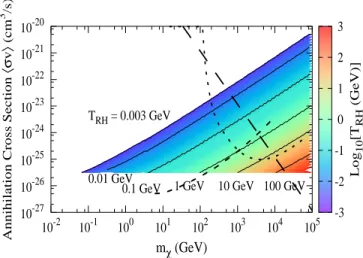
Figure 6 shows the allowed parameter space formχand hσvifor scenarios in which dark matter freezes out during
2These constraints on the reheat temperature were derived
10-2 10-1 100 101 102 103 104 105
mχ (GeV)
10-50 10-48 10-46 10-44 10-42 10-40 10-38 10-36
Annihilation Cross Section
〈σ
v
〉s
(cm
3 /s)
-3 -2 -1 0 1 2 3 4
Log
10
[T
RH
(GeV)]
TRH = 0.003 GeV
0.05 GeV
1 GeV
100 GeV
1000 GeV
m
χ/3.9 < T
RHFIG. 5: Allowed freeze-in parameter space for mχ and
hσvis. Equation (21) is not applicable to scenarios with
mχ/3.9< TRHbecause more than 1% of pair production oc-curs during radiation domination. Dark matter produced via freeze-in requires very small annihilation cross sections in or-der to reach the observed dark matter abundance. These small annihilation cross sections are not constrainable with current astrophysical observations.
kination. To obtain the observed dark matter abundance, freeze-out scenarios during kination must have an anni-hilation cross section greater than 3×10⁻²⁶cm3s−1. As
discussed in Section II B, freeze-out occurs earlier dur-ing kination than durdur-ing radiation domination, and to compensate, freeze-out scenarios during kination require larger annihilation cross sections to generate the same dark matter density.
In Figure 6 we include the Fermi-LAT [35] and H.E.S.S. [36] constraints for dark matter that annihilates via the bbchannel. The Fermi-LAT bounds cover a range of dark matter masses from the mass of the bottom quark to a mass of 104GeV. The H.E.S.S. bounds add additional
constraints to dark matter masses ranging from 200 GeV to 7×10⁴GeV. Dark matter annihilation cross sections
above the observational bounds are ruled out as these signals would have already been observed. Figure 6 also includes the partial-wave unitarity bound, which requires
hσvi.1/m2
χ [48–50]. We see from Figure 6 that the
unitarity bound rules out all kination scenarios withhσvi values larger than 4.5×10⁻²³cm3s−1. In addition, if
dark matter annihilates via the bb channel, Fermi-LAT and H.E.S.S. observations constrainhσvito be less than 2×10⁻²⁵cm3s−1andT
RH to be greater than 1 GeV.
Figure 7 shows the Fermi-LAT, H.E.S.S., and unitarity constraints on mχ and TRH for scenarios in which dark
matter freezes out during kination for various annihila-tion channels. For every value ofmχ andTRH we
calcu-late thehσvithat will produce the observed dark matter abundance via freeze-out using Eq. (16). If the calculated
10-2 10-1 100 101 102 103 104 105
mχ (GeV)
10-27 10-26 10-25 10-24 10-23 10-22 10-21 10-20
Annihilation Cross Section
〈σ
v
〉
(cm
3 /s)
-3 -2 -1 0 1 2 3
Log
10
[T
RH
(GeV)]
TRH = 0.003 GeV
0.01 GeV
0.1 GeV 1 GeV 10 GeV 100 GeV
FIG. 6: Allowed freeze-out parameter space formχandhσvi.
To obtain the observed dark matter abundance, scenarios with annihilation cross sections smaller than 3×10⁻²⁶cm3s−1 require freeze-out to occur during radiation domination. The short dashed line represents the H.E.S.S. [36] constraints for annihilation in thebb channel, and the medium dashed line is the Fermi-LAT [35] constraints, also for the bb annihila-tion channel. The long dashed line is the unitarity bound: hσvi.1/m2
χ. All of the kination scenarios above the
Fermi-LAT and H.E.S.S. constraint lines are ruled out as dark mat-ter annihilations would have already been detected by the corresponding observations.
hσvi is above the Fermi-LAT or H.E.S.S. constraints, then that scenario is ruled out. The ruled-out area below TRH = 3 MeV represents the fact that, in order to
pro-duce the correct abundance of light elements, reheating must occur before a temperature of∼3 MeV. The solid black line represents whenmχ= 100TRH. As discussed
in Section II B, Eq. (16) is accurate forTRH< mχ/100.
AsTRH increases beyond mχ/100, numerical tests with mχ>17 GeV indicate that the hσvi value that yields
the observed dark matter abundance rapidly decreases to 3×10⁻²⁶cm3s−1 as freeze-out occurs closer to
ra-diation domination. Therefore, we make the conserva-tive assumption that hσvi= 3×10⁻²⁶cm3s−1 will give
the observed dark matter abundance ifmχ>17 GeV and TRH > mχ/100.
Formχ<17 GeV, numerical tests show that Eq. (16)
remains accurate for reheat temperatures slightly higher than mχ/100 if reheating occurs after the QCD phase
transition. The QCD phase transition causes a sharp de-crease ing∗whenT = 0.17 GeV, and sinceTRH >3 MeV,
g∗sRH =g∗RH and H∝g−1/ 2
∗sRH during kination.
Con-sequently, the Hubble parameter at a given tempera-ture during kination sharply increases as TRH goes
be-low 0.17 GeV, which causes freeze-out to occur earlier. Therefore, Eq. (16) is applicable for scenarios withTRH
freeze-out still occurs during kination. For most annihila-tion channels, scenarios that generate the observed relic abundance with mχ <17 GeV are ruled out by
Fermi-LAT constraints. The exception is dark matter annihi-lating viaµ+µ−. Figure 7 shows that, for dark matter
an-nihilating via µ+µ−, Fermi-LAT constraints rule out all
scenarios withmχ .8 GeV. In addition, ifmχis between
8 GeV and 17 GeV, Fermi-LAT constraints rule out sce-narios with TRH.0.17 GeV. In these scenarios,
freeze-out occurs during kination even though TRH may be
higher thanmχ/100. AsTRHincreases beyond 0.17 GeV,
numerical tests with 8 GeV< mχ <17 GeV indicate that
thehσvivalue required to obtain the observed dark mat-ter abundance rapidly decreases to 3×10⁻²⁶cm3s−1 as
freeze-out occurs closer to radiation domination.
The resulting constraints on mχ and TRH are
contin-gent on dark matter reaching thermal equilibrium during kination. Equation (17) indicates that decreasing TRH
and increasingg∗s(mχ/1.5) increases the minimum value
ofhσvithat results in dark matter reaching thermal equi-librium. Therefore, solving Eq. (17) with the minimum reheat temperature of 3 MeV and g∗s(mχ/1.5) = 100
shows that, ifhσvi>3×10⁻³¹cm3s−1, dark matter will
freeze out during kination regardless ofTRH ormχ.
The Fermi-LAT and unitarity constraints establish an allowed mass range for each annihilation channel. The unitarity bound on hσvi places an upper bound on the allowed dark matter mass of 1.9×10⁴GeV for all
anni-hilation channels. The lower bound on the dark matter mass comes from the Fermi-LAT observations and is be-tween 8 GeV and 160 GeV, depending on the annihilation channel. AsTRHdecreases, the range of viable masses
de-creases. The addition of the H.E.S.S. constraints restrict dark matter annihilating viaτ+τ−to have a mass around
either 250 GeV or 9000 GeV. For dark matter masses be-tween 470 GeV and 2500 GeV, the H.E.S.S. observations constrainhσvito be less than 3×10⁻²⁶cm3s−1 for dark
matter annihilating viaτ+τ−, thereby ruling out all
sce-narios where dark matter freezes out during kination or radiation domination.
Figure 7 also shows that with the Fermi-LAT, H.E.S.S., and unitarity constraints we can place lower limits on TRH if dark matter reaches thermal equilibrium during
kination. For example, we can rule out kination scenarios with reheat temperatures below 0.05 GeV for dark matter annihilating via thee+e− orµ+µ−annihilation channel.
We are also able to rule out kination scenarios with re-heat temperatures below 0.6 GeV for the τ+τ− and uu
annihilation channels as well as reheat temperatures be-low 1 GeV for thebband W+W− annihilation channels.
In addition, kination scenarios where dark matter anni-hilates via thebb,τ+τ−, orW+W−annihilation channel
requireTRH be very close toTF, which implies that these
kination scenarios are on the verge of being ruled out. Throughout this work, we assumed that dark mat-ter consisted of one particle species. If dark matter consists of multiple particle species, then it is possible that only a fraction of the dark matter is thermally
pro-duced during kination. To determine what effect this has on the TRH constraints shown in Figure 7, we
ne-glect the ln(TF/TRH) term in Eq. (16) and make the
rough estimate that for dark matter freezing out dur-ing kination, Ωχh2∝mχ/(hσviTRH). If only a fraction
of the dark matter consists of a thermal relic, such that Ωχh2=fΩdmh2, then to scale the relic abundance by a
factor of f for a fixed dark matter mass requires scal-ing the product of hσvi andTRH by a factor of 1/f. In
addition, since the Fermi-LAT and H.E.S.S. constraints are obtained using the dark matter annihilation rate Γ =hσviρ2
χ/m2χ, alteringρχ will subsequently reduce the
annihilation rate by a factor off2and raise the maximum
allowed annihilation cross sectionhσvimax by a factor of
1/f2. Therefore, the minimum allowed reheat
temper-ature TRH,min∝ hσviTRH/hσvimax∝f−1/f−2∝f. For
example, for dark matter annihilating viaW+W−, the
minimum allowed reheat temperature is 1 GeV if dark matter consists of a single particle species. If only a frac-tion of dark matter is thermally produced during kinafrac-tion and Ωχh2= 0.05, thenf = 0.42 and the new minimum
allowed reheat temperature is roughly 0.34 GeV.
IV. CONCLUSION
Our uncertainty regarding the expansion history of the Universe between the end of inflation and the beginning of BBN allows for the possibility that within this pe-riod there was an intermittent era of kination. In this paper we have investigated the effects that a period of kination has on the thermal production of dark matter. Previous studies on this topic have required the use of specific kinaton potentials [38–40, 42, 43]. Our analysis is independent of the kinaton potential, and therefore our constraints onmχ,TRH, andhσviare applicable to all
ki-nation models assuming that dark matter consists of one particle species that undergoes s-wave annihilation. In addition to numerically solving for the dark matter relic abundance, we have also derived analytic relic abundance equations for freeze-out and freeze-in kination scenarios. Our scenarios are determined by three parameters: the dark matter massmχ, the reheat temperatureTRH, and
the dark matter annihilation cross sectionhσvi. In deriv-ing relic abundance equations for freeze-out (Eq. 16) and freeze-in (Eq. 21) scenarios, we have deduced physical re-lationships between our parameters and the dark matter relic abundance. For example, at a given temperature, the Hubble parameter during kination is higher than that during radiation domination. Therefore, freeze-out occurs earlier during kination, which increases the relic abundance. In order to compensate for this larger relic abundance, freeze-out scenarios require larger-than-canonicalhσvivalues in order to increase the annihilation rate and subsequently decrease the dark matter abun-dance to the observed value. If on the other hand, dark matter freezes in during kination, an increase inTRHwill
10-3
10-2
10-1
100
101
102
103
101 102 103 104
TRH
(GeV)
mχ (GeV)
HESS Constraints Fermi Constraints Unitary Constraint BBN Constraint
bb
10-3
10-2
10-1
100
101
102
103
101 102 103 104
TRH
(GeV)
mχ (GeV)
ee
10-3
10-2
10-1
100
101
102
103
101 102 103 104
TRH
(GeV)
mχ (GeV)
µµ
10-3
10-2
10-1
100
101
102
103
101 102 103 104
TRH
(GeV)
mχ (GeV)
ττ
10-3
10-2
10-1
100
101
102
103
101 102 103 104
TRH
(GeV)
mχ (GeV)
uu
10-3
10-2
10-1
100
101
102
103
102 103 104
TRH
(GeV)
mχ (GeV)
WW
FIG. 7: Constraints on mχ and TRH for dark matter produced via the freeze-out mechanism. These panels represent the following annihilation channels: bb(top left),e+e−(top right),µ+µ−(middle left),τ+τ−(middle right),uu(bottom left), and W+W− (bottom right). The solid black line represents whenm
χ= 100TRH. Below this line it is possible to reproduce the observed dark matter abundance if dark matter freezes out during kination. The shaded regions are those that are constrained by Fermi-LAT, H.E.S.S., unitarity, and BBN.
ρφ, which decreases the Hubble parameter. Decreasing
the Hubble parameter decreases the cooling rate, leaving more time for pair production and thereby increasing the relic abundance. To compensate for the increased cooling rate and bring the dark matter abundance into agreement with the observed value, freeze-in scenarios during kina-tion require largerhσvivalues compared to during
kina-tion significantly widens the field of potential dark matter candidates. In particular, thermally produced Winos and Higgsinos, which generally havehσvi>3×10⁻²⁶cm3s−1,
could constitute all the dark matter if they freeze out during a period of kination.
Our analytic relic abundance equations allow us to ef-ficiently determine the dark matter parameter space that would result in the observed dark matter abundance. To ensure that freeze-out occurs before reheating and that reheating occurs at a temperature above 3 MeV,hσvi val-ues between 2.7×10−38cm3s−1 and 3×10⁻²⁶cm3s−1
are forbidden for all dark matter masses. Using the PASS 8 Fermi-LAT observations of dwarf spheroidal galaxies, H.E.S.S. observations of the Galactic Center, and the unitarity bound on hσvi we further constrain kination models. The observational bounds and subsequent con-straints only apply to freeze-out scenarios because the requiredhσvivalues for freeze-in scenarios are below ob-servational thresholds. From the unitarity constraint, we were able to rule out all kination scenarios with hσvi greater than 4.5×10⁻²³cm3s−1. These constraints also
allowed us to rule out kination scenarios with reheat tem-peratures below 0.05 GeV for dark matter annihilating via the e+e− or µ+µ− annihilation channel. Similarly,
we ruled out kination scenarios with reheat temperatures below 0.6 GeV for theτ+τ−anduuannihilation channels
as well as reheat temperatures below 1 GeV for thebband W+W− annihilation channels. Since these new bounds
onTRHare below the electroweak phase transition,
kina-tion could facilitate baryogenesis [25]. These bounds on TRHare contingent on dark matter freezing out during
ki-nation. We have shown that, ifhσvi>3×10⁻³¹cm3s−1,
dark matter will freeze out during kination regardless of TRH ormχ. We also note that we only considers-wave
dark matter annihilation. If we consider a p-wave pro-cess, the annihilation rate in the galaxy would be sup-pressed relative to the annihilation rate at freeze-out and
our bounds would no longer apply.
We have shown that scenarios in which dark mat-ter is thermally produced during kination are not ruled out by current observational limits on the dark mat-ter annihilation cross section. In these scenarios, hσvi>3×10⁻²⁶cm3s−1is required to generate the
ob-served dark matter abundance via a freeze-out process. The observed dark matter abundance can be gener-ated by a freeze-in process ifhσvi<2.7×10−38cm3s−1.
Therefore, our uncertainty regarding the pre-BBN ex-pansion history prevents us from knowing the dark mat-ter annihilation cross section that yields the current dark matter abundance; there exists a degeneracy between the allowed values ofhσviandTRHthat cannot be eliminated
by relic abundance calculations alone. One possible ap-proach to breaking this degeneracy involves studying the evolution of the dark matter perturbations during kina-tion. The evolution of perturbations during kination will impact the small-scale matter power spectrum. There-fore, studying how the small-scale matter power spec-trum and small-scale structure formation are affected by kination may provide a means to further constrain kina-tion scenarios and reduce the range of viable annihilakina-tion cross sections.
Note added: While we were finishing this paper, Ref. [51] appeared on the arXiv. This paper also con-siders dark matter production during kination, and it similarly identifies the logarithmic decrease of the dark matter number density between freeze-out and reheating.
Acknowledgments
We thank Carisa Miller for her comments on our manuscript. This work was supported by NSF Grant No. PHY-1417446.
[1] A. H. Guth, Phys. Rev.D23, 347 (1981). [2] A. D. Linde, Phys. Lett.B108, 389 (1982).
[3] A. Albrecht and P. J. Steinhardt, Phys. Rev. Lett. 48, 1220 (1982).
[4] M. Kawasaki, K. Kohri, and N. Sugiyama, Phys. Rev. Lett.82, 4168 (1999), astro-ph/9811437.
[5] M. Kawasaki, K. Kohri, and N. Sugiyama, Phys. Rev.
D62, 023506 (2000), astro-ph/0002127.
[6] S. Hannestad, Phys. Rev. D70, 043506 (2004), astro-ph/0403291.
[7] K. Ichikawa, M. Kawasaki, and F. Takahashi, Phys. Rev.
D72, 043522 (2005), astro-ph/0505395.
[8] K. Ichikawa, M. Kawasaki, and F. Takahashi, JCAP
0705, 007 (2007), astro-ph/0611784.
[9] L. Kofman, A. D. Linde, and A. A. Starobinsky, Phys. Rev. Lett.73, 3195 (1994), hep-th/9405187.
[10] L. Kofman, A. D. Linde, and A. A. Starobinsky, Phys. Rev.D56, 3258 (1997), hep-ph/9704452.
[11] R. Allahverdi, R. Brandenberger, F.-Y. Cyr-Racine, and
A. Mazumdar, Ann. Rev. Nucl. Part. Sci.60, 27 (2010), 1001.2600.
[12] G. Kane, K. Sinha, and S. Watson, Int. J. Mod. Phys.
D24, 1530022 (2015), 1502.07746.
[13] M. S. Turner, Phys. Rev.D28, 1243 (1983).
[14] D. J. H. Chung, E. W. Kolb, and A. Riotto, Phys. Rev.
D60, 063504 (1999), hep-ph/9809453.
[15] M. Kamionkowski and M. S. Turner, Phys. Rev.D42, 3310 (1990).
[16] G. F. Giudice, E. W. Kolb, and A. Riotto, Phys. Rev.
D64, 023508 (2001), hep-ph/0005123.
[17] N. Fornengo, A. Riotto, and S. Scopel, Phys. Rev.D67, 023514 (2003), hep-ph/0208072.
[18] C. Pallis, Astropart. Phys. 21, 689 (2004), hep-ph/0402033.
[19] G. Gelmini, P. Gondolo, A. Soldatenko, and C. E. Ya-guna, Phys. Rev.D74, 083514 (2006), hep-ph/0605016. [20] G. B. Gelmini and P. Gondolo, Phys. Rev.D74, 023510
[21] M. Drewes, JCAP1411, 020 (2014), 1406.6243.
[22] G. L. Kane, P. Kumar, B. D. Nelson, and B. Zheng, Phys. Rev.D93, 063527 (2016), 1502.05406.
[23] A. L. Erickcek, Phys. Rev. D92, 103505 (2015), 1504.03335.
[24] B. Spokoiny, Phys. Lett. B315, 40 (1993), gr-qc/9306008.
[25] M. Joyce, Phys. Rev.D55, 1875 (1997), hep-ph/9606223. [26] P. G. Ferreira and M. Joyce, Phys. Rev. D58, 023503
(1998), astro-ph/9711102.
[27] P. J. E. Peebles and A. Vilenkin, Phys. Rev.D59, 063505 (1999), astro-ph/9810509.
[28] K. Dimopoulos and J. W. F. Valle, Astropart. Phys.18, 287 (2002), astro-ph/0111417.
[29] K. Dimopoulos, Phys. Rev. D68, 123506 (2003), astro-ph/0212264.
[30] D. J. H. Chung, L. L. Everett, K. Kong, and K. T. Matchev, JHEP10, 016 (2007), 0706.2375.
[31] M. Drees, H. Iminniyaz, and M. Kakizaki, Phys. Rev.
D73, 123502 (2006), hep-ph/0603165.
[32] D. Grin, T. L. Smith, and M. Kamionkowski, Phys. Rev.
D77, 085020 (2008), 0711.1352.
[33] S. Watson, Adv. Ser. Direct. High Energy Phys.21, 305 (2010), 0912.3003.
[34] A. Beniwal, M. Lewicki, J. D. Wells, M. White, and A. G. Williams (2017), 1702.06124.
[35] M. Ackermann et al. (Fermi-LAT), Phys. Rev. Lett.115, 231301 (2015), 1503.02641.
[36] V. Lefranc and E. Moulin (H.E.S.S.), PoSICRC2015,
1208 (2016), 1509.04123.
[37] S. Profumo and P. Ullio, JCAP0311, 006 (2003), hep-ph/0309220.
[38] C. Pallis, JCAP0510, 015 (2005), hep-ph/0503080. [39] C. Pallis, Nucl. Phys. B751, 129 (2006),
hep-ph/0510234.
[40] C. Pallis, inProceedings, 6th International Workshop on The identification of dark matter (IDM 2006): Rhodes, Greece, September 11-16, 2006 (2006), pp. 602–608, hep-ph/0610433.
[41] M. E. Gomez, S. Lola, C. Pallis, and J. Rodriguez-Quintero, JCAP0901, 027 (2009), 0809.1859.
[42] S. Lola, C. Pallis, and E. Tzelati, JCAP 0911, 017 (2009), 0907.2941.
[43] C. Pallis, Nucl. Phys.B831, 217 (2010), 0909.3026. [44] P. A. R. Ade et al. (Planck) (2015), 1502.01589. [45] L. J. Hall, K. Jedamzik, J. March-Russell, and S. M.
West, JHEP03, 080 (2010), 0911.1120.
[46] C. E. Yaguna, JHEP08, 060 (2011), 1105.1654. [47] P. S. Bhupal Dev, A. Mazumdar, and S. Qutub, Front.in
Phys.2, 26 (2014), 1311.5297.
[48] K. Griest and M. Kamionkowski, Phys. Rev. Lett.64, 615 (1990).
[49] L. Hui, Phys. Rev. Lett. 86, 3467 (2001), astro-ph/0102349.
[50] W.-L. Guo and X. Zhang, Phys. Rev. D79, 115023 (2009), 0904.2451.