Hydrator Therapies for Chronic Bronchitis
Lessons from Cystic Fibrosis
William D. Bennett1,2,3, Ashley G. Henderson1,2, and Scott H. Donaldson1,2
1
Pulmonary and Critical Care Medicine, Department of Medicine,2Marsico Lung Institute, Cystic Fibrosis Research Center, and3Center for Environmental Medicine, Asthma and Lung Biology, University of North Carolina at Chapel Hill, Chapel Hill, North Carolina
Abstract
Patients with the chronic bronchitis form of chronic obstructive pulmonary disease and cysticfibrosis share similar clinical features, including mucus obstruction of airways and the development of chronic/recurrent airways infections that often manifest as disease exacerbations. There is growing evidence that these diseases may have parallels in disease pathogenesis as well, including cysticfibrosis transmembrane conductance regulator dysfunction, mucus dehydration, and defective mucociliary clearance. As progress is made in the development of therapies that target the basic defects that lead to cysticfibrosis
lung disease, it is possible that similar approaches could also benefit patients with chronic bronchitis. A deeper
understanding of how tobacco smoke and other triggers of chronic bronchitis actually lead to disease, and exploration of the concept that therapies that restore cysticfibrosis
transmembrane conductance regulator function, mucus hydration, and/or mucociliary clearance may benefit patients with chronic bronchitis, hold the prospect of significant progress in treating this prevalent disease.
Keywords:chronic obstructive pulmonary disease; mucociliary clearance; hydrator; hypertonic saline; bronchitis
(Received in original form September 30, 2015; accepted in final form November 13, 2015 )
Supported by National Institutes of Health/National Heart, Lung, and Blood Institute grant 5 P01 HL108808. Author Contributions: All authors contributed to the conceptualization and writing of this manuscript.
Correspondence and requests for reprints should be addressed to Scott H. Donaldson, M.D., 300 Meadowmont Village Circle, Suite 204, Marsico Clinical Research Center, University of North Carolina at Chapel Hill, Chapel Hill, NC 27517. E-mail: [email protected]
Ann Am Thorac Soc Vol 13, Supplement 2, pp S186–S190, Apr 2016 Copyright©2016 by the American Thoracic Society
DOI: 10.1513/AnnalsATS.201509-652KV Internet address: www.atsjournals.org
Cysticfibrosis (CF) is an inherited disease with clearly defined ion transport
abnormalities that lead to defective lung host defenses (1). A growing understanding of CF pathogenesis has guided the development of therapeutics that
specifically target these basic defects and are having a significant impact on the outcome of this deadly disease. In recent years, parallels between CF and cigarette smoke– induced chronic bronchitis (CB) have been identified (2–4), opening up the possibility that specific treatment approaches used in CF could have similar beneficial effects in this much larger patient population (5). Given that the treatment of chronic obstructive pulmonary disease (COPD) has been constrained largely to a narrow range of therapeutic classes, namely bronchodilators
and antiinflammatory agents, the identification of new therapeutic targets is exciting and brings the hope that novel treatment approaches could eventually have an impact on patient outcomes.
In this article, we review shared themes in CF and CB pathogenesis and outline therapeutic approaches that address abnormalities in airway surface liquid (ASL) hydration and mucociliary clearance (MCC).
The Relationship between
Airway Surface Liquid
Hydration and
Mucus Transport
Patients with CF gradually develop bronchiectatic lung disease, manifesting as
productive cough with markedly thickened secretions and episodes of clinical
deterioration known as pulmonary exacerbations. The evolution of CF lung disease is typically a slowly progressive process that begins early in life, although the lung at birth is essentially normal. Our best understanding of how CF lung disease begins and progresses is based on well-described ion transport defects. Specifically, patients with CF lack cAMP-mediated anion transport because of the absence of a functional cysticfibrosis transmembrane conductance regulator (CFTR) channel. The relative importance of chloride vs,
activity becomes dysregulated because of the loss of CFTR’s inhibitory influence over this channel (8, 9). Although abnormalities in ion transport have been shown to cause defects in bacterial killing usingin vitroand animal model systems (10), it is clear that these specific ion transport defects also lead to mucus dehydration and reduced clearance (10, 11). Indeed,in vitrostudies have demonstrated that well-differentiated airway epithelial cultures progressively lose the ability to transport mucus as it becomes progressively dehydrated, thus providing a key mechanistic link between mucus dehydration and defective mucus clearance in patients (12). Ultimately, adherent mucus plaques and mucus plugs provide a nidus for the development of chronic infection and inflammation, which, in turn, drives airways destruction.
In vitroand animal model data supporting the mucus dehydration hypothesis are strong, andin vivohuman data linking mucus dehydration to defective mucus clearance are growing. Sputum samples collected from adults with CF are markedly dehydrated, as demonstrated by an elevation in the percent solids content. Although airway secretions from healthy subjects, collected via bronchoscopy or sputum induction, typically containz1.5% solids content (or.98% water), the sputum from a typical adult patient with CF will containz6% solids. Mucus samples removed from CF airways at the time of lung transplant are typically even more dehydrated (z12% solids) (13). Direct sampling of mucus overlying the central airways of young patients with CF (,4 yr of age) using bronchoscopic techniques reveals that their secretions are also abnormally dehydrated (i.e., they have an elevated percent solids content) but to a degree that is intermediate between healthy volunteers and adult subjects with CF (our unpublished data). Together, these data suggest that ASL/mucus dehydration is a process that progresses through the lifespan of these patients.
Potential Mechanisms of
Airway Surface Liquid
Dehydration in Chronic
Bronchitis
Several laboratories have reported that cigarette smoke, in both the acute and chronic settings, may induce CFTR dysfunction (2–4, 14, 15). Bothin vitroand
in vivostudies have shown that CFTR-mediated chloride transport is reduced by cigarette smoke, and that these defects may persist in former smokers with COPD. In fact, evidence of systemic CFTR dysfunction, including abnormal sweat chloride values, has also been demonstrated in active and former smokers with COPD (14, 15). Given the clinical and pathological parallels between CF and CB, including mucus retention, infection, and neutrophil-dominated airways inflammation, it has been hypothesized that acquired CFTR dysfunction in COPD may play an important role in disease pathogenesis. Specifically, reduced CFTR function could lead to ASL dehydration through the mechanisms already described, and this may result in defective mucus clearance. To test this hypothesis, patients with symptoms of CB and airways obstruction (mean FEV161.6% of predicted)
underwent induced sputum and
bronchoscopic procedures to collect lower airway secretions so that their solids content, an index of hydration, could be measured. Furthermore, MCC scans were performed using gamma scintigraphy to characterize the extent and pattern of mucus clearance defects. Interestingly, a moderate degree of mucus dehydration was observed when comparing with nonsmoking control subjects and asymptomatic smokers without airways obstruction, both in induced sputum (3% vs. 1.7–1.9% solids in control subjects) and infilter paper samples obtained via bronchoscopy(4% vs. 1.5–2% solids in control subjects). Furthermore, patients with CB had reduced MCC rates when compared with either smoking or nonsmoking control subjects without symptoms or airways obstruction. In fact, the degree of mucus dehydration, as assessed byfilter paper sampling of the lower airways, in fact correlated inversely with the observed rate of MCC and lung function in the same patient (12). Although these data do not provide definitive proof of causality, they clearly demonstrate a connection among progressive dehydration of the airways, defective mucus transport, and disease severity. Closer examination of MCC data in patients with CB reveals a clear slowing in the central airways, cilia-driven clearance, but generally preserved cough-driven clearance. In contrast, the MCC
defect described in patients with CF is most apparent in the peripheral lung region, and extremely poor cough clearance is also characteristic (16, 17). How differences in MCC patterns reflect the relevance of shared and dissimilar disease mechanisms in CF and CB is not yet clear but is worthy of further investigation.
Translating Hydrator
Therapies from Cystic Fibrosis
to Chronic Bronchitis
Hypertonic Saline
The strong weight of evidence linking mucus dehydration to the pathogenesis of CF lung disease has been a major driver for the development of new therapies that target this problem. Perhaps the simplest hydrator therapy to emerge is inhaled hypertonic saline (HS). Clinically, twice-daily HS was shown to dramatically reduce pulmonary exacerbations over the course of a 1-year clinical trial in patients with CF while providing more modest
improvements in lung function (18). As a result, HS is now used as a long-term therapy in more than 60% of patients with CF in the United States (19).
of regular usage, a sustained improvement in MCC (.8 h) was observed (16). Subsequent studies suggested that even a single dose of HS may have a prolonged impact on MCC in adult patients with CF (26), in marked contrast to that which was observed in healthy subjects (27). The working hypothesis explaining this paradox is that the large burden of dehydrated secretions in the CF airway can serve as a reservoir for water driven into the luminal compartment by HS, akin to a dehydrated sponge. The creation of this volume depot in the critically important mucus layer may prevent it from being rapidly reabsorbed across the epithelial surface. If correct, this hypothesis also suggests that the duration of effect, and perhaps the efficacy, of HS may relate to the severity of a patient’s lung disease and mucus burden, with greater effects being expected in patients with more advanced disease.
When considering patients with CB, the critical question that these data raise is whether HS, by reversing mucus dehydration, may effectively stimulate mucus transport, reduce mucus obstruction, and prevent disease exacerbations in this population as well. Not surprisingly, HS has been shown to acutely stimulate MCC in patients with the CB phenotype of COPD (12, 28). Importantly, the delivery of 7% sodium chloride via jet nebulizer also appears to be well tolerated. The key unanswered question, however, is whether long-term use of HS will improve clinical outcomes. Extrapolating from the CF experience, perhaps the most likely benefit may be a reduction in pulmonary exacerbations in patients at high risk of these events. Obviously, demonstration of this type of benefit will require a large study over a relatively long time period. Shorter-term and mechanistic outcome measures that may be of value include routine measures of lung function, patient-reported outcomes, and the assessment of the sustained effect that repeated HS
treatments have on MCC. A small, short-term study of this nature is currently underway (www.clinicaltrials.gov identifier [NCT 01792271]).
Other Hydrators
The development of other hydrator therapies for CF has also been pursued aggressively. Dry powder mannitol, sharing
an essentially identical mechanism of action with HS, has already been approved in Australia, the European Union, and the United Kingdom. Therapies that block or otherwise inhibit the activity of ENaC are also in active development. ENaC inhibitors reduce the reabsorption offluid from the ASL compartment and could therefore serve as an adjunct to therapies that increasefluid secretion into the airway. Although inhaled amiloride, the
prototypical ENaC inhibitor, failed to show significant clinical benefit in CF studies (29, 30), newer agents with much greater potency, longer duration of action, and improved safety profiles have emerged subsequently and have entered into clinical trials. Finally, small molecule modulators of the defective CFTR protein itself have moved rapidly through clinical development and are now available to approximately 50% of patients with CF (31–35). Although CFTR may have pleotropic effects in the lung, CFTR modulators may certainly be viewed as
“hydrators”because they have clearly been shown to improve ASL volumein vitro. Ivacaftor, a highly effective CFTR modulator that is approved for patients with CF carrying at least one gating mutation, was shown to dramatically increase MCC in patients with the G551D mutation, highlighting the relationship among ion transport, ASL hydration, and MCC (36).
Given the possibility that HS may prove to be too short acting or otherwise ineffective in the CB population,
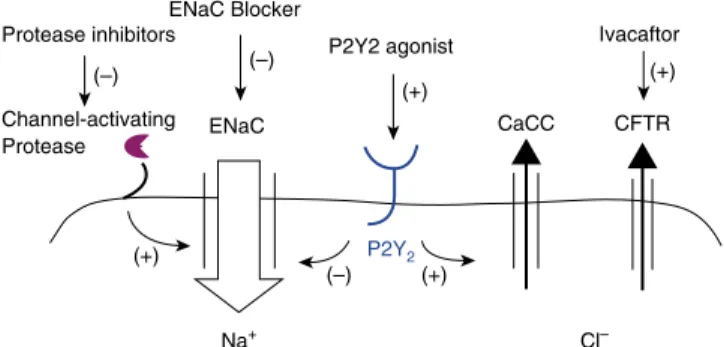
development of an appropriately designed alternative agent that is potent and long
acting is an attractive therapeutic option (Figure 1). Although sodium transport may not be up-regulated in patients with CB (unlike in those with CF), the use of an ENaC blocker to inhibit this rate-limiting step offluid reabsorption could still prove to be beneficial if mucus dehydration and defective MCC are important parts of CB disease pathogenesis. Agents that reduce ENaC activity via indirect mechanisms, such as the inhibition of surface proteases that are involved in channel activation, may also have potential usefulness. An approach that combines an ENaC blocker with a second agent that stimulatesfluid secretion, such as a hyperosmotic agent, may also be very attractive and worthy of investigation. Finally, stimulation of chloride secretion via non-CFTR pathways could be explored, including the use of P2Y2 agonists that stimulate calcium-activated chloride channels (37).
The evidence that CFTR dysfunction is present in patients with COPD raises the possibility that CFTR modulators could also provide therapeutic benefit. Obviously, these patients are expected to have a normal CFTR gene sequence, and the observed reduction in CFTR activity likely results from a reduced number of channels of the cell surface (2, 38). Ivacaftor is a CFTR modulator that increases channel gating and open probability of not only mutant channels with gating abnormalities (i.e., gating mutations, R117H, and temperature- or chemically corrected delF508), but also wild-type channels. It is conceivable, and there is supportingin
vitroevidence, that treatment of a patient with CB with reduced CFTR function
Protease inhibitors
(–)
(+)
(+) (–) Channel-activating
Protease ENaC
Na+ Cl–
CaCC CFTR
ENaC Blocker
P2Y2 agonist
P2Y2
Ivacaftor (–)
(+) (+)
using an effective CFTR modulator could increase the activity of residual channels, stimulate anion secretion, improve mucus hydration, and accelerate MCC (5). It seems likely, however, that the severity of the baseline CFTR dysfunction may influence whether this strategy is likely to be effective. It is well known that patients with mild CFTR mutations often have normal lung function despite possessing only 5 to 10% of wild-type channel activity. Therefore, the question is whether the reduction of CFTR activity in a patient with CB to 20–40% of normal is sufficient to be a primary driver of disease
pathogenesis, or whether such a patient would benefit clinically from a CFTR modulator that reverses this more modest degree of channel dysfunction. Furthermore, ivacaftor may reduce the plasma membrane stability of CFTR, and this could counteract any beneficial effect on channel open probability (39, 40). Therefore, although this hypothesis and treatment avenue remain intriguing, future studies that pursue this novel approach will need to be studied carefully.
Unanswered Questions and a
Path Forward
Many questions surround the ASL dehydration hypothesis and the potential use of hydrator therapies for CB. Although CFTR function appears to be reduced in these patients, is the degree of this function severe enough or relevant to disease pathogenesis? Airway secretions sampled from patients with CB are clearly more dehydrated than in those from healthy volunteers, but does this relate to CFTR dysfunction and is the severity of mucus dehydration sufficient to cause a defect in mucociliary transportin vivo? MCC is clearly abnormal in patients with CB, but is the pattern of the clearance defect similar to that of CF and reflective of the same underlying disease
mechanisms, or perhaps more related to the loss of ciliary function associated with smoking (41)? The answers to all of these important questions may inform us regarding the likelihood of ASL hydrators, as a class, to become a
clinically useful treatment approach. Furthermore, these answers may direct us to agents that have the greatest likelihood of success and the identification of patients that are most likely to respond. It will take a significant effort, including the conduct of clinical studies and treatment trials, to answer many of these questions. The use of appropriate outcome measures that are sensitive to and predictive of clinical benefits must also be developed to allow the selection of agents worthy of the investments needed to conduct large-scale clinical trials. Ultimately, this work and these investments are warranted, given the magnitude of harm that this disease inflicts on individuals and society as a whole, and given the current dearth of novel treatment approaches for COPD. The possibility of being able to target a novel element involved in disease pathogenesis and thereby improve patient outcomes is incredibly exciting and brings hope for the future.n
Author disclosuresare available with the text of this article at www.atsjournals.org.
References
1 Boucher RC. Airway surface dehydration in cysticfibrosis: pathogenesis and therapy.Annu Rev Med2007;58:157–170. 2 Clunes LA, Davies CM, Coakley RD, Aleksandrov AA, Henderson AG,
Zeman KL, Worthington EN, Gentzsch M, Kreda SM, Cholon D,et al. Cigarette smoke exposure induces CFTR internalization and insolubility, leading to airway surface liquid dehydration.FASEB J 2012;26:533–545.
3 Dransfield MT, Wilhelm AM, Flanagan B, Courville C, Tidwell SL, Raju SV, Gaggar A, Steele C, Tang LP, Liu B,et al. Acquired cysticfibrosis transmembrane conductance regulator dysfunction in the lower airways in COPD.Chest2013;144:498–506.
4 Cantin AM, Hanrahan JW, Bilodeau G, Ellis L, Dupuis A, Liao J, Zielenski J, Durie P. Cysticfibrosis transmembrane conductance regulator function is suppressed in cigarette smokers.Am J Respir Crit Care Med2006;173:1139–1144.
5 Sloane PA, Shastry S, Wilhelm A, Courville C, Tang LP, Backer K, Levin E, Raju SV, Li Y, Mazur M,et al. A pharmacologic approach to acquired cysticfibrosis transmembrane conductance regulator dysfunction in smoking related lung disease.PLoS One2012;7: e39809.
6 Cooper JL, Quinton PM, Ballard ST. Mucociliary transport in porcine trachea: differential effects of inhibiting chloride and bicarbonate secretion.Am J Physiol Lung Cell Mol Physiol2013;304:L184–L190. 7 Yang N, Garcia MA, Quinton PM. Normal mucus formation requires
cAMP-dependent HCO3- secretion and Ca21-mediated mucin exocytosis.J Physiol2013;591:4581–4593.
8 Boucher RC, Stutts MJ, Knowles MR, Cantley L, Gatzy JT. Na1 transport in cysticfibrosis respiratory epithelia. Abnormal basal rate and response to adenylate cyclase activation.J Clin Invest1986;78: 1245–1252.
9 Stutts MJ, Canessa CM, Olsen JC, Hamrick M, Cohn JA, Rossier BC, Boucher RC. CFTR as a cAMP-dependent regulator of sodium channels.Science1995;269:847–850. (see comments).
10 Stoltz DA, Meyerholz DK, Pezzulo AA, Ramachandran S, Rogan MP, Davis GJ, Hanfland RA, Wohlford-Lenane C, Dohrn CL, Bartlett JA, et al. Cysticfibrosis pigs develop lung disease and exhibit defective bacterial eradication at birth.Sci Transl Med2010;2:29ra31. 11 Mall M, Grubb BR, Harkema JR, O’Neal WK, Boucher RC. Increased
airway epithelial Na1absorption produces cysticfibrosis-like lung disease in mice.Nat Med2004;10:487–493.
12 Anderson WH, Coakley RD, Button B, Henderson AG, Zeman KL, Alexis NE, Peden DB, Lazarowski ER, Davis CW, Bailey S,et al. The relationship of mucus concentration (hydration) to mucus osmotic pressure and transport in chronic bronchitis.Am J Respir Crit Care Med2015;192:182–190.
13 Henderson AG, Ehre C, Button B, Abdullah LH, Cai LH, Leigh MW, DeMaria GC, Matsui H, Donaldson SH, Davis CW,et al. Cystic fibrosis airway secretions exhibit mucin hyperconcentration and increased osmotic pressure.J Clin Invest2014;124:3047–3060. 14 Courville CA, Tidwell S, Liu B, Accurso FJ, Dransfield MT, Rowe SM.
Acquired defects in CFTR-dependentb-adrenergic sweat secretion in chronic obstructive pulmonary disease.Respir Res 2014;15:25.
15 Raju SV, Jackson PL, Courville CA, McNicholas CM, Sloane PA, Sabbatini G, Tidwell S, Tang LP, Liu B, Fortenberry JA,et al. Cigarette smoke induces systemic defects in cysticfibrosis transmembrane conductance regulator function.Am J Respir Crit Care Med2013;188:1321–1330.
16 Donaldson SH, Bennett WD, Zeman KL, Knowles MR, Tarran R, Boucher RC. Mucus clearance and lung function in cysticfibrosis with hypertonic saline.N Engl J Med2006;354:241–250. 17 Bennett W, Zeman K, Donaldson SH, Donohue JF, Knowles MR,
Boucher RC. Cough clearance is less effective in cysticfibrosis than chronic bronchitis.Am J Respir Crit Care Med2004;169:A386. 18 Elkins MR, Robinson M, Rose BR, Harbour C, Moriarty CP, Marks GB,
19 Cystic Fibrosis Foundation Patient Registry: Annual Data Report 2013. 2014.
20 King M, Dasgupta B, Tomkiewicz RP, Brown NE. Rheology of cystic fibrosis sputum afterin vitrotreatment with hypertonic saline alone and in combination with recombinant human deoxyribonuclease I. Am J Respir Crit Care Med1997;156:173–177.
21 Robinson M, Hemming AL, Regnis JA, Wong AG, Bailey DL, Bautovich GJ, King M, Bye PT. Effect of increasing doses of hypertonic saline on mucociliary clearance in patients with cysticfibrosis.Thorax1997; 52:900–903.
22 Robinson M, Regnis JA, Bailey DL, King M, Bautovich GJ, Bye PT. Effect of hypertonic saline, amiloride, and cough on mucociliary clearance in patients with cysticfibrosis.Am J Respir Crit Care Med 1996;153:1503–1509.
23 Sood N, Bennett WD, Zeman K, Brown J, Foy C, Boucher RC, Knowles MR. Increasing concentration of inhaled saline with or without amiloride: effect on mucociliary clearance in normal subjects. Am J Respir Crit Care Med2003;167:158–163.
24 Daviskas E, Anderson SD. Hyperosmolar agents and clearance of mucus in the diseased airway.J Aerosol Med2006;19:100–109. 25 Daviskas E, Anderson SD, Eberl S, Chan HK, Bautovich G. Inhalation of
dry powder mannitol improves clearance of mucus in patients with bronchiectasis.Am J Respir Crit Care Med1999;159:1843–1848. 26 Bennett WD, Wu J, Fuller F, Balcazar JR, Zeman KL, Duckworth H, Donn KH, O’Riordan TG, Boucher RC, Donaldson SH. Duration of action of hypertonic saline on mucociliary clearance in the normal lung.J Appl Physiol (1985)2015;118:1483–1490.
27 Donaldson SHLB, Brown AW, Lechtzin N, Zeman K, Wu J, Waltz D, Bennett WD. Durable effect of hypertonic saline on mucociliary clearance in cysticfibrosis.J Aerosol Med Pulm Drug Deliv2011;24: 114.
28 Pavia D, Thomson ML, Clarke SW. Enhanced clearance of secretions from the human lung after the administration of hypertonic saline aerosol.Am Rev Respir Dis1978;117:199–203.
29 Knowles MR, Church NL, Waltner WE, Yankaskas JR, Gilligan P, King M, Edwards LJ, Helms RW, Boucher RC. A pilot study of aerosolized amiloride for the treatment of lung disease in cysticfibrosis.N Engl J Med1990;322:1189–1194.
30 Graham A, Hasani A, Alton EW, Martin GP, Marriott C, Hodson ME, Clarke SW, Geddes DM. No added benefit from nebulized amiloride in patients with cysticfibrosis.Eur Respir J1993;6:1243–1248. 31 Wainwright CE, Elborn JS, Ramsey BW, Marigowda G, Huang X, Cipolli
M, Colombo C, Davies JC, De Boeck K, Flume PA,et al.; TRAFFIC Study Group; TRANSPORT Study Group. Lumacaftor-ivacaftor in patients with cysticfibrosis homozygous for Phe508del CFTR. N Engl J Med2015;373:220–231.
32 Ramsey BW, Davies J, McElvaney NG, Tullis E, Bell SC, Drev´ˇ ınek P, Griese M, McKone EF, Wainwright CE, Konstan MW,et al.; VX08-770-102 Study Group. A CFTR potentiator in patients with cystic fibrosis and the G551D mutation.N Engl J Med2011;365: 1663–1672.
33 Davies JC, Wainwright CE, Canny GJ, Chilvers MA, Howenstine MS, Munck A, Mainz JG, Rodriguez S, Li H, Yen K,et al.; VX08-770-103 (ENVISION) Study Group. Efficacy and safety of ivacaftor in patients aged 6 to 11 years with cysticfibrosis with a G551D mutation.Am J Respir Crit Care Med2013;187:1219–1225.
34 De Boeck K, Munck A, Walker S, Faro A, Hiatt P, Gilmartin G, Higgins M. Efficacy and safety of ivacaftor in patients with cysticfibrosis and a non-G551D gating mutation.J Cyst Fibrosis2014;13:674-680. 35 Moss RB, Flume PA, Elborn JS, Cooke J, Rowe SM, McColley SA,
Rubenstein RC, Higgins M; VX11-770-110 (KONDUCT) Study Group. Efficacy and safety of ivacaftor in patients with cysticfibrosis who have an Arg117His-CFTR mutation: a double-blind, randomised controlled trial.Lancet Respir Med2015;3:524–533.
36 Rowe SM, Heltshe SL, Gonska T, Donaldson SH, Borowitz D, Gelfond D, Sagel SD, Khan U, Mayer-Hamblett N, Van Dalfsen JM,et al.; GOAL Investigators of the Cystic Fibrosis Foundation Therapeutics Development Network. Clinical mechanism of the cysticfibrosis transmembrane conductance regulator potentiator ivacaftor in G551D-mediated cysticfibrosis.Am J Respir Crit Care Med 2014;190:175–184.
37 Bennett WD, Zeman KL, Foy C, Shaffer CL, Johnson FL, Regnis JA, Sannuti A, Johnson J. Effect of aerosolized uridine 59-triphosphate on mucociliary clearance in mild chronic bronchitis.Am J Respir Crit Care Med2001;164:302–306.
38 Rasmussen JE, Sheridan JT, Polk W, Davies CM, Tarran R. Cigarette smoke-induced Ca21release leads to cysticfibrosis transmembrane conductance regulator (CFTR) dysfunction.J Biol Chem2014;289: 7671–7681.
39 Cholon DM, Quinney NL, Fulcher ML, Esther CR Jr, Das J, Dokholyan NV, Randell SH, Boucher RC, Gentzsch M. Potentiator ivacaftor abrogates pharmacological correction ofDivacaftor abrogates fibrosis.Sci Transl Med2014;6:246ra96.
40 Veit G, Avramescu RG, Perdomo D, Phuan PW, Bagdany M, Apaja PM, Borot F, Szollosi D, Wu YS, Finkbeiner WE,et al. Some gating potentiators, including VX-770, diminishDF508-CFTR functional expression.Sci Transl Med2014;6:246ra97.