African Journal of Reproductive Health September 2017; 21 (3): 76
ORIGINAL RESEARCH ARTICLE
Influence of Knowledge of Spousal Fertility Cycles on Male
Reproductive Health Participation in Ibadan Metropolis, Nigeria
Taiwo A.
Obembe
1,2*,
Kehinde O. Odebunmi
3,
Kayode O. Osungbade
2and Babatunde O
.
Adedokun
4University of Witwatersrand, School of Public Health, Education Campus, Johannesburg, South Africa1; Department of Health Policy and Management, Faculty of Public Health, College of Medicine, University of Ibadan2; Department of Hospice and Palliative Medicine, University College Hospital, Ibadan3; Department of Epidemiology and Medical Statistics, Faculty of Public Health, College of Medicine, University of Ibadan4
*For Correspondence: E-mail: [email protected]; Phone: +234-805-840-9495
Abstract
Despite the established roles and influence of men on women‟s uptake and utilization of reproductive health care interventions, the degree of involvement with intimate issues within the household which could help to understand male involvement and support remains an under-researched topic. The aim of this study was to investigate the degree of involvement at the family level of men within sub-urban communities of Ibadan in South-West Nigeria. A cross sectional survey design was conducted among 380 men selected from sub-urban communities in Ibadan, Oyo State using multi-stage sampling. Data was obtained using pre-tested, semi-structured, interviewer administered questionnaires. Data were analysed using descriptive statistics, bivariate analysis and logistic regression with level of significance set at 5%. Mean age of respondents was 41.1 ± 7.6 years. Men who were knowledgeable of spouse‟s menstrual cycles and ovulation dates were significantly more likely to have supported some form of public health intervention before (p<0.001). Age over 30, above secondary education, and men aware of menstrual dates of spouse were significant predictors of reproductive health interventions. Men who were aware of menstrual cycles of spouse were 96.6% more likely to be supportive or involved in reproductive health matters compared to those who were not (OR =0.034; 95% CI = 0.02 - 0.07; p<0.001). Involvement of men at family level as demonstrated in this study serves to influence and explain the level of involvement with reproductive health. Further research investigating other proximal factors that influence male participation is recommended. (Afr J Reprod Health 2017; 21[3]: 76-88).
Keywords: reproductive health, health disparities, male involvement, menstrual cycle, ovulatory cycles, fertility
Résumé
En dépit des rôles établis et de l'influence des hommes sur la prise en charge des femmes et l'utilisation des interventions en matière de soins de santé de la reproduction, le degré de participation aux problèmes intimes au sein du ménage qui pourrait aider à comprendre l'implication et le soutien des hommes demeure un sujet de recherche insuffisamment étudié. L'objectif de cette étude était d'étudier le degré d'implication au niveau familial des hommes dans les communautés sub-urbaines d'Ibadan dans le sud-ouest du Nigéria. Une étude transversale a été menée auprès de 380 hommes sélectionnés parmi les communautés sub-urbaines d'Ibadan, dans l‟État d'Oyo, en utilisant un échantillonnage en plusieurs étapes. Les données ont été obtenues à l'aide de questionnaires pré-testés, semi-structurés et administres à partir des interviews. Les données ont été analysées en utilisant des statistiques descriptives, une analyse bivariée et une régression logistique avec un niveau de signification fixé à 5%. L'âge moyen des répondants était de 41,1 ± 7,6 ans. Les hommes qui connaissaient bien les cycles menstruels et les dates d'ovulation des épouses étaient beaucoup plus susceptibles d'avoir soutenu une forme d'intervention de santé publique avant (p <0,001). L'âge de plus de 30 ans, l'enseignement supérieur au niveau secondaire, et les hommes connaissance les dates menstruelles des épouses constituaient des indices significatifs des interventions de santé reproductive. Les hommes qui connaissaient les cycles menstruels de l'époux étaient 96,6% plus susceptibles d'être favorables ou impliqués dans des problèmes de santé génésique par rapport à ceux qui n'étaient pas (OR = 0,034; IC 95% = 0,02 - 0,07; p <0,001). L'implication des hommes à l'échelle familiale, telle que démontrée dans cette étude, sert à influencer et à expliquer le niveau de participation à la santé de la reproduction. D'autres recherches sur d'autres facteurs proximaux qui influencent la participation des hommes sont recommandées. (Afr J Reprod Health 2017; 21[3]: 76-88).
African Journal of Reproductive Health September 2017; 21 (3):
77
Introduction
For several decades, health planners have mainly focused their studies on how the attitudes, knowledge and behavior of women can be adjusted especially with regards to reproduction, family planning, contraceptive use and fertility issues1. This initial drive was based on the obvious observation that women are responsible for the majority of processes involved with childbirth. However, as time went on, it became obvious that in some countries, studies and programs on reproductive health and behavior based solely on women were not delivering the desired results even after all key areas were attended to by the health planners. Further investigations revealed that in certain communities and countries at large, although women carry most of the physical and emotional strains of pregnancy, childbirth and child rearing, the men occupied critical roles in terms of decision making in most settings2. For instance, in India, it was reported that even though the women in Kerala were eligible to receive free contraception and were willing to do so, 40% of them did not use the contraception due to objection by their husbands1. In Nigeria and other parts of sub-Saharan Africa, males are recognized as the head of the household and are solely responsible for decision-making in most family oriented reproductive health issues3. This informed the decision of more studies to focus on the roles of men in determining the reproductive and fertility characteristics of their families.
In Nigeria, this need has taken on added importance as a result of the high household size reported in the country. The 2013 Nigeria Demographic and Health Survey (NDHS) puts the total fertility rate at 5.5, which is one of the highest in the world (even higher than the 5.05 in sub-Saharan Africa)4. This has largely stimulated studies on men from various standpoints. For instance, Oyediran and colleagues investigated the level of knowledge and use of contraceptive methods by Nigerian men5 while Wusu explored how the family structure and family size were dependent on the head of household characteristics6. Fertility desires have been investigated7 while Sedgh and colleagues went further to investigate and explore the role men
play in the occurrence of unplanned pregnancies8. Likewise, the evaluation of the knowledge of males for danger signs in pregnancy in Nigeria9 goes to further emphasize the role and importance of men in relevant public health issues and interventions. These studies also demonstrate the important roles men play in determining their partners‟ reproductive behaviours.
Even though studies have recognized the importance of determining the level of male involvement in women‟s lives at the family level in other patriarchal settings such as India and Papua New Guinea and in Nigeria10,11, the extent with regards to how involved males are with personal and reproductive issues of their spouses at the family level remains under-researched in Nigeria.. Exploring the degree of involvement by men at family and personal levels is important as it may actually serve as a proxy to understanding levels of support and involvement with public health outcomes. To the best of our knowledge, this is the first study that examines the degree of involvement at the family level. The study aims to answer the following questions: What is the extent of involvement of Nigerian men in their spouses‟ reproductive health? Is there any relationship between gender preference and the level of involvement of men in women‟s reproductive issues at the family level? This study expounds these issues by ascertaining the level of involvement of men in the fertility cycles of their partners as well as the factors associated with their involvement in women‟s lives at the family level.
Methods
Study area
African Journal of Reproductive Health September 2017; 21 (3):
78
(Ibadan North, Ibadan East, IbadanNorth-West, Ibadan South-North-West, and Ibadan South East) and six sub-urban local governments in the city where the study was conducted14.
Study population
Study population comprised males participants aged 18 – 65 years, recruited from sub-urban communities in Ibadan, who have resided for at least one year prior to the study.
Sampling strategy
Multistage sampling was used for selection of study participants. In the first stage, a sampling frame of all six local government areas of sub-urban Ibadan metropolitan area was obtained 15 and one local government area was selected randomly by balloting. In stage 2, a complete list of all the communities within the local government areas was obtained and 2 communities were selected from each local government using proportionate allocation based on the estimated sample size.
In stage 3, all enumeration areas in the selected communities were selected. Each enumeration area had 10-35 houses with about 6-10 adults per house. All eligible adults in each enumeration area were interviewed. Participants within the selected community who consented to participate in the study were recruited. Subsequently, every consecutive household were approached and fathers were interviewed in that manner according to how they gave consent.
Ethical approval for this study was sought and gotten from the University of Ibadan/University College Hospital Institutional Review Committee before study was initiated. Written informed consent was also obtained from participants before administering questionnaires. Proper community entry was later observed by obtaining approval from the appropriate community leaders. The study was thoroughly explained to participants before consent to participate in the study was obtained. A total of 380 men were selected to participate in the study
determined using the formula: n= NZ2p (1-p)/Nd2 + Z2p (1-p).
Data were collected between August 2014 and December 2014 by trained research assistants with semi-structured interviewer administered questionnaires, designed based on the study objectives. The questionnaire was initially pre-tested in a community which was similar in characteristics with the proposed study site. Ambiguities were corrected after which it was subjected to measures of internal consistency with the use of Cronbach‟s Alpha test to check the reliability of the survey instrument before final administration. A Cronbach alpha score of 0.87 was obtained that showed good internal consistency of our study instrument.
Independent variables included the socio-demographic characteristics, number of children, category of children (either male only, female only or mixed) while dependent variables included knowledge of spouse‟s menstrual cycle dates and ovulation day. For knowledge of menstrual cycle dates, responses were coded as “I am sure of her dates‟=1; “I used to know but can‟t remember now=2; “never bothered to find out=3”. For participants that answered “I used to know but can‟t remember now=2; “never bothered to find out=3”, responses were re-grouped into, “No I don‟t know”. While for ovulation dates, responses were coded as, “Yes=1”; “No=2”. Ethnicity was later re-classified as „Yoruba=1 and others=2” while marital status was also re-grouped into, “Married=1 and others=2”.
African Journal of Reproductive Health September 2017; 21 (3):
79
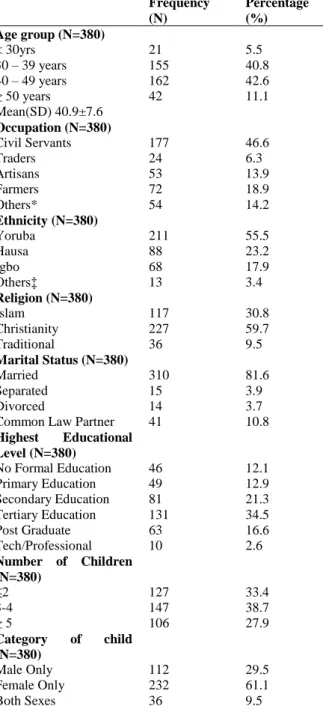
Table 1: Socio-Demographic Characteristics ofRespondents
*Others: Bricklayers, Security men, Students, Bankers, Unemployed, Healthcare personnel
‡Others: Hausa, Igbo, Efik, Ibibio, Tiv
determine the adjusted odds of knowledge of spouse‟s menstrual cycle dates and ovulation day. Results were reported at level of statistical significance set at 5%.
Results
Socio-demographic characteristics
A total of 380 questionnaires out of 410 questionnaires were returned, giving a response rate of 92.7%. Mean age of respondents was 41.1 ± 7.6 years while the ages ranged from 22 years to 63 years with the highest proportion in the 40-49 years age group (42.6%). Almost half (46.6%) of the respondents were civil servants followed by farmers (18.9%), traders (5.8%) and artisans (13.5%). The majority of the respondents (55.7%) were of Yoruba descent. Almost three out of every five respondents (59.7%) were of the Christian faith, 30.8% were Muslims, and 9.5% were traditionalists. The married respondents constituted a vast majority (81.6%), while about one-tenth (10.8%) of them were involved in common law partnerships. Respondents that had completed tertiary education accounted for the largest proportion of our respondents (34.5%), followed by those that completed secondary education (21.3%). Only 16.6% had completed some postgraduate training. About a third of respondents (33.4%) had less than 2 children and men with female-only children constituted 61.1% of respondents (Table 1).
Male involvement and factors associated with
male involvement in spouse’s menstrual and
ovulatory cycles
When asked of their spouse‟s menstrual cycles, just about one-quarter (25.5%) of them were affirmative of the exact dates of the menstrual dates of their partners. A breakdown of these figures by age group among those that were affirmative showed that 30-39 year age group had the highest proportion (47.4%) compared to those less than 30 years (4.1%), 40-49 years (37.2%) and over 50years (11.3%) – a difference that was not statistically significant (p=0.438). Other occupations (53.6%); participants that had completed secondary education (48.5%); Yoruba ethnicity (51.5%), married men (86.6%), could correctly recount the menstrual dates for their spouses more compared to their counterparts. Frequency
(N)
Percentage (%) Age group (N=380)
< 30yrs 21 5.5
30 – 39 years 155 40.8
40 – 49 years 162 42.6
≥ 50 years
Mean(SD) 40.9±7.6
42 11.1
Occupation (N=380)
Civil Servants 177 46.6
Traders 24 6.3
Artisans 53 13.9
Farmers 72 18.9
Others* 54 14.2
Ethnicity (N=380)
Yoruba 211 55.5
Hausa 88 23.2
Igbo 68 17.9
Others‡ 13 3.4
Religion (N=380)
Islam 117 30.8
Christianity 227 59.7
Traditional 36 9.5
Marital Status (N=380)
Married 310 81.6
Separated 15 3.9
Divorced 14 3.7
Common Law Partner 41 10.8
Highest Educational Level (N=380)
No Formal Education 46 12.1
Primary Education 49 12.9
Secondary Education 81 21.3 Tertiary Education 131 34.5
Post Graduate 63 16.6
Tech/Professional 10 2.6
Number of Children (N=380)
≤2 127 33.4
3-4 147 38.7
≥ 5 106 27.9
Category of child (N=380)
Male Only 112 29.5
Female Only 232 61.1
African Journal of Reproductive Health September 2017; 21 (3):
80
Table 2: Association between Socio-Demographic Characteristics and Male Involvement in Spousal Menstrual Cycle DatesDo you know/follow your wife/partner’s menstrual cycle dates 1. Age group I am sure of her
dates (n=97)
I am not sure of her dates
(n=283)
Chi Square P-value
< 30 years 4 (4.1%) 17 (6.0%) 2.694 .438§
30 -39 years 46 (47.4%) 109 (38.5%)
40-49 years 36 (37.2%) 126 (44.5%)
≥ 50 years 11 (11.3%) 31 (11.0%)
2. Occupation
Civil Servants 45 (46.4%) 132 (46.6%) .002 .966
Others* 52 (53.6%) 151 (53.4%)
3. Educational Status
No Education 11 (11.3%) 35 (12.4%) .635 .748
Professional & Primary Education
39 (40.2%) 101 (35.7%)
Secondary education & above
47 (48.5%) 147 (51.9%)
4. Ethnic Group
Yoruba 50 (51.5%) 161 (5.7%) .835 .361
Others‡ 47 (48.5%) 122 (94.3%)
5. Marital Status
Married 84 (86.6%) 226 (79.9%) 2.183 .140
Others¥ 13 (13.4%) 57 (20.1%)
6. Religion
Christianity 50 (51.5%) 177 (62.5%) 3.633 .057
Others# 47 (48.5%) 106 (37.5%)
7. How many children do you have now?
≤ 2 30 (30.9%) 97 (34.3%) 1.682 .431
3 – 4 35 (36.1%) 112 (39.6%)
≥ 5 32 (33.0%) 74 (26.1%)
8. Category of Child
Male only 31 (32.0%) 81 (28.6%) 1.156 .561
Female only 55 (56.7%) 177 (62.6%)
Both 11 (11.3%) 25 (8.8%)
9. Do you want more children?
Yes 70 (72.2%) 185 (65.4%) 1.511 .219
No 27 (27.8%) 98 (34.6%)
*Others: Traders, Artisans, farmers, Bricklayers, Security men, Students, Bead makers, Unemployed ‡ Others: Hausa, Igbo, Efik. Ibibio, Tiv
¥Others: Single, separated, divorced, widowed #Others: Islam, Traditional
§ Fishers‟ Exact
These findings were however not significant (p = 0.966; p=0.748; p=0.361; p=0.140 respectively). The effect of religion on whether men follow spousal dates was found to be marginally non-significant as more Christians (51.5%) compared to other religions (48.5%) could accurately tell the menstrual dates for their spouses (p = 0.057). With regards to the „number of children‟ and the
„category of children‟, more men with 3-4 children
(36.1%) and men with female-only children (56.7%) could accurately recount the
African Journal of Reproductive Health September 2017; 21 (3):
81
Table 3: Association between Socio-Demographic Characteristics and Male Knowledge of Spousal Ovulation DatesAre you aware/sure of your wife/partner’s ovulation day Yes
N (%)
No N (%)
Chi Square P-Value
1. Age Group
< 30 years 6 (7.5) 15 (5.0) 3.047 0.384
30 -39 years 35 (43.7) 120 (40.0)
40-49 years 34 (42.5) 128 (42.7)
≥ 50 years 5 (6.3) 37 (12.3)
2. Occupation
Civil Servants 43 (53.7) 134 (44.7) 2.094 .148
Others* 37 (46.3) 166 (55.3)
3. Ethnic Group
Yoruba 43 (53.7) 168 (56.0) .129 .719
Others‡ 37 (46.3) 132 (44.0)
4. Religion
Christianity 45 (56.3) 182 (60.7) .512 .522
Others # 35 (43.7) 118 (39.3)
5. Marital Status
Married 65 (81.3) 245 (81.7) .007 .932
Others ¥ 15 (18.7) 55 (18.3)
6 Educational Status
No Education 9 (11.2) 37 (12.3) .633 .729
Professional & Primary Education
27 (33.8) 113 (37.7)
Secondary Education & above
44 (55.0) 150 (50.0)
7. How many children do you have now?
≤2 29 (36.3) 98 (32.7) 0.547 0.761
3 – 4 31 (38.7) 116 (38.7)
≥ 5 20 (25.0) 86 (28.6)
8. Category of Child
Male only 28(35.0) 84(28.0) 2.273 0.321
Female only 43(53.8) 189 (63.0)
Both 9 (11.2) 27 (9.0)
9. Do you want more children
Yes 51 (63.7) 204 (68.0) .517 .472
No 29 (36.3) 96 (32.0)
*Others: Traders, Artisans, farmers, Bricklayers, Security men, Students, Bead makers, Unemployed ‡ Others: Hausa, Igbo, Efik. Ibibio, Tiv
¥Others: Single, separated, divorced, widowed #Others: Islam, Traditional
Awareness of ovulatory phases of spouse
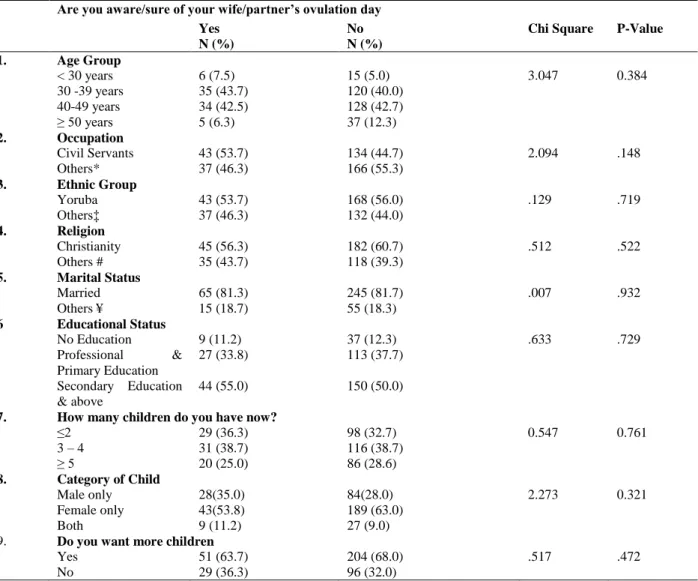
With regard to their partners‟ ovulatory cycles, only 80 (21.1%) of the respondents knew the exact days their partners were ovulating. Age group 30-39 years (43.7%) were most attentive to the ovulatory cycles of their spouses compared to the other age groups (p=0.384). Civil servants (53.7%) paid more attention to ovulatory cycles of their spouses compared to others (p=0.148), while Yorubas (53.7%) more than other ethnicities (46.3%) paid more attention to the spouses‟
African Journal of Reproductive Health September 2017; 21 (3):
82
Table 4: Test of Men‟s Knowledge of Ovulation in SpouseS/N Men‟s Knowledge of Ovulations Signs
Frequency (N) Percent (%) 1 Ovulation signs looked for (n=80)
Basal Body Temperature 19 23.8
Increased libido of spouse 24 30.0
Pimples 11 13.8
Others 26 32.5
Total 80 100.0
2 Ovulation period as perceived by respondent (n=80)
During her menses 5 6.2
1st week after menses 21 26.3
Mid-cycle 24 30.0
Last week before the next menses 12 15.0
I don‟t know 18 22.5
Total 80 100.0
3 Makes a conscious effort to have sexual intercourse with spouse during her ovulation
Yes 59 73.7
No 21 26.3
Total 80 100.0
Others: Abdominal cramps mid-cycle, salty sweat, ovulation kit, breast tenderness
Test of men’s knowledge of ovulation in
spouse
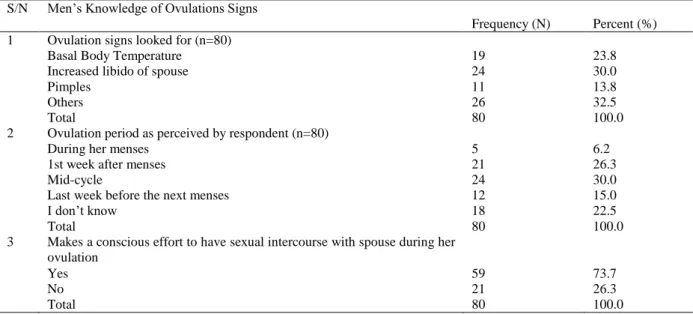
An increase in libido of the spouse was the most explored sign that men from sub-urban communities used to predict the ovulatory phase of their spouses (30.0%) followed closely by an increase in basal body temperature (23.8%). Interestingly, most men correctly identified the ovulation of their spouses to occur at mid-cycle (30.0%) followed by those who believed it occurred in the 1st week after menstruation (26.3%). A good proportion of respondents (22.5%) also admitted total lack of knowledge as to when this occurs. Of those that admitted to knowing the time of the month when their spouses are ovulating, 73.7% put in some effort to be with spouses at this time (Table 4).
Attendance/involvement with reproductive
health-related issue
More respondents between age groups of 30-39 years (42.7%); other occupations (51.6%); Christians (54.8%); married men (81.5%); educational status attainment of at least secondary education (52.4%); men with 3-4 children (37.1%) compared to their counterparts had been more involved in health matters regarding the family or
spouse before. These findings were equally not significant (p=0.384; p=0.623; p=0.175; p=0.964, p=0.120 and p=0.898 respectively). More Yorubas (58.2%) compared to other ethnicities had not been involved nor had accompanied their spouses for any health related matter before (p=0.131). Respondents with female only children (51.6%); respondents with lack of awareness of spousal ovulatory cycles/dates (62.1%); and men that were knowledgeable of spouses‟ menstrual dates (64.5%) were found to have accompanied their spouses for reproductive health related event before (p=0.026; p<0.001; p<0.001 respectively) (Table 5).
Predictors of involvement and support of
reproductive health issues
African Journal of Reproductive Health September 2017; 21 (3):
83
Table 5: Association between Socio-Demographic Characteristics and Involvement with Reproductive Health Issues*Significant Associations
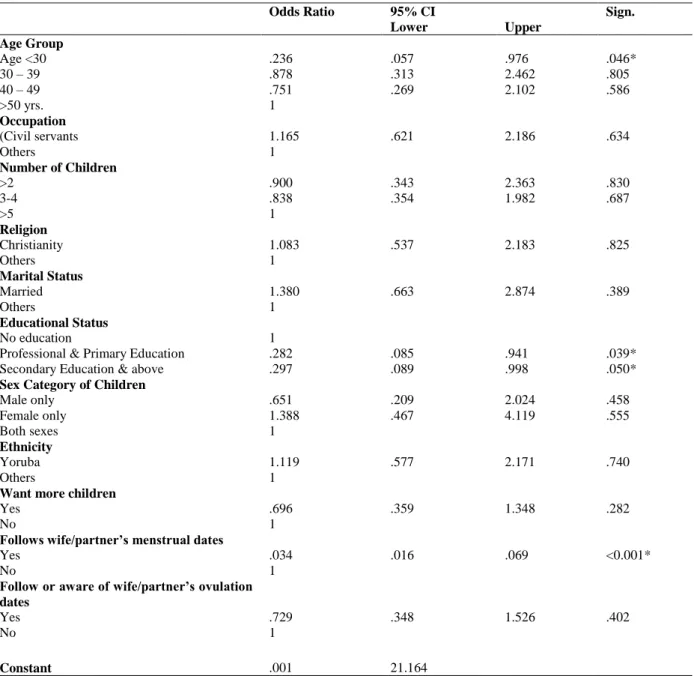
related matters compared to those without any form of education at all (OR=0.28; CI=0.09 – 0.94) (Table 6).
Discussion
The mean age of respondents (40.9±7.6) observed in this study is similar to that reported in other studies in Nigeria1,16. This is likely the case
because the demographic profile of the country has been found to be similar across all regions. In addition, studies involving men of reproductive age have reported similar results possibly an indication that the 30-49 year bracket represent the most active part of male reproductive years. The literacy rate of 87.3% observed in this study is relatively high when compared to the 70.5% male literacy rate at the national level4. When compared Ever accompanied spouse for a reproductive health related issue?
Yes N (%) (N=124)
No N (%) (N=256)
Chi Square P-Value
Age Group
< 30 years 10 (8.1) 11 (4.3) 3.052 0.384
30 -39 years 53(42.7) 102(39.8)
40-49 years 49(39.5) 113(44.1)
≥ 50 years 12(9.7) 30(11.8)
Occupation
Civil Servants 60 (48.4) 117 (45.7) 0.242 0.623
^Others 64 (51.6) 139 (54.3)
Ethnicity
Yoruba 62(50.0) 149(58.2) 2.276 0.131
^Others 62(50.0) 107(41.8)
Religion
Christianity 68 (54.8) 159 (62.1) 1.836 0.175
^Others 56 (45.2) 97 (37.9)
Marital Status
Married 101(81.5) 209 (81.6) 0.002 0.964
^Others 23 (18.5) 47 (18.4)
Educational Status
No education 9 (7.3) 37 (14.5) 4.245 .120
Professional & Primary Education 50 (40.3) 90 (35.2) Secondary Education &above 65 (52.4) 129 (50.3)
How many children do you have now?
≤2 43(34.7) 84(32.8) 0.214 0.898
3 – 4 46 (37.1) 101 (39.5)
≥ 5 35 (28.2) 71 (27.7)
Category of Child
Male only 47 (37.9) 65 (25.4) 7.322 0.026*
Female only 64 (51.6) 168 (65.6)
Both 13 (10.5) 23 (9.0)
Are you aware/sure of your wife/partner’s ovulation dates
Yes 47 (37.9) 33(12.9) 31.445 <0.001*
No 77(62.1) 223 (87.1)
Do you know/follow your wife/partner’s menstrual dates?
I am sure of her dates 80 (64.5) 17(6.6) 147.586 <0.001*
African Journal of Reproductive Health September 2017; 21 (3):
84
Table 6: Logistic Regression Predicting Participation in Reproductive Health Related IssuesOdds Ratio 95% CI Sign.
Lower Upper Age Group
Age <30 .236 .057 .976 .046*
30 – 39 .878 .313 2.462 .805
40 – 49 .751 .269 2.102 .586
>50 yrs. 1
Occupation
(Civil servants 1.165 .621 2.186 .634
Others 1
Number of Children
>2 .900 .343 2.363 .830
3-4 .838 .354 1.982 .687
>5 1
Religion
Christianity 1.083 .537 2.183 .825
Others 1
Marital Status
Married 1.380 .663 2.874 .389
Others 1
Educational Status
No education 1
Professional & Primary Education .282 .085 .941 .039*
Secondary Education & above .297 .089 .998 .050*
Sex Category of Children
Male only .651 .209 2.024 .458
Female only 1.388 .467 4.119 .555
Both sexes 1
Ethnicity
Yoruba 1.119 .577 2.171 .740
Others 1
Want more children
Yes .696 .359 1.348 .282
No 1
Follows wife/partner’s menstrual dates
Yes .034 .016 .069 <0.001*
No 1
Follow or aware of wife/partner’s ovulation dates
Yes .729 .348 1.526 .402
No 1
Constant .001 21.164
*significant
to other studies in other regions of the country, this figure is high. NDHS (2013) places the range of male literacy levels of other geo-political zones between 93.9% and 47.9% with only the South-South zone having a higher male literacy rate than the South West. This supports the theory that the Southwest region mainly inhabited by the Yorubas is one of the most educated regions in the country. This high literacy rate especially among the study
African Journal of Reproductive Health September 2017; 21 (3):
85
civil servants that lived in the sub-urbancommunities. This could be a pointer to the reality of urban growth – a logical perspective as to the prevalence of civil servants still resident in the sub-urban communities. According to literature, current rate of urbanisation in Nigeria is estimated at 5.5percent per annum with over 61.1 percent of 167million Nigerians (an equivalent of 102.203 million) already residing in sub-urban communities as of 201219 – a situation that calls for active policy response by the policy makers and governmental authorities. Oyeleye argues for policies that favour reduction in fertility as an appropriate policy response to the effects of uncontrolled urbanization20.
The mean number of children reported in this study, 3.47 is quite lower than the 5.6 national fertility rate4. After splitting the respondents into various educational groups, it was discovered that there was a reduction in the average number of children as educational level completed increased. This concurs with earlier studies linking educational status of either male or female partner to the number of children they have. For instance, Osili and Long found that female education was associated with lower fertility rates21. Also, Bongaarts argued that men with higher education tend to have fewer number of children22 thus highlighting the importance of education to predict household size.
Men aged 30-39 years, showed the greatest interest in involvement with partners‟ menstrual cycles. This may be due to the fact that the younger age group (<30years) are probably single and as such not concerned with issues regarding fertility talk less menstrual cycle of their partners23. The reason older age groups show increasing knowledge of their spouses‟ menstrual cycle dates may be due to the fact that they are probably married and had spent a longer amount of time together with their partners as opposed to the younger ones. In a mixed methods study, younger men were mostly concerned with just getting their partners pregnant and paid less attention to other details about their partners, especially when it pertained to reproductive and sexual health of their partners11. To further buttress this, improved levels of spousal communication
have been reported in studies where the majority of the male respondents belong to higher age groups24,25. This study also found that Yorubas had the highest proportion of men who knew exact menstrual cycle dates of their wives (Table 2). The polygamous nature commonly found with the Yorubas and Hausa clans could be barriers for intimate communication between husbands and wives26. Furthermore, an infamous notion by husbands thinking that discussions around family planning and female reproductive health with wives is a dent on their manhood27 may also be a plausible reason for this lackadaisical attitude. Even though we did not collect information on polygamy, higher rates of polygamous unions may be responsible for the observed lower proportions of men being aware of their wives‟ cycle dates among the other tribes. Educational status was found in this study to be highly associated with knowledge of menstrual cycle dates as those with postgraduate education had the highest proportion of men who knew menstruation dates of their partners, while those who completed technical education had the least. Higher knowledge of menstrual cycle dates noticed in men who had completed postgraduate education corroborates literature that affirms a link between educational status and improved reproductive and sexual health factors, Divo and Afework showed that men who were more educated sought to initiate discussions about family planning with their wives28. On the same note, males with higher education were more knowledgeable about natural family planning methods11, which relies heavily on knowledge of their partner‟s menstrual cycle.
African Journal of Reproductive Health September 2017; 21 (3):
86
ages29,30. The trend with respect to educationallevel completed with regards to ovulation, though, did not differ much from that of the knowledge of menstrual cycle dates nevertheless; respondents who had completed the government‟s prescribed years of basic education had a higher proportion of men who knew the exact days of their partner‟s ovulation. Once again, the importance of the link between educational status and the attitudes and behavior of males to reproductive health issues is brought to the fore. This had earlier being validated by Dunson and colleagues that established in their study a deeper involvement of more educated men with issues concerning the fertility and reproductive health of their partners31,32. A significant association between higher education levels of men and attendance at antenatal care (ANC) or reproductive health care services has been established33,34 for which our study corroborates further. Communication between partners was also shown to be higher among the more educated men 35. All of these indicate that education plays an important role in determining how involved a man is in his partner‟s reproductive health. The results also indicate that higher number of children was observed among those who had lower knowledge of their partners‟ ovulation dates. Notably, males who were interested in their spouse‟s sexual health had lower household sizes than their counterparts36,37. Although the difference is not statistically significant in this study, linking it with results from other studies, points to a likely association between knowledge of a partner‟s sexual health, controlled household sizes as well as practice of family planning – important statistics that demand due consideration when formulating reproductive health interventions or family planning and family spacing control policies. Jayalakshmi and colleagues in their study in India reported that although about 50% of their male respondents had knowledge of their partners‟ safe period, majority of them decided to have more than 3 children with the desire for sons as a primary factor10. However, in other settings, it was noticed that men in resource-poor settings do not have sufficient knowledge of the female reproductive cycle38. As
such, a possible reason for the contradiction in results may be associated with the poor education men have on the link between knowledge of their partners‟ menstrual and ovulation cycle and the conception process. It is likely that men in this study do not pay attention to such matters whether they have male children or not due to their ignorance of its importance to childbirth.
Our study however had some limitations. The choice of our study design being a cross-sectional study translated to the fact that causal relationships between explanatory and outcome variables could not be substantiated. Furthermore, the potential for recall bias is very important in this study as most of our questions had to do with recalling of dates. The cross-verification of dates quoted by our participants with their spouses would have been helpful to curtail this limitation. Readers should to be reminded that the results that demonstrate a high significance with regards to ethnicity could be as a result that the study was conducted in south-western Nigeria that is known to be inhabited primarily by the Yorubas. Lastly, the possibility of socially acceptable responses is very possible during the data collection process since our data was collected with the assistance of interviewers. Nevertheless, our study is the first (providing baseline statistics) that explains male involvement with reproductive health matters using more proximal family-oriented factors.
Conclusion
The significant association between men who were knowledgeable of spouse‟s menstrual dates and involvement in reproductive health issues calls for a need for campaigns that encourage more male involvement. Policies that transcend conventional norms, examining other important spheres of relationships that ultimately determine male involvement with reproductive health issues are urgently advocated particularly in low-income settings.
African Journal of Reproductive Health September 2017; 21 (3):
87
and ovulatory dates can further serve as veritableguides to draft feasible implementation work-plans as far as men are concerned.
Authors’ Contributions
Author TAO conceptualized the study, drafted the study protocol and obtained ethical approval to execute the study. Authors KOOD supervised the data collection process. Authors BOA and TAO carried out the data analysis. Author TAO wrote the initial draft manuscript and revised by author KOOS. All authors read and approved the final manuscript.
Acknowledgements
This authors appreciate Premier Medicaid International HMO, Ibadan Nigeria for providing financial (Grant No: 00001-03-014-PM) and technical assistance to execute the research. This research was also partially funded by the Consortium for Advanced Research Training in Africa (CARTA). CARTA is jointly led by the African Population and Health Research Center and the University of the Witwatersrand and funded by the Wellcome Trust (UK) (Grant No: 087547/Z/08/Z), the Department for International Development (DfID) under the Development Partnerships in Higher Education (DelPHE), the Carnegie Corporation of New York (Grant No: B 8606), the Ford Foundation (Grant No: 1100-0399), Google.Org (Grant No: 191994), SIDA (Grant No: 54100029) and MacArthur Foundation (Grant No: 10-95915-000-INP). The authors appreciate the assistance of Olajimi O. Latunji (Faculty of Public Health, University of Ibadan, Nigeria) for his technical inputs. Lastly, we thank all the participants that agreed to participate in this study.
Conflict of Interest
No competing interests exist.
References
1. Balaiah D, Ghule M, Naik DD, Parida RC and Hazari KT. Fertility attitudes and family planning
practicies of men in a rural community of Maharashtra. J Fam Welf. 2001;47(1):56–67. 2. Aransiola JO, Akinyemi AI and Fatusi AO. Women‟s
perceptions and reflections of male partners and couple dynamics in family planning adoption in selected urban slums in Nigeria:a qualitative exploration. BMC Public Health. 2014;1(14):869. 3. van Staveren I and Odebode O. Gender Norms as
Asymmetric Institutions: A case Study of Yoruba Women in Nigeria. J Econ Issues. 2007;41(4):903– 25.
4. National Population Commission (NPC) [Nigeria] and ICF International. Nigeria Demographic and Health Survey 2013. Abuja Niger Rockville, Maryland, USA. 2014;
5. Oyediran KA, Ishola GP and Feyisetan BJ. Factors Affecting Ever-Married Men‟s contraceptive knowledge and use in Nigeria. J Biosoc Sci [Internet]. 2002;34(4):497–510.
6. Wusu O. Interconnections among changing family structure, child rearing and fertility behaviour among the Ogu, Southwestern Nigeria: A qualitative study. Demogr Res. 2006;14:139–156. 7. Oladapo OT, Daniel OJ, Odusoga OL and Ayoola-
Sotubo O. Fertility desires and intentions of HIV-positive patients at a suburban specialist center. J Natl Med Assoc. 2005;97(12):1672–81.
8. Sedgh G, Bankole A, Oye-Adeniran B, Adewole IF, Singh S and Hussain R. Unwanted pregnancy and associated factors among Nigerian women. Int Fam Plan Perspect. 2006;32(4):175–84.
9. Sekoni OO and Owoaje ET. Male Knowledge of Danger Signs of Obstetric Complications in an Urban City in South West Nigeria. Ann Ibd Pg Med. 2014;12(2):89–95.
10. Jayalakshmi MS, Ambwani K, Prabhakar PK and Swain P. A study of male involvement in family planning. Heal Popul Perspect Issues. 2002;25(3):113–23. 11. Kura S, Vince J and Crouch-Chivers P. Male
involvement in sexual and reproductive health in the Mendi district, Southern Highlands province of Papua New Guinea: a descriptive study. Reprod Health [Internet]. 2013;10(1):46.
12. Ohunakin OS, Adaramola MS, Oyewola OM and Fagbenle RO. Solar energy applications and development in Nigeria: Drivers and Barriers. Renew Sustain Energy Rev. 2014;32:294–301. 13. Oyo. The Official Website of Oyo State [Internet]. The
Pacesetter State. 2014 [cited 2016 Mar 12]. Available from: http://www.oyostate.gov.ng/about-oyo-state/
14. National Population Commission. Population
Distribution By Sex, State, LGA & Senatorial District. 2006 Population and Housing Census. 2006 Popul Hous Census [Internet]. 2010;III.
Available from:
African Journal of Reproductive Health September 2017; 21 (3):
88
15. NURHI. Rapid Ibadan: Urbanization, Population and the Opportunity for Ibadan to Develop; Building a Strong City with a High Quality of Life. 2013. 16. Iliyasu Z, Abubakar IS, Galadanci HS and Aliyu MH.
Birth preparedness, Complication Readiness and Fathers‟ Participation in Maternity Care in a Northern Nigerian community. Afr J Reprod Health. 2010;14(1):21–32.
17. Jaiyeoba AO. Perceived impact of universal basic education on national development in Nigeria. Int J African African-American Stud. 2009;6(1). 18. Oyediran KA. Husband-wife communication and
couple‟s fertility desires among the Yoruba of Nigeria. 2002;
19. Daniel MM, Wapwera SD, Akande EM, Musa CC and Aliyu AA. Slum Housing Conditions and Eradication Practices in Some Selected Nigerian Cities. J Sustain Dev [Internet]. 2015;8(2):230–41. 20. Oyeleye OI. Challenges of Urbanization and Urban
Growth in Nigeria . Am J Sustain Cities Soc [Internet]. 2013;1(2):79–95.
21. Osili UO and Long BT. Does female schooling reduce fertility? Evidence from Nigeria. J Dev Econ. 2008;87(1):57–75.
22. Bongaarts J. The Implementation of preferences for Male Offspring. Popul Dev Rev. 2013;39(2):185–208. 23. Korra A and Haile M. Sexual behaviour and level of
awareness on reproductive health among youths: Evidence from Harar, Eastern Ethiopia. Ethiop J Heal Dev. 1999;13(2):107–13.
24. Kabagenyi A, Jennings L, Reid A, Nalwadda G, Ntozi J and Atuyambe L. Barriers to male involvement in contraceptive uptake and reproductive health services: a qualitative study of men and women‟s perceptions in two rural districts in Uganda. Reprod Health [Internet]. 2014;11(1):21.
25. Tumlinson K, Speizer IS, Davis JT, Fotso JC, Kuria P and Archer LH. Partner communication, discordant fertility goals, and contraceptive use in urban Kenya. Afr J Reprod Health [Internet]. 2013;17(3):79–90.
26. White DR and Burton ML. Causes of polygyny: Ecology, economy, kinship, and warfare. Am Anthropol. 1988;90(4):871–87.
27. Izugbara C, Ibisomi L, Ezeh AC and Mandara M. Gendered interests and poor spousal contraceptive communication in Islamic northern Nigeria. J Fam Plann Reprod Health Care. 2010;36(4):219–24.
28. Diro CW and Afework MF. Agreement and concordance between married couples regarding family planning utilization and fertility intention in Dukem, Ethiopia. BMC Public Health [Internet]. 2013;13(1):1–7.
29. Billari FC, Goisis A, Liefbroer AC, Settersten RA, Aassve A, Hagestad G and Speder Z. Social age deadlines for the childbearing of women and men. Hum Reprod. 2010 Mar;26(3):616–22.
30. Berrington A. Perpetual postponers? Women‟s, men‟s and couple‟s fertility intentions and subsequent fertility behaviour. Popul Trends. 2004;(117):9–19. 31. Dunson DB, Baird DD and Colombo B. Increased infert
ility with age in men and women. Obstet Gynecol. 2004;103(1):51–6.
32. Ani F, Abiodun O, Sotunsa J, Faturoti O, Imaralu J and Olaleye A. Demographic factors related to male invlovement in reproductive health care services in Nigeria. Eur J Contracept Reprod Heal Care. 2016;21(1):57–67.
33. Dutta M and Kapilashrami MC, Tiwari VK. Knowledge, awareness and extent of male participation in key areas of reproductive and child health in an urban slum of Delhi. Heal Popul Perspect Issues. 2004;27(2):49–66.
34. Shahjahan M, Mumu SJ, Afroz A, Chowdhury HA, Kabir R and Ahmed K. Determinants of male participation in reproductive healthcare services : a cross-sectional study. Reprod Health. 2013;10(27):2–7.
35. Mahmood N and RIngheim K. Factors Affecting Contraceptive Use in Pakistan. Pak Dev Rev. 1996;35(1):1–22.
36. Baschieri A, Cleland J, Floyd S, Dube A, Msona A, Molesworth A, Glynn JR, French N. Reproductive Preferences and Contraceptive Use: a Comparison of Monogamous and Polygamous Couples in Northern Malawi. J Biosoc Sci [Internet]. 2013;45(2):145–66.
37. Mosha I, Ruben R and Kakoko D. Family planning decisions, perceptions and gender dynamics among couples in Mwanza, Tanzania: a qualitative study. BMC Public Health [Internet]. 2013;13(1):523. 38. Greene ME and Biddlecom AE. Absent and Problematic
Men: Demographic Accounts of Male Reproductive Roles. Popul Dev Rev. 2000;26(1):81–115. 39. Federal Ministry of Health. Revised National Health