Mutant Hierarchies Support Selective Mutation
Kalpesh Kapoor
Department of Mathematics,
Indian Institute of Technology Guwahati 781 039, India. E-mail: [email protected]
Keywords:fault-based testing, mutation testing, first-order mutants, selective mutation
Received:October 25, 2009
Mutation testing attempts to assess the quality of a test set by its ability to distinguish the program under test from its mutants. One of the main difficulties faced in practice is due to the large number of mutants that can be generated for a program under test. Earlier research to solve this problem has suggested variants of mutation testing, and finding an effective set of mutation operators referred to as selective mutation. This paper presents an alternative approach for reducing the cost of testing by identifying hierarchies among first-order mutants. The key idea is to evaluate the strength of a mutant with respect to other mutants and ignore “weaker” mutants during testing. Unlike previous approaches, our method is formal and it is guaranteed that the effectiveness of a test suite will be identical with that can be achieved using all mutants. The theory described here is also applicable to the quantitative assessment of testing effort and can be used to guide successive testing steps in fault-based testing. We present an empirical evaluation to find reduction in the test effort using mutant classification and show that it supports selective mutation.
Povzetek: Metodo testiranja z mutanti so izboljšali s hierarhijo mutacij, ki izloˇca slabše mutante.
1
Introduction
Fault-based [23] testing approach relies on generating test set that can guarantee to detect all hypothesized faults in a Program Under Test (PUT). A fault is a manifesta-tion of an error, for example, misunderstanding about the semantics of an operator. A failure is the inability of the system or a system component to perform a function as dic-tated by the specification [15, 37]. In other words, a fault is locally incorrect (computational or control) operation that, when propagated, results in a failure [29, 35].
Mutation testing [4, 6] is a fault-based approach to test programs written in an imperative programming language. In mutation testing, a set of programs is generated by mak-ing a smak-ingle (well-defined) syntactic change in a given PUT. This set of programs, referred to as first-order mutants, are used for evaluating a test set. A test set is a collection of test cases where each test case is a set of inputs with expected output values for a PUT.
A mutant is said to be killedby a test set if it can dis-tinguish the mutant to be different from a PUT. Given a test set, its effectiveness, defined as mutation score, is measured by computing the percentage of first-order mu-tants that it killed with respect to the total number of non-equivalent mutants. Since the semantics of a PUT is not
A preliminary version of the theoretical foundation of this paper ap-peared in: K. Kapoor and J. P. Bowen, Ordering mutants to minimise test effort in mutation testing, proceedings of 4th International Workshop on Formal Approaches to Testing of Software (FATES), Springer-Verlag, LNCS, Volume 3395, pages 195–209, September 2004.
considered while generating mutants, some of them could be semantically equivalent to the PUT. Such mutants have to be identified manually or by other methods [26] and their number is reduced from the total number of mutants before computing the mutation score. In rest of the paper we refer to non-equivalent first-order mutants as simply mutants.
The two test hypotheses [11, 13] that form the basis for mutation testing are competent programmer; and coupling effect [6]. The former assumes that programmers are com-petent, however, they make small mistakes while writing programs. These small mistakes can be modelled as syntac-tic changes such as replacing>by≤etc. and are referred to as mutation operators. In practice, it is expected that the set of mutation operators either represent the commonly occurring faults or they enable generation of test cases that can expose complex faults. Thus the benefits of mutation analysis depends on the mutation operators that are used to generate the mutants from a PUT.
first order mutants.
If a PUT gives correct results for all the test cases in a test set with 100% mutation score then it is concluded that the PUT is correct with respect to the faults represented by the mutation operators. Thus such a test set is good at dis-tinguishing a program from its mutants and, if the program is faulty, the test set is also likely to be good at distinguish-ing the program from a correct program [13].
Thus, mutation testing provides a means of evaluating a test criteria and test sets. However, with the increase in size of implementation, it is computationally expensive or infeasible to consider all possible mutants that can be hypothesized as the number of possible mutants is usu-ally very large which makes the testing process expensive [14, 28, 27, 39].
The number of possible mutants is proportional to the product of the number of variables with the count of num-ber of times they are referred either in a definition or in use[27, 38]. A consequence of the generation of a large number of possible mutant programs is that they need to be executed in each step of the testing phase till an adequate test set is obtained. To overcome this problem, a number of approaches have been suggested, such as finding an effec-tive set of mutation operators, referred to as seleceffec-tive mu-tation [27], and variants of mumu-tation testing [14, 40]. The original idea, as described above, is referred to as strong mutation testing.
This paper presents an alternative approach for reducing the cost of mutation testing by the identification of hierar-chies among mutants. LetPk andPjbe two mutants of a given PUT. It is possible to reduce test effort by consider-ing only Pk if it can be deduced that a test set which can killPkis also be guaranteed to killPj.
The approach described here is also applicable to the quantitative assessment of testing effort and can be used to guide successive testing steps in fault-based testing. In particular, the objectives of this paper are:
a. To give theoretical foundation for identifying the rela-tionship among mutants and show that mutation oper-ator cannot be ordered without reference to a PUT;
b. To empirically evaluate the reduction in test effort that can be achieved by identifying the relationship among mutants;
c. To find if selective mutation study [27] is supported by our study.
The rest of the paper is organized as follows. The next section presents formal definitions in the context of mutant hierarchies. Section 3 describes the properties and condi-tions to identify the relacondi-tionship among mutants. Section 4 gives an overview of the related work. An empirical study conducted to evaluate our approach and compare it with selective mutation is described in Section 5. Finally, con-clusions are presented in Section 7.
2
Mutant Hierarchies
The theoretical and empirical study presented in this paper is done for the programs written in a subset of C program-ming language which include constructs such as loop, ar-ray and function calls. However, this does not impose any restriction on the use of those language constructs in pro-grams that are not included in the subset.
For the purpose of theoretical analysis below, we assume that the statements, and predicates in conditional state-ments (such asifandwhile), of a program are uniquely labelled. Boolean conditions are used solely for deciding the branch to be followed in the next step of the execu-tion and therefore are assumed not to modify the state of a program during execution. The assumption is justified as program transformation techniques can be used to achieve this and make programs more testable [12].
A label when given to a Boolean condition is said to be a
p-location, otherwise it is said to be ac-location. Note that a condition in an ifor whilestatement is given a unique label (i.e., different from the labels that are given to state-ments that appear inside thethen-elseor body of awhile statement, respectively). Letlkandljbe two locations inP that are mutated to obtain mutantsPkandPj respectively. These mutants will be known asintra-locationmutants of P if lk = lj, otherwise they will be referred to as
inter-locationmutants.
We denote the output obtained on execution of a program M with an inputxbyM(x). The notationM =M′ will be used to signify that a programMis semantically equiv-alent to another programM′. The state of a program under execution at an instant is set of pairs of variable and their corresponding values. A test case is a pair of input and the expected output. For simplicity, we will use input and test case interchangeably.
DefinitionLetPbe a PUT andPkbe a first-order mutant that differs fromP at a location. A test case,t, is said to kill a mutantPkif one of the following conditions hold:
a. P(t) ̸= Pk(t), where both P(t)andPk(t)are non-erroneous states.
b. eitherP(t)orPk(t), but not both, results in an erro-neous state.
c. both P(t) or Pk(t) results in different erroneous states.
case where both programs result in distinguishable erro-neous states such as a floating point exception and a mem-ory fault.
Our analysis remains applicable even if we change the definition with respect to other variants: weak [14] and firm [40] mutation testing which allow to distinguish a PUT and its mutant by observing their internal states that are not fi-nal. A partial order between mutant programs can be de-fined using the following relation.
Definition[Relation between Mutants] LetPkandPjbe the two mutants ofP andtbe a test case. ThenPk is said to be stronger thanPjdenoted byP, t⊢Pk ≥mPjif
∃t |tkillsPk⇒tkillsPj
The notationP, t ⊢Pk m Pj will be used to indicate thatPk is not stronger thanPj. For a pair of mutants,Pk andPj, ofP if bothP, t ⊢Pk mPjandP, t ⊢Pj m Pkhold for all test casestin a test set then bothPkandPj must be considered during mutation testing.
Definition[Mutant Class] A set of mutants,S, of a PUT is said form a mutant class if there exists a test case that kills all the mutants inS.
Note that the relation among the mutants and the defini-tion of mutant class are within the context of one test case. In other words, the mutant classes are induced by a test set. Therefore, for a given set of mutants, the mutant classes may be different with respect to different test sets. An al-ternative way to define the mutant relation,≥m, could be on the basis of comparing the constraints of all possible test inputs that kills a mutant rather than just by one single test case. This would make mutant classes unique for a given program and independent of test cases. However such a strong requirement will be hard and expensive to analyse in comparison to our weaker definition.
Fact 1. [26, 29, 35] A test case, t, can killPk provided the following necessary and sufficient conditions hold on executingPandPkwith inputt:
a. the execution must reach locationl(reachability);
b. the evaluation of expressions at locationlinPandPk
must result in different values at least once (infection);
c. the final states on termination of execution ofP and
Pkmust be different (propagation).
Condition (b) (i.e., infection) has been referred to as ne-cessityin [26], and the original state failure conditionin [29] consisting of anorigination condition and computa-tional transfer conditions.
Given a mutantPkwhich is obtained by applying a mu-tation operator at a locationl in a PUT with input domain D, let subdomain Dr
k ⊆ D be the set of inputs which reaches locationl; similarly,Di
k ⊆Dbe the set of inputs that can cause the original and mutated expression at the lo-cationlto result in different values andDpk⊆Dbe the set that causesP andPk to result in different final outcomes.
intfun(intx,inti) {
L1: while(i<= 2) { fun1 fun2
L2: if(x<= 4) if(x<4) if(x>4)
L3: x = x + 1;
L4: else
L5: x = x + 2;
L6: i = i + 1;
L7: }
L8: returnx;
}
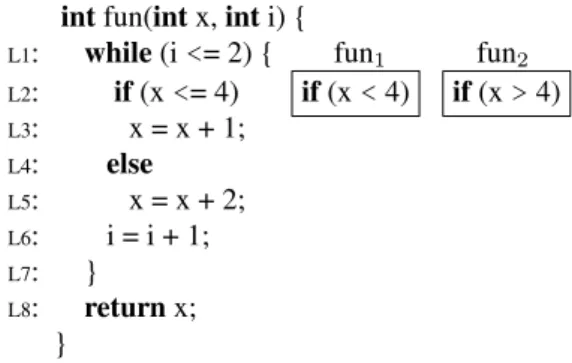
Figure 1: An example to illustrate the insufficiency of in-fection conditions.
Fact 2. [26] GivenP, a test case,t, will killPkifft∈Dpk
which impliest∈Dkr∩DikandDkp⊆Drk∩Dki.
Note that there may be test cases in Dik that does not satisfy the reachability condition. The computation of a test case that can kill a mutant is undecidable as the sets Drk, Dki and Dpk cannot be computed, in general. How-ever, in practice it is often possible to find such test cases using approximation techniques. On one hand, to compute (whenever feasible) the setDi
krequires only analysis of the expression at locationl. On the other hand, computation of Dr
k is more expensive and complex as it requires analysis of the paths that can reach locationl.
Proposition 1. ∀t(P, t⊢Pk≥mPj)⇔D p k⊆D
p j, where PkandPjare mutants ofP andtrepresents a test case.
Proof. The proof follows from the definitions.
3
Identifying Mutant Hierarchies
A brute-force method to identify≥mrelation is by check-ing ifDpk⊆Dpj. It is also possible to restrict the test cases to be selected from the setDpk∩Dpj, provided that this set is not empty, in which case killingPk will also guarantee the same forPj.
The objective of our analysis is to identify a subset of mutants with the same effectiveness as the whole set with-out generating all mutants. Therefore, if possible, the≥m relation between mutants should be established during their generation itself, thereby only producing the strongest mu-tants. This approach is an improvement over the method where mutants are first generated explicitly and then an at-tempt to establish a partial order among them is made.
3.1
Intra-location Mutants
LetP be an implemented program andPk andPj be two mutants ofP that are obtained by applying mutation oper-ator at locationlinP. LetCkandCjbe the predicates that correspond to the setsDi
kandDij, respectively.
Input Output x i fun fun1 fun2
3 1 5 6 6
4 1 7 8 7
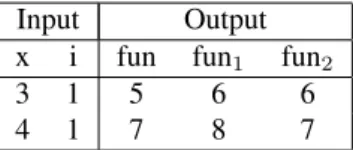
Table 1: A counter example for Theorem 1 based on the program shown in Figure 1.
intComp(intx) { Comp1 Comp2
L1: x = x + 1; x = x-1; x = x + 2;
L2: if(x == 5||x == 7)
L3: x = 9;
L4: else
L5: x = 6;
L6: returnx;
}
Figure 2: An example for Theorem 1.
<=, <and>are relational operators. The conditions (ob-tained by taking exclusive-or of two expressions, for in-stance,Cf un1 ≡x <= 4⊕x <4, where⊕is exclusive-or operatexclusive-or)Cf un1 andCf un2, in this case are x = 4 and true, respectively. AlthoughCf un1 impliesCf un2, it is not sufficient to claim a hierarchy between fun1 and fun2, in general. This is illustrated by the following theorem.
Theorem 1. LetPbe a PUT andPkandPjbe its two
mu-tants obtained by mutating a statement at locationl then,
Di
k⊆Djidoes not guarantee∀t(P, t⊢Pk≥mPj).
Proof. The statement holds for both a p-location and a c-location. We give counter-examples as a proof. Table 1 gives the output of two test cases for the program and its two mutants that are shown in the Figure 1. The first row shows that the mutants are not equivalent to the original program, whereas the second row shows that the conjecture is true for p-locations asf un1is killed andf un2remains live. Note that, as mentioned above,Cf un1 ⇒ Cf un2 i.e. Di
f un1 ⊆D i f un2.
Figure 2 shows a concrete example that illustrates the above theorem for a c-location. Consider the two mutants, Comp1 and Comp2, obtained by applying mutation oper-ator at location L1 in Comp (see Figure 2). TheDi sets for both mutants is the whole input domain D since the mutated statements would result in different values for any integer input. In other words, the conditionsC1andC2are
true. However, inputx = 8will kill Comp1; whereas in-putx = 3will kill Comp2(see Table 2). Thus, mutants
Input Output
(x) Comp Comp1 Comp2
8 6 9 6
3 6 6 9
Comp1 Comp2
Di D D
Dp {4,8} {3,4,5,6}
Table 2: Input, output and subdomains for the programs shown in Figure 2.
Comp1and Comp2are not related under≥mwith respect to all possible test cases.
The following formal observation gives insight into The-orem 1.
Dkp⊆Dr k∩D
i
k (Fact 2) Djp⊆Dr
j∩Dij (Fact 2) Dr
k =Drj (Same location mutants) Dki ⊆Dij (given)
The most favourable conclusion that can be drawn from the above statements is that both Dpk andDpj are subsets of Dr
k ∩D i
k. But this does not guaranteeD p k ⊆ D
p j (as required by Proposition 1).
Theorem 2. LetP,Pk,Pjandlbe the entities as stated in
Theorem 1. IfDi k∩D
i
j=∅thenPkandPjare not related
under≥mPorPis equivalent toPkorPj.
Proof. The first three conditions are identical with the above formal observation.
Di k∩D
i
j =∅ (given)
⇒ Dpk∩Djp=∅ (set theory)
⇒ Dpk =∅ ∨Dpj =∅∨
(Dpk*Djp∧Dpj *Dkp) (set theory)
⇔ P=Pk∨P =Pj∨
∀t(P, t⊢PkmPj∧
P, t⊢PjmPk) (Fact 2 & Prop. 1)
This is particularly helpful inisolatingthose mutants that definitely need to be considered during testing. However, a hierarchy can be established between mutants under certain conditions. These conditions are discussed below.
Theorem 3. LetP be a given PUT andlbe a p-location that corresponds to a condition,c. Further, letcbe mutated to c′ and c′′ giving mutants Pk and Pj, respectively. If (c′ ⇔ c′′) then one of the mutantPk orPj need not be considered during testing.
Proof. As per Fact 1 (c),P andPr(r∈ {k, j}) must fol-low different paths after reaching locationl(sometime dur-ing an execution) in order to be killed.
The condition(c′ ⇔ c′′)ensures that conditionc′ and c′′always evaluate to the same Boolean value. Thus, for a given test case, the path followed byPk andPj will al-ways be the same, ensuring that the infection and propa-gation conditions for bothPk andPj will be identical i.e.
∀t(P, t⊢P1≥mP2∧P, t⊢P2≥mP1).
The above condition in Theorem 3 is a very strong re-quirement. However, the property was found to be helpful in reducing the test effort during empirical study described in Section 5.
Remark 1. Why do we needc′ ⇔c′′condition to hold in general? To answer this question, let us consider the two mutantsPkandPj, obtained by mutating a condition for a
the number of times thewhileloop is executed inP,Pkand
Pj, respectively. Thus, the necessary conditions for killing
PkandPjarei̸=ikandi̸=ij respectively. To establish
∀t(P, t⊢Pk≥mPj), one of the following properties must
hold:
a. ik =ij, or
b. the resulting states must be the same after executing the body ofwhileloopikandijtimes.
The condition in Theorem 3 is equivalent to (a) above. However, the condition (b) is equally acceptable, but re-quires analysis of the program segment to guarantee that it holds for any test case that killsPk; this may be difficult to establish. It is also possible to weaken the requirement in Theorem 3 under certain conditions as described by the following theorem.
Theorem 4. LetP be a PUT,tbe a test case andl be a p-location that corresponds to a condition, c, inP. Fur-ther, letcbe mutated by two operators toc′ andc′′giving mutantsPk andPj, respectively. If(c⊕c′) ⇒(c⊕c′′), where⊕is exclusive-or operator, and the labellis reached during the execution exactly once thenP, t⊢Pk≥mPj.
Proof. The programsPandPkmust follow different paths after reaching locationl, sometime during an execution, in order to be distinguished. The condition(c⊕c′)⇒(c⊕c′′)
ensures thatPkandPjwill follow the same path, ifPand Pktake different paths.
The necessity for the criterion of checking the internal state can be explained as follows. Assume that the Boolean condition is evaluated twice and c′ differs from c in the second execution. However, it is possible that onlyc′′may differ fromc in the first execution but not in the second execution, in which case it is not guaranteed that killingPk will also ensure the same forPj.
Thus, Theorem 3, Remark 1 and Theorem 4 give three different possibilities to identify the hierarchies among mu-tants and also present the reasoning for the conditional re-quirements associated with them.
Note that in Theorem 4,candc′′may differ, butcand c′may evaluate to the same values, in which casePjmay be killed butPk will not. ThusPjcould be killed by more test cases than Pk. This can also be observed by noting thatc⊕c′defines the subdomainDki and considering the implication as a subset relation.
3.2
Inter-location Mutants
The above analysis is restricted to mutations in p-locations. For mutants that can be generated by mutating c-locations, we need to symbolically propagate the effect to nearest variable use in a predicate and then use theorems men-tioned above to identify the relationship among mutants. We illustrate this by an example:
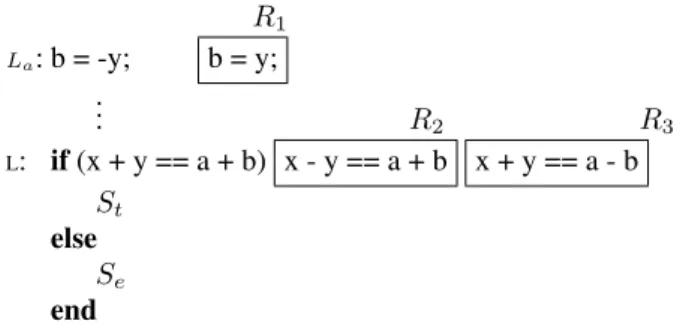
Consider the fragment of a PUT,R, shown in Figure 3. LetR1,R2andR3be three mutants ofRas shown in the
R1
La: b = -y; b = y;
..
. R2 R3
L: if(x + y == a + b) x - y == a + b x + y == a - b
St else
Se end
Figure 3: Fragment of a programR.
figure. If the definition of variablebat locationLais guar-anteed to reach locationLthen we can compareR1,R2and R3under≥m. Letorig,r1,r2andr3be predicates as defined below:
orig: x + y == a + b r1: x + y == a + y r2: x - y == a + b r3: x + y == a - b
By observing that the predicate
b==−y⇒((orig⊕r2)⇒(orig⊕r3))
is valid, we conclude thatR2≥mR3. To check the relation of R1 withR2, we propagate the assignment atLa toL which give us the following predicates:
orig’: x + y == a - y r2’: x - y == a - y
Since the predicate(orig′⊕r2′) ⇒ (orig′⊕r1)is also valid, R2 ≥m R1. Thus, if the mutantR2 can be killed, the other two mutants need not be considered during the testing. Note that, here we have also used known properties of the PUT in establishing the hierarchies. To consider the mutantR1, the impact of mutation is propagated to location L. This can also be seen as making the control conditions more explicit and has been studied in the context of test data generation in [12].
LetPj andPk be two mutants of a programP that are obtained by mutating locationljandlkrespectively. Con-sider the setR = Djr∩Drk. If R = ∅, there is no rela-tionship betweenPjandPkand both of them must be con-sidered during mutation testing. The checking of condition R=∅does not necessarily require explicit computation of the reachability sets. An example where such a condition holds is whenljandlkappear inthenandelsebranches of anifstatement that is reached exactly once in an execution with a test case.
the hierarchies among the mutants can be identified with the aid of theorems mentioned above.
Such an analysis, in which the internal state is observed and the effect of a fault is propagated, is studied in the liter-ature in terms of propagation conditions. For example, the local propagation of origination conditions is referred to as transfer conditions in [29].
The deductions required can be done automatically using existing tools such as the CVC3 [5], which can check the validity of quantifier-free first-order formulas over several interpreted theories including real linear arithmetic, arrays, uninterpreted functions, constants and abstract data types.
In the next section we give an overview of the related work.
4
Related Work
A number of research studies have been conducted to test the feasibility of mutation testing in an industrial context. For a recent survey on mutation testing see [18]. These studies concluded that mutation testing is difficult as the number of mutants generated and the time taken to kill each mutant when executed against the original program is myr-iad [28]. These research studies have proposed several vari-ations of mutation testing. The two variants suggested by them are weak mutation [14] and firm mutation [40].
In weak mutation, the outputs of the original and mu-tated programs are compared immediately after the execu-tion of the mutated statement. Firm mutaexecu-tion is a kind of “in-between” approach where the output of the original and mutated program can be compared at any location after the mutated statement and the end of the program. A short survey is presented in [28]. The variants of firm mutation testing can save some time during the execution and com-parison phase of a PUT with its mutants, since the whole program need not be executed when comparing the outputs of the original program with the mutants.
An approach of computing the detection conditions for hypothesized faults has been extensively studied, for ex-ample, inconstraint-based testing[7] and computation of failure conditions in [23, 29]. This require the sets Dpk andDjpto be computed by using symbolic execution tech-niques, which give a constraint on inputs that must be sat-isfied by a distinguishing test case. LetCkandCjbe two constraints that correspond to the subdomainsDpkandDpj respectively. Then, Ck ⇒ Cj will also guarantee that
∀t(P, t⊢Pk≥mPj).
Another alternative to reduce the test effort is selective mutation[27] which attempts to identify a subset of muta-tion operators without significantly affecting the effective-ness. The analysis of Boolean expressions has been exten-sively studied in the literature; see for example [33, 37]. In [21, 34], a hierarchy between different types of faults that can arise in Boolean specifications is analyzed. These results are applicable in the context of Theorem 4.
It was found that the mutation operators, ABS, AOR,
LCR, ROR and UOI, were sufficient for generating mu-tants. It was also observed that among those generated by these operators 57% mutants were equivalent mutants.
A similar approach, but complementary to that presented in this paper, has been suggested in [9, 30], involving the determination of an optimal ordering for the relational op-erators. The key idea can be stated as follows. LetP be a given program andPkandPjbe two of its mutants that are obtained by replacing a relational operator, sayRO, inP by other relational operators,ROk andROj respectively, whereROk is higher in the optimal ordering relation than ROj [30]. Then, for a given input, ifPkremains live then Pjwill also remain live. Thus, when attempting to kill mu-tants,Pk should be tried beforePj. However, Woodward in [39] has shown a fallacy in the above argument by pro-viding a counter example and suggested the following in the conclusion:
One final point is that the fallacious argument . . . is, in a sense, the opposite of that which a mutation tester really wants. The argument that “since this test data kills this mutant, it must be good and will kill these other mutants”, would offer even greater potential benefits.
This paper contributes towards the above argument. In the next section, we describe the empirical study per-formed to evaluate the cost savings obtained by identifying the relationship among mutants.
5
Experimental Evaluation
The programs considered in this study are written in C pro-gramming language. As mentioned earlier, a mutation op-erator can be defined to be a rule for generating mutants by making a single syntactic change in PUT for example, changing operator ‘+’ to ‘−’.
5.1
Experimental Setup
We have used 23 mutation operators that are adapted from operators defined in [20] for FORTRAN programming lan-guage. The summary of these operators is given in Table 3. Since mutation testing is applied at a unit or component level, in our study we have mutated all the functions in a PUT except themainfunction.
Operator Description
AAR array reference for array reference replacement ABS absolute value insertion
ACR array reference for constant replacement AOR arithmetic operator replacement
ASR array reference for scalar variable replacement CAR constant for array reference replacement CNR comparable array name replacement CRP constant replacement
CSR constant for scalar variable replacement DER do/while statement end replacement LCR logical connector replacement ROR relational operator replacement RSR return statement replacement
SAN statement analysis (replacement by TRAP) SAR scalar variable for array reference replacement SCR scalar for constant replacement
SDL statement deletion
SRC source constant replacement SVR scalar variable replacement UOI unary operator insertion
Table 3: Mutation operators [20]
be minimal. The symbolic evaluation is not done for the complete unit under test but for a segment consisting of the mutated line upto nearest p-location as mentioned in the section 2.
However, generating the set of strongest mutants may lead to problems due to the presence of equivalent mutants already in the set. Note that the propertyP, t⊢Pk ≥mPj holds trivially for allj ifP is equivalent toPk(i.e., when Dpk =∅). The statistics, as reported in [26], indicate that the number of equivalent mutants is typically in the range of 7 to 12% of the total number of mutants and the auto-matic detection rate using symbolic execution varies from 12 to 84% of the total number of equivalent mutants. An-other recent study [31] further explores the identification of equivalent mutants. Therefore in our empirical study we rely on the fact that a randomly selected mutant from the set of all mutants is likely to be non-equivalent.
Thus, although explicit generation of all mutants may not be required, the information regarding them must still be maintained. This information aboutP, t ⊢ Pk ≥m Pj will be required whenever it is deduced or suspected that P =Pk, for example when a significant amount of effort is spent in killingPk without success (such as, large size of the test set and large number of times reachability and infection conditions are met). The instantiation order for mutants is guided by the hierarchies among them.
We considered terminating sequential programs. Since application of a mutation operator can generate a program which may not terminate on execution, we kept a threshold of 5 seconds to decide if the execution is in an infinite loop. This approach is similar to that implemented in MuJava tool[22]. The comparison is made on the output as in the case of strong mutation testing.
The analysis for empirical study was done manually with the aid of CVC [5] tool. To analyze a given program, we used symbolic execution techniques which have been used in a wide variety of problems, such as, test data genera-tion [7] and detecting equivalent mutants [26]. In symbolic execution, a program is executed with the symbolic values representing arbitrary values, instead of actual input val-ues. Such an execution results in a tree in which every node consists of symbolic values of the variables and the path constraint that must be true to reach that node.
The steps to carry out the experiments are given in Table 4. LetP be a PUT andMbe the set of mutants ofP. We start with the execution of an instrumented mutant using a test case that kills the selected mutant. The instrumentation is done to enable the observation of internal state which are used to identify other mutants inMthat can also be killed using the same test case. Such mutants form a class. We restart the process with the remaining mutants and continue until no mutants are left to be classified or they are identi-fied as equivalent.
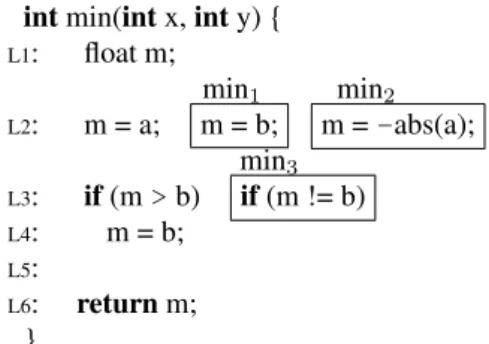
We illustrate the approach using an example shown in Figure 4. Consider the three possible mutants marked as min1 to min3. Assume that we explicitly generate min1 and would like to know if a test set that kills min1will also kill any of the other two mutants. Since min1 and min2 are obtained by mutating a c-location, we will propagate the effect to the p-location at L3. The necessary (but not sufficient) condition at locationL3to kill these mutants are given below.
Cmin1 :a != b ∨ (a > b ⊕ b > b)
1. Create a list of all mutants for the given PUT in increas-ing order of line number of the PUT. Let N be the num-ber of possible mutants.
2. Set i=0
3. LetPibe the ithmutant.
4. IfPiis already classified to be equivalent or in a mutant
class then goto step 9.
5. Identify the condition that are needed to establish the hierarchies for other intra-location and inter-location mutants withPi.
6. Check the conditions with theorem prover if they are valid. If yes, mark the corresponding mutants andPi
to belong to a single class.
7. GeneratePi with statements to observe satisfiability of conditions identified in the step 5.
8. Identify a test case to killPi. Mark the mutants to
be-long to a single class for which conditions identified in step 5 are satisfied while executingPiwith the test case
that killsPi.
9. Set i=i+1
10. If i̸=N goto step 3.
Table 4: Steps for Experimental Study.
intmin(intx,inty) {
L1: float m;
min1 min2
L2: m = a; m = b; m =-abs(a); min3
L3: if(m>b) if(m != b)
L4: m = b;
L5:
L6: returnm;
}
Figure 4: An example to illustrate the experimental ap-proach.
Cmin3 :(a > b ⊕ a != b)
If the test case {x = −6, y = 2} is used to kill mu-tant min1 then it is guaranteed that the same test case will also kill min2 and min3. However, if the test case
{x = 0, y = 1} is used to kill mutant min1 then only min3will be killed. This can be observed by checking the satisfiability of conditions given above for these test cases. Therefore, if we use latter test case, min1and min2will be the same class, whereas with former all three mutants will belong to the same class.
In step 6, the identification of hierarchies require check-ing validity of first-order quantifier-free logical formulas.
LetCbe such a formula that we want to validate to deter-mine if it holds at a locationl in a programP. There are three possibilities for the property to hold: (a)Cis valid;(b) Cis satisfiable for some test cases; (c)Cis false. For case (c), we did not the put the required checks in the generated mutant.
The following programs were considered for the empiri-cal study.
compare_str The program is taken from [1] and is in-tended to compares two strings. The specification re-quires to return true if the given input strings are iden-tical, otherwise false. However, the implementation returns correct output for unequal length strings and strings of equal length with the identical last charac-ters. Thus, the strings “cat” and “mat” are reported to be identical. The subtle issue, as mentioned in [1], is that the probability of random selection of input which will reveal the bug is very low. Probability that n strings will expose the fault is1−(25/26)n [1]. In our study, a strong mutant forced to select such an in-put. The implemented program is a first-order mutant of the intended program.
find This is an implementation of Hoare’s find algorithm. This program and its buggy version are studied earlier in [3, 10]. We have used the correct version of find al-gorithm. One of the strong mutant forced selection of input that detected it to be different from the incorrect version. As noted in [3], for the buggy version, it is extremely difficult to identify test case using random selection. The buggy version has two faults and there-fore is a second order mutant. Unlike previous studies, we decided to consider the correct version and check if the test set with 100% mutation score can also kill the second order buggy mutant.
gcd This program computes the greatest common divisor of given two positive integers.
iroot The program is taken from [16] and computes inte-ger square root of a given positive inteinte-ger. This was given as an exercise to the students of first course in structured programming. We observed that it was dif-ficult to get a correct implementation.
min Computes minimum of two numbers and is also stud-ied in [26, 27].
prime Tests if a given positive integer is prime. The im-plementation has a subtle bug which causes it to give incorrect result for only one input. The implemented (faulty) program is directly representable as a first or-der mutant of the intended program. It was required to generate the test case that detects the fault.
but realistic bug. In this case also, a test case detected the fault.
triangle This is the famous program, first mentioned in Myers [24], for testing whether the three given inte-gers form a triangle and its classification.
tcas TCAS (Traffic Alert and Collision Avoidance Sys-tem) is an aircraft conflict detection and resolution system. The SIR Siemens suite [8, 32] includes an ANSI C version of the resolution advisory component of TCAS system along with 41 faulty versions. The “Siemens” programs were assembled by Tom Ostrand and colleagues at Siemens Corporate Research. Our experiments include the 41 faulty versions and some other mutants.
5.2
Results Discussion
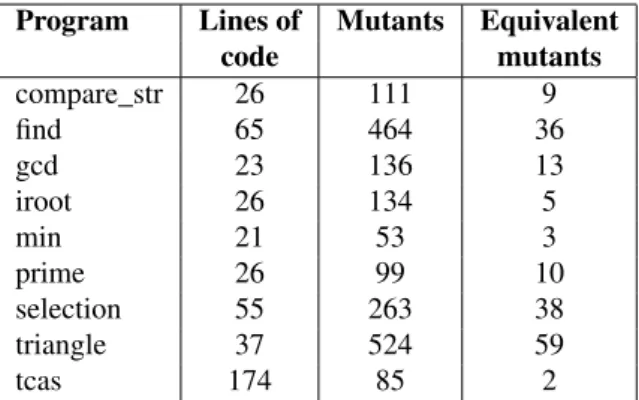
For the above programs, we studied number of equivalent mutants, number of mutant classes, operators with respect to those mutants in each mutant class that cannot be killed by the test cases used for other mutant classes. The statis-tics for these programs is given in Table 5 and 6. The sav-ings are calculated using the formula given below.
number of mutant classes
number of mutants−equivalent mutants×100
As can be observed in Table 6 the overall savings is above 90% in all the cases.
The maximum number of equivalent mutants and mutant classes were found for the triangleprogram. The reason for the higher number of equivalent mutants is due to the redundant testa ≤0∨b ≤ 0∨c ≤ 0in the presence of another check that sum of two sides is more than the third side. Also, the application ofabsoperator after initial test-ing of values to be positive since all values are guaranteed to be positive afterwards. Finally, the application of SVR operator on test for equilateral trianglea=b∧b=calso generates equivalent mutants.
For each of the above example, once the identification of mutant classes was complete, we identified those mu-tants in each class that cannot be killed by the test cases of all other classes. The table reports the mutation operators associated with such mutants.
In selective mutation study [27], it was found that the mutation operators, ABS, AOR, LCR, ROR and UOI, were sufficient for generating mutants. In our study, we also find that the strong mutant were generated by these operators. However, we also observed that some strong mutants were generated by SVR operator. In one case we found that DER operator too generated a strong mutant.
6
Threat to Validity
The threat to validity of our empirical results could be due the set of programs used in the study. Although the
pro-grams are selected from the variety of sources, they can-not be claimed to be representatives of set of all programs. Our strategy requires pre-analysis to identify the relation-ship among mutants.
In comparison, the selective mutation [27] does not re-quire any pre-analysis to generate mutants for a program al-though it may generate more mutants. The mutants are gen-erated using a subset of set of operators defined in the previ-ous study [20]. In contrast, our approach does not classify operators but attempts to identify relationship among mu-tants to avoid ignoring any mutant. Thus it is guaranteed to ensure the quality of a test set. Although this enables in-clusion of new operators without affecting the effectiveness but increases the overall cost of testing.
We expect the cost of our technique to be more than se-lective mutation but less compared to full mutation testing. From the effectiveness point of view, if selective mutation chooses appropriate set of mutants than it may be as ef-fective as full mutation testing. Also, since the program analysis in our study was done manually there is a possibil-ity that the results may differ with a completely automated analysis. Nevertheless, the results of empirical study pro-vide some confidence in the approach.
7
Conclusions
Mutation testing is a powerful testing approach that can not only ensure the checking of hypothesized faults but also the generation of test data satisfying common structural cov-erage criteria. The main difficulty faced in mutation test-ing is due to the large number of mutant programs that can be generated for a given implemented program. We have given a strategy that suggests the ordering of the mutants such that if a mutant is stronger than another, then killing the stronger will automatically kill the weaker. This ap-proach can significantly reduce the cost of mutation test-ing. Although our approach ensures the same effectiveness as full mutation testing, it is expensive than selective mu-tation testing. To obtain the exact cost comparison we will require extensive research on automation of our approach, which we plan to pursue in future.
Identification of such hierarchies is also useful in the quantitative assessment of the quality of fault detection ef-fectiveness, since, with the knowledge about mutant hier-archies, it is possible to reason if the mutation-adequacy score includesstrongmutants. This is particularly helpful in directing the test effort with every step of the testing pro-cess.
The issue in identifying all possible orderings is mainly due to the undecidability of the problem and it also depends on the complexity of the program. However as our empir-ical study shows, a significant cost saving can be achieved even if one can identify some of the possible orderings among the mutants.
Program Lines of Mutants Equivalent
code mutants
compare_str 26 111 9
find 65 464 36
gcd 23 136 13
iroot 26 134 5
min 21 53 3
prime 26 99 10
selection 55 263 38
triangle 37 524 59
tcas 174 85 2
Table 5: Statistics for programs considered in empirical study
Program Mutant Operators for Savings
classes strong mutants %
compare_str 7 ABS, ROR, RSR, SVR, UOI 93
find 5 ABS, ROR, UOI, SVR 99
gcd 4 ABS, AOR, ROR, UOI, SVR 97
iroot 4 AOR, CSR, UOI, DER 96
min 4 ABS, SVR, UOI 92
prime 4 CSR, ROR, UOI 95
selection 4 ABS, AOR, ROR, UOI 96
triangle 24 ABS, ROR, SVR 93
tcas 17 CRP, LCR, ROR, SVR 79
Table 6: Results for programs considered in empirical study
and thus can be evaluated in an effective way. Our work gives theoretical proof and the empirical evaluation with the examples taken from previous studies shows the fea-sibility of idea and significant cost savings that can be achieved. We found that the operators associated with strong mutants were the same as those identified in selec-tive mutation. However in addition SVR and DER opera-tors also generated strong mutants in some cases.
As the kind of analysis required to establish hierarchies is already part of various program analysis such as constant propagation, and transformation tools, and also tools like CVC3 [5] are already available, the given approach should be practical.
References
[1] R. C. Backhouse. Program Construction and Verifi-cation. Prentice-Hall International, 1986.
[2] A. Barr.Find the Bug: A Book of Incorrect Programs. Addison-Wesley, 2004.
[3] R. S. Boyer, B. Elspas, and K. N. Levitt. SELECT — a formal system for testing and debugging programs by symbolic execution. InInternational conference on Reliable software, pages 234–245, 1975.
[4] T. A. Budd, R. A. DeMillo, R. J. Lipton, and F. G. Sayward. Theoretical and Empirical Studies on using
Program Mutation to Test the Functional Correctness of Programs. In7th Symposium on Principles of Pro-gramming Languages, pages 220–233. ACM, 1980.
[5] CVC3: An Automatic Theorem Prover, 2007. http://www.cs.nyu.edu/acsys/cvc3/ (last accessed: Dec. 2007).
[6] R. A. DeMillo, R. J. Lipton, and F. G. Sayward. Hints on Test Data Selection: Help for the Practicing Pro-grammer.IEEE Computer, 11(4):34–41, April 1978.
[7] R. A. DeMillo and A. J. Offutt. Constraint-Based Automatic Test Data Generation. IEEE Transactions on Software Engineering, 17(9):900–910, September 1991.
[8] H. Do, S. G. Elbaum, and G. Rothermel. Supporting Controlled Experimentation with Testing Techniques: An Infrastructure and its Potential Impact. Empiri-cal Software Engineering: An International Journal, 10(4):405–435, 2005.
[9] I. M. M. Duncan and D. J. Robson. Ordered Muta-tion Testing. InACM SIGSOFT Software Engineering Notes, volume 15, pages 29–30, April 1990.
[11] M.-C. Gaudel. Testing can be Formal too. InTheory and Practice of Software Development (TAPSOFT), volume 915, pages 82–96, March 1995.
[12] M. Harman, L. Hu, R. Hierons, J. Wegener, H. Sthamer, A. Baresel, and M. Roper. Testability Transformation. IEEE Transactions on Software En-gineering, 30(1):3–16, 2004.
[13] R. M. Hierons. Comparing test sets and criteria in the presence of test hypotheses and fault domains. ACM Transactions on Software Engineering and Method-ology, 11(4):427–448, October 2002.
[14] W. E. Howden. Weak Mutation Testing and Com-pleteness of Test Sets.IEEE Transactions on Software Engineering, 8:371–379, July 1982.
[15] IEEE. IEEE Standard Glossary of Software Engi-neering Terminology, ANSI/IEEE Std. 610.12. New York: Institute of Electrical and Electronics Engi-neers, 1990.
[16] J. Jacky. The Way of Z: Practical Programming with Formal Methods. Cambridge University Press, 1997.
[17] Y. Jia and M. Harman. Higher Order Mutation Testing. Information and Software Technology, 51(10):1379–1393, October 2009.
[18] Y. Jia and M. Harman. An Analysis and Survey of the Development of Mutation Testing. IEEE Trans-actions on Software Engineering, To appear, 2010.
[19] K. Kapoor. Formal Analysis of Coupling Hypothe-sis for Logical Faults. Innovations in Systems and Software Engineering (A NASA Journal), 2(2):80–87, July 2006.
[20] K. N. King and A. J. Offutt. A Fortran Language Sys-tem for Mutation-Based Software Testing. Software Practice and Experience, 21(7):685–718, 1991.
[21] D. R. Kuhn. Fault Classes and Error Detection Ca-pability of Specification-based Testing. ACM Trans-actions on Software Engineering and Methodology, 8(4):411–424, October 1999.
[22] Y.-S. Ma, A. J. Offutt, and Y. R. Kwon. MuJava: An Automated Class Mutation System.Software Testing, Verification and Reliability, 15(2):97–133, June 2005.
[23] L. J. Morell. A Theory of Fault-based Testing. IEEE Transactions on Software Engineering, 16(8):844– 857, August 1990.
[24] G. Myers. The Art of Software Testing. Wiley-Interscience, 1979.
[25] A. J. Offutt. Investigations of the Software Test-ing CouplTest-ing Effect. ACM Transactions on Software Engineering and Methodology, 1(1):5–20, January 1992.
[26] A. J. Offutt and J. Pan. Automatically Detecting Equivalent Mutants and Infeasible Paths. Software Testing, Verification and Reliability, 7(3):165–192, September 1997.
[27] A. J. Offutt, G. Rothermel, R. H. Untch, and C. Zapf. An Experimental Determination of Sufficient Mutant Operator. ACM Transactions on Software Engineer-ing and Methodology, 5(2):99–118, April 1996.
[28] A. J. Offutt and R. H. Untch. Mutation 2000: Uniting the Orthogonal. In W. E. Wong, editor,Mutation Test-ing in the Twentieth and the Twenty First Centuries, pages 45–55. Kluwer, October 2000.
[29] D. J. Richardson and M. C. Thompson. An Analy-sis of Test Data Selection Criteria using the RELAY Model of Fault Detection.IEEE Transactions on Soft-ware Engineering, 19(6):533–553, June 1993.
[30] I. J. Riddell, M. A. Hennell, M. R. Woodward, and D. Hedley. Practical Aspects of Program Mutation. Technical report, University of Liverpool, UK, 1982.
[31] D. Schuler and A. Zeller. (Un-)Covering Equivalent Mutants. In3rd International Conference on Software Testing Verification and Validation (ICST’10), Paris, France, April 2010.
[32] SIR: Software-artifact Infrastructure Repository (SIR), 2010. http://sir.unl.edu/ (last accessed: Oct. 2010).
[33] K.-C. Tai. Theory of Fault-based Predicate Testing for Computer Programs.IEEE Transactions on Software Engineering, 22(8):552–562, August 1996.
[34] T. Tsuchiya and T. Kikuno. On Fault Classes and Er-ror Detection Capability of Specification-based Test-ing.ACM Transactions on Software Engineering and Methodology, 11(1):58–62, January 2002.
[35] J. M. Voas. PIE: A Dynamic Failure-Based Tech-nique. IEEE Transactions on Software Engineering, 18(2):717–727, August 1992.
[36] K. S. H. T. Wah. An Analysis of the Coupling Effect I: Single Test Data.Science of Computer Programming, 48:119–161, 2003.
[37] E. J. Weyuker, T. Goradia, and A. Singh. Automat-ically Generating Test Data from a Boolean Specifi-cation. IEEE Transactions on Software Engineering, 20(5):353–363, May 1994.
[39] M. R. Woodward. Concerning Ordered Mutation Testing of Relational Operators. Software Test-ing, Verification and Reliability, 1(3):35–40, October 1991.
![Table 3: Mutation operators [20]](https://thumb-us.123doks.com/thumbv2/123dok_us/8043324.2129818/7.892.274.652.120.507/table-mutation-operators.webp)